

What Is Christian Eschatology?
If you want to understand why large portions of the Western world have been fascinated, frightened, and occasionally paralyzed by questions about the end of history, you need to understand Christian eschatology.
It is, by almost any measure, the most widely discussed, most culturally influential, and most hotly debated end-times tradition in the world.
The word “eschatology” comes from the Greek word “eschaton,” which means “last things.”
Christian eschatology is the branch of Christian theology that deals with what happens at the end of history: the Second Coming of Jesus Christ, the resurrection of the dead, the final judgment, the nature of heaven and hell, and the ultimate destiny of creation itself.
Here is the first thing you need to know: Christians do not agree with each other about almost any of the details.
The Rapture, the Millennium, the Tribulation, the Antichrist, the sequence of events, whether prophecy is already fulfilled or still future, and whether everyone is eventually saved or not.
These questions have divided Christians for two thousand years and continue to generate passionate disagreement today.
That disagreement is not a sign of weakness. It is actually one of the most interesting things about Christian eschatology.
The same Bible, read by sincere and intelligent believers, produces wildly different conclusions about what the end of the world looks like.
Understanding why that is takes you deep into the heart of how Christianity reads its own scriptures.
This guide covers all of it. The biblical foundations, the four main interpretive frameworks, every major doctrine from the Rapture to the New Jerusalem, what different Christian traditions believe, how Christian end-times theology has shaped modern politics and popular culture, and a complete FAQ section answering the most commonly searched questions on this topic.
Whether you are a believing Christian trying to understand your own tradition, a skeptic trying to understand why 2 billion people think history is heading somewhere specific, or a student of comparative religion wanting to understand how Christian eschatology relates to Jewish and Islamic end-times belief, this is the most thorough introduction available.
Why Christian eschatology matters beyond the Church
Christian end-times theology has not stayed inside church walls. It has shaped Western civilization in ways most people never notice.
The Left Behind novel series, which depicts a dispensational premillennialist end-times scenario, sold over 80 million copies and became one of the best-selling fiction series in American history.
The 1970 book The Late Great Planet Earth by Hal Lindsey sold 28 million copies and was the best-selling non-fiction book of the entire decade.
Beyond books and films, end-times theology has directly influenced American foreign policy.
The dispensationalist belief that the founding of Israel in 1948 was a fulfillment of biblical prophecy and that the final events of history require a Jewish state in the Holy Land has been a major driver of evangelical Christian support for Israeli government policy for over seven decades.
Presidents from both parties have had to reckon with this constituency.
The imagery of the Apocalypse saturates secular culture too: zombie films as secularized end times narratives, climate anxiety borrowing the language of judgment and wrath, and dystopian fiction drawing on the book of Revelation’s imagery of totalitarian beasts and marks.
You cannot fully understand Western culture without understanding Christian eschatology.
Where It All Came From: Biblical Foundations and Historical Development
Christian eschatology did not emerge in a vacuum.
It grew out of Jewish apocalyptic tradition, was dramatically reshaped by the life and teachings of Jesus of Nazareth, and has been interpreted and reinterpreted across two thousand years of church history.
To understand where it stands today, you need to understand how it got there.
The Old Testament roots: what Christianity inherited from Judaism
The Hebrew prophets laid the foundation that Christian eschatology builds on.
Daniel’s visions of world empires, a final kingdom, the Son of Man coming on the clouds of heaven, and the resurrection of the dead in chapter 12 are the texts that New Testament writers return to more than any others.
Isaiah’s vision of a transformed creation, a child who is also a divine figure, and a suffering servant who redeems his people all get applied to Jesus in the New Testament.
Ezekiel’s war of Gog and Magog, which you will also find in Islamic and Jewish eschatology, gets picked up in Revelation 20.
Zechariah’s vision of a pierced figure, mourned by the whole nation, and a great battle at Jerusalem are applied to the Second Coming.
Malachi’s promise that Elijah will return before the great day of the Lord is applied by the Gospel writers to John the Baptist.
What matters here is that Christian eschatology is built on top of Jewish prophetic material, but it reads those texts through the lens of Jesus as their fulfillment.
This is precisely where Jewish and Christian interpretation diverges most sharply, and it is the root of a theological disagreement that has lasted two thousand years.
The New Testament: Jesus’s own end-times teachings
The most important eschatological text in the entire New Testament is not the book of Revelation.
It is the Olivet Discourse, found in Matthew 24 and 25, Mark 13, and Luke 21.
This is Jesus’s own answer to the question his disciples ask on the Mount of Olives: what are the signs of your coming and of the end of the age?
What Jesus says is remarkable and has been argued over ever since. He describes false messiahs, wars and rumors of wars, earthquakes and famines as the beginning of birth pains.
He describes the gospel being preached to all nations. He describes an abomination of desolation standing in the holy place, echoing Daniel’s prophecy.
He describes the greatest tribulation the world has ever seen. He describes cosmic signs: the sun darkened, the moon not giving its light, stars falling from heaven.
And then he describes the Son of Man coming on the clouds with great power and glory.
Then he says something that has puzzled interpreters for two thousand years: ‘Truly I tell you, this generation will not pass away until all these things have happened.’
That one verse has produced two irreconcilable camps. Preterists say it means exactly what it says: everything Jesus described was fulfilled in the destruction of Jerusalem by Rome in 70 CE, within a generation of his speaking.
Futurists say the word generation refers to a future generation that will see these signs, or that Jesus was speaking of the Jewish race surviving until the end. The debate remains live and unresolved.
Paul’s letters: resurrection, the Rapture proof-text, and the Man of Lawlessness
The apostle Paul contributes three texts that become central to Christian eschatology.
First Corinthians 15 is Paul’s great chapter on the resurrection: the dead will be raised imperishable, we will be changed in a moment, in the twinkling of an eye, at the last trumpet.
Paul argues the resurrection is not optional or metaphorical but the very foundation of Christian faith: if there is no resurrection of the dead, then Christ has not been raised, and if Christ has not been raised, your faith is futile.
First Thessalonians 4:13-18 is the passage on which the entire doctrine of the Rapture is built.
Paul writes that the dead in Christ will rise first, then those who are still alive will be caught up together with them in the clouds to meet the Lord in the air.
The Greek word for caught up is harpazo, which was translated into Latin as raptus, which gives us the word Rapture.
Critically, Paul gives no timetable here relative to a tribulation period. That connection was made much later, in the nineteenth century.
Second Thessalonians 2 gives us Paul’s description of the Man of Lawlessness, a figure who will be revealed before the Day of the Lord: he opposes and exalts himself above every so-called god, takes his seat in the Temple of God, and proclaims himself to be God.
Paul says something or someone is currently restraining him and will continue to do so until the appointed time.
What or who is doing the restraining is one of the most debated questions in all of New Testament scholarship.
The Book of Revelation: the most debated book ever written
The Book of Revelation, written by a man named John on the Greek island of Patmos during the reign of the Roman emperor Domitian around 95 CE, is the crown jewel and the great controversy of Christian eschatology.
No book in the Bible has generated more commentary, more disagreement, more artistic inspiration, or more fringe speculation.
Understanding Revelation requires understanding its genre. It is apocalyptic literature, a form that was common in Jewish writing between 200 BCE and 100 CE.
Apocalyptic literature uses vivid symbolic imagery: beasts with multiple heads, women clothed with the sun, numbers with coded meanings, cosmic battles between heavenly armies.
This imagery was not meant to be read as a literal photographic prediction of future events. It was meant to communicate theological truth through symbol and vision.
The book’s structure moves through three sets of seven judgments: seven seals opened from a scroll, seven trumpets blown by angels, and seven bowls of wrath poured out on the earth.
Between and around these judgments are visions of heavenly worship, of the church persevering through suffering, of the defeat of Rome (coded as Babylon), of the war of Gog and Magog, of Satan bound for a thousand years, and finally of the New Jerusalem descending from heaven to a renewed earth.
The four major frameworks for interpreting Revelation are Preterist (most of it was fulfilled in 70 CE), Historicist (it maps out the entire history of the Church from the first century to the present), Futurist (most of it is still to come), and Idealist (it is a timeless symbolic portrayal of the cosmic conflict between good and evil with no specific historical referents).
Most American evangelical Christians are Futurists. Most historic Protestants were Historicists. Catholics and Orthodox Christians tend toward Idealist or Preterist readings.
From the Early Church to John Nelson Darby: 2,000 years of interpretation
The early Church Fathers were largely what we would call premillennialists: they expected Christ to return, defeat evil, and reign on earth for a literal thousand years before the final judgment.
Justin Martyr, Irenaeus, and Tertullian all held versions of this view.
Augustine of Hippo, writing in the fifth century after the fall of Rome, shifted the trajectory of Western Christian eschatology dramatically.
In his massive work The City of God, Augustine argued that the millennium of Revelation 20 should be understood symbolically as the current age of the Church, not a future literal reign.
This amillennialist interpretation became the dominant view of both the Catholic Church and later the Protestant Reformers, and it remained so for over a thousand years.
The figure who changed everything for modern evangelical eschatology was John Nelson Darby, a nineteenth-century Anglo-Irish clergyman and founder of the Plymouth Brethren movement.
Darby developed a comprehensive system called dispensationalism, which divided all of history into distinct eras or dispensations in which God deals with humanity differently.
Central to his system was a sharp distinction between God’s plan for Israel and God’s plan for the Church, and the idea that the Church would be secretly removed from the earth before a period of tribulation aimed specifically at Israel.
Darby’s ideas spread to America through conferences, the Scofield Reference Bible published in 1909, Dallas Theological Seminary, and eventually through the most widely read Christian authors of the twentieth century.
Today, dispensational premillennialism is the dominant eschatological view among American evangelical and Baptist Protestants.
It is worth noting, however, that this view is less than 200 years old, is rejected by the Catholic Church, is rejected by Eastern Orthodoxy, and is rejected by most Reformed Protestants.
The Four Millennial Views: Christianity’s Great Internal Debate
The central question dividing Christian eschatology is deceptively simple: when does Jesus return relative to the thousand-year period described in Revelation 20?
The answer to that one question produces four entirely different eschatological systems, each with its own view of the Rapture, the Tribulation, the Antichrist, Israel, and the nature of the Church’s mission in the world.
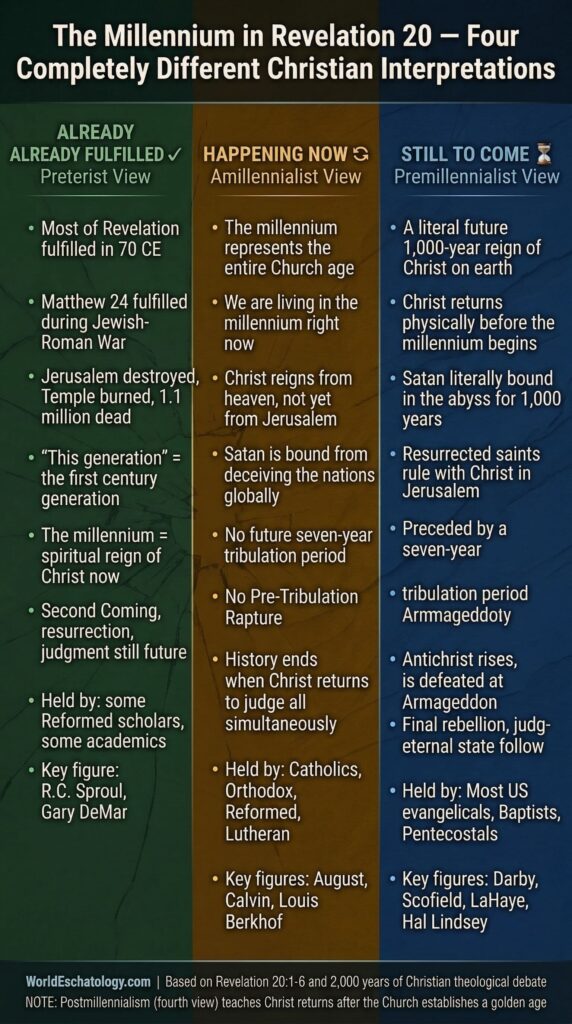
Premillennialism: Christ returns before the thousand years
Premillennialism teaches that Jesus Christ will return to earth physically and visibly before a literal thousand-year reign begins.
He defeats evil at his return, binds Satan, raises the righteous dead, and establishes a kingdom centered in Jerusalem that lasts a thousand years.
At the end of that period, Satan is released briefly, a final rebellion occurs, Satan is defeated permanently, the rest of the dead are raised, the final judgment takes place, and the eternal state begins.
There are two distinct forms of premillennialism that are often confused with each other.
Historic Premillennialism is the older form, held by the early Church Fathers.
It teaches that the Church will go through the tribulation period before Christ returns, that there is no separate secret Rapture, and that God’s promises to Israel are fulfilled spiritually through the Church.
Figures like George Eldon Ladd in the twentieth century championed this view.
Dispensational Premillennialism is the modern and currently more popular form.
It adds to the basic premillennialist framework a secret Rapture that happens before the tribulation, a sharp distinction between Israel and the Church as separate peoples of God with separate destinies, a literal seven-year tribulation period governed by the Antichrist, and a restored nation of Israel playing a central role in the end-times drama.
This is the view of the Left Behind novels, of Hal Lindsey, of most American televangelists, and of the majority of Southern Baptist and nondenominational evangelical churches.
Amillennialism: the thousand years is symbolic, and we are in it now
Amillennialism, despite its name, does not teach that there is no millennium.
It teaches that the thousand years of Revelation 20 is a symbolic number representing the entire period between Christ’s first and second comings.
We are currently living in the millennium. Christ is currently reigning, not on an earthly throne in Jerusalem, but from his heavenly throne.
Satan is currently bound in the sense that he cannot prevent the gospel from spreading to all nations, though he is still active in other ways.
In this view, there is no separate Rapture event, no literal seven-year tribulation period, no rebuilt Jewish Temple, and no political kingdom of Israel playing a central eschatological role.
History will end when Christ returns visibly and physically, the dead of all time are raised simultaneously, the final judgment takes place, and the eternal state begins.
The Church’s mission during the current age is to preach the gospel and make disciples, not to hasten a prophetic timetable.
This is the official position of the Roman Catholic Church, the Eastern Orthodox Church, most Lutheran denominations, most Anglican and Episcopal churches, and the majority of Reformed and Presbyterian churches.
It is, in other words, the majority position of global Christianity by any measure of denominational membership.
The popular perception that dispensational premillennialism is the default Christian position is largely a product of American evangelical cultural influence rather than historical or global Christian consensus.
Postmillennialism: the Church builds the kingdom, then Christ returns
Postmillennialism teaches that Christ will return after the millennium, not before it.
But unlike amillennialism, postmillennialism expects the millennium to be a future golden age, not the current church age.
The gospel will gradually triumph across the world, Christianity will spread until the majority of the world’s population are Christians, societies will be transformed by Christian principles, and this golden age of righteousness and peace will culminate in Christ’s return.
This optimistic view was enormously popular among Puritan theologians and nineteenth-century Protestant missionaries who believed they were building God’s kingdom on earth.
World War One and World War Two devastated postmillennialist confidence.
It seemed impossible to maintain that history was progressing toward a Christian golden age after the trenches of the Somme and the furnaces of Auschwitz.
But postmillennialism has experienced a significant revival in the twenty-first century, particularly among young Reformed Christians, Christian Reconstructionists, and advocates of what is called Dominionism or Theonomy.
These movements argue that Christians should actively seek to bring all areas of society, law, politics, and culture under the governance of biblical principles, not merely wait for Christ’s return.
The political implications of this theology are significant and increasingly visible in American public life.
Preterism: most prophecy was fulfilled in 70 CE
Preterism is the most intellectually surprising of the four views to many modern readers, because it argues that the vast majority of New Testament prophecy, including most of Matthew 24 and most of Revelation, was fulfilled in the first century, specifically in the destruction of Jerusalem and the Temple by the Roman army in 70 CE.
Partial Preterism, which is the mainstream form and is held by scholars like R.C. Sproul and Gary DeMar, argues that the Olivet Discourse was fulfilled in 70 CE, that Revelation 6 through 19 describes the events of the Jewish-Roman war, and that only the Second Coming, the final resurrection, and the final judgment remain in the future.
This view has considerable historical and exegetical support and deserves more attention than it typically receives in popular discussions.
Full Preterism, sometimes called Hyper-Preterism, goes further and argues that the resurrection described in the New Testament was a spiritual event that already occurred in 70 CE, and that the Second Coming has already happened in a spiritual sense.
This view is considered heretical by virtually all Christian denominations because it denies the future physical resurrection and Second Coming.
The appeal of Preterism for many thoughtful Christians is that it takes seriously Jesus’s statement that his generation would not pass away before all these things happened, it does not require elaborate future-projected interpretations of ancient symbols, and it roots the eschatological texts firmly in their first-century historical context.
The Core Doctrines: What Christian Eschatology Actually Teaches
Whatever millennial view a Christian holds, there are several core eschatological doctrines that show up across almost all traditions.
These are the concepts that generate the most searches, the most questions, and the most debate, both inside the Church and outside it.
The Second Coming of Christ (the Parousia)
The Second Coming of Jesus Christ is the central event around which all Christian eschatology revolves.
Every major branch of Christianity affirms it. The Nicene Creed, shared by Catholic, Orthodox, and most Protestant churches, states plainly: he will come again in glory to judge the living and the dead, and his kingdom will have no end.
The Greek word for the Second Coming is Parousia, which means presence or arrival and was used in the ancient world to describe the formal visit of a king or emperor to a city.
Paul uses it in his letters to describe Christ’s return. The New Testament consistently describes the Parousia as visible, bodily, and public: every eye will see him, he comes on the clouds with great power and glory, he is accompanied by angels and the sound of a great trumpet.
In dispensational theology, the Second Coming is actually split into two separate events separated by seven years: a secret return to rapture believers before the tribulation, and then a public, visible return at the end of the tribulation to defeat the Antichrist and establish the millennial kingdom.
Critics of this view argue that the New Testament knows nothing of a two-stage Second Coming and that this division was invented by Darby in the nineteenth century.
In amillennialist and preterist theology, the Second Coming is a single event that ends history: the dead are raised, the final judgment occurs, and the eternal state begins simultaneously.
There is no gap between the return and the judgment.
The Rapture: the most searched and most misunderstood doctrine
Almost nothing in Christian eschatology generates more internet searches or more confused questions than the Rapture.
And almost nothing is more widely misunderstood, even among Christians.
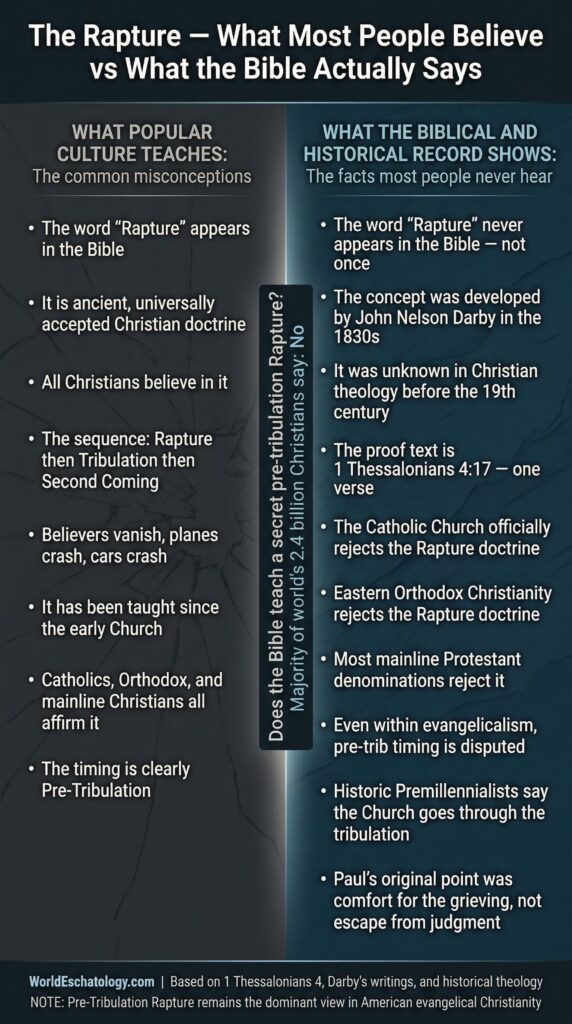
Here are the facts, laid out plainly. The word Rapture never appears in the Bible. Not once.
The concept is built on a single passage, 1 Thessalonians 4:17, where Paul writes that believers who are alive at Christ’s return will be caught up together with the resurrected dead to meet the Lord in the air.
The Latin word for caught up in the Vulgate translation of this verse is raptus, which is where the English word Rapture comes from.
Paul’s original point in this passage was not to describe a secret evacuation of believers from the earth.
He was comforting the Thessalonian Christians who were worried that their loved ones who had already died would miss out on the Second Coming.
His assurance was that the dead in Christ will rise first, and then the living will join them.
The imagery of meeting the Lord in the air was a common ancient metaphor for citizens going out to meet a visiting king and then escorting him back into the city.
The doctrine of a Pre-Tribulation Rapture, where all Christians are secretly removed from the earth before a seven-year tribulation begins, was developed by John Nelson Darby in the 1830s.
Before Darby, no Christian theologian had taught this doctrine in its modern form.
It spread through his conferences and writings, through the Scofield Reference Bible of 1909, and through the twentieth-century popular imagination to the point where millions of Americans now assume it is ancient, obvious, and universally accepted Christian teaching.
It is none of these things. The Roman Catholic Church does not teach the Rapture.
The Eastern Orthodox Church does not teach the Rapture. Lutheran, Anglican, Methodist, Presbyterian, and Reformed churches generally do not teach the Rapture.
Even within Protestant evangelicalism, there are significant numbers of Historic Premillennialists and Postmillennialists who reject it.
Globally, the majority of the world’s 2.4 billion Christians do not believe in a secret Pre-Tribulation Rapture.
Within the traditions that do affirm a Rapture, there are three positions on timing.
Pre-Tribulation Rapture, by far the most popular in American evangelicalism, places the Rapture before the seven-year tribulation.
Mid-Tribulation Rapture places it at the three-and-a-half-year midpoint, typically associated with the Antichrist’s desecration of the Temple.
Post-Tribulation Rapture places it at the very end of the tribulation, essentially merging it with the Second Coming.
Post-Tribulationism is closer to the Historic Premillennialist and to what the early Church Fathers actually taught.
The Great Tribulation: seven years of judgment
In dispensational eschatology, the Rapture is immediately followed by a seven-year period of unprecedented suffering called the Tribulation or the Great Tribulation.
This period is rooted in Daniel 9:24-27, where the angel Gabriel describes seventy weeks of years decreed over the Jewish people and Jerusalem.
Dispensationalists argue that sixty-nine of those weeks of years ended with the crucifixion of Jesus, and the final seventieth week is still future: the seven-year tribulation period.
The tribulation is divided into two halves of three and a half years each.
The first half is marked by the rise of the Antichrist, who brokers a peace deal between Israel and her enemies and allows the rebuilding of the Jewish Temple.
The second half, called the Great Tribulation proper, begins when the Antichrist breaks his treaty, enters the Temple, and declares himself God.
This act of desecration, called the abomination of desolation and drawn from Daniel 9:27 and 11:31, triggers the most terrible period of suffering in human history.
During the tribulation, the judgments of Revelation unfold sequentially. The seven seals bring conquest, war, famine, death, martyrdom, and cosmic disturbances.
The seven trumpets bring plagues reminiscent of the plagues of Egypt: hail and fire, seas turning to blood, waters made bitter, the sun and moon darkened, demonic locusts, and armies of 200 million mounted warriors.
The seven bowls bring the final concentrated judgments: painful sores, seas and rivers turned to blood, scorching heat, darkness, the drying of the Euphrates, and a catastrophic earthquake.
The tribulation ends at the Battle of Armageddon, the final gathering of the world’s armies at Megiddo in Israel to wage war against God and against the returned Christ.
In the dispensational account, this is when Jesus returns visibly with his heavenly armies, defeats the Antichrist, and begins the millennial reign.
The Antichrist: the most searched figure in Christian eschatology
Ask most people what the Antichrist is and they will describe a specific individual: a charismatic political leader who rises to global power, brokers world peace, is revealed to be pure evil at the midpoint of the tribulation, demands worship, performs miracles by the power of Satan, and is ultimately destroyed at the Second Coming.
That composite figure is so familiar from films, novels, and Sunday school lessons that most people assume it comes directly from the Bible.
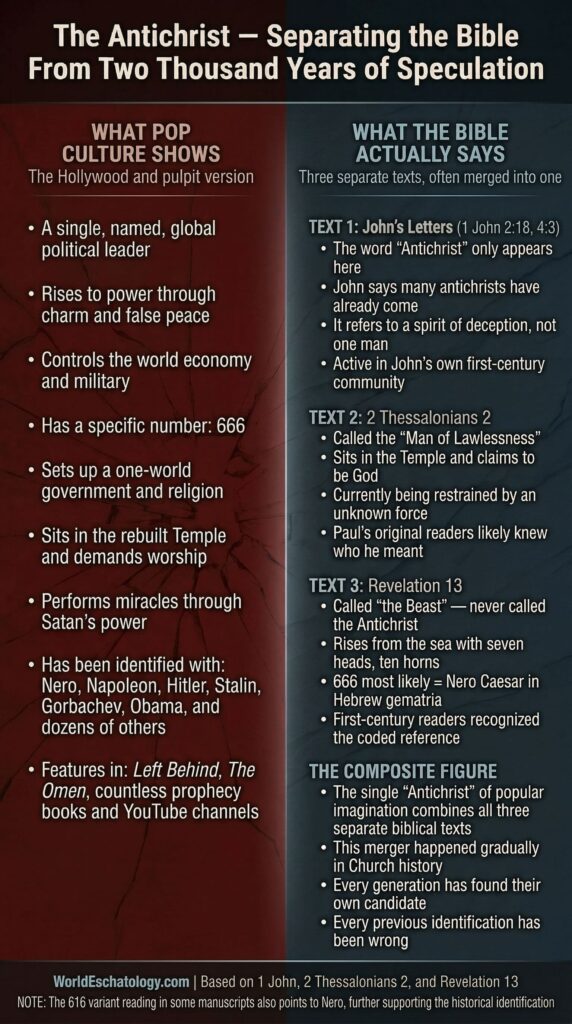
It is considerably more complicated than that. The actual word Antichrist appears only in John’s first and second letters, not in Revelation.
In those letters, John is not describing a single future world ruler. He is describing a spirit of deception already at work in his own time, and he says that many Antichrists have already come.
The spirit of Antichrist is any spirit that denies that Jesus Christ has come in the flesh.
The Beast of Revelation 13 is a different figure. He rises from the sea with ten horns and seven heads, receives his power from the Dragon (Satan), commands global worship, wages war against the saints, and has a number: 666.
Most contemporary scholars believe this figure was originally a coded reference to the Roman emperor Nero, because Nero Caesar in Hebrew letters adds up to 666, and the first-century readers of Revelation would have recognized the reference immediately.
The Man of Lawlessness in 2 Thessalonians 2 is yet another figure: he sets himself up in the Temple of God and declares himself to be God.
This passage was interpreted for most of church history as a reference to a specific Roman emperor or to the papacy (by the Reformers), not to a future political world ruler.
The composite Antichrist of popular imagination is the result of merging these three separate figures into one: the spirit of Antichrist from John’s letters, the Beast from Revelation, and the Man of Lawlessness from Paul’s letter.
This merger was a theological development of the early church, and it has proven extraordinarily durable in the popular imagination.
Throughout history, virtually every major political figure in times of crisis has been identified as the Antichrist by someone.
Nero, various Roman emperors, Pope Gregory I, Pope Innocent III, Napoleon Bonaparte, Adolf Hitler, Joseph Stalin, Mikhail Gorbachev, Saddam Hussein, Barack Obama, and numerous others have all been seriously proposed by someone as the fulfillment of this prophecy.
The fact that every previous identification has been wrong has done nothing to slow down new proposals.
The Mark of the Beast: 666 and the most searched number in religion
No single image from the book of Revelation has embedded itself more deeply into popular culture than the number 666 and the mark of the Beast.
Revelation 13:16-17 describes a second beast, called the False Prophet, who forces everyone to receive a mark on their right hand or forehead, without which no one can buy or sell.
The original meaning was almost certainly a reference to Roman coins bearing the emperor’s image and the economic pressure on Christians to participate in the imperial cult economy.
The number 666 uses a technique called gematria, where numbers correspond to letters, and Nero Caesar in Hebrew (or Neron Caesar in the form some manuscripts use) comes to 666.
The variant reading of 616 found in some early manuscripts also corresponds to Nero’s name in a slightly different Hebrew spelling, which strongly supports the Nero identification.
But the passage’s warning about a mark that controls participation in commerce has proven to be one of the most versatile and enduring symbols in Western history, applied to virtually every new development in identification and commerce technology.
In the twentieth century it was applied to social security numbers, UPC barcodes, and credit cards.
In the twenty-first century it has been applied to RFID chips, vaccine passports, digital IDs, central bank digital currencies, and biometric identification systems.
The theological point of the passage is about loyalty and worship, not technology.
The mark is a parody of the seal of God that marks believers in Revelation 7.
It represents a choice between allegiance to God and allegiance to the earthly power that demands ultimate loyalty.
The specific technology through which that choice gets expressed is secondary to the underlying question of who you belong to.
The Millennium: Revelation 20’s thousand years
Revelation 20:1-6 describes an angel descending from heaven, binding Satan with a great chain, and throwing him into the abyss for a thousand years, during which the souls of martyrs reign with Christ.
After the thousand years, Satan is released briefly, leads a final rebellion, is defeated, and is cast into the lake of fire.
This passage is the most disputed in all of Christian eschatology, and the dispute produced the four millennial views described in the previous section.
A few additional points deserve mention.
In premillennialist thinking, the millennium is a this-worldly period of peace, prosperity, and righteousness under the direct rule of Christ.
What exactly life looks like during it varies considerably. Some see it as a time when the full Mosaic law is restored and Temple sacrifices resume in a rebuilt Jerusalem.
Others emphasize the universal peace and abundance described in Isaiah’s prophetic visions.
The question of whether Gentile Christians participate in the millennial kingdom, and in what role, also generates debate.
In amillennialist thinking, we are currently in the millennium.
The binding of Satan refers to Satan’s inability to deceive the nations and prevent the gospel from spreading worldwide, which happened at the Cross and Resurrection.
The reigning of saints is the spiritual reality of believers being seated with Christ in heavenly places.
This interpretation removes the millennium from the category of future events and places it in the present experience of the Church.
Heaven, Hell, and the New Creation
Christian eschatology does not end with the millennium.
After the final judgment comes the eternal state: the permanent condition of all intelligent beings for the rest of forever.
What that looks like is one of the richest and most debated topics in all of Christian theology.
The traditional view of hell is eternal conscious torment: the unrighteous dead are resurrected, judged, and sentenced to a state of eternal conscious suffering, separated from God, in what Revelation calls the lake of fire.
This view has been the majority position of Catholic, Orthodox, and much of Protestant Christianity for most of Christian history.
It is defended by appealing to Jesus’s own warnings about Gehenna, to the imagery of eternal fire and the worm that does not die, and to the parallel structure of Matthew 25:46, where eternal punishment is contrasted with eternal life using the same Greek word for eternal.
Annihilationism, also called conditional immortality, argues that the unsaved do not suffer eternally but are raised, judged, and then permanently destroyed.
They cease to exist. Only the righteous receive the gift of immortality.
This view is gaining ground in evangelical theology and has serious defenders including John Stott, one of the most respected evangelical scholars of the twentieth century.
Annihilationists argue that eternal suffering is neither just nor supported by the biblical imagery of destruction and death that describes the fate of the lost.
Christian Universalism argues that ultimately every human being will be reconciled to God, that hell is a purgatorial process of purification rather than a permanent state, and that God’s love and power will ultimately overcome every resistance.
This view has ancient roots in figures like Origen and Gregory of Nyssa, experienced a major revival through the nineteenth-century theologian George MacDonald who influenced C.S. Lewis, and has seen significant contemporary advocacy through books like Rob Bell’s Love Wins.
It is considered heretical by Catholic, Orthodox, and most Protestant teaching, but it continues to attract thoughtful defenders.
The New Creation is the positive vision of the eternal state.
Revelation 21 and 22 describe a new heaven and a new earth, with the sea no longer existing, and the New Jerusalem descending from heaven like a bride adorned for her husband.
The city is staggeringly large: 1,400 miles on each side, a perfect cube or pyramid of gold and precious stones.
God dwells directly with humanity. There is no Temple because God himself is the Temple. There is no sun or moon because the glory of God illuminates everything.
The tree of life from Genesis reappears, its leaves for the healing of the nations.
The vision is not of souls floating in a disembodied heaven. It is of a renewed physical creation, a transformed earth, where resurrected bodies live in a perfected world in full and unmediated relationship with God.
N.T. Wright, the New Testament scholar and Anglican bishop, has argued powerfully that the traditional popular image of heaven as a place you go when you die and float around on clouds is not what the New Testament actually teaches.
The New Testament’s hope is resurrection, not escape from the physical world.
The Resurrection of the Dead and the Final Judgment
All mainstream branches of Christianity affirm a future, physical resurrection of the dead.
The Nicene Creed states: we look for the resurrection of the dead and the life of the world to come. This is not a metaphor.
Christians believe that the same bodies that went into the grave will be raised, transformed, and glorified, as Christ’s own resurrection body was physical yet different from ordinary physical bodies: he could eat fish, be touched, and was recognizable, yet could also appear in locked rooms and ascend into heaven.
Paul in 1 Corinthians 15 uses the image of a seed and a plant: the resurrection body is as different from the mortal body as a fully grown plant is from the seed it grew from, yet there is continuity between them.
The resurrection body is spiritual in the sense of being animated and governed by the Holy Spirit, not in the sense of being non-physical.
The final judgment in Christian theology is typically described as two events in dispensational theology, which can cause confusion.
The Judgment Seat of Christ, also called the Bema Seat from the Greek word for the judgment platform, is for believers and concerns their rewards in the kingdom, not their eternal destiny.
Their salvation is not at issue: that was settled at conversion. What is evaluated is their faithfulness in service and stewardship.
The Great White Throne Judgment of Revelation 20 is for the unrighteous dead, raised after the millennium.
Books are opened containing records of deeds, and the Book of Life is consulted. Anyone not found in the Book of Life is cast into the lake of fire.
In amillennialist and preterist theology, there is one final judgment for all people simultaneously at Christ’s return, not two separate judgments separated by a thousand years.
Signs of the End Times: What Christian Tradition Says to Watch For
People want to know whether the end is near. They have always wanted to know. The internet has simply made that desire more searchable.
Christian tradition provides a substantial list of signs, drawn from Jesus’s own words and from the prophetic texts of the New Testament.
The signs Jesus gave in Matthew 24
The Olivet Discourse gives the most systematic list of end-times signs in the entire New Testament, and Jesus himself provides them.
They include false messiahs who claim to be Christ, wars and rumors of wars, nation rising against nation and kingdom against kingdom, famines, earthquakes in various places, persecution and martyrdom of believers, widespread betrayal and hatred, the rise of false prophets, growing lawlessness and the cooling of love, and the preaching of the gospel to all nations.
Jesus also describes the abomination of desolation, drawn from Daniel, standing in the holy place, which in dispensational interpretation is the Antichrist’s desecration of the rebuilt Temple at the midpoint of the tribulation.
He describes a period of great tribulation unlike anything the world has ever seen or will see again.
He describes cosmic signs: the sun darkened, the moon not giving its light, stars falling, and the powers of heaven shaken.
And then the sign of the Son of Man in heaven, and his visible return on the clouds with power and great glory.
One of the most common questions people ask is whether current events, wars, earthquakes, famines, and pandemics mean the end is near.
The honest answer is that these signs have been present in every generation since Jesus spoke them.
Every generation has had wars, earthquakes, false prophets, and persecution of believers.
Jesus himself says that these are the beginning of birth pains, not the end itself.
The temptation to read current headlines as fulfillments of specific prophecy is as old as Christianity and has led to an unbroken string of failed predictions.
The rebirth of Israel: the most politically significant prophetic sign
For dispensational premillennialists, the founding of the modern State of Israel in 1948 is the single most significant prophetic event of the twentieth century.
The argument runs like this: Ezekiel 36 and 37 promise the return of the Jewish people to their land before the final redemption.
Jesus in Matthew 24:32-34 uses the fig tree as a parable: when you see it bud, you know summer is near.
Many dispensationalists identify the fig tree as Israel. The budding of the fig tree is the founding of the Israeli state.
The generation that sees this will not pass away before all these things happen.
This interpretation has driven enormous political consequences.
Christian Zionism, the evangelical support for the modern State of Israel rooted in this eschatological framework, has been a powerful political force in American domestic and foreign policy since at least the 1970s.
Organizations like Christians United for Israel, founded by pastor John Hagee, claim millions of members and significant lobbying influence in Washington.
The belief that American support for Israel is not merely a geopolitical preference but a divine obligation rooted in eschatological prophecy is a serious force in American politics.
The Third Temple: the most geopolitically explosive sign
Dispensational eschatology requires a rebuilt Jewish Temple in Jerusalem during the tribulation period, because the Antichrist must enter the Temple and declare himself God.
This requirement gives enormous eschatological significance to the current status of the Temple Mount, which is currently held by the Dome of the Rock and the al-Aqsa Mosque, two of Islam’s holiest sites.
The Temple Institute in Jerusalem has been preparing Temple implements and priestly garments for decades in anticipation of a rebuilt Temple.
In 2022 and subsequent years, the birth of red heifers in Israel matching the requirements of Numbers 19 for the purification ritual necessary to resume Temple service attracted enormous media attention in both religious and secular outlets.
The geopolitical implications of a serious attempt to rebuild the Temple on the Temple Mount are almost impossible to overstate.
Other commonly cited signs
Beyond the specific signs above, Christian end-times writers and teachers regularly identify additional signs in current events.
The rise of a global government or world authority is seen as setting the stage for the Antichrist’s political dominion.
The development of a global economic system is seen as making possible the mark of the Beast’s control over commerce.
The normalization of moral permissiveness and the decline of traditional religious observance is read as the falling away or apostasy that Paul describes in 2 Thessalonians 2.
In the digital age, technologies like RFID microchips, digital health passports, central bank digital currencies, and biometric identification have been repeatedly discussed in Christian end-times communities as potential mechanisms for the mark of the Beast system.
The appropriate response to these discussions is neither dismissive mockery nor credulous alarm, but careful biblical analysis about what the text actually describes and what it does not.
What Different Christian Traditions Believe
There is no single Christian eschatology. There are dozens of traditions, each with its own interpretation of the same biblical texts.
Here is where the major streams of Christianity actually stand.
Evangelical and Baptist Protestantism
The dominant eschatological view among American evangelical Christians, Southern Baptists, and most nondenominational megachurch communities is dispensational premillennialism.
This view saturates popular Christian culture through the Left Behind novel and film series by Tim LaHaye and Jerry Jenkins, through the books of Hal Lindsey, through Bible prophecy conferences, and through the teaching of prominent televangelists and megachurch pastors.
It is worth noting how recent and geographically specific this dominance is.
Dispensational premillennialism became the mainstream evangelical view in America largely in the second half of the twentieth century, primarily through the influence of Dallas Theological Seminary, the Scofield Reference Bible, and popular prophecy teachers.
Before that, and outside the United States today, it is a minority position even within Protestantism.
Roman Catholicism
The Roman Catholic Church is officially amillennialist and strongly resistant to the kind of end-times speculation that characterizes popular evangelical prophecy culture.
The Catechism of the Catholic Church teaches that the Church will pass through a final trial that will shake the faith of many believers, that the Antichrist is a figure who deceives the world, and that Christ will come again to judge the living and the dead.
But it explicitly warns against millenarianism, the belief in a literal earthly reign of Christ before the final judgment, calling it a distortion of the faith.
Within Catholic popular spirituality, however, Marian apparitions and their associated prophecies play a significant eschatological role that official theology does not always endorse.
The Third Secret of Fatima, the apparitions at Akita in Japan, and numerous private revelations about coming chastisements and a great tribulation are taken very seriously by many devout Catholics, even where they are not formally approved by the Church.
Eastern Orthodoxy
Eastern Orthodox eschatology has much in common with Catholic amillennialism but with a distinctively mystical flavor.
Orthodox Christianity is deeply resistant to the precise prophetic timetabling that characterizes Western end-times theology.
Orthodox thinkers are more likely to emphasize the already-present reality of the Kingdom in the Eucharist and the liturgy than to construct a future prophetic sequence.
The Antichrist in Orthodox theology is not primarily a future political figure but a spiritual reality and a type: a figure who epitomizes the deception of humanity away from God.
Some Orthodox theologians have written about a future Antichrist figure, but without the detailed biographical profile common in evangelical dispensationalism.
The emphasis falls on theosis, union with God, as the ultimate destiny of the redeemed, rather than on the sequence of prophetic events leading there.
Reformed and Presbyterian Christianity
Reformed theology, the tradition flowing from John Calvin through the Westminster Confession of Faith, has historically been either amillennialist or postmillennialist.
The Westminster Confession itself is carefully worded to accommodate both positions.
The great Princeton theologians of the nineteenth century, B.B. Warfield and Charles Hodge, were postmillennialists.
Most twentieth-century Reformed theologians gravitated toward amillennialism.
In the twenty-first century, there has been a significant revival of postmillennialism among young Reformed Christians, particularly those influenced by the Christian Reconstructionist theology of R.J. Rushdoony and his successors.
This revival connects eschatology directly to a program of cultural and political engagement: if Christ will return after the gospel has transformed culture, then the Church’s task is active cultural transformation, not withdrawal and waiting.
Pentecostal and Charismatic Christianity
Pentecostal and Charismatic Christianity, the fastest-growing form of Christianity globally, is strongly premillennialist and often dispensationalist, with additional dimensions not found in other traditions.
Pentecostals typically believe that spiritual gifts including prophecy, tongues, and healing are intensifying as a sign of the last days, fulfilling the Joel 2 promise that God would pour out his Spirit on all people in the last days.
Living prophets within Charismatic communities regularly make specific end-times predictions, sometimes including dates and named figures.
The accountability record of these prophecies has been mixed at best, yet the practice continues to generate enormous interest and following.
The Charismatic end-times subculture has its own media ecosystem, its own prophecy conferences, and its own celebrities, and it exercises real influence on millions of believers worldwide.
Where the Traditions Meet: Comparative Connections
Christian eschatology does not exist in isolation. It grew out of Judaism, and it shares important structural elements with Islamic eschatology.
Understanding where the traditions overlap and where they diverge is one of the most illuminating exercises in comparative religion.
The Christian Antichrist and the Islamic Dajjal
The most powerful comparative pair in all of eschatological study is the Christian Antichrist and the Islamic Dajjal.
Both are the greatest deceivers in human history. Both appear in the period immediately before the final divine intervention.
Both perform miracles that convince most of the world to follow them. Both demand to be worshipped.
Both are ultimately defeated by a returning divine or prophetic figure. Both target the Jewish people and Jerusalem with particular ferocity.
The differences are equally revealing. The Antichrist in Christian tradition is a political figure who rises through human ambition and satanic empowerment.
The Dajjal in Islamic tradition is more explicitly supernatural: one-eyed, traveling at extraordinary speed, performing miracles like bringing the dead back to life.
The Antichrist is defeated by the returning Christ at Armageddon. The Dajjal is defeated by the returning Prophet Jesus (Isa) at the gate of Ludd in Israel.
The surface-level parallels are striking enough that many scholars believe the traditions influenced each other.
The Second Coming and Islam’s return of Jesus
One of the most surprising facts in comparative eschatology, for many people who encounter it for the first time, is that Islam also believes in the return of Jesus.
In Islamic eschatology, Jesus (called Isa) did not die on the cross but was raised bodily to heaven by God and will return near the end of times to establish justice on earth.
But the Islamic Jesus returns not to be worshipped as God but to correct the theological error of those who made him into God.
He will break the cross, meaning he will refute the theology of the crucifixion and the divinity of Christ. He will kill the Dajjal.
He will rule by Islamic law. He will marry, have children, die naturally, and be buried in Medina next to the Prophet Muhammad.
The Christian Second Coming and the Islamic return of Jesus share the same protagonist but tell almost opposite stories about who he is and what he comes to do.
Understanding both versions is essential for anyone doing serious comparative eschatology.
Christian eschatology and the Jewish Messianic expectation
Christianity is, in its own self-understanding, the claim that Jewish Messianic prophecy has been at least partially fulfilled in Jesus of Nazareth.
The eschatological debate between Christianity and Judaism is therefore the oldest and deepest in the Western religious tradition.
The Jewish objection to Jesus as Messiah is not primarily theological but historical: he did not rebuild the Temple, did not gather all Jews to Israel, did not bring universal peace, did not cause all nations to recognize the one God.
The Christian response is the Second Coming: these tasks will be completed at his return.
For traditional Jews, a Messiah who requires a second visit to finish the job is not a Messiah in any recognizable Jewish sense.
Understanding this debate is essential context for understanding Christian eschatology, because Christian end-times thinking is in many ways structured around the argument that what Jesus left undone at his first coming will be completed at his second.
The Second Coming and the Hindu Kalki Avatar
The structural parallel between the Christian Second Coming and the Hindu concept of Kalki Avatar is genuinely striking.
In Hindu tradition, Kalki is the tenth and final avatar of Vishnu, who will appear at the end of the Kali Yuga riding a white horse, wielding a flaming sword, to defeat evil and establish the Satya Yuga, the age of truth and righteousness.
Revelation 19 describes Christ returning on a white horse, with a sharp sword coming from his mouth, to defeat the armies of the earth at Armageddon.
The imagery is remarkably parallel: a divine warrior figure on a white horse with a sword, arriving to defeat evil and inaugurate a new age of righteousness.
Whether this reflects shared ancient symbolism, independent parallel development, or something deeper is a question worth exploring.
Modern Christianity and the Contemporary Relevance of End-Times Theology
Christian eschatology is not only a matter of ancient texts and theological debate. It has real, measurable effects on contemporary politics, culture, and society.
Dispensationalism and American foreign policy
The influence of dispensational eschatology on American foreign policy is one of the most important and least discussed stories in modern political history.
The dispensationalist belief that the founding of Israel in 1948 was a fulfillment of biblical prophecy, that American support for Israel is a divine obligation, and that the events leading to Armageddon require a Jewish state in the Holy Land has created a powerful and durable political constituency.
Organizations like Christians United for Israel, founded by John Hagee in 2006, claim millions of members and routinely lobby Congress on Middle East policy.
Pastors like Jerry Falwell Sr. and Pat Robertson built media empires that translated eschatological conviction into political action.
Presidents from Reagan to Trump have had to reckon with this constituency, and some have explicitly adopted its language.
The relationship between eschatological theology and Middle East policy is a serious subject of academic study and deserves to be understood by anyone trying to make sense of American foreign policy.
End-times theology in popular culture
The Left Behind series by Tim LaHaye and Jerry Jenkins, which began publication in 1995 and eventually ran to sixteen novels plus numerous spin-offs, sold over 80 million copies and became one of the best-selling fiction series in American history.
It brought dispensational premillennialist eschatology to tens of millions of readers who had never sat through a prophecy conference, dramatizing the Rapture, the tribulation, and the rise of the Antichrist in readable thriller format.
The influence extends well beyond explicitly Christian media.
The imagery of the Apocalypse saturates secular film and fiction: zombie narratives as secularized end-times stories, disaster films drawing on the language of judgment and divine wrath, dystopian fiction from The Road to The Handmaid’s Tale building worlds shaped by eschatological imagination.
The Book of Eli, Children of Men, and even the secular science fiction of Cormac McCarthy all work with material that has deep roots in Christian eschatological tradition.
Failed prophecies: the most engaging story in eschatological history
One of the most humanly fascinating chapters in the entire history of Christian eschatology is its unbroken record of failed date-setting.
Despite Jesus’s explicit statement that no one knows the day or the hour, not even the angels of heaven but only the Father, Christians have been setting specific dates for the end of the world with remarkable confidence since the first century.
William Miller, an American Baptist preacher, calculated from Daniel 8:14 that Christ would return on October 22, 1844.
He had between 50,000 and 500,000 followers who sold their farms, gave away their possessions, and gathered to wait.
When October 23 arrived with the world still intact, the event became known as the Great Disappointment.
Some followers left the faith. Others regrouped and founded what became the Seventh-day Adventist Church, reinterpreting the date as referring to a heavenly rather than earthly event.
The Jehovah’s Witnesses, founded by Charles Taze Russell in the late nineteenth century, have predicted specific dates for the end of the world multiple times, most notably 1914, 1918, 1925, and 1975.
Each failure was absorbed by reinterpretation rather than abandonment. Hal Lindsey’s The Late Great Planet Earth, published in 1970, strongly implied that the Second Coming would occur within a generation of 1948, meaning by around 1988.
The book sold 28 million copies. Harold Camping, a California radio preacher, predicted the Rapture would occur on May 21, 2011, then revised to October 21, 2011, spending millions of dollars on billboard advertising campaigns. He was wrong both times.
The sociology of failed prophecy is genuinely fascinating. When a specific prediction fails, most believers do not abandon their faith.
They reinterpret the failure: the calculation was slightly wrong, God granted a reprieve, or the prophecy referred to an invisible spiritual event.
This cognitive pattern, studied extensively by psychologists, suggests that the function of eschatological belief is not primarily predictive but existential: it provides a framework for meaning and hope in an uncertain world, and that function persists even when specific predictions fail.
Key Concepts at a Glance
| Concept | Term / Source | What It Means | Key Denominations |
| Second Coming | Parousia (Greek) | Christ’s visible, physical return to earth | All Christian traditions |
| The Rapture | 1 Thess 4:17 | Believers caught up to meet Christ | Evangelical, Baptist (not Catholic/Orthodox) |
| Great Tribulation | Daniel 9 / Rev 6-19 | Seven years of global suffering under the Antichrist | Dispensationalist traditions |
| The Antichrist | Rev 13 / 2 Thess 2 | The great deceiver who demands worship before the end | All traditions (interpreted differently) |
| Mark of the Beast | Revelation 13:16-17 | Mark of allegiance to the Antichrist controlling commerce | All traditions (interpreted differently) |
| The Millennium | Revelation 20:1-6 | Thousand-year period of Christ’s reign (literal or symbolic) | All traditions (major disagreements) |
| Premillennialism | Darby / Early Fathers | Christ returns before the literal thousand years | Evangelical, Baptist, Pentecostal |
| Amillennialism | Augustine onward | Millennium = current Church age, symbolic | Catholic, Orthodox, Reformed, Lutheran |
| Postmillennialism | Puritan tradition | Church builds the kingdom, Christ returns after | Reformed, Christian Nationalist movements |
| New Jerusalem | Revelation 21-22 | The perfected eternal city on the new earth | All Christian traditions |
| Annihilationism | Conditional immortality | The unsaved cease to exist rather than suffer eternally | Adventist, some evangelicals |
Frequently Asked Questions About Christian Eschatology
These are the questions most commonly searched by people exploring Christian end-times beliefs. Here are direct, honest answers to each one.
Is the Rapture in the Bible?
The word Rapture does not appear in the Bible. The concept is built primarily on 1 Thessalonians 4:17, where Paul describes believers being caught up to meet the Lord in the air.
The Pre-Tribulation Rapture doctrine, which says believers will be secretly removed from the earth before a seven-year tribulation period, was developed by John Nelson Darby in the 1830s.
It was unknown in Christian theology before that point. Most of the world’s Christians, including Catholics, Orthodox Christians, and most mainline Protestants, do not believe in a Pre-Tribulation Rapture.
What is the Great Tribulation?
In dispensational eschatology, the Great Tribulation is a seven-year period of unprecedented global suffering following the Rapture, governed by the Antichrist.
It is based primarily on Daniel 9:24-27 and Revelation 6 through 19. The second half of this period, triggered by the Antichrist’s desecration of the rebuilt Temple, is called the Great Tribulation proper.
Amillennialists and Preterists do not interpret the tribulation as a future literal seven-year period. Preterists identify it with the Jewish-Roman war of 66 to 70 CE.
Who is the Antichrist according to the Bible?
The word Antichrist appears only in John’s letters, where it refers to a spirit of deception already at work in the first century.
The popular image of a single future political world ruler who is the Antichrist is a composite figure drawn from the Beast of Revelation 13, the Man of Lawlessness of 2 Thessalonians 2, and the spirit of Antichrist in John’s letters.
Throughout history, the Antichrist has been identified with Nero, various Roman emperors, different popes, Napoleon, Hitler, and scores of modern political figures. Every previous identification has proven incorrect.
What does 666 mean in Revelation?
The number 666 is called the number of the Beast in Revelation 13:18.
The most historically grounded interpretation is that it refers to the emperor Nero, because Nero Caesar in Hebrew letters equals 666 using the ancient practice of gematria.
The variant reading of 616 found in some manuscripts also corresponds to Nero’s name in a slightly different spelling.
In contemporary popular culture it is applied to various technologies and political figures as a mark of control over commerce.
The theological significance is about ultimate allegiance, not the specific technology involved.
Do Catholics believe in the Rapture?
No. The Roman Catholic Church does not teach the Pre-Tribulation Rapture doctrine.
The Catechism teaches that Christ will come again to judge the living and the dead, that there will be a resurrection of the dead and a final judgment, and that the Church will pass through a final trial.
But the specific dispensational framework involving a secret pre-tribulation removal of believers, a seven-year tribulation, and a rebuilt Temple is not Catholic teaching.
The Church explicitly warns against millenarianism.
What happens after the Second Coming?
According to premillennialist theology, the Second Coming is followed by the binding of Satan, the resurrection of believers, and a thousand-year reign of Christ on earth.
After the millennium, Satan is released, leads a final rebellion, is defeated, and the final resurrection and Great White Throne judgment occur, followed by the eternal state.
In amillennialist theology, the Second Coming immediately triggers the resurrection of all the dead, the final judgment of all humanity, and the beginning of the eternal state with no intervening millennium.
What is the difference between heaven and the New Earth?
In popular Christian imagination, heaven is where you go when you die and where you remain forever.
But the New Testament teaches something more specific: the eternal state is not a disembodied existence in heaven but a resurrected physical life on a renewed and perfected earth.
Revelation 21 describes a new heaven and a new earth, with the New Jerusalem descending from heaven to earth.
God dwells with humanity on the new earth. The ultimate Christian hope is not to escape the physical world but to inhabit a transformed and perfected version of it.
What are the signs of the end times according to Christianity?
Jesus in Matthew 24 lists the following signs: false messiahs, wars and rumors of wars, earthquakes, famines, persecution of believers, the preaching of the gospel to all nations, the abomination of desolation, and cosmic disturbances followed by his visible return.
Paul in 2 Thessalonians 2 mentions the falling away from faith and the revelation of the Man of Lawlessness.
Revelation describes its own sequence of seals, trumpets, and bowl judgments.
Dispensationalists add the founding of Israel in 1948, the rebuilding of the Temple, and the rise of a global government as specific contemporary signs.
Is Jesus coming back soon?
No one knows. Jesus himself said in Matthew 24:36 that no one knows the day or hour, not the angels, not even the Son, but only the Father.
This has not stopped an enormous number of Christians from making specific predictions, every one of which has been wrong.
Whether the Second Coming is imminent, years away, or centuries away is not knowable from the biblical text.
What the texts consistently emphasize is readiness and faithfulness rather than timetable prediction.
What is annihilationism?
Annihilationism, also called conditional immortality, is the belief that the unsaved dead are not tormented eternally but are resurrected, judged, and then permanently destroyed.
They cease to exist. Immortality is a gift given only to the righteous, not an inherent property of all human souls.
This view is held by a significant minority of evangelical scholars, including John Stott and Clark Pinnock, and is the official position of the Seventh-day Adventist Church.
It stands against the traditional majority position of eternal conscious torment.
What is the abomination of desolation?
The abomination of desolation is a phrase from Daniel 9:27, 11:31, and 12:11, referring to a desecration of the Temple that triggers the worst period of tribulation.
Jesus refers to it in Matthew 24:15. Historically, it was fulfilled in 168 BCE when the Seleucid king Antiochus IV Epiphanes erected an altar to Zeus in the Jerusalem Temple.
Preterists see a second fulfillment in the Roman desecration of the Temple in 70 CE.
Dispensationalists interpret it as a still-future event: the Antichrist entering the rebuilt Third Temple and declaring himself God at the midpoint of the tribulation.
Did any end-times predictions come true?
The record of specific end-times date predictions is essentially one of unbroken failure.
William Miller’s 1844 prediction, the Jehovah’s Witnesses’ dates of 1914, 1918, 1925, and 1975, Hal Lindsey’s implied generation-from-1948 timetable, Harold Camping’s 2011 predictions, and scores of others have all proven incorrect.
What does appear to have been fulfilled, according to Preterists with strong historical and exegetical arguments, is the bulk of the Olivet Discourse in the events of 70 CE.
But no specific prophetic date set by a human interpreter has proven correct.
Conclusion: Why Christian Eschatology Will Never Lose Its Audience
Christian eschatology is not going anywhere. The questions it asks are too deep and too human for that. When does history end?
Is there a purpose to suffering? Will evil be punished? Will the dead live again? Will God, if he exists, keep his promises?
These are not questions that any culture or generation has been able to ignore for long.
What makes Christian eschatology particularly fascinating as a field of study is the enormous diversity of answers that sincere, intelligent, and devout people have drawn from the same texts.
A Catholic theologian, a dispensationalist evangelical, a Reformed amillennialist, a Preterist scholar, and an Eastern Orthodox mystic can all read the same Bible and arrive at radically different pictures of what the end of the world looks like.
Understanding why they disagree, and what each tradition actually argues, is one of the richest and most rewarding journeys in comparative religious thought.
It is also increasingly relevant. In a world of real geopolitical conflict over the city of Jerusalem, real debates about artificial intelligence and human identity, real anxieties about the future of civilization, and real political movements drawing on eschatological frameworks to motivate action, understanding Christian end-times theology is not an optional extra for students of contemporary culture. It is a necessity.
The exploration does not end here. The Antichrist, the Rapture, Gog and Magog, the Dajjal of Islam, the Jewish Messiah, the Kalki Avatar of Hinduism: each of these subjects has its own rich and complicated story.
They intersect in surprising ways. They challenge each other. And together they form one of the most profound and enduring conversations in human history about what awaits us at the end.
4 thoughts on “Christian Eschatology: The Antichrist, the Rapture, and the Second Coming”