
At some point in your life, you have stood near a grave and asked the question.
Maybe you asked it quietly, to yourself, on the way home from a funeral. Maybe you asked it out loud, in the middle of a sleepless night, after a loss that was simply too large to process.
Maybe you are asking it right now, in the particular way that people turn to a search engine when they need an answer they cannot find anywhere else.
What happens after we die?
This is not a question that belongs to theology. It belongs to every human being who has ever lived and known that they would one day stop living.
It is the question that has driven the construction of pyramids and the writing of scriptures and the building of every temple, mosque, church, and shrine in human history.
And the answers that different civilisations have given to it, across thousands of years and thousands of miles of separation, are some of the most remarkable things our species has produced.
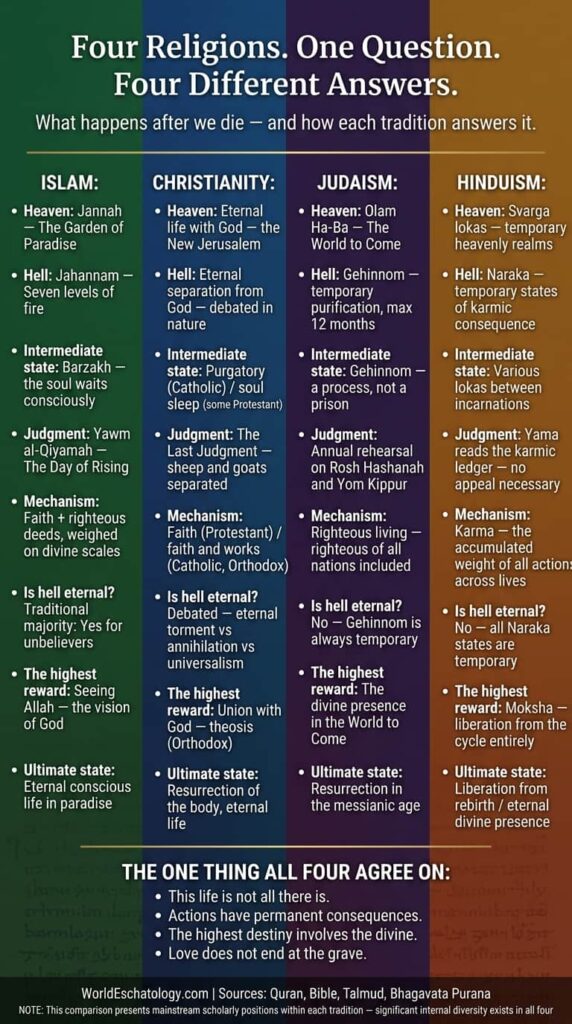
This article goes through four of those answers in depth: what Islam teaches about the afterlife, what Christianity teaches, what Judaism teaches, and what Hinduism teaches.
We cover heaven and hell across religions in each tradition’s sacred texts, the intermediate states between death and final judgment, the question of who gets in and who does not, the debate about whether hell is eternal or temporary, and the surprising areas of agreement that emerge when you look carefully at four traditions that appear, on the surface, to be saying very different things.
We try to present every tradition honestly and with genuine respect, neither softening what each tradition actually teaches nor sensationalising the parts that are difficult.
If you have ever wondered what your neighbour’s religion teaches about the afterlife, or what your own tradition really says beneath the simplified version you may have been given, this is the article for you.
Why Afterlife Beliefs Matter?
Before we go into any specific tradition, it is worth pausing on why this subject deserves serious attention rather than a quick comparison chart.
What you believe happens after you die shapes everything about how you live.
A person who believes in an eternal conscious hell for the unrighteous will make different decisions, feel different fears, and carry different motivations than someone who believes in annihilation, or in temporary purification followed by universal salvation, or in a cycle of rebirths governed by karma.
These are not abstract positions that live only in theology textbooks. They are the operating systems inside which billions of real people navigate their most important choices.
They also shape how people grieve. A Muslim mother who has lost a child draws on a specific set of beliefs about where that child is now, what the child experiences, and whether she will see them again.
A Hindu father navigating the same loss draws on a completely different framework.
A Jewish widow and a Catholic widower sitting in the same grief group are processing their bereavement through cosmologies that agree on some things and diverge on others in ways that matter enormously for how they actually experience their loss.
And afterlife beliefs shape how communities relate to each other.
The question of whether people outside your faith tradition have a path to heaven has been the basis of missionary movements, interreligious dialogues, crusades, and some of the most tender and most violent human interactions in history.
It is not a question you can set aside as purely theological.
One more thing worth establishing before we begin: this article does not argue for any of the four traditions over the others.
It presents what each tradition teaches, as honestly as possible, and lets the reader think. The goal is understanding, not persuasion.
How Islam describes heaven, hell, and life after death?
Of the four traditions covered in this article, Islam has produced the most systematic and detailed description of the afterlife.
The Quran describes both paradise and hellfire in vivid, concrete terms, and the hadith literature elaborates those descriptions with a specificity that no other major tradition matches.
For Muslims, the afterlife is not a vague spiritual hope. It is a described reality with geography, levels, sensory experience, and a precisely understood process of arrival.
Death and the Immediate Afterlife
In Islam, death is not the end of consciousness. It is a transition. When a person dies, the Angel of Death, Azrael, comes to receive the soul.
The nature of that reception is said to differ dramatically based on the person’s spiritual state.
For a righteous believer, the soul is drawn out gently. For someone who died in a state of sin and unbelief, the extraction is described as much more difficult.
After death, the soul enters a state called Barzakh, an Arabic word meaning barrier or partition.
Barzakh is the intermediate realm between this life and the Day of Judgment, a state that all souls inhabit from the moment of their death until the resurrection.
In Barzakh, the soul experiences a foretaste of what is to come. The righteous experience something of the pleasures of paradise.
Those who will face punishment experience something of what awaits them.
In Barzakh, two angels named Munkar and Nakir come to each soul and ask three questions: who is your Lord, what is your religion, and who is this man (referring to the Prophet Muhammad, peace be upon him).
The answers the soul gives, and the ease or difficulty with which it gives them, reflect the depth of its faith in life.
A soul whose faith was genuine and practised will answer easily. A soul whose faith was only superficial will struggle.
The grave itself is described in the hadith as either a garden from the gardens of paradise or a pit from the pits of hellfire, depending on the person’s state.
This concept, sometimes called the punishment of the grave or the bliss of the grave, is one of the most consistently emphasised aspects of Islamic eschatology precisely because it makes the afterlife immediately and personally relevant rather than something that only matters at the end of history.
Jannah — The Islamic Paradise
Jannah, the Arabic word for paradise, appears in the Quran over a hundred times.
Its root meaning is garden, and the image of a lush, well-watered garden in a desert landscape captures something of its original resonance for its first audience.
But the Quranic description of Jannah goes far beyond a garden. It is a place of everything that the human soul has ever genuinely longed for, and things beyond what the human soul has ever conceived.
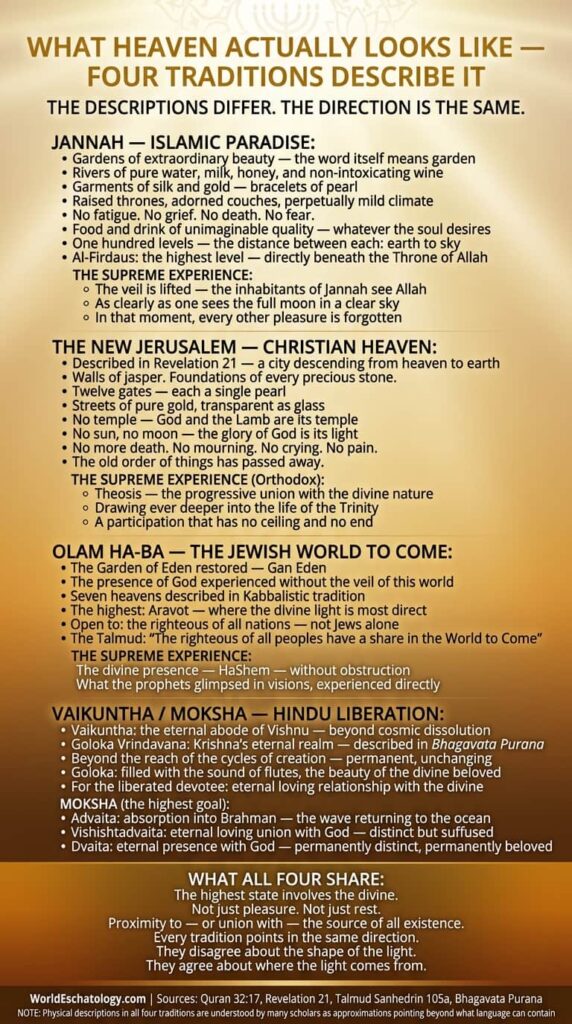
The Quran describes rivers in Jannah: rivers of pure water that never becomes stagnant, rivers of milk whose taste never changes, rivers of wine that does not intoxicate, and rivers of filtered honey.
The believers recline on adorned couches and raised thrones. They wear garments of fine silk and brocade and are adorned with bracelets of gold and pearl.
The weather is perpetually mild, neither too hot nor too cold. There is no fatigue, no grief, no death.
Quran 32:17
“No soul knows what joy has been kept hidden for them as a reward for what they used to do.”
This verse is significant because it places a limit on all description.
Everything the Quran and hadith describe about Jannah is a concession to human imagination, a way of pointing at something that ultimately exceeds what any description can contain.
The Prophet Muhammad, peace be upon him, reported that Allah said: I have prepared for my righteous servants what no eye has seen, no ear has heard, and what has never occurred to a human heart.
Jannah has levels, and scholars disagree on the exact number, though the most commonly cited number from authentic hadith is one hundred.
The highest level is Al-Firdaus, situated directly beneath the Throne of Allah, from which all the rivers of paradise flow.
This is the level the Prophet encouraged his companions to ask for in their prayers, because if you ask for paradise, ask for the highest.
The levels of Jannah are distributed based on the degree of a person’s faith and righteous deeds.
Prophets occupy the highest stations. The martyrs and the scholars of the faith follow.
The distance between each level is described in hadith as being like the distance between the earth and the sky, which gives some sense of the scale of differentiation.
But the greatest pleasure of Jannah, above the gardens and rivers and palaces and all the described delights, is described in both the Quran and hadith as the vision of Allah.
On certain days, the people of Jannah will see their Lord the way one sees the full moon in a clear sky, clearly, without obstruction, without the veil that separates the creature from the Creator in this world.
The hadith record that when this happens, the inhabitants of Jannah forget every pleasure they have experienced, so overwhelmed are they by what they now see.
This is considered the ultimate reward, the culmination of everything else.
Jahannam — The Islamic Hellfire
Jahannam is described in the Quran with the same vividness and specificity as Jannah, and it would be dishonest to soften what the text actually says.
Jahannam is a place of fire, of boiling water, of physical and spiritual suffering.
Like Jannah, Jahannam has levels, seven according to the most widely cited scholarly count, with each deeper level reserved for those whose crimes against faith and humanity were more severe.
The uppermost level is for those Muslims who sinned seriously but did not commit shirk, associating partners with Allah.
The deepest level, called Hawiyah or Al-Hutamah, is reserved for the hypocrites, those who professed faith outwardly while rejecting it inwardly, and for those who committed the most fundamental rejection of the divine.
The Quran describes the inhabitants of Jahannam drinking from boiling water and from a dark, bitter spring.
They are given food from a tree called the zaqqum, whose fruit is described as being like the heads of demons and whose consumption tears the stomach.
They wear garments of fire. The fire never relents and never allows them to die, which would be a release.
There is a serious and ongoing scholarly debate within Islam about whether Jahannam is truly eternal for all its inhabitants or whether divine mercy will eventually empty it.
Several major Islamic scholars, including Ibn Taymiyyah and his student Ibn al-Qayyim al-Jawziyyah, argued from Quranic and hadith evidence that the punishment of Jahannam, while severe and long-lasting, will eventually come to an end.
The verse that says the inhabitants of the fire will remain there forever is read by these scholars as meaning for a very long time rather than for infinite duration.
The majority position in traditional Islamic scholarship, however, maintains that Jahannam is eternal for those who die in a state of unbelief, while sinful Muslims may eventually be removed through divine mercy.
The Sirat is a bridge described in Islamic eschatology that spans over Jahannam and must be crossed by all souls on the way to Jannah.
It is described as thinner than a hair and sharper than a sword.
The righteous cross it at different speeds based on their deeds, some like lightning, some like the wind, some on horseback, some walking, some crawling.
Those whose deeds were insufficient fall from it into the fire below.
What Christianity teaches about heaven, hell, and final judgment?
Christianity presents a more internally contested picture of the afterlife than Islam does, and doing justice to that internal diversity is important for an honest article.
There is no single Christian position on the afterlife, and there never has been.
What there is, across all Christian traditions, is a shared conviction that this life is not all there is, that the choices made in this life have permanent consequences, and that the ultimate human destiny involves some form of relationship with God that death does not end.
Heaven in the New Testament
The New Testament uses several different terms and images for the final state of the righteous.
Jesus spoke of the Kingdom of God and the Kingdom of Heaven as a present reality that would one day be fully manifested.
He spoke of his Father’s house with many dwelling places or mansions. He promised the repentant criminal crucified beside him that they would be together in Paradise that very day.
The most extended and detailed description of the final state of the righteous in the New Testament comes from the last two chapters of Revelation, written by the Apostle John in a vision on the island of Patmos.
John describes a New Jerusalem descending from heaven to earth, a city of extraordinary dimensions, built of pure gold like transparent glass, its foundations adorned with every kind of precious stone, its twelve gates each made of a single pearl.
There is no temple in the city because God and the Lamb are its temple. There is no sun or moon because the glory of God provides its light.
“God’s dwelling place is now among the people, and he will dwell with them. They will be his people, and God himself will be with them and be their God. He will wipe every tear from their eyes. There will be no more death or mourning or crying or pain, for the old order of things has passed away.”
Paul, in his letters, described the content of heaven primarily in relational terms rather than physical ones.
He wrote that to be absent from the body is to be present with the Lord, suggesting an immediate conscious experience of the divine presence after death.
He wrote that what awaits the righteous is something that no eye has seen, no ear has heard, and no human mind has conceived.
And he described his own longing for death as a desire to depart and be with Christ, which he said was better by far, while acknowledging that his continuing life in the body was necessary for the benefit of those he served.
The Orthodox Christian tradition has developed the concept of theosis, which is the gradual transformation of the human person into an increasing likeness of and union with God.
For Orthodox Christians, heaven is not primarily a place but a state of progressive participation in the divine nature, a drawing ever deeper into the life of the Trinity that begins in this life through prayer and sacrament and continues without limit into eternity.
Hell in Christianity — Three Positions
The Christian tradition has never reached a single unified position on the nature of hell, and the debate has intensified rather than settled in recent centuries.
There are three main positions, each with serious theological advocates and serious scriptural arguments behind it.
The first and traditionally dominant position is eternal conscious torment.
The wicked are raised at the final judgment and sentenced to eternal punishment in a place of fire and separation from God.
This position rests on Jesus’s repeated use of the image of fire that does not go out and the worm that does not die, on the parable of Lazarus and the rich man describing conscious torment in Hades, and on Revelation’s description of the Lake of Fire as the second death into which death, Hades, the beast, the false prophet, and all whose names are not in the Book of Life are cast.
This is the traditional Catholic, Eastern Orthodox, and much of Protestant evangelical teaching.
The second position is annihilationism or conditional immortality. On this view, human beings are not inherently immortal.
Eternal life is a gift given to the righteous through Christ. Those who reject God are not punished eternally but are ultimately destroyed, ceasing to exist.
The fire of hell, on this reading, is a consuming fire that destroys rather than a sustaining fire that preserves and tortures.
This position is held by Seventh-Day Adventists, by some evangelical scholars including John Stott and Clark Pinnock, and has a significant following in contemporary evangelical circles.
The third position is universalism, sometimes called universal reconciliation.
All human souls are ultimately saved through a process that may include suffering and purification but ends in the restoration of every person to God.
This view was held by Origen, one of the most brilliant theologians of the early church, and has been advocated in various forms by theologians as significant as Hans Urs von Balthasar, Karl Barth in his own nuanced way, and more recently by David Bentley Hart.
Its scriptural basis includes Paul’s statements that God will be all in all, that every knee will bow and every tongue confess, and that God’s will is for all people to be saved and come to knowledge of the truth.
Purgatory — The Catholic Middle State
The Catholic Church teaches the doctrine of purgatory, which holds that souls who die in God’s grace and friendship but still require purification from the temporal effects of sin enter a state of final purification before entering heaven.
Purgatory is not a second chance. It is not a place for those who rejected God.
It is a process of completion for those who accepted God but whose transformation was not yet finished at the moment of death.
The primary scriptural basis in Catholic teaching is 2 Maccabees 12:46, which refers to praying for the dead so that they may be released from their sins, and Paul’s statement in 1 Corinthians 3 about some being saved as through fire.
The practice of praying for the dead and offering Mass for the souls of the departed flows from this doctrine and has been central to Catholic piety for centuries.
The Protestant Reformation rejected purgatory entirely, arguing that it had no clear biblical basis and that the doctrine implied a deficiency in Christ’s atoning work.
Most Protestant traditions teach that the soul enters immediately upon death either into the presence of God or into a state of judgment.
Some evangelical traditions teach soul sleep, the view that the soul rests in an unconscious state between death and the final resurrection, drawing on Paul’s repeated use of the metaphor of sleep for death.
How Judaism understands the afterlife, purification, and the world to come?
If you ask most people what Judaism teaches about heaven and hell, they will either say they do not know or give you an answer that reflects Christian eschatology rather than Jewish ones.
The Jewish afterlife is genuinely different from what most people expect, and it is genuinely important to understand it on its own terms.
The most striking fact about the Jewish afterlife is that the Hebrew Bible says remarkably little about it.
The Torah, the first five books of Moses that form the foundation of Jewish law and teaching, is almost entirely focused on this-worldly concerns: the covenant between God and Israel, the laws of righteous living, the consequences of faithfulness and faithlessness in the land.
Reward and punishment in the Torah are primarily communal and historical, affecting the fate of the nation in this world, not individual souls in the next.
Sheol — The Hebrew Bible’s Realm of the Dead
The Hebrew Bible does describe an afterlife realm, but it is not the heaven and hell of popular imagination.
It is called Sheol, and it is simply the place where the dead go.
Sheol is described as a shadowy, quiet realm beneath the earth where the dead exist in a diminished state, without the capacity for praise of God, without the engagement with life that characterised their earthly existence.
It is not a place of punishment, exactly, though it is certainly not a place of reward either. It is just where the dead are.
The psalmists write about Sheol with a kind of sorrowful acceptance. Going down to Sheol is synonymous with dying.
The dead in Sheol do not praise God, which is one of the reasons the psalmist asks God to save him from death, because in Sheol he cannot continue the worship that is the central act of his life.
There is no real theology of heaven and hell in the Hebrew Bible in the sense that Christians and Muslims understand those concepts.
Gehinnom — The Jewish Purification
By the time of the Talmud, Jewish thought had developed considerably.
The concept of Gehinnom emerges in rabbinic literature as a place of post-mortem purification and consequence.
The name comes from the Ge-Hinnom or Valley of Hinnom outside Jerusalem, which in biblical times had been used for child sacrifice by idolaters and was later used as the city’s garbage dump, where fires burned continuously.
Jesus borrowed this image when he spoke of Gehenna in the New Testament.
But the Jewish Gehinnom is fundamentally different from the Christian hell in one crucial respect: it is almost universally understood as temporary.
The overwhelming consensus of rabbinic literature is that the maximum time a soul spends in Gehinnom is twelve months, the period during which the mourner’s kaddish prayer is recited for the deceased by their relatives.
After twelve months, even the most sinful souls have been sufficiently purified and move on to Olam Ha-Ba, the World to Come.
The exceptions to this twelve-month rule are souls so thoroughly wicked that they are described as having no portion in the World to Come at all.
The Talmud gives a very short list of examples: those who deny the resurrection of the dead, those who deny the divine origin of the Torah, and a few specific historical figures of extraordinary wickedness.
For the vast majority of souls, Gehinnom is not a final destination. It is a process.
Olam Ha-Ba — The World to Come
Olam Ha-Ba, the World to Come, is the Jewish equivalent of heaven, though it is a more capacious concept than that simple equation suggests.
In some rabbinic contexts, it refers to the messianic age, the transformed world that will follow the coming of the Messiah and the resurrection of the dead.
In others, it refers to the individual soul’s experience after death and purification.
These two meanings coexist in the literature without being fully reconciled, and Jewish tradition has generally been comfortable with that ambiguity.
The Talmud includes one of the most generous afterlife statements in any major religious tradition.
Rabbi Joshua ben Hananiah taught that the righteous of all nations have a share in the World to Come. Not just Jews.
Not just those who follow specific theological doctrines. The righteous, defined primarily in terms of ethical conduct and sincere relationship with God, from every people and every background have a place in the final divine order.
Kabbalistic Judaism, the mystical stream of the tradition, developed a more elaborate afterlife cosmology.
The Zohar and later Kabbalistic texts describe seven heavens, each with its own character and inhabitants, a complex system of post-mortem purification, and the concept of gilgul neshamot, the transmigration of souls, which introduces something like reincarnation into the Jewish framework.
Gilgul is not universally accepted across Jewish traditions, and mainstream Orthodox Judaism does not treat it as a binding doctrine, but it is present and significant in the Kabbalistic tradition.
Contemporary Jewish Views
Contemporary Judaism is divided on afterlife questions in ways that roughly track the denominational divisions within the tradition.
Orthodox Judaism maintains the traditional doctrines of resurrection of the dead, Olam Ha-Ba, and some form of Gehinnom.
It is included in the Thirteen Principles of Faith articulated by Maimonides, making it a doctrinal commitment of traditional Orthodoxy.
Reform Judaism, which emerged in the nineteenth century as a modernising movement, largely set aside the traditional afterlife doctrines in its classical period and focused on ethical living in this world.
Contemporary Reform Judaism has moved toward a more open engagement with afterlife questions, acknowledging spiritual longing without committing to specific doctrines.
Conservative Judaism occupies a middle position, maintaining traditional liturgy that includes resurrection language while allowing significant diversity of belief among its members about the literal meaning of that language.
What Hinduism teaches about karma, rebirth, heaven, and hell?
Hinduism’s afterlife framework is the most complex and philosophically elaborate of the four traditions in this article, and it operates on fundamentally different assumptions from the Abrahamic faiths.
Understanding those different assumptions is essential before any specific description makes sense.
The most basic difference is this: in Islam, Christianity, and Judaism, a human being lives once, dies, and then enters a permanent or semi-permanent afterlife state.
In Hinduism, a human being lives many lives, cycling through death and rebirth in a process called samsara, and the afterlife between any given life is temporary, a pause and a consequence before the next incarnation.
The ultimate goal is not to reach heaven and stay there. The ultimate goal is to exit the cycle entirely, to achieve Moksha, liberation, and to be free from the necessity of rebirth altogether.
Karma — The Mechanism That Governs Everything
Karma is the law that governs the Hindu afterlife, and it is more precise and more impersonal than the concept of divine judgment in the Abrahamic traditions.
Karma simply means action, and the law of karma states that every action produces consequences that shape the actor’s future, not as a moral reward or punishment imposed from outside but as a natural consequence built into the fabric of reality itself.
Good actions, performed with righteous intention, produce good karma that elevates the soul toward the higher states of existence.
Bad actions, performed with selfish or harmful intention, produce bad karma that pulls the soul toward lower states.
The accumulation of karma across many lifetimes determines not just where you go after death but what kind of being you are reborn as in the next life.
This is a fundamentally different kind of moral architecture from anything in the Abrahamic traditions.
There is no single moment of judgment where everything is weighed and a verdict rendered.
The verdict is ongoing, built into the texture of each action, each thought, each choice.
You are, in the deepest sense, always already being judged, by the nature of reality itself, without appeal to an external authority.
Yama — The Lord of the Dead
Although karma is the ultimate governing principle, Hindu tradition does include a figure analogous to a judge of the dead: Yama, the god of death and dharma.
When a soul arrives in the afterlife realm, the mythological accounts describe it being brought before Yama, whose servant Chitragupta reads from a perfectly accurate account of everything the soul did in its life.
On the basis of this account, Yama determines whether the soul goes to the higher realms or the lower ones, and for how long.
Yama is not capricious or partial. He is described as the most just of judges precisely because he judges by the ledger of karma rather than by personal feeling.
He honours the righteous regardless of their caste or social position in life and assigns consequences to the wicked regardless of their earthly power or prestige.
In many ways he is the most egalitarian judge in the four traditions.
Svarga — The Hindu Heavens
The Hindu heavens are called Svarga, and like virtually everything in Hindu cosmology, they are plural and hierarchical.
The texts describe multiple heavenly realms, each presided over by different divine beings and offering different qualities of experience.
Indra’s heaven, Swarga Loka, is the most commonly described in the Puranas: a realm of extraordinary beauty and pleasure, music and dancing, divine company, freedom from suffering, and a life span measured in divine years.
But Svarga Loka and the other heavenly realms below Brahmaloka are not permanent destinations.
They are temporary rewards. When the good karma that earned admission to the heavenly realm is exhausted, the soul returns to earth and resumes the cycle of birth and death.
Even the gods are not permanent. Even the highest heavenly realms will eventually be dissolved at the end of a cosmic cycle.
The exception is Vaikuntha, the eternal abode of Lord Vishnu, which exists beyond the reach of the cycle of creation and dissolution.
Souls who reach Vaikuntha through genuine devotion to Vishnu, through bhakti, do not return.
Vaikuntha is the closest Hindu equivalent to the eternal heaven of the Abrahamic traditions, a permanent state of blissful presence with the divine that the cycle of samsara cannot touch.
Similarly, Kailash, the abode of Shiva, and Goloka Vrindavana, the supreme abode of Krishna described in the Bhagavata Purana, are eternal realms beyond the reach of the cosmic dissolution.
Different devotional streams within Hinduism describe different supreme destinations, but all of them share this quality of permanence as the distinguishing characteristic of the highest state.
Naraka — The Hindu Hells
The Hindu hells, called Naraka, are described in the Puranas with a detail and specificity that is startling to encounter.
The Vishnu Purana and the Bhagavata Purana describe multiple levels of Naraka, each associated with specific categories of sin.
The punishments are vivid, physical, and matched precisely to the nature of the transgression, operating on what might be called a poetic justice principle: those who harmed others in specific ways experience analogous suffering.
But the crucial distinction from the Christian and Islamic hells is that Naraka is temporary. Always. No soul is consigned to Naraka for eternity.
The punishment lasts for the period required to exhaust the bad karma that generated it, and then the soul moves on, either to another life on earth or to a higher realm, depending on its remaining karmic balance.
The Hindu hell is fundamentally a purification and consequence system, not a permanent sentence.
Moksha — Liberation Beyond Heaven and Hell
The highest goal in Hindu philosophy is not heaven. It is Moksha, liberation from the cycle of samsara entirely.
Moksha is the end of the necessity of rebirth, the permanent cessation of the cycle of death and reincarnation.
Different philosophical schools within Hinduism understand Moksha differently.
For Advaita Vedanta, the non-dual school associated with Adi Shankaracharya, Moksha is the recognition that the individual self, the Atman, is identical with the universal divine reality, Brahman.
Liberation is the dissolution of the illusion of individual separation into the recognition of the oneness that was always already the truth.
There is no personal God to be with in Moksha because there is ultimately nothing other than God.
For Vishishtadvaita, the qualified non-dual school of Ramanuja, Moksha is an eternal loving relationship with God in which the individual soul retains its distinct identity while being completely suffused with divine presence.
The soul does not merge into God but remains a distinct centre of consciousness in perpetual loving union with the divine.
For Dvaita Vedanta, the dualist school of Madhvacharya, the individual soul and God are eternally distinct, and Moksha consists of the soul’s eternal residence in the presence of God while remaining permanently different from God.
This is structurally the closest to the Abrahamic heaven, with an eternal personal God and eternal personal souls in permanent relationship.
What happens between death and final destiny in each religion?
All four traditions have something to say about the period between an individual’s death and their final state, and the variety of answers to this question is illuminating.
In Islam, the intermediate state is Barzakh, and it is understood as a real and vivid experience.
The soul in Barzakh is not sleeping. It is experiencing either a foretaste of paradise or a foretaste of punishment, depending on its state.
The grave itself is described as either spacious and fragrant, a window opening onto the gardens of paradise, or narrow and dark, pressing in on the soul.
Barzakh lasts from the moment of death until the Day of Judgment, which could be a very long time by earthly reckoning, but the soul in Barzakh does not experience it as endless waiting because the normal experience of time does not apply there.
In Christianity, the picture is complicated by denominational differences.
The Catholic Church teaches purgatory as the primary intermediate state for those destined for heaven, a process of purification that can be aided by the prayers of the living.
The Eastern Orthodox Church prays for the dead and believes in the possibility of post-mortem transformation but does not define purgatory in the precise way the Catholic Church does.
Most Protestant traditions reject purgatory and teach either an immediate conscious experience of the Lord’s presence for the righteous or soul sleep, the unconscious rest of the soul awaiting the final resurrection.
In Judaism, the intermediate state is Gehinnom, the place of purification.
The soul spends up to twelve months there, the period during which the mourner’s kaddish is recited, undergoing a process of cleansing from the moral and spiritual residue of its earthly life.
After this process, it enters Olam Ha-Ba. The kaddish prayer itself does not mention death or the afterlife at all; it is a prayer of praise to God, and the tradition understands reciting it on behalf of the deceased as an act that helps the soul in its purification.
In Hinduism, the intermediate period between lives is complex and described differently in different texts.
The soul may pass through various realms based on its karma before being assigned its next incarnation.
The period in these intermediate states can vary enormously: a soul with mostly good karma may spend a long time in the heavenly realms before its next birth, while a soul with mostly bad karma may move through painful states before returning to earth.
The pitru loka, the realm of the ancestors, plays an important role in this intermediate cosmology and is the reason the Hindu tradition maintains specific rituals for the deceased.
How each religion describes judgment after death?
Three of the four traditions in this article include some version of a final cosmic reckoning, a moment when the entire moral history of the world is laid out and the ultimate state of all souls is determined.
Hinduism’s framework, based on karma as an ongoing natural mechanism, is structurally different, but even Hinduism includes the figure of Yama as judge and the concept of a final cosmic dissolution and renewal.
The Islamic Day of Judgment
Yawm al-Qiyamah, the Day of Rising or Day of Judgment, is one of the most extensively described events in all of Islamic eschatology.
The Quran devotes significant portions of multiple suras to describing it, and the hadith literature elaborates the description with great specificity.
The day begins with the blowing of the trumpet by the Angel Israfil. At the first blow, everything alive dies.
At the second blow, all the dead are resurrected: every human being who has ever lived, in a fully restored physical body, gathering on the plain of Mahshar to await judgment.
The sun is brought close to the gathering, and the intensity of heat and anxiety is such that people will be sweating in proportion to their deeds.
Intercession will be sought. People will go first to Adam, then to Noah, then to Abraham, then to Moses, then to Jesus, and each will say that it is not for them to intercede on this day.
Finally the Prophet Muhammad, peace be upon him, will be given the right of intercession, and he will prostrate before Allah and praise him until he is told to raise his head and ask.
Each person is given their book of deeds: the righteous receive it in their right hand, a moment of joy.
The wicked receive it in their left hand or behind their back, a moment of horror. The scales are set, and every deed, however small, is weighed.
“Whoever does an atom’s weight of good will see it, and whoever does an atom’s weight of evil will see it.”
After the weighing of deeds comes the crossing of the Sirat bridge. The righteous cross it at different speeds reflecting the quality of their deeds and emerge on the other side into Jannah.
Those whose deeds were insufficient fall from it into Jahannam below.
The Christian Last Judgment
The Christian Last Judgment is described most fully in Matthew 25 and Revelation 20. In Matthew 25, Jesus describes the Son of Man coming in glory and sitting on a throne of judgment, with all nations gathered before him.
He separates them the way a shepherd separates sheep from goats: those on his right are welcomed into the kingdom prepared for them, and those on his left are sent into the eternal fire prepared for the devil and his angels.
The criterion of separation in this passage is notably practical: feeding the hungry, giving water to the thirsty, welcoming the stranger, clothing the naked, caring for the sick and imprisoned.
Whatever you did for the least of my brothers and sisters, Jesus says, you did for me.
In Revelation 20, John describes the great white throne judgment. Death and Hades give up their dead.
The books are opened, including the Book of Life. Anyone whose name is not found in the Book of Life is thrown into the Lake of Fire, described as the second death.
The first death is physical; the second is the permanent separation from God that constitutes hell.
Christian theology has long debated the relationship between faith and works in this judgment.
Protestant evangelical theology has generally insisted that salvation is by faith alone and that works are evidence of faith rather than the basis of salvation.
Catholic and Orthodox theology has understood faith and works as inseparable, with the works of mercy described in Matthew 25 being the natural expression of genuine faith rather than an alternative to it.
The Jewish Judgment
The Jewish tradition approaches judgment differently from the other three traditions in several respects.
The annual rhythm of Rosh Hashanah and Yom Kippur functions as a kind of yearly rehearsal of cosmic judgment: on Rosh Hashanah, the books are opened and all human beings are inscribed for the coming year, and on Yom Kippur, ten days later, the books are sealed.
This gives the Jewish tradition a cyclical, repeated experience of divine judgment rather than a single unrepeatable future event.
The final resurrection and judgment are affirmed in traditional Judaism as part of the messianic age, when the dead will be raised and the world will be transformed.
But the emphasis in Jewish religious life falls much more heavily on the lived practice of Torah in this world than on speculation about the mechanics of a final judgment.
Karma as Judgment
Hinduism does not have a single Day of Judgment in the way the Abrahamic traditions do, but it has something arguably more comprehensive: a system in which every action is constantly being assessed by the nature of reality itself and producing consequences that shape the soul’s future trajectory.
The judgment is not deferred to a future moment. It is built into the fabric of every present moment.
The figure of Yama sitting in judgment at the end of life is the mythological expression of this process, and the Puranic accounts of Yama’s court are vivid and detailed.
But theologically, Yama is not so much imposing consequences from outside as reading and applying the consequences that the soul has already created through its own actions.
The judgment is always a self-judgment, in the deepest sense.
Is hell eternal in every religion or only in some traditions?
No single question about the afterlife generates more theological controversy, more pastoral anxiety, and more honest human anguish than this one: is hell eternal?
The answer each tradition gives, and the internal debates within each tradition, are among the most important facts in comparative religious thought.
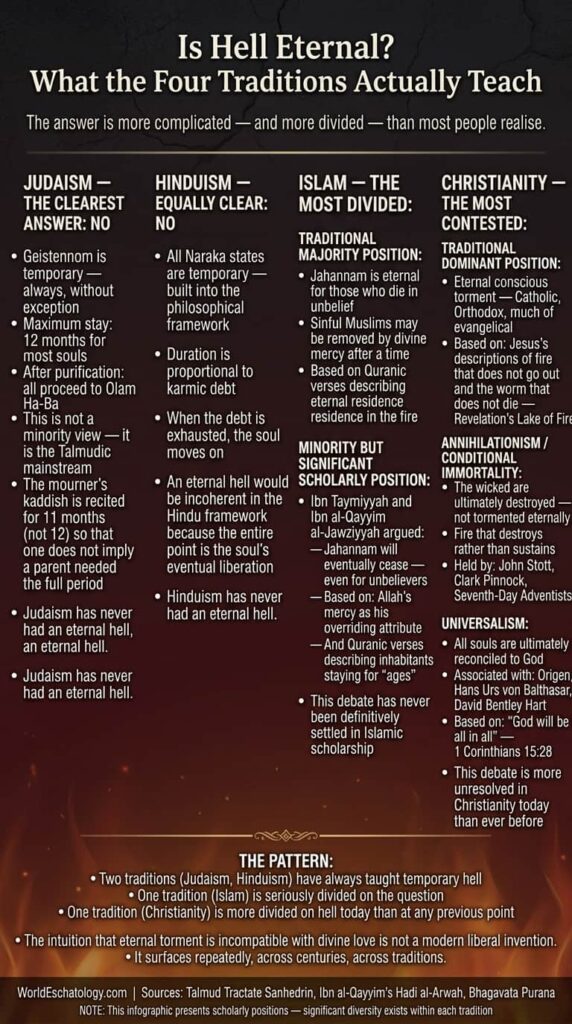
Judaism’s answer is the clearest and most uniform of the four: no. Gehinnom is temporary.
The maximum stay is twelve months, and this twelve-month limit is not a fringe position but the mainstream consensus of rabbinic literature. Judaism does not really have an eternal hell in the sense that Islam and Christianity have traditionally taught it.
The soul’s time in Gehinnom is a purification, not a sentence.
Hinduism’s answer is equally clear and equally uniform: no. The Naraka states are always temporary. No soul is in Naraka forever.
The duration of suffering is proportional to the karmic debt that generated it, and when that debt is exhausted, the soul moves on.
Hinduism has never had an eternal hell, and the concept would be philosophically incoherent within its framework, because the entire point of the system is the soul’s eventual liberation.
Islam’s answer is more divided. The traditional majority position holds that Jahannam is eternal for those who die in a state of unbelief, while sinful Muslims may be removed from it after a period of purification by divine mercy.
But the minority position, associated with major scholars including Ibn Taymiyyah and Ibn al-Qayyim al-Jawziyyah, argues from the Quran that even Jahannam will eventually cease, citing verses that describe the inhabitants of the fire remaining there for ages and the implications of Allah’s mercy as the overriding divine attribute.
This debate has never been definitively settled in Islamic jurisprudence.
Christianity is the most divided of the four. The traditional dominant position across Catholic, Orthodox, and much of Protestant Christianity has been eternal conscious torment.
But annihilationism has gained significant ground in contemporary evangelical scholarship, and universalism has been advocated by some of the twentieth and twenty-first centuries’ most sophisticated theologians.
The debate within Christianity about hell is arguably more intense and more unresolved today than at any previous point in the tradition’s history.
The convergence of Judaism and Hinduism on temporary hell, and the serious internal debates within Islam and Christianity about the same question, is one of the most significant patterns in this entire comparison.
It suggests that the intuition that eternal conscious torment is incompatible with a God of genuine love is not a modern liberal invention but a perennial religious intuition that surfaces repeatedly across traditions.
Who can reach heaven according to each religion?
The single deepest structural difference between the Abrahamic afterlife and the Hindu afterlife is the question of whether a human being lives once or many times.
This is not a minor disagreement about details. It is a fundamental difference in how human existence is understood.
All three Abrahamic traditions affirm the resurrection of the body as the ultimate human destiny.
Islam, Christianity, and Judaism all teach that the physical body will be raised from the dead at the end of history and that the soul will be reunited with the body for the final judgment and the eternal state.
The specific nature of the resurrection body is described differently in each tradition, but the basic conviction that individual human identity, including physical embodiment, is permanently significant is shared.
Hinduism teaches the rebirth of the soul in successive physical bodies, with the quality and character of each body determined by the karma accumulated in previous lives.
The individual soul, the Atman, is the continuous thread that passes through many physical expressions.
Each physical body is like a garment worn for a lifetime and then discarded, while the soul continues on to its next embodiment.
These two frameworks have radically different implications for how human life is understood.
In the Abrahamic framework, each human life is unique and irreplaceable: this specific individual, in this specific body, living this specific life, has a permanent significance that cannot be dissolved into any cycle.
Your choices, your relationships, your suffering and your joy, are all ultimately and permanently yours.
In the Hindu framework, the individual life has meaning within the larger arc of the soul’s journey across many lives, and the apparent losses and gains of a single lifetime are understood within a context of cosmic learning that spans far more than one incarnation.
Some scholars and mystics within the Christian tradition, most notably Origen of Alexandria, have been drawn toward ideas of pre-existence of souls and multiple lives.
The Cathar movement in medieval Christianity held views of reincarnation and was declared heretical.
Within contemporary Western spirituality, the influence of Hindu and Buddhist ideas has led many people in Christian and Jewish cultural contexts to hold hybrid views combining resurrection and reincarnation.
Within Judaism, the Kabbalistic concept of gilgul neshamot introduces a form of soul transmigration that has structural similarities to Hindu reincarnation.
Souls may return in new bodies to complete unfinished spiritual work or to make amends for wrongs done in previous lives.
This is not the mainstream position of Orthodox Judaism, but it is a significant stream within the Jewish mystical tradition.
The biggest similarities and differences between these afterlife beliefs.
After all the differences, and the differences are real and significant, there are convergences between these four traditions on afterlife questions that are too striking to pass over.
All four traditions agree that this life is not all there is. Whatever else they disagree about, none of these traditions teaches that death is the final word.
The human person, in all four frameworks, has a dimension that outlasts physical death.
This conviction is so deeply embedded in each tradition that it shapes every other aspect of their teaching about how to live.
All four traditions agree that actions in this life have consequences beyond it.
Whether the mechanism is divine judgment, karma, or some combination, all four frameworks hold that the moral quality of a human life matters permanently.
Good and evil are not symmetrical. The universe has a structure that honours goodness and imposes consequences for harm.
This is a profound convergence across traditions that otherwise disagree about almost everything.
All four traditions agree that the highest afterlife state involves proximity to the divine.
The ultimate human destiny, in all four frameworks, is not simply pleasure or rest but a relationship with the source of all existence.
Jannah’s supreme pleasure is the vision of Allah. Heaven’s ultimate content is being with God. Olam Ha-Ba is described in terms of the divine presence.
Moksha is liberation into or toward the divine reality. The details differ enormously, but the direction is the same.
All four traditions use the afterlife as a motivation for ethical and spiritual seriousness in this life.
None of them presents the afterlife as a theoretical curiosity with no practical implications.
All of them use what they believe about the next life to argue for how people should behave in this one.
The belief that your actions will have permanent consequences beyond your physical death is, in every one of these traditions, a reason to take those actions seriously now.
And perhaps most movingly, all four traditions are responses to the same human experience: the experience of loving someone who died.
The pyramids of Egypt were built for the dead. The Psalms were written by people who had lost everything they loved.
The Quran was revealed to a man who had buried his own children.
The Upanishads were composed by sages who sat with the fact of their own inevitable death and tried to understand what it meant.
The afterlife is not an abstract theological puzzle. It is humanity’s most sustained attempt to refuse the verdict that love ends at the grave.
What these four religions can teach us about death and the human soul?
Doctrine is one thing. What ordinary believers actually believe, sitting in their living rooms and thinking about the people they have lost, is sometimes quite different.
Survey research consistently shows that belief in hell has declined sharply in Western Christianity over the last century, even among people who identify as Christians.
A Pew Research survey found that while the majority of American Christians believe in heaven, a significantly smaller percentage believe in hell, and an even smaller percentage believe that people they know personally could end up there.
The emotional and moral resistance to eternal torment for real human beings, including people one has loved, appears to override doctrinal instruction for a large proportion of ordinary believers.
Within Islam, belief in Jannah and Jahannam remains considerably more doctrinally uniform than in Christianity, in part because Islamic theology has not undergone the same kind of modernist theological revision that has characterised much of Protestant Christianity since the nineteenth century.
The afterlife in Islam is not primarily a subject of internal theological controversy but a confirmed article of faith.
However, there is significant diversity in how literally Muslims interpret the physical descriptions of paradise and hellfire, with many educated Muslims understanding them as pointing toward realities beyond what physical description can contain.
Within contemporary Judaism, the range of afterlife belief is extraordinary.
Surveys consistently find that a significant percentage of American Jews are agnostic or uncertain about any kind of personal afterlife.
Many identify more strongly with the this-worldly, ethical dimension of Jewish teaching than with the eschatological doctrines.
At the same time, traditional Orthodox communities maintain robust commitment to the full range of classical Jewish afterlife belief including resurrection.
Within Hinduism, the framework of karma and reincarnation remains deeply embedded in the religious consciousness of ordinary believers across the subcontinent and in diaspora communities, more so than the specific details of Svarga and Naraka.
The idea that actions have consequences across lifetimes, that the soul continues beyond the death of any particular body, and that ultimate liberation from the cycle is the highest aspiration, is widely shared even among Hindus who engage relatively little with formal religious practice.
Frequently Asked Questions
What do different religions believe about heaven and hell?
Islam describes a detailed paradise called Jannah and a hellfire called Jahannam, both with multiple levels, arrived at after a Day of Judgment.
Christianity teaches heaven as eternal life with God and hell as eternal separation from God, with significant internal debate about hell’s nature.
Judaism teaches Olam Ha-Ba, the World to Come, as the ultimate destination after a temporary purification in Gehinnom.
Hinduism teaches temporary heavenly and hellish states between reincarnations, with Moksha, liberation from the cycle entirely, as the ultimate goal.
Do Muslims believe in heaven and hell?
Yes, very centrally. Belief in the afterlife is one of the Six Articles of Faith in Islam and is considered a fundamental doctrinal commitment.
Jannah (paradise) and Jahannam (hellfire) are described in extensive detail in the Quran and hadith, and the Day of Judgment when all souls are resurrected and their deeds weighed is among the most important events in Islamic eschatology.
What does Judaism say about heaven and hell?
Judaism’s afterlife teachings are more ambiguous and less systematic than Islam or Christianity.
The Hebrew Bible focuses primarily on this-worldly concerns.
Rabbinic Judaism developed the concept of Gehinnom as a temporary purification state lasting up to twelve months for most souls, after which they enter Olam Ha-Ba, the World to Come.
Jewish tradition generally holds that righteous people of all nations have a share in the World to Come.
What is the Hindu version of heaven and hell?
Hinduism describes Svarga, the heavenly realms, as temporary states of reward between incarnations, and Naraka, the hellish realms, as temporary states of consequence based on karma.
Neither is permanent. The ultimate goal is Moksha, liberation from the cycle of birth, death, and rebirth entirely.
Vaikuntha, the abode of Vishnu, is considered an eternal heaven beyond the reach of the cosmic cycle.
Do all religions believe in an afterlife?
All four traditions covered in this article do, though they understand it very differently.
Islam, Christianity, and Judaism teach a single life followed by judgment and a permanent or semi-permanent afterlife state.
Hinduism teaches a cycle of many lives with temporary afterlife states between them, with liberation from the cycle as the ultimate goal.
Is hell eternal in all religions?
No. Judaism teaches that Gehinnom is temporary, lasting a maximum of twelve months for most souls.
Hinduism teaches that all Naraka states are temporary. Islam is divided, with the traditional majority holding that Jahannam is eternal for unbelievers while some major scholars argue it will eventually cease.
Christianity is the most divided, with eternal conscious torment as the traditional teaching alongside significant minority positions of annihilationism and universalism.
What is purgatory and which religions believe in it?
Purgatory is the Catholic teaching of a post-mortem state of purification for souls destined for heaven who still require cleansing. It is not a second chance and is not for those who rejected God. Judaism’s Gehinnom serves a similar purification function. Islam’s Barzakh has elements of both comfort and difficulty depending on the soul’s state. Hinduism’s intermediate states involve karmic consequence that is also a form of purification. Most Protestant traditions reject purgatory.
What is Jannah in Islam?
Jannah is the Arabic word for paradise and refers to the Islamic heaven.
It is described in the Quran and hadith as a garden of extraordinary beauty with rivers of water, milk, wine, and honey; garments of silk and gold; eternal companionship; and the supreme pleasure of seeing Allah.
It has multiple levels, the highest being Al-Firdaus directly beneath the Throne of Allah. Jannah is the ultimate reward for those who lived with faith and righteousness.
What is Gehinnom in Judaism?
Gehinnom is the Jewish concept of a post-mortem purification state, named after the Valley of Hinnom outside Jerusalem.
It is not equivalent to the Christian or Islamic hell. Most souls spend a maximum of twelve months there, during which they are purified from the residue of their earthly sins, after which they enter Olam Ha-Ba, the World to Come.
It is understood as a temporary process rather than a permanent punishment.
What happens after death in Hinduism?
In Hinduism, the soul leaves the physical body and, guided by karma, may pass through various intermediate states.
Those with good karma may enjoy temporary stays in heavenly realms. Those with bad karma may experience temporary hellish states in Naraka.
Eventually, the soul is reborn into a new physical body appropriate to its karmic state. This cycle continues until the soul achieves Moksha, liberation, which ends the necessity of rebirth.
Who goes to heaven according to different religions?
In Islam, those who died with sincere faith in Allah and lived righteously, with mercy available for those who sinned but sought forgiveness.
In Christianity, those who are in a right relationship with God through faith and, in Catholic and Orthodox teaching, also through sacramental participation and moral life.
In Judaism, the righteous of all nations have a share in the World to Come, according to the Talmud.
In Hinduism, those with good karma may experience heavenly states, but the ultimate goal of Moksha, which transcends heaven, is open to all souls who persist in spiritual practice across many lifetimes.
Do non-Christians go to heaven according to Christianity?
This is one of the most debated questions in Christian theology. Traditional exclusivism holds that explicit faith in Christ is required.
Catholic teaching and many Protestant traditions hold to a form of inclusivism, where Christ’s saving work may extend to those who never heard the gospel but responded genuinely to the light they had.
Universalist theologians argue that ultimately all will be saved. The majority Catholic position since the Second Vatican Council has been that sincere followers of other religions may attain salvation through the grace of Christ even without explicit Christian faith.
Conclusion — The Question about Heaven and Hell Across Religions
There is a story in every tradition about a person who stood at a grave and would not let the person they loved simply be gone.
Mary Magdalene standing outside the empty tomb on Easter morning, unable to leave. The Prophet Muhammad sitting with the dying.
The grieving son in the Mahabharata who follows Yama himself to retrieve his father’s soul.
The Jewish mourner reciting the kaddish for eleven months, the prayer of praise to God that says nothing about death at all, just keeps insisting that God is worthy of praise even in the worst of all possible moments.
The afterlife is not, at its core, an academic subject. It is the shape that love takes when it refuses to accept that the person it loves is simply nowhere.
Every theology of heaven and hell, every description of paradise and fire, every doctrine of karma and resurrection, is also an answer to that refusal.
It is the community saying to the grieving person: your love is not wrong. It is not nothing. It is pointing at something real.
What is remarkable, reading through these four traditions carefully, is not the differences.
The differences are real and they matter, theologically, philosophically, and personally.
What is remarkable is that four traditions, developing across thousands of years in geographic and cultural contexts that had almost nothing to do with each other, all arrived at the same deep conviction: this is not all there is.
Love is not annihilated by death. The moral fabric of the universe is real. And the highest human destiny is some form of relationship with the source of all things that nothing can interrupt.
That convergence does not prove that any of them is correct. But it suggests that the question they are all answering is not a mistake.
It is the most important question there is. And these four traditions have spent millennia trying, with everything they had, to answer it honestly.
Whether you find your answers in one of these traditions, in all of them, or in none of them, the effort they represent is worth your respect.
And the question they are answering is worth your most serious attention.
Sources: The Holy Quran | Sahih Bukhari | Sahih Muslim | The Holy Bible (NIV, ESV)
The Talmud (Tractate Rosh Hashanah, Sanhedrin) | The Zohar | Bhagavata Purana | Vishnu Purana | Upanishads
WorldEschatology.com | All scriptural references presented from canonical sources within each tradition
1 thought on “Comparing Heaven and Hell Across Religions”