
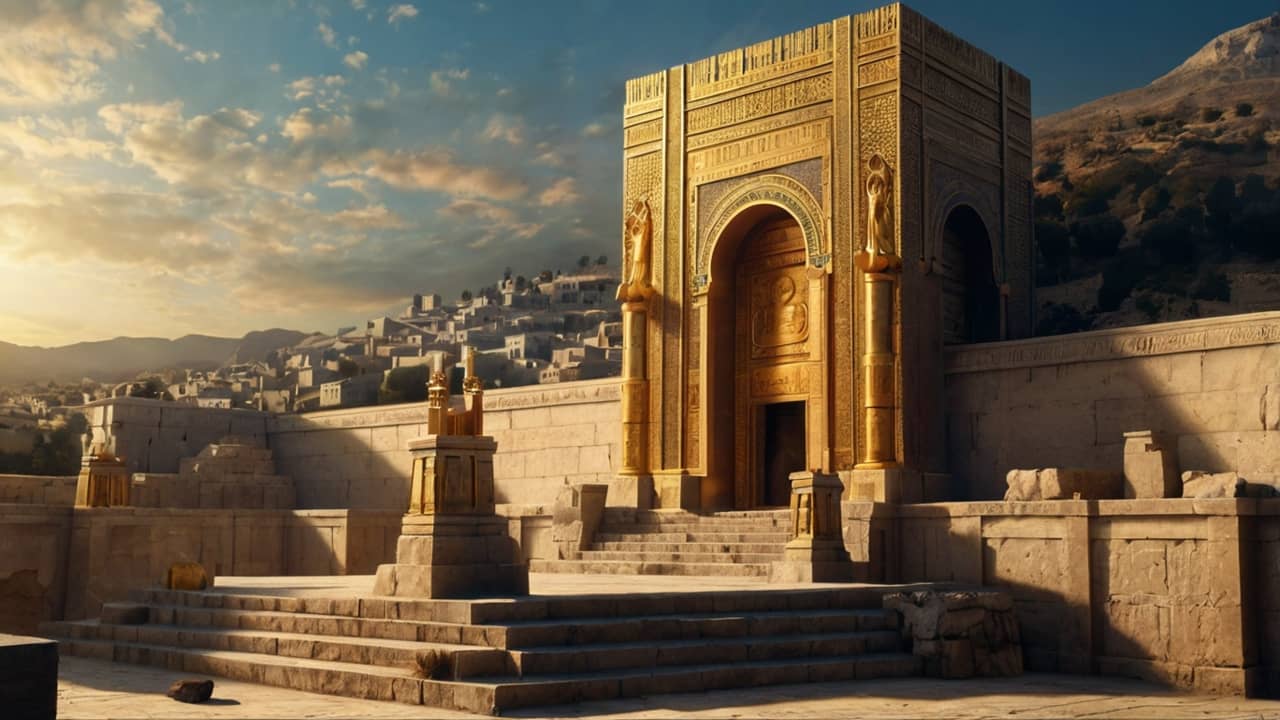
There is a piece of land in the middle of Jerusalem that measures roughly thirty-seven acres.
It is less than a third of a mile long. You could walk across it in about ten minutes.
And yet there is arguably no piece of real estate on the surface of the earth that carries more religious, political, and prophetic weight than this one hill.
To Jews, it is Har HaBayit, the Temple Mount, the holiest site in all of Judaism, the place where Abraham bound Isaac, where Solomon built the most magnificent structure the ancient world had seen, and where the very presence of God once dwelt in a cloud so thick that the priests could not stand to minister.
Two temples stood here. Both were destroyed. And for more than two thousand years, Jewish prayer three times a day has included the words: may the Holy Temple be rebuilt speedily and in our day.
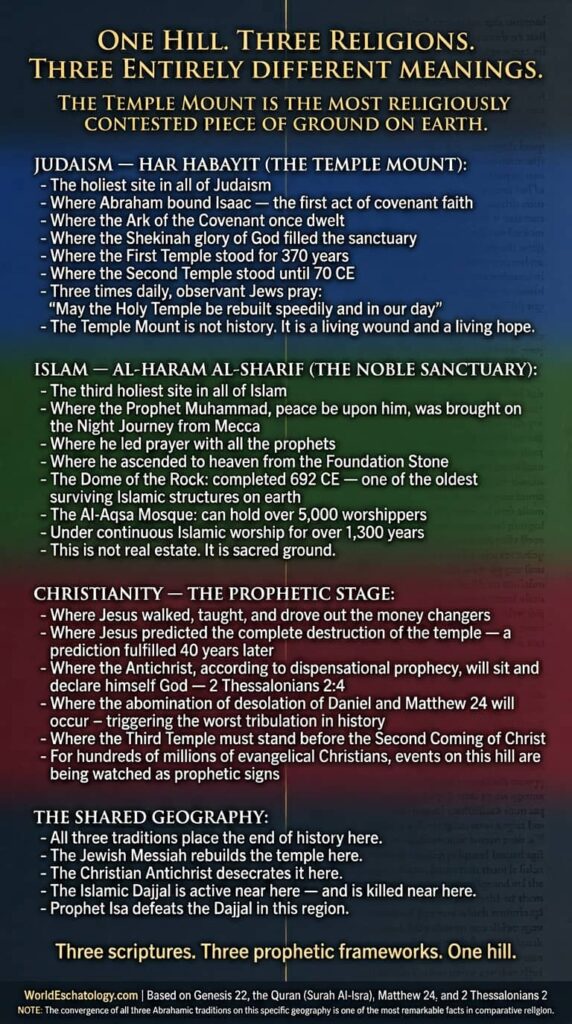
To Muslims, the same hill is Al-Haram Al-Sharif, the Noble Sanctuary, the third holiest site in all of Islam.
The Prophet Muhammad, peace be upon him, was carried here from Mecca on the Night Journey and ascended to heaven from this very rock.
The Dome of the Rock and the Al-Aqsa Mosque have stood here for over thirteen centuries. For the world’s 1.8 billion Muslims, this is not a real estate dispute. It is sacred ground.
To Christians, particularly those who read their Bibles through the lens of biblical prophecy, this hill is the location where a Third Temple must be built before the return of Jesus Christ, where the Antichrist will one day sit and declare himself God, and where the final chapters of human history will be written.
Three religions. One hill. And underneath all of it, a set of questions so volatile that a single visit by a single Israeli politician in the year 2000 was enough to ignite an armed uprising that lasted five years and killed thousands of people.
This article goes through all of it. The history of the two temples, the prophecies that speak of a third, the extraordinary and largely unreported preparations already happening on the ground in Israel, the debates within Judaism, Christianity, and Islam, the geopolitical impossibilities, and the question that sits at the centre of everything: will it be built?
Understanding the Temple Mount — What It Is and Why It Matters
Before any discussion of prophecy or politics, you need a clear picture of the physical site itself, because most people who have opinions about the Temple Mount have never stood on it and do not have an accurate sense of what it actually is.
The Temple Mount is a large elevated stone platform in the Old City of Jerusalem.
It was originally a natural hill called Mount Moriah, the same mountain where Abraham, according to the Book of Genesis, was commanded by God to sacrifice his son Isaac.
Over centuries, the hill was built up and expanded, most dramatically by King Herod the Great in the first century BCE, until it became the enormous rectangular platform that exists today, measuring roughly 490 metres from north to south and 280 metres from east to west.
On top of this platform today stand two structures that are among the most recognisable in the world.
The Dome of the Rock, with its golden dome gleaming over Jerusalem’s skyline, was completed in 692 CE and is one of the oldest surviving Islamic structures anywhere on earth.
It stands over the Foundation Stone, a large exposed rock believed in Jewish tradition to be the place where the world was created, where Abraham brought Isaac, and where the Ark of the Covenant once sat in the Holy of Holies.
The Al-Aqsa Mosque, the larger prayer hall to the south of the Dome, was built in the early eighth century and can accommodate over five thousand worshippers at a time.
At the base of the western retaining wall of the platform is the Western Wall, known in Hebrew as the Kotel.
This is what most people picture when they imagine Jews praying at the Temple Mount.
The Western Wall is not part of the temple itself. It is part of the retaining wall that Herod built to hold up the expanded platform.
It is the only significant remnant of the ancient temple complex still standing, and it has been the most sacred accessible site in Judaism since the destruction of the temple in 70 CE.
Above the Western Wall, on the platform itself, is where the two Islamic sanctuaries stand.
And it is the tension between what stood there before and what stands there now that is at the heart of everything that follows.
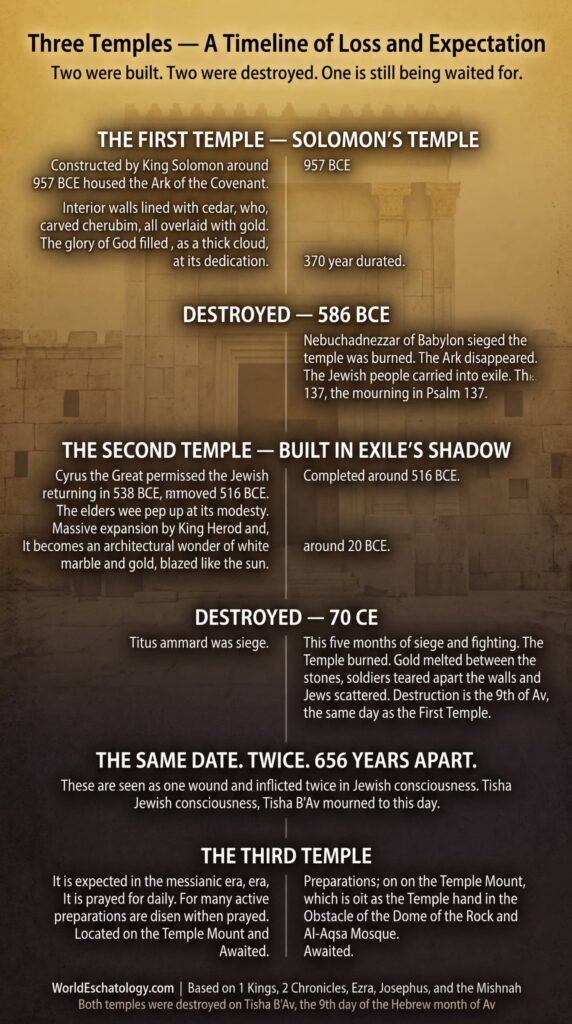
The First Temple — Solomon’s Glory and Babylon’s Fire
To understand why the Third Temple matters so much, you have to start at the beginning. And the beginning is Solomon.
Around 957 BCE, King Solomon, the son of David, completed what his father had dreamed of building: a permanent house for the God of Israel.
David had wanted to build it himself but was told by the prophet Nathan that because he was a man of war, the task would fall to his son, a man of peace.
Solomon spent seven years on the construction, employing tens of thousands of workers and materials sourced from as far away as Lebanon, whose famous cedars provided the timber.
The descriptions in 1 Kings and 2 Chronicles are extraordinary. The interior walls were lined with cedar and carved with cherubim, palm trees, and open flowers, all overlaid with gold.
The inner sanctuary, the Holy of Holies, was a perfect cube of twenty cubits, housing the Ark of the Covenant beneath the outstretched wings of two massive cherubim carved from olive wood and covered in gold.
At the dedication, a cloud so thick and heavy filled the temple that the priests could not stand to do their work. The text says the glory of the Lord filled the house.
For nearly four hundred years, the First Temple stood as the centre of Israelite religious life.
Pilgrims came three times a year for the major festivals. Sacrifices were offered daily.
The high priest entered the Holy of Holies once a year on Yom Kippur to stand before the Ark.
Then, in 586 BCE, the army of Nebuchadnezzar of Babylon besieged Jerusalem, broke through its walls, and burned the temple to the ground.
The Ark of the Covenant disappeared, never to be found again. The Jewish people were carried into exile in Babylon, and the sound of their mourning became the poetry of Psalm 137: by the rivers of Babylon we sat and wept when we remembered Zion.
The destruction of the First Temple is mourned in Judaism to this day on the fast of Tisha B’Av, the ninth day of the Hebrew month of Av.
It is a wound that has never fully healed, and it is the wound from which the longing for a Third Temple ultimately grows.
The Second Temple — Herod’s Wonder and Rome’s Destruction
The exile did not last forever. In 538 BCE, Cyrus the Great of Persia issued a decree allowing the Jewish exiles to return to their land and rebuild their temple.
The return was partial and difficult, and the rebuilding was slow.
The new temple, completed around 516 BCE, was a modest structure that made the elders who had seen Solomon’s temple weep when they looked at it. It was the same site but a shadow of the original.
Then came Herod the Great.
Herod was not a man who did things modestly. When he decided to renovate and expand the Second Temple complex, beginning around 20 BCE, he undertook one of the greatest construction projects of the ancient world.
He doubled the size of the Temple Mount platform itself, building massive retaining walls whose lower courses of Herodian stonework are still visible today.
The temple building itself was enlarged and faced with white marble and gold that, according to the Jewish historian Josephus, blazed in the morning sun so brilliantly that visitors could barely look at it directly.
This is the temple that Jesus walked through. He attended the festivals here. He taught in its courts.
He overturned the tables of the money changers in its outer precincts. And he sat on the Mount of Olives looking at it and made a prediction that must have seemed like madness to his disciples.
Matthew 24:2
“Do you see all these things? Truly I tell you, not one stone here will be left on another; every one will be thrown down.”
Forty years later, in 70 CE, the Roman general Titus besieged Jerusalem in response to a Jewish revolt.
The siege was brutal, lasting five months, and reducing the city to starvation. When the Romans finally broke through, they burned the temple.
The gold of the interior melted and ran down between the stones, and according to the Roman account, soldiers tore apart the very stones to get at it. The destruction was total.
And here is the detail that stops people cold when they hear it for the first time: the Romans destroyed the Second Temple on the same calendar date that the Babylonians had destroyed the First Temple.
The ninth of Av, Tisha B’Av, is now the date that encompasses both catastrophes. In Jewish consciousness, these two destructions are not separate tragedies.
They are one wound, inflicted twice, on the same day, by different empires, separated by 656 years.
The survivors scattered across the Roman world. Jerusalem was eventually rebuilt as a Roman city.
A temple to Jupiter was built on the Temple Mount. The Jews were barred from entering the city on pain of death.
And the longing for restoration settled into the Jewish soul as something that would wait, however long it had to, for the right moment.
The Prophecy Foundation — What Scripture Says About a Future Temple
Now we come to the heart of the matter. Is there actually a scriptural basis for a Third Temple, or is it a modern invention dressed up in ancient language?
The answer requires looking carefully at several different texts across both the Hebrew Bible and the New Testament.
Ezekiel’s Vision: Chapters 40 to 48
The most extensive and detailed prophetic vision of a future temple in the entire Bible comes from the prophet Ezekiel, who received it while in exile in Babylon in 573 BCE.
Over nine chapters, Ezekiel is taken in a vision to Israel and shown a magnificent temple with precise measurements, specific architectural features, and a surrounding landscape transformed from what it had ever been.
The critical point is this: Ezekiel’s vision cannot be the Second Temple.
The Second Temple was built after Ezekiel wrote, and it does not match what he described. The dimensions are different. The orientation is different.
The physical features are different. And the surrounding geography, including a miraculous river flowing from the temple eastward into the Dead Sea and making its waters fresh, has never happened.
So what is Ezekiel describing? There are two main interpretive camps. The first argues that Ezekiel’s temple is the Third Temple, to be built in the period leading up to or during the messianic era.
The second argues that it is a Millennial Temple, to be built after the Messiah’s arrival and the transformation of the land of Israel.
Both Jewish and Christian scholars are divided on this question, and we will look at it more closely in a dedicated section.
Daniel’s Seventy Weeks and the Temple
Daniel 9:27
“He will confirm a covenant with many for one week. In the middle of the week he will put an end to sacrifice and offering. And at the temple he will set up an abomination that causes desolation.”
This verse from Daniel is the foundation for the belief that a temple with functioning sacrifices will exist during the tribulation period.
The logic is straightforward: you cannot put an end to sacrifices that are not happening.
If this verse describes a future event, as most dispensational interpreters and many Jewish scholars believe, then a functioning temple must be in place before the midpoint of the seven-year period Daniel describes.
The same verse is referenced by Jesus in Matthew 24 when he warns his disciples about the abomination of desolation.
He told them that when they see this thing happening, those in Judea should flee to the mountains immediately.
Jesus was speaking of it as a future event even from his own day in the first century, which is one of the reasons dispensationalists argue it cannot refer solely to the Roman destruction of 70 CE.
Isaiah and the House of Prayer for All Nations
Isaiah 56:7
“These I will bring to my holy mountain and give them joy in my house of prayer. Their burnt offerings and sacrifices will be accepted on my altar; for my house will be called a house of prayer for all nations.”
Jesus quoted this verse when he drove out the money changers from the temple courts.
It is one of the passages that suggests the temple’s ultimate purpose extends beyond Israel alone to include all peoples.
Many Third Temple advocates see this as pointing toward a future temple with a universal spiritual dimension, different in character from the national institutions of the first two temples.
Malachi’s Promise
The prophet Malachi, the last of the Hebrew prophets, wrote about a time when the offerings of Judah and Jerusalem would again be pleasing to God as in former years, as in ancient times.
Jewish interpreters have traditionally read this as a reference to the restoration of temple worship in the messianic era.
What Jewish Tradition Actually Says — The Debate Within Judaism
Here is something that gets lost in most popular discussions of the Third Temple: Jewish opinion on this subject is not monolithic.
In fact, the differences between Jewish denominations and streams of thought on the temple question are substantial, and understanding them is essential for anyone who wants to engage with this topic honestly.
Orthodox Judaism: The Temple as Messianic Necessity
Within Orthodox Judaism, the rebuilding of the temple is not a fringe aspiration or a symbolic longing.
It is a core element of messianic expectation embedded in daily prayer and legal literature.
Three times a day, observant Jews recite the Amidah prayer, which includes the petition: may it be Your will that the Temple be rebuilt speedily in our days, and grant us our portion in Your Torah.
Maimonides, the twelfth-century rabbi and philosopher who is perhaps the greatest legal authority in all of Jewish history, listed the rebuilding of the temple and the restoration of the Davidic kingdom among the signs by which the Messiah would be identified.
In his Mishneh Torah, he outlined in precise detail exactly how the temple would be built and how the sacrificial service would be conducted. He was not writing poetry. He was writing law.
At the same time, mainstream Orthodox opinion has historically held that the temple should not and cannot be built until the Messiah comes.
It is God’s project, inaugurated by God’s anointed, not a human engineering initiative.
This is an important distinction, because it separates the spiritual longing from the activist agenda of groups like the Temple Institute.
Maimonides’ Philosophical Tension
Maimonides wrote something in his philosophical work The Guide for the Perplexed that has made rabbis argue for eight centuries.
He suggested that God deliberately moved Israel from animal sacrifice toward prayer as a higher and more spiritual form of worship, using the sacrificial system as a concession to the primitive religious consciousness of the ancient world rather than as an eternal ideal.
And yet in his legal code, he detailed exactly how those same sacrifices would resume in the Third Temple.
How do you reconcile these two positions? Maimonides scholars have wrestled with this question for generations.
Some say the legal code reflects obligation regardless of philosophical preference.
Others say the messianic era sacrifices will be of a different, transformed character.
Still others say Maimonides simply changed his mind between the two works.
The debate has never been resolved, which tells you something about how honestly the tradition grapples with its own complexity.
Conservative Judaism: Belief Without Animal Sacrifice
Conservative Judaism maintains the traditional belief in a Messiah and a rebuilt temple but draws a firm line at the restoration of animal sacrifice.
The Conservative movement holds that the historical development of Jewish law permits, even requires, adapting practices to changed circumstances and moral sensibilities.
Animal sacrifice in the modern world is considered incompatible with contemporary ethical consciousness, and the Conservative movement does not pray for its restoration.
Reform Judaism: The Symbolic Interpretation
Reform Judaism has largely reinterpreted the temple hope in symbolic terms.
The classical Reform movement of the nineteenth century explicitly rejected the idea of returning to Zion, rebuilding the temple, or restoring sacrificial worship.
Modern Reform Judaism maintains a connection to Israel and Jerusalem but continues to read the temple texts as metaphors for spiritual ideals rather than blueprints for a physical building.
The Temple Mount Today — Access, Control, and Constant Tension
Whatever the prophetic future of the Temple Mount may be, its present reality is a study in carefully managed tension that has, on multiple occasions, exploded into violence.
When Israel captured East Jerusalem in the Six-Day War of 1967, Israeli paratroopers reached the Western Wall and the Temple Mount for the first time in nineteen years.
The moment was electric. Rabbi Shlomo Goren, the chief chaplain of the Israeli army, stood at the Wall blowing a shofar, declaring that the Israeli army had returned to the holiest of holy places and would never leave.
Then Israeli Defense Minister Moshe Dayan made a decision that still shapes everything happening on the Temple Mount today.
He handed administrative control of the site back to the Jordanian Islamic Waqf, the religious trust that had managed the mosques there since the Jordanian period.
Israel would control security and access at the outer gates, but the Waqf would run the compound itself.
This arrangement, known as the status quo, has created a situation that satisfies almost nobody.
Jews are permitted to visit the Temple Mount only during restricted hours on weekdays, may not pray openly on the site, and are monitored by Waqf officials during their visits.
Muslims have open access for worship and daily prayers. The Waqf has authority over the Islamic structures and the platform between them.
The Flashpoints
The status quo has been tested repeatedly, sometimes catastrophically.
In September 2000, Ariel Sharon, then leader of the Israeli opposition, visited the Temple Mount with a large security escort to assert Israeli sovereignty over the compound.
The visit, however carefully staged, set off the Second Intifada, a Palestinian uprising that lasted until 2005 and killed over four thousand people on both sides.
A single visit to a piece of ground triggered five years of war.
In more recent years, visits to the Temple Mount by Israeli National Security Minister Itamar Ben-Gvir have drawn sharp international condemnation.
Ben-Gvir, a far-right politician who has openly advocated for Jewish prayer rights on the mount, has visited the site repeatedly under armed escort, each time producing protests from Jordan, the Palestinian Authority, Egypt, and multiple Arab governments.
The visits are legal under Israeli law. They are treated by the Muslim world as provocations of the highest order.
Every year on Tisha B’Av, the fast day commemorating both temple destructions, the largest numbers of Jews ascend the Temple Mount for the year.
The day reliably produces tension, confrontations at the gates, and international diplomatic statements.
It has become an annual test of how much pressure the status quo can absorb.
The Waqf’s Own Controversies
The Islamic Waqf has not been a neutral or uncontroversial administrator of the site either.
Construction work undertaken by the Waqf in the late 1990s and early 2000s, particularly the creation of an underground mosque in the southeastern corner of the platform in a space known as Solomon’s Stables, was carried out without archaeological oversight and involved the removal of enormous quantities of soil and debris from the mount using heavy machinery.
Israeli archaeologists and members of the public were horrified, as the removed material contained thousands of years of archaeological evidence that was simply dumped in the Kidron Valley.
Volunteers eventually sifted much of this material in what became the Temple Mount Sifting Project, recovering thousands of significant artefacts.
The episode deepened mutual suspicion on all sides and hardened positions that were already rigid.
The Temple Institute — Real Preparations for a Real Building
Most people who encounter the Third Temple subject for the first time assume it is entirely a matter of prophecy and theology, a spiritual aspiration rather than a practical plan. They are wrong.
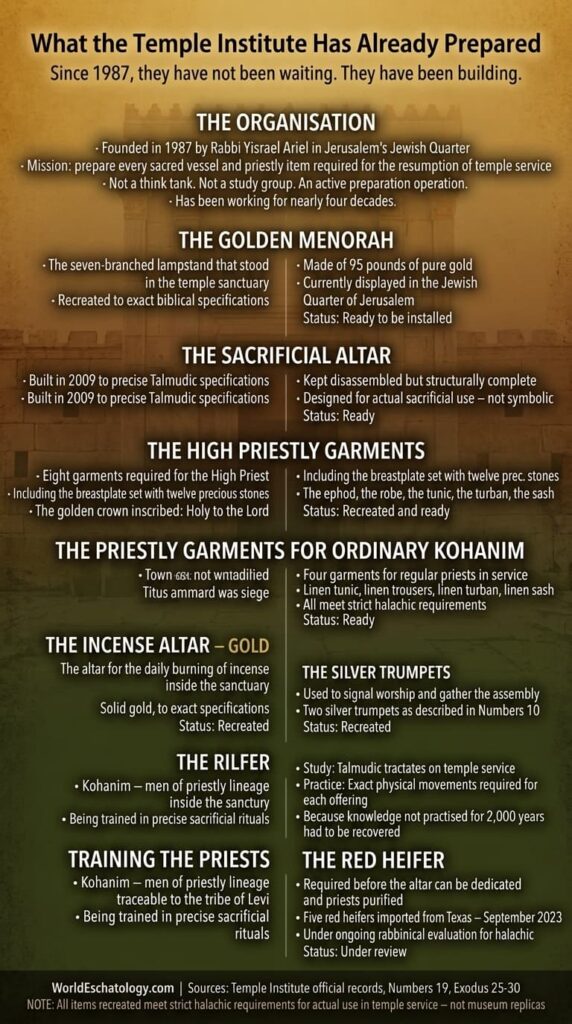
In Jerusalem’s Jewish Quarter in the Old City, there is an organisation called the Temple Institute, founded in 1987 by Rabbi Yisrael Ariel.
Its stated mission is to prepare for the construction of the Third Temple by recreating every sacred vessel and priestly garment required for temple service, training personnel in the rituals that would need to be performed, and educating the public about the temple’s centrality to Jewish life.
It is not a think tank or a study group. It is an active preparation organisation, and it has been working steadily for nearly four decades.
The Sacred Vessels
The Temple Institute has spent years and millions of dollars recreating the sacred vessels described in the Torah.
These include the golden menorah, the seven-branched lampstand that stood in the sanctuary, recreated to exact biblical specifications and made of 95 pounds of pure gold.
It is displayed in the Jewish Quarter of Jerusalem and, according to the Temple Institute, is ready to be installed the moment construction begins.
Other recreated items include the solid gold incense altar, the laver for priestly purification, the silver trumpets used to signal worship, the priestly garments for ordinary priests and the high priest, including the breastplate set with twelve precious stones and the golden crown inscribed with the words Holy to the Lord, and the sacrificial altar itself, built in 2009 and kept disassembled but ready.
Each item was recreated through meticulous study of Talmudic descriptions and ancient depictions, and each meets the strict halachic requirements for use in actual temple service.
Training the Priests
You cannot simply open a temple if no one knows how to run it.
The temple service described in the Torah and elaborated in the Talmud involves extraordinarily precise rituals: the exact manner of slaughter, the precise way to sprinkle blood on the altar, the specific order of daily offerings, the handling of incense, the maintenance of the lampstand, the requirements for priestly purity.
None of this knowledge has been practiced for two thousand years.
The Temple Institute and related organisations have established programmes to train Kohanim, Jewish men of priestly lineage traceable through patrilineal descent from the tribe of Levi, in these ancient rituals.
They study the relevant Talmudic tractates, practice the precise physical movements required, and learn the laws of ritual purity that govern priestly service. They are preparing for something they believe will happen.
The Red Heifer — A Sign That Went Global
In September 2023, five red heifers arrived at Ben Gurion Airport in Tel Aviv, flown from a ranch in Texas.
The story was reported by major news organisations around the world, not because red cows are normally newsworthy, but because of what these particular animals might represent.
Numbers 19 describes a ritual that must be performed before a new temple can be dedicated and before priests can be purified for service.
A completely red, unblemished female cow that has never been yoked must be slaughtered, burned, and its ashes mixed with water.
This water of purification is then sprinkled on anyone who has become ritually unclean through contact with a dead body.
Since virtually all Jews living today would be considered ritually impure by this standard, the ashes of the red heifer are a prerequisite for resuming any form of temple service.
The problem is that a true red heifer is extraordinarily rare. Jewish tradition holds that only nine such animals have existed in all of history, and that the tenth will be prepared by the Messiah.
A red heifer must be entirely red: even two black hairs disqualify it. It must never have been worked or yoked.
And it must meet a range of other precise criteria that Talmudic discussion has elaborated at length.
The five heifers imported from Texas attracted global attention partly because commentators in the Arab world, particularly in light of the Gaza conflict that began in October 2023, interpreted the arrival of red heifers as a sign of imminent Israeli plans to harm Al-Aqsa and begin Third Temple construction.
Hamas explicitly cited the red heifers in some of its communications in the period before and after the October 7 attacks.
The Temple Institute has been more measured. As of the most recent publicly available information, the heifers had not yet been certified as meeting all halachic requirements, and the rabbis overseeing the process noted that the exact timeline for any potential use remained uncertain.
But the fact that the story broke through into mainstream global news, and that it became a flashpoint in an active military conflict, tells you something about the temperature of this subject.
The Two Great Obstacles — Location and Political Reality
Even setting aside every theological question, the rebuilding of the Third Temple faces two obstacles so enormous that most analysts, religious and secular alike, consider them nearly insurmountable in any near-term timeframe.
Understanding these obstacles is essential to having an honest conversation about whether the temple will be built and under what circumstances.
Obstacle One: Nobody Knows Exactly Where to Build It
The Holy of Holies, the innermost sanctuary of the temple, must be built on the precise spot where the previous Holy of Holies stood.
This is not negotiable in halachic terms. The problem is that nobody knows for certain where that spot is.
The traditional assumption, held by most scholars and reflected in the way the Temple Mount is currently laid out in the popular imagination, is that the Holy of Holies stood directly under or very close to the Foundation Stone, the exposed rock at the centre of the Dome of the Rock.
If this is correct, then there is no possibility of building the temple without first dealing with the Dome of the Rock.
But not everyone accepts this assumption. In the 1980s, a Hebrew University archaeologist named Asher Kaufman published research arguing that the temples actually stood to the north of the Dome of the Rock, on a spot that is currently empty pavement on the temple platform.
His argument was based on a small dome on the northern part of the platform that he identified with ancient sources and on his reading of the surviving archaeological evidence.
A different scholar, Tuvia Sagiv, has argued for a southern location, placing the temple closer to where the Al-Aqsa Mosque now stands.
And there have been other proposals as well, each with its own scholarly arguments and weaknesses.
The only way to definitively answer the location question would be through archaeological excavation of the Temple Mount, which is currently prohibited by all parties.
The Waqf does not permit it. Israeli law does not authorise it. And nobody with the authority to change this is likely to do so in the foreseeable future.
So the debate continues in books and academic papers while the ground itself keeps its secrets.
Obstacle Two: The Political and Religious Reality
Even if the location question were resolved tomorrow, the political reality of the Temple Mount makes construction of any Jewish structure there effectively impossible under current conditions.
The site is administered by the Jordanian Islamic Waqf under a status quo that has been in place since 1967.
Jordan’s Hashemite monarchy has served as the custodian of the Islamic holy sites in Jerusalem for decades, a role that gives Jordan both religious prestige and a stake in the city’s stability that it protects fiercely.
Any move toward Jewish construction on the platform would immediately threaten the Jordanian peace treaty with Israel, one of the two peace treaties Israel has with Arab states.
Beyond Jordan, the Organisation of Islamic Cooperation, representing 57 Muslim-majority states, would treat any construction on the Temple Mount as an attack on Islam itself.
The geopolitical consequences would be severe and immediate.
Within Israel itself, most Orthodox halachic authorities have historically maintained that Jews are forbidden to ascend the Temple Mount at all in its current state, because of the impossibility of achieving the required ritual purity without the red heifer ashes, and because of the risk of accidentally walking on the site of the Holy of Holies in an impure state.
This prohibition, while increasingly contested by right-wing religious nationalist groups, remains the official position of the Chief Rabbinate of Israel.
And then there is international law. East Jerusalem, including the Old City and the Temple Mount, is designated as occupied territory under UN Security Council Resolution 242 and subsequent resolutions.
The international community does not recognise Israeli sovereignty over this part of the city.
Building a Jewish temple on the Temple Mount would put Israel in direct violation of international law in a way that would make its current legal situation look simple by comparison.
Three Possible Locations — Could the Temple Be Built Alongside the Mosques?
This is the question that surprises most people, because the popular assumption is binary: either the Dome of the Rock is removed or the temple cannot be built.
But the scholarly discussion is more nuanced than this, and it matters enormously for understanding the range of scenarios that different people envision.
The Traditional Location: Under the Dome of the Rock
The majority scholarly position, and the one assumed in most popular discussions, is that the Holy of Holies of both previous temples stood directly on or very close to the Foundation Stone beneath the Dome of the Rock.
This conclusion is based on the general topography of the mount, the position of the Eastern Gate, various ancient textual references, and what can be inferred from the Mishnah’s description of the temple’s layout.
If this is correct, and most scholars believe it probably is, then there is no scenario in which the Third Temple is built on the traditional site without a fundamental change in the status of the Dome of the Rock.
What that change would look like, how it would come about, and what its consequences would be, is something that different prophetic traditions answer very differently.
The Northern Location: Asher Kaufman’s Theory
Asher Kaufman’s research, published in the 1980s and elaborated since, places the Holy of Holies approximately 100 metres north of the Dome of the Rock, on a spot where a small shrine called the Dome of the Tablets or Dome of the Spirits currently stands.
This spot is essentially open pavement on the northern section of the mount.
If Kaufman is right, the Third Temple could theoretically be built in this northern position without touching either the Dome of the Rock or the Al-Aqsa Mosque, which stands to the south. From a purely physical standpoint, the structures could coexist on the platform.
The obvious counterargument is that no Muslim government or religious authority would accept Jewish construction anywhere on the Noble Sanctuary, regardless of where exactly on the platform it was positioned.
The Islamic claim to the site is not contingent on the precise location of the previous temples.
The northern location theory does not solve the political problem, even if it potentially addresses the halachic one.
The Southern Location: Tuvia Sagiv’s Hypothesis
Tuvia Sagiv has argued, based on a different reading of ancient sources and topographical analysis, that the temple stood further south than the traditional position, closer to where the Al-Aqsa Mosque now stands.
This theory has attracted less scholarly support than Kaufman’s northern theory but is mentioned in the literature and worth knowing about for completeness.
The practical implications of the southern theory are similar to those of the traditional theory: no construction without dealing with the existing Islamic structures.
What the New Testament Says: Jesus, Paul, and the Abomination of Desolation
Christians reading this article will want to know what the New Testament actually says about the Third Temple, because the popular prophecy culture around this subject can sometimes make it hard to distinguish what the Bible says from what prophecy commentators have added.
The honest answer is that the New Testament never uses the phrase Third Temple.
But several passages are understood by many interpreters to imply a functioning temple in the end-times period.
Jesus in Matthew 24
When Jesus warned his disciples about the abomination of desolation spoken of by the prophet Daniel, he was referencing Daniel 9:27’s description of sacrifice being stopped in a temple.
If his warning was intended to apply to a future period beyond 70 CE, as dispensationalists and many others argue, then a temple with active sacrifices must be in place for his words to make literal sense.
The phrase let the reader understand that Jesus inserted into his warning has been interpreted as a signal that he expected his readers to work out the implications for themselves.
And the implication, for those who read Daniel 9 as a future prophecy, is a temple.
Paul’s Description in 2 Thessalonians
2 Thessalonians 2:3-4
“Don’t let anyone deceive you in any way, for that day will not come until the rebellion occurs and the man of lawlessness is revealed, the man doomed to destruction. He will oppose and will exalt himself over everything that is called God or is worshipped, so that he sets himself up in God’s temple, proclaiming himself to be God.”
This is Paul’s clearest statement connecting the end-times figure he calls the man of lawlessness to a physical temple.
He sits in the temple of God. He declares himself to be God. For this to happen literally, a temple must exist.
The alternative interpretation, held by amillennialists and covenant theologians, is that the temple of God in Paul’s letters refers to the church, which Paul elsewhere calls God’s temple.
On this reading, the man of lawlessness desecrates the church rather than a physical building.
This is a serious exegetical position, not a dismissal of Paul’s words, and it has the advantage of not requiring the reconstruction of a physical building.
But the dispensational reading, which takes it as a literal future temple, has been the dominant interpretation in popular evangelical Christianity since the nineteenth century and has shaped the entire landscape of how millions of Christians think about Israel, Jerusalem, and the end times.
John in Revelation 11
In Revelation 11, John is told to measure the temple of God and the altar and count the worshippers there, but to leave out the outer court because it has been given to the Gentiles, who will trample the holy city for forty-two months.
This passage, set in a context of future tribulation events, is taken by dispensationalists as another confirmation that a functioning temple will exist during the end-times period.
The fact that the outer court is given to the Gentiles while the inner temple continues to function has even led some interpreters to suggest a scenario where the Islamic structures on the outer platform coexist temporarily with a Jewish temple on the inner precinct.
The Christian Prophetic Framework — How Dispensationalism Connects the Dots
For readers who have grown up in evangelical Christian environments, or who have read books like The Late Great Planet Earth or the Left Behind series, the Third Temple occupies a very specific and central place in the end-times sequence.
It is worth laying out this framework clearly, because it explains why so many American Christians follow Israeli politics related to the Temple Mount with intense interest.
In the dispensational framework, here is how the sequence runs.
A powerful world leader, the Antichrist, rises to prominence and brokers a seven-year peace deal or covenant between Israel and its neighbours.
This deal allows Israel to rebuild the temple and resume sacrificial worship.
For the first three and a half years of the seven, things appear peaceful. The temple functions. Sacrifices are offered.
Then, at the midpoint of the seven years, the Antichrist enters the temple, stops the sacrifices, and declares himself God.
This is the abomination of desolation that Jesus warned about. It triggers the worst period of tribulation the world has ever seen, lasting the remaining three and a half years.
At the end of this period, Jesus Christ returns, destroys the Antichrist, and the temple survives into the millennial reign.
This sequence, while it feels coherent and has the benefit of weaving together texts from Daniel, Matthew, 2 Thessalonians, and Revelation into a single narrative, is a relatively modern construction.
It was systematised primarily by John Nelson Darby in the nineteenth century and embedded in American evangelical culture through the Scofield Reference Bible, first published in 1909. It is not the universal Christian position on these texts.
Covenant theologians, including most Reformed, Anglican, Lutheran, and Catholic thinkers, read the same texts differently.
They see the church as the fulfilment of the temple theme in scripture, the new covenant community as the dwelling place of God’s Spirit, and the temple prophecies as already substantially fulfilled either in Christ himself or in the church.
On this reading, the demand for a literal rebuilt temple misunderstands what the New Testament is actually saying about where God now dwells.
Both readings have serious scholars behind them. Both have been tested in centuries of theological debate.
And both have profound implications for how their holders relate to current events in Jerusalem.
The Islamic Perspective — Al-Aqsa and What It Means
No article on the Third Temple can be honest or complete without giving serious space to the Islamic perspective, because for the world’s 1.8 billion Muslims, the Temple Mount issue is not primarily a matter of academic interest in ancient prophecy.
It is a question about a living, active, sacred site that has been under continuous Islamic worship for over thirteen centuries.
Why Al-Aqsa Matters to Muslims
The Al-Aqsa Mosque is the third holiest site in Islam, after the Masjid al-Haram in Mecca and the Masjid an-Nabawi in Medina.
Its significance rests on the Night Journey, the Isra and Mi’raj, described in the Quran in Surah Al-Isra and elaborated in the hadith.
The Prophet Muhammad, peace be upon him, was transported from Mecca to Jerusalem in a single night, led prayer with all the prophets at the Al-Aqsa site, and then ascended to the heavens from the rock now sheltered by the Dome of the Rock.
This is not incidental history for Muslims. It is one of the most sacred events in the Prophet’s life, and it makes the Noble Sanctuary a site of profound personal religious significance, not just institutional importance.
When Muslims speak of defending Al-Aqsa, they are not speaking of defending real estate. They are speaking of defending a place they consider among the most sacred on earth.
The History of Islamic Concern About the Site
Muslim anxieties about Israeli intentions toward the Temple Mount are not paranoia. They are grounded in documented history.
In the early 1980s, a network of Israeli extremists known as the Jewish Underground formulated and partially executed plans to blow up the Dome of the Rock.
They believed that harming the mosque would trigger a spiritual awakening among Israeli Jews and clear the way for the Third Temple.
Several members of this group went as far as preparing explosives and conducting reconnaissance on the structure before being arrested by Israeli security services in 1984. They were convicted of terrorism offences.
This was not a marginal group of isolated madmen. Several of those convicted had connections to mainstream Israeli political and religious life.
The episode demonstrated, in concrete terms, that the threat to the Islamic holy sites from certain segments of Israeli religious nationalism was real, not imagined.
Since then, a steady stream of incidents has maintained and reinforced Muslim concern.
The arson attack on Al-Aqsa in 1969 by an Australian Christian tourist. The 1990 Temple Mount massacre.
The Sharon visit in 2000. The repeated visits of Ben-Gvir in recent years. The arrival of the red heifers in 2023.
Viewed from within the Muslim world, these are not isolated incidents. They form a pattern.
The Islamic Eschatological Dimension
It is worth noting that Islamic eschatology also places Jerusalem at the centre of end-times events.
The Dajjal, the Islamic equivalent of the Antichrist, is expected to be stopped at the gates of both Mecca and Medina but will operate in the region of Jerusalem.
Prophet Isa, Jesus, peace be upon him, will kill the Dajjal near Jerusalem.
The events surrounding the Temple Mount are therefore not foreign to Islamic prophetic consciousness.
The convergence of all three Abrahamic traditions on this specific geography is one of the most remarkable facts in the study of comparative eschatology.
Ezekiel’s Temple — Third Temple or Millennial Temple?
We touched on Ezekiel’s vision earlier but it deserves its own section, because it is the most detailed and most debated prophetic text in the entire Third Temple discussion, and how you interpret it shapes almost everything else.
Ezekiel 40 to 48 describes a vision the prophet received in 573 BCE, fourteen years after the destruction of the First Temple.
He is transported to a high mountain in Israel and shown a magnificent city with a temple at its centre.
An angelic figure measures every part of the structure in exquisite detail: the outer and inner courts, the gates, the sanctuary, the altar, the priests’ chambers, the kitchens for the sacrificial meals, and the surrounding city.
What makes this vision unusual is not just its detail but its scope.
Ezekiel 47 describes a river flowing eastward from under the threshold of the temple, growing deeper as it goes, eventually reaching the Dead Sea and turning its waters fresh, teeming with fish of every kind.
Ezekiel 48 describes a redistribution of the entire land of Israel among the twelve tribes in a perfectly organised arrangement that has never existed in any historical period.
And the city at the centre of this renewed land bears a new name: the Lord Is There.
None of this happened after the return from Babylon. The Second Temple was built on a much more modest scale.
The river never flowed. The land was never redistributed. The Dead Sea remains the saltiest body of water on earth.
So whatever Ezekiel was describing, it was not the Second Temple.
The Pre-Millennial Reading
Many dispensational and traditional Jewish interpreters read Ezekiel’s temple as the Third Temple, to be built in the messianic era either before or during the tribulation period.
On this reading, Ezekiel’s vision is a prophetic blueprint that the Third Temple will fulfil.
The extraordinary geographical features, the river and the land redistribution, will be accomplished by divine intervention in the messianic age.
This reading has the advantage of taking Ezekiel’s physical descriptions at face value and not requiring an allegorical interpretation.
But it faces the significant problem that the Third Temple in the dispensational tribulation framework is desecrated by the Antichrist, which seems inconsistent with the sacred perfection Ezekiel describes.
The Millennial Reading
The alternative, held by many scholars across both Jewish and Christian traditions, is that Ezekiel’s temple is a Millennial Temple, to be built after the return of the Messiah and the transformation of the created order.
The miraculous river, the renewed land, the city called the Lord Is There all suggest a world so different from the current one that only the messianic era, when God himself rules directly on earth, could produce it.
On this reading, Ezekiel is not describing the Third Temple at all. He is describing a Fourth Temple, or more precisely, the Final Temple, the temple of the age to come.
The Third Temple that precedes it in the tribulation framework is a separate and lesser structure.
Rashi, the greatest biblical commentator in Jewish history, noted that many features of Ezekiel’s temple cannot be reconciled with existing Jewish law, which led him to the unusual conclusion that Elijah would have to come and resolve the contradictions before the temple could be built.
This acknowledgment that Ezekiel’s vision poses interpretive problems that current human understanding cannot resolve is itself revealing.
Will Animal Sacrifices Resume? The Hardest Question
If the Third Temple is built and temple service resumes, animal sacrifice comes with it.
This is the aspect of the Third Temple discussion that many people, religious and secular, find hardest to engage with honestly, and it deserves to be addressed directly.
The sacrificial system described in Leviticus and Numbers is extensive.
It includes daily burnt offerings of lambs morning and evening, additional offerings on the Sabbath and new moon, and major sacrificial festivals at Passover, Shavuot, and Sukkot.
The Day of Atonement involves the sacrifice of bulls and goats. The red heifer ritual involves the sacrifice of a cow.
A functioning temple means a functioning abattoir, with blood and fire and the specific smells that go with them, in the heart of Jerusalem.
Orthodox Judaism, in its mainstream form, expects exactly this.
The Talmud discusses the sacrificial service in meticulous detail because the rabbis intended it to be studied and practiced again.
The Temple Institute’s recreated altar is a real altar intended for real sacrifices. This is not metaphor.
Rabbi Abraham Isaac Kook, the first Chief Rabbi of pre-state Israel and one of the most influential Orthodox thinkers of the twentieth century, suggested that in the messianic era, only grain offerings would be brought, not animal sacrifices.
This view has been picked up by some progressive Orthodox thinkers who find the prospect of resumed animal sacrifice ethically troubling.
But it remains a minority position within Orthodoxy.
For Christians in the dispensational tradition, the question is slightly different.
If the temple is rebuilt during the tribulation period and sacrifices are offered, what is their theological status?
Paul’s letter to the Hebrews argues at length that the sacrificial system has been fulfilled and superseded by the death of Christ, the perfect sacrifice.
If so, are the tribulation sacrifices a step backward, a return to a system that has been transcended?
Dispensationalists typically answer that these sacrifices will be memorial in nature, looking back to the cross the way Communion does, offered by Jews who have not yet recognised Jesus as the Messiah. But critics of this view find it theologically strained.
The honest answer is that this is one of the most uncomfortable and unresolved questions in the entire Third Temple discussion, and the discomfort is itself theologically significant.
The Sanhedrin Revival — The Religious Court That Would Have to Authorise It
One aspect of the Third Temple preparations that gets far less attention than the red heifers or the golden menorah is the question of religious authority.
Who has the legal standing to authorise the construction and operation of the temple under Jewish law?
The answer, according to halachic tradition, is the Sanhedrin.
The Great Sanhedrin was the supreme religious court of ancient Israel, a body of seventy-one ordained judges who had the authority to rule on the most significant legal and religious questions facing the Jewish people.
It was dissolved, or went into a kind of dormancy, around the fifth century CE as Roman persecution made it impossible to maintain.
Its absence has been one of the legal obstacles to resuming the temple service, because certain decisions required by the construction and operation of the temple can only be made by a body with proper Sanhedrin authority.
In 2004, a group of Orthodox rabbis in Tiberias, drawing on a legal mechanism described by Maimonides, attempted to reconstitute the Sanhedrin.
The group has met periodically since then, issued rulings on various matters, and declared its intention to serve as the legal body that will oversee temple-related decisions when the time comes.
The mainstream Orthodox establishment, including the Chief Rabbinate of Israel, has not recognised this body as a legitimate Sanhedrin.
The objections are technical and substantial: the proper chain of ordination required for Sanhedrin membership was broken centuries ago and cannot simply be reconstituted by rabbinical agreement. Maimonides’ mechanism for reconstitution is itself disputed.
But the existence of this group, and its seriousness of purpose, is another data point in the picture of a movement that is not simply praying for the temple but actively trying to build the institutional infrastructure that would be required for it.
The Geopolitical Dimension — What Would Actually Need to Happen?
Let us be concrete about the geopolitical reality, because the prophetic discussions can sometimes float free of the hard political ground on which any actual construction would have to happen.
For the Third Temple to be built on the Temple Mount, at minimum the following would need to occur.
The Islamic Waqf’s administrative authority over the site would need to end or be fundamentally altered.
Jordan’s peace treaty with Israel, which is partly grounded in the Hashemite custodianship of the holy sites, would need to either be renegotiated or broken.
The international consensus that East Jerusalem is occupied territory would need to either change or be overwhelmed by events.
The Palestinian Authority, whose entire raison d’etre includes the claim to Jerusalem as the capital of a future Palestinian state, would need to either accept the temple’s construction or be rendered irrelevant.
And the 57 member states of the Organisation of Islamic Cooperation would need to either accept the outcome or be too weakened or divided to prevent it.
None of these things is impossible in principle. History has produced more surprising reversals.
But the combination of all of them happening in the sequence required is, under current conditions, far beyond what conventional political analysis would predict.
This is precisely why the prophetic traditions that expect the Third Temple all locate its construction in a context of extraordinary, unprecedented global upheaval.
Whether that upheaval is the tribulation of dispensational Christianity, the birth pangs of the messianic era in Jewish tradition, or the period of the Dajjal in Islamic eschatology, all of them agree that normal political conditions will not produce the temple.
Something outside the normal will have to happen first.
How This Connects to the Wider Eschatological Picture
The Third Temple does not stand alone in the prophetic landscape.
It is a hinge point that connects to nearly every other major eschatological theme across all three Abrahamic religions, and understanding those connections is what gives this subject its extraordinary depth.
In the dispensational Christian framework, the temple is the stage on which the Antichrist performs his most audacious act of self-deification, triggering the worst period of tribulation and eventually the Second Coming of Christ.
Without the temple, the sequence does not work. The temple is not a side note. It is the turning point of the entire end-times drama.
In Jewish eschatology, the temple is both the goal of the messianic age and its most visible sign.
When the Messiah comes, he will rebuild the temple.
Or perhaps more precisely, the rebuilding of the temple will be part of what the Messiah does, establishing the presence of God among his people in a way that surpasses anything that came before.
The messianic age without the temple is, in classical Jewish thinking, not really the messianic age.
In Islamic eschatology, the Temple Mount sits at the heart of the end-times geography.
Jerusalem is where the Dajjal will be active, where he will be stopped by the forces of the Mahdi, and where Prophet Isa will ultimately kill him.
The protection of Al-Aqsa is therefore not just a present political concern but an eschatological one.
What happens to the Noble Sanctuary is, in the Islamic prophetic framework, connected to what happens in the final chapters of history.
Three traditions. Three narratives. One hill. The fact that all three Abrahamic religions, working from different scriptures and different theological frameworks developed over many centuries, have converged on this specific location as the centre of the world’s final drama is one of the most remarkable facts in the study of religion.
Whatever you believe about the truth of these traditions, the convergence itself is worth sitting with.
Frequently Asked Questions
What is the Third Temple in the Bible?
The Third Temple refers to a future Jewish temple expected to be built on the Temple Mount in Jerusalem, on the site where Solomon’s First Temple and Herod’s Second Temple once stood.
The Bible never uses the phrase Third Temple explicitly, but several prophetic passages, including Ezekiel 40 to 48, Daniel 9:27, Matthew 24:15, and 2 Thessalonians 2:3-4, are interpreted by many scholars as implying a functioning temple in the end-times period.
Where will the Third Temple be built?
If built, the Third Temple would need to be on the Temple Mount in Jerusalem.
The precise location on the mount is debated: the traditional position places the Holy of Holies beneath or near the Dome of the Rock, while the northern theory associated with archaeologist Asher Kaufman places it in an open area north of the Dome that would not require removing the Islamic structure.
Will the Dome of the Rock be destroyed to build the Third Temple?
This is not certain and depends entirely on which location theory proves correct.
If the traditional location is right, the Dome of the Rock stands on or very near the spot required for the Holy of Holies.
The northern location theory suggests the temple could potentially be built without touching the Dome of the Rock.
No mainstream religious authority advocates for destroying the Dome of the Rock, and doing so would have catastrophic international consequences.
What is the Temple Institute in Jerusalem?
The Temple Institute is an organisation founded in 1987 in Jerusalem’s Jewish Quarter with the stated mission of preparing for the construction of the Third Temple.
It has recreated the sacred vessels and priestly garments required for temple service, including the golden menorah, the incense altar, the sacrificial altar, and the high priestly garments, and has established programmes to train Kohanim in the ancient priestly rituals.
What are red heifers and why do they matter for the Third Temple?
Numbers 19 requires the sacrifice and burning of a completely red, unblemished, never-yoked female cow to produce ashes for purification rituals that would be necessary before temple service could resume.
Such animals are extremely rare. Five red heifers were imported from Texas to Israel in September 2023 by the Temple Institute, generating global media attention and significant tension in the context of the Gaza conflict.
Do Jews believe the Third Temple will be built?
Orthodox Judaism includes the rebuilding of the temple as a core messianic expectation, embedded in daily prayer.
However, mainstream Orthodox opinion holds that it will be built by or in the time of the Messiah, not through human political initiative alone.
Conservative Judaism believes in a future temple but does not advocate restoring animal sacrifice. Reform Judaism interprets the temple hope largely in symbolic terms.
What does Islam say about the Third Temple?
Islam considers the Al-Aqsa Mosque and the Dome of the Rock among the most sacred sites in the religion and strongly opposes any construction that would threaten them.
Most Muslim scholars and governments view the Temple Movement as an affront to Islam and a threat to the Noble Sanctuary.
Islamic eschatology places Jerusalem at the centre of end-times events but understands those events through its own prophetic framework involving the Mahdi and the return of Prophet Isa.
What is the abomination of desolation?
The abomination of desolation is a phrase taken from Daniel 9:27, referenced by Jesus in Matthew 24:15, describing a future desecration of the temple by a figure who puts a stop to sacrifices and sets up something abominable in the holy place.
Dispensationalists identify this with the Antichrist entering the Third Temple at the midpoint of the tribulation and declaring himself God, as described by Paul in 2 Thessalonians 2:4.
What is the status quo on the Temple Mount?
The status quo is the arrangement established in 1967 when Israel’s Defense Minister Moshe Dayan handed administrative control of the Temple Mount to the Jordanian Islamic Waqf after Israel captured the site in the Six-Day War.
Under this arrangement, the Waqf administers the compound and the Islamic holy sites, while Israel controls security and access at the outer gates.
Non-Muslims including Jews can visit during restricted hours on weekdays but cannot pray openly on the mount.
Will animal sacrifices resume in the Third Temple?
Orthodox Jewish tradition and the Temple Institute expect the full sacrificial service, including animal sacrifices, to resume in the Third Temple.
Some Orthodox thinkers, including followers of Rabbi Abraham Isaac Kook’s view, suggest only grain offerings will be brought in the messianic era.
Conservative Judaism does not support restoring animal sacrifice.
Christians in the dispensational tradition interpret the tribulation-era sacrifices as memorial in nature, while covenant theologians generally do not expect a literal sacrificial system to be restored at all.
What is the Sanhedrin and why does it matter for the temple?
The Sanhedrin was the supreme religious court of ancient Israel, a body of seventy-one ordained judges required for major legal and religious decisions including those relating to the temple.
It fell into dormancy around the fifth century CE. A group of Orthodox rabbis attempted to reconstitute it in 2004, and this body continues to meet and issue rulings, intending to serve as the legal authority overseeing temple-related decisions when the time comes.
The mainstream Orthodox establishment has not recognised this reconstituted body as a legitimate Sanhedrin.
Conclusion — The Most Watched Hill in the World
There is a certain kind of conversation that starts with religion, moves through history, passes through archaeology and law, and ends up in geopolitics, all without ever leaving the same subject. The Third Temple is that kind of conversation.
What is remarkable is not just the complexity of it but the intensity. This is not a subject that people engage with at arm’s length.
Jews who pray three times a day for the temple’s rebuilding are expressing something as personal as grief and as hopeful as a promise.
Muslims who protest outside consulates when an Israeli minister visits the mount are not performing politics.
They are defending something they consider sacred in the most literal sense.
Christians who follow the Temple Institute’s activities with a sense of prophetic anticipation are reading these events through a framework that connects them to the return of Jesus Christ and the end of the world as they know it.
And underneath all of this human intensity is a set of ancient texts that have outlasted every empire that has ever controlled this hill.
The Babylonians controlled it. The Persians. The Greeks. The Romans. The Byzantines. The Umayyads. The Crusaders. The Mamluks. The Ottomans.
The British. And now the Israelis, in an arrangement so fraught and contested that a visit by a politician can start a war.
Whether you believe the Third Temple will be built depends partly on your theology and partly on your assessment of history’s direction.
What is harder to dispute is that the question itself is alive, active, and consequential in a way that few theological questions ever become.
The preparations are real. The obstacles are real. The stakes are real.
The next article in this series looks at the figure who, in both Christian and Jewish prophecy, is connected to the temple’s desecration: the Antichrist and his Islamic counterpart the Dajjal.
If you have read our earlier article on the Dajjal or on the Second Coming of Jesus Christ, the connections will become increasingly clear.
These narratives are not separate. They are chapters of the same story, told by different traditions, all pointing at the same geography and the same moment in time.
Sources: 1 Kings, 2 Chronicles, Ezekiel 40-48, Daniel 9, Matthew 24, 2 Thessalonians 2, Revelation 11
Maimonides: Mishneh Torah, Guide for the Perplexed | Josephus: The Jewish War | Asher Kaufman: The Temple of Jerusalem
WorldEschatology.com | Written with reference to Orthodox, Conservative, Reform, Catholic, and Islamic scholarly sources
1 thought on “The Third Temple | Jewish Prophecy and Modern Expectations”