What Is Hindu Eschatology?
Most people who search for end-times beliefs come with a particular picture in their heads. History is a straight line.
It began at creation. It will end at a final judgment. God will reward the righteous and punish the wicked, and that will be the last word.
Eschatology in Hinduism does not work like this at all.
In the Hindu tradition, time is not a straight line. It is a wheel.
Or more precisely, it is a series of enormous nested wheels within wheels, all turning according to a divine rhythm that has been turning since before the universe we live in was born and will keep turning long after this universe dissolves and a new one emerges from the silence.
The word “eschatology” refers to the study of the last things, the ultimate fate of the world and of souls.
Eschatology in Hinduism is the oldest, most mathematically detailed, and arguably the most philosophically sophisticated end-times framework that any civilization has ever produced.
Its time scales run into the trillions of years. Its account of how the world declines and is renewed has been documented in texts composed thousands of years ago.
And its descriptions of the age we currently live in are so accurate to contemporary experience that readers encountering them for the first time consistently find them unsettling.
The foundation of everything in Hindu eschatology is the concept of the Yugas, the four great ages that together form one complete cosmic cycle.
We are currently living in the fourth and darkest of those ages, called Kali Yuga.
And at the very end of this dark age, a figure called Kalki Avatar will appear on a white horse, sword in hand, to destroy evil and usher in the next golden age.
This guide covers all of it. The cosmic time structure, the character of each age, the detailed signs of Kali Yuga from the ancient scriptures, the coming of Kalki, the Hindu understanding of death and rebirth, and how all of this compares to the end-times beliefs of Christianity, Islam, and Judaism.
Whether you are Hindu, curious about world religions, or a student of comparative eschatology, this is the most complete introduction to eschatology in Hinduism in one place.
Why this tradition is different from everything else
Here is the single most important thing to understand before going any further.
In the Abrahamic religions, Christianity, Judaism, and Islam, the end of history is a one-time event. God created the world at a specific moment.
The world will end at a specific moment. What happens after that is permanent and eternal.
In Hinduism, the end of the world has already happened countless times. It will happen countless times more.
The universe we live in is one of an infinite series of universes, each arising from Brahman (the ultimate divine reality), playing out its full cycle of creation and dissolution, and returning to Brahman like a wave returning to the ocean.
There is no first creation and no final end. There is only the eternal rhythm of creation, preservation, and dissolution.
This does not mean the end of the world does not matter in Hindu thought. The Yuga cycle represents genuine moral and spiritual deterioration that affects billions of souls.
The coming of Kalki is a real and awaited event in the hindu end times prophecy. But the purpose of understanding it is not to prepare for a final judgment.
It is to understand where we are in the cosmic story and what that means for how we should live and practice right now.
The Cosmic Time Structure: Yugas, Kalpas, and the Wheel of Time
Before getting to Kali Yuga and what it means for us today, you need to understand the full structure of Hindu cosmic time.
Without this foundation, the individual concepts make no sense. With it, everything locks into place with remarkable clarity.
The four Yugas: the heartbeat of cosmic time
The four Yugas are the fundamental unit of Hindu eschatological time. The word “Yuga” means “age” or “era.”
Together, the four Yugas form one complete cycle called a Maha Yuga or Chatur Yuga, after which the whole sequence begins again.
Think of them as the four seasons of a cosmic year, except that each season lasts hundreds of thousands of human years.
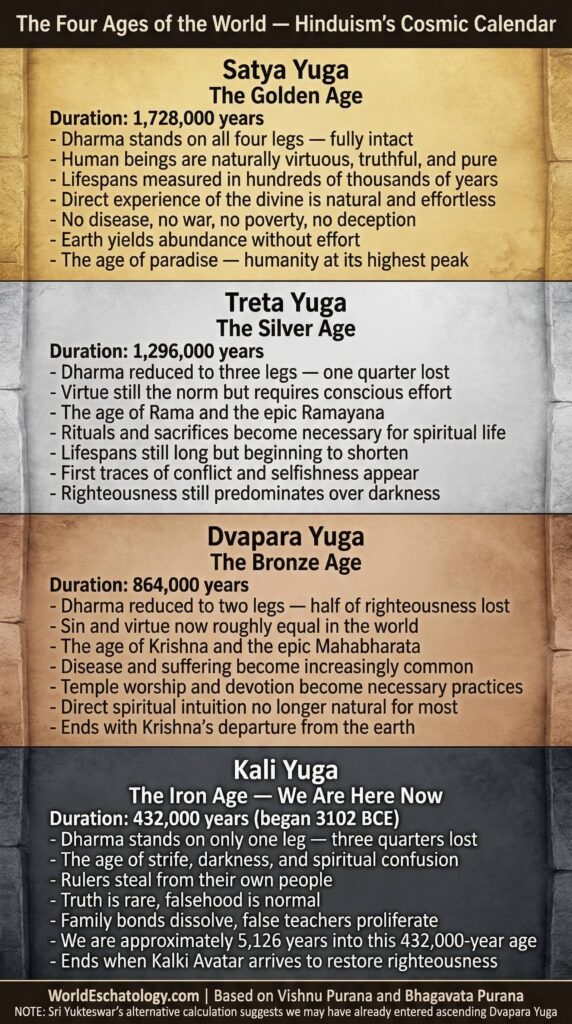
Satya Yuga is the first and greatest age, sometimes called the Golden Age or the Age of Truth. It lasts 1,728,000 years.
In Satya Yuga, dharma, the cosmic principle of righteousness, order, and virtue, stands on all four of its legs and is fully present in the world.
Human beings are naturally virtuous, truthful, compassionate, and pure. Lifespans are extraordinarily long, measured in hundreds of thousands of years.
Spiritual realization is easily achieved. There is no disease, no poverty, no warfare, and no deception.
The divine and human are in intimate, unobstructed relationship. This is the age that most traditions call paradise or the primordial golden age.
Treta Yuga is the second age, sometimes called the Silver Age. It lasts 1,296,000 years. Dharma has lost one of its four legs and now stands on three.
Virtue is still the norm, but it requires conscious effort rather than arising naturally.
This is the age of the great hero-king Rama, whose story is told in the Ramayana.
Sacrifices and rituals become necessary to maintain spiritual connection. Human lifespans shorten, though they are still far longer than today.
The first traces of selfishness and conflict appear, but they are still exceptional rather than normal.
Dvapara Yuga is the third age, the Bronze Age. It lasts 864,000 years. Dharma stands on only two legs. Righteousness and sin are now roughly equal in the world.
This is the age of Lord Krishna, whose life and teachings form the heart of the Mahabharata and the Bhagavad Gita. Disease and suffering become common.
Human beings must work much harder to maintain virtue. Rituals and devotion are necessary spiritual practices because direct spiritual intuition is no longer natural for most people.
At the very end of Dvapara Yuga, Krishna departs the world, and this departure triggers the beginning of the age we live in now.
Kali Yuga is the fourth and darkest age, the Iron Age. It lasts 432,000 years. Dharma stands on only one leg. Sin, confusion, and moral darkness predominate.
This age began approximately 5,125 years ago and will last another 426,875 years. We are at the very beginning of a very long darkness.
The signs and character of Kali Yuga are the subject of an entire section below, and they are the most-searched aspect of Vedic eschatology for good reason.
The Maha Yuga: one complete cycle
One complete cycle of all four Yugas is called a Maha Yuga or Chatur Yuga. Its total length is 4,320,000 years (1,728,000 plus 1,296,000 plus 864,000 plus 432,000).
This is the basic repeating unit of cosmic time in Hindu cosmology.
Notice the ratio: Satya Yuga is four times as long as Kali Yuga. Treta Yuga is three times as long. Dvapara Yuga is twice as long.
The ages shorten as they darken, which fits the human experience that good times feel long and hard times feel compressed into urgency.
After the Kali Yuga ends, the cycle does not stop. A new Satya Yuga begins immediately, though not before Kalki Avatar has cleared away the accumulated darkness of the preceding Kali Yuga.
The golden age always follows the dark age. There is no permanent defeat of goodness in Hindu eschatology.
The Manvantara: seventy-one Maha Yugas
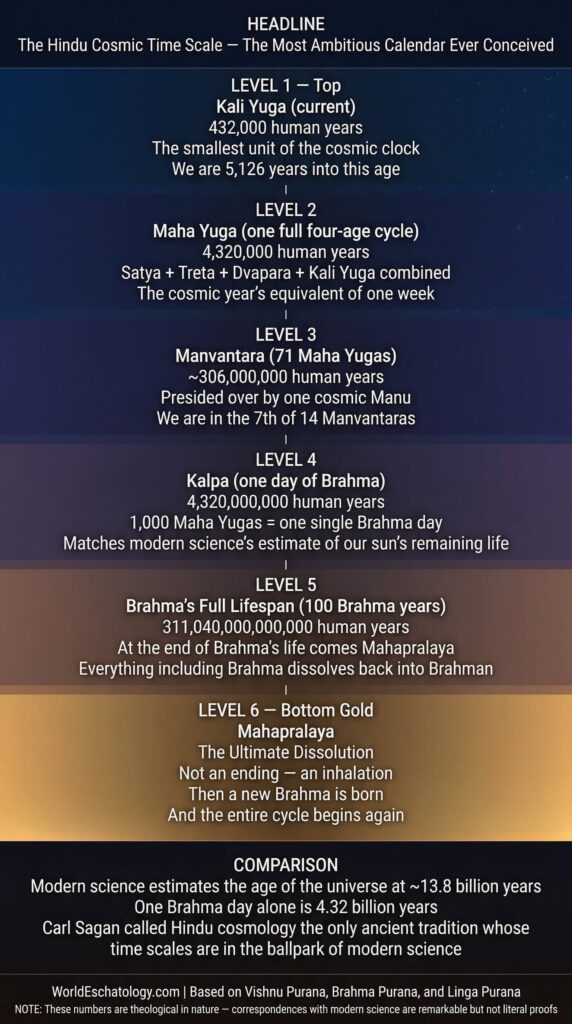
Seventy-one Maha Yugas together form one Manvantara, a period of approximately 306 million years.
Each Manvantara is presided over by a divine being called Manu, who is the progenitor of humanity for that particular era.
The Manu of our current Manvantara is called Vaivasvata Manu, and you may recognize the name: it is the Manu who survived the great flood in a boat guided by Vishnu in the form of a giant fish, a story that has remarkable parallels with Noah’s flood in the Abrahamic traditions.
We are currently in the seventh of the fourteen Manvantaras that make up one Kalpa.
This means that the Manu who is the ancestor of all current humanity is the seventh Manu.
We are also in the 28th Maha Yuga of the current Manvantara, within which we are in the Kali Yuga phase.
The Kalpa: one day in the life of Brahma
One Kalpa consists of 1,000 Maha Yugas, which equals 4.32 billion years. But in the Hindu cosmological framework, this 4.32 billion years is not an age of the universe.
It is one single day in the life of Brahma, the creator god.
At the end of each Kalpa, the universe undergoes a dissolution called Pralaya, during which Brahma rests for one equally long night (another 4.32 billion years).
During this night, the universe is not destroyed but is absorbed back into Brahma in a state of potential, like a seed containing a tree.
At the dawn of the next Kalpa, Brahma wakes and creation begins again.
Brahma lives for 100 such years, each year consisting of 360 such days and nights. This gives Brahma a lifespan of approximately 311 trillion human years.
At the end of Brahma’s life, the ultimate dissolution called Mahapralaya occurs, in which not just the universe but time and space themselves dissolve back into Brahman, the ultimate impersonal divine reality.
Then, after an equally inconceivable interval, a new Brahma is born and the entire cycle begins again from absolute stillness.
Here is the fact that secular and scientifically minded readers consistently find striking: the Kalpa of 4.32 billion years matches almost exactly current scientific estimates of the remaining lifespan of our sun before it expands into a red giant and renders Earth uninhabitable.
Carl Sagan, the American astronomer and science communicator, noted in his television series Cosmos that Hinduism is the only ancient religious tradition whose time scales are in the same ballpark as modern scientific cosmology.
He called it a remarkable coincidence, though Hindu philosophers would say it is no coincidence at all.
The Pralaya and Mahapralaya: dissolution, not destruction
It is important to understand what dissolution means in Hindu end times prophecy, because it is fundamentally different from destruction.
When the Pralaya comes at the end of a Kalpa, the universe does not disappear into nothingness.
It is absorbed back into its source, the way the ocean absorbs a wave. The wave has not been destroyed.
Its water, its energy, and its potential all return to the ocean and will give rise to new waves in the next creation.
The Puranas describe several kinds of Pralaya. Naimittika Pralaya is the occasional dissolution that happens at the end of each Kalpa, when Brahma sleeps.
Prakritika Pralaya is the elemental dissolution that happens at the end of Brahma’s entire lifespan.
Atyantika Pralaya is the individual dissolution that happens when a soul achieves Moksha, liberation from the cycle of rebirth.
And Nitya Pralaya is the constant micro-dissolution happening at every moment as the universe continuously recreates itself.
The Mahapralaya, the ultimate dissolution at the end of Brahma’s lifespan, is the closest thing in Hindu cosmology to a permanent end of everything.
But even this is not truly final. After an interval of absolute stillness, a new Brahma arises from the lotus that grows from Vishnu’s navel, and the whole cosmic drama begins again.
Kali Yuga: The Age We Are Living In Right Now
Of all the topics in Hindu eschatology, Kali Yuga attracts the most attention, the most searches, and the most heated discussion.
And for understandable reasons. The descriptions of Kali Yuga in the ancient scriptures read, to a startling degree, like a description of the contemporary world.
When did Kali Yuga begin, and how long will it last?
According to the most widely accepted Hindu calculation, Kali Yuga began at midnight on February 18, 3102 BCE.
This date corresponds to the departure of Lord Krishna from the earth after the conclusion of the Kurukshetra War described in the Mahabharata.
Krishna’s presence in the world had sustained a certain level of spiritual quality even in the declining Dvapara Yuga.
When he left, that sustaining presence withdrew, and the darkness of Kali Yuga began to assert itself.
The current Kali Yuga will last a total of 432,000 years. As of now, we are approximately 5,126 years into it.
This means we have completed roughly 1.2 percent of this age. The worst of Kali Yuga, the period the scriptures describe with the most intense darkness, is still tens of thousands of years in the future.
This realization is one of the most important and most surprising things a new reader can take from Hindu eschatology.
Most people who come to this topic assume they are near the end of Kali Yuga, that the signs of darkness around them indicate we are approaching the final crisis.
They are not wrong that the signs are real. But they are mistaken about where we are in the timeline. We are near the beginning of this age, not its climax.
The full weight of Kali Yuga has barely begun to settle in Vedic eschatology.
The signs and symptoms of Kali Yuga: from the ancient scriptures
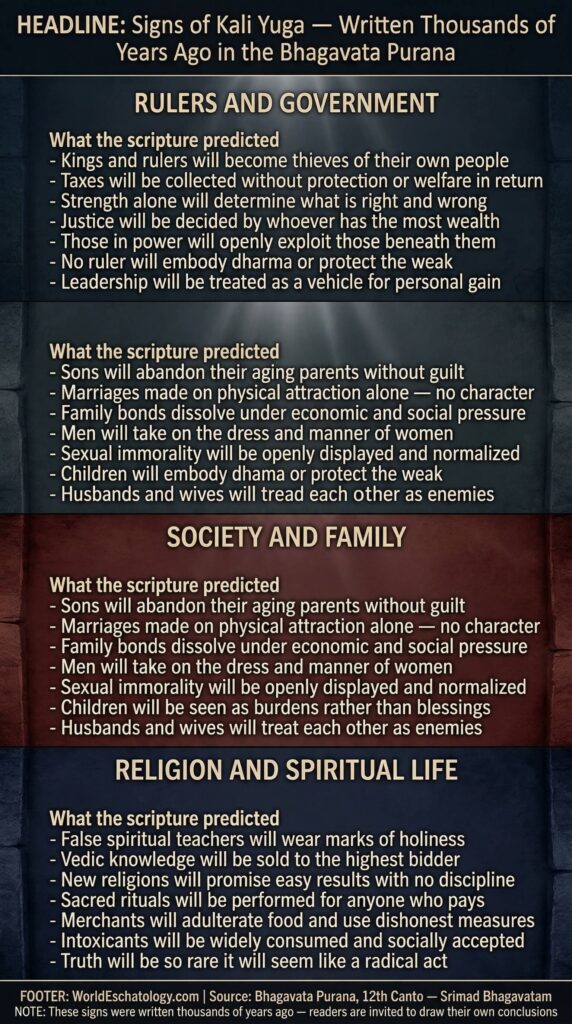
The Bhagavata Purana, also known as the Srimad Bhagavatam, is the primary source for the detailed signs of Kali Yuga.
Its twelfth canto, written thousands of years ago, contains a list of social, moral, and environmental conditions that characterize this age.
Reading this list carefully is one of the most genuinely remarkable experiences in all of comparative religious literature.
The text describes rulers who are thieves. It says that those who have wealth will be considered the most virtuous, and those who are poor will be assumed to be impious, regardless of their actual character.
Physical strength alone will determine what is right and what is wrong, with no reference to justice or dharma.
The rulers of the earth will collect taxes without providing protection or welfare in return.
The text says that men will abandon their own wives and children to work for others and that family bonds will dissolve under economic and social pressure.
Sons will no longer care for their aging parents. Marriages will be made on the basis of sexual attraction alone, without consideration of compatibility, character, or dharma.
A man’s worth will be judged entirely by his wealth and a woman’s worth by her physical appearance.
Water will become scarce and of poor quality. The earth will yield little grain without enormous effort. Famines will increase.
Human height and lifespan will both decrease steadily over the course of the age. Anxiety, fear, and depression will be the normal condition of most human beings.
The text describes a proliferation of false religious teachers who wear the outer marks of spirituality but have no inner realization and exploit their followers for money and power.
It says that people will abandon the genuine spiritual traditions of their ancestors in favor of new religions and cults that promise easy results and require no discipline.
The Vedic knowledge will be sold and commercialized. Brahmins will perform sacred rituals for anyone who pays, regardless of the ritual’s purpose.
Merchants will routinely adulterate their goods and use dishonest weights and measures.
Legal proceedings will be decided by who has the most money rather than who has the strongest case.
The boundaries between men and women in terms of dress, manner, and social role will blur and dissolve.
Sexual immorality will be openly displayed and considered normal. Intoxicants will be widely consumed and their use widely accepted.
Cities will be dominated by people with the morals and sensibilities of animals despite their outward human intelligence.
The countryside will be depopulated as people crowd into cities seeking wealth and entertainment. Natural disasters, both sudden and slow-moving, will increase in frequency and severity.
The Vedic eschatology concludes this list with a summary: in Kali Yuga, human beings will be short-lived, slow of understanding, unlucky, and mostly unfortunate.
They will have short attention spans, eat voraciously, breed prolifically, and show no wisdom.
They will suffer from constant anxiety and be easily manipulated by those who offer them security at the price of their freedom.
Whether you read this list as prophecy, as shrewd social observation, or as a perennial description of what happens when human civilization loses its moral anchoring is a matter of perspective.
What almost every reader agrees on is that the list is uncomfortably recognizable.
Kali: the demon of strife, not the goddess
One of the most persistent confusions among people new to this topic is between Kali Yuga and the goddess Kali.
They are entirely separate, and understanding this distinction matters.
Kali Yuga takes its name from a demon named Kali, spelled slightly differently in Sanskrit from the goddess Kali but frequently confused in transliteration.
This demon Kali is a male being who personifies strife, discord, hypocrisy, and the darkness of this age.
He is not evil in the absolute sense that Satan is evil in Christian theology.
He is more like the embodiment of the tendency toward confusion, conflict, and spiritual blindness that characterizes this particular cosmic period.
The Bhagavata Purana contains a famous story about how Kali asked King Parikshit, who ruled after the Kurukshetra War, where he might be allowed to dwell.
The king permitted him to reside in four places: wherever there is gambling, wherever there is drinking, wherever there is sexual immorality, and wherever there is violence and killing for profit.
Later, Kali also requested gold, because wherever gold resides, all four of the others tend to follow.
The goddess Kali, by contrast, is a powerful and revered deity in the Shakta tradition, representing the fierce, protective, and ultimately liberating aspect of the divine mother.
She destroys ego and illusion. She is worshipped as a goddess of liberation.
The two figures, the demon Kali and the goddess Kali, are as different as their names suggest they might be: one represents darkness, the other destroys it.
The Sri Yukteswar alternative: are we really still in Kali Yuga?
Not all Hindu thinkers accept the traditional calculation that places us 5,000 years into a 432,000-year Kali Yuga.
The most significant dissenting voice is that of Sri Yukteswar Giri, a respected Indian saint who was the teacher of Paramahansa Yogananda, whose Autobiography of a Yogi brought yoga and Hindu philosophy to millions of Western readers in the twentieth century.
In his 1894 book The Holy Science, Sri Yukteswar argued that the traditional Yuga calculation contains an error: the astronomical basis of the Yuga cycle suggests that each Yuga should be measured in multiples of 1,200 divine years (each divine year being 360 human years), giving a Kali Yuga of 1,200 multiplied by 360, or 432,000 years, for the full cycle but only 1,200 years for the actual descending Kali Yuga period.
On this calculation, Kali Yuga ended around 499 CE, the ascending Dvapara Yuga began around 1699 CE, and we are currently in the ascending phase of Dvapara Yuga, moving toward higher and higher levels of awareness.
This alternative framework appeals to those who see the explosion of scientific knowledge, democratic ideals, and global communication in the past few centuries as signs of an ascending age, not a deepening dark one.
It also fits the intuition that things are improving for humanity in certain measurable ways, even if the traditional signs of Kali Yuga are simultaneously very visible.
The debate between the traditional and Sri Yukteswar frameworks is one of the most actively discussed questions in contemporary Hindu philosophy online.
Both sides have serious arguments, and both frameworks have implications for how we understand the world we live in and what we should do about it.
Kalki Avatar: The Warrior Who Will End Kali Yuga
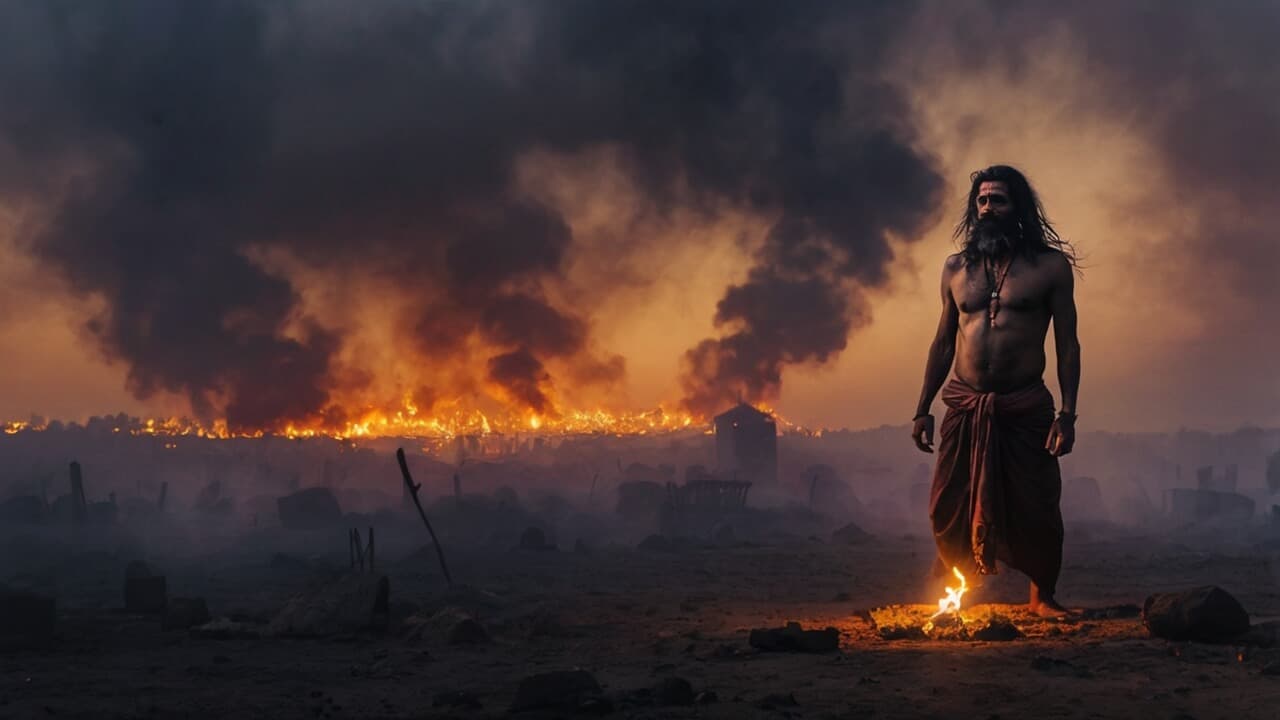
At the very end of Kali Yuga, when the darkness has reached its absolute maximum, when dharma has been all but extinguished from the earth, when the last few people who try to live righteously are scattered and persecuted, Vishnu will descend to earth for the tenth and final time in this Maha Yuga cycle.
He will come as Kalki Avatar, the destroyer of darkness, the restorer of righteousness, and the herald of the new golden age.
Who is Kalki? The tenth avatar of Vishnu
Kalki is the tenth avatar of Vishnu, the preserver god of the Hindu Trinity.
The word Kalki has several possible Sanskrit meanings: eternity, white horse, destroyer of filth and darkness, or the one who destroys ignorance.
All of these meanings point to the same figure and the same function in Vedic eschatology.
Unlike most previous avatars of Vishnu, who came as teachers, heroes, or divine servants working patiently within the world to nudge it back toward dharma, Kalki comes as an apocalyptic warrior.
He is not here to teach. He is not here to persuade or convert. His mission is to sweep the accumulated filth of the age aside by force and make way for a new beginning.
The Bhagavata Purana says that Kalki will roam the earth wielding an eight-petaled lotus of divine authority, riding his magnificent white horse Devadatta, and with his sword blazing like a comet, he will slay by the millions the thieves and pseudo-kings who have laid waste to the earth.
After Kalki’s work is complete, the earth will be purified. A new Satya Yuga will begin automatically.
The cosmic wheel will complete one more turn, and the golden age will return as it always has, as surely as dawn follows the darkest hour of the night.
The Kalki Purana: his birth, life, and mission in detail
The Kalki Purana is a dedicated Puranic text describing Kalki’s life in remarkable detail.
According to this text, Kalki will be born in the village of Shambhala to a Brahmin family of great purity.
His father’s name is Vishnuyasha, meaning one whose glory is Vishnu, and his mother’s name is Sumati, meaning one of good mind.
The name Vishnuyasha also appears in some traditions as Yashvanta.
From his birth, Kalki will display divine qualities. He will receive his education and warrior training from the sage Parashurama, who himself is the sixth avatar of Vishnu and who is immortal, having been born in a previous age and sustained in existence to prepare and train the final avatar.
Parashurama will teach Kalki on Mount Mahendra, passing on the complete knowledge of warfare, scripture, and dharma.
Kalki will receive divine weapons from the gods. Shiva will give him a parrot who can see the past, present, and future.
Indra will give him the white horse Devadatta, who can travel anywhere instantaneously. Agni and Vayu will give him divine weapons of fire and wind.
He will marry Padmavati, a princess who is an incarnation of Lakshmi, Vishnu’s consort. Together they will have four sons.
His kingdom will be established in Shambhala, and from there he will conduct his campaigns against the demonic rulers who have divided the earth among themselves and oppressed its people.
The Kalki Purana describes his military campaigns in considerable detail, including battles across the Indian subcontinent and beyond.
His final great battle will be against two demon kings named Koka and Vikoka, and after their defeat the earth will finally be purified and ready for the kalki ushers in satya yuga to begin.
Shambhala: the connection to Buddhist eschatology
The village of Shambhala, where Kalki is prophesied to be born, is one of the most interesting cross-tradition links in all of comparative eschatology.
In Tibetan Buddhist tradition, Shambhala is a hidden mystical kingdom located somewhere in Central Asia, possibly in the Himalayas or beyond, from which a future king called Rigden Dragpo will emerge at a time of great darkness to defeat evil forces and establish a golden age of Buddhist teaching.
The parallels are striking. Both traditions speak of a hidden sacred place called Shambhala as the origin point of a future savior figure who will arrive at a time of maximum global darkness, defeat evil forces through military means, and usher in a new era of righteousness.
Both figures have divine origins and extraordinary capabilities. Both arrive on what is essentially the same eschatological timetable.
Scholars debate whether the two traditions independently developed the same story or whether one influenced the other in Vedic eschatology.
What is certain is that the Shambhala connection makes a fascinating article in its own right and creates genuine cross-tradition reader interest.
Has Kalki already come? Modern claims and what the texts actually say
Because Kali Yuga is the age of false religious teachers, it should come as no surprise that several figures have claimed to be Kalki Avatar in modern times.
The most widely known is Vijaykumar Naidu of Tamil Nadu, who founded the Kalki movement in the 1980s under the name Kalki Bhagavan and attracted millions of followers with claims of divine revelation and miraculous powers.
The movement, now called Oneness University, continues to operate today.
Various other teachers in New Age and neo-Hindu circles have been identified or have identified themselves as Kalki.
Almost universally, these claims fail against the textual criteria in the Kalki Purana. Kalki is specifically described as not yet born.
He will be born in the village of Shambhala, he will train under Parashurama, he will ride a white horse, and he will end Kali Yuga through military conquest and cosmic transformation.
None of these conditions have been met by any recent claimant according to Vedic eschatology.
The honest answer to whether Kalki has arrived is no, not according to the scriptural criteria, and not according to the timetable that places us only 5,000 years into a 432,000-year age.
His arrival, by traditional reckoning, is still hundreds of thousands of years away.
The ten avatars of Vishnu: understanding the eschatological sequence
To fully understand Kalki’s significance, it helps to understand him as the tenth in a sequence of ten avatars known as the Dashavatara.
Vishnu descends to earth in different forms whenever dharma has declined so severely that the universe needs direct divine intervention to restore it.
Each avatar is perfectly suited to the needs of its particular age and crisis.
Matsya, the fish, saved the primordial scriptures and the first Manu from a great flood.
Kurma, the tortoise, supported the mountain used to churn the cosmic ocean.
Varaha, the boar, rescued the earth from drowning. Narasimha, the man-lion, killed a demon king who could not be killed by man or beast.
Vamana, the dwarf, reclaimed the three worlds from a demon king through a miraculous expansion of his form.
Parashurama cleared the earth of corrupt warriors. Rama restored dharma through his exemplary life of virtue.
Krishna taught the Bhagavad Gita and guided the course of the Mahabharata War.
The Buddha, in many Hindu traditions, is included as the ninth avatar, said to have come to teach compassion and lead away from the excessive ritualism that was corrupting Vedic religion at that time.
Kalki is the tenth, the warrior who comes not to teach but to end.
His role in the Dashavatara is the eschatological culmination: after all the patient preservation work of the previous nine avatars, the final avatar comes to close the account and start fresh.
The sequence as a whole tells the story of how the divine has engaged with creation across vast stretches of time, adapting its intervention to what each age required.
The Trimurti: The Cosmic Roles of Brahma, Vishnu, and Shiva
Hindu eschatology is not driven by a single divine figure acting alone.
It is the coordinated work of the Trimurti, the three-formed divine reality that simultaneously creates, preserves, and dissolves the universe.
Understanding the distinct roles of Brahma, Vishnu, and Shiva is essential to understanding how Hindu end-times theology actually works.
Brahma: the creator at the beginning of each cycle
Brahma is the creator aspect of the divine Trimurti.
At the dawn of each Kalpa, Brahma emerges from the lotus growing from Vishnu’s navel (or in some traditions, from the primordial cosmic egg) and creates the universe: the stars, the planets, the realms of existence, the beings who inhabit them, and the Vedas, the sacred knowledge that will guide those beings toward dharma and liberation.
Brahma is not worshipped as widely as Vishnu or Shiva in contemporary Hinduism, perhaps because his work of creation is considered complete for this Kalpa and ongoing creation is largely in the hands of the cosmos itself.
Vishnu: the preserver who intervenes through avatars
Vishnu is the preserver aspect of the Trimurti, and his role is the most directly eschatological.
Whenever dharma declines to a point where the cosmic balance is threatened, Vishnu descends into the created world as an avatar, a divine incarnation suited to the specific need of that moment.
The Bhagavad Gita contains the most famous statement of this principle, in Krishna’s words: whenever there is a decline of dharma and a rise of adharma, I manifest myself.
For the protection of the good, for the destruction of the wicked, and for the establishment of righteousness, I am born from age to age.
This is the theological engine of Hindu eschatology. The darkness of each age is not a sign of divine abandonment.
It is the occasion for divine descent. Every Kali Yuga ends not with the world simply collapsing under its own weight but with Vishnu’s personal intervention as Kalki, who actively terminates the age and opens the way for the next golden era.
Shiva: the destroyer whose destruction is liberation
Shiva is the destroyer aspect of the Trimurti, and his role is the most often misunderstood by people coming to Hinduism from Abrahamic backgrounds.
Shiva does not destroy because he is evil or malevolent. He destroys because destruction is the necessary precondition of renewal.
Without the dissolution of old forms, new and higher forms cannot emerge.
The most powerful image of Shiva’s cosmic role is Nataraja, Shiva as the Lord of the Dance.
In this form, he dances the universe into existence and will one day dance it out of existence.
His dance is called the Tandava, and its most intense form, the Rudra Tandava, will be the mechanism of the final Mahapralaya.
The circle of fire surrounding Nataraja represents the cycle of creation and dissolution that has no beginning and no end.
The small drum in his upper right hand beats out the rhythm of creation. The flames in his upper left hand represent dissolution.
His lower right hand gestures protection and reassurance to the devotee. His lower left hand points to his raised foot, offering the path of liberation.
His right foot presses down on the demon of ignorance.
The image is one of the great symbols of human civilization precisely because it holds so much truth in a single visual form: creation and destruction are not opposites.
They are the two hands of the same divine dancer. The universe’s end is not a tragedy. It is part of the dance.
Death, Afterlife, Karma, and Liberation: Hindu Eschatology at the Individual Level
So far we have been discussing eschatology at the cosmic and civilizational level: the Yuga cycle, the dissolution of universes, the coming of Kalki.
But Hindu eschatology also has a deeply personal dimension. What happens to the individual soul?
What is the relationship between the soul’s journey and the cosmic cycle? And what is the ultimate goal?
Samsara: the wheel of birth, death, and rebirth
In Hindu tradition, the individual soul does not live once, face a final judgment, and then rest in a permanent heaven or hell.
The soul, called Atman in Sanskrit, is eternal. It has existed before this life and will continue after it.
Between each life, the soul undergoes a process of evaluation and assignment, and then it is reborn into a new body, a new life, a new set of circumstances.
This cycle of birth, death, and rebirth is called Samsara, literally meaning wandering or flowing together.
Samsara is not a neutral process. It is the fundamental predicament of all conscious beings.
Every birth brings suffering. Every life ends in death. Every death leads to another birth.
The soul wanders through countless lifetimes across all the realms of existence: divine realms where pleasure and ease predominate, the human realm which is the most precious because it alone allows the pursuit of liberation, animal realms, and lower realms of suffering.
The goal of Hindu spiritual life is not to live a good life so you can go to heaven. It is to escape Samsara altogether.
To achieve this escape is called Moksha, and it is the supreme purpose of human existence.
Karma: the law that governs the journey
What determines where a soul is reborn after death? Karma.
The word karma means action, but in its deeper usage it refers to the principle that every action, thought, and intention generates a corresponding consequence that the actor must eventually experience.
Good actions generate good karma that leads to better circumstances in future lives.
Harmful actions generate negative karma that leads to suffering.
Hindu philosophy distinguishes three types of karma. Sanchita karma is the accumulated total of all karma generated across all past lives.
It is the vast storehouse from which each life’s circumstances are drawn.
Prarabdha karma is the specific portion of sanchita karma that has been activated for this particular lifetime, determining the body, family, circumstances, and key events of the current life.
It is the karma that has already been set in motion, like an arrow already loosed from a bow.
Kriyamana karma is the karma being generated by current actions, which will ripen in this life or future lives.
Karma and the Yuga cycle are deeply connected. As Kali Yuga deepens, the collective karma of humanity as a whole is considered to decline, making it harder for individuals to make good choices, harder for dharma to find support in social structures, and harder for spiritual knowledge to be preserved and transmitted accurately.
The age amplifies the effects of negative karma and makes spiritual effort more difficult, though as we will see, not impossible.
Yama and the halls of divine judgment
After death, according to Hindu tradition, the soul undergoes a process of divine judgment administered by Yama, the god of death and dharma.
Yama is not an enemy. He is the lord of cosmic justice, and his assessment of the soul is precisely accurate.
His assistant Chitragupta maintains a perfect record of every soul’s deeds, thoughts, and intentions across its entire life. Nothing is forgotten. Nothing is overlooked.
Based on this accounting, the soul is assigned its next destination.
Those with predominantly good karma may spend time in one of the many Svarga lokas, the heavenly realms of pleasure and elevated consciousness, before returning to earth for another human birth when that karma is exhausted.
Those with predominantly negative karma may spend time in one of the Narakas, often translated as hells, for purification and the experience of the consequences of their actions, before also returning to earth.
The crucial point is that both heaven and hell in Hinduism are temporary. They are not final destinations.
They are stops on the longer journey of Samsara, places where the soul processes its accumulated karma before returning to the human realm, which is the only realm from which Moksha can be fully pursued.
The Garuda Purana, one of the Mahapuranas, describes the journey of the soul after death in vivid and sometimes quite graphic detail, and it remains one of the most widely read texts in Hindu tradition.
Moksha: the ultimate eschatological goal
If Samsara is the problem and karma is the mechanism, Moksha is the solution. Moksha means liberation, release, or freedom.
It is the permanent ending of the cycle of birth and death, the merging of the individual Atman with universal Brahman, and the return of the wave to the ocean.
This is the most important concept for distinguishing Hindu eschatology from Abrahamic eschatology.
In the Abrahamic traditions, the ultimate goal is collective: the redemption of history, the establishment of God’s kingdom, and the final judgment that separates the righteous from the wicked.
In the Hindu apocalypse, the ultimate goal is individual: the liberation of each soul from the wheel of Samsara through its own spiritual realization.
The end of the world matters, but it matters less than the liberation of the individual soul.
A soul that achieves Moksha in the middle of Kali Yuga has reached the ultimate destination regardless of what the cosmic calendar says.
The four main paths to Moksha in Hindu philosophy are Jnana Yoga (the path of knowledge and discrimination, realizing the true nature of the Atman), Bhakti Yoga (the path of devotion and love for a personal deity), Karma Yoga (the path of selfless action, performing one’s duties without attachment to results), and Raja Yoga (the path of meditation and mental discipline).
All four are described in the Bhagavad Gita as valid paths suited to different temperaments. All four lead to the same destination.
The Scriptural Foundations: Where Hindu Eschatology Comes From
Hindu eschatology is not the invention of any single teacher or the content of any single book.
It is drawn from a vast ocean of scriptural literature composed across thousands of years.
Understanding which texts say what helps distinguish authentic tradition from popular distortion.
The Puranas: the primary eschatological texts
The 18 Mahapuranas are the primary source of Hindu eschatological content.
The word “Purana” means “ancient story,” and these texts contain the cosmological, genealogical, and eschatological material that is less prominent in the more philosophical Upanishads and more liturgical Vedas.
The Bhagavata Purana, also called Srimad Bhagavatam, is the most important single source.
Its twelfth canto contains the most detailed account of Kali Yuga’s signs, the description of Kalki’s appearance, and the sequence of events leading from the end of Kali Yuga into the new Satya Yuga.
The Vishnu Purana provides the most systematic account of the four Yugas, the Kalpas, and the Manvantaras.
The Linga Purana and Shiva Purana provide the most detailed accounts of the dissolution of the universe and Shiva’s cosmic role.
The Kalki Purana is entirely devoted to the life and mission of the final avatar of Hindu apocalypse.
The Mahabharata and Bhagavad Gita
The Mahabharata, the world’s longest epic poem, contains extensive eschatological material in several of its sections.
The Vana Parva and Shanti Parva include detailed descriptions of the degeneration of each Yuga and the signs of approaching dissolution.
The epic as a whole is set at the transition point between Dvapara Yuga and Kali Yuga, and the Kurukshetra War itself is often read as the eschatological event that marks that transition.
The Bhagavad Gita, embedded within the Mahabharata as a dialogue between the warrior Arjuna and the divine Krishna on the battlefield of Kurukshetra, provides the foundational theological statement that underlies the entire Hindu eschatological system: whenever dharma declines and adharma rises, the divine descends.
This statement in chapter 4, verses 7 and 8, is the most quoted verse in all of Hindu eschatology and the theological bedrock on which the entire avatar doctrine rests.
The Vedas and Upanishads: the philosophical foundation
While the specific prophecies and cosmological details come primarily from the Puranas, the philosophical framework that gives Hindu eschatology its depth comes from the Vedas and especially the Upanishads.
The concept of Brahman as the ultimate reality from which all creation arises and to which it returns at Mahapralaya, the concept of Atman as the individual soul that is ultimately identical with Brahman, and the concept of Maya as the creative power through which the divine manifests the appearance of a universe: these foundational ideas are Upanishadic, and without them the Yuga cycle, the Pralaya, and Moksha make no sense.
Where the Traditions Meet: Comparative Connections
Hindu eschatology does not exist in isolation. It shares deep structural parallels with the end-times traditions of Christianity, Islam, and Judaism and has fascinating connections with Buddhist eschatology as well.
These comparisons are some of the most genuinely illuminating in all of comparative religion.
Kalki Avatar and the Christian Second Coming
The most striking comparison in this entire category is between Kalki Avatar and the Second Coming of Jesus Christ as described in Revelation 19.
In Revelation 19:11-16, John describes his vision: a white horse whose rider is called Faithful and True, who judges and wages war in righteousness, whose eyes are like blazing fire, who has many crowns on his head, who is dressed in a robe dipped in blood, and who has a sharp sword coming from his mouth to strike down the nations.
He will rule with an iron scepter.
The Kalki Purana describes Kalki as arriving on a white horse named Devadatta, carrying a blazing sword, destroying the wicked kings and demons who have corrupted the earth, and ushering in a new golden age.
The imagery is so similar that scholars who encounter both texts for the first time consistently do a double-take.
The differences are equally revealing and important. In Christian eschatology, the Second Coming is a final event. History ends.
There is no next golden age followed by another decline. The resurrected dead enter either eternal life or eternal judgment. Time itself is superseded by eternity.
In Hindu eschatology, Kalki ends Kali Yuga and begins a new Satya Yuga, but that kalki ushers in satya yuga will itself eventually decline through Treta and Dvapara Yuga into the next Kali Yuga, and the cycle will continue.
The Hindu wheel never stops turning. The Christian story ends.
Kali Yuga and the Islamic signs of the approaching end
The minor signs of Qiyamah listed in Islamic hadith literature and the signs of Kali Yuga in the Bhagavata Purana describe social and moral conditions that are remarkably similar.
Both traditions describe: rulers who steal from their own people, scholars who sell their knowledge for worldly gain, the dissolution of family bonds and parental respect, the normalization of sexual immorality, the proliferation of false religious teachers, the widespread consumption of intoxicants, and the replacement of truth with power as the measure of right and wrong.
These parallels are striking enough to suggest that both traditions are, in different languages and through different theological frameworks, describing a common human experience of moral and social deterioration under certain historical conditions.
Whether that reflects independent observation of the same universal human tendencies, historical influence between the traditions, or something more mysterious is a genuinely interesting question.
Kali Yuga and the Jewish Ikveta d’Meshicha
The Talmudic concept of Ikveta d’Meshicha, the footsteps of the Messiah, refers to the generation immediately before the Messiah’s arrival, which the rabbis described as a period of extreme moral decline.
Tractate Sanhedrin 97a describes this period: arrogance will increase, truth will be rare, the face of the generation will be like the face of a dog (meaning shameless), scholars will be held in contempt, the government will turn to heresy, and no one will be able to rebuke anyone else.
The parallel to the Kali Yuga descriptions in the Bhagavata Purana is remarkable.
Both traditions, writing from completely different cultural contexts and with completely different theological frameworks, describe the period immediately before the arrival of the redemptive figure as characterized by the same bundle of social pathologies.
The convergence suggests something universal about how human civilizations experience periods of moral and spiritual crisis.
Shambhala and Tibetan Buddhist eschatology
The Shambhala connection between Hindu and Buddhist eschatology deserves extended treatment because it is genuinely extraordinary.
In Tibetan Buddhist tradition, Shambhala is a mystical kingdom described in the Kalachakra Tantra as hidden somewhere in the north, accessible only to those of sufficient spiritual purity.
From Shambhala, a future king named Rigden Dragpo, also called the Kalki of Shambhala, will emerge when the world has fallen into maximum darkness and corruption, leading a great army to defeat the forces of materialism and spiritual ignorance and establish a golden age of dharma.
The parallels with the Hindu Kalki are extraordinary: the same place name (Shambhala), the same role (a warrior king who arrives at maximum darkness to establish a new golden age), and even a shared title (Kalki appears in both the Hindu Kalki Purana and in certain Tibetan Buddhist texts about the Shambhala king).
The most likely explanation is that both traditions drew from a shared ancient source, possibly a pre-Buddhist sacred geography of the Himalayan region, and developed it in their own distinctive directions.
Whatever its origin, the shared symbolism creates one of the richest comparative eschatological discussions available.
Modern Hinduism and Contemporary Relevance
Hindu cosmology and modern science: the remarkable correspondences
The relationship between eschatology in Hinduism and modern scientific estimates of cosmic timescales is one of the most frequently discussed topics in contemporary Hindu philosophy.
The correspondences are genuinely striking and deserve careful treatment.
The Kalpa of 4.32 billion years is remarkably close to the estimated remaining lifespan of the sun before it expands and engulfs the inner solar system, roughly 5 billion years.
The Brahma day-and-night cycle of 8.64 billion years is close to some estimates of the observable universe’s current age, approximately 13.8 billion years.
The Manvantara of approximately 306 million years has been compared to the estimated interval between major mass extinction events in Earth’s paleontological record, which occur roughly every 60 to 100 million years (though this comparison is less precise).
Carl Sagan’s observation in his Cosmos series is worth quoting here in spirit: the Hindu tradition is alone among ancient traditions in having cosmological time scales that are in the same order of magnitude as those produced by modern science.
Every other ancient cosmology, Greek, Babylonian, Egyptian, biblical, describes a universe that is at most a few thousand years old and will last at most a few thousand more.
Hindu cosmology describes a universe measured in billions and trillions of years and embedded in a framework of infinite time.
How Hindu apocalypse thinkers arrived at numbers of this magnitude remains one of the genuine mysteries of the history of human thought.
Escatologia Hindu is important, however, to be intellectually honest about what these correspondences are and are not.
They are remarkable, genuinely so. They may reflect a sophisticated astronomical and philosophical tradition that preserved ancient insights in mythological form.
What they are not is proof that the Hindu texts are literally scientifically accurate.
The specific numbers differ from modern measurements by significant margins, and the framework is theological rather than empirical.
The correspondence is worth noting and wondering about. It is not worth overstating.
Kali Yuga in the New Age movement and Western spirituality
The concept of Kali Yuga entered Western spiritual discourse primarily through Theosophy in the late nineteenth and early twentieth centuries.
Helena Blavatsky incorporated Yuga cosmology into her system, though in a modified form that blended Hindu, Buddhist, and Western occultist ideas.
Her student Annie Besant and later Jiddu Krishnamurti (who famously rejected his appointed role as World Teacher) brought Hindu cosmological ideas to wide Western audiences.
In the twentieth century, Sri Aurobindo offered a deeply original reinterpretation of the Yuga cycle as a description of the evolution of human consciousness rather than a cosmic calendar.
For Aurobindo, the ages represent stages of collective human spiritual development, and the darkness of Kali Yuga is not a fatalistic cycle but an evolutionary pressure that is giving birth to a new level of human consciousness. His ideas influenced the New Age movement significantly.
The Yuga cycle concept has been extensively paralleled with the Western astrological concept of the Ages, particularly the shift from the Age of Pisces to the Age of Aquarius that became a central theme of the 1960s counterculture.
The parallels are mostly structural rather than precise, but they contributed to wide interest in Hindu cosmological concepts among Western spiritual seekers.
Spiritual practice in Kali Yuga: the surprising good news
Here is the aspect of Hindu eschatology that almost no popular treatment mentions, and it is genuinely important.
The same scriptures that describe Kali Yuga’s horrors with unflinching clarity also contain some of the most hopeful and encouraging spiritual teaching in all of Hindu literature.
The Bhagavata Purana says something remarkable about Kali Yuga: it is actually the best age in which to achieve liberation.
Not the easiest in the sense that life is comfortable, but the easiest in the sense that the spiritual path is unusually accessible and powerful for those who sincerely walk it.
The text makes the comparison explicit. What took meditating yogis ten thousand years to achieve in Satya Yuga, what required elaborate and expensive sacrifices for a thousand years in Treta Yuga, what required complex temple rituals maintained for a hundred years in Dvapara Yuga, can be achieved in Kali Yuga simply through the sincere chanting of God’s names.
The age of maximum external darkness is also, paradoxically, the age of maximum spiritual availability.
The divine is closer than it has ever been, precisely because it needs to be.
This is not wishful thinking or theological spin.
It is a consistent teaching across multiple Puranic texts and is echoed by great saints of the Kali Yuga era, from Chaitanya Mahaprabhu in the sixteenth century to Ramakrishna Paramahamsa and Swami Vivekananda in the nineteenth, to Prabhupada, Ramana Maharshi, and Paramahansa Yogananda in the twentieth.
All of them taught, from different angles and in different ways, that the tools available in Kali Yuga are simple, accessible, and extraordinarily effective for those who use them sincerely.
The darkness of the age is real. The signs of Kali Yuga are real. But the divine response to the darkness is equally real, and it has been woven into the fabric of this age from the beginning.
| Concept | Sanskrit Term | Meaning and Duration | Primary Source |
| Golden Age | Satya Yuga | 1,728,000 years — full dharma, spiritual perfection, long lifespans | Vishnu Purana, Bhagavata Purana |
| Silver Age | Treta Yuga | 1,296,000 years — dharma on three legs, age of Rama and the Ramayana | Vishnu Purana, Ramayana |
| Bronze Age | Dvapara Yuga | 864,000 years — dharma half present, age of Krishna and Mahabharata | Vishnu Purana, Mahabharata |
| Iron Age | Kali Yuga | 432,000 years — one quarter dharma, current age, began 3102 BCE | Bhagavata Purana 12th Canto |
| Full cycle | Maha Yuga | 4,320,000 years — one complete four-Yuga cycle | Vishnu Purana |
| 71 Maha Yugas | Manvantara | ~306 million years — presided over by one cosmic Manu | Vishnu Purana |
| One Brahma day | Kalpa | 4.32 billion years — 1,000 Maha Yugas | Vishnu Purana, Brahma Purana |
| Periodic dissolution | Pralaya | Cosmic rest at end of each Kalpa — universe absorbed into Brahma | Multiple Puranas |
| Ultimate dissolution | Mahapralaya | End of Brahma’s lifespan — everything returns to Brahman | Linga Purana, Shiva Purana |
| Final avatar | Kalki Avatar | Tenth avatar of Vishnu, warrior on white horse who ends Kali Yuga | Kalki Purana, Bhagavata Purana |
| Cycle of rebirth | Samsara | Endless cycle of birth, death, and rebirth governing all souls | Upanishads, Bhagavad Gita |
| Cosmic law of action | Karma | Law of cause and effect governing all actions and their consequences | Upanishads, Bhagavad Gita |
| Liberation | Moksha | Permanent freedom from Samsara — the ultimate goal of Hindu life | Upanishads, Bhagavad Gita |
| Righteousness | Dharma | Cosmic moral order that the Yugas measure and Kalki restores | Vedas, Mahabharata, Gita |
Frequently Asked Questions About Hindu Eschatology
Here are direct, honest answers to the questions most commonly searched by people exploring Hindu end times beliefs.
What is Kali Yuga?
Kali Yuga is the fourth and final age in the Hindu cosmic cycle of four ages called the Yugas.
It is the darkest and most spiritually degraded of the four ages, characterized by the near-total decline of dharma (cosmic righteousness and order).
Its name comes from Kali, a demon who personifies strife and discord. It began in 3102 BCE according to traditional Hindu calculation and will last a total of 432,000 years.
We are currently approximately 5,126 years into it.
Are we currently in Kali Yuga?
According to the mainstream traditional Hindu calculation, yes. Kali Yuga began in 3102 BCE and will last 432,000 years, meaning we are in its very early stages.
However, the nineteenth-century Indian sage Sri Yukteswar argued in The Holy Science that the traditional calculation contains an error and that we actually left Kali Yuga centuries ago and are now in an ascending Dvapara Yuga of increasing awareness and knowledge.
Both views have serious proponents, and the debate between them is one of the most active in contemporary Hindu philosophy.
When will Kali Yuga end?
According to the traditional calculation, Kali Yuga began in 3102 BCE and lasts 432,000 years, meaning it will end approximately 426,875 years from now.
At its end, Kalki Avatar will appear to destroy the last of the demonic rulers, purify the earth, and kalki ushers in new satya yuga.
According to Sri Yukteswar’s alternative calculation, Kali Yuga already ended around 499 CE and the ascending Dwapara Yuga began around 1699 CE.
Who is Kalki Avatar?
Kalki is the tenth and final avatar (divine incarnation) of Vishnu, the preserver god of the Hindu Trinity, in the current Maha Yuga cycle.
He has not yet appeared. According to the Kalki Purana and the Bhagavata Purana, he will be born in the village of Shambhala to a Brahmin family, will receive warrior training from the sage Parashurama, will ride a white horse named Devadatta, will carry a blazing sword, and will destroy the wicked kings and demonic forces that have corrupted the earth at the end of Kali Yuga.
After his mission is complete, a new Satya Yuga begins.
Has Kalki Avatar been born yet?
According to the scriptural criteria and the traditional Yuga timetable, no. Kalki will appear at the very end of Kali Yuga, which by traditional reckoning is still hundreds of thousands of years away.
Several individuals have claimed to be Kalki Avatar in modern times, but none have fulfilled the specific criteria described in the Kalki Purana, including being born in Shambhala, training under Parashurama, and ending Kali Yuga through the destruction of its ruling demonic forces.
What are the signs of Kali Yuga?
The Bhagavata Purana lists many signs: rulers who steal from their subjects, the equation of wealth with virtue and poverty with impiety, the dissolution of family bonds, the proliferation of false religious teachers who exploit followers for money, the adulteration of food and goods by merchants, the normalization of sexual immorality, widespread consumption of intoxicants, the scarcity of water and food, decreasing human lifespans and height, and constant anxiety as the normal condition of life.
Most people encountering this list for the first time find it uncomfortably recognizable.
What happens after Kali Yuga ends?
After Kali Yuga ends, following Kalki Avatar’s purification of the earth, kalki ushers in new satya yuga begins automatically.
The cosmic wheel completes one full turn of the Maha Yuga cycle and starts again at the top.
The new Satya Yuga is a golden age: dharma is fully restored, standing on all four legs, human beings are naturally virtuous and spiritually pure, lifespans are enormously long, and direct experience of the divine is accessible to all.
This golden age will eventually decline again through Treta, Dvapara, and Kali Yugas, and the cycle will repeat.
What is the difference between Kali Yuga and Satya Yuga?
Satya Yuga is the first and greatest age, the golden age of full dharma, spiritual perfection, and extremely long human lifespans.
It lasts 1,728,000 years. Kali Yuga is the fourth and darkest age, where dharma has declined to one quarter of its full measure, human lifespans are short, spiritual practice is difficult, and social and moral corruption is the norm.
It lasts 432,000 years. The ratio of their lengths (4:1) matches the ratio of their dharmic content (4 legs: 1 leg).
What is Moksha in Hinduism?
Moksha means liberation or release. It is the permanent ending of the cycle of birth, death, and rebirth (Samsara) through the realization of the Atman (individual soul) as identical with Brahman (the ultimate divine reality).
A soul that achieves Moksha does not return to Samsara. It merges with Brahman as a wave merges with the ocean.
Moksha is the ultimate goal of Hindu spiritual life and can be pursued through multiple paths: knowledge (Jnana Yoga), devotion (Bhakti Yoga), selfless action (Karma Yoga), or meditation (Raja Yoga).
Is Kali Yuga the end of the world?
No, not in the permanent sense. In Hindu cosmology, the end of the world is not a final event but a recurring one.
Kali Yuga ends, a new Satya Yuga begins, and the cycle continues.
The entire Maha Yuga cycle repeats 1,000 times in one Kalpa (one day of Brahma), and even the dissolution at the end of each Kalpa is not permanent.
After Brahma’s night of rest, a new Kalpa begins. Even the ultimate Mahapralaya at the end of Brahma’s lifespan is followed eventually by a new Brahma and a new creation.
What do Hindus believe happens after death?
After death, the soul (Atman) undergoes judgment by Yama, the god of death and dharma, based on its accumulated karma maintained in Chitragupta’s cosmic records.
Souls with good karma may spend time in heavenly realms (Svarga lokas) before returning for another birth.
Souls with negative karma may spend time in purificatory realms (Narakas) before returning. Both are temporary.
Only Moksha, the permanent liberation from the cycle, offers a final destination. The Garuda Purana provides the most detailed traditional account of the soul’s journey after death.
How long is one Kalpa?
One Kalpa equals 1,000 Maha Yugas, or 4.32 billion years. This represents one day in the life of Brahma the creator god.
Brahma’s night (Pralaya, the period of cosmic rest) lasts equally long.
Brahma lives for 100 years of such days and nights, giving him a lifespan of approximately 311 trillion human years.
At the end of Brahma’s life, the ultimate dissolution called Mahapralaya occurs before a new Brahma arises and the cosmic cycle begins again.
Is Kali Yuga mentioned in the Bhagavad Gita?
The Bhagavad Gita does not use the term Kali Yuga explicitly, but it contains the foundational theological verse that underlies all of Hindu eschatology: whenever dharma declines and adharma rises, I manifest myself.
For the protection of the good, the destruction of the wicked, and the establishment of righteousness, I am born from age to age.
This verse (Chapter 4, verses 7-8) is the doctrinal basis for the avatar system and for the expectation of Kalki’s coming at the end of Kali Yuga.
The detailed descriptions of Kali Yuga itself are found primarily in the Bhagavata Purana and the Vishnu Purana.
Conclusion: What Hindu Eschatology Teaches Us About Time, Hope, and the Human Condition
Of all the end-times traditions covered on this site, Hindu eschatology is the one that most dramatically reframes the question itself.
The other traditions ask: when will the world end, and what comes after?
Hindu eschatology asks: what does it mean that the world has no end, that endings and beginnings are the same thing, and that the cosmos is engaged in an eternal dance of creation and dissolution that has been going on longer than the human mind can hold?
The Yuga cycle is not a comforting story. The honest reading of Kali Yuga’s signs does not allow for easy reassurance.
We are in a dark age. The scriptures say so. The evidence around us says so.
The decline of truth, the corruption of power, the degradation of spiritual life, the dissolution of family and community bonds: these are not temporary blips in a basically healthy civilization.
They are the defining character of the age we were born into.
But the story does not end with darkness. It never does, in Hindu cosmology. Kali Yuga will end. Kalki will come.
The wheel will turn. The next Satya Yuga will arrive with all its glory, its long-lived and spiritually luminous humanity, its direct experience of the divine.
And between now and then, the tradition says clearly: the path to liberation is open, more accessible than in any previous age, available to anyone willing to sincerely walk it.
Chant the names of God. Practice devotion. Act selflessly. Meditate. The simple tools of this difficult age are extraordinarily powerful.
That combination of unflinching honesty about the darkness and unshakeable confidence in the ultimate victory of light is what makes Hindu eschatology not just a fascinating intellectual tradition but a living source of wisdom and hope for hundreds of millions of people today.
3 thoughts on “Hindu Eschatology: Understanding the Prophecy of Kalki and Kali Yuga”