No book in the Bible has been read more, argued over more, or misunderstood more than the Book of Revelation.
It sits at the end of the Christian scriptures like a sealed door that everyone wants to open, and for two thousand years people have been trying to force that door with every tool available: political allegory, numerical calculation, newspaper headlines, and prophetic timelines.
Most of the results have been more creative than accurate.
This article is an attempt to actually explain what Revelation says, chapter by chapter, with enough historical and literary context to make the imagery make sense rather than seem like a random collection of terrifying pictures.
Along the way it covers the major interpretive questions, the frequently asked questions that millions of people search for every day, and the comparative perspectives that help situate Revelation within the wider human conversation about the end of history.
The goal is clarity rather than agenda.
INTRODUCTION AND FOUNDATIONS
Why Revelation Is the Most Read and Most Misunderstood Book in the Bible
Revelation draws people in because it promises answers to the biggest questions: what is going to happen to the world, when will evil finally be defeated, what does the future hold.
Every generation that has lived through war, plague, economic collapse, or political chaos has turned to Revelation and found in its imagery something that seemed to speak directly to their moment.
The book has a genius for being relevant. The problem is that its relevance is often manufactured by imposing our own fears and hopes onto a text that was written in a very specific historical situation for a very specific audience.
The most common mistake people make with Revelation is treating it as a secret code about events that were still future when John wrote it and are still future now.
Most of its first readers would have recognized its images immediately, because John was speaking their language, a language of Jewish apocalyptic symbolism that was as familiar to them as political cartoons are to us.
Once you learn that language even a little, the book becomes much less strange and much more powerful.
What Kind of Book Revelation Is?
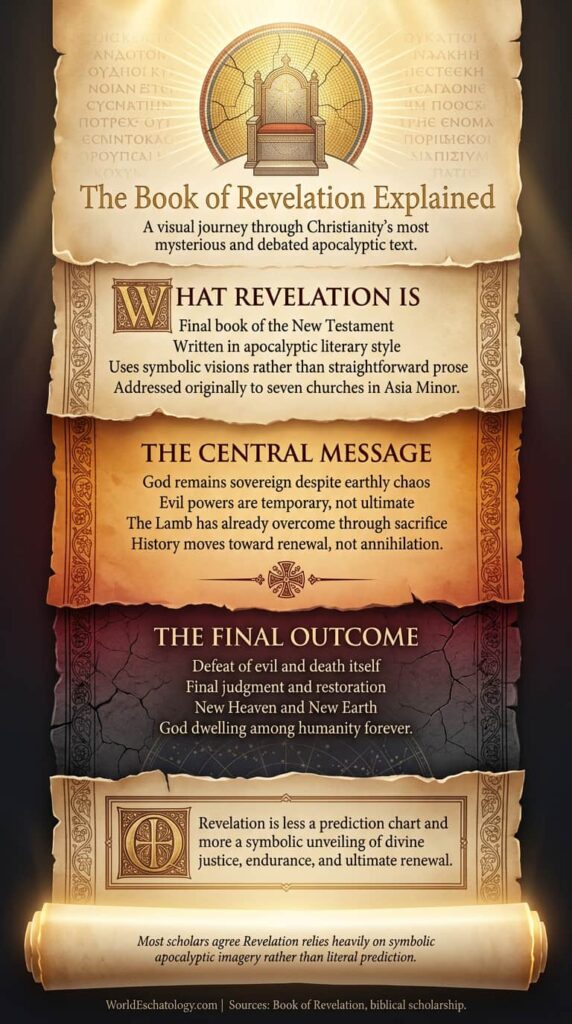
Revelation belongs to a genre called apocalyptic literature.
The word apocalypse simply means unveiling or revelation in Greek, and apocalyptic literature is writing that claims to draw back the curtain on ultimate reality, showing the cosmic dimension of historical events.
It communicates through vivid symbolic imagery rather than straightforward prose, and its symbols are drawn from a shared tradition that the original audience would have understood.
Numbers, colors, animals, geographic locations all carry specific meanings in this tradition.
Taking them literally is like trying to understand a political cartoon by asking what country actually has a face shaped like a boot.
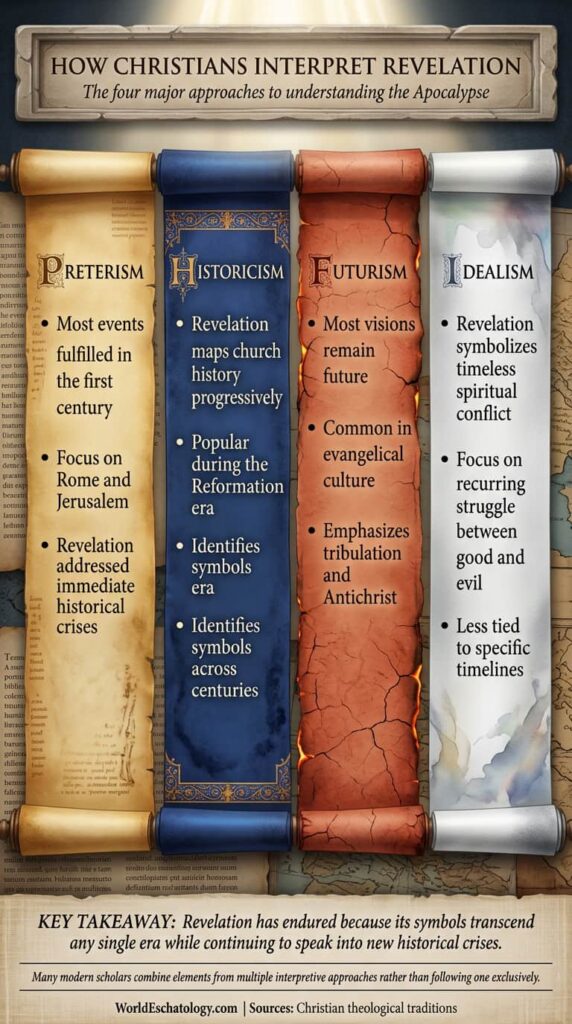
There are four main schools of interpretation.
Preterism holds that Revelation describes events already fulfilled in the first century, primarily the destruction of Jerusalem in 70 CE and the persecution under Nero or Domitian.
Historicism holds that Revelation maps out the entire span of church history from John’s day to the end.
Futurism holds that most of Revelation describes events still in the future, a position that has become dominant in evangelical popular culture through the dispensationalist movement.
Idealism holds that Revelation is a timeless spiritual drama with no specific historical fulfillment, expressing eternal truths about the conflict between good and evil. Most serious scholars draw on elements of more than one approach.
Who Wrote Revelation and When
The author identifies himself simply as John, a servant of Jesus Christ who was on the island of Patmos when he received the visions.
The question of which John this is has been debated since the early Church.
Many early Church Fathers identified him with the Apostle John, the son of Zebedee.
Others, including the third-century bishop Dionysius of Alexandria, argued on the basis of the Greek style and theological vocabulary that the author was a different John, sometimes called John the Elder or John of Patmos.
The scholarly consensus today leans toward a different John than the Gospel writer, but the question remains genuinely open.
The dating question turns on which Roman emperor John’s imagery is pointing to.
The two main positions are a Neronian date of around 64 to 68 CE and a Domitianic date of around 95 to 96 CE.
The Neronian date fits if Revelation was written just before or during Nero’s persecution of Christians in Rome.
The Domitianic date, supported by the early Church Father Irenaeus and by most modern scholars, fits the intensity of the imperial cult pressure in Asia Minor that the seven letters address.
The date matters because it shapes which historical events the first-century preterist reading can identify as fulfillments.
The Seven Churches and the Roman Context
Revelation was addressed to seven specific Christian communities in Asia Minor: Ephesus, Smyrna, Pergamum, Thyatira, Sardis, Philadelphia, and Laodicea.
These were real cities with real churches facing real problems.
The most pressing of those problems was the Roman imperial cult, the system of worship directed at the emperor and the gods of Rome that permeated economic, social, and civic life.
Refusing to participate had consequences. It meant exclusion from trade guilds, social ostracism, and in some cases legal jeopardy.
Revelation was written to communities navigating this pressure, and understanding that is the essential key to understanding why the book was written.
Chapter by chapter overview of the book of revelation
Chapters 1 to 3: Letters to the Seven Churches
Chapter 1: The Vision of the Risen Christ
John’s opening vision on Patmos is one of the most overwhelming descriptions of the risen Christ in all of Christian scripture.
He sees someone like a son of man standing among seven golden lampstands.
His head and hair are white as snow, his eyes like blazing fire, his feet like bronze glowing in a furnace, his voice like the sound of rushing waters.
He holds seven stars in his right hand and a sharp double-edged sword comes out of his mouth. John falls at his feet as if dead. The figure places his right hand on John and tells him not to be afraid.
Every element of this vision is loaded with meaning drawn from the Old Testament, particularly Daniel chapters 7 and 10.
The white hair evokes the Ancient of Days in Daniel. The sword from the mouth communicates judgment through spoken word.
The seven lampstands are immediately explained as the seven churches.
This opening vision establishes the authority of everything that follows: these are not John’s own dreams or speculations but a direct communication from the risen Christ.
Chapters 2 and 3: Letters to the Seven Churches
Each letter follows the same basic pattern: an identification of Christ drawn from chapter 1’s vision, a statement of what Christ knows about the church’s situation, a commendation of what is good, a criticism of what is wrong (for five of the seven), a call to repent or hold fast, and a promise to those who overcome.
The letters range widely in tone from the warm encouragement to suffering Smyrna to the blunt rebuke of Sardis and Laodicea.
Ephesus has worked hard and tested false apostles but has lost its first love.
Smyrna faces poverty and persecution from those John calls the synagogue of Satan, a term of great historical controversy.
Pergamum lives where Satan’s throne is, a likely reference to the city’s prominent imperial cult temple, but tolerates the teaching of Balaam and the Nicolaitans.
Thyatira has love and faith and service growing over time but tolerates a false prophetess who leads people into sexual immorality and food sacrificed to idols.
Sardis has a reputation for being alive but is dead, with only a few who have not soiled their clothes.
Philadelphia has kept Christ’s word with little strength and is promised an open door no one can shut.
Laodicea is neither hot nor cold but lukewarm, self-satisfied and not knowing it is wretched, pitiful, poor, blind, and naked.
The letters together paint a realistic picture of first-century Christian communities under pressure, full of both genuine faith and genuine failure.
Chapters 4 and 5: The Heavenly Throne Room
The Interpretive Heart of the Book
Before any judgment or any catastrophe is described, John is taken up into heaven and shown what ultimate reality looks like.
Chapter 4 shows the heavenly throne room: a figure on the throne with the appearance of jasper and ruby, a rainbow around the throne, twenty-four elders in white with gold crowns, four living creatures covered with eyes who never stop saying Holy, holy, holy is the Lord God Almighty.
The throne room pulses with worship. The message is clear: whatever is happening on earth, this is what is actually true at the deepest level of reality.
God is on the throne and is being worshipped without ceasing.
Chapter 5 introduces the central mystery: a scroll with seven seals that no one in heaven or earth or under the earth is able to open.
John weeps. Then one of the elders tells him that the Lion of the tribe of Judah has triumphed and is able to open it.
John looks and sees not a lion but a Lamb, standing as if it had been slaughtered, at the center of the throne.
The Lamb takes the scroll and the entire heavenly court erupts in worship.
The Lamb who was slain is the only one worthy to open history because he has already paid the price of history’s redemption.
This is the theological center of the entire book: the victory has already been won, and everything that follows happens within that frame.
Chapters 6 and 7: The Seven Seals
The Four Horsemen and the Sealing of God’s People
As the Lamb opens each seal, a vision unfolds. The first four seals release the four horsemen.
The first horseman rides a white horse and carries a bow, going out to conquer. The second rides a red horse and is given power to take peace from the earth with a large sword.
The third rides a black horse carrying scales, bringing famine, a day’s wages for a loaf of bread.
The fourth rides a pale horse named Death, followed by Hades, given power over a quarter of the earth to kill by sword, famine, plague, and wild animals.
These four horsemen have become among the most famous images in all of Western literature.
The fifth seal reveals souls under the altar who have been slain for God’s word, asking how long before their blood is avenged.
They are given white robes and told to wait a little longer.
The sixth seal brings cosmic upheaval: a great earthquake, the sun turning black, the moon turning blood red, stars falling, the sky rolling up like a scroll, every mountain and island moved.
Kings, generals, and everyone else hides in caves begging the mountains to fall on them and hide them from the wrath of the Lamb.
Chapter 7 then shows 144,000 sealed from the twelve tribes of Israel, followed by a vast multitude from every nation standing before the throne in white robes, having come out of the great tribulation.
Chapters 8 to 11: The Seven Trumpets
Escalating Judgments and the Two Witnesses
The seventh seal opens to half an hour of silence in heaven before seven angels with seven trumpets appear.
The first four trumpets bring partial destruction: a third of the earth burned, a third of the sea turned to blood, a third of rivers and springs made bitter, a third of sun, moon, and stars darkened.
These images echo the plagues of Exodus, establishing a typological connection between God’s historical judgment on Egypt and the judgments described here.
The fifth trumpet releases locust-like creatures from the Abyss who torment but do not kill those without God’s seal for five months.
The sixth trumpet releases four angels bound at the Euphrates to kill a third of humanity with an army of two hundred million mounted troops breathing fire, smoke, and sulfur.
The haunting observation follows: the rest of mankind still did not repent.
Chapter 10 brings a mighty angel standing with one foot on sea and one on land, holding a little scroll.
Seven thunders speak but John is told not to write down what they said. The angel announces there will be no more delay. Chapter 11 introduces two witnesses who prophesy for 1,260 days, have power to shut the sky and turn water into blood.
When they finish their testimony, the beast from the Abyss kills them.
Their bodies lie in the great city for three and a half days while the inhabitants celebrate, then God breathes life into them and they ascend to heaven in a cloud as their enemies watch.
The seventh trumpet then sounds, bringing a heavenly announcement that the kingdom of the world has become the kingdom of our Lord and of his Christ, and he will reign forever.
Chapter 11 functions as a structural midpoint and a summary of the whole book’s movement.
Chapters 12 to 14: The Cosmic Conflict
The Woman, the Dragon, the Two Beasts, and 666
Chapter 12 pulls back to show the cosmic backstory. A woman clothed with the sun, moon under her feet, and a crown of twelve stars is pregnant and cries out in labor.
A great red dragon with seven heads and ten horns tries to devour her child. The child, a male who will rule all nations with an iron scepter, is snatched up to God’s throne.
The woman flees to the wilderness. War breaks out in heaven: Michael and his angels fight the dragon and his angels, and the dragon, identified as the ancient serpent called the devil and Satan, is hurled to the earth.
The woman is pursued but protected. The dragon goes off to wage war against the rest of her offspring, those who keep God’s commandments and hold to the testimony of Jesus.
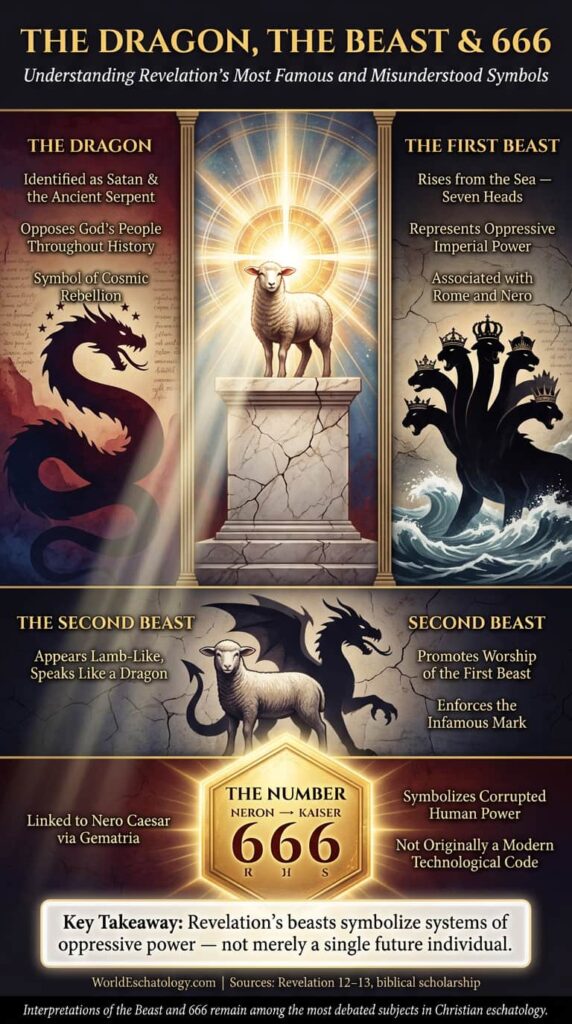
Chapter 13 introduces two beasts. The first rises from the sea with seven heads and ten horns, receiving authority from the dragon for forty-two months.
One of its heads has a mortal wound that had been healed, and the whole world is filled with amazement and follows the beast, worshipping it.
It makes war against the saints and conquers them, and all who dwell on earth whose names are not in the book of life worship it.
The second beast rises from the earth, looking like a lamb but speaking like a dragon.
It causes people to worship the first beast and forces everyone to receive a mark on their right hand or forehead, without which no one can buy or sell. Its number is 666.
The number 666 is one of the most Googled topics in all of biblical studies. The practice of assigning numerical values to letters, called gematria, was common in the ancient world.
When you apply this to the name Neron Caesar spelled in Hebrew characters, the total is 666.
This identification is the most widely supported among academic biblical scholars, and some manuscripts of Revelation give the number as 616, which corresponds to the Latin spelling of Nero’s name, further confirming the connection.
The beast is a stand-in for Rome and for Roman imperial power, not a code to be cracked in newspaper headlines two thousand years later.
Chapter 14 shows the 144,000 with the Lamb on Mount Zion, three angels with urgent messages, and a double harvest of the earth representing judgment.
Chapters 15 and 16: The Seven Bowls
The Final Plagues and Armageddon
Chapter 15 introduces seven angels with the seven last plagues, described as the completion of God’s wrath.
Those who had been victorious over the beast sing the song of Moses and the Lamb.
The heavenly temple fills with smoke and no one can enter until the seven plagues are completed.
Chapter 16 pours out these bowls in rapid succession, each one intensifying the trumpet judgments: painful sores on those with the mark of the beast, sea turned to blood, rivers and springs turned to blood, scorching heat from the sun, darkness over the kingdom of the beast, the Euphrates dried up to prepare the way for the kings of the east, and finally a catastrophic earthquake greater than any since mankind has been on earth, splitting the great city into three parts.
The sixth bowl gathers the kings of the whole world to a place called in Hebrew Armageddon, which means the mountain of Megiddo.
Megiddo was a strategic location in northern Israel where decisive battles had been fought throughout Old Testament history, including the death of King Josiah.
Whether Armageddon is meant as a literal geographic location or as a symbolic site of cosmic conflict is one of the genuinely debated questions in Revelation scholarship.
The text itself gives no battle description at this point, simply the gathering. The actual confrontation comes in chapter 19.
Popular culture has turned Armageddon into a synonym for nuclear war or world-ending catastrophe, which goes well beyond what the text actually describes.
Chapters 17 and 18: The Fall of Babylon
Who Is Babylon and Why Her Fall Matters
Chapter 17 introduces one of the most vivid and politically charged images in the entire book:
a woman called Babylon the Great sitting on a scarlet beast, dressed in purple and scarlet and glittering with gold and jewels and pearls, holding a golden cup filled with abominations.
She is drunk with the blood of God’s holy people. An angel explains that the seven heads are seven hills on which the woman sits, and seven kings.
Rome was famously built on seven hills and was known throughout the ancient world by that description.
The angel’s explanation is not subtle: the first-century reader would have recognized Babylon as Rome immediately.
Later interpreters have applied the Babylon imagery to the medieval papacy, the British Empire, America, and various other systems of power, and the imagery is flexible enough to fit more than one application without its original reference being Rome.
Chapter 18 narrates Babylon’s fall with the emotional register of a funeral.
Merchants who traded with her and grew rich from her weep and mourn because no one buys their cargo anymore.
The list of trade goods is extraordinary in its specificity: gold and silver, precious stones and pearls, fine linen and purple and silk and scarlet, all sorts of scented wood, all articles of ivory, costly wood, bronze and iron and marble, cinnamon, spice, incense, myrrh and frankincense, wine and olive oil and fine flour, wheat, cattle, sheep, horses and carriages, and the bodies and souls of human beings.
This is a devastating economic critique embedded in prophetic poetry.
Chapter 18 is not simply about religious corruption but about the entire system of imperial commerce that enriches the powerful at the expense of human bodies and souls.
Revelation’s vision of Babylon’s fall is also a vision of economic justice.
Chapters 19 and 20: The Return of Christ and the Millennium
The Rider on the White Horse and the Thousand Years
Chapter 19 opens with an explosion of joy in heaven at Babylon’s fall, the four-fold hallelujah that has shaped Christian worship ever since.
The marriage supper of the Lamb is announced, and the bride has made herself ready.
Then comes one of the most dramatic images in the book: heaven stands open and a white horse appears, its rider called Faithful and True.
His eyes are like blazing fire, he wears many crowns, his robe is dipped in blood, his name is the Word of God.
The armies of heaven follow him on white horses. Out of his mouth comes a sharp sword with which to strike the nations.
On his thigh is written King of Kings and Lord of Lords. The beast and the kings of the earth gather to make war but the beast is captured, thrown alive into the lake of fire.
The rest are killed by the sword coming from the rider’s mouth. This is victory through the spoken word, through truth, not through conventional military violence.
Chapter 20 describes Satan being bound for a thousand years and thrown into the Abyss while the martyrs who had not worshipped the beast reign with Christ.
After the thousand years Satan is released, gathers the nations for one final rebellion called Gog and Magog, and is defeated by fire from heaven before being thrown into the lake of fire.
Then the great white throne judgment: all the dead, great and small, stand before the throne.
Books are opened and the dead are judged according to what they had done as recorded in the books.
Death and Hades are thrown into the lake of fire, called the second death. Anyone whose name is not found in the book of life is thrown there as well.
The question of what the thousand years means has divided Christian theology into three major camps.
Premillennialism holds that Christ physically returns before the thousand years to establish a literal kingdom on earth.
This is the dominant view in evangelical and charismatic Christianity today.
Postmillennialism holds that the gospel will eventually transform the world, producing a golden age of Christian influence after which Christ returns.
Amillennialism, the position held by most Reformed, Catholic, and Orthodox Christians, holds that the thousand years is a symbolic number representing the entire current church age between Christ’s first and second coming, during which Satan’s power has been curtailed by the cross.
Each position has serious biblical and theological arguments in its favor.
Chapters 21 and 22: The New Creation
New Heaven, New Earth, New Jerusalem
The final two chapters of Revelation are among the most beautiful in all of scripture.
John sees a new heaven and a new earth, the first heaven and earth having passed away and the sea no longer existing.
Then he sees the holy city, the new Jerusalem, coming down out of heaven from God, prepared as a bride adorned for her husband.
A loud voice from the throne announces that God’s dwelling place is now among the people, he will dwell with them and they will be his people.
He will wipe every tear from their eyes. There will be no more death, no more mourning or crying or pain, because the old order of things has passed away.
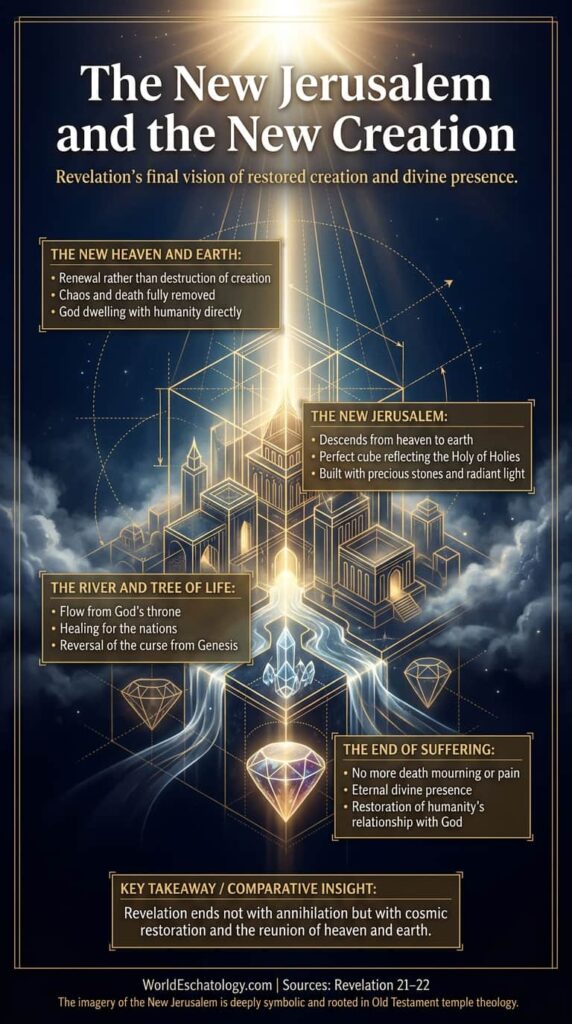
The new Jerusalem is described in extraordinary detail. Its dimensions are staggering: 1,500 miles in length, width, and height, a perfect cube, which recalls the shape of the Holy of Holies in the Jerusalem Temple.
Its walls have twelve foundations bearing the names of the twelve apostles and twelve gates bearing the names of the twelve tribes.
The walls are made of jasper, the city of pure gold like transparent glass, the foundations adorned with every kind of precious stone.
There is no temple in the city because the Lord God Almighty and the Lamb are its temple. There is no need for sun or moon because the glory of God gives it light.
Chapter 22 flows from the throne the river of the water of life, clear as crystal, with the tree of life growing on each side of the river, bearing fruit every month, its leaves for the healing of the nations.
The servants of God see his face and his name is on their foreheads. There will be no more night.
This is the reversal of Genesis 3: the curse is lifted, access to the tree of life is restored, God and humanity dwell together without barrier.
The book closes with Christ repeating three times that he is coming soon, with the invitation of the Spirit and the Bride saying come, and with the final blessing on those who keep the words of this book.
THE MAJOR INTERPRETIVE QUESTIONS
Is Revelation Primarily About the Past or the Future?
This is the fundamental question that divides all Revelation interpretation.
Preterists argue that the internal evidence points overwhelmingly to first-century fulfillment: John says the time is near three times in the book, he says things that must soon take place, and he addresses specific communities with specific first-century problems.
The number 666, the seven hills, the persecution of the saints, all of this fits the Roman context precisely.
Full preterists argue that everything in Revelation was fulfilled by 70 CE. Partial preterists say most of it was fulfilled then but some final events remain future.
Futurists, particularly in the dispensationalist tradition, argue that most of Revelation from chapter 4 onward describes events that will unfold during a future seven-year tribulation period after the church has been raptured.
This view dominates evangelical popular culture through the influence of the Scofield Reference Bible and the Left Behind series, but it is a relatively recent development in Christian theological history, not the historic mainstream position.
The honest answer is that the text supports neither pure preterism nor pure futurism without some degree of forced interpretation, and that the wisest approach holds the historical context seriously while remaining open to patterns that transcend their original moment.
Who Are the 144,000?
The 144,000 appear twice: sealed in chapter 7 from the twelve tribes of Israel and standing with the Lamb on Mount Zion in chapter 14.
The three main positions are: they are a literal number of Jewish people from literal ethnic tribes who will be sealed during a future tribulation period; they are a symbolic number representing the full community of God’s people, 12 times 12 times 1,000 being a symbol of completeness; or they are specifically the church as the continuation of true Israel.
The second option is supported by the observation that the tribe names in chapter 7 do not match the traditional twelve tribes exactly and that the multitude from every nation in chapter 7 seems to be the same group seen from different angles.
The number 144 is 12 squared and 1,000 represents completeness, making this almost certainly a symbolic way of saying the full, complete people of God rather than a literal census.
What Is the Tribulation?
The tribulation concept in popular Christian culture draws primarily from Daniel 9:27 and from Revelation’s three-and-a-half-year and seven-year periods.
The seven-year tribulation framework is built by combining Daniel’s seventieth week with Revelation’s various time periods of forty-two months and 1,260 days, which are different ways of expressing three and a half years.
Whether this framework is justified by the texts is genuinely debated.
The specific phrase great tribulation comes from Revelation 7:14 and from Jesus’s words in Matthew 24, and preterists argue this refers to the catastrophic destruction of Jerusalem in 70 CE while futurists argue it refers to a still-future global crisis.
The Rapture and Revelation
The rapture concept is not derived from Revelation at all. It comes primarily from 1 Thessalonians 4:16-17, where Paul describes believers being caught up to meet the Lord in the air.
Revelation does not use rapture language. The question of whether Revelation assumes a pre-tribulation rapture has already occurred (and therefore the church is not present during the seal, trumpet, and bowl judgments) is a point of major debate.
Pre-tribulationists say the church’s absence from the judgments implies it has been raptured.
Critics say the church-like community is clearly present throughout Revelation, being persecuted and holding on in the midst of the judgments.
This is one of the places where the interpretive framework being used most determines what the text appears to say.
Who Is the Antichrist in Revelation?
The word Antichrist never appears in Revelation. The Beast is not called the Antichrist anywhere in the book.
The Antichrist concept comes from the letters of John, where it refers to a spirit or type of person who denies that Jesus has come in the flesh.
The Beast of Revelation, the Man of Lawlessness of 2 Thessalonians, and John’s antichrists were merged into a single composite figure by the Church Fathers and that composite has dominated popular Christian eschatology ever since.
In its original Revelation context, the beast most clearly represents the Roman imperial system with Nero as its most recent and terrible expression.
Later interpreters have identified the beast with the papacy, with various political leaders, and with future world government systems.
The Mark of the Beast in Modern Interpretation
Few topics in Revelation have generated more popular speculation than the mark of the Beast.
Every generation finds a new candidate: tattoos, social security numbers, barcodes, microchips, RFID implants, vaccine passports, digital IDs.
These identifications reveal more about each generation’s technological anxieties than about the text itself.
In its original context, the mark mirrors the seal placed on God’s servants in chapter 7, a counter-seal indicating allegiance to the beast rather than to God.
The economic dimension is central: without the mark, no one can buy or sell.
In the Roman context, refusal to participate in the imperial cult had exactly this kind of economic consequence.
The mark is primarily a symbol of allegiance and identity, not a specific technology, though the concern about economic exclusion for those who refuse the beast’s system is perennially applicable.
Is Revelation Relevant Today?
Yes, emphatically. Not primarily as a roadmap of future events but as a piece of pastoral theology written for communities under pressure.
The core message of Revelation has spoken to every oppressed community in Christian history because it says two things that people living under unjust power desperately need to hear:
first, that the powers of this world, however overwhelming they appear, are not ultimate and will not last; and second, that the suffering of faithful people is not meaningless but is held in the hands of a God who sees, keeps records, and will act.
The African American church’s deep engagement with Revelation during slavery and Jim Crow, the use of Revelation imagery by liberation theologians in Latin America, and the sustaining power it has had for persecuted Christians in every century, these are the real evidence of its relevance, far more significant than any prophetic timeline.
REVELATION IN COMPARATIVE PERSPECTIVE
Revelation and the Old Testament
Scholars have counted over 400 Old Testament allusions in Revelation, more than in any other New Testament book.
John never directly quotes the Old Testament but saturates every paragraph with its imagery, language, and patterns.
Daniel is the most important single source: the four beasts, the son of man, the time, times, and half a time, the Ancient of Days, the opened books of judgment all come from Daniel.
Ezekiel’s throne chariot vision, the four living creatures, the measuring of the temple, the Gog and Magog battle, the river from the temple all feed into Revelation.
Isaiah’s new creation, Zechariah’s four horsemen and Joshua the high priest, the Psalms of divine enthronement, Exodus plagues, all of these provide the building blocks John assembles into his vision.
You cannot read Revelation intelligently without reading the Old Testament seriously.
Revelation and Jewish Apocalyptic Literature
Revelation makes much more sense when you read it alongside other Jewish apocalyptic texts from the same era.
Works like 4 Ezra, 2 Baruch, and 1 Enoch use the same literary techniques: heavenly journeys, angelic guides, symbolic animals, cosmic battles, and divine judgment scenes.
They were written by Jews processing the trauma of Roman oppression and the destruction of the Temple, and they speak the same visual and symbolic language John speaks.
This context does not undermine Revelation’s authority but actually illuminates it, showing how John uses a living tradition of prophetic imagery rather than inventing symbols from scratch.
Revelation and Islam
Islamic eschatology and the Book of Revelation address many of the same ultimate questions through different frameworks.
The Dajjal tradition in Islam shares significant structural features with Revelation’s Beast: both are supreme deceivers who perform false miracles, gather worldwide followings, and are defeated by a figure associated with Jesus.
The Islamic tradition’s account of Isa descending to defeat the Dajjal has an obvious structural parallel with Revelation’s rider on the white horse defeating the Beast.
Both traditions also include a Gog and Magog episode following the defeat of the main deceiver figure.
These parallels reflect shared roots in the broader Abrahamic apocalyptic tradition rather than direct borrowing, and they coexist with genuine theological differences about who Jesus is and what his return means.
Revelation and Hindu Eschatology
The cosmic imagery of Revelation, the divine throne, the cosmic battles between good and evil, the destruction of the corrupt world order, and the emergence of a renewed creation finds broad structural parallels in Hindu eschatological thought.
The descent of Kalki at the end of Kali Yuga, riding a white horse and wielding a blazing sword to destroy the corrupt order, has a visual parallel with Revelation’s rider on the white horse that is striking enough to have attracted the attention of comparative religion scholars.
Both traditions describe the current world order as under the dominance of forces opposed to divine righteousness, both expect a dramatic divine intervention rather than gradual human progress, and both promise a new era of justice and abundance after the current age ends.
These parallels likely reflect the universal human intuition about the shape of cosmic justice rather than any direct historical connection.
Revelation in Art, Literature, and Culture
Revelation has shaped Western culture more deeply than any other biblical book.
Albrecht Durer’s woodcuts of the four horsemen and the apocalyptic visions are among the most influential works of art in European history.
William Blake produced entire illuminated books interpreting Revelation through his own prophetic vision. Dante’s Divine Comedy is saturated with Revelation imagery.
John Milton’s Paradise Lost and Paradise Regained both draw on the cosmic framework Revelation provides.
In the twentieth and twenty-first centuries, Revelation has been the source material for an enormous range of literature, film, and music, from the T.S. Eliot’s wasteland imagery to the Left Behind series to countless horror and science fiction franchises.
Politically, Revelation has been invoked by revolutionaries and conservatives, by liberation theologians and empire builders, which is itself testimony to the text’s extraordinary capacity for multiple applications.
FREQUENTLY ASKED QUESTIONS
What is the Book of Revelation about in simple terms?
Revelation is a letter written by a Christian leader named John to seven churches in Asia Minor around the end of the first century CE.
Using vivid symbolic imagery drawn from Jewish apocalyptic tradition, it describes visions that John received while in exile on the island of Patmos.
The core message is that despite the overwhelming power of the Roman Empire and the suffering of Christians who refuse to worship its gods, God is on the throne, the victory has already been won through Christ’s death and resurrection, the powers of evil will ultimately be destroyed, and God will create a new world where he dwells with his people forever.
It is primarily a pastoral letter written to encourage communities under pressure, not a timeline of future political events.
Who wrote the Book of Revelation?
The author identifies himself as John, a servant of Jesus Christ on the island of Patmos.
Early Church tradition identified him with the Apostle John, son of Zebedee, who also wrote the Gospel of John.
Modern scholars are more divided, with many arguing that the different Greek style and theological vocabulary suggest a different author, sometimes called John the Elder or John of Patmos.
The question remains genuinely open in biblical scholarship.
When was the Book of Revelation written?
The two main dating positions are around 68 CE during the reign of Nero and around 95 to 96 CE during the reign of Domitian.
The earlier date is supported by internal evidence that some scholars find points to Nero’s time.
The later date is supported by the early Church Father Irenaeus and by most modern scholars who see the intense imperial cult pressure described in the seven letters as more characteristic of Domitian’s reign.
The majority scholarly view favors the Domitianic date.
What do the seven churches in Revelation represent?
The seven churches are real historical communities in Asia Minor that received Revelation as a circular letter.
Each receives a specific message addressing its particular situation. In symbolic terms, the number seven in Jewish tradition represents completeness, so the seven churches together represent the whole church.
Many interpreters also see the churches as representing recurring types of Christian communities in every age, meaning the letters continue to be relevant to churches that resemble Ephesus, Laodicea, or Smyrna in their own ways.
Who are the four horsemen of the Apocalypse?
The four horsemen are released when the Lamb opens the first four seals in Revelation chapter 6.
The white horse rider goes out to conquer, the red horse rider brings war and takes peace from the earth, the black horse rider brings famine, and the pale horse rider is named Death and is followed by Hades.
These four figures draw on imagery from Zechariah’s four horsemen in the Old Testament and represent forces of conquest, conflict, scarcity, and death that characterize human history under the current broken order.
Whether they represent specific historical events, recurring patterns, or future specific occurrences depends on your overall interpretive approach.
What does the number 666 mean?
The number 666 is the number of the beast from Revelation 13.
Using gematria, the practice of assigning numerical values to letters, the name Neron Caesar spelled in Hebrew letters totals 666.
This identification with the Roman Emperor Nero is the most widely accepted among academic biblical scholars.
Some manuscripts of Revelation give the number as 616, which equals the Latin spelling of Nero’s name, further supporting the connection.
Theologically, 666 also communicates that the beast falls short of divine perfection: seven is the number of completeness in Jewish symbolism, and 666 is a triple failure to reach it.
Who are the 144,000 in Revelation?
The 144,000 are sealed from the twelve tribes of Israel in chapter 7 and appear with the Lamb on Mount Zion in chapter 14.
Most biblical scholars understand the number symbolically rather than literally: 12 times 12 times 1,000 represents the complete, full people of God rather than a precise census.
The fact that the tribe names in chapter 7 do not precisely match the traditional twelve tribes, and that an innumerable multitude from every nation appears in the same passage, suggests the 144,000 and the great multitude are the same group seen from two different angles.
What is the mark of the Beast?
The mark of the Beast in Revelation 13 is a sign placed on the right hand or forehead of those who worship the beast, without which no one can buy or sell.
In its original context it mirrors the seal of God placed on his servants in chapter 7, representing allegiance and identity.
In the Roman context, participation in the imperial cult had real economic consequences for those who refused, making the mark’s economic function historically resonant.
Every generation finds a new technological candidate for the mark, from tattoos to microchips to digital IDs.
These applications are creative but should not distract from the text’s primary meaning: the mark is a symbol of ultimate allegiance, not a specific technology.
What is Armageddon in the Bible?
Armageddon appears once in the Bible, in Revelation 16:16, as the Hebrew name for the place where the kings of the whole world are gathered for the great battle of God Almighty.
The name means the mountain of Megiddo, referring to an area in northern Israel famous for decisive battles throughout Old Testament history.
The actual battle description does not come at this point in Revelation but in chapter 19 with the rider on the white horse.
Whether Armageddon is a literal geographic location or a symbolic staging ground for cosmic conflict is debated.
Popular culture has used the word to mean world-ending catastrophe in general, which is a significant departure from its specific biblical meaning.
What is the millennium in Revelation 20?
The millennium is a thousand-year period described in Revelation 20:1-6 during which Satan is bound in the Abyss and martyrs reign with Christ.
It is the source of three major interpretive positions. Premillennialism holds that Christ returns physically before the thousand years to establish a literal earthly kingdom.
Postmillennialism holds that the gospel progressively transforms the world, producing a golden age after which Christ returns.
Amillennialism holds that the thousand years is symbolic, representing the current church age between Christ’s first and second coming.
This last position is the historic position of most Catholic, Orthodox, and Reformed Christians.
What is the difference between premillennialism, amillennialism, and postmillennialism?
These three positions differ on when Christ returns in relation to the millennium of Revelation 20 and what the millennium represents.
Premillennialism says Christ returns before the millennium and reigns on earth for a literal thousand years; this is the dominant view in evangelical and charismatic Christianity today.
Amillennialism says the millennium is the current church age and Christ returns at its end to usher in the final judgment and new creation; this is the most common view in Reformed, Catholic, and Orthodox traditions.
Postmillennialism says the church’s preaching of the gospel will eventually lead to a golden age of Christian influence on earth, after which Christ returns; this was more popular in the nineteenth century than today.
What is the rapture and is it in Revelation?
The rapture is the concept of believers being caught up to meet Christ at his return, drawn primarily from 1 Thessalonians 4:16-17.
The word rapture itself does not appear in Revelation.
The specific doctrine of a secret pre-tribulation rapture that removes the church before the judgments of Revelation begin is a relatively modern development, traced primarily to John Nelson Darby in the mid-nineteenth century.
It is not the historic position of most Christian traditions. Those who hold it argue that the church’s absence from the explicit judgments of Revelation implies it has already been removed.
Critics argue that the community of believers is clearly present throughout Revelation being tested and persecuted.
Who is the Antichrist in Revelation?
The word Antichrist does not appear anywhere in Revelation.
The Beast of Revelation 13 is the figure most associated with the Antichrist concept in popular culture, but this identification came through the Church Fathers who merged the Beast, the Man of Lawlessness from 2 Thessalonians 2, and the antichrists of 1 John into a composite figure.
In its original Revelation context, the Beast most clearly represents the Roman imperial system and Nero as its most notorious expression.
Later readers have applied it to the medieval papacy, various political leaders, and a future world ruler.
The range of these applications reflects both the text’s symbolic flexibility and the persistent human pattern of identifying the current enemy as the ultimate evil.
What is Babylon in Revelation?
Babylon in Revelation is a symbol for Rome. The angel explicitly identifies the seven heads of the beast as seven hills, pointing to Rome, the city famous for being built on seven hills.
Calling Rome Babylon also evokes the Old Testament Babylon that destroyed Jerusalem and exiled the Jewish people, positioning Rome as the new embodiment of pagan imperial power.
The imagery in chapters 17 and 18 fits first-century Rome precisely: the description of her economic dominance, the mourning merchants, and the blood of prophets and saints all match the historical reality of Roman power.
Later interpreters have applied Babylon to the medieval papacy, to various empires, and to any corrupt system of power and commerce that exploits the vulnerable.
What is the new Jerusalem?
The new Jerusalem is the city that descends from heaven to the new earth in Revelation 21, representing the final state of God’s people in perfect relationship with God.
Its dimensions form a perfect cube, recalling the Holy of Holies, the innermost sanctuary of the Jerusalem Temple where God’s presence dwelt.
It has no temple because God himself and the Lamb are its temple. It has no sun or moon because God’s glory illuminates it.
Its gates are named for the twelve tribes of Israel and its foundations for the twelve apostles, integrating the whole story of God’s people.
It represents not an escape to heaven but heaven coming to earth, God making his home permanently among his people.
What is the great tribulation?
The phrase great tribulation appears in Revelation 7:14 to describe what the innumerable multitude has come out of.
Jesus uses the same phrase in Matthew 24:21 to describe an unprecedented time of distress.
Preterists identify this with the destruction of Jerusalem in 70 CE, which was indeed an event of almost unimaginable suffering for the Jewish people.
Futurists identify it with a future three-and-a-half or seven-year period of global catastrophe before Christ’s return.
Most scholars agree that the term refers to intense and severe suffering, but the question of when and how it is fulfilled remains one of the central debates in Revelation interpretation.
What are the seven seals, seven trumpets, and seven bowls?
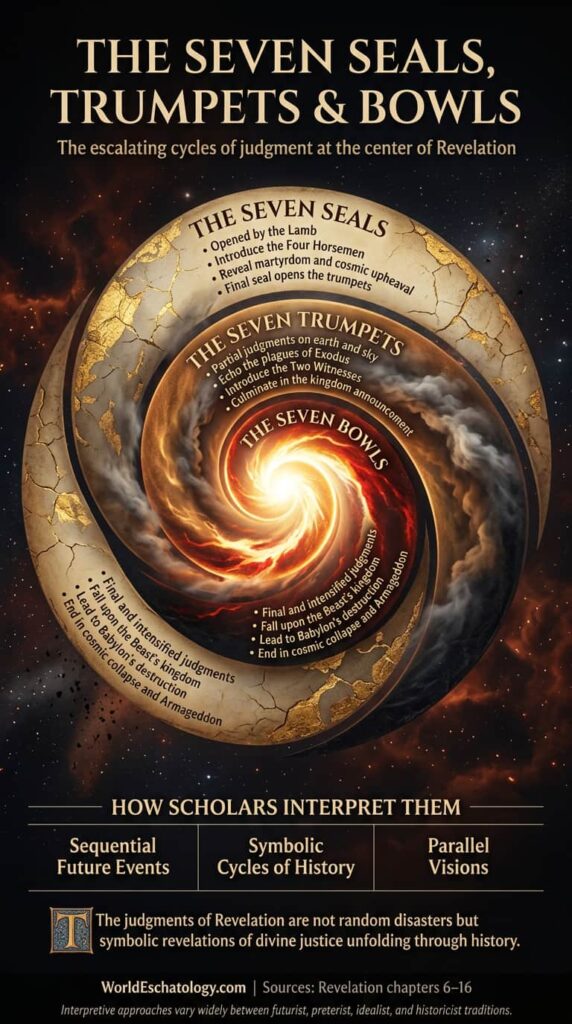
These three series of seven judgments form the main structural spine of Revelation from chapters 6 to 16.
The seven seals are opened by the Lamb in chapters 6 and 8, releasing the four horsemen, revealing the martyrs under the altar, and bringing cosmic upheaval.
The seventh seal opens to reveal the seven trumpets. The seven trumpets are sounded in chapters 8 to 11, bringing partial destruction of the earth, sea, rivers, and sky, then increasingly intense plagues.
The seventh trumpet announces the kingdom. The seven bowls of God’s wrath are poured out in chapter 16, intensifying the trumpet judgments and culminating in the fall of Babylon.
Many scholars see these three series not as sequential future events but as three views of the same period seen from different angles, each building in intensity toward the same climax.
What is the lake of fire?
The lake of fire appears in Revelation 19 and 20 as the final destination of the beast, the false prophet, the devil, death, Hades, and those whose names are not found in the book of life.
It is called the second death in Revelation 20:14 and 21:8. It represents the ultimate and final separation from God.
Whether it is to be understood as a literal physical location of conscious torment or as a symbol for annihilation and permanent exclusion from God’s presence is one of the most debated questions in Christian theology, not just in Revelation scholarship.
The text itself uses imagery rather than providing a precise theological definition, and Christian traditions have interpreted it along a spectrum from eternal conscious torment to annihilationism.
What is the second death in Revelation?
The second death is explicitly defined in Revelation 21:8 as the lake of fire, where the cowardly, the unbelieving, the vile, the murderers, the sexually immoral, those who practice magic arts, the idolaters, and all liars will be consigned.
The first death is ordinary physical death. The second death represents final, irreversible separation from God after the final judgment.
Those who participate in the first resurrection, described in Revelation 20, will not be harmed by the second death.
The concept communicates that death as we know it is not the ultimate end, that there is a judgment beyond death, and that the final condition of a person is determined not by the fact of their physical death but by their relationship to Christ.
What does Revelation say about the end of the world?
Revelation does not describe the end of the world in the sense of the universe ceasing to exist.
It describes the end of the current broken world order and its replacement by a renewed creation: a new heaven and a new earth.
The sea is no more, which in Revelation’s symbolic world means chaos and evil are eliminated. Death itself is destroyed.
The created order is not annihilated but transformed and restored. This is consistent with other New Testament passages that describe creation being liberated from its bondage to decay rather than destroyed.
The popular image of heaven as a disembodied spiritual state is actually foreign to Revelation’s vision, which is thoroughly material and thoroughly this-worldly in its hope.
Is Revelation meant to be taken literally?
Most biblical scholars and theologians would answer: some of it, but not most of it, and the challenge is knowing which is which.
The letters to the seven churches in chapters 2 and 3 are addressed to specific historical communities and are generally taken more literally.
The symbolic visions use a well-established code of apocalyptic imagery that was not meant to be taken literally by its original audience.
A beast with seven heads and ten horns is not a literal creature but a symbol for Roman imperial power.
The new Jerusalem that is 1,500 miles in every direction is a symbolic expression of completeness and perfection, not an architectural blueprint.
The key is reading Revelation the way its first readers would have read it, in the context of the Jewish apocalyptic tradition it belongs to.
What is the Book of Life in Revelation?
The Book of Life appears multiple times in Revelation and refers to a divine record of those who belong to God and will share in the new creation.
In chapter 20 the dead are judged according to what they had done as recorded in the books, and those not found in the book of life are thrown into the lake of fire.
In chapter 21 only those written in the Lamb’s book of life will enter the new Jerusalem.
The concept draws on Old Testament imagery of divine records and communicates that entry into God’s eternal presence is a matter of divine knowledge and grace rather than of circumstance or accident.
Revelation does not provide a systematic theology of how one’s name comes to be written or not written in the book.
Who are the two witnesses in Revelation 11?
The two witnesses of Revelation 11 prophesy for 1,260 days, have power to shut the sky so it does not rain and to turn water into blood, are killed by the beast from the Abyss, lie unburied for three and a half days as the inhabitants celebrate, and then are raised and ascend to heaven.
The imagery draws on Moses (turning water to blood) and Elijah (shutting the sky from rain), leading many interpreters to identify the two witnesses with these two Old Testament prophets or with figures representing the Law and the Prophets.
Others see them as the church’s witness in word and deed. The symbolic number two in Jewish law represents sufficient testimony.
Whoever they are, their pattern of witness, suffering, death, resurrection, and vindication mirrors Christ’s own pattern.
What is the whore of Babylon?
The whore of Babylon, formally called Babylon the Great, Mother of Prostitutes and of the Abominations of the Earth, is the woman of Revelation 17 who sits on the beast and on seven hills, drunk with the blood of God’s holy people.
In its original context she represents Rome, whose famous hills were recognized throughout the ancient world and whose appetite for luxury commerce and blood sports matched the description exactly.
The term prostitute in prophetic literature typically represents unfaithful alliance with foreign powers and their gods, and Rome’s seduction of the nations into her imperial economic and religious system fits perfectly.
The image has been applied to the medieval papacy, to modern economic systems, and to any power that seduces others with luxury while shedding innocent blood.
What does Revelation say happens after death?
Revelation addresses the state of the dead primarily in terms of the final judgment and the new creation rather than providing a detailed account of the intermediate state.
The souls of the martyrs under the altar in chapter 6 are in God’s presence awaiting final vindication.
The first resurrection of chapter 20 involves the reign of the saints with Christ during the millennium period.
The great white throne judgment involves all the dead, great and small, being raised for final judgment.
After judgment, those in the new creation dwell with God forever in a restored material world where death no longer exists.
Revelation’s vision of the afterlife is therefore ultimately not about going to a disembodied heaven but about the resurrection of the body and the renewal of the whole creation.
Is the Book of Revelation the same as the Apocalypse?
Yes. The word apocalypse is the Greek word for revelation, meaning an unveiling or disclosure.
The Book of Revelation is titled The Apocalypse of John in Greek, which is why it is sometimes called simply The Apocalypse.
The word apocalypse in its original meaning refers specifically to this kind of visionary literature that claims to draw back the curtain on ultimate reality.
Over time the word came to be used more broadly in popular culture to mean any catastrophic end-of-the-world event, which is a secondary meaning derived from the content of this book rather than from the original meaning of the word itself.
Conclusion
What Revelation Has Been Trying to Say All Along
Revelation is not primarily a timeline. It is a pastoral letter written to communities of people who were afraid and suffering and asking whether following Jesus was worth the cost.
The answer John gives through his visions is overwhelming: yes, because the story is already decided. The Lamb has already overcome.
The throne of God is real and eternal. The powers that seem so terrifying and invincible right now are already defeated at the deepest level of reality, and their end is certain.
The suffering of the faithful is not meaningless. Every tear is seen. Every name is written. The new creation is coming.
The Central Message for Every Generation
The reason Revelation has sustained communities under pressure in every century is not because every century finds its specific future events in it.
It is because every century faces the same essential challenge: whether to trust in what is seen, the overwhelming power of whatever empire or system or force currently dominates the world, or to trust in what is not seen, the sovereignty of God and the victory of the Lamb.
Revelation’s answer is always the same. The kingdoms of this world will become the kingdom of our Lord. Every tear will be wiped away.
Death itself will die. God will dwell with his people forever. That message has never been irrelevant and never will be.
How to Read Revelation Going Forward
The best way to read Revelation is with the Old Testament in one hand, a good commentary in the other, and the first-century historical context in mind.
Learn enough about Jewish apocalyptic literature to recognize when John is using its conventions.
Hold your interpretive positions humbly, because the history of Revelation interpretation is a long record of confident people being confidently wrong about the specific applications of its imagery.
Let the worship scenes in chapters 4, 5, 7, 11, 15, and 19 do their intended work on your heart, because Revelation is as much a call to worship as it is a vision of history.
And remember that the book ends not with destruction but with an invitation: the Spirit and the Bride say come. That is the final word of Revelation. It is a welcome, not a warning.
WorldEschatology.com
Sources: The Holy Bible (ESV, NIV, NRSV); G.K. Beale, The Book of Revelation (NIGTC); N.T. Wright, Revelation for Everyone; Craig Keener, Revelation (NIV Application Commentary); Eugene Peterson, Reversed Thunder; Richard Bauckham, The Theology of the Book of Revelation; Ben Witherington III, Revelation; David deSilva, Seeing Things John’s Way; Josephus, Jewish War
1 thought on “The Book of Revelation Explained: Chapter by Chapter Overview”