

Here is a fact that surprises most people who hear it for the first time. The word antichrist appears exactly five times in the entire Bible.
Every single one of those appearances is in two short letters written by the Apostle John.
Not one of them appears in the Book of Revelation. Not one appears in Daniel. Not one appears in any of Paul’s letters.
And yet the Antichrist has become one of the most culturally powerful concepts in Western civilisation.
It has driven bestselling novels, blockbuster films, political movements, and genuine religious anxiety across centuries.
The Left Behind series sold over eighty million copies. Every decade since the Reformation, a new candidate has been named and earnestly believed in by serious, faithful people.
The Antichrist is everywhere in Western imagination.
But how much of what people believe about the Antichrist actually comes from those five verses?
And how much has been constructed from a complex weaving together of Daniel, Paul, Revelation, and centuries of interpretive tradition?
These are not hostile questions. They are honest ones, and answering them is the only way to understand what scripture actually teaches versus what has been built on top of it.
This article goes through everything about antichrist in the bible. The word itself and what it means in Greek.
The only verses that use it. The other biblical figures who are brought into the antichrist discussion by scholars, including the man of lawlessness in Paul, the little horn in Daniel, and the beast of Revelation.
The four major ways Christian scholars have interpreted these texts. The long history of identifications that turned out to be wrong.
The mark of the beast and what 666 actually means. And the practical question of what all this is meant to produce in the life of a believer.
What the Word Actually Means
Before examining a single verse, the Greek origin of the word antichrist matters, because the meaning of the prefix is less settled than most people assume.
The word is formed from two Greek components: anti and Christos. Christos is the Greek translation of the Hebrew Mashiach, meaning the Anointed One, the Messiah.
The prefix anti is where the nuance lies. In modern English, anti almost always means against.
An antiwar movement is against war. But in classical Greek, anti carried a second meaning: instead of, or in place of. A substitute. A replacement.
This matters because both meanings have scriptural support. The antichrist is certainly against Christ, opposing him, denying him, working to undermine his kingdom.
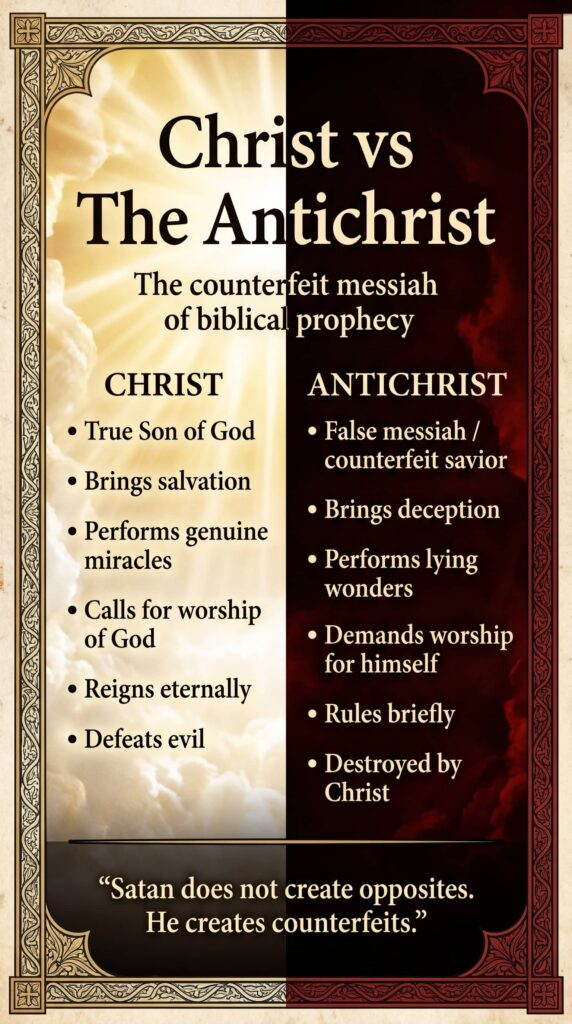
But the antichrist is also, in the deepest sense, a counterfeit messiah, someone who presents themselves as a replacement for Christ, an alternative saviour, a figure who offers what only Christ can genuinely provide but offers it falsely.
The related Greek term pseudokhristos, which appears in Matthew 24 and Mark 13, translates more precisely as false Christ.
Jesus warned his disciples that many false Christs would arise. These are not merely people opposed to Christ in some general sense.
They are people who claim to be him, who present themselves as the fulfilment of messianic hope.
The antichrist, in the fullest biblical sense, is both against Christ and a counterfeit of him simultaneously.
The Five Actual Verses: What John Said
Because these five verses are the only places in all of scripture where the word antichrist actually appears, they deserve to be read carefully rather than assumed to be familiar.
1 John 2:18 and the Many Antichrists
“Children, it is the last hour, and as you have heard that antichrist is coming, so now many antichrists have come. Therefore we know that it is the last hour.”
This verse establishes two things at once: there is a singular antichrist whose coming is expected, and there are already many antichrists present in John’s own time.
This dual usage is the first and most important interpretive tension in the entire subject. John is not making a mistake or being inconsistent.
He is saying that the spirit and character of what the antichrist represents has already manifested in multiple figures, and that this very multiplicity is a sign of the last hour.
These early antichrists, John says in the following verses, went out from us but were not of us, meaning they were people within the Christian community who left it, whose departure revealed that they had never genuinely belonged to it.
The antichrists of John’s day were not external persecutors. They were internal defectors from the faith.
1 John 2:22: The Defining Characteristic
1 John 2:22
“Who is the liar but he who denies that Jesus is the Christ? This is the antichrist, he who denies the Father and the Son.”
John gives a specific theological definition here. The antichrist is one who denies that Jesus is the Christ.
This is not a political description. It is a doctrinal one. The antichrist is, at its core, a theological category: the denial of the messianic identity and the divine sonship of Jesus.
In John’s context, this was likely directed at early Gnostic or proto-Gnostic teachers who denied either that Jesus was genuinely divine, genuinely human, or genuinely the Jewish Messiah.
The first-century church faced multiple versions of this denial, and John regarded all of them as antichrist in character.
1 John 4:3: The Spirit Already in the World
1 John 4:3
“And every spirit that does not confess Jesus is not from God. This is the spirit of the antichrist, which you heard was coming and is now already in the world.”
Here John shifts from a personal description to a spiritual one. The antichrist is not only a coming individual but a spirit, an animating force, a direction in which certain teachings and movements flow.
And this spirit, John says, was already present in the first century. This is significant: the spirit of antichrist is not exclusively a future phenomenon.
It is an ongoing reality that believers must discern and resist in every age.
2 John 1:7: The Deceiver and the Antichrist
2 John 1:7
“For many deceivers have gone out into the world, those who do not confess the coming of Jesus Christ in the flesh. Such a one is the deceiver and the antichrist.”
The final use of the word adds the dimension of deception to the definition. The antichrist is a deceiver.
The specific doctrinal issue, again, is the denial of the incarnation: the refusal to confess that Jesus Christ has come in the flesh.
This targeted the Docetist heresy, which taught that Christ only appeared to have a human body and did not truly suffer or die.
For John, this was not a minor theological quibble. It struck at the heart of the gospel.
The Man of Lawlessness in 2 Thessalonians
If John gives us the word, Paul gives us the most detailed description of the individual figure that most Christians have in mind when they think about the Antichrist.
The passage is 2 Thessalonians 2:1-12, and Paul does not call this figure the antichrist. He calls him the man of lawlessness, or in some translations the man of sin.
The context matters for reading this passage well. The Thessalonian church had been told, apparently by someone claiming to speak with prophetic authority, that the Day of the Lord had already come.
They were confused and unsettled. Paul wrote to correct this urgently.
“Let no one deceive you in any way. For that day will not come, unless the rebellion comes first, and the man of lawlessness is revealed, the son of destruction, who opposes and exalts himself against every so-called god or object of worship, so that he takes his seat in the temple of God, proclaiming himself to be God.”
The Great Apostasy
Paul says that the Day of the Lord cannot come until two things happen first: the rebellion or apostasy, and the revelation of the man of lawlessness.
The Greek word for rebellion here is apostasia, from which we get the English apostasy.
This is a massive, widespread defection from the faith, not a gradual drift but a decisive turning away. Its scale is implied by the fact that Paul treats it as an obvious, unmissable precondition.
The Self-Deification
The man of lawlessness sets himself up in the temple of God and proclaims himself to be God. This is the climax of his presumption.
He does not merely oppose God from the outside. He occupies the place that belongs to God and claims the position that belongs to God.
The temple reference has generated significant debate: does this mean a literal rebuilt Jerusalem temple, or does it refer to the church as the temple of the Spirit, or is it symbolic of any sacred space?
The answer to this question depends significantly on which interpretive framework you bring to the passage.
The Restrainer
Paul refers to something or someone currently holding back the full manifestation of the man of lawlessness.
2 Thessalonians 2:6-7
“And you know what is restraining him now so that he may be revealed in his time. For the mystery of lawlessness is already at work. Only he who now restrains it will do so until he is out of the way.”
Paul is frustratingly elliptical here. He seems to assume the Thessalonians know what he means, but he does not say it plainly for us.
The major scholarly positions on what the restrainer is include: the Roman Empire and its law and order, which most of the church fathers believed;
the Holy Spirit and the church’s presence in the world, which is the most common evangelical view and is closely tied to the pre-tribulation rapture doctrine;
the archangel Michael, who in Daniel 12 is described as the one who stands guard over God’s people; and the preaching of the gospel to all nations, which must be completed before the end can come.
None of these positions has achieved consensus, and each has genuine problems. The honest answer is that the passage’s ambiguity is real.
His End
Paul is explicit about how the man of lawlessness concludes. He will be destroyed by the Lord Jesus, who will consume him with the breath of his mouth and destroy him by the appearance of his coming.
The apparent invincibility of the man of lawlessness is therefore always a temporary phenomenon. His defeat is not in doubt. Only the timing is unknown.
Daniel’s Little Horn and the Antichrist Typology
Before the New Testament, the prophetic imagination was already working with figures that would become templates for later antichrist theology.
The Book of Daniel provides the most important of these, and understanding Daniel is essential for understanding both Paul’s man of lawlessness and John’s beast of Revelation.
Daniel 7: The Little Horn
In Daniel’s vision of four beasts representing four empires, a little horn emerges among ten horns on the fourth beast.
This little horn has eyes like a man and a mouth speaking great things. It wages war against the holy ones and prevails over them.
It attempts to change times and laws. It is given power for a time, times, and half a time, which most interpreters read as three and a half years.
The figure is eventually destroyed when the Ancient of Days sits in judgment and the dominion of the holy ones of the Most High is established.
The structural parallel with the New Testament antichrist is unmistakable: a boastful figure who temporarily prevails against the people of God and is destroyed by divine judgment.
Daniel 9:27 and the Abomination of Desolation
Daniel 9:27
“And he shall make a strong covenant with many for one week, and for half of the week he shall put an end to sacrifice and offering. And on the wing of abominations shall come one who makes desolate, until the decreed end is poured out on the desolator.”
This verse became a crucial piece of the antichrist architecture. A figure makes a covenant, breaks it at the midpoint by ending sacrifice and offering, and desecrates the sacred space.
Jesus explicitly references this verse in his Olivet Discourse, telling his disciples that the abomination of desolation spoken of by the prophet Daniel is a sign to watch for.
The historically grounded interpretation identifies this as already fulfilled by Antiochus IV Epiphanes, the Seleucid king who in 167 BCE stopped the daily temple sacrifices, installed a statue of Zeus in the Jerusalem temple, and sacrificed pigs on the altar.
This sacrilege was so historically significant that it generated the Maccabean revolt.
The futurist interpretation holds that while Antiochus was a historical type, the ultimate fulfilment is a future desecration of a rebuilt temple by the end-times Antichrist.
Daniel 11: The King Who Does as He Pleases
Daniel 11 gives the most sustained portrait of a self-exalting king in the entire Old Testament. This king does as he pleases and exalts himself above every god.
He speaks against the God of gods. He succeeds until the time of wrath is completed. He honours a god of fortresses, a god his ancestors did not know.
These characteristics form a template that New Testament writers clearly had in mind when describing the figure opposing Christ at the end of times.
The historical identification is again Antiochus IV Epiphanes for much of the chapter, but many scholars, both ancient and modern, have argued that the latter sections of Daniel 11 go beyond what Antiochus actually did historically and anticipate a future figure whose actions exceed even the horror of the Maccabean persecution.
Abomination of Desolation: What Jesus Said in Matthew 24
Jesus’s reference to Daniel in the Olivet Discourse is one of the most debated passages in the entire New Testament, and understanding the debate is essential for understanding how people read the antichrist texts.
Matthew 24:15-16
“So when you see the abomination of desolation spoken of by the prophet Daniel, standing in the holy place (let the reader understand), then let those who are in Judea flee to the mountains.”
The parenthetical phrase let the reader understand is remarkable.
Matthew, writing his gospel, inserted a signal to his readers that this passage requires careful interpretation and is not straightforward.
This is itself an invitation to take the interpretive questions seriously.
The preterist reading holds that Jesus was warning his disciples about the Roman destruction of Jerusalem in 70 CE.
The abomination of desolation would be the Roman standards being brought into the sacred precincts of the temple, a desecration that would signal the time to flee.
The instruction to those in Judea to flee immediately was thus practical survival advice for his first-century disciples, and the fact that many Jewish Christians did flee Jerusalem before the Roman siege and survived is taken as evidence that this prediction was fulfilled.
The futurist reading holds that while 70 CE may have been a partial fulfilment, the ultimate reference is to a future desecration of a rebuilt third temple in Jerusalem by the Antichrist at the midpoint of the tribulation period, as described in 2 Thessalonians 2.
On this reading, the instruction to flee is forward-looking advice to future believers living in that period.
The honest position is that both a first-century historical fulfilment and a future eschatological fulfilment are possible, and that the double-fulfilment pattern, where a prophecy is partially fulfilled in one historical event while pointing beyond it to a greater future fulfilment, is a pattern found elsewhere in biblical prophecy.
The Beast of Revelation 13: The Most Famous Image
Revelation 13 is the most cinematically powerful passage in the entire antichrist discussion, and it is the source of most of the popular imagery associated with the Antichrist in Western culture.
It does not use the word antichrist. But from the earliest centuries of the church, the beast of Revelation 13 has been identified with the figure John describes in his letters, the figure Paul describes in 2 Thessalonians, and the figure Daniel describes in his visions.
The Beast from the Sea
Revelation 13:1-2
“And I saw a beast rising out of the sea, with ten horns and seven heads, with ten diadems on its horns and blasphemous names on its heads. And the beast that I saw was like a leopard; its feet were like a bear’s, and its mouth was like a lion’s mouth. And to it the dragon gave his power and his throne and great authority.”
The composite animal imagery deliberately echoes Daniel 7, where the four beasts representing four empires were a lion, a bear, a leopard, and a terrifying fourth creature.
John’s single beast incorporates all four, suggesting that it represents the final, concentrated expression of all the world-dominating imperial powers that have ever existed.
The sea from which it rises was, in ancient Jewish symbolism, the source of chaos and disorder. Political empires in biblical imagination arose from the turbulent sea of nations.
The beast is an imperial power of overwhelming scope, empowered by the dragon who is identified in Revelation 12 as the ancient serpent, the devil, Satan.
One of the seven heads has a fatal wound that has been healed, and the world marvels at this apparent resurrection.
This detail has generated enormous speculation. Some read it as a literal individual who dies and returns. Others read it as an empire that appeared to fall and revived.
The preterist view often identifies it with Nero and the Nero redivivus myth, the widespread first-century rumour that Nero had not really died and would return from the east at the head of a Parthian army.
What the Beast Does
The beast is given authority to act for forty-two months, the same three and a half years that appear in Daniel.
During this period it speaks great blasphemies against God, blasphemes his name and his tabernacle, and makes war against the saints and conquers them.
It is given authority over every tribe, people, language, and nation, and all who dwell on earth worship it, except those whose names are written in the Lamb’s book of life.
This is not merely political domination. It is religious domination. The beast does not merely control territory or economies.
It demands worship. It claims the allegiance that belongs to God alone.
This is the deepest characteristic of the antichrist across all the biblical texts: it is not content with power. It wants worship.
The Beast from the Earth: The False Prophet
Revelation 13 describes a second beast that rises from the earth rather than the sea.
This second beast has two horns like a lamb but speaks like a dragon, a chilling image of religious deception: it looks like a gentle sheep but speaks with the voice of the enemy.
It exercises all the authority of the first beast, performs great signs including calling fire from heaven, deceives the inhabitants of the earth, and enforces the worship of the first beast.
This second beast is called the false prophet in Revelation 16:13, 19:20, and 20:10.
It represents the religious dimension of the antichrist system: the institutional religion that legitimises the political power of the first beast and leads people into false worship through signs and wonders.
The pairing of the beast and the false prophet as the two earthly faces of the dragon’s power creates what theologians call the unholy trinity: the dragon counterfeiting the Father, the beast counterfeiting the Son, and the false prophet counterfeiting the Holy Spirit.
The Mark of the Beast and the Number 666
No single passage in the entire antichrist discussion has generated more popular attention, more speculation, and more serious scholarly debate than Revelation 13:16-18.
Revelation 13:16-18
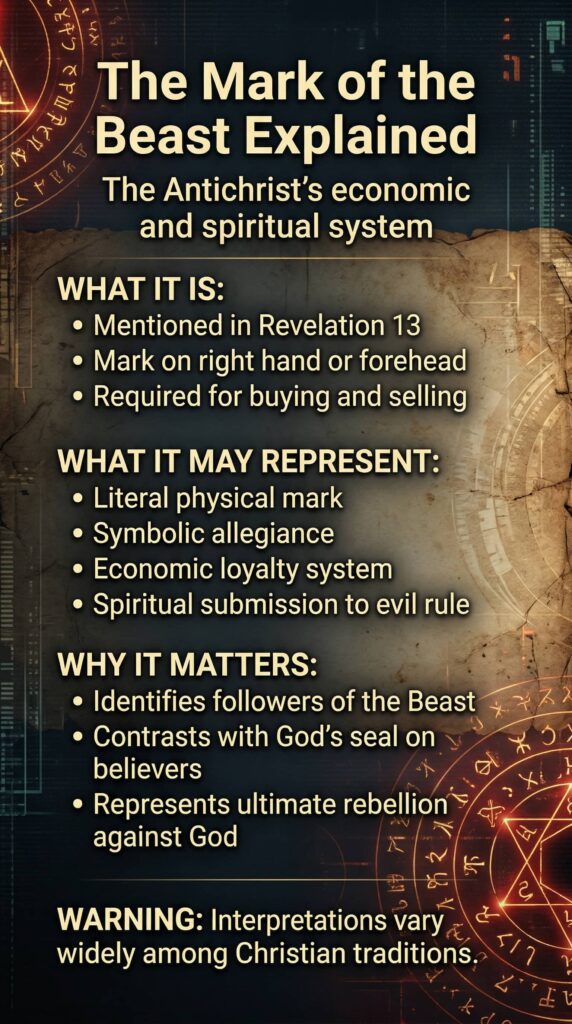
“Also it causes all, both small and great, both rich and poor, both free and slave, to be marked on the right hand or the forehead, so that no one can buy or sell unless he has the mark, that is, the name of the beast or the number of its name. This calls for wisdom: let the one who has understanding calculate the number of the beast, for it is the number of a man, and his number is 666.”
What the Mark Represents
The mark is a symbol of belonging and allegiance. In the ancient world, marks were used to identify slaves, soldiers, and devotees of particular gods.
Being marked meant belonging to someone. The mark of the beast identifies its bearers as belonging to the beast’s system, as having made the choice to align themselves with its authority rather than God’s.
The placement on the right hand or forehead is significant and has been connected by many scholars to the Jewish practice of phylacteries, the small leather boxes containing scripture passages that observant Jewish men wore on their hand and forehead during prayer.
The mark of the beast would then be a direct parody of this practice: rather than being marked by the commands of God, its bearers are marked by submission to the beast.
The contrast is between two kinds of devotion, two competing claims on the totality of a person’s life and allegiance.
The economic consequence of not having the mark, inability to buy or sell, shows that the beast’s system extends beyond formal religious worship into every dimension of daily material life.
Resistance is made costly at the most practical level. This connects to the first-century context in which Christians who refused to offer incense to the emperor’s image faced genuine economic and social exclusion.
What 666 Means: Four Scholarly Positions
The text itself says this calls for wisdom and invites calculation, signalling that the number is a puzzle to be interpreted rather than a literal count. Four major interpretive positions exist.
Preterist Interpretation: Nero Caesar. Since the 1830s, the most developed scholarly argument has been that 666, using the ancient practice of gematria (assigning numerical values to letters), spells Nero Caesar when the Greek form of the name is transliterated into Hebrew and the values summed.
Nero, the first Roman emperor to systematically persecute Christians, fits much of the beast’s description: a murderer who declared himself divine, who persecuted the saints, and whose reign ended with his own suicide and a civil war that nearly destroyed Rome.
An early Greek manuscript tradition reads 616 rather than 666, which corresponds to the Latin form of Nero’s name, a detail that strengthens the Nero hypothesis for many scholars.
Futurist Interpretation: A Future Individual. In the dominant modern evangelical reading, 666 identifies a specific future person whose identity cannot be known until the tribulation period begins.
Various attempts to pre-calculate the number have been made throughout history and have consistently been wrong.
The futurist position generally advises against premature identification and holds that the number will be recognisable in its proper eschatological context.
Idealist Interpretation: The Number of Imperfection. In this reading, the number’s significance is symbolic rather than computational.
Seven is the biblical number of completeness and divine perfection. Six falls short of seven. Three sixes, 666, represents the ultimate human claim to be what only God is: the supreme being worthy of worship.
The beast, in claiming divinity, is always 666: always short of the 777 it pretends to be. This interpretation emphasises the theological meaning over any specific historical identification.
Historicist Interpretation: A Historical Pattern. Historicists, who view Revelation as a panorama of church history, have applied 666 to various historical figures and institutions.
The Protestant Reformers most commonly applied it to the papacy, with various calculations involving Latin titles.
Seventh-day Adventists have maintained a version of this historicist reading.
From a modern scholarly perspective, the historicist identification faces the difficulty that many different names can be made to produce 666 with sufficient creativity in choosing the language and title used.
What the Mark Is Not
Given the enormous popular interest in the mark of the beast, it is worth being direct about what the biblical text does not say.
The text does not say the mark is a microchip. It does not say it is a vaccine. It does not say it is a QR code, a barcode, a cryptocurrency wallet, or any other modern technological system.
None of these appear in Revelation and none were remotely part of the world in which Revelation was written.
This does not mean modern technologies cannot be used for oppressive ends that bear a resemblance to the mark’s economic control function.
They can, and the pattern the mark describes, the weaponising of economic participation to enforce ideological conformity, is a genuinely recurring feature of authoritarian systems.
But the specific identification of any current technology as the mark of the beast involves much more speculation than the text itself supports.
Four Ways Scholars Read These Texts
One of the most important things a reader can understand about the antichrist discussions is that sincere, intelligent, faithful Christians have read the same biblical texts and reached substantially different conclusions.
This is not a sign of the texts’ failure. It is a sign that they are complex, multilayered, and capable of genuine interpretation rather than simple decoding.
There are four main interpretive frameworks, and knowing them is essential for understanding why the debates are structured the way they are.
Preterism
Preterism, from the Latin praeter meaning past, holds that the prophecies of Daniel and Revelation were fulfilled in the first century, primarily in the events surrounding the Jewish-Roman War and the destruction of Jerusalem in 70 CE.
The beast is the Roman Empire, particularly Nero. The false prophet is the Roman imperial cult.
The mark of the beast is the economic coercion of emperor worship. The abomination of desolation was the Roman standards in the temple precincts.
Partial preterism, which is the orthodox version of this position, maintains that while most of Revelation was fulfilled in the first century, certain elements including the physical return of Christ, the general resurrection, and the final judgment remain future events.
Full preterism, which holds that everything including the Second Coming was fulfilled in 70 CE, is considered outside the bounds of Christian orthodoxy by virtually all major denominations.
Futurism
Futurism, which is the dominant framework in modern American evangelical Christianity, holds that the central prophecies of Daniel and Revelation are yet to be fulfilled in a future tribulation period.
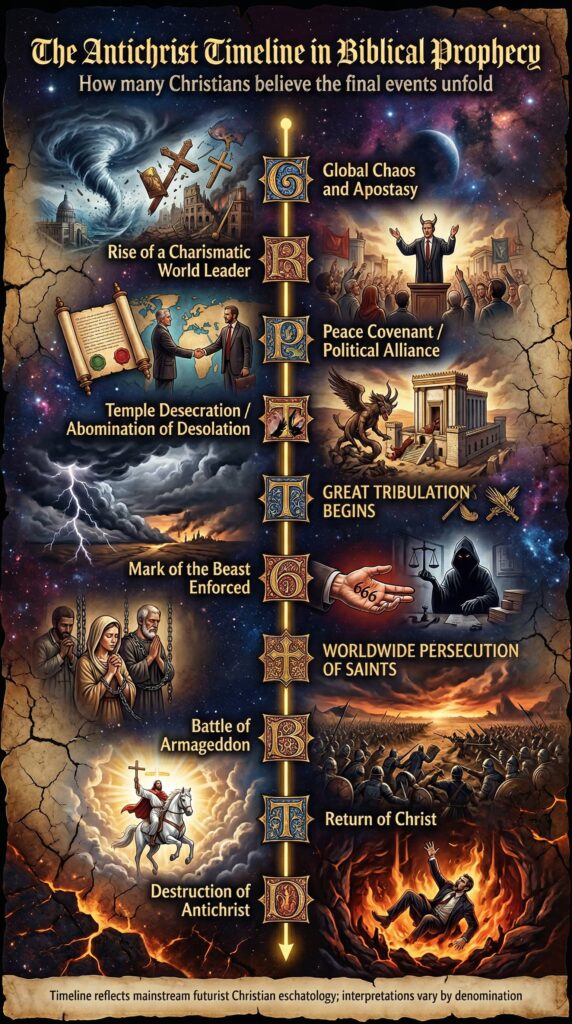
The Antichrist is a specific individual who will arise at the end of history, make a seven-year covenant with Israel, break it at the midpoint, desecrate a rebuilt Jerusalem temple, demand global worship, and enforce the mark of the beast before being destroyed at the Second Coming of Christ.
This framework was developed systematically by John Nelson Darby in the nineteenth century as part of dispensationalism and was popularised through the Scofield Reference Bible, Hal Lindsey’s The Late Great Planet Earth, and the Left Behind series.
It is not the universal historic position of the church but has become the default eschatological framework in much of American evangelicalism.
Historicism
Historicism interprets Revelation as a panoramic map of church history from John’s day to the Second Coming of Christ.
The various seals, trumpets, and bowls represent identifiable periods and events in Western history.
The beast and the antichrist figure have been historically identified in this framework primarily with the papacy, an identification made by nearly all the major Protestant Reformers including Martin Luther, John Calvin, John Knox, and William Tyndale.
This identification was not made lightly or purely polemically. The Reformers believed they had strong scriptural and historical evidence for it, including the papacy’s claim to supreme authority over church and state, the persecution of Protestant believers, and the use of Latin titles that they calculated to produce 666.
While this identification is largely rejected in modern ecumenical scholarship, it dominated Protestant eschatology for centuries and shaped enormous amounts of Christian thought and culture.
Idealism
Idealism, also called the symbolic or allegorical approach, treats Revelation as a timeless portrayal of the cosmic conflict between good and evil, not intended to predict specific historical events at all.
The beast represents any oppressive political power that sets itself against God and his people.
The mark represents any system of allegiance that excludes those who will not comply. The number 666 represents the fundamental inadequacy of human systems that claim divine status.
On this reading, Revelation is always relevant because every age has its beasts and its marks.
The book’s value lies not in its predictive accuracy but in its theological categories, which name the spiritual character of the forces that oppose the kingdom of God in every historical period.
The Long History of Failed Identifications
One of the most instructive facts about the antichrist tradition is the history of identifications that seemed obvious and certain to the people making them and turned out to be wrong.
This history is not an argument against taking the biblical texts seriously. It is an argument for holding specific identifications with significantly more humility than is usually shown.
Nero was the most historically grounded identification, as we have seen.
Antiochus IV Epiphanes matches Daniel’s descriptions with remarkable precision. But the list that follows is a catalogue of confident failures.
The medieval papacy was identified as the antichrist by the Reformers with great conviction and considerable textual argument.
Each subsequent pope was identified by Protestant writers as the current embodiment of this antichrist system.
Pope Leo X was Luther’s specific identification. Pope Pius IX was widely identified in the nineteenth century.
This identification proved impossible to sustain as the relationship between Protestantism and Catholicism evolved.
Napoleon Bonaparte was identified as the Antichrist with great specificity by multiple serious Protestant scholars who applied the prophetic numbers and dates to his career.
Kaiser Wilhelm II generated similar identification during the First World War. Mussolini was identified as the revived Roman Empire’s leader by prophecy writers of the 1930s.
Adolf Hitler, whose actions genuinely came closer to the antichrist typology than most could have imagined, was widely identified during the Second World War.
The Soviet Union and its leaders generated a generation of antichrist speculation, particularly focused on Mikhail Gorbachev, whose prominent birthmark on his forehead was solemnly connected to the mark of the beast by a number of otherwise serious prophecy teachers.
Henry Kissinger, for a period, was identified by writers who calculated his name in Hebrew to produce 666.
Various American presidents have been earnestly identified as the Antichrist by people on the opposite end of the political spectrum in almost every election cycle.
The pattern is consistent and instructive. The Antichrist is always identified with the most frightening political figure or system of the moment.
The identification is made with great confidence. It turns out to be wrong. This does not mean the biblical texts are meaningless.
It means that the texts are not as easy to apply to specific historical figures as they appear, and that the history of identifications should produce in readers a significant degree of caution about the next confident identification they encounter.
The Antichrist and the Islamic Dajjal
Readers who have followed this eschatological series will already have encountered detailed coverage of the Dajjal in the dedicated article.
But the parallel between the biblical Antichrist and the Islamic Dajjal is one of the most remarkable convergences in comparative religion and deserves specific attention here.
Both figures are supreme deceivers who arise near the end of history. Both perform counterfeit miracles to establish their false claims.
Both have identifying marks: the Antichrist’s number 666 and the Dajjal’s forehead inscription K-F-R. Both claim divine status.
Both are defeated by the returning Jesus Christ. Both are associated with control over economic life and the coercion of allegiance.
The differences are equally significant. The Dajjal in Islamic eschatology is primarily a supernatural deceiver of faith, while the Antichrist in most Christian readings is primarily a political tyrant who also demands religious worship.
The theological frameworks surrounding the returning Jesus differ substantially: in Christianity, he returns as the divine Son of God; in Islam, he returns as a prophet completing a specific mission.
The Dajjal is described with specific physical characteristics including his one blind eye, while the biblical Antichrist is not given physical distinguishing marks.
The theological thesis of Joel Richardson, which has attracted significant attention, holds that the Islamic Mahdi is actually the figure who corresponds to the biblical Antichrist, and that the Islamic Dajjal corresponds to the returning Christ of Revelation 19 in the Islamic narrative, a proposal that his Islamic eschatological framework would cast as the true returning Messiah.
This is a provocative identification that Muslims strongly reject but that has generated serious scholarly engagement.
Readers interested in the full Islamic framework should consult the dedicated articles on the Dajjal and the Major Signs of Qiyamah in this series.
The Spirit of Antichrist at Work Now
John’s letters make clear that the antichrist is not only a future individual but a present spiritual reality.
Understanding this dimension is arguably the most practically important aspect of the entire subject.
1 John 4:1-3
“Beloved, do not believe every spirit, but test the spirits to see whether they are from God, for many false prophets have gone out into the world. By this you know the Spirit of God: every spirit that confesses that Jesus Christ has come in the flesh is from God, and every spirit that does not confess Jesus is not from God. This is the spirit of the antichrist, which you heard was coming and is now already in the world.”
The spirit of antichrist, as John describes it, is a specific theological orientation. It does not confess that Jesus Christ has come in the flesh.
This was directed at Docetists in John’s day, who denied the genuine humanity of Christ. But the principle extends to every teaching that systematically distorts or denies the person of Christ as revealed in the gospel.
The spirit of antichrist is not identified with any particular political ideology or cultural movement in scripture. John’s criterion is theological: what does it say about Jesus?
Any movement, teaching, or influence that leads people away from the genuine Jesus of the New Testament, that substitutes a different Jesus, a Jesus of pure spirit without real flesh, a Jesus who did not really die, a Jesus who is merely one enlightened teacher among many, or a Jesus who did not really rise bodily from the dead, exhibits the spirit of antichrist in John’s sense.
This is different from saying that anyone who disagrees with Christians about theology is an antichrist.
John’s category is specific: it is the denial of the core confession about Jesus that distinguishes authentic Christian faith from what presents itself as Christian while undermining the faith’s foundation.
The practical implication John draws from this is spiritual discernment: test the spirits. Not every teacher who speaks in the name of Christ is speaking from the Spirit of Christ.
The test is theological: what do they say about Jesus? Not whether they are eloquent, popular, powerful, or healing. What do they actually teach about the one whose name they invoke?
What Happens to the Antichrist
Scripture is explicit about how the story of the antichrist ends, and this ending is theologically significant.
2 Thessalonians 2:8
“And then the lawless one will be revealed, whom the Lord Jesus will kill with the breath of his mouth and bring to nothing by the appearance of his coming.”
Paul’s description of the Antichrist’s destruction is deliberately anti-climactic in terms of what it requires of Christ.
There is no great battle. No protracted struggle. The breath of his mouth. The brightness of his appearing.
The man of lawlessness, who seated himself in the temple of God and proclaimed himself divine, is not destroyed by a superior force after a close contest.
He is undone by the mere appearance of the real thing.
Revelation 19:20 elaborates the scene: the beast and the false prophet are captured at the return of Christ on the white horse and thrown alive into the lake of fire burning with sulfur.
In Revelation 20:10, after the millennium, the devil joins them there. All three members of the unholy trinity, the dragon, the beast, and the false prophet, end in the same place.
The theological significance of this ending is not primarily punitive, though it is that. It is revelatory.
The entire project of the antichrist, the attempt to be what only God is, to claim the worship and allegiance that belong to God alone, to substitute a false messiah for the real one, is exposed as the fundamental failure it always was.
The man of lawlessness, for all his apparent power over the whole earth, was never a genuine rival.
He was always a creature overstepping the limits of creatureliness. And the Creator requires only a word to end it.
Is the Antichrist Alive Now?
This question generates enormous search traffic and enormous amounts of irresponsible speculation. It deserves an honest, direct answer.
The truthful answer is: nobody knows. And the reason nobody knows is not a failure of intelligence or faith.
It is built into the structure of what scripture says about the antichrist’s revelation.
Paul says the man of lawlessness will be revealed at the appointed time, when the restrainer is taken out of the way.
His appearance is not something that can be deduced from current conditions or calculated from historical events. It is something that will be unmistakably evident when it happens.
John Chrysostom, who preached in Antioch and Constantinople in the late fourth and early fifth centuries and is widely regarded as the greatest preacher in the history of the early church, specifically warned against speculating about the Antichrist’s identity.
He said that knowing what Paul had written was sufficient protection against deception and that further speculation was unnecessary and potentially harmful. His warning has not aged badly.
The history of identifications reviewed earlier shows that every generation that was certain it had identified the Antichrist was wrong.
This is not a small sampling error. It is a consistent pattern across sixteen centuries of Christian eschatology.
The practical implication is not that the Antichrist is not coming. It is that the manner in which he will be identified when he does come is not through the kind of prophetic calculation that has historically been applied.
When he arrives, the clarity will not come from prophecy charts and gematria tables. It will come from the unmistakable nature of the events themselves.
The pastoral instruction that several of the sources consulted above share, and that the scripture itself supports, is this: do not spend your time looking for the Antichrist. Spend your time looking for Jesus Christ.
Frequently Asked Questions
Who is the Antichrist in the Bible?
The Bible describes the antichrist in two ways simultaneously. In 1 and 2 John, the term refers both to a spirit of opposition to Christ already present in the world and to a coming individual figure.
Other biblical texts describe related figures: the man of lawlessness in 2 Thessalonians, the little horn in Daniel, and the beast of Revelation 13.
Whether these are all descriptions of the same individual or distinct but related figures is debated among scholars.
How many times is the word antichrist in the Bible?
The specific word antichrist appears five times in the Bible, all in the letters of the Apostle John: twice in 1 John 2:18, and once each in 1 John 2:22, 1 John 4:3, and 2 John 1:7. The word does not appear in Revelation, Daniel, or any of Paul’s letters.
What is the mark of the beast?
The mark of the beast appears in Revelation 13:16-18 and is described as a mark on the right hand or forehead without which no one can buy or sell. It identifies its bearers as belonging to the beast’s system of authority. Its nature is debated:
it may be a literal physical mark, an economic system of allegiance, or a symbolic representation of submission to any power that opposes God. The text itself says it requires wisdom to understand.
What does 666 mean?
The number 666 has been interpreted in multiple ways. Preterist scholars argue it is a gematria encoding of Nero Caesar, whose name in Greek transliterated into Hebrew produces the value 666.
The idealist interpretation holds that 6 is the number of man falling short of divine perfection (7), and 666 is the ultimate human claim to divinity.
Futurists hold that it identifies a specific future individual whose identity will be known in its proper eschatological context.
What is the abomination of desolation?
The abomination of desolation is a phrase from Daniel 9:27, referenced by Jesus in Matthew 24:15, describing the desecration of the sacred space of the temple by a blasphemous figure or act.
It was historically fulfilled by Antiochus IV Epiphanes in 167 BCE. Futurist interpreters hold that it will be fulfilled again by the end-times Antichrist desecrating a rebuilt Jerusalem temple at the midpoint of the tribulation period.
Who is the man of lawlessness in 2 Thessalonians?
The man of lawlessness is Paul’s description in 2 Thessalonians 2 of a figure who will be revealed before the Day of the Lord.
He will seat himself in the temple of God, proclaim himself to be God, perform counterfeit signs and wonders by the power of Satan, and be destroyed by the Lord Jesus at his coming.
This figure is widely identified with the Antichrist, though Paul uses different terminology.
What is the restrainer in 2 Thessalonians 2?
Paul refers to a restrainer that currently holds back the full manifestation of the man of lawlessness.
He does not identify the restrainer explicitly. Major scholarly positions include the Roman Empire, the Holy Spirit working through the church, the archangel Michael, and the proclamation of the gospel. No consensus has been reached on this question.
Is the Antichrist a real person or a system?
The biblical texts support both readings simultaneously. The spirit of antichrist is clearly a pattern or orientation rather than a single individual, and John says many antichrists were already present in his day.
But the man of lawlessness in Paul and the beast in Revelation are described in personal terms suggesting an individual.
Most interpreters hold that the spirit of antichrist manifests in various individuals and systems throughout history while also pointing toward a final individual figure at the end of times.
What happens to the Antichrist?
The Lord Jesus destroys the man of lawlessness with the breath of his mouth and the brightness of his appearing, according to 2 Thessalonians 2:8.
In Revelation 19:20, the beast and the false prophet are captured at the return of Christ and thrown into the lake of fire. In Revelation 20:10, after the millennium, they are joined there by the devil.
What is the spirit of antichrist?
The spirit of antichrist, as described by John in 1 John 4:3, is any spirit or teaching that does not confess that Jesus Christ has come in the flesh.
It is not identified with political ideologies or cultural movements but with the specific denial or distortion of the person of Jesus Christ.
John says this spirit was already active in the world in his own time.
Is the Antichrist the same as the Islamic Dajjal?
The two figures share significant parallels: both are supreme deceivers of the end times, both perform counterfeit miracles, both claim divine status, and both are defeated by the returning Jesus Christ.
The differences are also significant: the Dajjal is primarily a supernatural deceiver of faith while the Antichrist is primarily a political tyrant, and their theological frameworks differ substantially.
Some scholars, including Joel Richardson, have argued that the Islamic Mahdi corresponds to the biblical Antichrist and the Dajjal corresponds to the returning Christ, a thesis that Muslims strongly reject.
Has the Antichrist been identified?
Many identifications have been made throughout Christian history, including Nero Caesar, Antiochus IV Epiphanes, various popes, Napoleon, Hitler, Soviet leaders, and various contemporary political figures.
Every specific identification has turned out to be wrong. The pattern of failed identifications across sixteen centuries suggests significant caution is warranted about any current or future specific identification.
Conclusion: What Scripture Says and What It Is For
Reading through everything the Bible actually says about the antichrist, without importing the frameworks that centuries of interpretation have built around it, produces a clearer and in some ways more demanding picture than the popular version.
Scripture clearly teaches that there is a spirit of antichrist already at work in the world, characterised by the systematic denial of who Jesus is.
It clearly teaches that many antichrists have arisen throughout church history and will continue to arise.
It clearly teaches that a figure of extraordinary deceptive power will arise at the end of times, claiming divine authority, performing counterfeit signs, establishing a system of economic and religious coercion, and being destroyed by the return of Jesus Christ.
What scripture does not definitively provide is a decoded map of current events, a reliable method for identifying the Antichrist before his time, or a precise timeline of when these events will occur.
The history of those who claimed to provide these things is not encouraging.
The purpose of the antichrist texts is not to satisfy eschatological curiosity or to provide material for prophetic speculation.
John wrote his letters to people being troubled by false teachers and told them that knowing the theological criterion for discernment, what do they say about Jesus, was the protection they needed.
Paul wrote to people who had been thrown into confusion by claims that the Day of the Lord had already come and told them that the events had not yet happened and that they should go back to work and stop being anxious.
Jesus warned his disciples about false Christs and false prophets and told them not to be deceived or alarmed.
The consistent pastoral instruction of scripture on this subject is not: be vigilant in scanning current events for signs of the Antichrist.
It is: know the Christ so well that no counterfeit will deceive you. Maintain the theological clarity that confesses who Jesus is.
Be grounded enough in what is true that what is false, however spectacular its signs and wonders, cannot uproot you.
That instruction is as necessary and as timely now as it was when John first wrote it, in the last hour that has been pressing on the church since the moment Jesus left and has not lifted yet.
Sources: The Holy Bible (ESV, NIV, NKJV) | 1 John, 2 John, 2 Thessalonians | Daniel 7, 8, 9, 11 | Matthew 24 | Revelation 13, 19, 20
Historical theology: Justin Martyr, Irenaeus, Tertullian, John Chrysostom, Martin Luther, John Calvin | Modern scholarship: G.K. Beale, R.C. Sproul, Joel Richardson
WorldEschatology.com | All scriptural citations drawn from canonical Christian scripture