
Imagine the scene that has been described in tens of millions of copies of the Left Behind novels.
Planes falling from the sky because pilots have vanished mid-flight. Highways full of driverless cars.
Hospitals where surgeons have disappeared from operating theatres.
Every Christian in the world suddenly and silently removed from the earth, leaving behind a confused and terrified population to face seven years of tribulation under the Antichrist.
That image is so vivid, so narratively compelling, and so thoroughly embedded in the popular religious imagination of American evangelical Christianity, that it has effectively become the default picture of what the end times will look like for millions of people.
Eighty million copies of the Left Behind series sold. The word raptured has entered ordinary English.
The pre-tribulation rapture feels, to those who grew up with it, like the obvious and straightforward reading of what the Bible says.
But here is the honest starting point: the word rapture does not appear in any English Bible translation.
The doctrine of a pre-tribulation rapture was not taught by any major Christian theologian before the 1820s.
The majority of the world’s two billion Christians do not hold this view.
And the primary passage on which rapture theology rests, 1 Thessalonians 4:13-18, is a passage about comfort for the bereaved that does not mention a tribulation, a seven-year period, or a separation of events seven years apart.
None of this settles the debate. The pre-tribulation position has serious biblical arguments behind it, defended by careful and intelligent scholars.
But it does mean that the question deserves honest engagement rather than the assumption that popular familiarity equals theological certainty.
This article goes through everything: where the word rapture comes from and what the Greek behind it actually means;
the primary biblical passages on which rapture theology is built; the five main theological positions on the timing and nature of the rapture; the history of how the pre-tribulation doctrine developed and when it first appeared;
the strongest arguments for and against each view; what Catholics, Orthodox, Reformed, and majority-world Christians believe; and what the debate means for how ordinary Christians should think about the return of Christ.
The Word Rapture: Where It Comes From
Before any theology, the linguistic history of the word rapture is worth understanding because it immediately establishes something important: the concept was not always called by this name, and the name carries implications that shape how people read the texts.
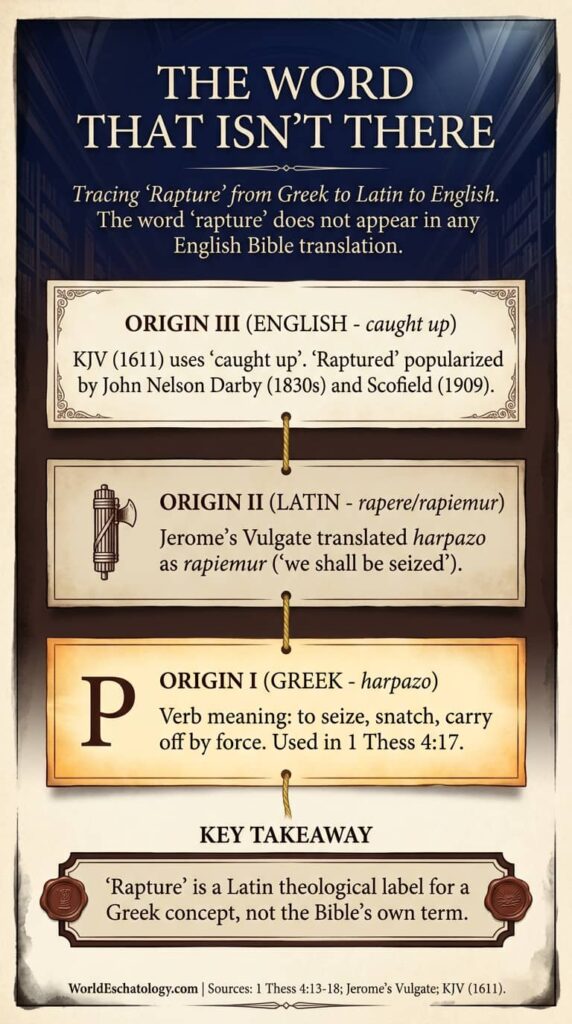
The word rapture comes from the Latin raptura, itself derived from the verb rapere, meaning to seize, to snatch, or to carry off by force.
When Jerome translated the Greek New Testament into Latin in the late fourth century, producing the translation known as the Vulgate that became the Catholic Church’s official Bible for over a thousand years, he rendered the Greek verb harpazo in 1 Thessalonians 4:17 as rapiemur, the first-person plural future passive of rapere.
We shall be seized. We shall be snatched away.
When Protestant translators produced English Bibles working directly from the Greek rather than the Latin, they translated harpazo as caught up rather than raptured.
The King James Version, published in 1611, reads: then we which are alive and remain shall be caught up together with them in the clouds to meet the Lord in the air.
The word raptured is not there. It never became part of the standard English biblical vocabulary the way justification and sanctification did.
The doctrine of the rapture was subsequently named after the Latin word in academic theological discussion, and the name eventually entered popular usage through the dispensationalist movement.
The Greek word harpazo itself is revealing. It means to seize upon with force, to snatch, to carry away.
It is used elsewhere in the New Testament: in Acts 8:39, the Spirit of the Lord snatched Philip away after he baptised the Ethiopian eunuch;
in 2 Corinthians 12:2-4, Paul describes being caught up to the third heaven in what is likely a vision or mystical experience;
in Revelation 12:5, the male child is caught up to God and his throne. In each use, the word describes a sudden, forceful divine action that removes someone from one place to another.
What it does not tell us is whether this removal is secret or public, temporary or permanent, before or after any tribulation period.
Those questions are answered, or not answered, by context rather than by the word itself.
The Foundation Text: 1 Thessalonians 4:13-18
The primary biblical basis for rapture theology is 1 Thessalonians 4:13-18. Understanding this passage carefully, including its context and purpose, is the most important step in evaluating the various rapture positions.
Paul wrote 1 Thessalonians to a church he had founded and then had to leave abruptly.
Some members of the Thessalonian church had died since Paul’s departure, and the surviving believers were grieving not just with ordinary grief but with a specific theological anxiety:
they were worried that their dead brothers and sisters had somehow missed out on the return of Christ.
If the Lord returns and the living are transformed and gathered to him, what happens to those who already died? Did they lose their place?
Paul writes to correct this anxiety and provide comfort. His answer is not a complex eschatological timeline.
It is an assurance: the dead in Christ will not be left out. They will rise first. Then the living will join them. And together they will be with the Lord.
1 Thessalonians 4:16-17
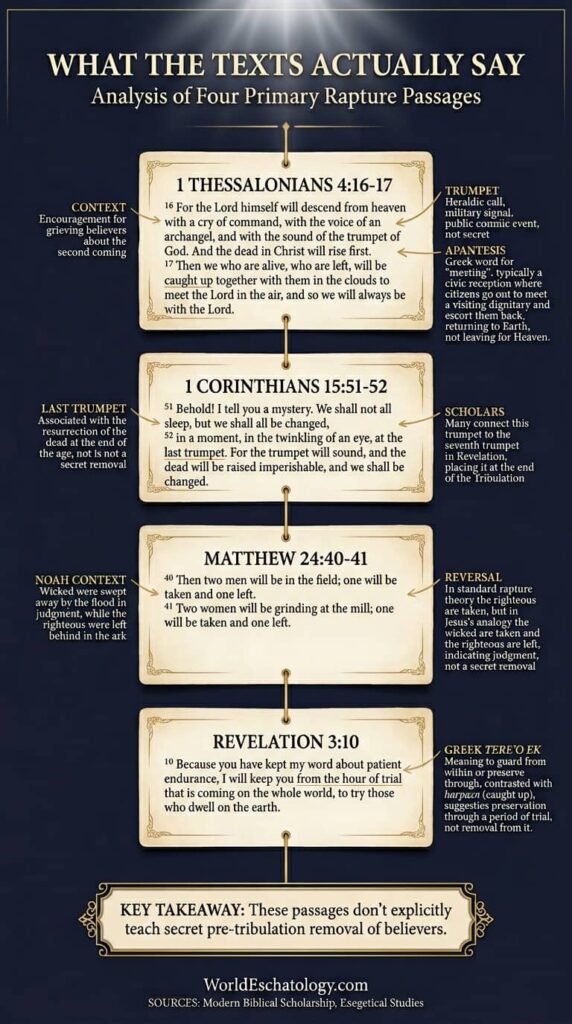
“For the Lord himself will descend from heaven with a cry of command, with the voice of an archangel, and with the sound of the trumpet of God. And the dead in Christ will rise first. Then we who are alive, who are left, will be caught up together with them in the clouds to meet the Lord in the air, and so we will always be with the Lord.”
Several features of this passage are important to examine carefully rather than assume.
First, the descent of Christ is described as loud, unmistakably public, and dramatic: a cry of command, the voice of an archangel, the sound of the trumpet of God.
This does not obviously describe a secret, invisible event. Pre-tribulationists who hold a secret rapture have responses to this observation, but the text itself emphasises public drama rather than hiddenness.
Second, the phrase to meet the Lord in the air uses the Greek word apantesis, which was a technical term in the Greco-Roman world for a specific cultural custom:
when a dignitary or ruler was approaching a city, the citizens would go out to meet him and then escort him back into the city.
The crowd going out to meet the dignitary was not being taken away from their city permanently.
They were greeting the arriving guest and bringing him in. Post-tribulationists argue that this detail is decisive:
the caught up believers are going out to meet the returning Christ and will then accompany him back to earth, just as the Thessalonian crowd would escort a visiting Roman official into their city.
Third, the passage says nothing about a tribulation, a seven-year period, or a separation between this event and the Second Coming.
The conclusion so we will always be with the Lord is the theological point, not a statement about timing.
And Paul’s instruction at the end, comfort one another with these words, establishes the pastoral purpose of the entire passage: it is meant to produce comfort for the bereaved, not to construct an eschatological timeline.
The Second Key Passage: 1 Corinthians 15:50-55
The second primary passage in rapture theology comes from Paul’s great chapter on resurrection in 1 Corinthians 15.
Having argued at length for the reality and necessity of bodily resurrection, Paul concludes with a description of what will happen to believers who are still alive when Christ returns.
1 Corinthians 15:51-52
“Behold, I tell you a mystery: we shall not all sleep, but we shall all be changed, in a moment, in the twinkling of an eye, at the last trumpet. For the trumpet will sound, and the dead will be raised imperishable, and we shall be changed.”
Paul calls this a mystery in the technical theological sense he uses consistently: a truth that was not previously disclosed but is now being revealed.
The mystery is specifically that not all believers will die before Christ’s return. Some will be alive and will be changed, transformed into their resurrection state, without passing through physical death.
This transformation happens in a moment, in the twinkling of an eye.
The phrase at the last trumpet is one of the most debated details in the entire rapture discussion.
For post-tribulationists, the last trumpet of 1 Corinthians 15 is the same event as the seventh trumpet of Revelation 11, which sounds at the end of the tribulation period and is accompanied by voices in heaven declaring that the kingdom of the world has become the kingdom of Christ.
If the trumpet in 1 Corinthians 15 is the last trumpet, and if Revelation 11’s seventh trumpet is also the last trumpet, they are most naturally read as the same event, placing the transformation of believers at the end of the tribulation rather than before it.
Pre-tribulationists respond that these are different trumpets with different purposes and different audiences.
The trumpet of 1 Corinthians 15 is directed at the church. The seventh trumpet of Revelation 11 is directed at the world.
The different contexts and different purposes mean they need not be the same event.
The word last in Paul’s usage may mean the last trumpet of this dispensation or the last trumpet of the church age rather than the last trumpet in any absolute cosmic sense.
This is a genuine exegetical disagreement between serious scholars, not a case where one side has an obvious exegetical advantage.
The honest answer is that the identification of these two trumpets is possible but not certain, and both the identification and the non-identification are defended by careful scholars.
Other Passages Used in Rapture Theology
Beyond 1 Thessalonians 4 and 1 Corinthians 15, rapture theology draws on several other passages, and each deserves honest examination.
John 14:1-3
John 14:1-3
“Let not your hearts be troubled. Believe in God; believe also in me. In my Father’s house are many rooms. If it were not so, would I have told you that I go to prepare a place for you? And if I go and prepare a place for you, I will come again and will take you to myself, that where I am you may be also.”
Pre-tribulationists cite this as a description of the rapture: Christ coming to take believers to the Father’s house, a separate event from his coming to the earth at the Second Coming.
The Father’s house language suggests a heavenly destination, consistent with the picture of believers being taken to heaven before the tribulation.
Post-tribulationists respond that this passage is Jesus’s general promise to his disciples about the ultimate reunion with him, not a specific description of a timing event.
The promise that where I am you may be also is fulfilled in various ways across the New Testament, including at death when Paul says to be absent from the body is to be present with the Lord, and ultimately at the Second Coming when believers are transformed and gathered.
The passage does not say anything about timing relative to a tribulation.
Matthew 24:40-41
Matthew 24:40-41
“Then two men will be in the field; one will be taken and one left. Two women will be grinding at the mill; one will be taken and one left.”
This passage has been used extensively in pre-tribulation teaching as a description of the rapture: believers are suddenly taken while unbelievers are left behind.
The title of the Left Behind series comes directly from this reading.
However, a careful reading of the context produces a very different picture.
In the preceding verses, Matthew 24:37-39, Jesus compares the coming of the Son of Man to the flood of Noah: as in the days of Noah, they were eating and drinking, marrying and giving in marriage, until the day when Noah entered the ark, and they were unaware until the flood came and swept them all away.
The ones swept away in the flood are the wicked, not the righteous. Noah and his family were left, not taken.
If the same pattern applies to verses 40-41, the ones taken may be taken in judgment, as the flood took the wicked, while the ones left are the righteous who remain as Noah remained.
This is the reading of a growing number of evangelical scholars, and it represents a direct reversal of the popular pre-tribulation reading: those left behind are the saved, not the unsaved.
The implication is significant: far from supporting a secret removal of believers before the tribulation, this passage may describe the removal of the wicked at the Second Coming.
Revelation 3:10
Revelation 3:10
“Because you have kept my word about patient endurance, I will keep you from the hour of trial that is coming on the whole world, to try those who dwell on the earth.”
This promise to the church of Philadelphia is one of the key pre-tribulation texts.
The argument is that keeping believers from the hour of trial means removing them from the time period itself, not merely protecting them within it.
The phrase the hour of trial is understood as the tribulation, and the promise is of removal from that period rather than preservation through it.
Post-tribulationists and pre-wrath advocates respond by examining the Greek phrase tereo ek, translated keep from.
They note that the same construction appears in John 17:15, where Jesus prays not that the Father would take his disciples out of the world but that he would keep them from the evil one.
The disciples were kept from the evil one while remaining in the world. By the same construction, being kept from the hour of trial could mean divine protection within the trial rather than removal from the world entirely.
The pre-tribulation response is that the phrase the hour of trial is specifically about a time period, and being kept from a time period is different from being kept from a person.
Promising to keep someone from a storm means they will not be in the storm.
The Greek allows for both readings, and scholars have not reached consensus on which is more natural.
2 Thessalonians 2:1-3
This passage creates one of the most significant difficulties for the pre-tribulation position.
Paul tells the Thessalonians not to be shaken by claims that the Day of the Lord has already come, because that day will not come unless the rebellion comes first and the man of lawlessness is revealed.
Post-tribulationists argue that this passage directly undermines pre-tribulational imminence.
If the Day of the Lord, which in pre-tribulation theology is the event that follows the rapture, cannot come until specific preceding events, then the rapture which triggers it cannot be imminent without preceding signs either.
Pre-tribulationists respond that the Day of the Lord in this passage refers to the Second Coming proper rather than the rapture, and that the rapture remains imminent even if the Second Coming requires preceding events.
The History of the Doctrine: When Did It Begin?
One of the most important facts about the pre-tribulation rapture is that it is a historically recent doctrine, and this historical observation carries genuine theological weight.
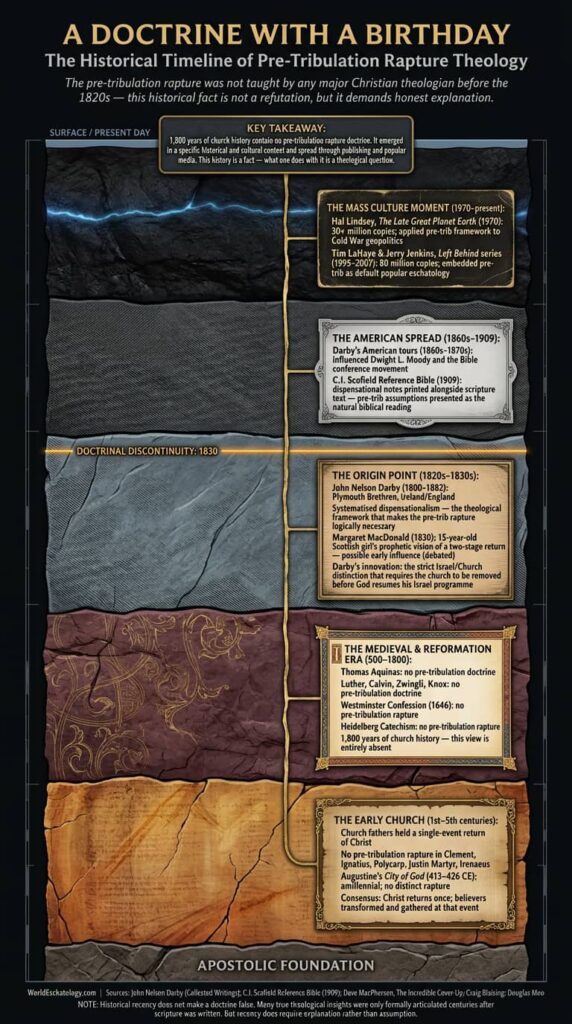
The concept of the rapture as a distinct eschatological event separate from the Second Coming was not taught by the early church fathers.
It was not taught by Augustine, the most influential theologian of the early medieval church. It was not taught by Thomas Aquinas.
It was not taught by the Protestant Reformers: not Luther, not Calvin, not Zwingli, not Knox.
The Westminster Confession, the Heidelberg Catechism, and the other great Reformed confessions of the sixteenth and seventeenth centuries contain no doctrine of a pre-tribulation rapture.
John Nelson Darby and the Birth of Dispensationalism
The doctrine as we know it today was systematised by John Nelson Darby, a former Anglican curate who became a leader in the Plymouth Brethren movement in Ireland and England in the 1820s and 1830s.
Darby developed a comprehensive theological framework called dispensationalism, which divided human history into distinct eras or dispensations in which God dealt with humanity on different terms and toward different purposes.
The cornerstone of Darby’s system was a strict distinction between Israel and the church as two separate peoples of God with two separate destinies.
Old Testament prophecies about Israel’s national restoration were to be fulfilled literally for the Jewish nation.
The church was a distinct entity that had its own programme and would be removed from the scene at the rapture so that God could complete his unfinished business with Israel during the final seven years of Daniel’s seventy-week programme.
Darby was the first person to place the rapture into this comprehensive eschatological framework, making it a logically necessary element of the system rather than merely one possible reading of individual texts.
Without the rapture, the dispensational programme breaks down. With the rapture in place, the whole system achieves an internal coherence that made it theologically attractive.
Margaret MacDonald and the Question of Origins
In 1830, a fifteen-year-old Scottish girl named Margaret MacDonald reportedly had a prophetic vision in which she described a two-stage return of Christ, with the first stage involving the removal of certain believers before the manifestation of evil.
The historian Dave MacPherson argued extensively in The Incredible Cover-Up and subsequent books that Darby was aware of MacDonald’s vision and that it influenced his development of the pre-tribulation rapture doctrine.
Darby himself denied this and the question has been debated among scholars ever since.
Some pre-tribulationists have pointed out that vague notions of an imminent return of Christ and a distinction between the church’s hope and Israel’s earthly promises can be found in certain Puritan writings before MacDonald.
The scholarly consensus is that the MacDonald influence is unproven, but the question of whether Darby originated the idea independently or developed it from circulating prophetic speculation in the early nineteenth century remains genuinely open.
The American Spread
Darby visited America several times in the 1860s and 1870s, and his dispensational system was embraced by significant figures in American Protestant ministry, most importantly Dwight L. Moody, the most influential American evangelist of the late nineteenth century.
Through Moody’s influence, dispensationalism became embedded in the American Bible conference movement and in the network of Bible institutes that trained the next generation of evangelical pastors and teachers.
C.I. Scofield’s Reference Bible, first published in 1909, was the decisive vehicle for establishing dispensational pre-tribulationalism in popular American Christianity.
The Scofield Bible printed dispensational commentary notes alongside the biblical text on the same page, so that readers encountering the Bible through this edition found pre-tribulational assumptions presented as the natural meaning of the text rather than as one theological option among several.
For generations of American Christians, the Scofield notes were simply what the Bible said.
Hal Lindsey’s The Late Great Planet Earth, published in 1970, brought dispensational eschatology to thirty million readers who would never have read a theology book.
Tim LaHaye and Jerry Jenkins’s Left Behind series, beginning in 1995, multiplied that reach to eighty million.
These two works did more to establish pre-tribulationalism in the popular imagination than any academic theology could have done, precisely because they operated through narrative and cultural engagement rather than argument.
The Five Main Views: A Complete and Fair Presentation
With the foundation established, the five main positions on the rapture can now be presented with the depth and fairness they each deserve.
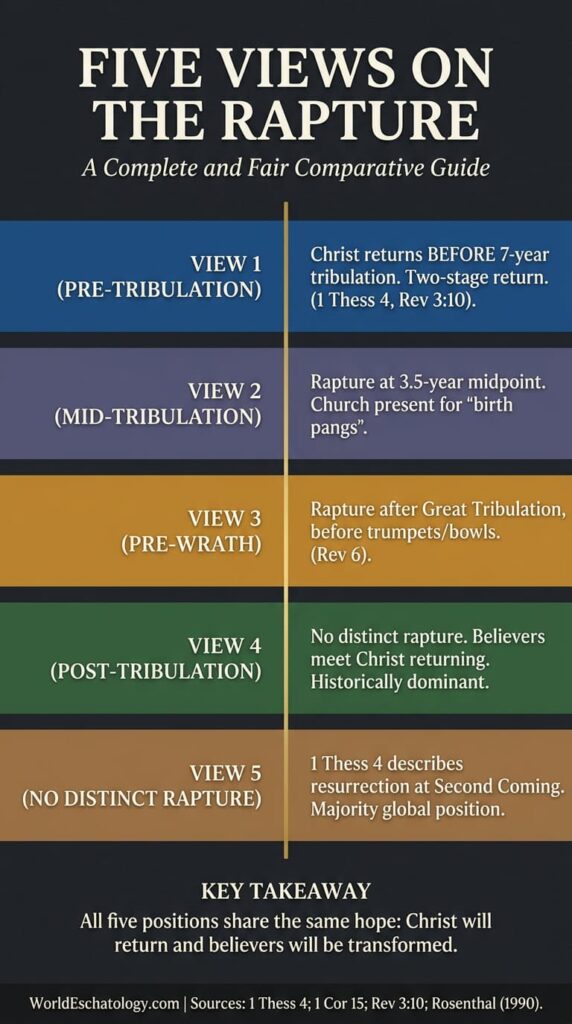
VIEW ONE: Pre-Tribulation Rapture
Christ returns secretly before the seven-year tribulation to take all believers, living and dead, from the earth.
The tribulation then unfolds without the church. At the end of the seven years, Christ returns visibly with his church for the Second Coming, the defeat of the Antichrist, and the establishment of the millennial kingdom.
The rapture and the Second Coming are two distinct phases of Christ’s return, separated by seven years.
The pre-tribulation position rests on several primary arguments.
The church is absent from Revelation 4 through 19, the section describing the tribulation, which pre-tribulationists take as evidence that the church has been removed before the tribulation begins.
The doctrine of imminence holds that Christ can return at any moment without preceding signs, which requires the rapture to precede the tribulation’s identifiable signs.
God has promised to keep the church from his wrath in 1 Thessalonians 5:9 and Revelation 3:10, and the tribulation is a period of divine wrath from which the church is therefore excluded.
The strict separation between Israel and the church in dispensational theology requires the church to be absent during the tribulation period, which focuses on God’s purposes for Israel.
Its most significant weaknesses: it was not known before the 1830s and John Nelson Darby, which requires explanation if it is the natural reading of scripture;
the New Testament never explicitly states that there are two phases of Christ’s return; the last trumpet of 1 Corinthians 15 appears to be identified with the end-of-tribulation seventh trumpet of Revelation 11;
Matthew 24:40-41 may describe the taking of the wicked in judgment rather than the rapture of believers; and 2 Thessalonians 2 appears to require preceding events before the Day of the Lord in a way that undermines imminence.
VIEW TWO: Mid-Tribulation Rapture
The rapture occurs at the midpoint of the seven-year tribulation, at the three-and-a-half-year mark.
Believers go through the first half, the beginning of birth pangs, but are removed before the Great Tribulation of the second half, which is when God’s wrath is fully poured out.
The mid-tribulation position attempts to reconcile the pre-tribulational argument that believers are protected from God’s wrath with the post-tribulational argument that Christians are not immune from suffering and persecution.
The first half of the tribulation is not the wrath of God but the wrath of the Antichrist and the beginning of global disorder.
The second half, the Great Tribulation, is when God’s direct judgments fall, and the church is removed before that happens.
It is the least widely held of the five positions. Pre-tribulationists object that any part of the seven-year period is tribulation and the church should not be present for any of it.
Post-tribulationists object that the distinction between the two halves is arbitrary and that the separation of Daniel’s seventieth week into two qualitatively different periods is not supported by a plain reading of the text.
The mid-tribulation position has not generated the same volume of scholarly defence as either pre-tribulation or post-tribulation.
VIEW THREE: Pre-Wrath Rapture
The rapture occurs after the Great Tribulation, which is the Antichrist’s persecution of believers, but before the outpouring of God’s wrath in the trumpets and bowls.
The church is protected from God’s wrath, not from tribulation in general. The rapture is placed somewhere in the second half of the seven years, after the sixth seal of Revelation 6, when the great day of God’s wrath begins.
Marvin Rosenthal developed this position systematically in The Pre-Wrath Rapture of the Church in 1990, and it has gained substantial scholarly traction since then.
The central exegetical argument is that Christians are never promised immunity from persecution, only from God’s specific wrath.
The tribulation is primarily the Antichrist’s persecution of believers and the unbelieving world’s suffering.
God’s wrath does not begin until the sixth seal, when the text itself says the great day of their wrath has come, implying that before the sixth seal, the wrath had not yet arrived.
The pre-wrath view handles the problem of Matthew 24 more naturally than either the pre-tribulation or post-tribulation view, and it provides a more exegetically precise answer to the wrath question than the broad claim that the entire tribulation is God’s wrath.
Its weakness is its complexity: it requires careful attention to the sequence of events in Revelation and the identification of where in the sequence God’s wrath specifically begins, which involves interpretive choices that not all scholars find equally compelling.
VIEW FOUR: Post-Tribulation Rapture
There is no distinct rapture event separate from the Second Coming.
The catching up of believers described in 1 Thessalonians 4 occurs at the Second Coming of Christ at the end of the tribulation.
Believers go through the tribulation as the church has always gone through suffering and persecution.
The caught up language describes believers rising to meet the returning Christ in the air and accompanying him back to earth.
Post-tribulationalism is the oldest continuous position in Christian history and can be traced to the early church fathers, the vast majority of the medieval church, the Protestant Reformers, and the mainstream of global Christianity outside American evangelical dispensationalism.
Its primary biblical arguments are robust. The apantesis argument from 1 Thessalonians 4 places the meeting in the air as a greeting of the arriving Christ rather than a removal from the earth.
The last trumpet of 1 Corinthians 15 is the seventh trumpet of Revelation 11. Matthew 24:31 describes the gathering of the elect after the tribulation at the Son of Man’s return.
The first resurrection of Revelation 20 is described as the first, implying there is no prior resurrection of church-age believers.
The most significant challenge for post-tribulationalism is the logical problem it faces:
if all living believers are transformed into glorified bodies at the Second Coming, who populates the millennial kingdom in ordinary physical bodies capable of giving birth to children?
Pre-tribulationists argue that a post-tribulation rapture leaves no one in natural human bodies to enter the millennium, since all believers would be glorified and all unbelievers judged at the Second Coming.
Post-tribulationists respond that this problem is resolved by the presence of tribulation saints who are gathered to Christ but not yet glorified at this point, and by reading the millennium passages in ways that do not require the population to be entirely composed of pre-glorification humans.
VIEW FIVE: No Distinct Rapture Event
The concept of a rapture as a distinct eschatological event is not taught in scripture.
First Thessalonians 4 and 1 Corinthians 15 describe the resurrection of believers at the Second Coming, not a separate prior event.
This is the position of most Catholics, Orthodox Christians, Reformed Protestants, and theologians outside the dispensationalist tradition.
This position is held, implicitly or explicitly, by the majority of the world’s Christians. It does not deny that believers will be transformed and gathered to Christ at his return.
It denies that this gathering is a separate event from the Second Coming.
The passages that pre-tribulationists cite as rapture texts are read as descriptions of the resurrection and transformation that accompany the single event of Christ’s return to judge the living and the dead.
This reading is simpler, requires fewer exegetical assumptions, and has a far longer historical pedigree than any rapture position.
What Most of the World’s Christians Believe
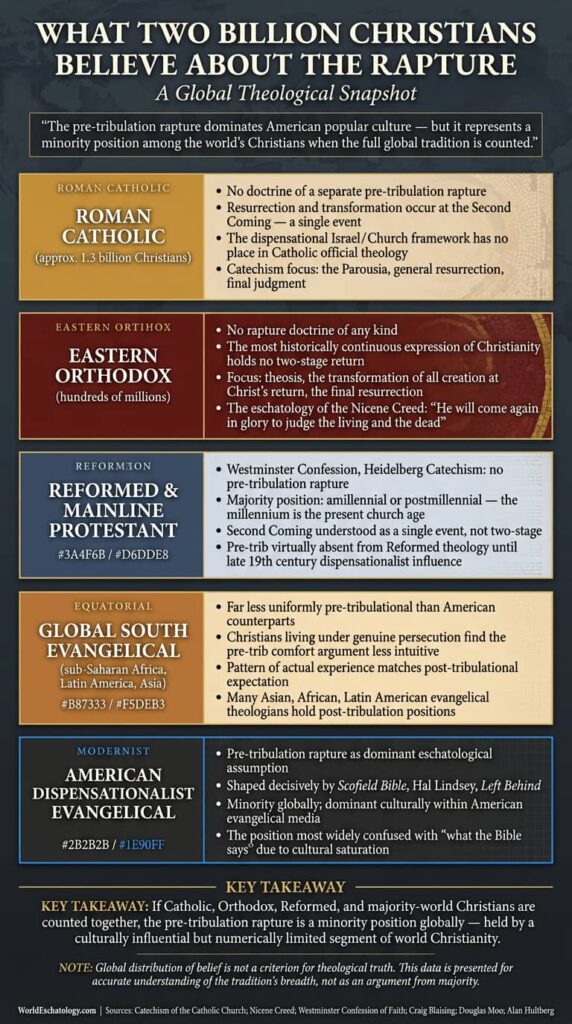
The pre-tribulation rapture is the most widely discussed rapture view in English-language popular culture, but it is important to understand how narrow its actual global footprint is among the world’s Christians.
The Roman Catholic Church, representing approximately 1.3 billion Christians, has no doctrine of a separate rapture event.
Catholic eschatology understands the resurrection of the dead and the transformation of believers as events accompanying the Second Coming, which is a single event.
The concept of a pre-tribulation removal of the church from the world before a seven-year period has no place in Catholic official teaching.
The Eastern Orthodox churches, representing hundreds of millions of Christians and arguably the most historically continuous expression of Christianity, similarly have no rapture doctrine.
Orthodox eschatology focuses on the deification and transformation of all creation at the return of Christ and the final resurrection, without a dispensational scheme involving a separate rapture and tribulation.
The Reformed and mainline Protestant traditions, shaped by the theology of Calvin and the Westminster Confession, have historically been either amillennial or postmillennial in their eschatology.
They understand the millennium of Revelation 20 as the present church age rather than a future literal thousand-year reign and the Second Coming as a single event rather than a two-stage return.
The pre-tribulation rapture is virtually absent from Reformed theological tradition until the late nineteenth century when dispensationalism began influencing some Reformed churches through the Bible conference movement.
Perhaps most significantly, Christians in the Global South, including the rapidly growing evangelical churches of sub-Saharan Africa, Latin America, and Asia, are far less uniformly pre-tribulational than their American counterparts.
Christians who live in contexts of genuine persecution, where following Christ has already cost them homes, livelihoods, family relationships, and sometimes physical safety, find the pre-tribulation comfort argument less intuitive than those in contexts of religious freedom and material security.
Many Asian, African, and Latin American evangelical theologians hold post-tribulational positions precisely because the pattern of their own experience matches the post-tribulational expectation rather than the pre-tribulational one.
If you count all Catholics, all Orthodox, all mainline and Reformed Protestants, and the majority-world evangelicals who hold non-pre-tribulational positions, the pre-tribulation rapture is held by a minority of the world’s Christians, even if it is dominant in American popular evangelical culture.
This does not make it wrong. But it means the claim that it is the obvious or natural reading of scripture deserves scrutiny.
The Secret Rapture: What the Bible Actually Says
The secret rapture is a specific feature of the pre-tribulation position holding that the rapture will be invisible to unbelievers: they will not see Christ himself, they will only witness the sudden disappearance of believers.
This is how the Left Behind series depicts the event. But the secret character of the rapture is not actually stated in the texts on which the doctrine rests.
First Thessalonians 4 describes the descent of Christ with a cry of command, the voice of an archangel, and the sound of the trumpet of God.
These are not descriptions of a quiet, invisible event. They are descriptions of something dramatic and publicly audible.
The standard pre-tribulation response is that these sounds are heard only by believers, not by the surrounding world, drawing a parallel with John 12:28-29 where a voice from heaven was heard by some as thunder and by others as an angel’s voice.
The parallel has some force, but the comparison also reveals the interpretive work required.
The text itself does not say the sounds are limited to believers. That limitation is an assumption imported into the passage to protect the doctrine of secrecy, which is itself an implication of the pre-tribulation timing rather than a direct biblical claim.
Post-tribulationists argue that the secrecy concept was added to the doctrine in the development of dispensationalism rather than being derived from the texts.
The need for secrecy arises from the logic of the system: if the rapture is visible and public, it is hard to explain how unbelievers would not be aware that Christ has come and gone and the tribulation has begun, which would undermine the pattern of surprise described in Matthew 24 for his actual coming.
The secret rapture solves this problem within the dispensational system but requires reading silence as secrecy in the texts themselves.
The Tribulation: What the Bible Actually Describes
Since the entire rapture debate turns on the relationship between believers and the tribulation period, it is worth establishing what the Bible actually says about the tribulation rather than assuming that the seven-year dispensational framework is obviously present in the texts.
The word translated as tribulation in most English Bibles is the Greek thlipsis, which simply means pressure, affliction, or distress.
It is used throughout the New Testament to describe ordinary Christian suffering and is not inherently eschatological.
Paul says in Acts 14:22 that through many tribulations we must enter the kingdom of God. Jesus in John 16:33 says in the world you will have tribulation.
These are not references to a specific end-times period but to the general experience of faithful living in a fallen world.
The specific eschatological tribulation period draws primarily on two sources:
Matthew 24:21’s reference to a great tribulation such as has not been from the beginning of the world until now, nor ever will be, and Daniel’s prophecies about a period of intense suffering associated with the desecration of the temple.
The seven-year structure comes from Daniel 9:27’s reference to one week in the context of the seventy-weeks prophecy.
Preterists argue that this entire prophetic framework was fulfilled in the Jewish-Roman War of 66 to 73 CE and the destruction of Jerusalem.
Futurists argue that a final seven-year period remains to be fulfilled.
What the Bible describes as the tribulation’s content includes the persecution of believers by the beast, the outpouring of divine judgments on the unbelieving world, the ministry of the two witnesses, the sealing of the 144,000, and the martyrdom of saints who refused to worship the beast.
The presence of saints who are actively following Christ and being persecuted throughout the tribulation creates a genuine difficulty for the pre-tribulation position:
if the church has been raptured, who are these tribulation saints, and how were they saved without the Holy Spirit whom pre-tribulationists generally understand as removed with the church?
Israel, the Church, and Why Dispensationalism Matters
The pre-tribulation rapture is not simply an isolated theological claim.
It is an integral part of a larger theological system called dispensationalism, and it cannot be properly evaluated without understanding that system and its foundational assumptions.
The cornerstone of dispensational theology is the sharp distinction between Israel and the church as two separate peoples of God with two separate destinies and two separate programmes.
The church is not the fulfilment of Old Testament promises to Israel. Those promises belong to ethnic Israel and will be fulfilled literally and nationally in the future.
The church is a distinct entity, a parenthesis in God’s programme for Israel, that began at Pentecost and will end at the rapture.
When the church is removed, God’s programme for Israel resumes for the final seven years of Daniel’s seventieth week.
This distinction is what makes the pre-tribulation rapture theologically necessary within dispensationalism.
If God’s purpose for the tribulation is the completion of Israel’s programme and the fulfilment of Old Testament promises to the Jewish nation, then the church, as a separate entity, does not belong there.
The rapture removes the church so that the tribulation can serve its proper Israel-focused purpose.
Non-dispensationalist theologians dispute the foundational assumption.
The New Testament, they argue, consistently describes the church as the true Israel, the fulfilment of the Abrahamic covenant, and the body into which both Jews and Gentiles are incorporated.
Galatians 3:29 says that if you belong to Christ then you are Abraham’s offspring, heirs according to promise.
Romans 11 describes Gentile believers as wild olive branches grafted into the original olive tree of Israel.
Ephesians 2 says the dividing wall between Jew and Gentile has been broken down and the two have become one new humanity.
On this reading, the church-Israel distinction that makes the dispensational system work is not a biblical distinction but a theological imposition that the New Testament authors would not recognise.
This is not a peripheral debate. It is the foundational disagreement that determines whether the pre-tribulation rapture is theologically coherent or not.
Within dispensationalism, the rapture makes perfect sense. Outside dispensationalism, the need for a separate rapture largely disappears because the premise that requires it does not hold.
The Rapture in Popular Culture
The rapture, particularly in its pre-tribulational form, has had a cultural impact so significant that it has effectively reshaped how millions of people, many of whom have never read a theology book, understand the end times.
Hal Lindsey’s The Late Great Planet Earth, published in 1970, applied the pre-tribulation dispensational framework to contemporary Cold War geopolitics in a way that was accessible, exciting, and felt urgently relevant.
It sold over thirty million copies and was translated into more than fifty languages.
For an entire generation of American Christians, Lindsey’s framework became the default eschatological lens through which they read both the Bible and the daily news.
Tim LaHaye and Jerry Jenkins’s Left Behind series, beginning in 1995, multiplied that cultural influence through narrative fiction.
The series depicts the pre-tribulation rapture and the subsequent tribulation with the vividness and detail of a thriller novel.
Eighty million copies sold. Multiple films. A video game series.
The specific images the books created, the driverless cars, the vanished pilots, the Antichrist rising to global power from a United Nations platform, became the default mental pictures that millions of readers associated with biblical end-times prophecy.
The cultural effects have been both positive and problematic.
Positively, the books prompted millions of people to engage with christian eschatology who would otherwise never have thought about it, and for some readers that engagement led to genuine sustained study of the primary sources.
Negatively, the books present the pre-tribulation position as the obvious and uncomplicated reading of scripture, and the significant weight of scholarly argument on the other side is invisible within a narrative framework.
Readers who encounter the doctrine first through fiction rather than through theology have difficulty distinguishing what LaHaye and Jenkins added from what the Bible actually says.
The rapture has also entered broader popular culture in ways disconnected from specifically Christian meaning.
The word raptured is used colloquially to describe ecstatic experience. Rapture imagery appears in film, music, and literature as a general symbol of sudden transformation or departure.
The cultural penetration of this specific theological concept has been extraordinary by any measure.
What This Means for Ordinary Christians: The Pastoral Dimension
The rapture debate matters pastorally as well as theologically, and the pastoral implications are worth taking seriously.
Different rapture positions produce different spiritual orientations.
A Christian who expects to be raptured before any serious tribulation will relate to suffering and difficulty differently from one who expects to go through it.
This is not merely theoretical. Christians in genuinely persecuted contexts around the world live with the practical reality of what it costs to follow Christ, and the theological framework they carry into that suffering shapes how they experience it and what meaning they draw from it.
A number of pastoral theologians have noted the specific problem created by teaching a pre-tribulation rapture as certain truth to Christians who then experience severe persecution.
If I was promised I would be removed before tribulation and I am experiencing tribulation, either God’s promise has failed or I am not really a believer or my theology was wrong.
The first two options are spiritually catastrophic. The third is a crisis of confidence in the teachers and institutions that formed the person’s faith.
The pattern has been documented among persecuted Christians in China, the Middle East, and elsewhere whose pre-tribulation expectations were not prepared for the actual suffering they experienced.
The post-tribulation perspective, which expects the church to go through tribulation as it always has, does not produce this crisis because the experience confirms rather than contradicts the theological expectation.
Christians have always suffered. The tribulation is a more intense version of what the church has always known, not an anomaly that should not be happening.
Across all positions, the New Testament’s consistent pastoral instruction in every passage about Christ’s return is the same: be ready.
Be faithful. Do not be caught doing what you should not be doing when he comes.
The specific timing of the rapture relative to the tribulation is secondary to the orientation of heart and life that every position agrees on.
Paul’s conclusion to 1 Thessalonians 4 is comfort one another with these words, and that comfort is not contingent on resolving the timing debate.
It is contingent on the certainty that the Lord himself will descend from heaven and that we will always be with the Lord. That certainty is shared across all five positions.
Frequently Asked Questions
What does the Bible say about the rapture?
The Bible does not use the word rapture, but the concept draws on 1 Thessalonians 4:13-18, where Paul describes believers being caught up in the clouds to meet the Lord in the air, and 1 Corinthians 15:50-55, where he describes believers being changed in a moment at the last trumpet.
Other passages used in rapture theology include John 14:1-3, Matthew 24:40-41, and Revelation 3:10. These passages are interpreted differently by different theological traditions.
Is the rapture in the Bible?
The word rapture is not in the Bible. The concept is drawn from several New Testament passages, primarily 1 Thessalonians 4:13-18, where the Greek word harpazo, meaning to seize or snatch away, describes believers being caught up to meet the Lord.
Whether this describes a distinct event separate from the Second Coming, as pre-tribulationists hold, or whether it describes the gathering at the Second Coming itself, as post-tribulationists hold, is one of the central questions in the debate.
Where does the word rapture come from?
The word rapture comes from the Latin raptura, derived from the verb rapere meaning to seize or carry off.
Jerome’s fourth-century Latin translation of the Bible, the Vulgate, used the word rapiemur to render the Greek harpazo in 1 Thessalonians 4:17.
English Bibles translated directly from the Greek used caught up instead of raptured.
The term rapture entered theological vocabulary through academic discussion of the Latin text and was popularised through the dispensationalist movement beginning in the nineteenth century.
What is the pre-tribulation rapture?
The pre-tribulation rapture is the view that Christ will return secretly before a seven-year tribulation period to take all believers, living and dead, from the earth.
The tribulation then occurs without the church, after which Christ returns visibly with his church for the Second Coming.
This view was developed systematically by John Nelson Darby in the 1820s and 1830s and was popularised through C.I. Scofield’s Reference Bible, Hal Lindsey’s The Late Great Planet Earth, and Tim LaHaye’s Left Behind series.
What is the difference between the rapture and the Second Coming?
In pre-tribulation dispensational theology, the rapture and the Second Coming are two distinct phases of Christ’s return separated by seven years.
At the rapture, Christ comes secretly for his church before the tribulation.
At the Second Coming, he returns visibly to the earth after the tribulation with his church to defeat the Antichrist and establish the millennium.
In post-tribulation and non-dispensational theology, these are not two separate events but two ways of describing the single return of Christ, which occurs at the end of the tribulation period.
Is the rapture real?
Whether the rapture as a distinct event is real depends on which theological framework you apply to the relevant biblical passages.
All Christian traditions that engage with eschatology agree that Christ will return, that believers will be transformed and gathered to him, and that the dead in Christ will be raised.
The disagreement is about whether this gathering happens as a separate event before a tribulation period or as part of the single event of Christ’s Second Coming. Both positions are held by serious, biblically literate Christians.
When will the rapture happen?
No one knows. Even within the pre-tribulation framework, which holds that the rapture will occur before the tribulation, the timing of the tribulation itself is unknown.
Jesus specifically said that no one knows the day or the hour, not the angels in heaven, but only the Father.
The doctrine of imminence, which is a core principle of pre-tribulationalism, holds that the rapture could happen at any moment without preceding signs, making any specific prediction impossible.
Did John Nelson Darby invent the rapture?
John Nelson Darby systematised the pre-tribulation rapture doctrine in the 1820s and 1830s and was the first to place it within a comprehensive theological framework called dispensationalism.
Whether he originated the idea independently or whether it developed from earlier prophetic speculation in his circle, including the possible influence of Margaret MacDonald’s 1830 vision, is debated.
What is clear is that the pre-tribulation rapture as a systematic doctrine was not taught by any major Christian theologian before Darby.
What does caught up mean in 1 Thessalonians 4?
Caught up in 1 Thessalonians 4:17 translates the Greek word harpazo, meaning to seize, snatch, or take forcibly.
The passage describes believers being caught up in the clouds to meet the Lord in the air at his descent.
The phrase to meet uses the Greek word apantesis, which described the custom of citizens going out to meet a visiting dignitary and then escorting him back to the city.
Post-tribulationists use this custom to argue that the believers meet the descending Christ and accompany him back to earth.
Pre-tribulationists understand the caught up as a removal to heaven.
Do Catholics believe in the rapture?
The Catholic Church does not teach the pre-tribulation rapture doctrine.
Catholic eschatology holds that the resurrection of the dead and the transformation of believers occur at the Second Coming of Christ, which is a single event rather than a two-stage return.
The dispensational framework that makes the pre-tribulation rapture theologically necessary, with its strict distinction between Israel and the church, is not part of Catholic theological tradition.
What is the post-tribulation view?
The post-tribulation view holds that there is no separate rapture event distinct from the Second Coming.
Believers go through the tribulation as the church has always gone through suffering and persecution.
The catching up of believers described in 1 Thessalonians 4 occurs at the Second Coming of Christ at the end of the tribulation, when believers rise to meet the descending Christ in the air and accompany him back to earth.
This is the oldest continuous position in church history and is held by most Catholics, Orthodox, Reformed Protestants, and many evangelical Christians outside the American dispensationalist tradition.
What is harpazo in the Bible?
Harpazo is the Greek verb meaning to seize, snatch, or take forcibly. It appears in 1 Thessalonians 4:17 as the word translated caught up, which is the primary scriptural basis for rapture theology.
It also appears in Acts 8:39 where the Spirit snatches Philip away after a baptism, in 2 Corinthians 12:2-4 where Paul describes being caught up to the third heaven, and in Revelation 12:5 where the male child is caught up to God.
The Latin rapere, from which rapture derives, was the Vulgate’s translation of harpazo.
Will believers go through the tribulation?
This is the central question of the rapture debate. Pre-tribulationists hold that believers will be raptured before the tribulation begins.
Mid-tribulationists hold that believers will go through the first three-and-a-half years but be removed before the Great Tribulation of the second half.
Pre-wrath advocates hold that believers go through the Great Tribulation but are removed before God’s specific wrath in the trumpets and bowls.
Post-tribulationists hold that believers will go through the entire tribulation, protected by God’s grace but not removed from the earth.
Christians hold all four views sincerely and with serious scriptural arguments.
What is the Left Behind view of the rapture?
The Left Behind view, based on Tim LaHaye’s bestselling novel series, depicts the pre-tribulation rapture as a sudden secret removal of all Christians from the earth, leaving behind confused unbelievers.
The series then follows the tribulation period, the rise of the Antichrist, and the events leading to the Second Coming.
The books present this picture as the straightforward biblical teaching on the end times.
Theologically, the Left Behind series represents classic dispensational pre-tribulationalism popularised through narrative fiction rather than theological argument.
Conclusion: What We Can Say with Confidence
After working through all of this, it is possible to identify with confidence what the Bible teaches about the return of Christ and what remains genuinely contested.
What the Bible clearly teaches, across all theological traditions: Christ will return visibly and personally.
The dead in Christ will be raised. Living believers will be transformed. All believers will be gathered to Christ and will be with him forever.
This is the great hope of the Christian faith, and it is shared equally by pre-tribulationists, post-tribulationists, pre-wrath advocates, and everyone else engaged in this debate.
What is genuinely contested: whether the gathering of believers to Christ is a distinct event separated from his final return by seven years, or whether it is the single event of his return.
Whether believers will be present on earth during the tribulation period or removed before it.
Whether the church and Israel are distinct entities requiring separate divine programmes or whether the church is the fulfilment of the Abrahamic covenant’s promise to all nations.
These are not peripheral questions, but they are questions on which sincere, intelligent, careful readers of the same Bible have reached different conclusions for good reasons.
The history of the pre-tribulation doctrine’s development is a fact that deserves honest acknowledgment by those who hold it: the doctrine was not known before the 1820s, and this recency requires explanation if it is the natural reading of scripture.
The post-tribulation position’s claim to antiquity is also a fact: the majority of the world’s Christians, for most of church history, have understood the catching up of believers as part of the single event of the Second Coming.
But in the end, the pastoral instruction of every passage discussing the return of Christ points in the same direction regardless of one’s position on timing. Be ready. Be faithful.
Comfort one another with the certainty that the Lord himself will descend from heaven and that those who are in Christ will always be with him.
That certainty does not require resolving the rapture debate. It only requires trusting the one who promised it.
Sources: The Holy Bible (ESV, NIV, NASB, KJV) | 1 Thessalonians 4:13-18, 1 Corinthians 15:50-55 | Matthew 24, Revelation 3:10, 20:7-10
Historical theology: John Nelson Darby, C.I. Scofield, Marvin Rosenthal, Robert Gundry | Modern scholarship: Craig Blaising, Douglas Moo, Alan Hultberg
WorldEschatology.com | All scriptural citations from canonical Christian scripture
1 thought on “Is the Rapture Biblical? Key Bible Verses and Prophetic Context”