
Every few generations, Jewish history produces a moment of collective holding of breath.
A figure emerges, or rumor of one spreads, and for a brief and electric season, ordinary Jews from Portugal to Poland, from Yemen to New York, begin to ask the same question: could this be him?
Could this be the Mashiach, the Jewish Messiah, the anointed one who will end exile and usher in a world transformed?
The question is not abstract theology. It has driven people to sell their homes, abandon their trades, and follow strangers across deserts and seas. It has also, time and again, broken hearts.
This article traces the concept of the Mashiach from its biblical roots through the Talmudic discussions, the medieval codifications, the mystical traditions, the catastrophe of false messiahs, and the denominational divergences of the modern era.
It covers what the primary sources actually say about who the Mashiach is, what he will and will not do, how one might recognize him, and why the Jewish messianic idea has captivated, inspired, and sometimes devastated the people it belongs to.
What Mashiach Actually Means: Getting the Word Right
The first correction that any serious study of this subject requires is etymological.
In popular usage in the English-speaking world, the word messiah carries a weight of meaning derived almost entirely from Christian theology.
It suggests a divine or semi-divine figure whose primary role is the spiritual salvation of humanity through sacrificial death and resurrection.
None of these concepts belong to the classical Jewish idea of the Mashiach.
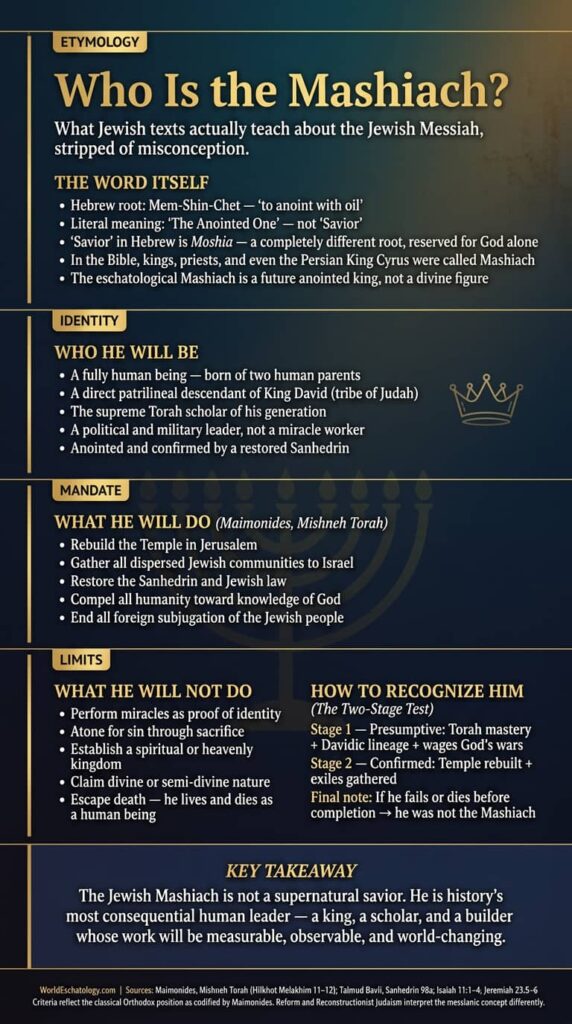
The Hebrew word Mashiach comes from the three-letter root mem-shin-chet, which means to smear, to paint, or most specifically, to anoint with oil.
The practice of anointing with sacred oil was one of the central rituals of ancient Israelite society. Kings were anointed when they ascended the throne.
High priests were anointed at their consecration. Occasionally, the Tanakh records a prophet being anointed.
In every case, the act of anointing marked a person as set apart by God for a particular role.
The title Mashiach simply means the anointed one, and in the Hebrew Bible it was applied freely to living figures: to Saul (1 Samuel 24:10), to David (2 Samuel 23:1), and even, remarkably, to the Persian king Cyrus (Isaiah 45:1), who liberated the Jewish people from Babylonian captivity without being Jewish at all.
The distinct concept of a future Mashiach, a single eschatological figure who would redeem Israel and transform the world, developed more gradually.
Modern scholars note that this idea is not explicitly spelled out in the Torah itself (the first five books of the Bible) and that it crystallized more fully during the age of the prophets, particularly during and after the catastrophe of the Babylonian exile.
Traditional Jewish interpretation, however, maintains that the foundations of messianic thought are embedded throughout the Torah in passages that require interpretation to unlock.
The question of when and how the concept emerged is itself a matter of live scholarly debate within Jewish academic circles.
What matters for the purposes of understanding the Jewish tradition is the sharp difference between Mashiach and the English word messiah.
The word moshia, meaning savior or redeemer, comes from an entirely different Hebrew root (yod-shin-ayin) and is reserved in Jewish prayer almost exclusively for God.
To call the Mashiach a savior in the Christian sense would be, from a traditional Jewish perspective, a category error of the most fundamental kind.
The Mashiach does not save souls. He does not atone for sin. He is a human being, a political and religious leader, who will accomplish certain historical tasks that the texts spell out with some precision.
The Biblical Prophets and the Roots of Messianic Expectation
The roots of Jewish messianic thought lie in a cluster of prophetic texts that emerged from the trauma of military defeat, exile, and national humiliation.
The destruction of the First Temple in 586 BCE by the Babylonians, the forced deportation of the Judean elite to Babylon, and the end of the Davidic monarchy created a theological crisis.
How could God have allowed his chosen people to be so thoroughly defeated? What was the future of the covenant?
The prophets responded to these questions with visions of a restored future, and at the center of many of these visions stood a restored Davidic king.
The prophet Isaiah is the single most important biblical source for messianic ideas.
His writings span several chapters that later interpreters would mine exhaustively for messianic content.
Isaiah 11 is perhaps the single most cited messianic passage in all of Jewish literature, describing a figure who will arise from the stump of Jesse (the father of David):
Isaiah 11:1-4
“A shoot will grow from the stump of Jesse, and a branch from his roots will bear fruit. The spirit of the Lord will rest upon him, a spirit of wisdom and understanding, a spirit of counsel and might, a spirit of knowledge and fear of the Lord. He will sense the fear of the Lord, and he will not judge by what his eyes see or decide by what his ears hear. He will judge the poor with righteousness, and decide with equity for the meek of the earth.”
The same chapter continues with one of the most enduring descriptions of the messianic era, the famous vision of the wolf dwelling with the lamb, the leopard lying down with the kid, and the earth being full of the knowledge of the Lord as the waters cover the sea (Isaiah 11:6-9).
Whether these verses describe literal ecological transformation or serve as allegory for a new kind of human civilization became a point of significant debate between Maimonides and other authorities, as we will see below.
Jeremiah contributes another foundational passage. Writing during the Babylonian exile, he described a future Davidic king in terms that later became standard in Jewish messianic taxonomy:
“The days are coming, declares the Lord, when I will raise up for David a righteous branch, a king who will reign wisely and do what is just and right in the land. In his days Judah will be saved and Israel will live in safety. This is the name by which he will be called: The Lord Our Righteousness.”
Ezekiel, prophesying in Babylon itself, added additional elements to the picture: the regathering of the dispersed Jewish people from the nations, the reunification of the divided kingdoms of Israel and Judah, and the establishment of a new covenant.
The prophet Zechariah contributed vivid imagery of a messianic king entering Jerusalem humbly, riding upon a donkey, and of great apocalyptic battles preceding the messianic era.
Micah and Hosea contributed visions of peace and restoration. Taken together, the prophetic corpus creates a rich tapestry of expectation, though one that requires considerable interpretive work to weave into a coherent systematic account.
It is important to note that the prophets themselves show no sign of presenting a single, systematic doctrine of the Messiah.
They were poets and preachers responding to the conditions of their own time, and their visions overlap, contradict, and build upon one another in ways that later interpreters, both Jewish and Christian, would find challenging.
The task of systematizing these visions into a coherent account of who the Mashiach is and what he will do fell to the rabbis of the Talmudic era and, decisively, to the medieval legal scholars.
The Talmud on Mashiach: A Conversation Without a Conclusion
The Babylonian Talmud, compiled and edited between roughly 200 and 500 CE, contains some of the most vivid and wide-ranging Jewish discussions of the Mashiach.
These discussions appear primarily in the tractate Sanhedrin, particularly in folios 96b through 99a, a section often called the messianic passages of the Talmud.
What strikes any attentive reader of these pages is how much the rabbis disagreed with one another, and how comfortable they were leaving questions unresolved.
The Talmud preserves a remarkable spectrum of views on when and under what conditions the Mashiach will come.
One of the most quoted passages records a dispute about whether the messianic era will be conditional on repentance.
Rabbi Eliezer held that Israel must repent before the redeemer can come.
Rabbi Yehoshua argued that the redemption will happen at a divinely appointed time regardless of Israel’s spiritual condition, citing the verse in Isaiah that God will hasten it in its time.
The Talmud does not resolve this dispute, and both positions have had long afterlives in Jewish thought.
The famous passage in Sanhedrin 98a records the Talmudic sage Samuel stating one of the most striking and counterintuitive claims in all messianic literature: that the messianic era will differ from the present world only in the subjugation of foreign kingdoms over Israel.
This radical minimalism, which Maimonides would later cite approvingly, strips the messianic era of its supernatural character and presents it as essentially a period of restored Jewish political sovereignty.
Against this view, other sages portrayed the messianic era as involving miraculous transformation: the resurrection of the dead, a reversal of natural order, and a direct encounter with the divine.
The Talmud also records a fascinating and somewhat unsettling tradition about the so-called birth pangs of the Mashiach, the period of tribulation expected to precede his arrival. Sanhedrin 97a and 98a describe signs of this coming period:
Talmud Bavli, Sanhedrin 97a
“In the generation in which the son of David comes, insolence will increase, prices will soar, the vine will yield its fruit but wine will be expensive, and the ruling power will turn to heresy and there will be no rebuke.”
The Talmud goes further, recording the rabbi Ulla and others saying they hope the Mashiach will come but they do not wish to see it, because the period preceding his arrival will be so catastrophically difficult.
This is a remarkable sentiment, combining deep faith in the reality of the Mashiach with honest dread of the suffering that will accompany his coming.
It speaks to the psychological honesty of the rabbinic tradition, unwilling to paint an entirely rosy picture even of its greatest hope.
The Talmud also introduces the question of names attributed to the Mashiach.
Sanhedrin 98b records a tradition in which various sages suggest different names for the Mashiach, each naming him after his own rabbi, until one sage suggests that his name is Yinnon, based on Psalm 72:17.
The passage has a self-aware, even playful quality, acknowledging that the sages are projecting their own ideals onto the messianic figure.
What no rabbi in the Talmud does is name a specific individual as the Mashiach without a definitive fulfillment of the conditions for recognizing him.
Maimonides and the Legal Definition of the Mashiach
If the prophets gave the Mashiach his poetry and the Talmudic sages gave him his theological complexity, it was Moses Maimonides, the twelfth-century Spanish-born philosopher and legal codifier known as the Rambam, who gave him his clearest legal definition.
Writing in his monumental Mishneh Torah, a fourteen-volume systematic codification of all of Jewish law, Maimonides addressed the Mashiach in the final two chapters of the final section, Hilkhot Melakhim Umilchamoteihem (Laws of Kings and Their Wars).
His account remains the single most authoritative normative statement on the subject in traditional Judaism.
Maimonides was characteristically precise. He identified the Mashiach as a human king, descended from the male line of David, who would accomplish three primary tasks: rebuilding the Temple in Jerusalem, gathering all the Jewish people back to the land of Israel, and compelling the entire world to follow the path of Torah.
He is emphatically not a miracle worker in Maimonides’s account. He is not expected to resurrect the dead as a prerequisite, nor to perform supernatural signs to prove his identity.
He is a political and religious leader of exceptional caliber.
Maimonides articulated a provisional test for messianic identity that has become standard in traditional discussions. He wrote in Hilkhot Melakhim 11:4:
Maimonides, Mishneh Torah, Hilkhot Melakhim 11:4
“If a king will arise from the House of David who diligently contemplates the Torah and observes its commandments as David his father did, and will compel all of Israel to walk in it and reinforce the breaches, and fight the wars of God, we may, with assurance, consider him Mashiach. If he succeeds in the above, builds the Temple in its place, and gathers the dispersed of Israel, he is definitely the Mashiach.”
The two-stage structure of Maimonides’s test is crucial: a presumptive candidate (a chazakah, a legal presumption) who meets certain behavioral and military criteria, and then confirmation once the Temple is built and the ingathering accomplished.
Maimonides pointedly adds that if the candidate fails or is killed before completing the task, he has been proven not to be the Mashiach.
This formulation was clearly designed with Bar Kokhba, the failed messianic pretender of the second century, in mind, and it serves as a structural critique of all failed messianic claims.
Equally significant is what Maimonides says about the messianic era itself.
Siding firmly with Samuel’s minimalist view from the Talmud, he wrote that the messianic era would be characterized primarily by the restoration of Jewish sovereignty and the end of foreign subjugation.
The laws of nature would not change. The wolf and the lamb passage from Isaiah, he argued, is an allegory for the transformation of human relations, not a literal prediction of zoological changes.
This rationalist reading, though it had significant support in the tradition, placed Maimonides in tension with more supernaturalist accounts of the messianic era that were widespread in popular Jewish imagination.
Nachmanides (Rabbi Moses ben Nachman, the Ramban), the great thirteenth-century Catalan scholar who was Maimonides’s most significant medieval critic, took a different view.
Nachmanides accepted a more supernatural account of the messianic era and was more willing to take prophetic imagery literally. He also placed greater emphasis on the miraculous dimensions of the redemption.
This debate between the rationalist Maimonidean account and the more mystical, supernaturalist alternative has never been definitively resolved in the Jewish tradition, and both currents remain alive today.
The Criteria for Recognizing the Mashiach: What the Texts Require
Lineage from the House of David
The requirement that the Mashiach descend from King David through a pure male line is one of the most consistently maintained criteria across all the classical sources.
Jeremiah 23:5 specifies a righteous branch raised up for David. The Talmudic tradition elaborates this into a requirement for an unbroken patrilineal descent from the royal tribe of Judah, specifically through the Davidic line.
This requirement has serious practical implications: it means that anyone from the priestly tribes of Levi and Kohen is automatically excluded, since David belonged to the tribe of Judah. The Mashiach cannot be a Cohen or a Levite.
The challenge of establishing Davidic descent in the present day is not lost on traditional authorities.
After the destruction of the Second Temple and the subsequent dispersions, formal genealogical records were scattered and ultimately lost.
The Talmud itself (Kiddushin 70b-71a) acknowledges that in the messianic era, Elijah the prophet will resolve questions of doubtful lineage using prophetic insight.
This acknowledgment of a genealogical problem does not, in the traditional view, invalidate the requirement; it simply points to the supernatural confirmation that will accompany the genuine Mashiach’s identification.
Torah Mastery and Observance
The Mashiach is not simply a military or political leader. He is described by Maimonides as someone who diligently contemplates the Torah and observes its commandments.
Isaiah 11:2-3 describes the spirit of wisdom, understanding, counsel, and knowledge that will rest upon him, and his judgment will transcend the evidence of his senses, cutting to the truth of every matter.
He is, in the classical account, the supreme Torah scholar of his generation as well as its supreme king.
These two roles, the scholar and the sovereign, are combined in the Mashiach in a way that reflects the Jewish ideal of leadership as grounded in learning and righteousness rather than merely in power.
Compelling Israel and the World
One of the most politically charged elements of the traditional messianic portrait is the Mashiach’s role in compelling Israel to return to Torah observance and compelling the nations of the world to follow righteous paths.
The word compel is deliberately strong. Maimonides uses the term yekhof, which carries connotations of coercion.
This has been the source of considerable discomfort for modern interpreters who are sensitive to the implications of religious coercion, and Reform and Reconstructionist thinkers in particular have either reinterpreted or rejected this element of the traditional account.
Within Orthodoxy, the tension is typically managed by emphasizing that the Mashiach will make righteousness so compelling and evident that it will feel like free choice.
Building the Temple and Gathering the Exiles
The two most concrete and observable criteria for the Mashiach’s identity, in Maimonides’s account, are the rebuilding of the Temple in Jerusalem and the physical ingathering of all the dispersed Jewish people to the land of Israel.
These are the definitive confirmatory signs that distinguish a genuine Mashiach from a presumptive candidate. Until these have occurred, no messianic claim can be confirmed.
This requirement makes the Mashiach’s identity, in principle, empirically verifiable in a way that purely spiritual or supernatural claims cannot be.
The requirement to build the Temple has created obvious tensions in the modern era, given that the Temple Mount is currently home to the Dome of the Rock and the Al-Aqsa Mosque, among the most sacred sites in Islam.
Traditional authorities do not treat this practical complication as a theological problem; they hold that when the time comes, God will arrange the circumstances necessary for the Temple’s rebuilding.
The specific method by which this will happen is not specified in the classical sources.
The Two Messiahs: Mashiach ben Yosef and Mashiach ben David
One of the most fascinating and often overlooked dimensions of traditional Jewish messianic thought is the tradition of two distinct messianic figures, each with a separate role in the process of redemption.
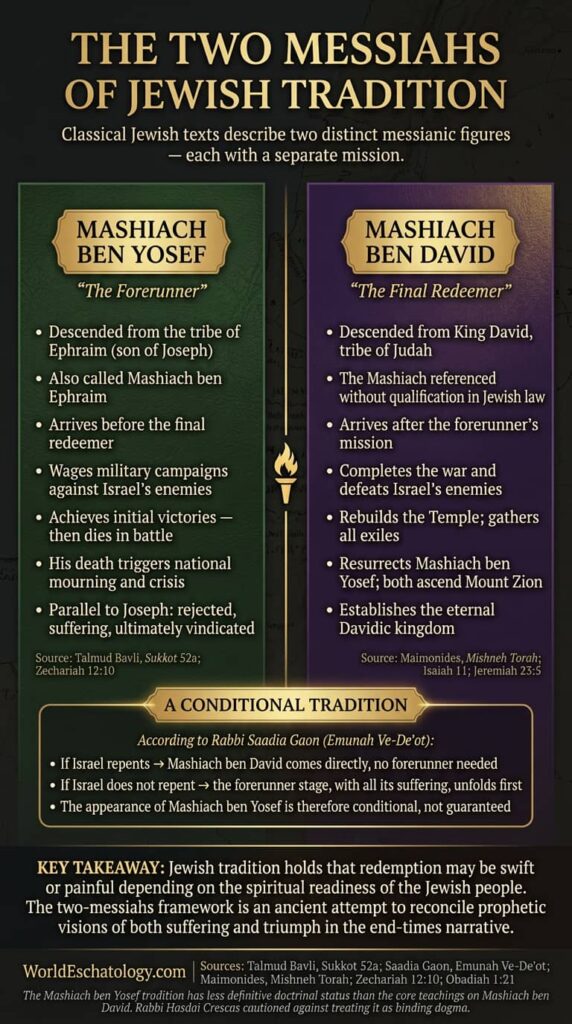
The term Mashiach, when used without qualification, always refers to Mashiach ben David, the final redeemer from the line of King David.
But the tradition also speaks of Mashiach ben Yosef, the Mashiach descended from Joseph, from the tribe of Ephraim, who comes first and prepares the way for the final redeemer.
The figure of Mashiach ben Yosef appears in the Talmud and Midrash, though his role is elaborated most fully in later sources including the Zohar and various Midrashic collections.
According to the tradition found in Sukkot 52a of the Babylonian Talmud, Mashiach ben Yosef will wage war against Israel’s enemies, achieve initial military victories, but then die in battle.
His death will trigger a period of great mourning and crisis. The Talmud identifies the mourning described in Zechariah 12:10 with lamentation over the death of Mashiach ben Yosef.
The essential task of Mashiach ben Yosef, across the sources that discuss him, is to act as a military and political forerunner to the final redeemer.
Rabbi Saadia Gaon, the great tenth-century Babylonian authority, wrote in his Emunah Ve-De’ot that whether Mashiach ben Yosef will actually appear depends on the spiritual state of the Jewish people.
If the Jewish people are worthy, the final redemption will come directly and miraculously. If they are not, the painful preparatory stage, including the role of Mashiach ben Yosef, will be necessary.
The parallel between Mashiach ben Yosef and the biblical figure of Joseph son of Jacob is deliberate and structurally significant.
Just as Joseph was rejected by his brothers, sold into slavery, suffered greatly, and then was eventually vindicated and elevated to a position of leadership from which he saved his entire family, Mashiach ben Yosef is understood to suffer and initially to fail before his ultimate role in the redemptive process is understood.
Rabbi Hasdai Crescas, the great fourteenth-century Spanish philosopher, was notably skeptical of the whole framework surrounding Mashiach ben Yosef, arguing that no certain knowledge can be derived from the rabbinic discussions on the subject and that it should not be treated as dogma.
His caution is worth remembering: the two-messiahs tradition, while ancient and widespread, has a different status in Jewish law than the core requirements associated with Mashiach ben David.
The Role of Elijah: The Forerunner and His Mission
Before the Mashiach himself arrives, Jewish tradition holds that the prophet Elijah will appear.
This expectation is grounded in one of the last verses of the Hebrew prophets, Malachi 3:23-24, which declares that God will send the prophet Elijah before the coming of the great and awesome day of the Lord, to turn the hearts of fathers to children and children to fathers.
Elijah thus functions in Jewish eschatology as the herald of the messianic era, the forerunner whose appearance signals that the final redemption is at hand.
The Talmud develops Elijah’s role considerably. He is expected to resolve all legal disputes and questions of lineage that cannot be settled by ordinary means (Eduyot 8:7).
He will announce the coming of the Mashiach to the Jewish people. In the Passover Seder, the tradition of opening the door and pouring a cup of wine for Elijah reflects this expectation of his imminent arrival.
In many traditional households, the moment the door is opened for Elijah is treated with a quiet seriousness, a ritualized expression of genuine hope.
The Talmudic discussions of Elijah’s arrival introduce one of the most poignant tensions in messianic thought: the expectation that anyone could be the Mashiach at any moment, combined with an honest acknowledgment of how unlikely this seems.
The daily prayer of Ani Maamin, a formulation of Maimonides’s Thirteen Principles of Faith, includes the declaration that the believer believes with perfect faith in the coming of the Mashiach, and though he tarries, still waits for him each day.
The word for tarry is yitmahmehah, one of the most emotionally charged words in Jewish liturgy, capturing millennia of faithful waiting across catastrophic historical conditions.
The Kabbalistic Messiah: Cosmic Repair and Mystical Redemption
The rationalist account of the Mashiach offered by Maimonides represents one major current in the Jewish tradition.
Running alongside it, and in some periods actually dominant in popular Jewish consciousness, is a very different vision of the Mashiach and the messianic era developed by the Kabbalists, particularly those of the sixteenth-century mystical renaissance in Safed.
Isaac Luria, known as the Ari (1534-1572), developed a comprehensive cosmological framework in which the history of the universe is understood as a process of divine exile and redemption.
In Lurianic Kabbalah, the very act of creation involved a catastrophic rupture, the shevirat ha-kelim or breaking of the vessels, in which the divine light shattered the containers meant to hold it and scattered in the form of sparks throughout the material world.
These sparks of holiness are trapped within husks of impurity, the kelipot, and the task of every Jew, through the performance of commandments and acts of righteousness, is to participate in the process of tikkun, the cosmic repair that will eventually liberate all these sparks and allow redemption to occur.
Within this framework, the Mashiach is not merely a political leader who will accomplish historical tasks.
He is the figure whose arrival marks the completion of the cosmic repair process.
Every mitzvah performed, every act of Torah study, every sincere prayer contributes to the tikkun that hasten his arrival.
This gave Jewish observance a cosmic urgency that the more rationalist account could not provide, and it helps explain why Lurianic Kabbalah spread so rapidly through the Jewish world in the aftermath of the Spanish expulsion of 1492, when catastrophe desperately needed both explanation and hope.
The Zohar, the foundational text of the Kabbalistic tradition attributed to the second-century Rabbi Shimon bar Yochai but almost certainly composed in thirteenth-century Spain, speaks of the messianic era in terms that go far beyond Maimonides’s sober minimalism.
In Kabbalistic terms, the messianic era will involve a revelation of the hidden dimensions of Torah, a direct encounter with divine wisdom that will make the present state of human understanding seem like darkness compared to light.
The Chabad tradition, building on Lurianic and Hasidic foundations, holds that the dissemination of mystical teaching itself is a preparation for the messianic era, which is why the Lubavitcher Rebbe Menachem Mendel Schneerson dedicated so much of his leadership to the worldwide spread of Hasidic teachings.
The History of False Messiahs: When Hope Became Catastrophe
Bar Kokhba and the Second-Century Disaster
The history of Jewish messianism is partly a history of hope fulfilled and partly a history of hope betrayed, sometimes with devastating consequences.
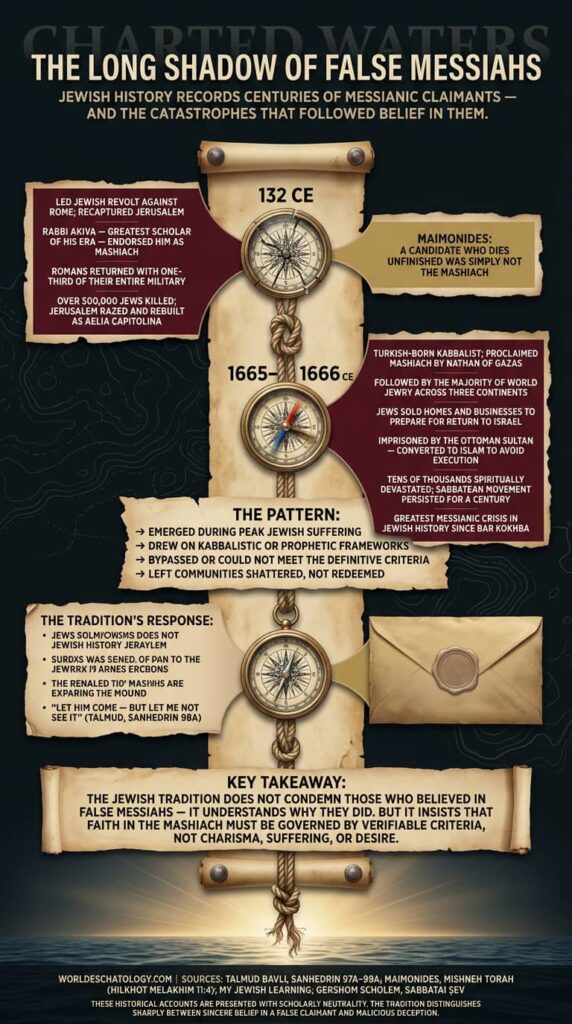
The most instructive and instructive early case is that of Shimon bar Kosiba, known as Bar Kokhba, who led a Jewish revolt against Roman rule beginning around 132 CE.
Rabbi Akiva, considered by many the greatest scholar of his generation, applied to Bar Kokhba the verse from Numbers 24:17 about a star arising from Jacob, giving him the name Bar Kokhba, Son of a Star, as a messianic title.
Other sages of the period accepted this identification, at least provisionally.
Bar Kokhba’s revolt achieved remarkable initial success. He recaptured Jerusalem, resumed sacrifices at the site of the Temple, and administered an independent Jewish state for roughly three years.
Then the Romans returned with a third of their entire military force. The revolt was crushed. The Romans killed an estimated half million Jews in the Battle of Beitar and its aftermath.
Jerusalem was razed and rebuilt as the Roman city Aelia Capitolica, from which Jews were banned. Rabbi Akiva himself was executed with spectacular cruelty.
What is remarkable is how Maimonides processed this catastrophe. Rather than treating it as a rebuke to messianic belief itself, he used it to clarify the rules of messianic identification.
Maimonides wrote that Bar Kokhba was neither a fool nor a sinner; he was simply not confirmed as the Mashiach because he died before fulfilling the definitive criteria.
This careful, legal framing allowed the tradition to absorb the failure of Bar Kokhba without abandoning the messianic idea, and it established the principle that a messianic candidate who fails or is killed has simply been proven not to be the Mashiach.
The tradition does not require grief about the error, only correction.
Shabbetai Zevi and the Greatest Crisis of Jewish Messianism
No figure in the history of Jewish messianism produced a crisis comparable to that generated by Shabbetai Zevi (1626-1676), a Turkish-born Kabbalist who declared himself the Mashiach in 1665 and gathered what may have been the largest and most geographically widespread following ever assembled around a single Jewish messianic figure.
At its peak, the Sabbatean movement had adherents from Amsterdam to Yemen, from Hamburg to Morocco, encompassing Jews of every social class and educational level, including many leading Talmudic scholars and Kabbalists.
The context matters enormously. The year 1648 had seen the Khmelnytsky massacres in Ukraine and Poland, in which Cossack forces slaughtered tens of thousands of Jews in some of the worst violence against Jewish communities before the twentieth century.
Many Jews interpreted the massacres through the lens of Lurianic Kabbalah as the birth pangs of the Messiah, the inevitable suffering that precedes redemption.
The Zohar had suggested that the year 1648 would mark the beginning of the messianic era.
When Nathan of Gaza, a young and genuinely brilliant Kabbalist, proclaimed Shabbetai Zevi the Mashiach in 1665, the timing and the framework seemed, to many, to confirm everything.
Tens of thousands of Jews sold their homes and businesses in anticipation of the imminent return to the land of Israel.
The messianic excitement spread faster than any communication technology of the era could normally have allowed.
Synagogues across Europe recited prayers for the new king of Israel. Then, in September 1666, after being imprisoned by the Ottoman sultan and faced with the choice between death and conversion to Islam, Shabbetai Zevi converted to Islam.
The shock was immense and the psychological devastation profound. Some of his followers explained the apostasy through Lurianic categories, arguing that the Messiah had to descend into impurity to retrieve the holy sparks trapped there.
Others simply walked away, shattered. Rabbi Jacob Sasportas of Amsterdam, who had courageously opposed the movement from the beginning, was largely vindicated, but the damage to Jewish communities, to trust, to faith, had been done on a massive scale.
The aftermath of the Sabbatean catastrophe had long-term consequences for the Jewish world. It deepened suspicion of Kabbalah among rationalist rabbinic authorities.
It contributed to the communal crisis that would eventually give birth to Hasidism on one side and the Jewish Enlightenment on the other.
And it bequeathed to subsequent Jewish tradition a deep wariness about messianic enthusiasm, a healthy skepticism about individuals who claimed to be the Mashiach without having fulfilled the definitive criteria.
The Messianic Era: What Happens After the Mashiach Comes
The arrival of the Mashiach is not, in Jewish thought, the end of the story but rather the beginning of a new chapter in human history.
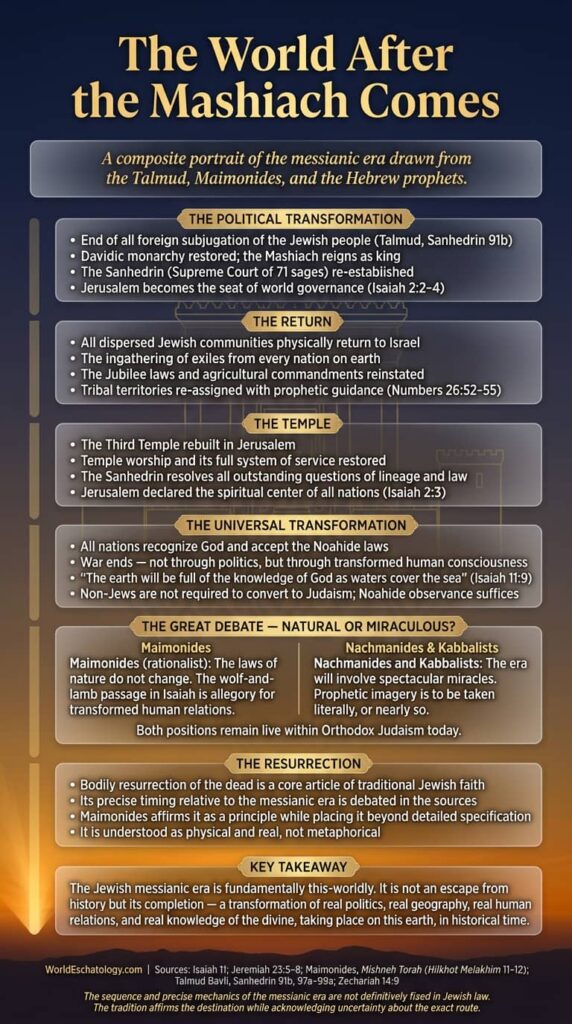
The period following his arrival, often called Yemot HaMashiach (the Days of the Mashiach) or the Olam Ha-Ba (the World to Come, though this term is also used for the afterlife), is described in the sources in terms that range from the soberly practical to the cosmically transformative.
The most widely agreed-upon features of the messianic era across the classical sources include the following:
all the dispersed Jewish communities will physically return to the land of Israel; the Temple in Jerusalem will be rebuilt and its worship restored;
the Sanhedrin, the supreme Jewish court of seventy-one sages, will be reestablished; the Davidic dynasty will govern Israel; and the knowledge of God will spread throughout all humanity.
Isaiah 11:9 captures the vision: the earth will be full of the knowledge of the Lord as the waters cover the sea.
The relationship of the messianic era to the resurrection of the dead is one of the most complex issues in Jewish eschatology.
The Talmud and the later tradition generally hold that resurrection will occur, but the timing of its relationship to the messianic era is debated.
Some authorities place the resurrection at the very beginning of the messianic age; others suggest it will occur at its end; still others treat the question as fundamentally unknowable in its precise sequence.
What is consistently affirmed is that the resurrection of the dead is a core belief of traditional Judaism, included in Maimonides’s Thirteen Principles of Faith, and that it is understood as a physical, bodily resurrection rather than a purely spiritual one.
The distinction between the rationalist and supernaturalist accounts of the messianic era becomes most acute on the question of miracles.
Maimonides insisted that the world will continue to function according to its natural laws during the messianic era; the difference will be in the political and social circumstances of the Jewish people.
Other authorities, citing the prophetic literature and the Midrashic tradition, held that the messianic era will involve spectacular miracles: the ingathering of exiles on clouds, miraculous abundance of crops, and transformations of the natural world.
The tradition has not resolved this tension, and both visions coexist within Orthodox Judaism today.
Denominational Divergence: How Modern Jewish Movements Read the Mashiach
Orthodox Judaism: The Traditional Account
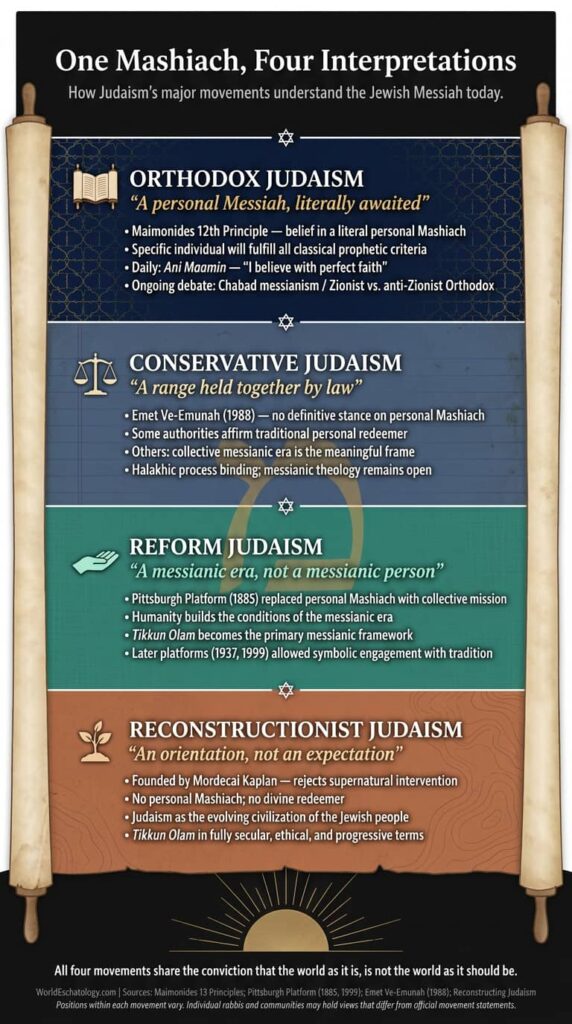
Orthodox Judaism, in all its variations from modern Orthodoxy to the Haredi world to the various Hasidic dynasties, maintains the traditional account of the Mashiach as a personal individual who will literally fulfill the criteria spelled out by Maimonides and the classical sources.
Belief in the coming of the Mashiach is Maimonides’s twelfth Principle of Faith, and Orthodox Judaism treats this as a binding article of belief.
The daily Ani Maamin prayer, which Orthodox Jews recite as part of the morning service, includes the declaration of faith in the Mashiach’s coming even if he tarries.
Within Orthodoxy, the most intense and publicly visible contemporary messianic question concerns the status of Rabbi Menachem Mendel Schneerson, the seventh Lubavitcher Rebbe, who died in 1994.
A significant portion of the Chabad-Lubavitch movement, which Schneerson led and transformed into the world’s largest Hasidic organization, believes that Schneerson was and remains the Mashiach, and that his death does not disqualify him because he will either be revealed as the Mashiach in a resurrection or his death is to be understood in some other way.
This position has been condemned by many major Orthodox authorities as crossing a red line comparable to the errors of false messianism, while Chabad leaders who hold this view maintain that precedents in Jewish tradition support the possibility of a Mashiach who dies and is subsequently identified.
The dispute remains unresolved and is a source of significant tension within the Orthodox world.
Conservative Judaism: A Middle Ground
Conservative Judaism occupies an uncertain middle ground on the question of the Mashiach.
The movement’s 1988 statement of principles, Emet Ve-Emunah, does not categorically affirm or deny belief in a personal Mashiach, leaving room for varying beliefs within the movement.
Some Conservative authorities maintain the traditional expectation of a personal redeemer.
Others have reinterpreted the messianic concept in terms closer to the Reform position, emphasizing the human responsibility to bring about a messianic era of justice and peace.
The Conservative movement’s commitment to halakhic process but openness to historical development creates a space in which different members hold genuinely different positions on this question.
Reform Judaism: The Messianic Era Without the Messiah
Reform Judaism, beginning with the Pittsburgh Platform of 1885, formally rejected the concept of a personal Mashiach.
The Pittsburgh Platform’s statement was unambiguous: it rejected the restoration of the Davidic kingdom and the return to Palestine as national homeland, and replaced the expectation of a personal Messiah with the concept of a collective human task of building a messianic era.
This repositioning had profound implications: the messianic energy was redirected from waiting for a providential redeemer to working for social justice and the improvement of human conditions.
Tikkun Olam, the repair of the world, became the central messianic category for Reform Jews, and its meaning shifted from the Kabbalistic sense of cosmic repair to a more secular and progressive sense of social and political responsibility.
Subsequent Reform documents, including the Columbus Platform of 1937 and the Pittsburgh Platform of 1999, have modulated these positions somewhat, allowing for greater engagement with traditional categories.
Some contemporary Reform thinkers have argued for a recovery of the personal Mashiach concept as a necessary symbol of hope in a world that cannot fully redeem itself by its own efforts.
But the dominant tendency in Reform Judaism remains the substitution of a collective messianic project for the personal Mashiach of the classical tradition.
Reconstructionist Judaism: Rejecting the Personal Messiah Entirely
Reconstructionist Judaism, founded by Mordecai Kaplan in the early twentieth century, takes the most thoroughgoing naturalist position.
Kaplan’s theology rejected the concept of a supernatural God who intervenes in history, and consequently also rejected the concept of a divinely sent personal redeemer.
In the Reconstructionist framework, Judaism is the evolving civilization of the Jewish people, and the messianic idea is best understood as an orientation toward an ideal future that human beings are responsible for building through their own efforts.
There is no waiting for a Mashiach; there is only the collective project of Tikkun Olam, understood in the Reform sense as social and ethical repair of the world.
What the Mashiach Will Not Be: Correcting Common Misconceptions
Any honest account of the Jewish Mashiach must include a clear statement of what the classical tradition rules out, because so much popular understanding of the Jewish Messiah is shaped by Christian theological categories that are explicitly rejected in Jewish thought.
The Mashiach will not be divine or semi-divine. The notion that the Mashiach is a manifestation of God, an incarnation of the divine, or possessed of a divine nature in any sense, is not merely absent from the Jewish sources but is actively contradicted by them.
God, in Jewish theology, is absolutely one and has no human incarnation.
The Mashiach is a human being, born of two human parents, who will live a human life and who will die a human death after accomplishing his mission.
The Mashiach will not atone for sin. The Jewish concept of atonement involves repentance, prayer, restitution, and the grace of God.
It does not involve the sacrifice of an innocent party on behalf of the guilty. This concept, central to Christian soteriology, has no classical precedent in normative Jewish thought.
A Jew who commits a sin must repent before God directly; there is no intermediary whose death changes the calculus.
The Mashiach will not perform miracles as his primary credential. Maimonides is explicit on this point: the Mashiach is not expected to perform signs and wonders to prove his identity.
His credentials are genealogical, behavioral, and ultimately historical, consisting in the actual accomplishment of the tasks assigned to him.
A miracle worker who does not rebuild the Temple and gather the exiles has not met the messianic criteria, regardless of the wonders he performs.
The Mashiach will not establish a purely spiritual or otherworldly kingdom. The Jewish messianic vision is fundamentally this-worldly.
The Mashiach will govern an actual political state, administer actual laws, lead an actual army if necessary, and accomplish actual historical tasks.
The Kingdom of God, in the Jewish messianic sense, is a transformation of earthly reality, not an escape from it into a heavenly realm.
This is one of the most fundamental differences between the Jewish and Christian messianic visions, and it is not a difference that can be resolved through reinterpretation.
The traditions are genuinely and importantly distinct.
Messianic Signs and the End of Days: Chevlei Mashiach
The tradition of signs preceding the messianic era, sometimes called the Chevlei Mashiach or birth pangs of the Mashiach, is one of the oldest and most vivid elements of Jewish eschatological thought.
The image of birth pangs is deliberately ambivalent: the pain is real and serious, but it is productive pain leading to something new.
The tradition thus acknowledges that the coming of the Mashiach will be preceded by a period of unprecedented difficulty, without suggesting that this difficulty is purposeless.
The Talmudic list of messianic signs in Sanhedrin 97a is remarkably sociological in character. Insolence will increase. Prices will soar.
The ruling powers will promote heresy. Torah scholars will be despised. Truth will be hidden. Young people will shame their elders.
The Galilee will be destroyed. These are not cosmic catastrophes but social and moral deteriorations, the kind of decay that happens when a civilization loses its ethical foundations.
The tradition seems to suggest that the period before the Mashiach’s arrival will be characterized above all by a crisis of authority and moral seriousness.
Later traditions, particularly those emerging from the Kabbalistic milieu, add additional signs and stages.
The Zohar’s treatment of the end of days is elaborate and partly cryptic, involving cosmic battles between the forces of holiness and impurity, the political transformation of nations, and a series of events in the land of Israel that will signal the approach of redemption.
Some contemporary Orthodox thinkers read the establishment of the modern State of Israel in 1948 and the reunification of Jerusalem in 1967 as possible messianic signs, though this is a contested interpretation, particularly since many anti-Zionist Orthodox authorities (most prominently the Satmar Hasidic dynasty) hold that the State of Israel was established against God’s will and cannot be part of the authentic messianic process.
Zionism, the State of Israel, and the Messianic Question
No discussion of the Jewish messianic idea in the modern era can avoid the question of Zionism and the State of Israel.
The relationship between political Zionism and religious messianism is one of the most genuinely complex and disputed questions in modern Jewish thought, precisely because it intersects the most sacred categories of Jewish hope with the most mundane categories of political history.
For religious Zionists, particularly in the tradition of Rabbi Abraham Isaac Kook (1865-1935) and his son Rabbi Zvi Yehuda Kook, the return of the Jewish people to the land of Israel and the establishment of the State of Israel represent the beginning of the process of messianic redemption, the atchalta de-geulah or first flowering of the redemption.
In this reading, the secular Zionist pioneers, even though they themselves were often anti-religious, were unknowing instruments of divine providence, performing the preparatory tasks that will eventually culminate in the arrival of the Mashiach.
This theology has been enormously influential in religious Zionist and settler communities in Israel.
Opposed to this view, the Satmar Hasidic movement, following the teaching of Rabbi Yoel Teitelbaum (1887-1979), argued that the establishment of a Jewish state through purely human political means, without awaiting the Mashiach, was a theological rebellion against God.
The three oaths described in the Talmud (Ketubot 111a) were interpreted by the Satmar position as binding commitments by the Jewish people not to ascend to the land of Israel en masse or to rebel against the nations, until the time of the divine redemption.
From this perspective, Zionism was not messianic but anti-messianic, and its political successes were a temptation rather than a sign.
Most traditional Orthodox authorities have navigated a middle path between these poles, neither claiming that the State of Israel is the messianic redemption nor condemning Zionism in the terms the Satmar tradition employs.
For these authorities, the State of Israel is a significant and potentially providential historical development without being a theological category in the sense that religious Zionism asserts.
Tikkun Olam and the Human Contribution to Redemption
One of the most intellectually and spiritually generative aspects of Jewish messianism is its tradition of thinking about the human role in bringing the redemption.
If the messianic era is God’s gift to the Jewish people and to humanity, is there anything that human beings can do to hasten its arrival, or must they simply wait?
The classical Talmudic tradition contains both perspectives. The school of Rabbi Eliezer held that Israel’s repentance was a prerequisite for redemption.
The school of Rabbi Yehoshua held that redemption would come at its divinely appointed time regardless.
Maimonides, characteristically, emphasized the moral and legal dimensions: fulfilling the commandments, studying Torah, and maintaining righteous conduct.
The Kabbalistic tradition, particularly through Lurianic frameworks, gave the human contribution a cosmic significance:
each act of righteousness performed with the proper intention, each prayer recited with focused devotion, each deed of kindness toward another person, contributes to the tikkun that liberates a spark of holiness and advances the cosmic repair process.
In modern usage, particularly outside Orthodox circles, Tikkun Olam has undergone a significant semantic transformation.
What was originally a Kabbalistic concept describing the cosmic repair process has been reinterpreted, especially in Reform and progressive Jewish contexts, as a mandate for social justice activism.
This transformation is not without its critics; some scholars argue that the contemporary usage of Tikkun Olam has lost its theological foundations and become a vague synonym for liberal politics.
But the underlying impulse, the sense that Jewish action in the world has a redemptive significance that extends beyond the individual and the community to humanity as a whole, remains recognizably connected to the classical tradition.
The Mashiach and the Nations of the World
The Jewish messianic vision is not, contrary to some popular misconceptions, a narrowly nationalist one concerned only with the redemption of the Jewish people.
The classical sources consistently describe the messianic era as a transformation of all humanity.
Isaiah 2:2-4 describes all nations streaming to the mountain of the Lord’s house in Jerusalem to learn Torah and to have their disputes adjudicated by the God of Israel, resulting in the conversion of swords into plowshares and the end of war.
Micah 4:2-3 offers a nearly identical vision. Zechariah 14:9 declares that on that day, the Lord will be one and his name will be one.
In Maimonides’s account, one of the Mashiach’s tasks is to direct all humanity toward the service of God and the study of Torah.
The Noahide laws, the seven commandments that Jewish tradition holds to be binding upon all humanity, will be universally accepted and observed.
This is not understood as a conversion of all gentiles to Judaism; the tradition has consistently held that non-Jews who observe the Noahide laws have a share in the World to Come and do not need to become Jewish.
The messianic era represents a convergence of humanity toward shared ethical and spiritual foundations, not a homogenization of all people into a single religious community.
This universalist dimension of the Jewish messianic vision has sometimes been overlooked, particularly by critics who portray Jewish messianism as self-centered or exclusive.
The classical sources are clear: the Mashiach’s coming is good news for all of humanity.
The end of war, the end of famine, the establishment of universal justice, and the spread of the knowledge of God are benefits that flow to every human being on earth, not only to Jews.
The Jewish people’s particular role in this vision, as the nation through which the Torah and its wisdom flow to the world, makes them instruments of universal blessing rather than recipients of exclusive privilege.
Frequently Asked Questions About the Jewish Messiah and Mashiach
What does the word Mashiach mean in Hebrew?
The Hebrew word Mashiach comes from the root mem-shin-chet, meaning to anoint with oil.
It literally means the anointed one, referring to the ancient practice of anointing kings and priests with sacred oil to mark them as set apart by God for a particular role.
The word does not mean savior, which comes from an entirely different Hebrew root. In its original biblical usage, Mashiach was applied to living kings and priests, not only to a future eschatological figure.
Is the Jewish Messiah the same as the Christian Messiah?
No, the two concepts are significantly different. The Jewish Mashiach is a human being, born of human parents, who will accomplish specific historical and political tasks: rebuilding the Temple, gathering the Jewish people to Israel, and leading humanity toward universal knowledge of God.
He will not be divine, will not atone for sin through sacrifice, and will not establish a spiritual or heavenly kingdom.
The Christian concept of the Messiah, developed from Jewish foundations but elaborated in very different directions, attributes divine or semi-divine nature to the Messiah and makes spiritual salvation through his death and resurrection central to his role.
These are genuinely different ideas, and it is a disservice to both traditions to blur the distinction.
What does Maimonides say are the requirements for the Mashiach?
In his Mishneh Torah (Hilkhot Melakhim 11:4), Maimonides identifies three prior requirements: descent from the House of David through a male line, diligent study and observance of the Torah, and waging God’s wars (understood as defending and extending the Jewish people’s ability to live according to the Torah).
If a candidate meets these requirements, he may be treated as a presumptive Mashiach.
Confirmation comes from actually building the Temple and physically gathering the dispersed Jewish people to Israel.
A candidate who fails or is killed before achieving these goals has been proven not to be the Mashiach.
Why do Jews not believe Jesus was the Mashiach?
The classical Jewish response to this question is that Jesus did not fulfill the defining criteria for the Mashiach established in the Jewish sources.
He did not rebuild the Temple, which was destroyed in 70 CE, decades after his death. He did not gather the Jewish people to Israel.
He did not establish a government in Israel that became the center of world governance. He did not bring about an era of universal peace.
From the traditional Jewish perspective, these are not matters of interpretation but of historical fact, and the absence of their fulfillment means Jesus does not meet the messianic criteria, regardless of his other qualities.
Who are the two messiahs in Jewish tradition?
Jewish tradition, developed in Talmudic and Midrashic sources, speaks of two distinct messianic figures.
Mashiach ben David, the final redeemer from the line of King David, is the figure most people mean when they speak of the Jewish Messiah.
Mashiach ben Yosef (or ben Ephraim), from the tribe of Ephraim descended from Joseph, is understood to come first as a military and political forerunner.
According to most sources, Mashiach ben Yosef will die in battle during a great war, triggering a period of crisis and mourning, after which Mashiach ben David will emerge to complete the redemption.
This two-messiahs tradition is ancient but has a less definitive doctrinal status than the core teachings about Mashiach ben David.
What is the difference between the Orthodox and Reform views on the Mashiach?
Orthodox Judaism maintains the traditional belief in a personal Mashiach, a specific individual who will literally fulfill the criteria described by Maimonides and the classical sources.
This belief is treated as a core article of faith. Reform Judaism, beginning with the Pittsburgh Platform of 1885, replaced the personal Mashiach with the concept of a messianic era that humanity is collectively responsible for building through social justice, ethical conduct, and the repair of the world.
Reform Jews generally do not wait for a personal redeemer; they work to bring about the conditions of the messianic era through human effort. Conservative Judaism holds a range of positions between these two poles.
What is Tikkun Olam and how does it relate to the Mashiach?
In its original Kabbalistic sense, Tikkun Olam refers to the cosmic repair process by which the scattered sparks of divine light, dispersed through the breaking of the vessels at the moment of creation in Lurianic thought, are gathered and restored through righteous human action.
This repair process, when complete, will bring about the conditions for messianic redemption.
In contemporary usage, particularly in Reform and liberal Jewish contexts, Tikkun Olam has been reinterpreted to mean social justice activism and the improvement of human society.
While this reinterpretation has lost some of its theological grounding, it retains the core intuition that Jewish action in the world has redemptive significance.
What are the signs that the Mashiach is coming?
The Talmud, particularly in tractate Sanhedrin (97a-98a), describes a series of social and moral signs that will precede the Mashiach’s arrival: an increase in insolence and moral laxity, economic inflation, a ruling power that promotes denial of God, the degradation of Torah scholars, and the hiding of truth.
Later Kabbalistic and medieval sources add additional signs. It should be noted that the tradition includes strong warnings against trying to calculate the precise timing of the Mashiach’s coming, and some of the greatest Talmudic authorities expressed a preference for not being alive to see the messianic birth pangs because of the suffering they will entail.
What is Mashiach ben Yosef and why might he die?
Mashiach ben Yosef is the forerunner messiah from the tribe of Ephraim (a son of Joseph) who, according to many sources in the Talmud and Midrash, will wage successful military campaigns against Israel’s enemies but will ultimately be killed in battle before Mashiach ben David arrives.
His death is associated with the mourning described in Zechariah 12:10. Rabbi Saadia Gaon’s view, that whether Mashiach ben Yosef actually appears depends on the spiritual state of the Jewish people, is one of the most significant interpretations: if Israel repents, the painful forerunner stage may be bypassed entirely and Mashiach ben David will come directly.
Did Shabbetai Zevi really convince most Jews he was the Messiah?
At the height of his movement in 1665-1666, Shabbetai Zevi gathered what is estimated to have been a majority of world Jewry as followers, or at least sympathetic to his claims.
Communities from Amsterdam to Istanbul, from Yemen to England, were caught up in the fervor, with many Jews selling their possessions in anticipation of the imminent journey to the land of Israel.
His subsequent conversion to Islam in 1666 devastated his following, though a significant minority continued to believe in him through various theological rationalizations, and the aftershocks of the Sabbatean movement affected Jewish communities for nearly a century afterward.
What is the Lubavitcher Rebbe controversy about the Mashiach?
Rabbi Menachem Mendel Schneerson, who led the Chabad-Lubavitch Hasidic movement until his death in 1994, was identified as a potential Mashiach by many of his followers beginning in the 1980s.
After his death, a portion of the Chabad community continued to maintain that he was the Mashiach and that his death does not disqualify him, anticipating either his resurrection or some other resolution of the apparent contradiction.
Most major Orthodox authorities have condemned this position as a form of false messianism that crosses fundamental theological boundaries.
The controversy remains unresolved and continues to create tensions within and around the Chabad movement.
What will the world look like after the Mashiach comes?
The classical sources describe a world transformed politically, socially, and spiritually. All the dispersed Jewish communities will return to Israel.
The Temple will be rebuilt and its worship restored. The Sanhedrin will be reestablished.
War will end, not through political negotiation but through a genuine transformation of human consciousness toward peace and justice.
All nations will recognize God and send representatives to Jerusalem to learn Torah.
The earth will be full of the knowledge of God as the waters cover the sea (Isaiah 11:9).
Whether the miraculous imagery of the prophets, such as the wolf dwelling with the lamb, is to be read literally or as allegory for transformed human relations, is a matter of genuine dispute within the tradition.
Is belief in the Mashiach required for all Jews?
In traditional Orthodox Judaism, belief in the coming of the Mashiach is Maimonides’s twelfth of the Thirteen Principles of Faith, and Maimonides stated that anyone who does not believe in the Mashiach has denied not only the prophets but the Torah and Moses.
This makes it one of the non-negotiable articles of orthodox belief. Reform and Reconstructionist Judaism have explicitly moved away from this requirement, treating the messianic idea as symbolically significant but not doctrinally binding in its traditional personal form.
Conservative Judaism maintains a range of positions. For most traditional Jews, the daily prayer Ani Maamin, which includes the declaration of faith in the Mashiach, serves as the regular liturgical expression of this belief.
Conclusion: The Living Question
There is a reason that the question of the Mashiach has never become merely academic for the Jewish people.
It is not the kind of question that retreats gracefully into the realm of historical curiosity.
Every generation of Jews has lived the question in real time, shaped by the circumstances of persecution, survival, emancipation, catastrophe, and renewal that have characterized Jewish history.
The Mashiach is not, in the Jewish imagination, a figure from a distant mythology. He is a presence always just beyond the horizon of the possible, the answer to the question that exile and suffering keep asking.
What the texts actually say about the Mashiach is both more modest and more demanding than popular imagination suggests.
More modest, because the Mashiach is fully human, not divine, and the messianic era, at least in Maimonides’s account, is not a cosmic miracle but a political and historical achievement.
More demanding, because the criteria are specific and verifiable, and the tradition has shown again and again, through the wreckage of false messianic movements, that it will not bend the criteria to accommodate a beloved figure who has not actually done what the Mashiach is supposed to do.
The Jewish tradition on this subject is also richer and more internally diverse than any single account can fully capture.
The rationalist Maimonidean vision and the mystical Lurianic vision represent genuinely different ways of imagining redemption, and both have shaped Jewish life profoundly.
The denominational differences between Orthodox, Conservative, Reform, and Reconstructionist Judaism on this question reflect real theological commitments, and flattening them into a single Jewish view would misrepresent all of them.
What runs through all of these currents, from the Talmud’s honest arguments to Maimonides’s careful legal definitions, from the Zohar’s cosmic drama to the Reform movement’s this-worldly social vision, is a conviction that the present state of the world is not its final state.
That history is going somewhere. That human suffering and injustice are not the last word.
The Mashiach is Judaism’s way of insisting, across three thousand years and against every historical argument that might be made against such insistence, that the world can be repaired and will be repaired, and that the Jewish people will be alive to see it.
For a people who have survived what the Jewish people have survived, that is not a small thing to believe.
2 thoughts on “Who Is the Mashiach (Jewish Messiah)? What Jewish Texts Actually Say”