

The Prophet Muhammad, peace be upon him, held up two fingers pressed close together and said: I and the Hour have been sent like this. That statement was made fourteen centuries ago.
And yet every generation of Muslims that has lived since has looked at the world around them, read the hadith describing the signs of the approaching Hour, and felt a deep and genuine recognition: these things are happening. These are the signs.
That recognition is not an illusion or a failure of perspective. It is exactly what the minor signs are designed to produce.
The Prophet did not describe the signs of the Hour to provide a countdown clock that one generation would be able to decode more precisely than others.
He described them so that every generation of believers would live with the awareness that the Hour is near, that actions have consequences, and that the preparation that matters must happen now, before the gate closes.
But the recognition must be disciplined. Not every earthquake is the sign. Not every moral decline is the specific sign the Prophet named.
Not every popular claim about which minor signs have appeared is based on authentic narrations.
The subject of the minor signs has been surrounded by weak hadith, fabricated traditions, and confident popular claims that exceed what the authenticated sources actually support.
This article covers all of it properly. The difference between major and minor signs of qiyamah and why it matters? and answers the questions about have all the minor signs of qiyamah happen
The three scholarly categories that divide the minor signs into those already fulfilled, those ongoing, and those still to come.
The thematic treatment of each major category of signs with their hadith sources. The signs still expected before the major signs begin.
The common mistakes Muslims make about this subject. And the honest answer to the most searched question: which minor signs have already appeared, and what does that mean for where we are?
Quran 47:18
“Then do they await except that the Hour should come upon them unexpectedly? But already there have come some of its indications. Then what good to them, when it has come, will be their remembrance?”
Minor Signs and Major Signs: Why the Distinction Matters
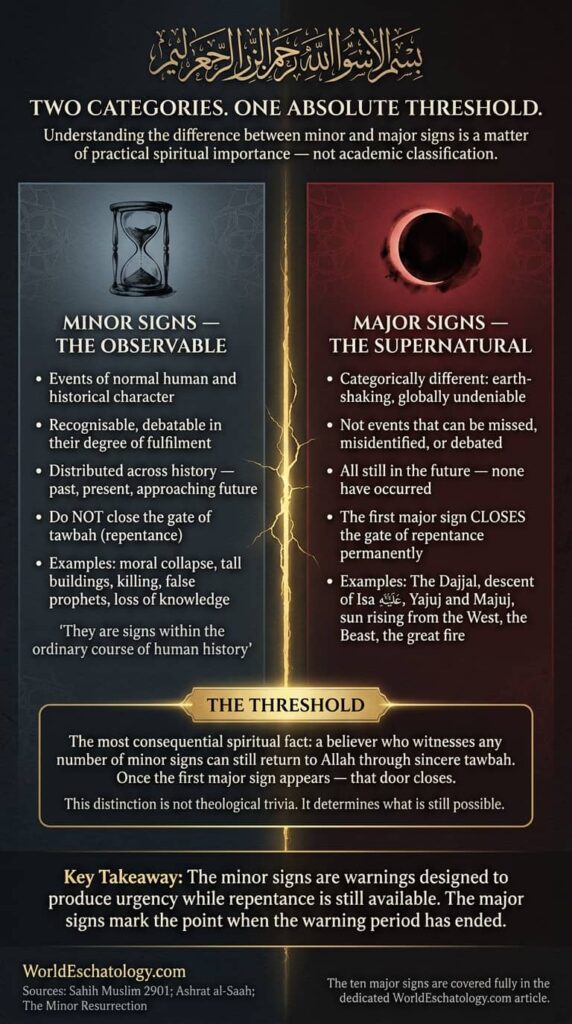
Every discussion of the minor signs must begin with a clear understanding of how they differ from the major signs, because conflating the two categories produces serious theological errors.
The minor signs are events of normal human and historical character, prophesied by the Prophet to take place before Qiyamah. We will also take a look at the signs of qiyamah that have already happened
They include things like the consumption of alcohol, the loss of religious knowledge, the prevalence of ignorance and immorality, the spread of killing, the competition in constructing tall buildings, and the breakdown of family ties.
They are recognizable events that occur within the ordinary course of human history, observable by the people who witness them, and debatable in terms of their fulfillment and degree.
The major signs are categorically different. They are supernatural, earth-shaking, globally visible events: the emergence of the Dajjal, the descent of Prophet Isa, the emergence of Yajuj and Majuj, the rising of the sun from the west, the beast from the earth, and the great fire.
These are not events that can be missed, misidentified, or debated. When the sun rises from the west, no one will be uncertain about it.
The major signs are covered in full in the dedicated article on the ten major signs of Qiyamah in this series.
The most important theological consequence of this distinction concerns the door of repentance.
The minor signs, however numerous and however serious, do not close the gate of tawbah.
A person can witness any number of minor signs and still return to Allah through sincere repentance, and their return will be accepted.
But once the first major sign appears, the gate of repentance closes. This is the principle that makes knowing the distinction between the two categories a matter of practical spiritual importance, not merely academic classification.
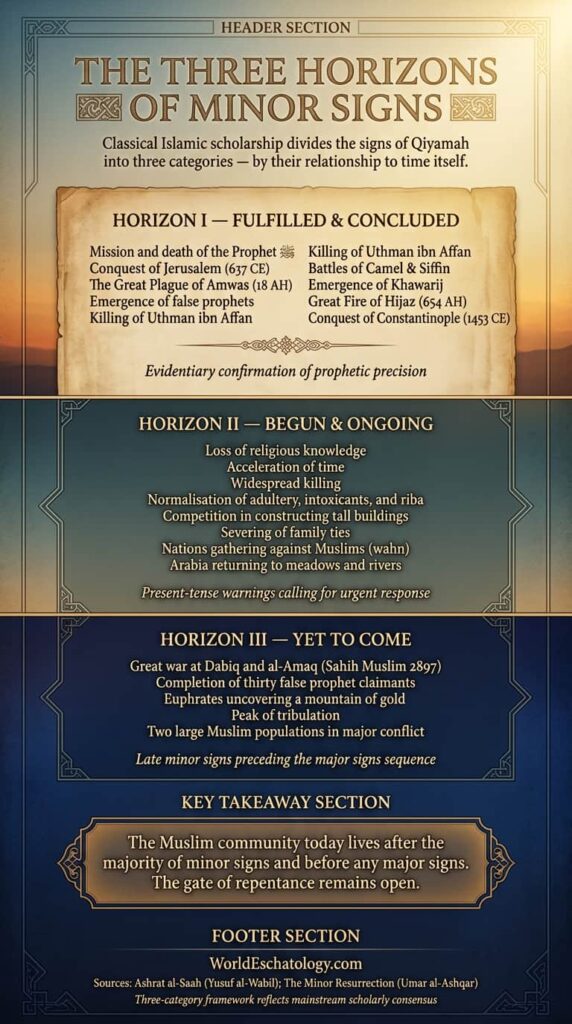
The Three Sub-Categories of Minor Signs
Classical Islamic scholarship has further divided the minor signs into three subcategories based on their relationship to historical time, and this framework, drawn from scholars including Shaykh Yusuf al-Wabil in his authoritative work Ashrat al-Saah and Shaykh Umar Sulayman al-Ashqar in The Minor Resurrection, is the most intellectually honest way to organise the subject.
Signs of qiyamah that have already happened. These are prophecies fulfilled in specific historical events that have concluded.
The conquest of Jerusalem, the great plague of Amwas, the emergence of false prophets in the Prophet’s lifetime, and the fall of Constantinople.
They serve primarily as confirmation of prophetic knowledge and as evidence that the remaining signs will equally be fulfilled.
Signs of qiyamah happening now These are the signs that began in the early generations of Islam and continue to intensify in the present.
The loss of knowledge, the spread of tribulation, the acceleration of time, the prevalence of moral collapse, and the competition in tall buildings.
These are the signs that Muslim readers feel most directly in their own lives.
Minor signs of the day of judgement that have not happened. A small number of specifically described events are understood by scholars to still lie in the future, closer to the onset of the major signs.
These include specific geopolitical events described in authentic hadith that have not yet come to pass and how many signs of qiyamah are left.
The Prophetic Foundation: Where These Signs Come From
The minor signs are not gathered in a single hadith the way the ten major signs are listed in the famous narration of Sahih Muslim 2901.
They are distributed across dozens of authentic narrations in the major collections: Sahih Bukhari, Sahih Muslim, Abu Dawud, Tirmidhi, Ibn Majah, and the Musnad of Ahmad ibn Hanbal.
Several narrations serve as major anchor texts for the minor signs as a body.
The longest and most comprehensive is a narration attributed to Abdullah ibn Masud, may Allah be pleased with him, in which the companions asked the Prophet about the signs of Qiyamah and he described a sweeping list of moral and social conditions.
This narration, collected across multiple chains, forms the basis for much of the popular understanding of the minor signs.
Sahih Bukhari 7061
“The Hour will not be established until time passes quickly, a year being like a month, a month like a week, a week like a day, a day like an hour, and an hour like the burning of a palm leaf.”
The critical scholarly note for this article is that not everything circulating as a minor sign of Qiyamah in popular Islamic discourse is actually from an authenticated source.
Some signs cited in popular lectures, social media posts, and even published books trace back to weak or fabricated hadith.
The two primary reference works that apply proper hadith methodology to this subject are Ashrat al-Saah by Shaykh Yusuf al-Wabil and The Minor Resurrection by Shaykh Umar Sulayman al-Ashqar, both published by major Islamic academic institutions.
This article follows what these and other mainstream scholars have authenticated.
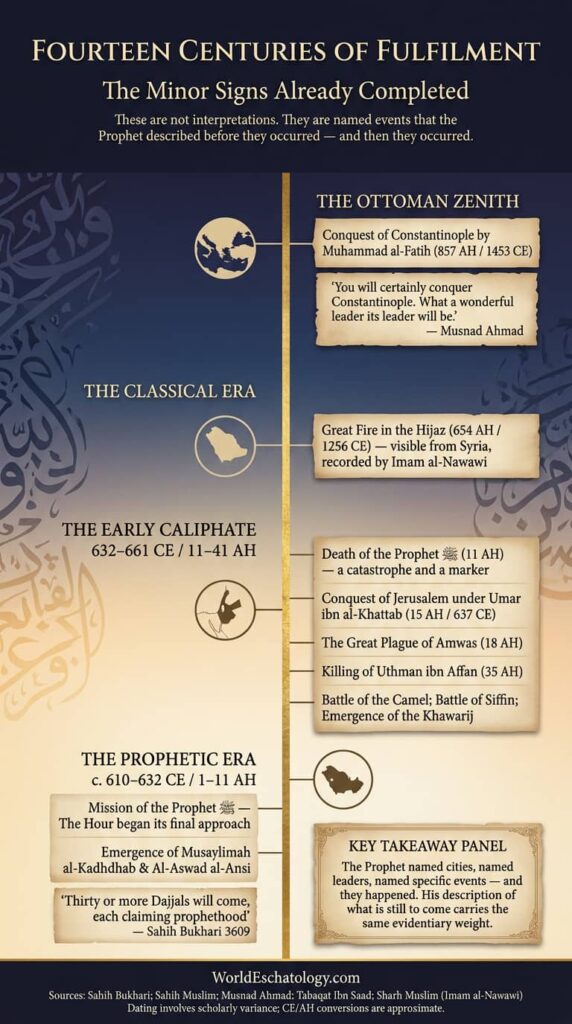
Signs Already Fulfilled: The Historical Confirmations
The signs in this category were fulfilled in specific historical events and have concluded.
Their primary function now is evidentiary: they confirm that the Prophet described real events with real precision, and this confirmation strengthens the believer’s certainty that the signs still to come will be equally fulfilled.
The Mission and Death of the Prophet
The sending of the Prophet himself, peace be upon him, was the first minor sign of the approaching Hour.
The Prophet said: I and the Hour have been sent together. His arrival as the final prophet meant the door of prophethood was closed and the final chapter of human history had begun.
His death shortly after was a catastrophe for the Muslim community and simultaneously marked a further step in the approach of the Hour.
These two events bracket the beginning of the minor signs sequence.
The minor signs of the hour conquest of Jerusalem hadith
The Prophet specifically mentioned the conquest of Bayt al-Maqdis as a sign of the Hour.
This was fulfilled in 637 CE, just six years after the Prophet’s death, when Umar ibn al-Khattab, may Allah be pleased with him, personally received the keys of Jerusalem from the Byzantine Patriarch Sophronius.
The Prophet had named the city, named the event, and it happened within a generation of his death.
The Great Plague of Amwas
The Prophet warned of a great plague that would take many lives among the believers.
In 18 AH, the plague of Amwas struck Syria and Palestine and killed an enormous number of the Prophet’s companions, including Abu Ubayda ibn al-Jarrah, the commander of the Muslim forces in Syria, and Muadh ibn Jabal.
The scale of the loss among the most learned and senior companions gave this plague a significance beyond its immediate deaths.
The Emergence of False Prophets
The Prophet said: The Last Hour will not come before there come forth thirty or so Dajjals, liars, each of them claiming to be a messenger of Allah.
The emergence of Musaylimah al-Kadhdhab and Al-Aswad al-Ansi during the Prophet’s own lifetime, followed by others in subsequent generations, began the fulfilment of this sign.
The exact count of thirty is understood by scholars as indicating an approximate number rather than a precise figure.
The Tribulations Among the Companions
The Prophet described internal tribulations that would strike the Muslim community with great severity.
These were fulfilled in the killing of Uthman ibn Affan, the third Caliph, in 35 AH, which opened a wound in the community that did not close.
The Battle of the Camel between Ali and Aisha, and the Battle of Siffin between Ali and Muawiyah, followed.
The emergence of the Khawarij, the first extremist sect that declared other Muslims to be apostates and made their killing permissible, was itself a specifically described sign, with the Prophet warning that they would recite the Quran but it would not pass their throats.
The Great Fire in the Hijaz
A great fire emerging from the land of the Hijaz was mentioned in the prophetic literature as a minor sign.
The scholar Allamah Nawawi, writing in the thirteenth century, recorded the emergence of a massive fire in Hairah, east of Madinah, visible to the people of Syria and described as illuminating the necks of camels from hundreds of miles away.
Though this sign is less commonly discussed in contemporary treatment of the minor signs, the classical scholars included it among the fulfilled ones.
The Conquest of Constantinople
The Prophet said: You will certainly conquer Constantinople. What a wonderful leader its leader will be, and what a wonderful army that army.
This prophecy was fulfilled in 857 AH, 1453 CE, when the Ottoman Sultan Muhammad ibn Murad, known to history as Muhammad al-Fatih, led his army in the conquest of the city that had withstood every previous Muslim attempt for eight centuries.
The specific naming of Constantinople in the prophetic text makes this among the most precisely fulfilled of all the minor signs.
Signs Ongoing Today: What the Prophet Described Is All Around Us
This category carries the greatest immediate relevance for Muslim readers because these are the signs that are present in the world right now.
They began early in Islamic history and have been intensifying ever since.
The Prophet described not a single moment of their appearance but a direction of travel, and that direction of travel is visible to anyone paying attention.
The Loss of Religious Knowledge
Among the clearest and most frequently cited ongoing minor signs is the gradual removal of religious knowledge from the earth.
This does not mean the disappearance of books or recorded texts.
It means the physical death of those who carry knowledge with genuine understanding, application, and spiritual depth, and their replacement by people who carry the form of knowledge without its substance.
“Allah does not take away knowledge by snatching it from the people, but He takes it away by taking away the scholars, so that when no scholar remains, people take ignorant persons as their leaders. They are asked to deliver religious verdicts and they give them without knowledge, going astray themselves and leading others astray.”
This sign describes a process rather than a single event. In every generation, the depth of scholarship is compared to the preceding generation, and in every generation since the companions, there has been a recognisable decline.
What the Prophet described is not the sudden disappearance of scholars but the gradual thinning of the chain, the increasing distance between the living scholarly tradition and the depth that characterised the first generations.
The contemporary dimension of this sign is the explosion of unqualified voices on religious matters enabled by digital media.
When anyone with a camera and a microphone can deliver religious rulings to millions of people, and when audiences cannot always distinguish between genuine scholarship and confident performance of scholarship, the condition the Prophet described is intensifying in a historically unprecedented way.
The Acceleration of Time
The Prophet said that as the Hour approached, time would pass rapidly: a year like a month, a month like a week, a week like a day, a day like an hour, and an hour like the time it takes to kindle a fire.
Scholars have offered two primary interpretations of this sign.
The first is literal: that the actual passage of time accelerates by divine decree as the Hour approaches, something impossible to verify from within time itself but consistent with the divine power over all creation.
The second is experiential: that the barakah, the blessed quality and spiritual weight, of time diminishes, so that people feel that time passes without the depth of experience and spiritual benefit that the same duration of time produced for earlier generations.
A day in which one prays, studies, reflects, and engages in meaningful acts of remembrance has a different experiential quality from a day spent in distraction, entertainment, and urgency that produces nothing of lasting value.
Both interpretations are alive in the scholarly tradition, and both contain practical instruction.
If time is accelerating, or if its quality is diminishing, the appropriate response is to redeem what time remains with greater intentionality and spiritual seriousness.
The Spread of Tribulations and the Frequency of Fitna
The Prophet described a time in which tribulations would come like waves, each wave worse than the one before.
He said: Hasten to do good deeds before tribulations come like pieces of dark night, when a man will be a believer in the morning and a disbeliever by evening, or a believer in the evening and a disbeliever by morning, and he will sell his religion for a little of this world’s goods.
The concept of fitna in the eschatological context is not merely political conflict or military tribulation.
It means a situation that creates confusion between right and wrong, that tests the believer’s ability to distinguish truth from falsehood, that makes maintaining sincere faith difficult because the environment itself is working against it.
The Prophet described fitna arriving in such rapid succession that a person escaping one would fall directly into the next.
The practical instruction embedded in this sign is one of the most specific in the entire hadith literature on this subject: be like the first of the two sons of Adam, meaning the one who was killed rather than the one who killed.
If you cannot find a good group to join, sit alone with your faith intact rather than participating in the tribulation.
This is not passivity. It is the preservation of the most important thing when everything external is in chaos.
The Widespread Killing
The Prophet warned that the Hour would not come until killing became so prevalent that a killer would not know why he was killing and the killed would not know why they were killed.
He said: There will be harj and he was asked what harj is, and he said: killing, killing.
The specific quality that makes this sign distinctive is not the quantity of killing but its purposelessness.
Wars have always been fought. People have always been killed. What the Prophet described is killing that has been decoupled from any comprehensible purpose or motivation, violence that has become reflexive rather than calculated, destruction that serves no identifiable goal.
The twentieth century, with its industrial scale of purposeless killing in trenches and concentration camps and purges, and the twenty-first century’s pattern of terrorism and mass violence whose stated motivations rarely make sense to the victims, has brought this description into sharp relief.
The Competition in Constructing Tall Buildings
One of the most visually striking minor signs is the prophecy about competing in the construction of tall buildings.
The Prophet was asked about the signs of the Hour and among his answers he included that you would see barefooted, naked, destitute shepherds competing in constructing tall buildings.
“You will see the barefooted, naked, destitute shepherds competing in constructing tall buildings.”
The social inversion described in this sign is its most theologically significant feature. It is not merely that tall buildings will be built.
It is that those who were historically the most economically marginalised will be the ones driving the competition.
The Arabian Peninsula, whose people were largely Bedouin herdsmen at the time of the prophecy, has transformed into the location of some of the tallest and most extravagant buildings on earth, built with the oil wealth that came to a region that the Prophet’s contemporaries knew as a land of camels and sand.
The scholarly consensus is that this sign has been fulfilled.
Some scholars understand the competition in building as symbolic of a broader spiritual and social inversion: the values of permanence, rootedness, and the accumulation of the akhirah have been replaced by the values of display, competition, and the accumulation of the dunya.
The Erosion of Trust and the Collapse of Honesty
The Prophet warned about a time when the trustworthy would be considered untrustworthy and the untrustworthy would be considered reliable, when the people fit for leadership would be passed over and the people unfit for it would be elevated.
He said the Hour would come when a trust becomes a means of making profit, when people give charity reluctantly, when leaders are oppressors.
The most chilling formulation of this sign is the hadith about the Day of Judgment approaching when the only transaction left in the market is lying: nothing would be sold except through deception.
The seller lies about the product. The buyer lies about his ability to pay. The intermediary lies to both. Commerce itself has become a system of mutually agreed-upon dishonesty.
The Severing of Family Ties
The Prophet specifically named the severing of family ties as a sign of the approaching Hour.
People would establish close ties with strangers while cutting off their own relatives.
The nuclear family would contract while the networks of acquaintance would expand.
Blood relationships, which the tradition describes as carrying a specific divine weight and sanctity, would be treated as less important than relationships of utility and convenience.
This sign has a contemporary dimension that would have been difficult to imagine in earlier periods.
The digital world enables the construction of elaborate networks of virtual acquaintance with people across the globe while living in physical proximity to parents, siblings, and extended family who are effectively strangers.
The form of connection has never been more accessible. The depth of connection, particularly the depth grounded in shared history, obligation, and sacrifice, may never have been more attenuated.
The Spread of Intoxicants
The Prophet warned about the widespread consumption of wine and intoxicants, saying that they would be drunk under different names.
The phrasing under different names is particularly interesting: it suggests that the prohibition would be circumvented through renaming rather than directly challenged.
What is essentially alcohol or intoxicating substance would be marketed, consumed, and normalised while its formal name was avoided.
The contemporary landscape of recreational drugs, pharmaceutical dependencies, and the global normalisation of alcohol consumption makes this sign one of the most clearly ongoing in the present moment.
The Prophet’s phrase under different names also connects to the contemporary phenomenon of substances marketed as legal highs or mood enhancers, designed to produce the effects the tradition prohibits while technically avoiding the prohibited category.
The Prevalence of Musical Instruments
The Prophet warned that musical instruments would become prevalent and that people would make permissible what they had no right to permit.
This sign is extensively discussed in the traditional literature and generates the most internal debate among Muslim scholars, since there is genuine scholarly disagreement about the permissibility of different forms of music in Islamic law.
The eschatological significance of the sign, separate from the legal debate, is about normalisation: the things the tradition warned against becoming so pervasive and so socially expected that resistance to them marks the resistant person as strange rather than as principled.
When the exception becomes the rule, when what was discouraged becomes the social default, the spiritual environment has changed in a way that has consequences for how easily the individual believer can maintain their orientation.
The Spread of Riba
The Prophet warned that a time would come when the dust of riba, interest and usury, would reach everyone, meaning that even those who did not directly engage in it would be affected by it simply by living in an economy structured around it.
“There will come a time when you will not find a single person who has not eaten from riba; and whoever has not eaten it will be reached by its dust.”
The global financial system of the twenty-first century is built around interest-bearing debt at every level, from personal credit cards to sovereign debt to the monetary policies of central banks.
A Muslim living in any modern economy is unavoidably embedded in a system where riba is structural rather than incidental.
The Prophet described exactly this condition: not the choice to engage in usury but the impossibility of escaping its effects simply by living in the world as it has become structured.
Widespread Immorality and Public Shamelessness
The Prophet warned about a time when sexual immorality would become not merely private sin but public norm.
He described fornication as becoming so widespread and so open that it would resemble the public behaviour of animals.
He described women who dress but are effectively naked, who are seduced and who seduce others, as people who will not enter paradise and will not perceive its fragrance from a great distance.
The contemporary context is clear. The Prophet described not merely the existence of sexual immorality, which has characterised every human society, but its public celebration and normalisation, the collapse of the shame that previously kept it private and the replacement of shame with pride in what the tradition considers transgression.
The sign is not about the existence of sin. It is about the disappearance of the recognition that it is sin.
Signs Related to Knowledge and Scholarship
The signs connected to the state of religious knowledge deserve their own dedicated treatment because they represent one of the most serious and practically important categories in the entire minor signs discussion.
The Prophet placed this category at the very top of his concerns for his community.
When Abu Dhar asked the Prophet what he feared most for his ummah, the Prophet’s answer was not the Dajjal. His answer was misguided scholars.
Musnad Ahmad 21334 (authenticated by al-Arnaut)
“What I fear most for my ummah are misguided leaders.”
This hadith is among the most practically urgent in the entire body of prophetic literature on the signs of the Hour.
The Dajjal is a clearly identified external threat whose characteristics are described in detail and whose defeat is assured.
The misguided scholar is an internal threat who operates from within the tradition, uses the language and authority of religious knowledge, and leads people astray precisely because they trust that language and authority.
The signs connected to knowledge and scholarship include the multiplication of fatwas from unqualified sources, the acceptance of religious authority on the basis of popularity rather than competence, the seeking of rulings that confirm what the seeker already wants to do rather than what they genuinely need to hear, and the replacement of the living scholarly tradition with the individual’s direct and unmediated reading of texts without the context that makes those texts intelligible.
The instruction the prophetic tradition gives in response to these signs is specific: know who you take your religion from.
The question the tradition asks of a religious source is not whether they are eloquent or popular or confident.
It is whether their knowledge traces through a reliable chain of transmission, whether their character is consistent with what they teach, and whether their conclusions are consistent with the established positions of the scholarly tradition on foundational matters.
Signs Related to Political and Governance Collapse
A significant category of the minor signs concerns the condition of political leadership and governance.
The Prophet was specific about the political signs, naming conditions of leadership that would mark the deterioration of the social order that makes righteous living easier.
The most comprehensive political sign is the general principle that leadership would pass to those unfit to hold it.
The Prophet said: when you see the matter of leadership given to those who do not deserve it, then wait for the Hour.
The criteria for legitimate leadership in the Islamic tradition are character, knowledge, competence, and the willingness to carry the trust of those being led as a genuine responsibility rather than an opportunity for enrichment.
When these criteria are inverted, when leadership goes to those who are most aggressive in seeking it rather than those most qualified to hold it, the social condition that enables the community’s flourishing is undermined.
The Prophet also described a condition of leaders who are oppressors and traders who are liars.
He connected specific social and economic abuses to the approach of the Hour, embedding in his description of the signs a moral anatomy of societal collapse:
distrust at the top produces distrust throughout, oppression normalises itself, and the institutions meant to enforce justice become instruments of the very injustice they were designed to prevent.
A specific and frequently discussed political sign is the prophecy about peoples gathering against the Muslims the way diners gather around a communal dish, not because the Muslims are small in number but because they are afflicted with wahn.
When the companions asked what wahn is, the Prophet said: love of the worldly life and hatred of death.
The sign is not about external military threat but about an internal spiritual condition that makes the community vulnerable: the prioritisation of comfort and survival in this world over the values and commitments that make a community worth defending.
Signs Related to Geography and the Physical World
Several minor signs relate to specific geographical and physical developments that the Prophet described with a precision that has been noted by scholars.
The Land of Arabia Becoming Meadows
The Prophet said: The Hour will not come until the land of the Arabs returns to being meadows and rivers.
The Arabian Peninsula at the time of the prophecy was predominantly desert.
The transformation of arid desert land into green spaces through irrigation, infrastructure, and water management is something that the oil wealth of the twentieth and twenty-first centuries has made possible for the first time.
The greening of the Arabian Peninsula, through vast agricultural projects and urban landscaping funded by petroleum revenues, represents a historically unprecedented transformation of the land.
The Euphrates and the Mountain of Gold
The Prophet described a sign involving the Euphrates river uncovering or revealing a mountain of gold.
He said: The Euphrates will soon uncover a mountain of gold, so whoever is present should not take anything from it.
Some scholars have understood this as referring to mineral wealth, oil reserves, or other resources hidden beneath the Euphrates basin.
Others understand it more literally as a future physical event. The Prophet’s specific warning not to take from it is significant: the sign itself is not an opportunity but a trial, and those who take from it destroy each other over it.
The Closeness of Cities
The Prophet described a time when cities would seem to draw close together, understood by contemporary scholars as a description of the compression of geographical distance through transportation and communication technology.
A journey that once took months now takes hours. A conversation that once required physical proximity now happens instantaneously across continents.
The world has shrunk in a way that would have seemed literally miraculous to the Prophet’s contemporaries, and the prophetic description anticipated this condition.
Signs Related to the State of the Muslim Ummah
Several minor signs speak specifically about the internal condition of the Muslim community rather than about the broader state of the world.
These are among the most personally challenging signs for Muslim readers because they describe failure within the community rather than threatening forces from outside it.
The Prophet described a time when Muslims would be attacked and consumed by their enemies not because of the enemies’ strength but because of the Muslims’ own internal weakness: love of the world, fear of death, and the abandonment of the brotherhood that is the spiritual foundation of the community.
He described groups within the Muslim world fighting each other and causing more damage to the community than external enemies could inflict.
He described a time when the Quran would be widely recited but not understood, when the words of Allah would be on the tongues of millions but not in their hearts, when the form of religious practice would be maintained while its spirit had departed.
The hadith about a group who would recite the Quran but it would not pass their throats, used in its primary meaning about the Khawarij, also speaks to a broader pattern:
the displacement of genuine engagement with the Quran by mechanical recitation without the reflection, understanding, and application that transforms the reciter.
The Prophet also described the abandonment of the Sunnah, the rejection of authentic prophetic guidance in favour of personal reasoning untethered from the tradition.
He warned about a time when someone would say: follow the Quran only and leave the hadith, rejecting the prophetic model of how the Quran is to be understood and lived.
This sign is understood as a warning about the fragmentation of the tradition’s interpretive authority.
Signs Still to Come: What Has Not Yet Appeared
A small number of specifically described minor signs are understood by mainstream Islamic scholars to be still in the future.
These are distinct from the major signs, which are entirely future, but are among the late minor signs expected to appear in the period leading up to the major signs sequence.
The Great War at Dabiq and al-Amaq
The Prophet specifically described a great battle between the Muslims and the Romans at a place called Dabiq or al-Amaq, both locations in the region of Syria.
This battle is described in Sahih Muslim and other authentic collections as a sign of the Hour.
The Prophet described this battle as occurring in the period of signs preceding the emergence of the Dajjal.
Scholars have been careful to note that identifying any current conflict in Syria or the surrounding region with this specific sign requires caution given the history of premature identifications.
The sign’s specific geographical names and the specific nature of the conflict described make it identifiable when it occurs rather than requiring interpretation of current events to fit the description.
The Completion of the Count of False Prophets
The Prophet said that thirty or more Dajjals claiming prophethood would emerge before the Hour.
The counting of individuals who have historically made such claims across Islamic history is a matter of scholarly discussion, with some counts approaching the prophetic number.
The sign is understood as still ongoing, with its completion being a marker of proximity to the final events.
The Peak of Killing and Tribulation
The hadith describes the killing reaching a level at which a person walking past a grave will wish they were in it, not out of despair but simply because the living have it worse than the dead.
This level of tribulation is understood by scholars as the peak of the period of minor signs, immediately preceding the emergence of the major ones.
The world has experienced great suffering in human history, but the specific level described, where death appears preferable to life to the average person, is understood as not yet having been reached at global scale.
How Many Minor Signs Have Already Appeared?
This is the most frequently searched question about the minor signs, and it deserves a direct, honest answer.
According to the scholarly consensus, the majority of the minor signs have already appeared. This is not a casual claim.
It is based on careful examination of the authenticated hadith describing the minor signs against the historical record and the current state of the world.
The signs of the Prophet’s lifetime and immediate aftermath are complete. The major historical fulfilments are complete.
The moral and social signs are ongoing and in many cases intensifying. The geographical signs related to the Arabian Peninsula are fulfilled.
What remains from the minor signs is a small category of late signs, primarily the specific geopolitical events described in authentic narrations that have not yet occurred at the scale described.
This answer has a specific implication that must be stated clearly: the Muslim community is living in the period after most minor signs and before any major signs.
The gate of repentance is still open. The Dajjal has not emerged. Prophet Isa has not descended.
The sun has not risen from the west. Everything that determines eternal destiny is still within the reach of sincere repentance and genuine practice.
The response to knowing that most minor signs have appeared is not panic, not fatalism, and not the obsessive calculation of remaining signs.
It is urgency: the urgency of a person who understands that the time for preparation is now, before the preparation becomes impossible.
It is the urgency that produces prayer performed with presence, charity given with genuine sacrifice, family ties maintained even when inconvenient, and the purification of the heart that makes a person ready for whatever comes next.
Common Mistakes Muslims Make About the Minor Signs
The minor signs are a subject surrounded by popular misconceptions that deserve direct correction, because many of these misconceptions cause genuine harm to the believer’s relationship with the signs and to their practical religious life.
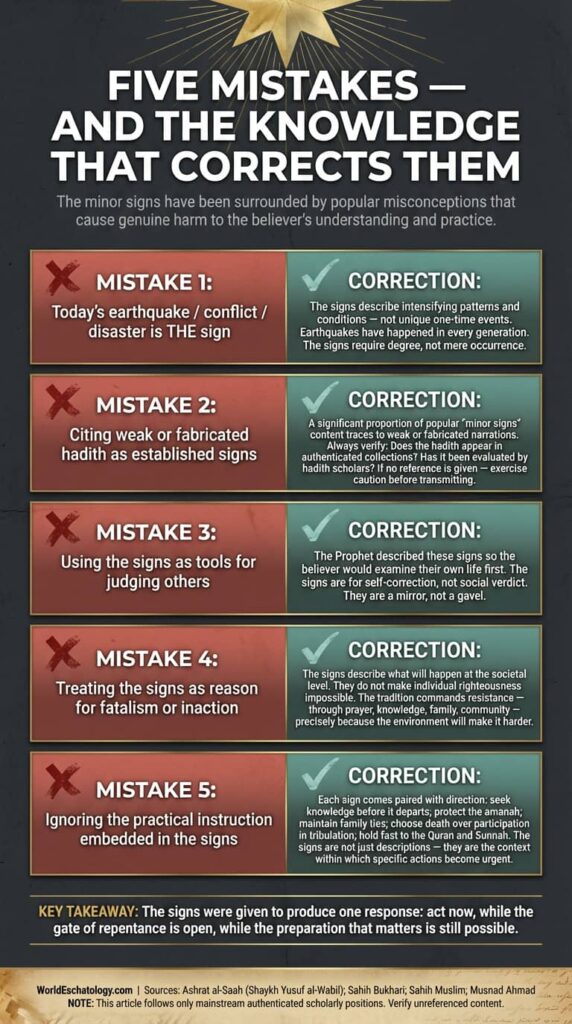
The first mistake is treating every current event as a specific fulfilment of a named sign.
Earthquakes happen. Moral decline happens. Political instability happens. These things have happened in every generation of human history.
The minor signs describe patterns and conditions that intensify as the Hour approaches, not a unique one-time occurrence of each condition that marks its fulfilment.
When a Muslim says today’s earthquake is the sign of Qiyamah, they are going beyond what the hadith actually says.
The second mistake is citing weak or fabricated hadith as authentic signs.
A significant proportion of what circulates in popular Islamic discourse as minor signs traces to narrations that hadith scholars have classified as weak or fabricated.
The rule for this subject, as for all Islamic knowledge, is to verify the source.
If a sign is cited without a hadith reference, or with a reference to a collection known to contain weak narrations, the appropriate response is caution rather than confident transmission.
The third mistake is using the signs primarily as a tool of social criticism.
The signs describe moral and social conditions that the believer should examine first in their own life before applying them to others.
The Prophet gave these descriptions so that the Muslim would recognise the conditions in themselves and in their immediate environment and respond with self-correction.
They were not given as a framework for judging other Muslims or non-Muslims.
The fourth mistake is treating the signs as a source of fatalism.
The signs describe what will happen. They do not say that nothing can be improved or that the direction of moral decline is irreversible at the individual level.
An individual believer can resist every social condition described in the minor signs through personal practice, genuine scholarship, and community building.
The purpose of the signs is to produce not surrender but the specific kind of urgency and clarity that motivates serious preparation.
The fifth mistake is ignoring the practical spiritual instruction embedded in the signs.
The Prophet did not describe the minor signs and then say: so there is nothing to do.
He described them in the context of instruction: seek knowledge before it departs, hold fast to the Quran and Sunnah, maintain the bonds of family and community, protect the amanah, perform the acts of worship that root the heart in its relationship with Allah.
The signs are not just descriptions. They are the context within which practical instruction becomes urgent.
The Full Referenced List of Minor Signs
Signs Fulfilled in Early Islamic History
Mission of the Prophet (Sahih Bukhari, Muslim)
The sending of the final Prophet as the first sign of the Hour’s nearness.
Death of the Prophet (Sahih Bukhari, Muslim)
His death as a catastrophe and marker of the Hour drawing closer.
Conquest of Jerusalem (Hadith in Tabaqat Ibn Saad)
Fulfilled 637 CE under Umar ibn al-Khattab.
Plague of Amwas (Hadith in Tabaqat)
Fulfilled 18 AH, killed major companions in Syria and Palestine.
Emergence of Musaylimah and Al-Aswad (Sahih Bukhari)
False prophets appearing in the Prophet’s own lifetime.
Killing of Uthman ibn Affan (Sahih Bukhari)
The first great internal tribulation among the Muslims.
Battle of the Camel and Siffin (Sahih Bukhari, Muslim)
The predicted civil wars among the companions.
Emergence of the Khawarij (Sahih Bukhari, Muslim)
The first extremist sect, described in specific prophetic detail.
Great Fire in the Hijaz (Recorded by al-Nawawi in Sharh Muslim)
Massive fire visible from Syria and beyond, 654 AH.
Conquest of Constantinople (Musnad Ahmad)
Fulfilled 1453 CE under Muhammad al-Fatih.
Signs Ongoing in the Present
Loss of religious knowledge (Sahih Bukhari 100)
Gradual departure of depth with the death of true scholars.
Spread of ignorance (Sahih Bukhari 81)
Prevalence of unqualified religious voices and lack of discernment.
Acceleration of time (Sahih Bukhari 7061)
Time passing rapidly, loss of barakah in hours and days.
Widespread killing (Sahih Bukhari 7066)
Purposeless violence where neither killer nor killed understands why.
Widespread adultery and fornication (Ibn Majah 4019)
Public normalisation of what the tradition considers transgression.
Spread of intoxicants (Sahih Bukhari 5590)
Wine consumed under different names, normalised across societies.
Prevalence of musical instruments (Sahih Bukhari 5590)
Musical instruments found in every home without reservation.
Spread of riba throughout the economy (Sunan Abu Dawud)
Even those not directly engaging in usury reached by its dust.
Competition in constructing tall buildings (Sahih Muslim 8)
Barefooted shepherds competing in towering structures.
Severing of family ties (Hadith in Musnad Ahmad)
Closeness with strangers, estrangement from family.
Collapse of trust and honesty (Sahih Bukhari 5576)
Trustworthy treated as untrustworthy, markets built on deception.
Leaders who are oppressors (Tirmidhi)
Leadership given to the unqualified, oppression by those in power.
Widespread tribulations (Sahih Bukhari 7084)
Fitna arriving in waves, each worse than the last.
Misguided scholars in positions of authority (Musnad Ahmad 21334)
The thing the Prophet feared more than the Dajjal for his ummah.
Nations gathering against the Muslims (Abu Dawud 4297)
Not because of enemy strength but Muslim wahn, love of the world.
Arabian Peninsula returning to meadows (Sahih Muslim 157)
Desert land transformed through wealth and irrigation.
Widespread shamelessness and public immorality (Ibn Hibban)
Public display of what the tradition considers grave sin.
Signs Still to Come
Great war at Dabiq and al-Amaq (Sahih Muslim 2897)
A major battle in Syria preceding the emergence of the Dajjal.
Completion of thirty false prophet claimants (Sahih Bukhari 3609)
The count of those claiming prophethood approaching its prophetic number.
Peak of killing where death is preferable to life (Tirmidhi 2198)
Tribulation reaching its maximum intensity before the major signs.
Two large groups of Muslims in major conflict (Sahih Bukhari 7121)
Large-scale warfare between Muslim populations.
Euphrates uncovering a mountain of gold (Sahih Bukhari 7119)
With the warning that none should take from it.
What the Minor Signs Are Actually For: The Spiritual Purpose
After fourteen centuries of accumulating fulfilment, it would be easy to treat the minor signs primarily as a prophetic achievement, a demonstration of the Prophet’s knowledge of what would come.
And they are that. But they are not primarily that.
The minor signs are a spiritual instrument designed to produce a specific effect in the believer who encounters them: the combination of urgency and clarity that motivates genuine preparation. Not anxiety.
Not the obsessive monitoring of current events for eschatological significance. Not the fatalism that says the world is declining and nothing can be done. Urgency and clarity.
The Quranic framing of the entire subject is found in Surah Muhammad 47:18: do they then await except that the Hour should come upon them unexpectedly?
But already there have come some of its indications. The signs are given precisely so that the arrival of the Hour is not unexpected.
A person who has been given a detailed description of the conditions that will precede a great event has no excuse for being caught entirely unprepared when those conditions arrive.
The Prophet connected the signs to specific practical responses at every turn.
When he described the loss of knowledge, he instructed the believers to seek knowledge before it was gone.
When he described the spread of killing, he instructed the believers to be like the killed rather than the killer during fitna.
When he described the acceleration of time, the implicit instruction is to make better use of what time remains.
When he described the departure of trust, the instruction was to be the person who keeps trust even when everyone around them has abandoned it.
The minor signs are not a spectacle to be watched.
They are a mirror to be held up, first and primarily to oneself, and the appropriate response to what the mirror shows is not the comfort of knowing that history is proceeding as described, but the urgency of a person who understands that what comes next depends on what they do right now.
Frequently Asked Questions
What are the minor signs of Qiyamah?
The minor signs of Qiyamah are prophesied events of a normal human and historical character that indicate the approaching Hour.
They include the loss of religious knowledge, the spread of tribulations, the acceleration of time, widespread killing, moral decline, the competition in building tall buildings, the severing of family ties, the spread of intoxicants and musical instruments, and the prevalence of riba.
They are described across dozens of authentic narrations in Sahih Bukhari, Sahih Muslim, and other canonical collections.
How many minor signs of Qiyamah are there?
Scholars count between seventy and over one hundred minor signs depending on how broadly authenticated hadith are drawn upon and how specifically individual signs are defined.
The most rigorous scholarly treatments, including Shaykh Yusuf al-Wabil’s Ashrat al-Saah, work from authenticated sources and identify signs that can be clearly distinguished from each other.
Many popular lists include weak or fabricated hadith in their counts.
Which minor signs of Qiyamah have appeared?
According to the scholarly consensus, the majority of the minor signs have already appeared or are currently ongoing.
Historical fulfilments include the conquest of Jerusalem, the plague of Amwas, the emergence of false prophets, the internal tribulations among the companions, and the conquest of Constantinople.
Ongoing signs include the loss of knowledge, the spread of tribulations, the acceleration of time, widespread moral decline, competition in tall buildings, and the dominance of riba in economic life.
A small number of late minor signs are still expected to occur before the major signs begin.
What is the difference between minor and major signs of Qiyamah?
Minor signs are events of normal human and historical character that have been occurring since the Prophet’s time and continue to intensify.
They can be missed or debated. They do not close the door of repentance.
Major signs are supernatural, earth-shaking, globally unmistakable events: the Dajjal, the descent of Prophet Isa, Yajuj and Majuj, the rising of the sun from the west, the beast of the earth, and others.
When the first major sign appears, the gate of repentance closes permanently. None of the major signs have yet occurred.
What is fitna in relation to Qiyamah?
Fitna in the eschatological context means a trial that tests faith and creates confusion between right and wrong, truth and falsehood.
The Prophet described the minor signs as involving an intensifying series of fitnah that arrive like waves, each worse than the last.
The practical instruction embedded in this description is to be like the killed rather than the killer during fitna, to sit with one’s faith intact rather than participating in tribulation when no clearly right side exists.
What does time accelerating mean as a sign of Qiyamah?
The hadith in Sahih Bukhari 7061 describes time passing rapidly as the Hour approaches: a year like a month, a month like a week, and so on.
Scholars offer two main interpretations: that time literally shortens by divine decree, or that the barakah and spiritual weight of time diminishes so that people feel time passing without the depth of benefit that the same period produced for earlier generations.
Both interpretations point to the same practical instruction: make intentional and spiritually meaningful use of the time available.
Is the spread of music a sign of Qiyamah?
Yes. The Prophet warned in an authentic hadith collected in Sahih Bukhari that musical instruments would become prevalent in every home and that people would make permissible what they had no right to permit.
The eschatological significance of this sign is primarily about normalisation: the conditions the tradition warned against becoming so pervasive that maintaining resistance to them marks the resistant person as unusual.
The detailed legal debate about specific forms of music is a separate question from the eschatological sign.
What is the sign of tall buildings in Islam?
The Prophet described among the signs of the Hour that you would see barefooted, naked, destitute shepherds competing in constructing tall buildings.
This hadith is in Sahih Muslim. The sign describes a social inversion: those who were historically the most marginalised driving a competition in architectural display.
The Arabian Peninsula’s transformation from a land of Bedouin herdsmen to a location of some of the world’s tallest and most extravagant buildings is widely cited by scholars as the fulfilment of this sign.
What is the sign of knowledge being removed before Qiyamah?
The Prophet described in Sahih Bukhari 100 that Allah takes away knowledge not by snatching it from the people but by taking away the scholars, so that when no genuine scholar remains, people take the ignorant as their leaders who give religious rulings without knowledge and go astray themselves while leading others astray.
This sign is ongoing: every generation of scholars that passes represents a reduction in the depth of the living scholarly tradition, and its replacement by unqualified voices on religious matters accelerates with each generation.
Have all minor signs of Qiyamah appeared?
No, not all minor signs have appeared. The majority have appeared, and a substantial proportion are currently ongoing.
However, a small number of specifically described late minor signs, including a major battle at Dabiq in Syria, the completion of the prophesied count of false prophets, and the peak level of killing described as making people wish they were in the grave, are understood by scholars as still to come. None of the major signs have appeared.
How many signs of qiyamah are left to come?
Among the minor signs still expected: the great war at Dabiq described in Sahih Muslim, the completion of the count of false prophets, and the peak of killing and tribulation immediately before the major signs.
After these, the major signs will begin: the emergence of the Imam Mahdi, the Dajjal, the descent of Prophet Isa, Yajuj and Majuj, the three great landslides, the Dukhan, the Dabbat al-Ard, the rising of the sun from the west, and the fire from Yemen.
What did the Prophet say about the signs of the Hour?
The Prophet described the signs of the Hour across dozens of narrations collected in the canonical hadith collections.
His descriptions included specific historical prophecies, moral and social conditions of the approaching period, and the ten major signs.
He connected each description to practical instruction for the believer: seek knowledge, hold to the Sunnah, be like the killed rather than the killer during fitna, maintain family ties, protect the amanah, and perform acts of worship with the urgency of someone who understands that the Hour is nearer than it appears.
Conclusion: Signs as Preparation, Not as Performance
Fourteen centuries after the Prophet held up two adjacent fingers and said the Hour and I have been sent like this, the minor signs he described have accumulated around every generation that has lived since and have accumulated most visibly around this one.
The cities have grown taller than anything his companions could have imagined. Trust has become a commodity.
Time moves through people’s hands without settling. The scholars depart and the substitutes multiply.
The world has grown smaller and lonelier simultaneously. The signs he named are everywhere the honest observer looks.
And the gate is still open. Not forever. Not in the face of the first major sign. But now, in this moment, in the ordinary time that is the lobby before the Hour, the gate of sincere return to Allah is fully open.
The minor signs were not given to produce a generation of people who can identify them precisely on a chart.
They were given to produce a generation of people who live with the awareness that the Hour is near, that what they do in the time remaining matters permanently, and that the preparation that the Quran and Sunnah describe is not optional equipment for the spiritually ambitious but essential equipment for anyone who understands what is coming.
The signs are real. The Hour is coming. The gate is open.
The most important thing about the minor signs is not what they tell us about the world. It is what they invite us to do with the time we still have.
Sources: Sahih Bukhari, Sahih Muslim, Abu Dawud, Tirmidhi, Ibn Majah, Musnad Ahmad ibn Hanbal
Scholarly references: Shaykh Yusuf al-Wabil: Ashrat al-Saah | Shaykh Umar Sulayman al-Ashqar: The Minor Resurrection | IslamQA.info
WorldEschatology.com | All hadith cited from canonical collections and verified through primary scholarly sources
2 thoughts on “7 Minor Signs of Qiyamah That Are Currently Unfolding”