
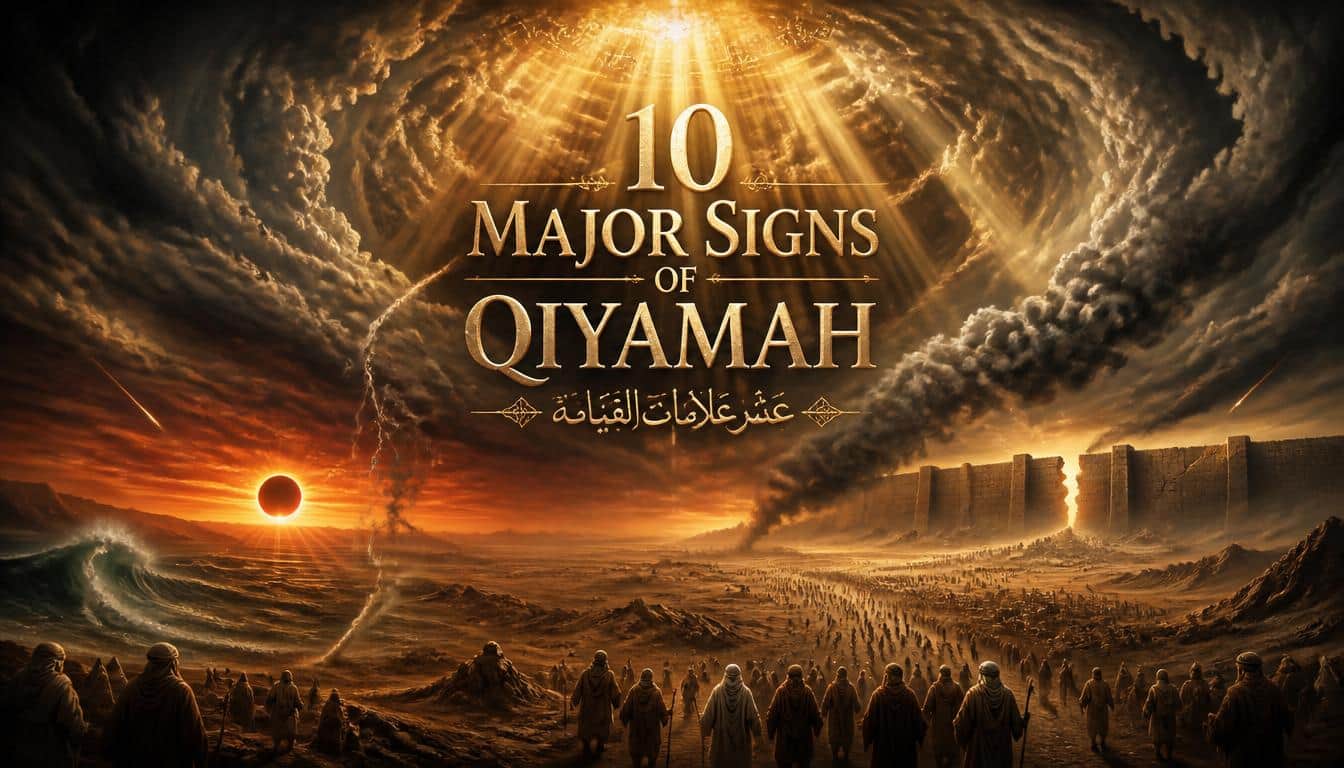
The 10 Definitive Events Before the Final Hour — From Authentic Hadith
The companions were sitting together, talking quietly among themselves.
The subject was the Day of Judgment, the way people who have thought deeply about something will sometimes discuss it among themselves, turning the great questions over in their hands the way you might turn a stone.
They were not expecting the Prophet, peace be upon him, to appear. But he did, leaning down from an upper floor, and he asked them: what are you discussing?
They told him. And he did not redirect the conversation. He did not tell them to concern themselves with something more immediately practical.
He leaned in and gave them something that has been studied, memorised, and transmitted across fourteen centuries of Islamic scholarship: a list of ten signs, ten specific definitive events, that will occur one after another before the Final Hour arrives.
This moment is recorded in Sahih Muslim, number 2901, narrated by the companion Hudhayfah ibn Asid al-Ghifari, may Allah be pleased with him.
It is not a vague prophetic impression. It is not a symbolic metaphor requiring elaborate interpretation.
It is a specific list, from the most authoritative hadith collection in Sunni Islam, of the events that will mark the final chapter of human history on this earth.
None of the ten major signs have occurred yet. When the first one appears, the sequence that follows will be unlike anything humanity has ever witnessed.
The purpose of this article is to go through major signs of qiyamah carefully, from authentic sources, with the depth and honesty they deserve.
We will cover what each sign is, what the hadith and Quran say about it in detail, its theological significance, and the scholarly discussions that have accumulated around it.
We will also address, directly and honestly, the questions that Muslim readers most want answered: are any of these signs already here?
What is the correct sequence? And what does all of this mean for how a believer should live right now?
Sahih muslim 2901 ten signs of the hour list
Before covering any individual sign, the hadith itself deserves to be set out completely and carefully, because everything that follows depends on understanding its source and its authority.
Hudhayfah ibn Asid al-Ghifari, may Allah be pleased with him, reported: The Messenger of Allah, peace be upon him, came to us while we were discussing.
He said: What are you discussing about? They said: We are discussing the Last Hour. He said:
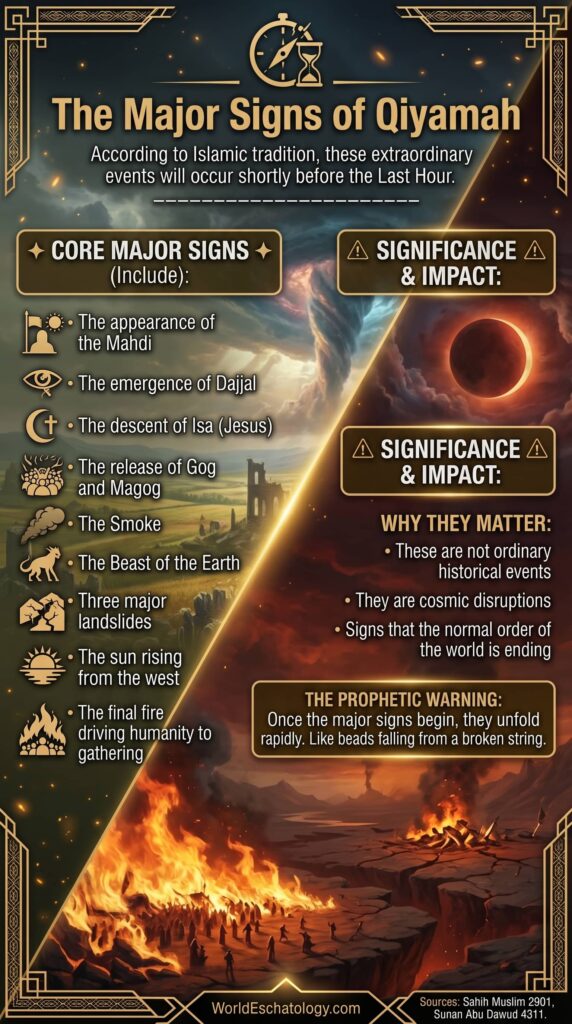
“The Last Hour would not come until the ten signs appear: land-sliding in the east, land-sliding in the west, land-sliding in the Arabian Peninsula, the smoke, the Dajjal, the beast of the earth, Gog and Magog, the rising of the sun from the west, and the fire which would emerge from the lower part of Aden. And the tenth, from related narrations in the same collection, is the descent of Jesus, son of Mary, peace be upon him.”
The chain of narration for this hadith passes through Shu’ba, one of the greatest hadith scholars in Islamic history, through Furat al-Qazzaz, through Abu al-Tufayl, to the companion Abu Sariha Hudhayfah ibn Asid.
Imam Muslim collected it in his Sahih, the second most authoritative hadith collection in Sunni Islam after Sahih Bukhari.
It is also found in the collections of Ibn Majah, Ahmad, and others. Its authenticity is not in question.
One thing must be said clearly at the outset, because intellectual honesty requires it: the hadith lists ten signs, but it does not definitively specify their order.
Scholars have discussed at length which sign precedes which, and there is genuine disagreement.
What is agreed upon, from other narrations, is a core sequence: the Mahdi emerges, then the Dajjal appears, then Prophet Isa descends and kills the Dajjal, then Yajuj and Majuj emerge.
Beyond this core sequence, some signs’ precise placement in the timeline is a matter of scholarly discussion rather than settled doctrine.
This article presents the signs in the order most commonly cited by classical and contemporary scholars, while being honest where uncertainty exists.
Minor Signs and Major Signs — Why the Distinction Matters
Islamic eschatology divides the signs preceding the Day of Judgment into two categories, and the distinction between them is not merely academic. It is theologically critical.
The minor signs are the smaller, ongoing indicators that the Hour is approaching. They include the death of the Prophet, peace be upon him, itself as the first minor sign.
They include the conquest of Jerusalem, the appearance of false prophets, the spread of wealth and tall buildings, the increase in tribulations, the loss of trust and Islamic knowledge, the increase in earthquakes, and hundreds of other social, moral, and historical indicators described across the collections of Bukhari, Muslim, Abu Dawud, Tirmidhi, and others.
Many of these minor signs have occurred. Some are occurring right now. The minor signs are not concentrated in a single time period but are distributed across the entire span of time from the Prophet’s own era until just before the Hour.
The major signs are categorically different. They are supernatural in character. They are described as occurring in rapid succession, one after another, once the first one has appeared.
And they have a specific, terrifying theological consequence: when the first major sign appears, the gate of repentance closes permanently.
Sahih Bukhari
“Whoever does not repent before the sun rises from the west, and repents after that, his repentance will not be accepted.”
This is why the major signs are treated with such gravity in Islamic scholarship. A minor sign is a warning to increase in good deeds and strengthen one’s faith.
A major sign, once it appears, marks the beginning of a sequence that the soul can no longer redirect through repentance.
The time for building one’s relationship with Allah is before the sequence begins.
According to the consensus of contemporary Islamic scholars, none of the ten major signs have yet appeared.
They are all still in the future. This is not a casual observation. It is a careful scholarly position based on the fact that the major signs are described as unmissable, earth-shaking, globally visible events.
When the Dajjal appears, no one will be uncertain about it. When the sun rises from the west, no one will mistake it for anything else. The major signs cannot have occurred quietly.
SIGN ONE: The Emergence of the Imam Mahdi
The Mahdi does not appear by name in the hadith of Hudhayfah ibn Asid, but he is affirmed in dozens of other authentic narrations as the figure whose emergence initiates the entire sequence of major signs.
He is, in the framework of classical Islamic scholarship, the first domino in a sequence that ends with the blowing of the trumpet.
Who He Is
The Mahdi, whose title means the rightly guided one, is a man from the lineage of the Prophet Muhammad, peace be upon him, specifically from Banu Hashim, the clan of the Prophet.
The most widely cited narrations describe him as sharing the Prophet’s name: his name will be the same as mine and his father’s name will be the same as my father’s name. He will be Muhammad ibn Abdullah.
He is not a prophet. No new prophet comes after the Prophet Muhammad, peace be upon him, who is the seal of the prophets.
The Mahdi is a righteous man, a just ruler, someone whose emergence and qualities are prophesied but who is not himself a divine figure.
The Circumstances of His Emergence
The narrations describe a world in significant disorder preceding the Mahdi’s appearance.
After a period of intense dispute over leadership and succession, the Mahdi, not seeking power, will flee from Madinah to Makkah to avoid being forced into a leadership role.
But when he reaches Makkah, people will seek him out, find him, and bring him, against his initial reluctance, to the Masjid Al-Haram.
There, between the Rukn and the Maqam, a group of 313 sincere believers will pledge allegiance to him.
News of this pledge will spread. An army will be sent from the direction of Syria to suppress him.
That army will be swallowed into the earth in the desert before reaching him, which will be taken as a divine sign confirming his legitimacy.
What He Does
The Mahdi’s reign is described as a period of extraordinary justice. The Prophet, peace be upon him, said that the earth will be filled with justice and fairness after having been filled with oppression and injustice.
He will distribute wealth without counting it. He will rule for a period that the narrations variously describe as seven, eight, or nine years, with the scholarly position being that these are years of prophetic duration that Allah knows precisely.
He leads the Muslim forces against the Dajjal. He is the leader of the prayer at which Prophet Isa descends, and in one of the most theologically illuminating moments in the entire eschatological narrative, when the Mahdi steps back to allow Isa to lead the prayer, Isa will decline, place the Mahdi forward, and himself pray behind him.
This gesture communicates the Islamic understanding of the relationship between the two figures more powerfully than any doctrinal statement.
The Sunni and Shia Positions
It would be incomplete not to acknowledge that the Mahdi is understood very differently in Sunni and Shia theology.
In mainstream Sunni Islam, the Mahdi is a future figure, not yet born, who will emerge at the end of times.
In Twelver Shia Islam, the Mahdi has already been born: he is Muhammad ibn al-Hasan al-Askari, born in 869 CE, who is believed to be in a state of occultation, living but hidden from the world, and will return at the appointed time.
The hadith evidence and the theological frameworks surrounding this question differ significantly between the two traditions, and both have serious scholars behind them.
This article follows the mainstream Sunni position, while acknowledging the Shia understanding with the respect it deserves.
SIGN TWO: The Emergence of the Dajjal
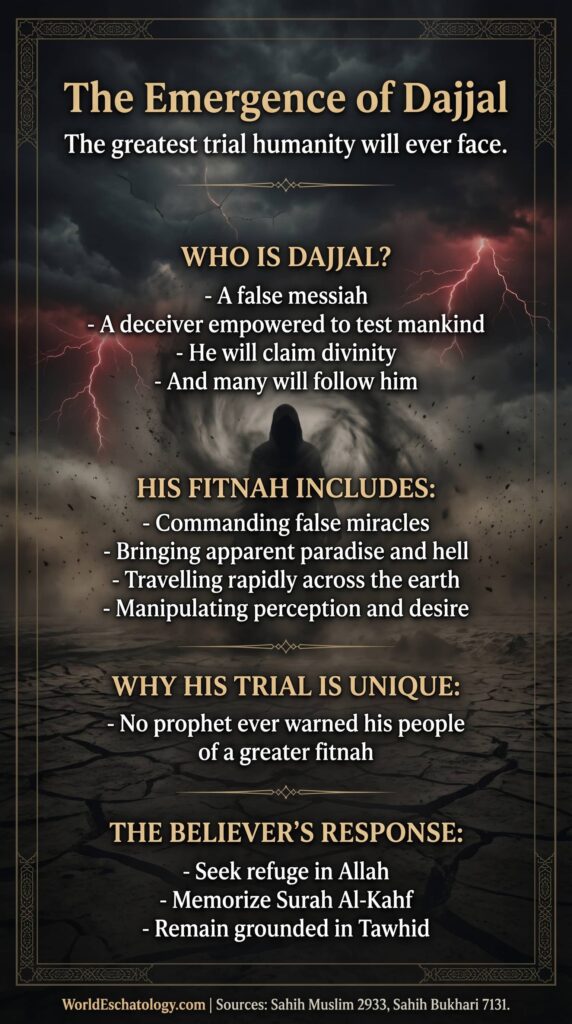
The Dajjal is the greatest individual trial in human history.
The Prophet, peace be upon him, warned about him more repeatedly and more urgently than about any other single future event, seeking refuge from his fitna in every prayer and instructing his companions to do the same.
From the time of Adam until the Day of Judgment, there will not be a greater tribulation on the face of the earth.
His Physical Description and Identifying Marks
The hadith describe the Dajjal with specific physical characteristics intended to make him identifiable when he appears.
He is blind in one eye, described as a floating grape, whitened and bulging, while the other eye is described as a glinting, unhealthy luminance.
He is heavyset, with thick curly hair and a reddish complexion. His defining identifier is the word K-F-R, kafir, written between his eyes, visible to every believer whether literate or not.
He is currently imprisoned on an island, bound in chains, according to the detailed narration of the companion Tamim al-Dari, which the Prophet confirmed publicly from the pulpit.
When the time comes, his chains will be released and he will emerge.
His Powers and Deceptions
The Dajjal will possess supernatural abilities that will seem, to those who do not know, like signs of divine power.
He will command rain to fall over the lands of his followers, and crops will grow for those who accept him.
He will command the earth to withhold its produce from those who reject him.
He will carry what appears to be a river of water and a river of fire, but the Prophet specifically instructed that the fire is actually cool water and the water is actually fire.
He will appear to bring a dead person back to life. He will travel the earth at extraordinary speed.
And eventually he will stand in Jerusalem and declare himself God, a claim that his one eye and the mark on his forehead directly refute for any believer with their eyes open.
Duration and the Protected Cities
His time on earth is described in a famous narration: his first day will be like a year, the second day like a month, the third day like a week, and the remaining days like normal days.
Scholars have noted that this totals approximately fourteen months by a rough calculation, though the exact duration is known only to Allah.
He will not be able to enter Mecca or Medina. Angels guard the entrances to both cities.
He will camp outside Medina and the city will shake three times during his encampment, drawing out the hypocrites and those weak in faith.
The protection prescribed for the believer: memorise and recite the opening or closing ten verses of Surah Al-Kahf, seek refuge from his fitna in every prayer, and if you hear of his emergence, flee from him rather than going to confront him in confidence of your own strength.
SIGN THREE: The Descent of Prophet Isa (Jesus), Peace Be Upon Him
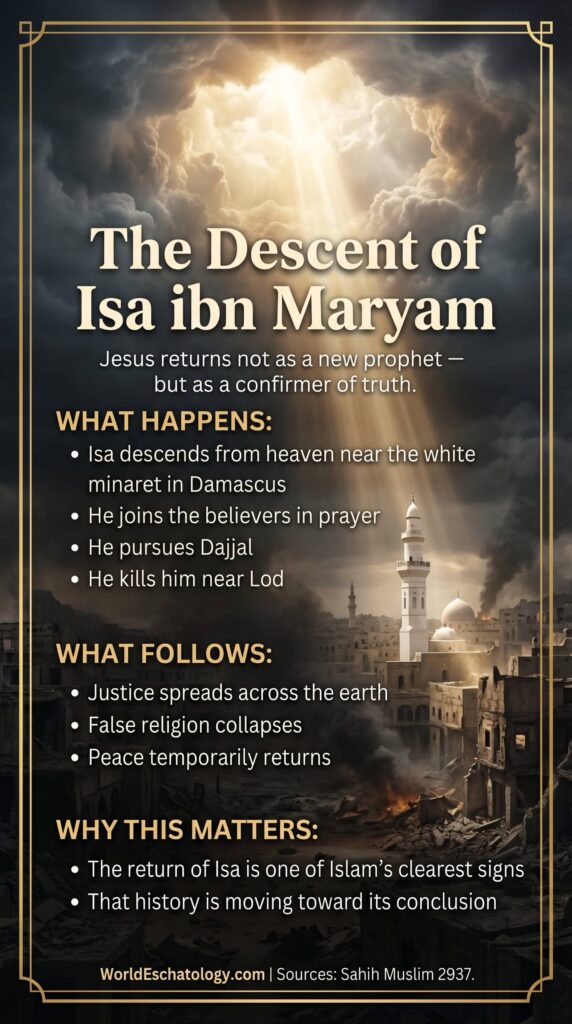
The descent of Prophet Isa ibn Maryam is the turning point of the entire sequence. He comes not as a new prophet and not with a new message.
He comes to fulfil his role as the one who kills the Dajjal, restores justice, and confirms what the final message of Islam has always taught.
The Descent — How It Happens
The narration of Nawwas ibn Sam’an, collected in Sahih Muslim, describes the moment of his descent in extraordinary detail.
Isa will descend near the white minaret in the east of Damascus, wearing two garments lightly dyed with saffron, his hands resting on the wings of two angels.
When he bows his head, drops will fall from it, and when he raises it, drops like pearls will scatter from his hair.
Sahih Muslim — Narration of Nawwas ibn Sam’an
“Every disbeliever who smells the breath of Isa will die, and his breath will reach as far as he can see. He will then search for the Dajjal until he catches him at the gate of Ludd, and he will kill him.”
The Death of the Dajjal
The hadith is specific: the Dajjal will be killed at the eastern gate of Ludd, a location in modern Israel near the city of Lod.
When the Dajjal sees Prophet Isa, he will begin to dissolve, as salt dissolves in water. Isa will pursue him and kill him with his spear at that gate.
The Dajjal’s reign, which felt eternal to those experiencing it, comes to an abrupt end at the hand of the man whose identity the Dajjal had been counterfeit all along.
His Reign on Earth
After the defeat of the Dajjal, Prophet Isa will rule the earth as a just and righteous leader.
The Prophet, peace be upon him, described this period as one of extraordinary blessing: He will break the cross, kill the pigs, and abolish the jizyah tax, meaning he will remove the distortions that accumulated in Christianity after his departure and restore the pure monotheism he originally taught.
Wealth will be in such abundance that no one will accept charity. Peace will spread so completely that lions and camels will graze together.
Isa will remain on earth for a period that authentic narrations describe as forty years, during which he will marry and have children.
He will die a natural death, and the Muslims will perform his funeral prayer and bury him.
According to one narration, he will be buried next to the Prophet Muhammad, peace be upon him, in Madinah.
What This Sign Means
The descent of Prophet Isa is the most significant moment in the Islamic eschatological narrative for interfaith dialogue, because it is the event most recognised from the outside.
Christians await the Second Coming of Jesus. Muslims await the descent of Prophet Isa.
They are waiting for the same person, understood through different theological frameworks.
The similarities and differences between these two expectations were explored in our earlier article on the Second Coming of Jesus Christ, and this article connects directly to that discussion.
SIGN FOUR: The Emergence of Yajuj and Majuj (Gog and Magog)
Yajuj and Majuj emerge after the defeat of the Dajjal, during the time of Prophet Isa on earth.
Their emergence is described in the Quran itself, not only in the hadith, and the scale of the tribulation they bring dwarfs even the devastation of the Dajjal.
The Quranic Background — Dhul-Qarnayn and the Barrier
The story of Yajuj and Majuj begins in Surah Al-Kahf, which is itself the surah prescribed as protection from the Dajjal.
In the story of Dhul-Qarnayn, the great ruler travels to the east and west and north and south of the earth, and in the north he encounters a people who beg him to build a barrier against the corruption of Yajuj and Majuj, two tribes who are devastating everything around them.
Dhul-Qarnayn builds the barrier from iron and copper, and the Quran records his acknowledgment that when the promise of his Lord comes, the barrier will be levelled to the ground.
“When Yajuj and Majuj are let loose and they swiftly swarm from every mound, and the True Promise draws near, then the eyes of the disbelievers will stare in horror: Woe to us! We were so heedless of this!”
Their Emergence and What They Do
The hadith describes how Yajuj and Majuj will emerge after Prophet Isa has defeated the Dajjal.
They come in overwhelming numbers, described in narrations as so vast that the first of them will drink an entire lake dry and the last of them will pass by the dried lakebed and say: there was water here once. They spread across the earth, consuming and destroying everything in their path.
In their arrogance, they will shoot their arrows into the sky, and the arrows will return stained with what appears to be blood, and they will declare that they have killed the inhabitants of the heavens.
This detail communicates their profound spiritual blindness and their complete removal from any relationship with the divine.
Prophet Isa’s Response and Their Destruction
Prophet Isa takes the believers to Mount Tur for protection, because no human military force can resist Yajuj and Majuj.
He supplicates to Allah, and Allah responds by sending a worm or insect into the necks of Yajuj and Majuj.
In a single night, they all die. The morning comes and the earth is covered with their bodies.
The death of Yajuj and Majuj is followed by a period of extraordinary abundance. The earth produces such growth that a single pomegranate is enough to feed a group of people.
The Quran’s description in Surah Al-Anbiya of the earth being prepared as a dwelling place for the righteous is understood by many scholars to refer to this period.
Who Are Yajuj and Majuj?
This is one of the most debated questions in Islamic eschatological scholarship. Some scholars historically identified them with specific peoples known in the ancient world.
Others have understood them as a people currently unknown, hidden behind the barrier, who will only be revealed at the appointed time.
The honest scholarly position is that we do not know precisely who they are or where they currently are, only that they exist and will emerge at the time Allah has appointed.
Attempts to definitively identify them with any currently existing group should be viewed with appropriate caution.
SIGN FIVE: Ad-Dukhan — The Great Smoke
The smoke, called Al-Dukhan in Arabic, is referenced directly in the Quran in a passage whose eschatological interpretation has been one of the more debated questions in Islamic scholarship for centuries.
Quran 44:10-11
“Then watch for the Day when the sky will bring a visible smoke, covering the people. This is a painful torment.”
The Two Scholarly Positions
There is a genuine scholarly disagreement about whether this sign has already occurred or is still in the future.
The view attributed to the companion Abdullah ibn Masud, may Allah be pleased with him, understood the smoke as having already occurred in the form of a severe drought and famine that struck the Quraysh of Mecca during the early period of Islam, when hunger and hardship caused people’s vision to blur in a way that seemed like seeing smoke.
Ibn Masud held that this was the fulfillment of the verse.
The majority scholarly position, however, is that the great smoke is a future event of the end times, a literal smoke that will physically cover the earth.
This position is based on several considerations: the context of Surah Ad-Dukhan, where the smoke is described alongside other clear end-times events; narrations that describe the smoke as a sign that believers will experience as a head cold while disbelievers will experience with severe physical suffering; and the fact that Imam Muslim included the smoke among the ten signs in the narration of Hudhayfah ibn Asid, which is clearly about future major signs.
The majority scholarly position, which is that the smoke is a future major sign yet to occur, is the one most consistent with the overall hadith evidence.
When it comes, it will be unmissable: a visible smoke covering the heavens, simultaneously a mercy in the form of a lesser suffering for believers and a torment for those who have rejected the truth.
SIGN SIX: The Dabbat Al-Ard — The Beast of the Earth
Of all ten major signs, the Dabbat Al-Ard, the Beast of the Earth, is perhaps the least familiar to general audiences and the one that generates the most genuine curiosity.
The Quran mentions it directly, and the hadith describe its function in the end-times sequence with a specificity that is striking.
Quran 27:82
“And when the Word is fulfilled against them, We will bring forth for them a creature from the earth that will speak to them, because the people were not certain of Our signs.”
What the Beast Does
The narrations describe the Beast emerging from the earth, a description that distinguishes it from ordinary animals known to human experience.
When it emerges, it will do something no other creature in the major signs sequence does: it will speak to the people. And its speech will have a specific, permanent consequence.
The Beast will mark every human being. Believers will be marked with a white mark on their faces, and disbelievers will be marked with a black mark on their faces.
After the Beast has completed this marking, the spiritual state of every person alive will be externally visible and permanent.
There will be no more ambiguity about who is a believer and who is not. The period of choice and concealed faith and outward conformity will be over.
Some narrations also describe the Beast as carrying the staff of Moses and the ring of Solomon, with which it will strike or mark people.
The staff of Moses, which was used to part the Red Sea, and the ring of Solomon, associated with divine authority over creation, suggest that the Beast is an instrument of divine revelation rather than a creature of destruction.
Where It Emerges From
The narrations differ on the precise location of the Beast’s emergence. Some mention a location near Mecca, others near Jerusalem, and some mention a mountain in Arabia.
As with several other details of the major signs, the honest position is that the precise location is not definitively established in the authentic sources.
What is clear is that its emergence will be a universal event, marking every person alive on the earth.
What the Beast Does Not Do
It is important to be clear about what the Beast is not. It is not a creature of military destruction in the manner of Yajuj and Majuj. It does not kill or devastate.
Its role is revelatory: it makes visible what was always internally true about each person’s relationship with Allah.
It is, in a sense, a cosmic truth-telling, the moment when the divine reality about each soul becomes externally manifest in a form that every eye can see.
SIGN SEVEN: The Rising of the Sun from the West
Of all ten major signs, the rising of the sun from the west carries the most devastating theological consequence for those who have delayed their return to Allah: it is the permanent closure of the gate of repentance.
The Hadith and the Quran
Sahih Bukhari
“The Hour will not be established until the sun rises from the west. And when it rises from the west and the people see it, they will all believe — but that will not benefit them, because the gates of repentance will have been closed.”
The Quranic basis for this is Surah Al-Anam 6:158: the Day that some signs of your Lord come, no soul will benefit from its faith if it had none before, or if it had not done good through its faith.
The classical commentators understand the rising of the sun from the west as one of the primary fulfilments of this verse.
The Nature of the Event
When the sun rises from the west, people will believe. Not out of genuine spiritual conviction developed over a lifetime of reflection and practice, but out of shock at seeing the natural order reversed before their eyes.
This kind of forced recognition, produced by terror and the undeniable evidence of the senses, is not the faith that opens the door of divine acceptance.
That door required sincere, freely given turning toward Allah in a moment when it was still possible to turn away.
Islamic scholars have discussed the mechanism by which the sun would rise from the west. Is this a reversal of the earth’s rotation?
A supernatural intervention that does not require a physical mechanism? The honest answer is that the Islamic tradition does not specify the mechanism, only the event.
Allah, who created the sun and established its rotation, can cause it to rise from any direction He wills, by whatever means He has always known He would use for this moment.
The Relationship with the Beast
Scholars differ on which of these two signs, the rising of the sun from the west or the emergence of the Dabbat Al-Ard, comes first.
Some hold that the sun rises first and then the Beast emerges. Others hold the reverse.
What both signs share is their role in permanently closing the door of tawbah: after both of these events have occurred, the distinction between believer and disbeliever is fixed and final.
The universe is preparing for the next phase, and the time for individual spiritual decision-making has passed.
SIGN EIGHT, NINE, AND TEN: The Three Great Landslides and the Fire from Yemen
The hadith of Hudhayfah ibn Asid lists three landslides and a fire as four of the ten signs, and they are presented together here because the narrations describe them in close proximity to each other in the sequence.
The Three Landslides — Khasf
The hadith specifies three great land sinkings: one in the east, one in the west, and one in the Arabian Peninsula.
These are not described as ordinary earthquakes. They are catastrophic geological events, described in other narrations as swallowing entire armies and large groups of people into the earth.
They represent a divine intervention in the physical structure of the planet that goes beyond anything that has occurred in human recorded history.
The landslide in the east, the landslide in the west, and the landslide in the Arabian Peninsula each have their own significance in the scholarly literature.
The Arabian Peninsula landslide is sometimes understood as particularly significant because of the religious weight that region carries in Islamic eschatology.
Some scholars have speculated about the geographical locations these might correspond to, but the authentic narrations do not provide enough detail to make specific identifications with confidence.
What the three landslides share is their function: they are physical manifestations of divine power at a scale that makes it impossible for the remaining human population to dismiss what is happening.
They are the earth itself testifying to the approach of the Hour.
The Fire from Yemen — The Final Gathering Sign
The fire from Aden, in present-day Yemen, is the last of the ten signs before the Hour itself.
But its function is different from what the word fire might initially suggest. This fire does not destroy. It gathers.
The narrations describe the fire emerging from the lower part of Aden and driving the remaining people toward the place of assembly, the plain of Mahshar where the Day of Judgment will take place.
The fire travels with the people, spending the night wherever they spend the night, resting where they rest, gradually herding all of surviving humanity toward the place where they will stand before Allah. It is less a catastrophe than a cosmic escort.
This sign is understood as the final event in the physical world before the trumpet of Israfil blows.
After the fire has gathered everyone, the next phase begins: the death of everything alive at the first trumpet blast, and the resurrection of all the dead at the second.
The fire from Yemen is the last word the physical world speaks before the Day of Judgment commences.
Additional Events Near the End
The hadith literature describes several events that occur at the very culmination of the sequence, after the ten major signs.
A gentle, pleasant wind will blow that will take the soul of every believer remaining on earth, the righteous being mercifully removed from the world before its worst final state.
A man from Ethiopia will destroy the Kaaba stone by stone, and no human power will prevent him, because Allah will have willed the removal of the physical symbols of this age of worship.
After all of this, only the most heedless and morally bankrupt people will remain, and upon them the Hour will fall. The Prophet said: the Hour will not be established upon anyone who says Allah, Allah.
The Sequence — What Order Do They Actually Happen In?
This is one of the most searched questions related to the major signs, and it deserves honest treatment rather than false certainty.
The hadith of Hudhayfah ibn Asid lists the signs but does not specify their complete order with the same definitiveness that it lists the signs themselves.
Shaykh Muhammad ibn Salih al-Uthaymin, may Allah have mercy on him, when asked whether the major signs will occur in a specific order, gave a response that is worth knowing: the order of some of the major portents is known, and in the case of others the order is not known.
What is known from the overall hadith evidence:
The Mahdi emerges first, initiating the sequence and leading the Muslim community through the first phase of the end times.
The Dajjal appears during the Mahdi’s time, and his tribulation is the greatest individual trial in human history.
Prophet Isa descends and kills the Dajjal, after which he rules the earth in a period of justice and peace.
Yajuj and Majuj emerge during Isa’s time and are destroyed by divine intervention after devastating the earth.
The placement of the Dukhan, the Dabbat Al-Ard, the rising of the sun from the west, and the three landslides relative to each other and relative to the above sequence is a matter of scholarly discussion.
Some scholars, including Al-Safarini, have attempted detailed orderings of all the signs, but contemporary scholars like Ibn Uthaymin have noted that some of those orderings are not supportable from the hadith evidence alone.
The honest answer for a believer is this: know the signs, know the sequence where it is established, and hold the uncertain parts with the intellectual humility that the evidence calls for.
Detailed prophetic timelines constructed beyond what the authentic sources explicitly state should be treated with caution.
Have Any of the Major Signs Appeared Yet?
This is the question that most readers come to this subject wanting answered, and the answer is clear: no. Not one of the ten major signs has yet appeared.
This is not a close call. The major signs are described with qualities that make them unmistakable.
When the Dajjal emerges, he will be globally visible and his presence will be impossible to deny or ignore.
When Prophet Isa descends, the entire Muslim community will be gathered for prayer at the moment of his descent.
When the sun rises from the west, every human being alive on earth will see it simultaneously. When Yajuj and Majuj emerge, they will overwhelm entire regions and drink entire lakes dry.
These are not events that could have occurred quietly, in a regional context, or in a form that requires symbolic interpretation to identify.
People who point to current earthquakes, political upheavals, moral decline, or technological changes as the major signs are conflating the minor signs with the major ones.
Earthquakes are a minor sign. Political conflict is a minor sign. Moral decline is a minor sign.
Many minor signs have indeed occurred, which is itself significant and sobering. But the major signs are of a completely different category.
What the absence of the major signs means is also significant: we are still in a window of possibility.
The gate of repentance is still open. The time for building one’s faith, for sincere return to Allah, for righteous deeds and the purification of the heart, is now, before the sequence begins.
The Prophet did not describe these signs to induce paralysis or despair. He described them so that the believer would take the time they have more seriously.
How the Major Signs Connect to the Broader Eschatological Picture
The ten major signs do not stand alone. They are the climactic chapter of a narrative that this series of articles has been building toward from its opening piece on the Dajjal.
The Dajjal, whose description and significance were covered in the first article of this series, is Sign Two in the sequence.
Everything we wrote there, the one-eyed deceiver, the mark on his forehead, his false paradise and fire, the protection of Surah Al-Kahf, the fact of his current imprisonment on an island, all of that is preparation for understanding his role in this sequence.
He is not a standalone figure. He is the second act in a drama that begins with the Mahdi and ends with the fire from Yemen.
Prophet Isa, whose Second Coming was covered in our article on what the Bible teaches about the return of Christ, appears here as Sign Three.
The Islamic and Christian accounts of the same event were compared there in detail, and that comparison is even more meaningful in the context of the full sequence: Isa does not come in the Islamic account to establish a kingdom from scratch.
He comes to kill a specific person, at a specific gate, near a specific city, and his work connects directly to the Mahdi who preceded him and the Yajuj and Majuj who follow him.
The geography of the major signs also connects to our article on the Third Temple.
Jerusalem is the location of the Dajjal’s proclamation of divinity, the gate of Ludd is where the Dajjal is killed, and the area around the holy land is the theatre of the most concentrated end-times activity in the entire Islamic eschatological narrative.
These are not coincidences of geography. They are the meeting point of the Abrahamic eschatological traditions at the most consequential moments in human history.
What the Major Signs Mean for the Believer Right Now
Every piece of prophetic knowledge in Islam exists for a reason that is practical, not merely intellectual.
The Prophet did not describe these events to satisfy curiosity or to provide material for theological speculation. He described them because knowing them transforms how a believer lives.
The fact that the gate of repentance closes with the first major sign means that the most important spiritual work is the work that happens now, in ordinary time, before the extraordinary events begin.
Building a sincere relationship with Allah, maintaining the five prayers with presence and intention, purifying the heart of the diseases that the Dajjal’s fitna specifically targets: love of the dunya over the akhirah, arrogance, deception, and the weakening of genuine faith beneath a surface appearance of religiosity.
The Prophet specifically prescribed protection from the major signs: seek refuge from the fitna of the Dajjal in every prayer, recite Surah Al-Kahf on Fridays, maintain sincerity of faith so that the marking of the Beast will be a white mark rather than a black one, and perform such deeds that a gentle wind will find a soul to take rather than leaving it behind.
There is also a broader lesson in the nature of the signs themselves. The Dajjal’s greatest power is deception, and the antidote to deception is knowledge grounded in certainty of faith.
The Beast’s marking exposes what was always internally true. The fire from Yemen gathers everyone to accountability.
Each sign in its way is a statement about what matters: not appearances, not worldly power, not the ability to produce impressive phenomena, but the actual state of the heart in its relationship with its Creator.
The ten major signs are a roadmap not primarily of cosmic events but of cosmic values. Knowing them is not an end in itself.
It is an invitation to live in a way that the approach of those events would find you not scrambling to catch up, but already standing in the right place.
Frequently Asked Questions
What are the 10 major signs of Qiyamah?
Based on the hadith of Hudhayfah ibn Asid in Sahih Muslim 2901 and related narrations, the ten major signs are:
the emergence of the Imam Mahdi, the emergence of the Dajjal, the descent of Prophet Isa (Jesus), peace be upon him, the emergence of Yajuj and Majuj (Gog and Magog), the great smoke (Ad-Dukhan), the emergence of the Dabbat Al-Ard (Beast of the Earth), the rising of the sun from the west, and three great landslides (one in the east, one in the west, one in the Arabian Peninsula), and the fire from Aden that drives people to their assembly point.
Which major signs of Qiyamah have appeared?
None. According to the scholarly consensus, not one of the ten major signs has yet appeared.
The major signs are described as supernatural, earth-shaking, globally visible events that cannot be missed or misidentified.
Earthquakes, moral decline, political conflict, and technological changes are among the minor signs, many of which have occurred, but these are categorically different from the major signs.
What is the order of the major signs of Qiyamah?
The firmly established sequence from the hadith evidence is: the Mahdi emerges, then the Dajjal appears, then Prophet Isa descends and kills the Dajjal, then Yajuj and Majuj emerge and are destroyed.
The precise placement of the other signs, the Dukhan, the Beast, the sun rising from the west, and the three landslides, relative to each other is a matter of scholarly discussion rather than definitively established sequence.
Is the Imam Mahdi one of the major signs?
Yes. While the Mahdi is not named in the specific hadith of Hudhayfah ibn Asid listing the ten signs, he is confirmed by multiple other authentic narrations as the figure whose emergence initiates the sequence of major signs.
He is the leader of the Muslim community when the Dajjal appears and the leader behind whom Prophet Isa will pray.
What is the Dabbat Al-Ard?
The Dabbat Al-Ard, the Beast of the Earth, is mentioned in the Quran in Surah An-Naml 27:82.
It will emerge from the earth, speak to humanity, and mark every believer with a white mark and every disbeliever with a black mark, permanently making visible the spiritual state of every person alive. It is not a creature of destruction but of revelation.
What is Ad-Dukhan in Islam?
Ad-Dukhan is the great smoke mentioned in Surah Ad-Dukhan 44:10-11. It is a visible smoke that will cover the earth as one of the major signs.
The mainstream scholarly position holds that it is a future event yet to occur. When it appears, believers will experience it as something like a minor discomfort while disbelievers will experience severe physical suffering.
Will the sun rise from the west before Judgment Day?
Yes, according to authentic hadith collected in Sahih Bukhari and Sahih Muslim.
The rising of the sun from the west is one of the ten major signs, and it carries the specific theological consequence that the door of repentance closes permanently when it occurs.
Anyone who believes after seeing the sun rise from the west, having not believed before, will receive no benefit from that belief.
What happens after Yajuj and Majuj?
After the emergence and destruction of Yajuj and Majuj, the narrations describe a period of extraordinary abundance on earth.
Prophet Isa continues his reign. Eventually the remaining major signs occur, a gentle wind takes the souls of all remaining believers, the fire from Yemen gathers the final survivors to the plain of assembly where the Day of Judgment begins.
What is the hadith about the 10 major signs?
The primary source is Sahih Muslim 2901, narrated by the companion Hudhayfah ibn Asid al-Ghifari.
The Prophet, peace be upon him, came upon his companions discussing the Last Hour and said: the Last Hour would not come until the ten signs appear, and then listed them.
This single narration is the most authoritative source for the ten major signs as a collective unit.
How many signs of Qiyamah are left?
All ten major signs remain to occur, as none have appeared yet. The majority of minor signs have occurred, and some continue to unfold.
Scholars describe the current period as one in which humanity is past the age of the minor signs and approaching the threshold of the major ones, though only Allah knows the precise timing.
What is the first major sign of Qiyamah?
While the hadith of Hudhayfah ibn Asid does not definitively establish the order of all ten signs, the scholarly consensus based on multiple narrations is that the emergence of the Imam Mahdi initiates the sequence of major signs and is therefore understood as the first.
His appearance is what sets the rest of the events in motion.
Conclusion — Knowledge as Preparation, Not as Performance
The companions were discussing the Day of Judgment. The Prophet joined them, not to redirect them to something more immediately practical, but to give them more.
More knowledge. More detail. More clarity about what was coming and in what form.
The ten major signs of Qiyamah are not Islamic folklore or apocalyptic entertainment.
They are a specific, authenticated prophetic account of the most significant sequence of events in human history.
They were given to the believers not so that every generation would convince itself that those events were imminent in its own lifetime, but so that every generation would live with the kind of awareness that genuine proximity to the final accounting produces.
None of these signs have appeared. The gate of repentance is open. The time for sincere relationship with Allah is now, in the ordinary days before the extraordinary days begin.
The Prophet, peace be upon him, sought refuge from the fitna of the Dajjal in his own prayers, while the Dajjal was still centuries away.
He was not anxious about the Dajjal. He was serious about his own spiritual state, and he taught his companions to be serious about theirs.
That is the lesson the ten major signs are designed to produce. Not fear. Not obsession with timelines.
Not the constant scanning of current events for signs of the sequence beginning.
But seriousness about the soul, urgency about the things that actually matter, and the kind of faith that a gentle wind would find worth carrying to its Lord.
The sequence will come when it comes. Our work is to be ready before it does.
Sources: Sahih Muslim 2901 | Sahih Bukhari | Sunan Abu Dawud | Ibn Majah | Quran (Surah Al-Kahf, Ad-Dukhan, Al-Anbiya, An-Naml)
Classical scholarship: Ibn Kathir — Al-Nihayah | Shaykh Yusuf al-Wabil — Ashrat As-Sa’ah | Shaykh Ibn Uthaymin — Fatawa
WorldEschatology.com | All hadith presented from canonical collections with chain verification