

Billions of people across Islam and Christianity believe a great deceiver will appear before the end of the world. Muslims call him the Dajjal. Christians call him the Antichrist.
And more people than ever are asking whether these two figures are actually the same being described in different religious languages, or whether they are genuinely separate figures with different identities and different roles.
The question matters more than it might first appear. It shapes how believers interpret current events, how they evaluate political leaders and global institutions, and how they understand where history is heading.
It also touches on some of the deepest questions in the relationship between Islam and Christianity, including the nature of Jesus, the meaning of prophetic revelation, and whether two traditions that emerged from overlapping sources are ultimately pointing toward the same reality or toward different ones.
The answer, as this article will show, is more honest and more interesting than a simple yes or no.
These two figures share a common root and a common function, but they have developed in ways that reflect real and significant theological differences between their traditions.
Collapsing them into one loses something important from both. Treating them as completely unrelated ignores a convergence that is too significant and too consistent to dismiss.
This article works through all the major dimensions of the question: what each tradition actually says in its primary sources, how the two figures compare directly across every major category, what the Jewish tradition adds to the picture, who has been identified as each figure across history and why those identifications have all failed, and what serious scholars of religion make of the whole comparative picture.
The goal throughout is clarity, accuracy, and respect for what each tradition actually teaches. A note on approach: this article treats both Islamic and Christian sources with equal seriousness.
It does not flatten genuine differences in the name of an easy interfaith harmony that neither tradition would actually recognize as its own.
Where the two traditions genuinely agree, that agreement is highlighted. Where they genuinely differ, those differences are stated plainly. Both communities deserve that honesty.
Why This Question Matters Right Now
Social media has placed Muslim and Christian eschatological communities in the same online spaces for the first time in history.
Both groups are looking at the same anxious world, interpreting it through their own end-times frameworks, and discovering that the other tradition has a remarkably similar villain at the center of its story.
Shared concerns about surveillance technology, digital currency, global governance, and the erosion of truth have given both the Dajjal concept and the Antichrist concept new urgency and new audiences.
Understanding what each tradition actually says, rather than what social media content claims it says, is more important now than it has ever been.
What the Word Dajjal Actually Means
The word Dajjal comes from the Arabic root meaning to deceive, to cheat, to cover truth with a false surface.
It means the great deceiver. In full, the figure is called Al-Masih Ad-Dajjal, the False Messiah or the Counterfeit Anointed One.
The name itself positions him against the authentic Messiah: he is the fake, and his name announces that fact before a single hadith about him is cited.
His defining quality is not power or cruelty but deception. He makes falsehood look like truth and truth look like falsehood.
What the Word Antichrist Actually Means
The Greek word antichristos appears exactly four times in the New Testament, all in the letters of John, and not once in the Book of Revelation.
The prefix anti in Greek carries two meanings: against and in place of. So antichristos means either one who opposes Christ or one who substitutes himself for Christ, a false Christ.
John’s original usage is striking: he writes that many antichrists have already come, describing the spirit of antichrist as already active in his own time.
The singular, uniquely powerful end-times Antichrist of popular imagination came later, through centuries of theological development that merged John’s antichrists with other biblical figures.
Why Comparing These Two Figures Is Theologically Complex
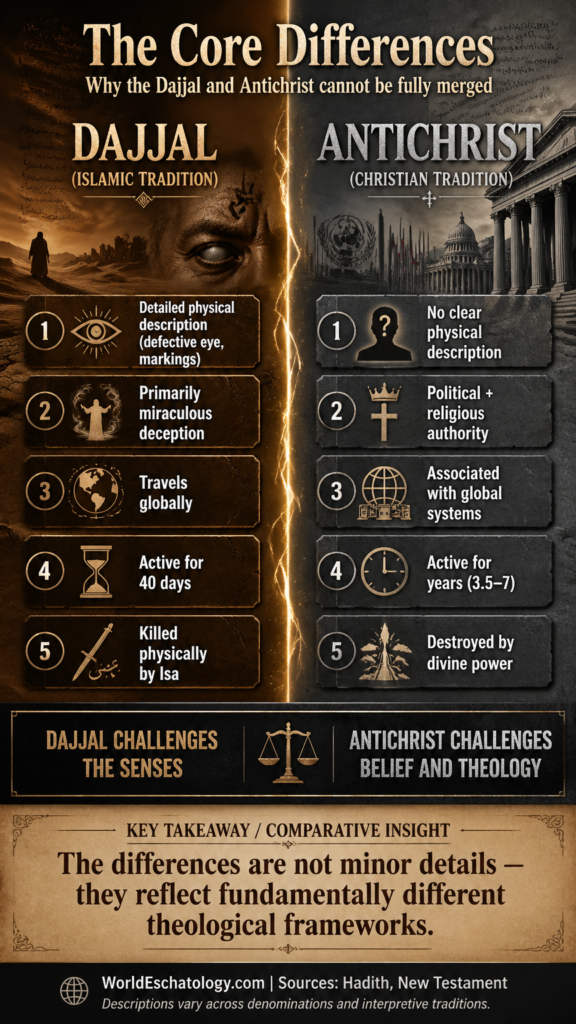
The two figures are not simply the same person in different cultural clothing. The Dajjal has a specific physical description, specific powers, specific travel routes, and is killed in a specific location.
The Antichrist, in Christian eschatology, has a political and institutional character, making covenants with nations and setting himself up as God in a Temple, that differs meaningfully from the Dajjal’s primarily miraculous mode of operation.
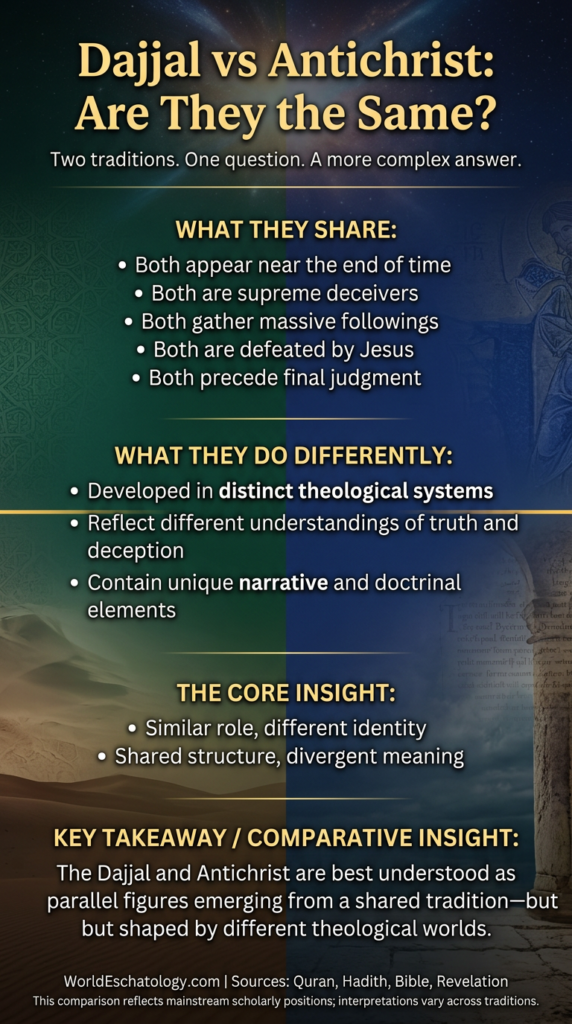
Both figures occupy the same structural position in their traditions, a supreme deceiver defeated by Jesus near the end of history, but the specific details reflect genuine theological differences that cannot be smoothed away.
The Shared Abrahamic Root
Both figures grew from the same soil. The Jewish apocalyptic literature of the Second Temple period, particularly the Book of Daniel, the Book of Enoch, and texts found among the Dead Sea Scrolls, developed detailed visions of a great end-times villain before either Christianity or Islam existed.
Christianity developed the Antichrist concept directly from this tradition. Islam emerged in a context of sustained contact with both Jewish and Christian communities whose apocalyptic ideas were circulating widely.
This shared root explains why the two figures resemble each other as much as they do, while each tradition’s specific theological commitments explain why they developed in different directions.
THE DAJJAL IN ISLAMIC TRADITION
Primary Sources: Which Hadiths Say What
The Dajjal appears nowhere in the Quran. His entire portrait in Islam is drawn from the hadith literature, the recorded sayings and actions of the Prophet Muhammad.
The most reliable descriptions come from Sahih Bukhari and Sahih Muslim, the two most rigorously verified hadith collections.
Additional details appear in Sunan Abu Dawud, Ibn Majah, and Jami at-Tirmidhi.
Islamic scholars assess individual narrations through the science of hadith criticism, examining chains of transmission and narrator reliability.
The hadiths about the Dajjal are numerous, and while they differ in some details, the mainstream approach accepts all reliably transmitted details as genuine aspects of his portrait.
Why the Dajjal Is Not in the Quran
Islamic scholarship does not consider the Dajjal’s absence from the Quran a problem.
Many important elements of Islamic belief and practice are established through the hadith tradition alone.
The Prophet reportedly said he warned his community about the Dajjal more insistently than any prophet before him warned his community, making the hadith testimony extensive and authoritative.
Some scholars also see thematic connections between Surah Al-Kahf and the concerns the Dajjal raises, though the Dajjal is not named in the Quran directly.
The Physical Description of the Dajjal
The hadiths provide a highly specific physical portrait. The Dajjal is a young man with reddish-white skin, broad build, and thick curly hair.
His most distinctive feature is his defective eye: some narrations specify the right eye is blind and protrudes like a floating grape; others describe the left.
Most scholars reconcile these by understanding both eyes as impaired in different ways. Between his eyes, the Arabic word kafir, meaning disbeliever, is written.
Every believing Muslim will be able to read this word regardless of their literacy, while the deceived will not see it at all. He rides an enormous donkey whose strides cover extraordinary distances.
The Dajjal’s Origins and Current Location
The hadith of Tamim Ad-Dari, found in Sahih Muslim, provides the tradition’s most specific information about the Dajjal’s current whereabouts.
Tamim, a companion of the Prophet who had converted from Christianity, reported being blown off course at sea and encountering a chained being on an island who identified himself as the Dajjal.
The Prophet confirmed this identification, establishing that the Dajjal already existed at that time and was imprisoned, awaiting the divine permission for his release.
This means the Dajjal is not a future human being who has yet to be born but an already-existing supernatural being held in confinement until the appointed time.
The Powers of the Dajjal
The Dajjal’s powers will make him genuinely terrifying to witness. He commands rain: lands that follow him will flourish, while lands that reject him will suffer drought and famine.
He appears to raise a young man from the dead as a public demonstration, though Islamic scholars note this is a divinely permitted display rather than genuine resurrection.
He travels with two rivers, one appearing to be water and the other fire; in reality the river of apparent fire is cool and sweet, and the river of apparent water burns.
This reversal of appearances is the Dajjal’s defining technique in concentrated form. He also travels with a mountain of bread, offering material abundance to his followers.
The Dajjal’s Campaign and the Cities He Cannot Enter
After his release, the Dajjal will travel across the entire earth at extraordinary speed, spending time in every city and using his powers to attract followers and test believers.
His campaign will last forty days, but these are not ordinary days: the first day will be as long as a year, the second as long as a month, the third as long as a week, and the remaining days will be normal in length.
The only cities he cannot enter are Mecca and Medina, which are guarded by angels.
He will camp near Medina, and his presence will cause the hypocrites within it to come out and join him while the genuine believers remain inside.
Who Follows the Dajjal and Who Resists
The hadiths describe those most vulnerable to the Dajjal as people for whom material desire has become the dominant force in their lives.
One narration in Sahih Muslim mentions seventy thousand Jews of Isfahan as among his followers.
Mainstream Islamic scholars handle this by emphasizing that the Dajjal will attract followers from all backgrounds, and that neither ethnicity nor religious identity guarantees immunity.
The protection is genuine faith and knowledge, not group membership.
Those who will resist him most effectively are believers deeply grounded in their faith, those who regularly recite Surah Al-Kahf, and those who have learned the Prophet’s detailed descriptions of him in advance.
The Defeat of the Dajjal
The Dajjal’s end comes through the descent of Isa ibn Maryam, Jesus son of Mary, from the heavens near a white minaret east of Damascus.
When the Dajjal sees Isa, he begins to dissolve like salt in water out of terror. Isa pursues him and kills him at the gate of Lud, in the area of present-day Israel, striking him with a spear.
The blood on the spear is shown to the people as proof of his death.
After the Dajjal is killed, Isa will lead the believers through a subsequent period of peace, followed by the release and destruction of Gog and Magog, before the final major signs of the Day of Judgment unfold.
Protection Against the Dajjal
The hadith tradition is unusually practical about spiritual protection. The most frequently mentioned protection is memorizing the first or last ten verses of Surah Al-Kahf, the Quran’s eighteenth chapter.
Regular Friday recitation of the full surah is widely recommended. The Prophet also taught a supplication to be recited in every prayer’s final sitting, seeking Allah’s protection specifically from the trial of the Dajjal.
The themes of Surah Al-Kahf, maintaining faith under overwhelming social pressure, understanding that things often are not what they appear, and trusting divine wisdom over surface appearances, are precisely the spiritual qualities needed to resist the Dajjal’s specific mode of deception.
THE ANTICHRIST IN CHRISTIAN TRADITION
What the Bible Actually Says: Four Appearances of the Word
The word Antichrist appears only four times in the New Testament, all in John’s letters.
In First John chapter two, John says that even now many antichrists have come, identifying them as people who had left the Christian community and who denied that Jesus is the Christ.
He introduces the term in a context of present, already-active false teaching rather than as a description of a single future figure.
In First John chapter four he describes the spirit of the antichrist as already in the world, and in Second John he warns against welcoming those who deny Christ’s teaching.
John’s original usage describes a spirit or quality embodied by many people, not exclusively a singular end-times individual. That development came later.
The Beast of Revelation and the Number 666
Revelation’s Beast is the figure most associated with the Antichrist in popular Christian culture, though the word Antichrist never appears in Revelation.
The Beast rules for forty-two months, receives authority from Satan, and requires everyone to receive a mark without which no one can buy or sell.
The number 666 is described as the number of a man requiring wisdom to calculate.
Using gematria, the ancient practice of assigning numerical values to letters, the name Neron Caesar in Hebrew characters totals 666, leading most academic biblical scholars to conclude that Revelation’s original audience understood this as a reference to the Emperor Nero.
Some manuscripts give the number as 616, the value of the Latin spelling of Nero’s name, further supporting this.
Three interpretive schools exist: preterists see the Beast as already fulfilled in Roman history; historicists see it as an ongoing institutional force; futurists see it as a specific individual yet to come.
The Man of Lawlessness in 2 Thessalonians
Paul’s description in 2 Thessalonians chapter two adds crucial elements to the Antichrist picture.
The man of lawlessness will exalt himself above every god, sit in the Temple of God, and proclaim himself to be God.
He will perform signs and wonders by the power of Satan, deceiving those who are perishing because they did not love the truth.
Paul also mentions a restrainer currently preventing his revelation, whose removal will precede the man of lawlessness being unveiled.
The identity of this restrainer has been debated for two thousand years, with proposals including the Roman Empire, the Holy Spirit, the Church, and the Archangel Michael.
The Little Horn of Daniel
The Old Testament foundation for Antichrist theology lies in Daniel chapters seven and eleven.
Daniel’s Little Horn arises among ten kings, speaks arrogantly against God, wages war against the holy people, and rules for a time, times, and half a time, a phrase most interpreters understand as three and a half years.
Chapter eleven describes the career of Antiochus Epiphanes, the Seleucid king who desecrated the Jerusalem Temple in 167 BCE, in such historical detail that many scholars believe it was written during his reign.
Christian eschatology has traditionally read the later verses as extending beyond Antiochus to a future figure, linking the Little Horn to Paul’s Man of Lawlessness and Revelation’s Beast in a single composite portrait.
How the Composite Antichrist Was Built by the Church Fathers
By the second century, theologians like Irenaeus of Lyon, Tertullian, and Hippolytus of Rome had merged John’s antichrists, Paul’s Man of Lawlessness, Daniel’s Little Horn, and Revelation’s Beast into a single unified figure.
Irenaeus described a future individual from the tribe of Dan who would rebuild the Jerusalem Temple and reign for three and a half years before being destroyed at Christ’s return.
Hippolytus wrote the most systematic early treatment, adding that the Antichrist would be born of a prostitute, educated in wickedness, and would circumcise himself as a false sign of allegiance to Jewish tradition.
Augustine was more cautious, interested in the spiritual meaning of the figure rather than its literal historical details, and his caution has periodically moderated eschatological speculation across the centuries.
Protestant Eschatology and the Papal Antichrist
The Protestant Reformation transformed the Antichrist tradition decisively.
Luther identified the papacy as the Antichrist based on the historicist interpretation of Daniel and Revelation, arguing that the Man of Lawlessness sitting in the Temple of God described not a future individual but the papacy’s centuries-long claim to supreme authority over the Church.
This identification was written into major Protestant confessional documents including the Westminster Confession of Faith and remained the mainstream Protestant position for several centuries.
The shift toward a futurist Antichrist, a specific end-times individual rather than an institution, happened gradually through the eighteenth and nineteenth centuries, driven by the dispensationalist movement of John Nelson Darby.
Dispensationalism and the Modern Popular Antichrist
The Antichrist that dominates evangelical popular culture today is almost entirely a product of the dispensationalist theological system developed by Darby and popularized through the Scofield Reference Bible (1909) and then through the Left Behind novel series by Tim LaHaye and Jerry Jenkins, which sold over eighty million copies.
In this framework, after a Rapture removes all true Christians, a charismatic world leader, the Antichrist, arises, makes a seven-year covenant with Israel, breaks it at the midpoint, sets himself up as God in a rebuilt Jerusalem Temple, requires everyone to take the mark 666, and is finally destroyed at the Battle of Armageddon when Christ returns.
This specific narrative, though relatively recent in Christian theological history, is now the default image of the Antichrist for a large portion of the world’s Christians.
Catholic and Orthodox Perspectives
The Catholic Catechism describes a supreme religious deception before Christ’s return, a pseudo-messianism in which man glorifies himself in place of God, without endorsing the specific dispensationalist timeline.
Eastern Orthodoxy, shaped significantly by John of Damascus and by nineteenth and twentieth century Russian theological reflection, tends to emphasize the seductive goodness of the Antichrist rather than his obvious evil.
The philosopher Vladimir Solovyov’s famous Short Story of the Antichrist portrays him as a great humanitarian and spiritual leader who unites the world’s religions before revealing his true nature, a portrayal that captures the Orthodox sense that the great deception will be genuinely compelling rather than obviously wicked.
The Core Similarities: What Both Traditions Genuinely Share
The genuine parallels between the two figures are significant and should not be minimized.
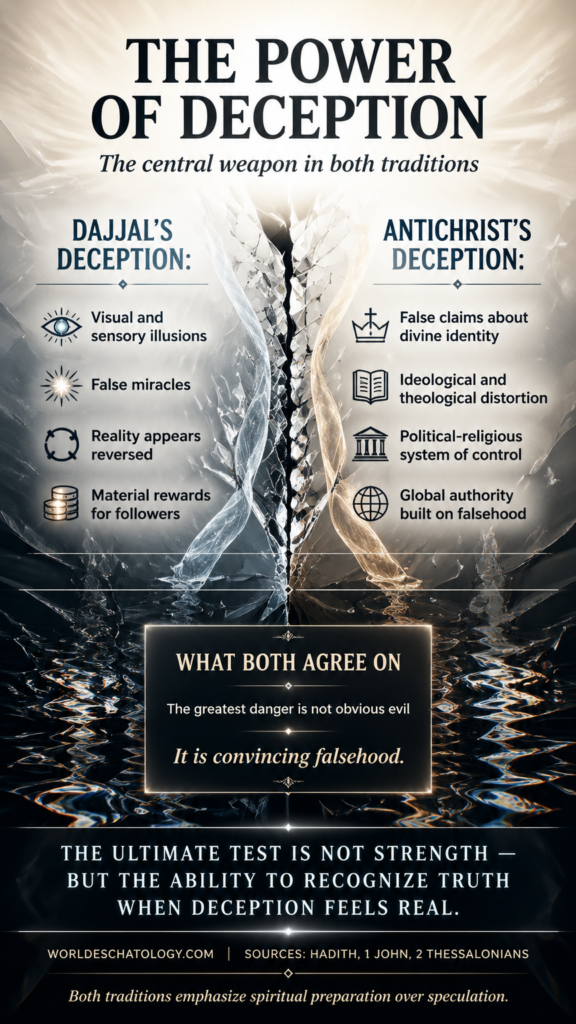
Both appear at the end of time. Both are supreme deceivers who use apparent miracles or signs to mislead people.
Both gather enormous worldwide followings. Both are defeated by a figure associated with Jesus. Both precede the final judgment of humanity.
The emphasis on deception as the central weapon is particularly striking: the Dajjal’s name means the great deceiver; the spirit of antichrist in John’s letters is the spirit of falsehood; Paul’s Man of Lawlessness succeeds because his followers did not love the truth.
Both traditions are making the same fundamental claim: the greatest danger at the end of time will not be obvious evil but sophisticated, apparently compelling falsehood.
The Core Differences That Cannot Be Reconciled
The differences are equally significant. The Dajjal’s physical description, one defective eye, a word written on his forehead, specific skin and hair characteristics, has no parallel in any Christian description of the Antichrist.
The Antichrist’s political and institutional character, making treaties with nations, sitting in a Temple claiming to be God, governing through a global economic system, differs meaningfully from the Dajjal’s primarily miraculous mode of deception.
The hadiths describe the Dajjal’s campaign lasting forty days; Christian eschatology gives the Antichrist three and a half to seven years.
These are not details that can be smoothed over. They reflect genuine differences in how each tradition has developed its understanding of the figure.
The Question of Jesus: Agreement That Conceals Deep Disagreement
Both traditions agree that Jesus defeats the great deceiver. In Islam, Isa descends and kills the Dajjal with a spear at Lud.
In Christianity, Jesus returns and destroys the Antichrist at his Second Coming. This structural agreement is real and meaningful.
But the theological meaning is entirely different. In Islamic theology, Isa is a prophet and messenger, the most honored of prophets except Muhammad, human in nature, acting as a divine instrument.
When he kills the Dajjal, he is executing divine judgment as a prophet. In Christian theology, Jesus is the divine Son of God, the Second Person of the Trinity, whose return in glory is the cosmic climax of all creation.
When he defeats the Antichrist, he is not acting as a prophet but as the divine Lord of all history. The event looks similar. What it means is profoundly different.
The Role of Deception: Different Mechanisms
Both traditions make deception central, but the mechanisms differ.
The Dajjal’s deception is primarily visual and sensory: apparent miracles, rivers that look like one thing but are another, apparent resurrection, material abundance for followers and drought for resisters.
The test he poses is whether believers will trust what their eyes tell them over what their faith tells them.
The Antichrist’s deception, particularly in the biblical texts, has a more theological and ideological character: false claims to divine status, false teaching about Christ’s nature, a global system of political and religious authority built on lies.
The Dajjal challenges the senses. The Antichrist challenges the mind and the soul’s understanding of who God is.
Geography, Duration, and Method of Defeat
The Dajjal travels every city on earth except Mecca and Medina; the Antichrist in dispensationalist eschatology is centered in Jerusalem and its rebuilt Temple.
The Dajjal is active for forty days with the first three dramatically extended; the Antichrist reigns for three and a half years in his most intense phase.
The Dajjal is physically killed by Isa’s spear, his blood shown to the people as proof; Paul says the Antichrist will be destroyed by the breath of Christ’s mouth and the brightness of his coming, while Revelation throws him alive into the lake of fire.
In both cases divine power defeats him, but the specific mode reflects each tradition’s theology of how divine power works.
What Happens After Each Figure Is Defeated
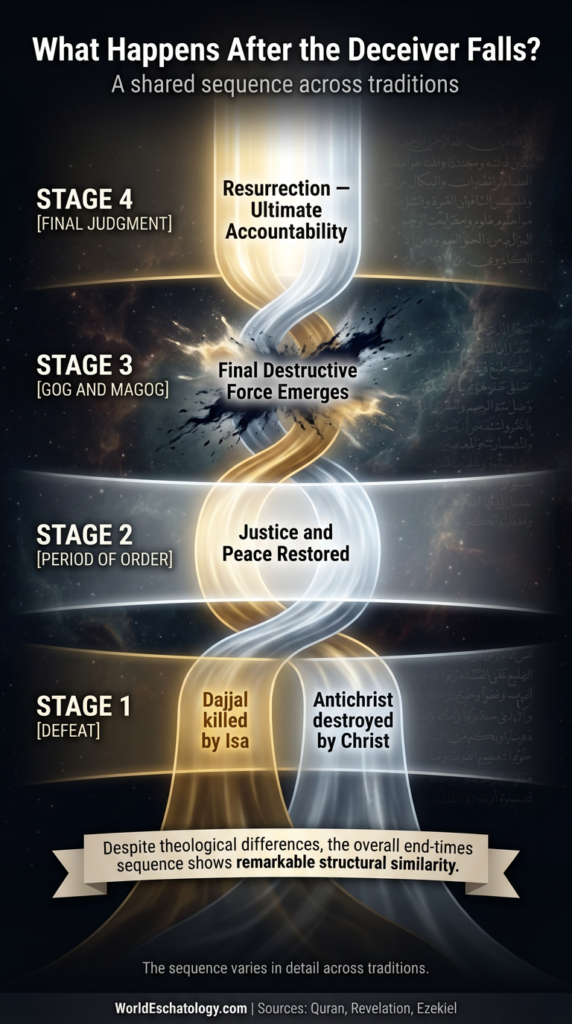
After the Dajjal’s death, Isa leads a period of peace and justice. Then Gog and Magog are released, cause widespread destruction, and are killed by divine plague.
Further major signs follow before the Day of Resurrection.
In Christian dispensationalism, the Antichrist’s defeat at Armageddon is followed by Christ’s thousand-year Millennial reign on earth, then a final release of Satan, a final rebellion called Gog and Magog in Revelation, Satan’s final defeat, the Last Judgment, and the creation of a new heaven and new earth.
The structural parallel is notable: peace after the deceiver’s defeat, then a Gog and Magog crisis, then the final judgment. The theological frameworks around each step differ substantially, but the broad sequence shares the same shape.
THE JEWISH DIMENSION
Does Judaism Have an Antichrist or Dajjal Figure?
Mainstream biblical Judaism does not have a figure equivalent in centrality to the Dajjal or the Antichrist.
The apocalyptic writings that produced the most detailed Jewish speculation about end-times villains, works like the Book of Enoch, were not included in the Hebrew Bible canon as defined by the rabbis after 70 CE.
However, in medieval Jewish apocalyptic literature, a figure called Armilus appears who occupies exactly the structural position that both the Dajjal and the Antichrist occupy in their respective traditions.
Armilus: The Jewish Figure Closest to Both
Armilus appears in texts like Sefer Zerubbabel and various medieval midrashim.
He is born of Satan, claims to be God, demands worship from all nations, wages war against the Jewish people, and kills the Messiah son of Joseph before being defeated by the Messiah son of David.
His physical description includes eyes that are defective in different sizes and a mark on his forehead, details strikingly similar to the Dajjal’s portrait.
Some scholars see this as evidence of a common source tradition shared across all three Abrahamic faiths.
Others see it as Jewish borrowing from Christian Antichrist traditions or vice versa.
The debate has not been settled, but Armilus is the clearest evidence that all three traditions are working with overlapping eschatological material.
Gog and Magog in All Three Traditions
Gog and Magog appear in the Hebrew Bible (Ezekiel 38 to 39), in the New Testament (Revelation 20), and in the Quran as Yajuj and Majuj (Surah Al-Kahf and Surah Al-Anbiya).
In Ezekiel, Gog leads a coalition against a restored Israel and is destroyed by divine intervention. In Revelation, they represent the final rebellion after the Millennium.
In Islamic tradition, they erupt after the killing of the Dajjal and are destroyed by divine plague.
In all three traditions, they represent a final destructive force that appears after the defeat of the main deceiver figure, suggesting that the overall eschatological sequence, great deceiver, defeat by divine intervention, Gog and Magog crisis, final judgment, is a shared Abrahamic framework.
Second Temple Jewish Apocalypticism and Its Influence
The Book of Daniel is the single most important text for both Christian Antichrist theology and the broader apocalyptic framework that influenced Islamic eschatology.
Its language of the abomination of desolation, the little horn, and the three and a half year period of dominance fed directly into Christian eschatological thinking and into the cultural environment in which early Islamic eschatological traditions developed.
The Dead Sea Scrolls reveal a community deeply preoccupied with the end of history and the final cosmic battle between good and evil, a framework whose echoes are visible in both the Christian Antichrist tradition and the Islamic Dajjal tradition.
HISTORICAL FIGURES IDENTIFIED AS DAJJAL OR ANTICHRIST
Historical Figures Muslims Have Identified as the Dajjal
Throughout Islamic history, the Dajjal label has been applied to figures who seemed to fulfill the conditions of maximum threat to the Muslim world.
The Mongol invasions of the thirteenth century prompted some scholars and preachers to identify Genghis Khan or his successors as the Dajjal or his forerunner, given the scale of destruction and the collapse of Islamic political order they represented.
The Crusader presence in the Holy Land also generated Dajjal-related commentary, with some preachers framing the Crusades within a prophetic end-times narrative to motivate resistance and maintain community morale during periods of extreme pressure.
In the modern period, various figures from Napoleon to specific Western political leaders, as well as institutions like the global financial system and the state of Israel, have been identified as the Dajjal or as expressions of the Dajjalic system.
Mainstream Islamic scholarship has consistently warned against these identifications, pointing out that no historical figure has come close to fulfilling the specific physical and supernatural criteria the hadiths describe.
The hadiths are clear that when the real Dajjal comes, the signs will be unmistakable: his one eye, the word written on his forehead visible to every believer, his supernatural powers over rain and the dead, the global scale of his campaign. None of these criteria have been met by any historical individual.
Historical Figures Christians Have Identified as the Antichrist
The history of Antichrist identification in Christianity is extraordinarily long and reveals the concept’s function as a way of placing current enemies within a cosmic framework.
Early Christians identified the Antichrist with the Emperor Nero, with some scholarly support from the gematria of his name.
The Emperor Domitian, during whose reign Revelation may have been written, was also proposed.
Various later emperors, including Julian the Apostate who attempted to reverse the Christianization of the Roman Empire, attracted the label from Christian writers of their eras.
The Protestant Reformation produced the most consequential identification: Luther’s conclusion that the papacy was the Antichrist, written into major Protestant confessional documents and used to justify the sharpest possible break with Rome.
In the modern period, every generation has produced its candidates: Napoleon, Kaiser Wilhelm, Mussolini, Hitler, Stalin, various American presidents from both parties, Henry Kissinger, Mikhail Gorbachev, and many more.
The breadth and ideological diversity of this list reveals that the label functions as much as a political weapon as a genuine eschatological identification.
Democrats identify Republican presidents as the Antichrist; Republicans identify Democratic ones. This pattern should give any serious interpreter pause.
The Pattern of Failed Identifications and What It Teaches
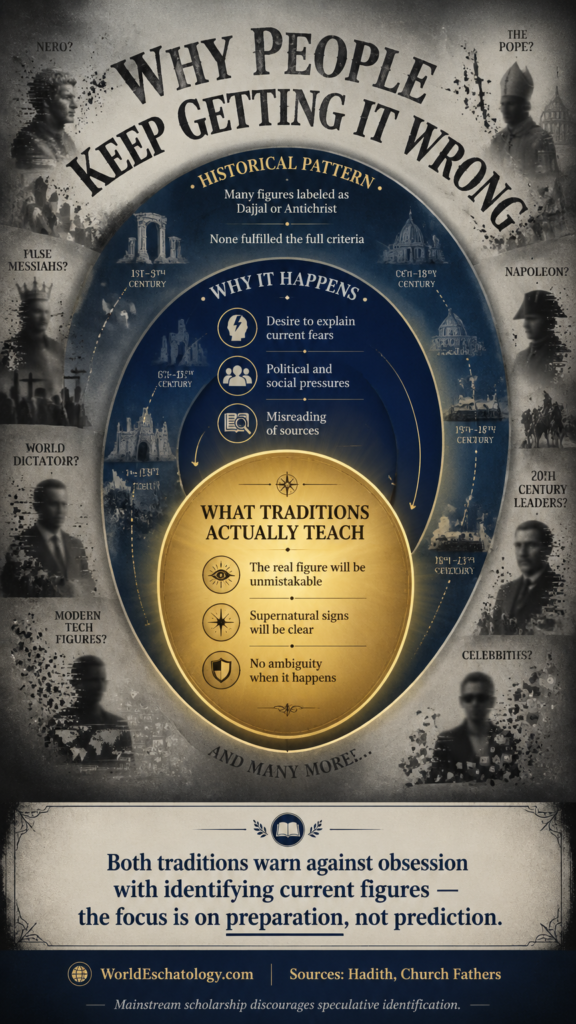
Every single identification of the Dajjal or Antichrist in history has proven incorrect.
Every proposed candidate has died without fulfilling the definitive eschatological criteria described in the primary sources.
This does not disprove the existence of either figure in the traditional view; it simply means that the genuine article will be so distinctively fulfilling the specific criteria that no serious ambiguity will remain when he actually appears.
The hadiths describe conditions surrounding the Dajjal’s coming that are globally recognizable and supernaturally unmistakable.
The same is true of the biblical descriptions of the Antichrist at the height of his power.
What the pattern of failures does reveal is the psychological function of these concepts.
Identifying a current enemy as the Dajjal or Antichrist is a way of saying that current struggles are cosmically significant, not random, and part of a divine story with a meaningful ending.
This is a genuine and understandable human need, particularly in periods of great anxiety and upheaval.
But it produces identifications driven more by the fears of the identifier than by accurate reading of the primary sources.
Both traditions themselves warn against this tendency: the Prophet’s detailed advance description of the Dajjal was specifically intended to prevent Muslims from being misled by false identifications as much as by the Dajjal himself.
Modern Candidates and Technological Interpretations
Contemporary eschatological discourse in both communities has expanded beyond individual figures to include technological systems.
Digital surveillance, cashless payment systems, and artificial intelligence have all been interpreted as potential expressions of the Dajjal’s one-eye symbolism, the Antichrist’s mark of the Beast system, or both simultaneously.
The structural resonance is genuine: Revelation’s description of a mark without which no one can buy or sell does parallel the logic of a fully controlled digital financial system.
The Dajjal’s technique of making things appear to be what they are not is structurally parallel to what advanced AI-generated deepfake technology does at scale.
Mainstream scholars in both traditions acknowledge these parallels as worth noticing while counseling against treating them as definitive identifications.
Modern technology creates conditions that could be exploited by such a figure without constituting that figure itself.
What both traditions consistently say is that the identifying mark of the genuine figure will be supernatural in a way that goes beyond what any current technology achieves: a being whose powers operate at a level that challenges the deepest foundations of faith, not merely one whose systems create inconvenience or even serious economic coercion.
Why the Comparison Matters for Muslims
For Muslims, the Dajjal is one of the ten major signs of the Hour and fits within a precise eschatological sequence that includes the Mahdi, the descent of Isa, the release of Gog and Magog, and other specific signs.
Incorporating Christian dispensationalist details into the Islamic Dajjal portrait, such as the seven-year covenant with Israel or the rebuilt Temple claim, produces a hybrid figure that does not accurately represent either tradition.
The Islamic tradition has its own rich resources for understanding the Dajjal, grounded in fourteen centuries of hadith scholarship, and these are sufficient without borrowing from Christian eschatology.
The specific protection practices the tradition recommends, memorizing Surah Al-Kahf, reciting the prescribed supplications in every prayer, maintaining genuine faith and regular community, are also lost when the Dajjal is reduced to a character in a cross-traditional conspiracy narrative.
The tradition’s emphasis is on inner preparation, not on identifying current candidates.
Muslims who spend more energy speculating about which institution is the Dajjal than on actually strengthening their relationship with Allah and their knowledge of the prophetic warnings have, in a practical sense, already become less equipped to face the genuine trial when it comes.
Why the Comparison Matters for Christians
For Christians, the comparison with the Dajjal tradition can genuinely illuminate aspects of the Antichrist concept that sometimes get overshadowed by the dispensationalist timeline-building that dominates evangelical popular culture.
The Islamic tradition’s intense focus on deception as the primary weapon, on the visual and sensory character of the Dajjal’s miracles, and on spiritual grounding as the primary protection, resonates with important themes in John’s letters and in Paul’s account of those who perished because they did not love the truth.
These themes can get buried under the prophetic timeline charts and geopolitical calculations that dominate popular Christian eschatology.
The comparison also raises an honest question worth sitting with: if two of the world’s major religions, developing in significant contact with shared source traditions, have both arrived at the expectation of a supreme end-times deceiver defeated by Jesus, what does this convergence say about the reality being described?
This question can be approached with genuine intellectual seriousness without requiring either tradition to surrender its distinctive claims.
It suggests that both traditions are pointing toward something real about the shape of history and about the nature of the greatest spiritual danger that human beings face.
The Interfaith Conversation and Its Dangers
At its best, the comparison between the Dajjal and the Antichrist opens a productive conversation about shared concerns and different wisdom.
Both traditions have thought deeply about deception, about what makes human beings spiritually vulnerable, and about the qualities needed to resist sophisticated falsehood.
The Islamic tradition’s practical specificity about protection, the hadiths’ concrete recommendations about what to memorize, what to pray, and where to be, offers resources that Christian communities can find instructive.
The Christian tradition’s theological depth about the content of deception, the specific false claims about divine identity that characterize the Antichrist, offers resources for Islamic reflection about the spiritual dimensions of the Dajjal’s challenge.
The serious danger, which has caused real harm across history, is using these comparisons to generate hostility toward real people and real communities.
The history of both the Antichrist and Dajjal concepts includes deeply troubling episodes where these labels were used to dehumanize real religious and ethnic communities, contributing to persecution and violence.
The traditions themselves, properly read, do not sanction this. Both say that sincere believers grounded in genuine faith will resist the great deceiver regardless of their background, and that the mark identifying the deceiver is visible to those whose hearts are oriented toward truth.
That framework, properly understood, should produce solidarity between sincere believers across traditions, not mutual accusation.
MODERN CONTEXTS AND POPULAR CULTURE
The Dajjal in Contemporary Islamic Discourse
The Dajjal occupies a prominent place in contemporary Muslim media across a wide range of registers.
At the scholarly end, senior scholars engage with the hadith material through established methods of hadith criticism and classical jurisprudence, emphasizing spiritual preparation over specific contemporary identifications.
Works by scholars like Sheikh Imran Hosein, who has written extensively about the Dajjal and his connection to modern geopolitical and financial systems, have attracted large audiences precisely because they attempt to bridge classical scholarship and contemporary analysis.
At the popular end, particularly on YouTube and social media, the Dajjal has become a lens through which many Muslims interpret geopolitics, technology, and global institutions.
The one-eye imagery appears in connection with perceived Illuminati symbolism in entertainment. Global financial institutions are identified as expressions of the Dajjalic system.
These interpretations are often creative and sometimes genuinely insightful but frequently exceed what the authenticated hadiths support and can generate conspiratorial anxiety rather than the spiritual groundedness the tradition actually recommends.
The tradition’s goal in describing the Dajjal in advance was to produce alert, grounded believers, not frightened, suspicious ones.
The Antichrist in Contemporary Christian Culture
The Antichrist in contemporary evangelical Christian culture is almost entirely the dispensationalist figure popularized by Left Behind: a charismatic global political leader who will arise, seize world power, break a covenant with Israel, demand worship, and require everyone to take his mark.
This figure has become one of the most recognizable archetypes in American popular entertainment, appearing in explicitly Christian fiction like Left Behind and in secular films like The Omen, which depicted the Antichrist as a child who grows up to fulfill his dark destiny.
Within serious Christian theology, significant pushback exists against this framework from preterist, historicist, and amillennialist scholars who argue the dispensationalist model is poorly supported by the biblical texts in their historical and literary context.
These scholars note that the Left Behind narrative, though enormously influential in shaping popular expectations, was essentially invented in the nineteenth century and is not the way the Church read these texts for the vast majority of its history.
Understanding this debate is important for anyone who wants to engage seriously with the Antichrist concept rather than simply accepting the most culturally dominant version of it.
Conspiracy Theories That Conflate the Two Figures
A distinctive genre of online content treats the Dajjal and Antichrist as the same figure and connects both to contemporary conspiracy theories about global governance, secret societies, and technological control.
The typical approach identifies a current global development, connects it simultaneously to hadith descriptions and biblical descriptions, and presents a unified eschatological narrative as though both traditions were chapters of the same book.
This content draws audiences from both Muslim and Christian backgrounds who find the interfaith eschatological framework compelling and who appreciate the sense that their tradition’s warnings are being taken seriously.
Mainstream scholars in both traditions are critical of this genre not simply because of the specific identifications being made but because of its underlying methodology.
Treating two traditions’ sacred texts as interchangeable sources for a single unified narrative strips both of their theological context and produces a hybrid that is faithful to neither.
The result is an eschatology driven by conspiracy logic rather than by careful engagement with either tradition’s authentic interpretive resources.
Believers who engage with this content often find that it generates anxiety and political radicalization rather than the peace, rootedness, and practical spiritual preparation that their traditions actually recommend.
Digital Currency, AI, and Eschatological Anxiety
The development of digital currency systems, biometric identification, and artificial intelligence has generated more eschatological commentary in recent years than any other technological development.
The resonance between Revelation’s mark of the Beast and the logic of a fully controlled digital financial system is obvious and has been noted by both Christian and Muslim commentators.
The ability to include or exclude individuals from economic participation based on compliance with a system’s rules has a clear structural resemblance to what both traditions describe as a feature of the great deceiver’s reign.
AI’s capacity to generate convincing false images, audio, and video connects directly to the Dajjal’s defining technique of making things appear to be what they are not.
The technology for creating media indistinguishable from authentic content is developing faster than the ability to detect it, and the implications for public discourse and shared truth are genuinely serious.
Mainstream scholars in both traditions acknowledge these as real structural parallels worth taking seriously, while emphasizing that modern technology creates conditions that could be exploited by such a figure without constituting that figure itself.
The spiritual response is the same regardless of the technology: anchor yourself deeply in divine truth so that no counterfeit can displace it.
Scholary Perspective on Dajjal vs the Antichrist
What Academic Scholars Say About the Relationship
Academic scholars of religion, working through history, philology, and comparative religion, generally see both figures as emerging from the shared apocalyptic imagination of the late antique Near Eastern world, roughly from 200 BCE to 700 CE.
The Second Temple Jewish apocalyptic tradition provided the basic building blocks that both Christianity and Islam incorporated into their eschatological frameworks:
a great deceiver who performs false miracles, a period of unprecedented trial, a divine intervention that defeats the deceiver, and the inauguration of a new era of peace and righteousness.
Scholars like David Cook, who has written extensively on Islamic apocalyptic literature, have documented the ways early Islamic eschatological traditions engaged creatively and selectively with this shared pool rather than simply borrowing wholesale from either Jewish or Christian sources.
The Islamic tradition incorporated some elements, modified others, and rejected still others in accordance with its own theological commitments.
The result is a Dajjal tradition that is genuinely rooted in the same soil as the Christian Antichrist concept while being distinctively shaped by the Islamic prophetic revelation and theological framework.
The Question of Islamic Borrowing from Christian Sources
Academic scholars generally see evidence of Christian and Jewish apocalyptic influence on early Islamic eschatological traditions.
The hadith of Tamim Ad-Dari is itself transmitted by a former Christian who brought with him knowledge of earlier traditions about a chained being awaiting release at the end of time.
Various structural parallels between the Dajjal and the Antichrist are difficult to explain as purely independent development by communities that had no contact with each other.
Traditional Islamic scholarship approaches this differently: rather than seeing parallels as evidence of borrowing, the traditional view understands them as confirmation that all the prophets, from Moses and Jesus to Muhammad, were given knowledge of the same coming trial and warned their communities about the same reality.
The similarities between the Dajjal and earlier traditions are, on this view, evidence of a shared prophetic lineage rather than of cultural transmission in the usual historical sense.
Both perspectives are internally coherent and reflect fundamentally different starting assumptions about the nature of prophetic revelation and how religious knowledge is transmitted across traditions.
Shared Sources and Psychological Functions
Beyond the question of direct borrowing, scholars increasingly emphasize that both traditions may have drawn independently on a common pool of older Near Eastern apocalyptic material, explaining the similarities without requiring a single direct line of transmission.
This approach honors the genuine historical contact between communities while also acknowledging that some parallels may reflect independent discovery of the same patterns rather than deliberate appropriation.
Scholars of religion also offer insight into why figures like the Dajjal and Antichrist are so culturally persistent across centuries and so regularly activated in times of social anxiety.
Psychologically, they name diffuse anxiety, providing a framework that transforms formless dread into a recognizable pattern with a name and a shape.
Socially, shared eschatological frameworks strengthen community identity, motivate the practice of virtues the tradition considers important, and give believers a sense that current struggles have cosmic meaning and a guaranteed outcome.
The danger arises when the social function, defining the in-group against an identified enemy, overrides the spiritual function, which is to motivate genuine inner preparation and genuine resistance to deception in all its forms.
FREQUENTLY ASKED QUESTIONS
Is the Dajjal the same as the Antichrist?
They are similar but not identical. Both figures occupy the same structural position in their traditions as a supreme deceiver defeated by Jesus near the end of history.
Both emerge from the same general Abrahamic apocalyptic tradition that was developed most richly in Second Temple Jewish literature before being incorporated into Christianity and Islam in different ways. But the specific details of each figure differ significantly.
The Dajjal has a precise physical description in the hadiths, including a specific eye condition, a word written on his forehead, particular skin and hair characteristics, and a specific donkey, that has no equivalent in any Christian description of the Antichrist.
The Antichrist’s political and institutional character, making treaties with nations, sitting in a Temple claiming to be God, governing through a global economic system requiring a mark, differs meaningfully from the Dajjal’s primarily miraculous mode of deception.
Their durations on earth differ. Their methods of defeat differ.
The most honest answer is that these two figures are best understood as related expressions of a shared human and prophetic concern about deception, developed in different theological directions by two traditions with genuinely different understandings of who God is, who Jesus is, and what the end of history means.
Collapsing them into one loses the specific wisdom of each tradition.
Treating them as completely unrelated misses the real and significant convergence between two of the world’s major religions on one of the most important questions about the human future.
Is the Antichrist mentioned in the Quran?
No. Neither the word Antichrist nor the Islamic equivalent Dajjal appears in the Quran.
The Dajjal is described entirely through the hadith literature, the recorded sayings and actions of the Prophet Muhammad.
Some scholars see thematic connections between Surah Al-Kahf and the concerns the Dajjal raises, particularly the chapter’s stories about maintaining faith under overwhelming social pressure and about how divine wisdom often contradicts surface appearances.
But there is no direct Quranic reference to either the Christian Antichrist or the Islamic Dajjal by name.
The authority for the Dajjal doctrine in Islam rests entirely on the prophetic hadith tradition, which Islamic theology treats as independently authoritative alongside the Quran.
Is the Dajjal mentioned in the Bible?
The word Dajjal does not appear in the Bible. Some scholars of comparative religion see structural parallels between the Dajjal and figures like the Beast of Revelation, the Man of Lawlessness, and Daniel’s Little Horn.
These parallels are real in terms of function and narrative position. But they are not references to the same named figure, and the specific details of the Dajjal’s hadith portrait have no direct biblical equivalent.
Will Jesus kill the Dajjal?
Yes, according to Islamic hadith tradition. Isa ibn Maryam descends from the heavens near a white minaret east of Damascus, pursues the Dajjal to the gate of Lud in present-day Israel, and kills him with a spear.
The hadiths describe the Dajjal dissolving like salt in water when he sees Isa approaching, but Isa pursues him and strikes the killing blow.
The blood on the spear is shown to the believers as proof. This is one of the most structurally striking parallels with Christian eschatology, where Jesus also returns from heaven and defeats the Antichrist.
But the theological meaning differs profoundly: in Islam, Isa is the greatest prophet before Muhammad, human in nature, acting as a divine instrument.
In Christianity, Jesus is the divine Son of God whose return is the cosmic climax of all history.
The surface similarity conceals a fundamental difference in what the event means within each tradition’s framework.
What does the Dajjal look like?
The hadiths describe a young man with reddish-white skin, broad build, and thick curly hair.
His most distinctive feature is his defective eye: one eye is blind and protrudes like a floating grape, the other is dim and weak.
The word kafir, meaning disbeliever, is written between his eyes, visible to all believers regardless of literacy and invisible to those without faith.
He rides an enormous donkey with strides covering vast distances.
The Prophet is reported to have said that the Dajjal resembles a specific companion named Ibn Qatan, giving his community a human reference point for the figure’s general appearance.
No Christian description of the Antichrist provides anything close to this level of physical specificity.
What does the Antichrist look like?
The biblical texts provide no specific physical description of the Antichrist.
The Beast of Revelation has seven heads and ten horns, universally understood as symbolic rather than literal physical features representing kingdoms and kings.
The Man of Lawlessness in 2 Thessalonians is not physically described at all. John’s antichrist is a spirit or quality, not a described individual.
Later Church Fathers like Hippolytus added details, suggesting the Antichrist would be dark, fierce, or otherwise intimidating in appearance, but these are theological elaborations based on interpretive reasoning rather than descriptions drawn from the biblical text.
The absence of physical description in the Christian sources is one of the clearest differences from the Islamic Dajjal tradition.
Where is the Dajjal now?
According to the hadith of Tamim Ad-Dari in Sahih Muslim, the Dajjal is currently imprisoned and chained on an island, a being who has existed since at least the time of the Prophet and who is waiting for the divine permission to be released.
Islamic scholars generally advise against speculating about the island’s precise location, emphasizing that the important response is spiritual preparation rather than geographic investigation.
What is the number 666 and what does it mean?
The number 666 appears in Revelation 13 as the number of the Beast, described as the number of a man requiring wisdom to calculate.
Using gematria, the value of Neron Caesar in Hebrew characters totals 666, leading most academic biblical scholars to conclude that Revelation’s first-century audience understood this as a reference to the Emperor Nero.
Some manuscripts give the number as 616, the value of Nero’s name in Latin, further supporting this.
In evangelical popular culture, 666 is interpreted as a future mark to be required by the Antichrist, drawing on Revelation’s description of buying and selling being controlled by this mark.
Who are Gog and Magog and how do they relate to both figures?
Gog and Magog appear in Ezekiel, Revelation, and the Quran. In Islamic eschatology they are released and cause widespread destruction after the killing of the Dajjal, then killed by divine plague.
In Christian dispensationalism, their final rebellion follows the Millennium that comes after the Antichrist’s defeat.
In both traditions, Gog and Magog represent a second eschatological crisis that follows the defeat of the primary deceiver, suggesting that all three Abrahamic traditions share a broad end-times sequence: great deceiver, divine defeat, Gog and Magog crisis, final judgment.
Which eye of the Dajjal is blind?
The hadiths differ on this point. Some specify the right eye; others describe the left.
Most Islamic scholars reconcile these by understanding both eyes as defective in different ways, one blind and protruding, the other dim and weak.
The theological significance is more important than the specific side: the Dajjal, despite all his apparent miraculous power, cannot see truly, which mirrors his fundamental inability to convey or perceive truth.
What surah protects against the Dajjal?
Surah Al-Kahf, the eighteenth chapter of the Quran, is specifically recommended in the hadiths as protection against the Dajjal.
The Prophet recommended memorizing its first ten or last ten verses, and regular Friday recitation of the full surah is widely practiced.
Its themes of maintaining faith under enormous pressure, recognizing that appearances deceive, and trusting divine wisdom over surface evidence are precisely the spiritual qualities needed to resist the Dajjal’s mode of deception.
Will the Antichrist be a political or a religious leader?
The biblical texts suggest both. Paul’s Man of Lawlessness combines religious blasphemy, claiming to be God, with implied political authority.
Revelation’s Beast exercises global political and economic power. The dispensationalist framework presents the Antichrist as beginning as a political figure and then assuming a divine religious claim at the midpoint of the tribulation.
The Catholic and Orthodox traditions emphasize the religious dimension.
The most faithful answer to the biblical texts is that the Antichrist will represent a fusion of political and religious authority, the ultimate collapse of the boundary between the two.
Are there multiple Antichrists?
According to John’s letters, yes and no. John explicitly says many antichrists have already come, describing the spirit of antichrist as already active in the world.
Most Christian traditions hold both dimensions together: there is a singular Antichrist who will appear at the end of history embodying this spirit in its fullest and most dangerous form, and there have been and continue to be many antichrists throughout history who embody aspects of the same spirit of opposition to Christ and to the truth.
What does Islam say about the Christian Antichrist specifically?
Islam does not have a doctrine about the Christian Antichrist as such. When Muslims engage with the concept, they typically draw parallels with the Dajjal tradition.
Some features of Christian Antichrist descriptions, particularly the emphasis on miraculous deception and the defeat by Jesus, are recognized as consistent with Islamic accounts of the Dajjal.
Other features, including specific political and Temple-related details, do not have clear parallels in the Islamic framework.
What does Christianity say about the Islamic Dajjal specifically?
No Christian theological tradition officially incorporates the Dajjal.
Christians who engage with the question typically do so through comparative religion or interfaith dialogue, noting parallels with the Antichrist concept.
Some Christian scholars have found the hadith tradition’s specificity and practical focus on spiritual protection instructive for their own tradition’s engagement with end-times preparedness.
Has the Dajjal been born yet?
Based on the Tamim Ad-Dari narration, the Dajjal already existed in the Prophet’s time, chained on an island.
This indicates he is not a future human being yet to be born but an already-existing being awaiting divine permission for release.
Islamic scholars understand him as a created being, not born in the ordinary human sense, who exists outside the normal human life cycle.
What is Armilus?
Armilus is a figure in medieval Jewish apocalyptic literature who occupies the same structural position as both the Dajjal and the Antichrist.
He claims to be God, demands worship, kills the Messiah son of Joseph, and is defeated by the Messiah son of David.
His physical description, including defective eyes and a mark on his forehead, resembles aspects of the Dajjal’s portrait.
His existence is evidence that all three Abrahamic traditions have been working with overlapping eschatological material, likely drawing from shared ancient sources.
Is the Dajjal human or supernatural?
The tradition presents the Dajjal as a created being who is neither fully human in the ordinary sense nor a purely spiritual entity.
He has a body, can be physically killed, and has a physical description.
But his extraordinary longevity, his imprisonment since ancient times, and his supernatural powers place him outside normal human categories.
Islamic scholars describe him as a created being given specific characteristics and powers by Allah as the supreme test for humanity at the end of time.
Is the Antichrist human or supernatural?
Christian tradition has generally held that the Antichrist will be a human being, though one extraordinarily empowered by Satan.
Hippolytus explicitly stated he would be born of human parents. The dispensationalist tradition maintains this view.
Revelation’s Beast has both human and symbolic supernatural dimensions that have generated ongoing debate.
The dominant Christian position is a human being so completely given over to Satan’s influence that the distinction between human and satanic agency becomes practically meaningless in his actions.
What comes after the defeat of each figure?
In Islam, Isa leads a period of peace after the Dajjal’s death.
Gog and Magog are then released and destroyed by divine plague, followed by further major signs before the Day of Resurrection.
In Christian dispensationalism, Christ’s Millennial reign follows the Antichrist’s defeat, then a final Gog and Magog rebellion, then the Last Judgment and the new creation.
Both traditions describe peace after the deceiver’s defeat, then a Gog and Magog crisis, then final judgment.
The broad sequence is shared; the theological meaning of each step differs significantly.
CONCLUSION
What the Comparison Ultimately Reveals
After examining everything both traditions say about these two figures, the comparison reveals something genuinely important:
two of the world’s largest religions, with a combined following of over four billion people, share a profound conviction that the greatest danger at the end of history will not be obvious destruction but sophisticated, appealing, apparently miraculous deception.
Both traditions have devoted enormous theological energy to describing this deception in advance, warning believers about its specific characteristics, and providing concrete resources for spiritual resistance.
This shared conviction is not coincidence or cultural borrowing alone. It reflects something genuinely true about human experience: that we are most vulnerable not to what obviously threatens us but to what persuasively misleads us.
The comparison also reveals where the two traditions genuinely diverge, and these divergences matter as much as the convergences.
The Dajjal tradition’s physical specificity, its emphasis on supernatural miracle as the mechanism of deception, and its grounding in a prophetic framework that centers on divine unity and prophetic succession is distinctively Islamic.
The Antichrist tradition’s theological depth about false claims to divine identity, its development through centuries of Christian reflection on the nature of Christ and the character of his opponents, and its grounding in a framework that centers on the incarnation and Second Coming of the divine Son, is distinctively Christian.
Both deserve to be engaged on their own terms, with the full seriousness of their own traditions, rather than as interchangeable pieces of a generic end-times mosaic.
The Spiritual Wisdom Both Traditions Offer
The spiritual wisdom that both traditions offer for resisting the great deceiver points in the same direction even when the specific forms differ.
The Islamic tradition recommends deep familiarity with divine revelation through regular recitation of Surah Al-Kahf, daily supplication seeking Allah’s protection from the Dajjal’s trial, maintenance of genuine prayer and fasting, and commitment to the community of believers who reinforce each other’s faith.
The Christian tradition emphasizes loving the truth enough to suffer for it rather than accepting comfortable falsehood, remaining in genuine fellowship with other believers, keeping the actual content of the gospel clear in the mind and heart, and cultivating the kind of relationship with God that cannot be shaken by impressive signs that contradict revealed truth.
The common thread in all of these recommendations is orientation toward something real and transcendent that cannot be manufactured by the deceiver, however powerful he is.
Both traditions are saying that the person who genuinely knows God, who has made the effort to build a real relationship with divine truth rather than a comfortable religious habit, is the person who the great deceiver cannot ultimately reach. Impressive miracles do not move them because their faith is not based on miracles but on something deeper.
Political and economic pressure does not break them because their ultimate allegiance is not to any system that can be controlled or withdrawn.
This is the promise both traditions hold out, and it is the invitation that both the Dajjal concept and the Antichrist concept, at their best, are trying to extend.
What It Means That Both Traditions Expect a Deceiver Rather Than a Destroyer
The final observation worth sitting with is the significance of the fact that both traditions make deception, not destruction, the primary weapon of their end-times villain.
This choice is theologically and psychologically profound. A pure destroyer would be easier to recognize and easier to resist.
You know where you stand with an enemy who simply comes to kill. The Dajjal and the Antichrist are dangerous precisely because they will not look like what they are.
They will look good, or at least impressive and compelling. Their miracles will be genuine enough in appearance to challenge the faith of people who thought their faith was firm.
Their promises will address real human needs and real human anxieties.
Both traditions are saying that the most important quality to cultivate in the face of this ultimate deception is the ability to remain faithful to truth when truth is unpopular, when the evidence of the senses points elsewhere, when the crowd is moving in a different direction, when the cost of resisting seems very high.
This is not a quality that develops overnight or in a crisis. It develops through years of faithful practice, honest engagement with scripture and tradition, genuine prayer, genuine community, and the slow and unglamorous work of becoming a person whose love of truth is strong enough to withstand the most sophisticated possible assault on it.
That is ultimately what both the Dajjal tradition and the Antichrist tradition are inviting their respective communities toward:
not anxiety about the future, not obsession with identifying current candidates, but the deepening of the qualities of heart and mind that make genuine deception, in the end, impossible.
WorldEschatology.com
Sources: Sahih Bukhari; Sahih Muslim; Sunan Abu Dawud; Sunan Ibn Majah; The Holy Quran; The Holy Bible (ESV); 1 John; 2 Thessalonians; Daniel; Revelation; Irenaeus, Against Heresies; Hippolytus, On Christ and Antichrist; Augustine, City of God; Sefer Zerubbabel; David Cook, Contemporary Muslim Apocalyptic Literature; Tim LaHaye and Jerry Jenkins, Left Behind Series
1 thought on “Dajjal vs the Antichrist: Are They the Same Figure?”