Who Is Imam Mahdi? What Islamic Texts Actually Say

Few figures in all of Islamic thought generate as much hope, as much debate, and as much confusion as the Imam Mahdi.

For over a billion Muslims around the world, the Mahdi is not a myth or a metaphor.

He is a real future person whose coming is as certain as the rising of the sun, a divinely guided leader who will appear at a moment of maximum global crisis and restore justice to a world that has been overwhelmed by oppression.

And yet, for all the passion that surrounds the Mahdi concept, remarkably few people have read what the Islamic primary sources actually say about him.

The popular image of the Mahdi is often a mixture of authentic hadith material, later scholarly elaboration, sectarian interpretation, and in some cases outright speculation.

The result is a figure who means different things to different communities and who has been claimed, invoked, and misused more than almost any other concept in Islamic religious history.

This article goes back to the primary sources. It examines what the hadith collections actually say, how classical scholars assessed the strength of the Mahdi traditions, what the specific signs of his coming are according to the texts, how Sunni and Shia Islam understand him in fundamentally different ways, who has claimed to be the Mahdi across history and what happened as a result, and how the Mahdi concept compares with similar figures in other world traditions.

The goal is to give you the real picture rather than a simplified summary.

A note before we begin: this article approaches all sources with scholarly honesty. Where the hadith evidence is strong, that is stated clearly.

Where it is weaker or disputed, that is also stated clearly. Where Sunni and Shia traditions genuinely differ, both are presented fairly. The subject deserves nothing less.

Life During Mahdi Rule Islamic End Times Explained

INTRODUCTION AND FOUNDATIONS

Why the Question of Imam Mahdi Matters Right Now

The eschatological anxiety that is driving millions of people to search for answers about the Mahdi right now is real and understandable.

Wars in Muslim-majority lands, political instability across the Middle East, the rise of movements that invoke Islamic end-times frameworks, the widespread sense that something fundamental about the current world order is breaking down, all of this creates exactly the kind of atmosphere in which Mahdi expectations become urgent and immediate rather than distant and theoretical.

What makes the current moment particularly interesting is that this search crosses denominational lines.

Sunni and Shia Muslims, who have very different specific doctrines about the Mahdi, are both experiencing heightened eschatological awareness.

And the subject has reached non-Muslim audiences as well, who encounter the Mahdi concept in news coverage, in comparative religion discussions, and in the growing genre of interfaith eschatological content that connects Islamic end-times expectations with those of Christianity and Judaism.

Understanding what the Islamic texts actually say, as opposed to what various political, sectarian, or sensationalist voices claim they say, has never been more important.

What the Word Mahdi Actually Means

The word Mahdi comes from the Arabic root ha-dal-ya, which means to guide or to be guided.

Mahdi is the passive participle of this root, meaning the one who has been guided, specifically the one who has been guided by Allah.

The full theological implication is significant: the Mahdi is not someone who has found the right path through his own effort or intelligence.

He is someone whom God has specifically chosen and guided to fulfill a particular purpose at a particular moment in history.

This etymology sets the Mahdi apart from other kinds of religious leaders.

He is not called the wisest, the most learned, or the most powerful, though the hadith tradition attributes all of these qualities to him.

He is called the guided one. His defining characteristic is divine guidance, the direct divine preparation that equips him for his unique mission.

The name also carries an implicit contrast with the Dajjal, whose name means the great deceiver, the one who leads astray.

The Mahdi guides toward truth; the Dajjal misleads away from it. They are, in the Islamic eschatological imagination, the supreme embodiments of two opposite principles.

Belief in the Mahdi: Article of Faith or Scholarly Discussion?

One of the most important distinctions to understand about the Mahdi doctrine in Sunni Islam is that it does not have the same doctrinal status as the core pillars of faith.

Belief in Allah, in His angels, in His scriptures, in His prophets, in the Last Day, and in divine decree are explicitly established as obligatory articles of Islamic faith.

The Mahdi is not among the six pillars of faith as typically enumerated.

What classical Sunni scholarship has generally held is that the coming of the Mahdi is established by a sufficient weight of hadith evidence that it constitutes a matter of Sunni consensus, and that denying his coming without good scholarly reason is a serious error.

But the specific status of this belief as obligatory versus strongly recommended has been debated by scholars, and a minority of respected scholars, most famously the historian and sociologist Ibn Khaldun, have questioned the reliability of the hadith evidence.

In Twelver Shia Islam, by contrast, belief in the Mahdi as the Twelfth Imam currently in occultation is absolutely central to the faith, an essential pillar of the creed rather than a secondary eschatological matter.

THE MAHDI IN THE PRIMARY ISLAMIC SOURCES

Primary Hadith Sources: Which Collections Say What

The hadith traditions about the Mahdi are spread across multiple collections and vary in their degree of reliability as assessed by the classical hadith sciences.

The most important collections for Mahdi traditions are Sunan Abu Dawud, Sunan Ibn Majah, Jami at-Tirmidhi, and the Musnad of Imam Ahmad ibn Hanbal.

None of the Mahdi hadiths are found in Sahih Bukhari, the collection considered most rigorously verified in Sunni hadith scholarship.

This absence from Bukhari has been noted by some scholars as significant, though others point out that Bukhari’s collection was selective by design and that absence from it does not automatically weaken a tradition.

The hadiths in Sunan Abu Dawud and Sunan Ibn Majah include the most frequently cited descriptions of the Mahdi’s name, lineage, physical characteristics, and mission.

Tirmidhi’s collection includes several Mahdi traditions that he himself graded, and his assessments have been important in how later scholars evaluated these narrations.

The Musnad of Ahmad ibn Hanbal contains a large number of Mahdi-related traditions, and Imam Ahmad’s willingness to include them in his collection has been used as evidence of their general reliability.

Why the Mahdi Is Not Mentioned in the Quran

Like the Dajjal, the Mahdi is not mentioned by name anywhere in the Quran. This fact is sometimes raised by those who question the doctrine, and it deserves an honest answer.

The Quran does not explicitly describe either the Mahdi or many other specific details of Islamic eschatology that are established through the hadith tradition.

The hadith tradition in Islamic theology is an independent source of religious authority, not merely a commentary on the Quran.

Islamic scholars have also pointed to Quranic verses that they understand as thematic references to the Mahdi era without naming him directly.

Verses describing the establishment of justice on earth, the promise to the righteous of succession and authority, and prophecies of a future victory of divine guidance over all other ways of life have all been cited in connection with the Mahdi tradition.

But these are interpretive connections made by later scholars, not explicit Quranic descriptions of the Mahdi himself.

The Concept of Tawatur and the Strength of the Mahdi Doctrine

In the hadith sciences, tawatur refers to mass transmission, a level of narration in which so many independent chains of transmission carry the same report that it becomes inconceivable that all of them could have fabricated or misremembered the same content.

A hadith reaching this level of transmission is considered certain rather than merely probable. Individual Mahdi hadiths, taken one by one, have varying degrees of reliability.

Some are assessed as sahih (sound), some as hasan (good), some as weak.

But classical scholars have argued that the sheer number of Mahdi traditions across so many chains of transmission, even if no single chain is perfect, gives the overall doctrine a collective weight that amounts to a form of tawatur.

This argument was made explicitly by scholars like Ibn Hajar al-Asqalani, Al-Suyuti, and Al-Qurtubi.

Al-Suyuti compiled a specific treatise concluding that the collective weight of Mahdi traditions established the doctrine beyond reasonable doubt, and this became the mainstream Sunni scholarly position.

Scholars Who Affirmed and Scholars Who Questioned the Mahdi Doctrine

The names of scholars who affirmed the Mahdi doctrine read like a roll call of classical Islamic scholarship’s greatest figures.

Ibn Kathir, whose Tafsir and historical works remain essential references, affirmed the Mahdi doctrine while noting that some specific narrations were weaker than others.

Ibn Hajar al-Asqalani, the greatest hadith scholar of the medieval period by most assessments, affirmed it. Al-Nawawi, Al-Qurtubi, and Al-Suyuti all affirmed it.

This consensus is not something to be taken lightly.

The most significant dissenting voice is that of Ibn Khaldun (1332 to 1406), the brilliant historian and social theorist whose Muqaddimah contains a detailed and skeptical examination of Mahdi hadiths.

Ibn Khaldun argued that many of the specific Mahdi narrations were weak, that their transmitters included unreliable narrators, and that the social and political function of Mahdi belief in producing popular movements should make Muslims cautious about the doctrine.

His critique has been valued as a scholarly contribution even by those who ultimately disagreed with his conclusions.

Mainstream scholarship responded by pointing to the collective weight of the traditions and the consensus of the major hadith scholars, but Ibn Khaldun’s dissent remains the most serious classical challenge to the doctrine.

WHO IS THE IMAM MAHDI?

Who is Imam Mahdi Signs of His Appearance in Mecca

The Mahdi’s Lineage: Descent from the Prophet

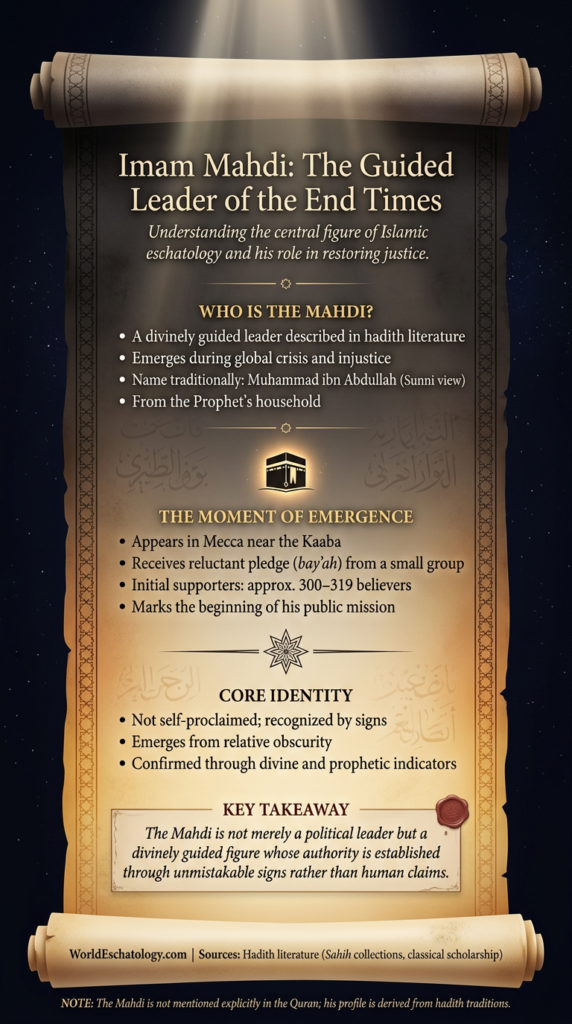
One of the most consistently stated characteristics of the Mahdi across the hadith literature is his descent from the Prophet Muhammad through his daughter Fatimah.

Several narrations specify this lineage, establishing that the Mahdi will come from the ahl al-bayt, the household of the Prophet.

This prophetic descent is not incidental to his identity but is understood as one of the divine qualifications for his mission.

He carries the blood of the Prophet, and with it, in the Islamic understanding, something of the spiritual inheritance of prophethood.

Within the ahl al-bayt, some hadiths specify descent through Hasan, the Prophet’s elder grandson, while others specify descent through Husayn, the younger grandson.

Classical scholars have generally not seen this as a contradiction but as either a matter of different narrations emphasizing different lines or as reflecting that the full genealogical chain will trace through multiple prophetic descendants.

For Sunni Muslims, this lineage is an important characteristic of the Mahdi’s identity but does not in itself determine who he is.

For Shia Muslims, the specific lineage through Husayn is essential and shapes the entire doctrine.

The Mahdi’s Name

One of the most famous hadith about the Mahdi is also one of the most practically significant for identification purposes.

The Prophet Muhammad is reported to have said that the Mahdi’s name will be the same as his own name, Muhammad, and that his father’s name will be the same as the Prophet’s father’s name, Abdullah.

This means that the Mahdi will be named Muhammad ibn Abdullah.

The theological weight of this detail is considerable. The Mahdi will share the name of the Prophet, the most honored name in the Islamic tradition.

His father will share the name of the Prophet’s father. This naming parallel is understood as part of the divine preparation for the Mahdi’s role, a confirmation that he stands in a specific relationship to the prophetic inheritance.

It is also, of course, a practical identifying detail, though one that many Muslim men carry, since Muhammad and Abdullah are among the most common names in the Muslim world.

The Mahdi’s Physical Description

The hadith literature provides a number of physical details about the Mahdi’s appearance.

He is described as having a broad forehead and an aquiline or slightly hooked nose. Some narrations describe him as having a gap between his front teeth.

He is described as of moderate or good height and of a pleasant, dignified bearing. His complexion is described as fair or reddish in some narrations.

The physical description serves a similar function to the description of the Dajjal’s appearance: it provides identifying markers intended to help believers recognize the genuine figure and distinguish him from impostors.

Classical scholars have noted that the physical details, while specific, are the kinds of features that could belong to many individuals, and that the definitive confirmation of the Mahdi’s identity will come not from physical appearance alone but from the constellation of circumstances and signs accompanying his emergence.

The Mahdi’s Emergence: From Where and Under What Circumstances

The hadiths indicate that the Mahdi will emerge from the Arabian Peninsula, with Medina specifically mentioned in several narrations as connected to his origins.

He will emerge in a time of great crisis and civil conflict, and his initial recognition will come at the Kaaba in Mecca, where he will be pledged allegiance by a group of believers at the corner of the Black Stone.

What is particularly striking about the accounts of the Mahdi’s emergence is his reluctance. He will not present himself as the Mahdi.

He will not seek power or leadership. He will be pushed into his role by circumstances and by the insistence of those around him who recognize the signs.

Some narrations describe him as being in Medina when he is sought out and brought to Mecca. Others describe him as wanting to flee the responsibility being placed on him.

This reluctance is understood as one of the signs of his genuine character, in sharp contrast to false Mahdi claimants who have historically sought the role rather than being pressed into it.

The Mahdi’s Character and Spiritual Qualities

The hadith literature describes the Mahdi’s personal qualities in terms that emphasize piety, humility, and justice rather than charisma or political cunning.

He is described as someone who fills his time with worship and righteous conduct before his emergence into public leadership. He is not known for political ambition.

He is described as distressed by the state of the world and its injustice, carrying a genuine concern for the suffering of people rather than a desire for power.

Classical scholars have emphasized that the Mahdi’s qualities are those of a true servant of Allah who happens to be placed in a position of leadership rather than those of a man who schemes his way to the top.

His justice is described as a direct reflection of his God-consciousness rather than a political strategy.

He will establish justice because he genuinely cannot tolerate injustice, not because justice serves his interests.

This characterization is important for understanding why Islamic scholarship has consistently warned against self-proclaimed Mahdi claimants, who by the very act of claiming the role demonstrate the ambition that the genuine Mahdi will conspicuously lack.

The Mahdi’s Age and the Duration of His Reign

The hadiths give some indication of the Mahdi’s age when he emerges, with various narrations suggesting he will be between thirty and forty years old, placing him in the prime of life for a leader in the classical Arabian understanding.

This detail is consistent with the general expectation that the Mahdi will be someone who has lived long enough to develop wisdom and character but is still in the physical prime that leadership requires.

The duration of the Mahdi’s reign is a question where the hadiths give varying answers, and classical scholars have worked to reconcile them.

Some hadiths say seven years, others say eight, and still others mention nine. Some narrations specify forty years.

Ibn Khaldun and others who have examined these narrations have noted the discrepancies, while scholars who affirm the doctrine have generally argued either that the different numbers refer to different phases of his leadership, that some narrations are stronger than others, or that the variation reflects the imprecision involved in prophetic descriptions of future events.

The Mahdi as Political and Military Leader

One of the most important things to understand about the Mahdi in the hadith tradition is that he is not primarily a spiritual figure in the sense of a teacher or a mystic.

He is a political and military leader who will govern a real state, lead real armies, make real decisions about governance, and administer real justice to real populations.

The Islamic tradition does not envision the Mahdi as a figure who transforms the world through preaching alone.

He transforms it through leadership, through military action when necessary, and through the implementation of divine law in a functioning society.

This this-worldly dimension of the Mahdi’s role is one of the features that distinguishes Islamic eschatology from some other religious end-times frameworks.

The Mahdi does not rapture believers out of history. He enters history at its most chaotic point and reorders it.

He does not promise an escape from the world but a radical transformation of it.

This is consistent with the broader Islamic theological commitment to the relevance of divine guidance to real political and social conditions rather than only to personal spiritual development.

THE SIGNS PRECEDING THE MAHDI’S EMERGENCE

The Signs of the Hour and Where the Mahdi Fits

Islamic eschatology distinguishes between the minor signs of the Day of Judgment, which are many and spread across a long period of time, and the major signs, which are ten specific events that occur in rapid succession near the actual approach of the Hour.

The Mahdi’s emergence is generally counted among the major signs, specifically as one of the first of the major signs, preceding the descent of Isa, the release of Gog and Magog, and the appearance of the Dajjal in their proper eschatological sequence.

This placement is important for understanding the Mahdi’s role. He does not appear after the world’s problems have been partially solved and conditions are improving.

He appears when conditions are at their worst, when the minor signs have run their course and the world is in a state of maximum crisis.

His emergence is itself a sign that the end of history is approaching, and everything that follows him in the eschatological sequence, the Dajjal, Isa, Gog and Magog, the major cosmic signs, flows from and follows his establishment of leadership.

Who Defeats Dajjal The Role Of Isa And Mahdi

The Great Fitnah That Precedes His Coming

The Arabic word fitnah refers to trial, tribulation, and civil strife, and the hadiths describe a period of intense and widespread fitnah as the immediate context for the Mahdi’s emergence.

This is not ordinary political instability. The hadiths describe a level of social breakdown in which people can no longer distinguish friends from enemies, in which communities that were once united are torn apart by conflict, and in which the very fabric of Muslim society is under threat.

Some narrations describe widespread killing to the point where the killer does not know why he is killing and the killed does not know why he is being killed.

Others describe conflicts between groups identified by direction or geography, with armies from different regions clashing in the Arabian Peninsula.

The overall picture is of a pre-Mahdi period in which the Muslim world is experiencing a crisis of governance, legitimacy, and social cohesion so severe that the appearance of a divinely guided leader becomes not just hoped for but desperately necessary for survival.

The Army Swallowed by the Earth

One of the most dramatic of all the pre-Mahdi signs is the hadith describing an army that will march against the Mahdi and will be swallowed by the earth somewhere between Mecca and Medina.

This narration appears in Sahih Muslim, one of the two most rigorously verified collections, giving it a higher degree of reliability than many other Mahdi-related traditions.

The army is described as going down into the earth at a specific location in the desert between the two holy cities.

Classical scholars have understood this event as a direct divine intervention to protect the Mahdi and confirm his divine mandate.

An army that sets out with the intention of destroying the Mahdi is instead destroyed by the earth itself, a sign that cannot be explained by natural causes and that will be recognized as divine confirmation of the Mahdi’s legitimacy.

Some scholars have also seen in this narration a warning to those who would oppose the Mahdi out of political ambition or sectarian loyalty, that opposition to the Mahdi is opposition to divine will with corresponding divine consequences.

The Caller from the Sky

Several hadith traditions describe a call or a voice from the sky that will announce the Mahdi’s identity and confirm him to all people simultaneously.

This heavenly announcement will be heard across the world, and some narrations say it will be in Arabic while others say everyone will hear it in their own language.

The significance of this sign is that it removes all ambiguity about the Mahdi’s identity: the divine confirmation will be public, unmistakable, and global.

Classical scholars have discussed whether this call is a miraculous sound produced directly by divine command, the call of an angel, or a natural phenomenon used by divine will for this purpose.

The specific mechanism has been less important to scholars than the function: the heavenly call serves as the definitive divine endorsement that distinguishes the genuine Mahdi from the many false claimants who will have appeared before him and who may continue to appear alongside him.

The Black Banners of Khorasan

Few Mahdi-related traditions have been more debated, more misused, or more frequently misrepresented than the hadith traditions about black banners coming from Khorasan.

Khorasan is a historical region that roughly corresponds to parts of modern Iran, Afghanistan, and Central Asia.

The hadiths in question describe black banners emerging from this eastern direction, with some traditions connecting them to an army that will support the Mahdi.

The scholarly problems with this tradition are significant.

Several of the most frequently cited black banners hadiths are considered weak by hadith critics, meaning their chains of transmission include narrators whose reliability has been questioned.

The more reliable traditions do not make as specific or as dramatic a claim as the popular versions that circulate widely online and in popular Islamic literature.

This has not prevented the black banners tradition from being claimed by numerous political and militant movements across Islamic history, from the Abbasid revolution of the eighth century, whose armies did march under black banners from Khorasan, to various modern movements.

Mainstream Islamic scholarship has been consistently critical of the application of this tradition to specific contemporary movements.

The Abbasid revolution itself was sometimes retrospectively presented as a fulfillment of the black banners prophecy, a claim that classical scholars largely rejected.

More recently, various militant organizations have used the black banners imagery to claim divine mandate for their campaigns.

Traditional scholars have pointed out that the hadith evidence for the specific black banners tradition is weak, that claiming fulfillment of eschatological prophecy for political purposes is itself a classic sign of false messianic movements, and that the genuine Mahdi will be identified by the full constellation of signs, not by the color of a flag.

The Bay’ah at the Kaaba

The hadiths describe a specific and dramatic scene in which the Mahdi receives his initial pledge of allegiance.

He will be at the Kaaba in Mecca, standing between the Rukn (the corner where the Black Stone is) and the Maqam Ibrahim (the station of Abraham).

A group of believers, having recognized him as the Mahdi through the signs they have witnessed and their knowledge of the prophetic descriptions, will press their pledge of allegiance upon him.

The number of this initial group of supporters is given in various narrations as somewhere between three hundred and three hundred and nineteen, a figure that resonates with the number of companions who fought at the Battle of Badr, the first and most important military victory of early Islam.

This parallel is understood as deeply meaningful: just as a small but faithful group was sufficient to establish Islam at Badr, a small but faithful group will be sufficient to establish the Mahdi’s leadership.

The Mahdi will accept their pledge reluctantly, under their insistence, and it is from this moment that his public leadership of the Muslim community formally begins.

THE MAHDI’S MISSION AND ROLE

The Restorer of Justice

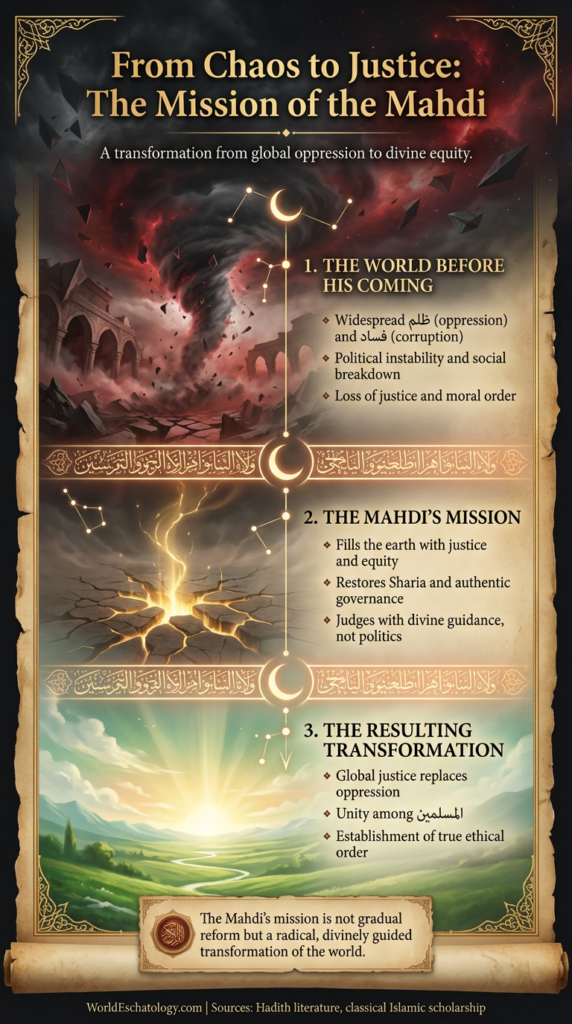
Across all Mahdi traditions, Sunni and Shia alike, across hadiths of varying reliability and across centuries of scholarly commentary, one description appears with near-perfect consistency: the Mahdi will fill the earth with justice and equity after it has been filled with oppression and tyranny.

This formula, or a close variant of it, is the defining mission statement of the Mahdi in Islamic tradition, and it is the element that resonates most deeply with Muslim communities experiencing injustice in every era.

The specific character of this justice is important. It is not a gradual reform or a political improvement.

It is a radical transformation from a condition of maximum oppression to one of maximum justice.

The world will not merely become somewhat better under the Mahdi. It will be transformed in a way that reverses the dominant condition of Kali Yuga-like degradation that preceded his coming.

This is a genuinely eschatological promise: the kind of justice that human political effort alone cannot produce, made possible by divine guidance operating through a specific chosen individual.

The Mahdi and Islamic Law

The hadith tradition is consistent in describing the Mahdi’s role as including the restoration and enforcement of the Sharia, the divine law of Islam.

He will govern by the book of Allah and the Sunnah of His Prophet. He will end the compromises, corruptions, and departures from Islamic law that will have accumulated during the period of crisis preceding his emergence.

He will judge between people with justice, and his judgments will be based on direct divine guidance rather than on political calculation.

Classical scholars have understood this aspect of the Mahdi’s role as confirming that his authority is religious as well as political.

He is not merely a just ruler in a secular sense. He is the leader of the Muslim community in the fullest religious sense, implementing divine law with the kind of commitment and knowledge that the ordinary political process cannot produce.

This understanding also helps explain why the Mahdi traditions have been so attractive to movements seeking to establish what they describe as authentic Islamic governance, though the tradition itself is clear that the genuine Mahdi will be known by the full set of signs and will not need to claim the role through political struggle.

The Mahdi’s Military Campaigns and the Conquest of Constantinople

The hadith tradition describes the Mahdi as leading military campaigns, including a significant campaign that the narrations describe as the conquest of Constantinople.

Constantinople, the historic capital of the Byzantine Empire and subsequently of the Ottoman Empire, was conquered by the Ottomans in 1453 CE.

Some scholars argue that the prophetic reference to Constantinople’s conquest was fulfilled by that historical event.

Others argue that the Mahdi-era conquest refers to a future event in the same geographic area, perhaps a reconquest of a spiritually significant city rather than the same historical conquest.

The military dimension of the Mahdi’s role has been one of the most politically charged aspects of the tradition throughout Islamic history.

Movements seeking to frame their military campaigns as divinely mandated have frequently invoked Mahdi traditions about conquests and battles.

Traditional scholarship has responded by emphasizing that the Mahdi’s military campaigns will follow his confirmed emergence through the full set of divine signs, and that military action taken before these signs are fulfilled in their entirety is not the Mahdi’s campaign regardless of how it is presented.

The Mahdi Leading Prayer with Isa

One of the most theologically significant moments in the entire Islamic eschatological sequence is the scene that will unfold when Isa ibn Maryam descends from the heavens.

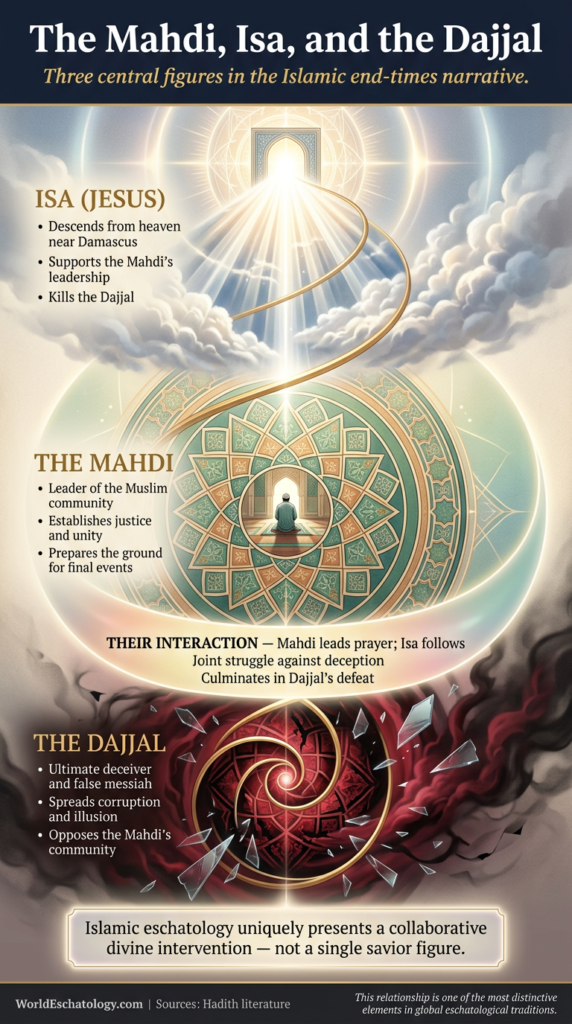
According to the hadiths, Isa will descend near Damascus, and the believers will already be gathered under the Mahdi’s leadership preparing for the morning prayer.

When Isa descends, the Mahdi will step back and offer Isa the position of prayer leader, out of respect for his prophetic status.

Isa will decline. He will tell the Mahdi to lead the prayer, because the prayer was established for the Muslim community and the Mahdi is the appointed leader of that community.

The Mahdi will then lead the prayer with Isa praying behind him as a follower. This exchange is rich with theological significance.

It establishes that Isa, when he returns, will follow Islamic law and the leadership of the Muslim community rather than establishing a new dispensation.

It confirms the Mahdi’s legitimate authority even in the presence of a prophet. And it demonstrates the harmony between the two figures who will together confront and defeat the Dajjal.

The Mahdi’s Treasury and Generosity

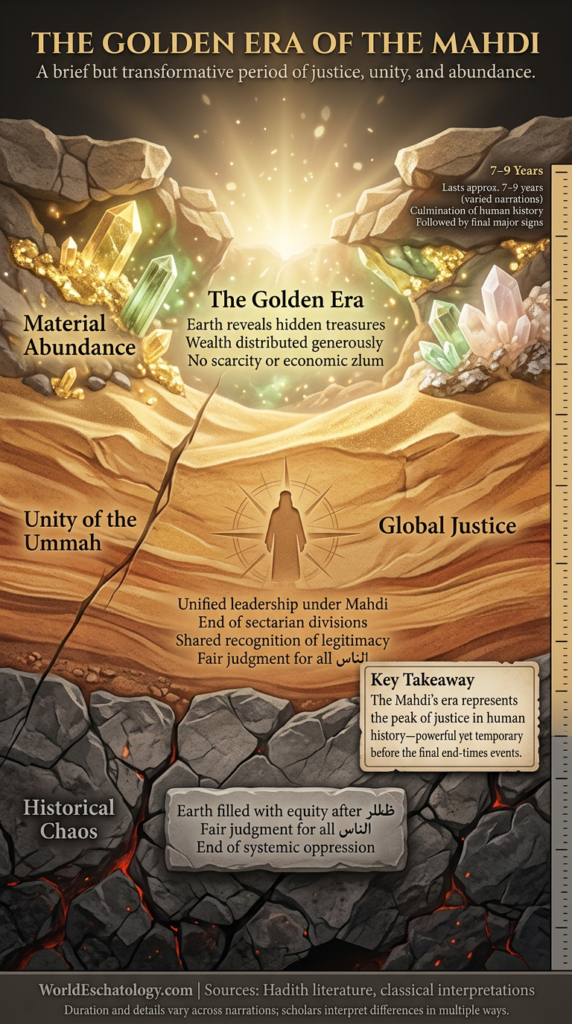
The hadith tradition includes descriptions of extraordinary material abundance during the Mahdi’s reign.

He will have access to treasures of the earth that will be revealed to him, and he will distribute wealth with unprecedented generosity.

The narrations describe him giving to anyone who asks without counting, without recording, without conditions.

People will come to him asking for wealth and he will give them handfuls, sometimes more than they can carry.

This abundance is understood as divine provision rather than the result of economic policy.

The earth will give up its hidden treasures during the Mahdi’s time, and rain will fall in abundance making the land exceptionally fertile.

This material dimension of the Mahdi’s era serves to confirm that his justice is comprehensive, including economic justice and freedom from want rather than only political or legal justice.

It also serves as a contrast with the economic suffering that will have preceded his coming and with the economic coercion that will characterize the Dajjal’s campaign.

The Relationship Between the Mahdi and the Dajjal

The Mahdi and the Dajjal are the two poles of the Islamic end-times sequence, and their relationship is not incidental but central to the eschatological narrative.

The Mahdi’s emergence creates the conditions that will eventually lead to the Dajjal’s release.

As the Mahdi consolidates leadership of the Muslim community and begins his campaign of justice, the Dajjal will be released from his imprisonment and begin his own campaign of deception.

The Mahdi will not be killed by the Dajjal, and the Dajjal will not defeat the Mahdi’s forces during the period of the Mahdi’s leadership.

The showdown between the forces of truth and the forces of deception will continue until Isa descends, at which point the Dajjal will be killed at the gate of Lud.

After the Dajjal’s death, the Mahdi will continue his leadership through the period of Isa’s time on earth, and the Muslim community will experience the golden era of justice and abundance that the tradition promises as the culmination of his mission.

THE SUNNI MAHDI VERSUS THE SHIA MAHDI
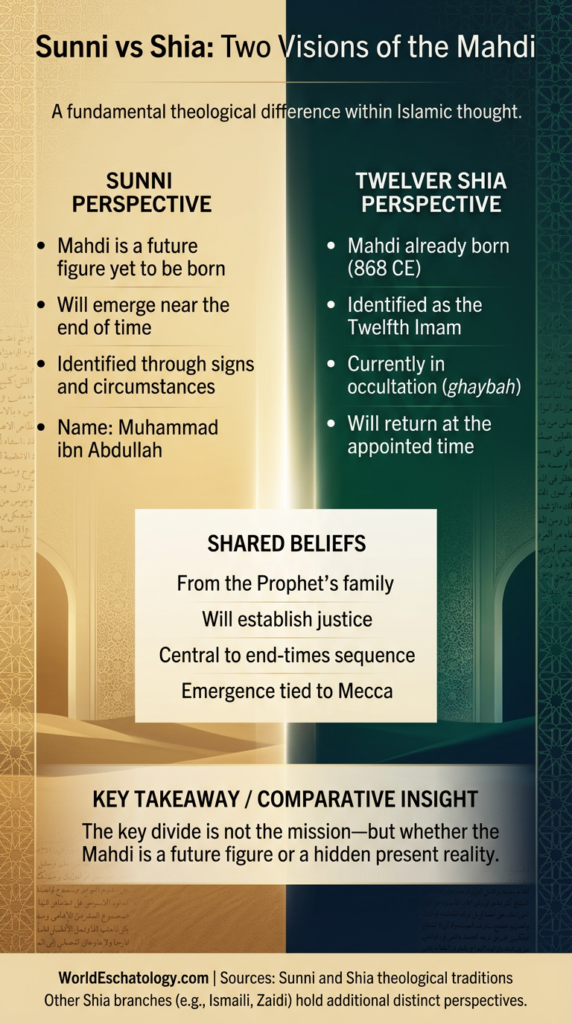
Sunni Vs Shia Mahdi Key Differences Explained Simply

The Fundamental Difference in Understanding

The single most important distinction in global Muslim understanding of the Mahdi is the difference between the Sunni and Shia positions, and it is a difference so fundamental that the two positions are not simply variations on the same belief but genuinely different doctrines.

For mainstream Sunni Islam, the Mahdi is a future figure who has not yet been born and who will emerge at some point before the end of time.

For Twelver Shia Islam, which is the largest branch of Shia Islam and represents the majority of Shia Muslims worldwide, the Mahdi has already been born, is currently alive, and is in a state of occultation waiting for the divine permission to return.

This difference is not a minor theological detail. It shapes everything about how the two communities relate to the Mahdi concept.

For Sunni Muslims, awaiting the Mahdi means preparing for a figure who does not yet exist.

For Twelver Shia Muslims, awaiting the Mahdi means maintaining faith in a specific living person, the Twelfth Imam Muhammad al-Mahdi, whose return will occur at the appointed time but whose existence and spiritual authority are present realities.

The Twelfth Imam in Shia Theology

The Twelver Shia doctrine of the Twelfth Imam is one of the most distinctive and theologically sophisticated doctrines in all of Islamic thought.

According to this doctrine, the legitimate leadership of the Muslim community after the Prophet Muhammad passed through a series of twelve Imams, each designated by his predecessor and each carrying a divinely endowed spiritual authority that made his guidance on religious matters infallible.

The Twelfth of these Imams was Muhammad ibn Hasan al-Askari, born in 868 CE according to the Shia tradition.

When the Eleventh Imam, Hasan al-Askari, died in 874 CE, his son Muhammad was approximately five or six years old.

According to Shia doctrine, the young imam went into a state called the Minor Occultation, during which he communicated with the community through four designated representatives called the Four Gates or Four Babs.

This period of Minor Occultation lasted from 874 CE to 941 CE. When the last of the Four Gates died, the Major Occultation began, in which the Twelfth Imam withdrew from all direct contact with the community.

According to Twelver Shia doctrine, he remains alive, hidden from ordinary perception, guiding the community through divinely appointed channels, and will return at the end of time as the Mahdi.

The Concept of Occultation in Shia Theology

The concept of ghaybah, or occultation, is central to Twelver Shia theology and requires serious engagement rather than dismissal.

The theological argument for the occultation is that the Imam’s physical presence was not safe given the hostile political environment of the Abbasid caliphate, which viewed Shia Imams as threats to its legitimacy and had a history of imprisoning or killing them.

The occultation was therefore a divinely protected withdrawal that preserved the Imam’s life until the appointed time of his return.

During the Major Occultation, the Shia community has been guided by the most qualified scholars of Islamic law, who act as deputies of the Hidden Imam in administering the community’s religious and, in the political theory developed by Ayatollah Khomeini and embodied in the Islamic Republic of Iran, its political affairs as well.

The doctrine of wilayat al-faqih, the guardianship of the Islamic jurist, is the most politically consequential development from the doctrine of the occultation, and it remains controversial even within Shia scholarship, with many senior Shia scholars arguing that political governance should not be claimed in the name of the Hidden Imam’s authority.

The Four Gates of the Minor Occultation

The four representatives who served as intermediaries between the Hidden Imam and the Shia community during the Minor Occultation (874 to 941 CE) are known as the Four Gates.

The first was Uthman ibn Said al-Askar, followed by his son Muhammad ibn Uthman al-Askar, then Husayn ibn Ruh al-Nawbakhti, and finally Ali ibn Muhammad al-Samarri.

These four men were recognized by the Shia community as authorized representatives who could transmit questions to the Imam and convey his responses.

Their deaths did not bring about the Imam’s return but rather, according to doctrine, the beginning of the Major Occultation in which direct representation ended.

The Major Occultation was announced through a final letter attributed to the Imam, transmitted before al-Samarri’s death in 941 CE, stating that no fifth Gate would follow.

From that point, no one has been authorized to claim direct communication from the Hidden Imam, and such claims have been rejected by mainstream Shia scholarship.

Other Shia Perspectives on the Mahdi

Within the broader Shia family of traditions, the Twelver position is the most widely held but not the only one.

Ismaili Islam identifies the living Imam with the Aga Khan and does not share the Twelver doctrine of an occulted Twelfth Imam awaiting return.

Zaidi Shia Islam, predominant in Yemen, holds yet another position on Imamic authority, not requiring the Imam to be sinless or infallible in the way Twelver doctrine does, and having a more activist understanding of Imamic leadership that does not include the doctrine of occultation in the same form.

These different Shia positions on the Imam and the Mahdi reflect the genuine theological diversity within the broader Shia tradition, a diversity that is often obscured when Shia Islam is discussed as a monolithic category.

Where Sunni and Shia Mahdi Traditions Overlap

Despite the fundamental difference over whether the Mahdi has already been born and is in occultation or will be born in the future, Sunni and Shia traditions share a significant amount of Mahdi-related material.

Both traditions agree that the Mahdi will be from the prophetic household, that his name will be Muhammad ibn Abdullah according to Sunni traditions (though Shia traditions already have a specific individual in mind with a different father’s name), that he will establish justice, that he will emerge in the Arabian Peninsula, that he will be associated with the Kaaba, and that his emergence will be one of the major signs of the approaching end of time.

The political history of Sunni-Shia relations has complicated honest engagement with these shared elements.

Both communities have sometimes emphasized the differences in a way that obscures the genuine common ground, driven by the political conflicts that have accompanied theological differences across centuries of Islamic history.

A genuinely scholarly engagement with the Mahdi traditions across both denominations reveals more common material than the polemical discourse in either direction would suggest.

HISTORICAL FIGURES IDENTIFIED AS THE MAHDI

The Pattern of Mahdi Claimants

Islamic history records a recurring pattern: in periods of intense crisis, oppression, or colonial pressure, figures have emerged claiming to be the Mahdi, attracting large followings, sometimes establishing states, and ultimately either dying before fulfilling the definitive eschatological criteria or being defeated by opposing forces.

Understanding this pattern is essential for understanding both the power of the Mahdi concept and the dangers of its misuse.

The conditions that have historically produced Mahdi claimants share certain common features.

They typically involve a Muslim community experiencing severe external threat, whether from foreign invaders, colonial powers, or internal tyranny.

They involve a breakdown of the established religious and political order that once provided stability.

And they involve a population that is well-acquainted with the Mahdi concept and is actively looking for its fulfillment.

When a figure appears who seems to display the right combination of personal qualities, prophetic lineage, and dramatic circumstances, the conditions for mass messianic belief are in place.

Muhammad Ahmad of Sudan: The Most Consequential Modern Mahdi Claimant

The most historically significant Mahdi claimant of the modern period was Muhammad Ahmad ibn Abd Allah of Sudan (1844 to 1885), who declared himself the Expected Mahdi in 1881 and led one of the most remarkable political and military movements in nineteenth-century Islamic history.

Muhammad Ahmad emerged during a period when Sudan was under Egyptian administration backed by British power, conditions that many Sudanese Muslims experienced as foreign domination that violated Islamic principles of governance.

Muhammad Ahmad was recognized as deeply pious and had studied with major Sudanese scholars.

His forces, the Ansar, won remarkable military victories against Egyptian and British forces, culminating in the capture of Khartoum in January 1885, during which British General Charles Gordon was killed.

Muhammad Ahmad died of illness in June 1885, without fulfilling the definitive eschatological criteria.

The Battle of Omdurman and the Mahdist State’s End

After Muhammad Ahmad’s death, his successor the Khalifa Abdallahi maintained the Mahdist state for over a decade before the British under Lord Kitchener defeated the Ansar at the Battle of Omdurman in 1898.

The battle was a decisive demonstration of the gap between nineteenth-century spear-and-sword warfare and the machine guns and artillery of the British imperial army.

Thousands of Mahdist fighters were killed, and the Khalifa was later captured and executed.

Muhammad Ahmad’s legacy in Sudan is enduring. He remains a symbol of anticolonial resistance, and his Ansar movement shaped Sudanese politics for generations.

For mainstream Islamic scholarship, his story is a lesson in how genuine personal piety and real political injustice can produce a Mahdi movement that nonetheless fails the full eschatological criteria.

Juhayman al-Otaybi and the Grand Mosque Seizure of 1979

The most dramatic Mahdi-related event of the twentieth century was the seizure of the Grand Mosque in Mecca on November 20, 1979, by a group of several hundred armed followers led by Juhayman al-Otaybi, a former Saudi National Guard sergeant and conservative religious activist.

Juhayman’s group declared his brother-in-law Muhammad ibn Abd Allah al-Qahtani to be the Mahdi, claiming that his name matching the prophetic description (Muhammad ibn Abdullah) and the timing at the start of the fifteenth Islamic century were confirmatory signs.

The seizure created a global crisis unlike anything in modern Islamic history.

Saudi authorities requested religious authorization to use force within the sacred precincts, and the two-week siege ended with outside military assistance.

Muhammad al-Qahtani was killed in the fighting and Juhayman along with sixty-two others were executed.

The Saudi government responded in part by giving greater authority to conservative religious institutions, with consequences for global Islam that are still debated today.

Other Historical Mahdi Claimants

The history of Mahdi claimants extends far beyond these two most famous examples.

Ibn Tumart, the founder of the Almohad dynasty in twelfth-century North Africa, claimed Mahdi status and used it to build a movement that overthrew the Almoravid dynasty and established an empire across North Africa and Spain.

Various figures in South Asia, sub-Saharan Africa, and Central Asia have claimed Mahdi status at moments of crisis, some attracting small followings and quickly fading, others building significant political and religious movements.

The lesson that runs through all of these cases is consistent. Each claimant appeared under conditions of genuine crisis and genuine injustice.

Each had qualities, personal piety, apparent prophetic lineage, specific timing, that seemed to match aspects of the Mahdi description.

None fulfilled the definitive criteria: none lived to establish the global justice the tradition describes, none was confirmed by the full set of eschatological signs including the heavenly call and the descending of Isa, and none’s leadership lasted in the way the tradition describes.

Mainstream Islamic scholarship has used these cases to make the argument that the genuine Mahdi will be unambiguous, confirmed by divine signs that go beyond what any historical claimant has produced.

THE MAHDI IN COMPARATIVE PERSPECTIVE

The Mahdi and the Jewish Messiah

The structural parallel between the Mahdi and the Jewish Messiah is one of the most frequently observed in comparative religion, and it goes deeper than surface similarity.

Both figures appear at a moment of maximum historical crisis. Both come to restore justice to a world overwhelmed by injustice and oppression.

Both come from a specific royal or prophetic lineage, David’s line for the Jewish Messiah and the Prophet’s household for the Mahdi. Both precede a period of world transformation that includes the defeat of a great enemy and the establishment of a new era of peace and divine recognition.

The genuine differences are equally significant.

The Jewish Messianic tradition does not include a figure equivalent to Isa descending from heaven, and the Jewish Messiah’s mission does not follow the Islamic eschatological sequence.

The Mahdi is the leader of the global Muslim community while the Jewish Messiah is the redeemer of the Jewish people with universal implications.

Both traditions express a conviction that divine justice will prevail in history, but through theological frameworks that are distinctly their own.

The Mahdi and Isa: Their Relationship in Islamic Eschatology

The relationship between the Mahdi and Isa in Islamic eschatology is unique in world religious thought.

Two of history’s most significant religious figures will be present simultaneously in the end times, with clearly defined and complementary roles.

The Mahdi provides the political and military leadership of the Muslim community. Isa provides the prophetic authority that defeats the Dajjal.

Neither figure operates without the other in the crucial moments of the eschatological sequence.

This is sometimes misread as Isa being superior to the Mahdi, but the tradition does not support that reading.

When Isa insists the Mahdi lead the prayer, he is affirming the Mahdi’s legitimate authority.

The two figures operate in mutual recognition and complementary roles, showing that the Islamic end-times framework envisions not a single messianic hero but a collaborative divine intervention.

The Mahdi in Sufi Thought

Sufi mysticism has developed its own understanding of the Mahdi that sometimes runs alongside and sometimes diverges from the mainstream eschatological portrait in the hadith literature.

In Sufi thought, the concept of the Qutb, the spiritual pole or axis around which the world turns, is related to the Mahdi idea.

The Qutb is the highest spiritual station among the hierarchy of saints who maintain the spiritual order of the world through their constant devotion.

Some Sufi traditions identify the Mahdi with the highest expression of this Qutb function.

Sufi thought emphasizes the Mahdi’s inner spiritual qualities and his proximity to the divine somewhat more than the political and military dimensions in the hadith tradition.

This is a different emphasis rather than a contradiction: the figure who governs justly and leads armies is also, in the Sufi reading, someone at the highest spiritual station accessible to a human being other than a prophet.

The Mahdi Concept in Ahmadiyya Islam

The Ahmadiyya Muslim Community, founded by Mirza Ghulam Ahmad (1835 to 1908) in British India, holds a position on the Mahdi that mainstream Sunni and Shia Islam both reject.

Mirza Ghulam Ahmad claimed to be simultaneously the promised Mahdi and the promised Messiah whose coming was foretold in Islamic tradition.

He argued that his mission fulfilled both the Mahdi prophecies and the expectation of Isa’s descent, the latter through a reinterpretation of what Isa’s return means.

Mainstream Islamic scholarship rejects these claims on the grounds that Mirza Ghulam Ahmad’s position involved a form of prophethood after Muhammad, which contradicts the Islamic doctrine of the finality of prophethood established in the Quran.

The Pakistani government declared Ahmadis non-Muslims in 1974, and they face legal restrictions in various Muslim-majority countries.

The Ahmadiyya community considers itself Muslim and disputes these characterizations, making this one of the most contested identity questions in the contemporary Muslim world.

MODERN SCHOLARLY AND SECTARIAN DEBATES

The Spectrum of Contemporary Sunni Scholarly Opinion

Contemporary Sunni scholarship on the Mahdi spans a wider range than many people realize.

At one end, scholars in the traditionalist mainstream affirm the Mahdi doctrine as firmly established by the collective weight of hadith evidence and by centuries of scholarly consensus.

At the other end, a small but not insignificant minority of contemporary scholars, influenced by hadith-critical methodologies that have become more widespread in the modern period, argue that many specific Mahdi traditions are too weak to support the weight of doctrine placed on them.

The mainstream position, represented by scholars at institutions like Al-Azhar in Egypt, the major Saudi religious universities, and in Deobandi and Barelvi scholarship in South Asia, treats the coming of the Mahdi as established fact.

Contemporary scholars in these traditions spend less time debating whether the Mahdi will come and more time discussing how to understand specific details of the traditions and how to avoid the misuse of Mahdi expectations for political purposes.

The Mahdi Concept in Modern Political Islam

The political use of Mahdi expectations has been one of the most consequential and most problematic aspects of the tradition in the modern period.

Various movements have framed their political agendas in terms of preparing for the Mahdi, establishing conditions for his emergence, or acting as forerunners of his leadership.

The Iranian Revolution of 1979 and the Islamic Republic’s doctrine of wilayat al-faqih is explicitly connected to the Shia doctrine of the Hidden Imam’s authority.

Various Sunni Islamist movements have used Mahdi expectations to claim divine mandate for their activities.

Traditional scholarship consistently warns against this politicization: the genuine Mahdi will be identified by specific signs no political movement has yet produced, and claiming to act in his name to justify violence is precisely the false messianism that the tradition condemns.

The Question of Sign-Watching and Its Dangers

One of the most practically relevant debates in contemporary Islamic eschatology is whether it is appropriate and spiritually healthy for Muslims to actively watch for and interpret current events as signs of the Mahdi’s imminent emergence.

The online Islamic eschatology community produces an enormous volume of content connecting everything from political developments to natural disasters to technological changes to hadith descriptions of end-times signs.

Traditional scholarship is divided. Some scholars see knowledge of the signs as protective preparation.

Others argue that sign-watching content generates anxiety, promotes conspiracy thinking, and distracts from genuine spiritual preparation.

The Prophet’s emphasis was on spiritual readiness rather than calculating timing, and most classical scholars discussed eschatological signs as motivation for inner preparation rather than political calculation.

WHAT THE MAHDI’S COMING WILL MEAN FOR THE WORLD

What Will Happen When Imam Mahdi Comes

The Transformation Under the Mahdi’s Justice

The most consistently and vividly described feature of the Mahdi’s era in the hadith tradition is its justice.

The earth, which will have been filled with oppression and tyranny before his coming, will be filled with justice and equity under his leadership.

This is not a metaphor for gradual improvement but a description of a real transformation of political and social conditions on a global scale.

The specific mechanisms of this transformation are not spelled out in detail, but the overall direction is clear: every form of systematic injustice that characterizes the pre-Mahdi world will be corrected under his leadership.

The hadiths describe people coming to the Mahdi from distant lands seeking his justice and his generosity.

His reputation will spread across the world, and those who have been oppressed everywhere will know that in his realm, justice is real and available to them.

This universal reach of his justice distinguishes him from even the most admirable historical rulers, who could achieve justice within their territories but could not transform the conditions of the whole world.

The Mahdi’s justice is eschatological in character: it represents the full expression of divine will in human political reality that history has never before achieved.

Uniting the Muslim World and Material Abundance

The hadith tradition describes the Mahdi’s era as including the end of the sectarian conflicts that have divided the Muslim community since the earliest generations.

The Mahdi will unite Muslims under a single legitimate leadership for the first time since the earliest period of Islamic history.

This unity is not achieved through forced uniformity but through the recognition by all sincere Muslims that the Mahdi is who the tradition says he will be, a recognition confirmed by divine signs that leave no room for reasonable doubt.

The material abundance of the Mahdi’s era is described in terms that go beyond ordinary economic improvement.

The earth will yield its produce generously, rain will fall at the right times and in the right amounts, and the hidden treasures of the earth will be revealed and made available for distribution.

The Prophet is reported to have said that in the Mahdi’s time, a man will ask for wealth and will be given more than he can carry.

This abundance is inseparable from the justice of the era: it is the material expression of a world that is finally aligned with divine intention, no longer distorted by the greed and corruption that turned natural abundance into scarcity for the many and excess for the few.

The Brief Duration of the Golden Age

Despite the extraordinary nature of the Mahdi’s era, it is described as relatively brief in duration.

The various hadith figures, seven, eight, or nine years, and in some narrations forty years, are all short in cosmic terms.

The Mahdi’s era is not a permanent solution to human history but a culminating moment, a final expression of divine justice in earthly form before the full eschatological sequence plays out through the major signs and eventually the Day of Resurrection itself.

This brevity is theologically meaningful. The Islamic tradition does not promise a permanent utopia within human history.

It promises a temporary but real fulfillment of the divine intention for human community, followed by the transition out of the current human condition entirely into the reality of the Day of Judgment and what follows it.

The Mahdi’s era is the culmination of human history on earth, its highest point, the moment when the divine purpose for human civilization achieves its most complete earthly expression before history as we know it ends.

FREQUENTLY ASKED QUESTIONS

Who is Imam Mahdi in Islam?

The Imam Mahdi is a divinely guided leader whose coming is described in the hadith literature of Islam as one of the major signs of the approaching Day of Judgment.

His name means the guided one, and he is expected to emerge at a time of maximum global crisis and injustice, establishing justice and equity across the earth after it has been filled with oppression.

In Sunni Islam he is a future figure yet to be born. In Twelver Shia Islam he is identified with the Twelfth Imam Muhammad ibn Hasan al-Askari, believed to have been born in 868 CE and to be currently in a state of occultation awaiting his return.

Is the Mahdi mentioned in the Quran?

No, the Mahdi is not mentioned by name in the Quran. His entire portrait in mainstream Islamic tradition is drawn from the hadith literature, the recorded sayings and actions of the Prophet Muhammad.

Some scholars have identified Quranic verses about the establishment of justice on earth or the victory of divine guidance as thematic references to the Mahdi era, but these are interpretive connections rather than explicit Quranic descriptions.

In Islamic theology the hadith tradition is an independent source of religious authority, and absence from the Quran does not in itself weaken a doctrine that is firmly established in the authenticated hadith collections.

What are the signs of the Mahdi’s coming?

The major signs associated with the period immediately before and surrounding the Mahdi’s emergence include widespread fitnah (civil strife and social breakdown) across the Muslim world, the swallowing of an army by the earth between Mecca and Medina (narrated in Sahih Muslim), a heavenly call or voice that announces his identity to all people simultaneously, and the pledge of allegiance given to him at the Kaaba by a small group of believers between the Rukn and the Maqam Ibrahim.

The controversial black banners from Khorasan tradition is also frequently cited, though the hadith evidence for this specific sign is weaker than for the others and it has been heavily misused by political movements claiming divine mandate.

What is the Mahdi’s name?

According to a well-known hadith, the Mahdi’s name will match the Prophet Muhammad’s own name, Muhammad, and his father’s name will match the Prophet’s father’s name, Abdullah. He will therefore be known as Muhammad ibn Abdullah.

This specific naming detail is one of the identifying characteristics given in the tradition.

It should be noted that Muhammad and Abdullah are both extremely common names in the Muslim world, so the name alone is insufficient to identify the Mahdi.

The full constellation of signs and circumstances is needed for genuine identification.

What does the Mahdi look like?

The hadith literature describes the Mahdi as having a broad forehead, an aquiline or slightly hooked nose, and a gap between his front teeth.

His complexion is described as fair or reddish in some narrations. He is described as being of moderate or good height with a dignified bearing.

These physical characteristics are meant to serve as identifying details alongside the other signs of his emergence, not as sufficient identifiers on their own.

No currently living person can be identified as the Mahdi on the basis of physical description alone.

Has the Mahdi been born yet?

The answer depends entirely on which Muslim tradition you follow. In mainstream Sunni Islam, the Mahdi has not yet been born.

He is a future figure who will be born at the appropriate time near the end of history.

In Twelver Shia Islam, the Mahdi was born in 868 CE as the son of the Eleventh Imam Hasan al-Askari, and is currently alive and in a state of occultation called the Major Occultation, which began in 941 CE.

These are not merely different opinions on the same question but represent genuinely different theological frameworks with different implications for how believers relate to the Mahdi doctrine in their religious lives.

Where will the Mahdi come from?

The hadiths indicate that the Mahdi will emerge from the Arabian Peninsula, with Medina specifically connected to his origins in several narrations.

His public emergence will be at the Kaaba in Mecca, where he will receive the initial pledge of allegiance from a group of believers.

His emergence will be from a context of anonymity: he will not be a famous political or religious leader before the moment of his emergence, but rather someone whose qualities will have been recognized by a small group who then press the role upon him at the sacred precincts of the Kaaba.

What is the difference between the Sunni and Shia Mahdi?

The core difference is whether the Mahdi has already been born. Sunni Islam holds that he is a future figure yet to be born.

Twelver Shia Islam holds that he was born in 868 CE as the Twelfth Imam and is currently in occultation.

Sunni traditions identify him as Muhammad ibn Abdullah; Shia traditions identify him as Muhammad ibn Hasan.

Despite these differences, both share the expectation that he will restore justice, emerge in the Arabian Peninsula, and be central to the final eschatological sequence before the Day of Judgment.

Who is the Twelfth Imam in Shia Islam?

The Twelfth Imam in Twelver Shia Islam is Muhammad ibn Hasan al-Askari, the son of the Eleventh Imam Hasan al-Askari.

According to Shia doctrine, he was born in Samarra in 868 CE and went into the Minor Occultation at the age of approximately five or six when his father died in 874 CE.

He communicated with the community through four designated representatives during the Minor Occultation.

Since 941 CE, when the last of these representatives died, he has been in the Major Occultation, hidden from ordinary human perception but alive and spiritually present.

He is expected to return at the end of time as the Mahdi to fulfill the eschatological mission described in the traditions.

What is the occultation of the Imam?

Ghaybah, or occultation, refers to the Hidden Imam being withdrawn from ordinary human contact while remaining alive.

The theological justification combines the practical need for the Imam’s protection from a hostile Abbasid caliphate with a divine wisdom in withholding his full presence until the appointed time.

Since the Major Occultation began in 941 CE, the Shia community has been guided by qualified religious scholars acting as the Imam’s deputies, though the extent of that authority, especially in political governance, remains debated within Shia scholarship.

Will the Mahdi and Jesus appear at the same time?

Yes, according to the Islamic hadith tradition. The Mahdi will be leading the Muslim community when Isa ibn Maryam descends from the heavens.

Their simultaneous presence is one of the defining features of the Islamic eschatological sequence.

The famous scene of the Mahdi stepping back to offer Isa the prayer leadership, and Isa declining and insisting the Mahdi lead, establishes that both figures will be present and active at the same time.

Together they will confront the Dajjal, with Isa killing the Dajjal at the gate of Lud.

After the Dajjal’s defeat, Isa will continue to live under the Mahdi’s leadership for a period before the subsequent major signs unfold.

How long will the Mahdi rule?

The hadith sources give varying answers: seven years in some narrations, eight in others, nine in others, and forty years in some.

Classical scholars have offered several ways of reconciling these differences.

One approach is that the different numbers represent different phases of his leadership, with some counting only the initial period and others counting the full duration.

Another is that the shorter figures reflect the most reliable narrations and the longer figures come from weaker chains.

The most commonly cited figures in mainstream discussions are seven or eight years, though the honest answer is that the tradition does not give a single unambiguous answer on this specific detail.

What is the relationship between the Mahdi and the Dajjal?

The Mahdi and the Dajjal represent the two opposing poles of the Islamic end-times sequence.

The Mahdi is the divinely guided leader of the believing community; the Dajjal is the supreme deceiver who will try to destroy that community.

Their campaigns will overlap: as the Mahdi consolidates leadership, the Dajjal will be released and begin his own campaign.

The Mahdi will lead the believers’ resistance to the Dajjal’s deception, and the Dajjal’s forces will besiege the believers at various points.

The final confrontation will come when Isa descends and kills the Dajjal, with the Mahdi’s community providing the context of faithful leadership that makes Isa’s intervention possible.

What are the black banners of Khorasan?

The black banners of Khorasan refer to hadith traditions about armies with black banners from the eastern region of Khorasan connected to the Mahdi’s emergence.

Several of the most cited versions are considered weak by hadith critics.

From the Abbasid revolution of the eighth century to modern militant organizations, groups have invoked these traditions to claim divine mandate.

Mainstream scholarship consistently warns against these identifications. The genuine Mahdi will be known by the full set of eschatological signs, not by a flag color.

Is belief in the Mahdi obligatory in Sunni Islam?

This is a question where mainstream Sunni scholarship has not reached a single unanimous position.

The majority view in classical and contemporary Sunni scholarship is that the coming of the Mahdi is established by a sufficient weight of hadith evidence to constitute a matter of Sunni consensus, and that denying it without good scholarly grounds is a serious error.

However, the specific question of whether it is an obligatory article of faith in the same category as the six pillars of iman is not uniformly answered.

Most scholars treat it as strongly established and practically obligatory to believe while acknowledging that the doctrinal status is not identical to the explicitly Quranic articles of faith.

What did Ibn Khaldun say about the Mahdi?

Ibn Khaldun, the fourteenth-century historian and social theorist, examined the Mahdi hadith traditions critically in his Muqaddimah and found most of them wanting.

He argued that specific Mahdi narrations were transmitted through chains including unreliable narrators and that the social function of Mahdi belief in mobilizing political movements should make Muslims cautious.

Mainstream hadith scholars responded by defending the collective weight of the traditions and the consensus of major scholars like Ibn Hajar al-Asqalani.

Ibn Khaldun’s dissent remains the most sophisticated classical challenge to the doctrine and is worth reading by anyone who wants to understand the debate honestly.

Who was Muhammad Ahmad, the Sudanese Mahdi?

Muhammad Ahmad ibn Abd Allah (1844 to 1885) was a Sudanese religious scholar and Sufi teacher who declared himself the Expected Mahdi in 1881 and led a successful revolution against Egyptian and British colonial rule in Sudan.

His forces captured Khartoum in January 1885, killing the British General Charles Gordon.

He died of illness just months after this victory, in June 1885, before fulfilling the definitive eschatological criteria. He is remembered in Sudan as a national hero and anticolonial leader.

For mainstream Islamic scholarship, his story illustrates both the genuine appeal of Mahdi movements in conditions of oppression and the consistent pattern of claimants who fail to fulfill the full prophetic description.

What happened at the Grand Mosque seizure in 1979?

On November 20, 1979, Juhayman al-Otaybi and several hundred followers seized the Grand Mosque in Mecca, declaring his brother-in-law Muhammad al-Qahtani the Mahdi.

The two-week siege was ended with outside military assistance. Al-Qahtani was killed in the fighting and Juhayman along with sixty-two others were subsequently executed.

The event had lasting effects on Saudi religious policy and shocked the entire Muslim world.

What does the Mahdi do after the Dajjal is killed?

After Isa kills the Dajjal, the Mahdi continues his leadership of the Muslim community through the subsequent period.

Isa will be present on earth and will participate in the life of the community, living under Islamic law and according to the Mahdi’s established governance.

The release and subsequent destruction of Gog and Magog will occur during this period, followed by Isa’s own death at some point after living for a specific number of years on earth.

After Isa’s death, the subsequent major signs of the Day of Judgment will continue to unfold, eventually leading to the rising of the sun from the west and the other cosmic signs preceding the Day of Resurrection.

Is the Ahmadiyya Mahdi accepted in mainstream Islam?

No. Mainstream Sunni and Shia Islam both reject Mirza Ghulam Ahmad’s claim to be the promised Mahdi and Messiah.

The primary objection from Sunni scholarship is that Mirza Ghulam Ahmad’s claims involved a form of prophethood after Muhammad, which contradicts the Islamic doctrine of the finality of prophethood (khatm al-nubuwwa) that is established in the Quran and hadith as a fundamental article of faith.

Ahmadis consider themselves Muslims and dispute this characterization, but they are legally classified as non-Muslims in Pakistan and face significant legal restrictions in several Muslim-majority countries.

The status of the Ahmadiyya community is one of the most contested religious identity questions in the contemporary Muslim world.

Can the Mahdi be identified before he fulfills the signs?

The Islamic tradition suggests that the definitive identification of the Mahdi will only be possible once the confirming signs have occurred.

The heavenly call that announces his identity to all people simultaneously is understood as the point of definitive public confirmation.

Before this, recognizing him will be possible for those who know the prophetic descriptions and witness the specific circumstances of his emergence, particularly the scene at the Kaaba and the swallowing of the army by the earth.

Claiming to identify the Mahdi before these signs have occurred is exactly the kind of premature identification that has historically produced false movements and serious harm to Muslim communities.

What is the bay’ah of the Mahdi at the Kaaba?

The bay’ah, or pledge of allegiance, that marks the Mahdi’s formal emergence as the leader of the Muslim community will take place at the Kaaba in Mecca.

The hadiths describe him standing between the Rukn (the corner housing the Black Stone) and the Maqam Ibrahim (the station of Abraham) when a group of approximately three hundred to three hundred and nineteen believers press their allegiance upon him.

He will accept this pledge reluctantly. This initial group, often compared to the three hundred and thirteen companions who fought at Badr, will be the nucleus of the community that rallies around him.

The bay’ah is the public inauguration of his leadership, the moment after which his mission formally begins.

What happens to the world after the Mahdi’s era ends?

After the Mahdi’s era, the major eschatological signs continue in sequence.

Following the defeat of Gog and Magog and the death of Isa, the earth will experience a period of unusual peace and abundance before the remaining major signs appear.

The sun rising from the west is one of the final major signs before the Day of Resurrection, and Islamic tradition holds that the door of repentance closes at this point, meaning that faith accepted after seeing this sign will not avail.

Eventually the Day of Resurrection comes, all of humanity from the beginning of time is raised and gathered, and the final judgment takes place.

The Mahdi’s era is therefore not the end but the culmination of earthly human history before the transition to the eternal realities of the afterlife.

CONCLUSION

What the Mahdi Concept Reveals About Islamic Eschatology

The Mahdi concept reveals something essential about how Islam understands the relationship between divine justice and human history.

Unlike religious frameworks that locate ultimate justice entirely in an otherworldly afterlife, Islamic eschatology insists that divine justice will be established within human history, on this earth, in real political and social conditions, before the final transition to eternity.

The Mahdi is the instrument of this this-worldly divine justice, the proof that God does not simply observe human suffering and promise recompense in the next world, but actually intervenes in history to right its wrongs before the end.

This theological commitment has made the Mahdi concept both a source of genuine hope for oppressed communities across centuries of Islamic history and a concept vulnerable to misuse by those who claim divine mandate for their own political projects.

The challenge for Muslim communities has always been to hold the genuine hope alive while maintaining the discernment that protects against false claims.

The detailed prophetic descriptions of the Mahdi exist precisely for this purpose: not to provide material for speculation but to make the genuine figure unmistakable when he finally appears.

The Spiritual Meaning of Waiting for the Mahdi

The tradition’s guidance on how to live while waiting for the Mahdi is more important and more practical than the eschatological details themselves.

The Prophet’s instructions for believers in the end times consistently emphasize the same themes: maintain your prayers, uphold your character, hold fast to the Quran and the Sunnah, seek knowledge, maintain justice in your own dealings, and avoid the corruption that characterizes the pre-Mahdi era.

The waiting is not passive resignation but active preparation through the cultivation of precisely the qualities that the Mahdi’s era will express on a global scale.

The tradition also warns explicitly against the kind of impatient action that tries to force eschatological fulfillment through human means.

Claiming the Mahdi role, following a false claimant, or using Mahdi expectations to justify violence or the seizure of power are all presented in the tradition as signs of spiritual immaturity at best and dangerous deviation at worst.

The genuine believer who understands the Mahdi tradition correctly should be, above all, someone of profound personal righteousness, someone who embodies the justice they are waiting for the Mahdi to establish on a global scale.

The Enduring Power of the Mahdi Hope

The reason that a concept rooted in medieval hadith literature continues to speak with urgency to Muslims living through the crises and injustices of the twenty-first century is not hard to understand.

The world that the hadiths describe as the context for the Mahdi’s emergence, a world of widespread oppression, corrupt leadership, social breakdown, and the dominance of material over spiritual values, is recognizable to anyone paying attention to global conditions.

The promise that this will not be the permanent condition of human civilization, that divine justice will prevail and that a specific person chosen and guided by Allah will be the instrument of that prevailing, speaks to something fundamental in the human heart.

What the tradition ultimately offers is not a prediction to be tracked but a hope to be lived.

The Mahdi is coming, the tradition says, and when he comes the world will be transformed.

In the meantime, the believer’s task is to be the kind of person who is ready to recognize him, ready to support him, and ready to have contributed, through a life of justice and sincere worship, to the world that his coming will complete.

WorldEschatology.com

Sources: Sunan Abu Dawud; Sunan Ibn Majah; Jami at-Tirmidhi; Musnad Ahmad ibn Hanbal; Sahih Muslim; Ibn Kathir, Al-Bidaya wa al-Nihaya; Al-Suyuti, Al-Hawi lil-Fatawa; Ibn Hajar al-Asqalani, Fath al-Bari; Ibn Khaldun, Muqaddimah; Al-Qurtubi, Al-Tadhkira; Sheikh Imran Hosein, The Awaited Imam al-Mahdi; David Cook, Contemporary Muslim Apocalyptic Literature

Leave a Comment