
Karma and reincarnation are probably the two most widely recognized concepts that Hinduism has given to the world.
They appear in everyday conversation, in self-help books, in pop music lyrics, and in news commentary.
And yet for all their popularity, they are also two of the most consistently misunderstood ideas in global religious thought.
Most people who use the word “karma” have never engaged with what Hinduism actually teaches about it.
Most people who think they understand reincarnation in Hinduism are actually working with a simplified version that loses what the tradition considers most important.
This article covers what karma, reincarnation, and Hinduism actually teach, how samsara and moksha work as an interlocking system,
how different Hindu schools understand liberation, and how the Bhagavad Gita frames samsara, moksha, and karma for every kind of practitioner.
None of these pieces makes full sense without the others.
KARMA IN HINDUISM
What the Word Karma Actually Means
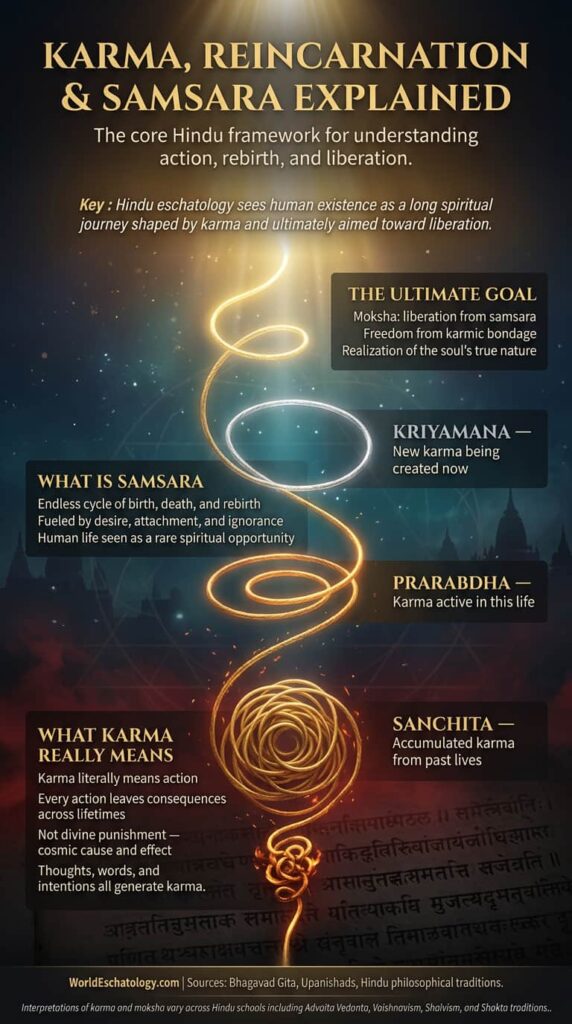
The Sanskrit word karma comes from the root kri, which means to do or to act. Karma literally means action. Not fate.
Not cosmic punishment. Not the universe getting back at you for being unkind. In its most basic meaning, karma simply refers to any action: physical, verbal, or mental.
The full doctrine of karma in Hinduism is a teaching about the consequences of action, about the fact that every action leaves a trace, and about how those traces shape the conditions of our lives now and in future lives.
This distinction matters enormously. In the popular Western understanding, karma has become almost synonymous with instant moral justice, the idea that if something bad happens to you it must be because you did something bad.
This is a serious distortion of the Hindu understanding. Karma is not a punishment system run by a divine judge.
It is a description of the natural moral structure of the cosmos, comparable in its operation to the physical law of cause and effect.
Just as a seed planted in good soil produces fruit naturally and without a supernatural authority decreeing it, an action performed with certain qualities produces natural consequences that follow the actor across time.
The Three Types of Karma
Classical Hindu philosophy distinguishes three types of karma that together account for the full scope of how past and present actions shape human experience.
Sanchita karma is the total accumulated karma from all of a soul’s previous lives.
Imagine it as a vast storehouse containing the residue of every action, thought, and intention the soul has ever generated across all its incarnations.
Most of this accumulated karma is not currently being experienced. It is waiting in the storehouse, available to be drawn upon in future lives as conditions allow.
Prarabdha karma is the portion of the sanchita karma that has been selected, so to speak, for the current lifetime.
It is the karma that is already in motion and being worked out through the experiences of this life.
The circumstances you were born into, including your family, your physical constitution, the general conditions of your early life, are understood in Hinduism as the expression of prarabdha karma.
This is not unchangeable fate, but it is the starting landscape within which your present choices are made.
Kriyamana karma is the new karma you are creating right now through your present actions, words, and thoughts.
This is the karma of free choice, the karma that will add to the sanchita storehouse and potentially shape future lives or future conditions in this life.
The existence of kriyamana karma is why the doctrine of karma in Hinduism is fundamentally a teaching about freedom and responsibility rather than about fate.
You are not simply living out a predetermined script. You are actively participating in the shaping of your own future.
How Karma Works: The Moral Structure of the Cosmos
Every action leaves what the tradition calls a samskara, an impression or groove in the fabric of the soul.
Positive, selfless, and spiritually oriented actions create positive samskaras that tend toward clarity, freedom, and movement toward liberation.
Negative, selfish, or harmful actions create negative samskaras that tend toward further entanglement in the cycle of samsara.
These samskaras are not punishments. They are the natural residue of action, the way that what we repeatedly do shapes what we become.
The role of intention is critical in karma reincarnation Hinduism.
The Bhagavad Gita, the most widely read of all Hindu sacred texts, teaches that action performed with genuine selflessness and without attachment to personal outcomes, what Krishna calls nishkama karma or action without desire, does not generate binding karma.
When you act without the ego’s investment in how things turn out, the action completes itself and releases.
It is attachment to results, the deep identification with outcomes, that creates the karmic binding that ties the soul to further reincarnation.
What Karma Is Not
Karma in Hinduism is not fatalism. The doctrine does not teach that everything that happens to you was predetermined and nothing can be changed.
The existence of kriyamana karma, the karma of present free choice, explicitly contradicts fatalism.
What karma teaches is that you are living within conditions shaped by your past, while retaining real freedom in how you respond to those conditions.
Karma is also not a guarantee that suffering is always deserved or that prosperity always indicates virtue.
The texts acknowledge that the relationship between karma and specific life circumstances is enormously complex.
The visible life is only one strand of a vast karmic web that stretches across many lifetimes.
What appears as undeserved suffering in one lifetime may be the resolution of something created many lifetimes ago.
This complexity is precisely why the tradition discourages using karma as a tool for judging others.
SAMSARA
The Cycle of Birth, Death, and Rebirth
Samsara is the Sanskrit term for the continuous cycle of birth, death, and rebirth that all souls undergo until they achieve moksha.
The word means flowing together or wandering, evoking a river carrying the soul from one life to another with no rest until liberation is achieved.
Samsara is the condition of being bound by karma and reincarnation that Hindu eschatology describes in detail.
Understanding samsara is inseparable from understanding karma reincarnation Hinduism as a whole.
The tradition describes samsara as characterized by dukkha, a word often translated as suffering but more precisely meaning impermanence and unsatisfactoriness.
This does not mean that life contains no joy or meaning. It means that even the greatest pleasures and the deepest relationships within samsara are impermanent and cannot provide the lasting fulfillment the soul ultimately seeks.
The joy of samsara is real but transient. The suffering of samsara is also real and often profound. Together they create the condition that makes the soul eventually long for liberation.
What Reincarnates: The Subtle Body
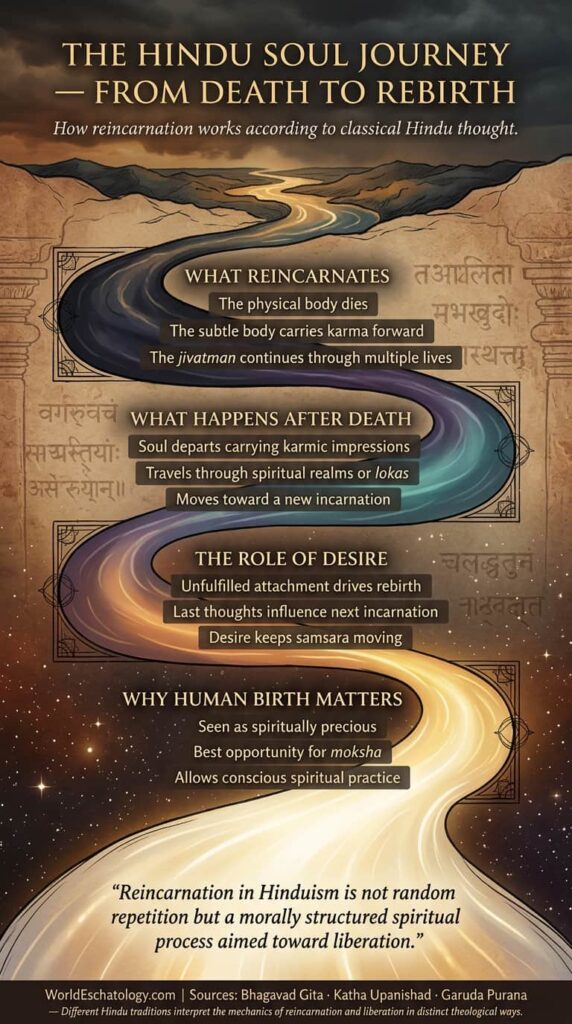
A crucial and often misunderstood question in Hindu reincarnation is what exactly transmigrates between lives. It is not the physical body, which decays and returns to the elements.
It is also not simply the personality, which changes significantly across lifetimes. What transmigrates is the jivatman, the individual soul, together with what the tradition calls the sukshma sharira, the subtle body.
The subtle body is the non-physical vehicle of consciousness that carries the karmic record, the samskaras, the desires, and the tendencies accumulated across lifetimes.
It is the subtle body that enters a new physical body at birth and departs at death.
This is why Hindu philosophy distinguishes three bodies in its analysis of the human being: the gross body (sthula sharira) is the physical body that dies and decays; the subtle body (sukshma sharira) carries consciousness and karma between lives; and the causal body (karana sharira) is the deepest layer, the seed of individual existence that connects the jivatman to its source in the infinite Brahman.
Desire and Reincarnation
The Upanishads are clear about what perpetuates samsara: desire and attachment.
The soul is pulled toward a new reincarnation by unfulfilled desires and attachments not completed in the previous life.
The last thought at the moment of death concentrates the dominant tendencies of the life just lived and shapes the direction of the next incarnation. Loosening desire is therefore central to samsara moksha work.
This is why the tradition places such emphasis on spiritual practice that loosens desire.
The goal is freedom from compulsive craving that pulls the soul back through samsara into another reincarnation to seek what it missed.
Moksha is the state in which this pulling force is finally gone.
The Range of Possible Incarnations and the Value of Human Birth
Hindu texts describe the soul as capable of incarnating across an enormous range of forms, including animal, human, and divine or demigod forms, depending on the quality of its karma.
The human birth is specifically highlighted across the Bhagavad Gita, the Puranas, and the Upanishads as an extraordinarily precious opportunity.
Only in the human form does the soul have the combination of sufficient intelligence, sufficient freedom of will, and sufficient capacity for spiritual practice to make real progress toward moksha.
The tradition treats the birth as a human being as a rare gift that carries profound responsibility.
THE INTERMEDIATE STATE BETWEEN LIVES
What Happens After Death in Hindusim
Hindu texts including the Katha Upanishad and the Garuda Purana describe what happens after death.
The prana, the life force, withdraws from the body and the subtle body begins its journey carrying the karmic record.
Traditional Hindu practice surrounds death with specific rituals to ease this transition through the realms appropriate to the soul’s karmic state before the next reincarnation.
The Two Paths: Devayana and Pitriyana
The Upanishads describe two paths after death. The Devayana, path of the gods, is taken by souls with genuine spiritual knowledge moving toward moksha.
These souls do not return to samsara. They travel toward the ultimate reality without coming back to the cycle of karma and reincarnation in Hinduism.
The Pitriyana, path of the ancestors, is taken by souls with good karma who have not yet achieved liberating knowledge.
These souls reach Svarga, the heavenly realm, where they enjoy the fruits of good karma. But Svarga is temporary.
When the merit is exhausted the soul returns to earth in a new reincarnation, samsara continuing its cycle.
The Lokas: Realms Between Lives
Hindu cosmology describes multiple lokas or realms souls may inhabit between reincarnations. Svarga is the realm of reward for souls with good karma.
Naraka is the realm of purification for negative karma, a temporary condition rather than eternal damnation where difficult karma is worked through before samsara continues in a new birth.
After the relevant karma is experienced, the soul moves toward reincarnation carrying its karmic record into the next life.
MOKSHA
What Moksha Means
Moksha is the ultimate goal of human existence in Hindu thought. The word comes from the Sanskrit root moksh meaning to release or free.
Moksha means liberation from samsara, freedom from the binding force of karma, and realization of the soul’s true nature.
Moksha samsara explained properly means understanding that moksha is not arriving somewhere new but recognizing what was always already true.
The bondage of samsara was the product of avidya, ignorance, and moksha is the removal of that ignorance. When moksha is achieved, samsara and reincarnation end permanently.
The Four Paths to Moksha
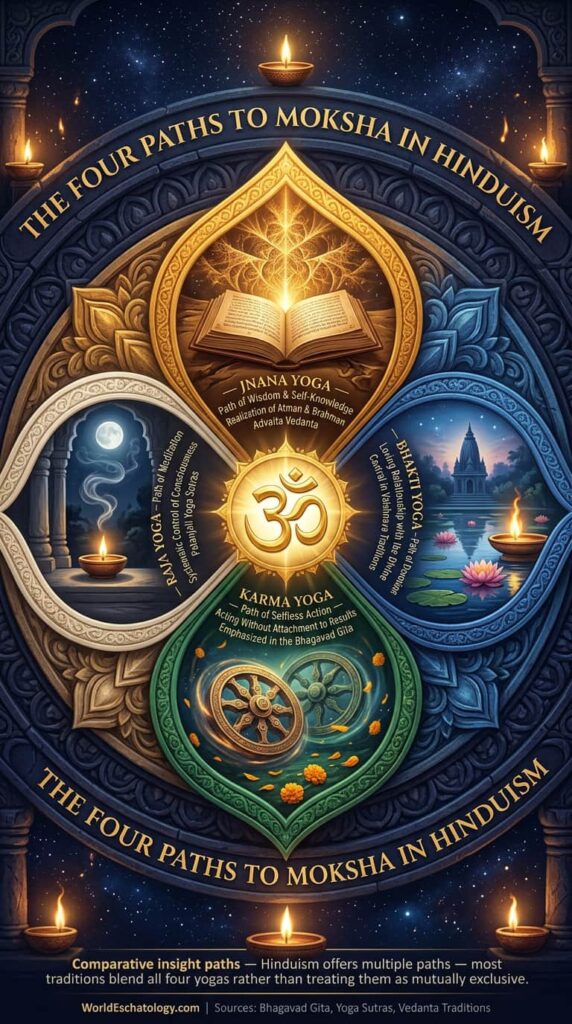
Hindu philosophy describes four major paths through which a person can move toward moksha, understanding that different temperaments require different approaches.
Jnana Yoga is the path of knowledge and discriminative wisdom. It involves direct investigation of reality through study, reflection, and meditation, distinguishing what is real from what merely appears real.
This path, most closely associated with Advaita Vedanta, leads to moksha through the direct recognition that the self is identical with infinite Brahman, completely dissolving the ignorance that keeps the soul in samsara.
Bhakti Yoga is the path of loving devotion to a personal deity. The practitioner pours all of their love, attention, and energy into their relationship with God, whether understood as Vishnu, Krishna, Shiva, or the Goddess.
This is the path most emphasized in the Bhakti movements and in traditions like the Hare Krishna movement.
Bhakti Yoga teaches that the grace of God is the primary liberating force and that surrender in love is the most direct route to moksha.
Karma Yoga is the path of selfless action, doing what needs to be done in the world without personal attachment to outcomes.
The Bhagavad Gita presents karma yoga as available to everyone regardless of their life situation.
It is the path of living fully in the world while not being bound by the world, acting for the good without ego investment in results.
Raja Yoga is the path of meditation and mental discipline, systematically training the mind to become still and focused until the true nature of consciousness is directly perceived.
It is most fully described in Patanjali’s Yoga Sutras and forms the basis of the classical ashtanga or eight-limbed yoga system.
Advaita vs Dualistic Schools on Moksha
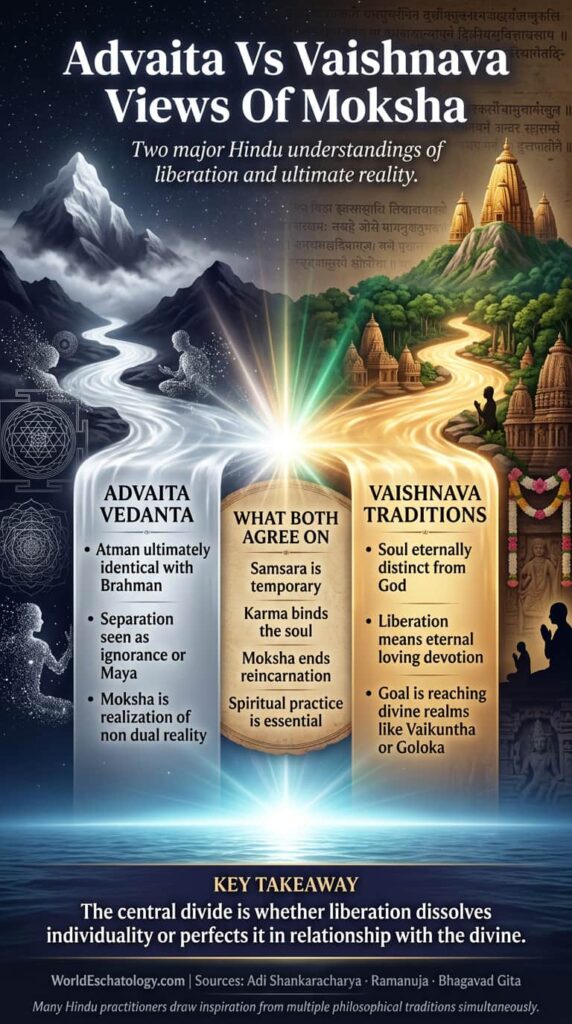
The most important theological division in Hindu understandings of moksha samsara explained is between Advaita Vedanta and the various dualistic or qualified non-dualist schools.
Adi Shankaracharya’s Advaita Vedanta teaches that the individual soul, the Atman, is ultimately identical with Brahman, the ultimate infinite reality.
The apparent separateness of individual souls and the world is Maya, not in the sense of being unreal but in the sense of being a misperception of the ultimate nature of things.
Moksha in Advaita is the direct recognition that Atman is Brahman, that the individual self was never separate from the infinite to begin with.
There is no individual soul that goes somewhere. There is only the recognition of what is.
Ramanuja’s Vishishtadvaita and Madhva’s Dvaita represent the dualistic response. Here the individual soul is real and eternally distinct from Brahman.
Moksha is not the dissolution of individuality but its liberation from samsara into eternal loving relationship with the divine.
For a Vaishnava, moksha means reaching Vaikuntha or Goloka as a fully realized soul in eternal devotion.
Samsara ends and moksha begins, but the soul’s individuality and its love for God continue forever.
What the Liberated State Feels Like
The liberated state in moksha is described as sat-chit-ananda: pure being, pure consciousness, and pure bliss.
The liberated soul is no longer bound by karma, no longer subject to samsara, no longer pulled toward reincarnation. It has recognized its own nature as infinite and is fully free.
KARMA, REINCARNATION, AND THE YUGA CYCLE
The soul’s journey through karma and reincarnation in Hinduism does not happen in a static universe.
It happens within the enormous cosmic timeframe of the Yuga cycle, the four recurring ages of Satya, Treta, Dvapara, and Kali Yuga that together form one Mahayuga.
We are currently in Kali Yuga, the age of greatest spiritual darkness and the most challenging conditions for human spiritual life.
The tradition holds that achieving moksha in Kali Yuga is simultaneously more difficult and, through the power of devotion and divine grace, more immediately available than in earlier ages.
The Bhagavata Purana specifically teaches that what required thousands of years of meditation in Satya Yuga can be achieved in Kali Yuga through sincere devotional practice.
The karmic challenge of the current age, combined with its specific spiritual opening, makes the right use of human birth in Kali Yuga a question of genuine urgency in the Hindu eschatological framework.
DIFFERENT HINDU SCHOOLS
Advaita Vedanta on Karma and Reincarnation
Advaita Vedanta holds that karma and reincarnation in Hinduism are real within the relative experience of Maya but ultimately transcended in the recognition of non-dual Brahman.
From the absolute perspective there is no individual soul that truly transmigrates. This does not make the samsara and moksha teachings false.
They are valid guidance for anyone who has not yet achieved the direct recognition of Brahman.
They describe how samsara works within the dream, even as the deeper teaching points toward waking from it.
The Vaishnava Understanding
Vaishnava traditions, including the ISKCON movement founded by Srila Prabhupada on the basis of the Gaudiya Vaishnava lineage, have their own distinctive understanding of karma reincarnation Hinduism.
The goal in Vaishnava thought is not impersonal liberation but the cultivation of loving devotion to Krishna or Vishnu that ultimately results in being drawn to the divine realm.
Karma yoga in this context means offering all action to Krishna and performing every duty as an act of devotion.
Reincarnation continues as long as the soul is not fully surrendered to Krishna’s will.
When the devotee achieves genuine surrender and pure love, the grace of Krishna liberates them from samsara and brings them to Goloka, the eternal transcendent realm.
Shaiva and Shakta Perspectives
Shaivism understands liberation as the direct recognition of identity with Shiva. Karma and reincarnation in Hinduism operate within the soul’s apparent contraction from this infinite consciousness.
Shakta traditions understand samsara as the Goddess experiencing the drama of creation and dissolution.
Moksha in Shakta thought is the recognition that the very energy driving karma and reincarnation is the Goddess herself.
THE BHAGAVAD GITA ON KARMA AND REINCARNATION
The Eternal Soul and the Changing Body
The Bhagavad Gita is the most important single text for understanding karma and reincarnation in Hinduism for the majority of Hindus across all traditions.
In the second chapter, Krishna makes one of the most powerful statements about reincarnation in all of Indian literature.
He tells Arjuna that the soul is never born and never dies. It is not cut by weapons, burned by fire, moistened by water, or dried by wind. It is ancient, unborn, eternal, everlasting.
As a person puts on new garments and puts off old ones, the soul takes on new bodies while putting off old ones.
This is the Hindu doctrine of reincarnation presented with maximum clarity and force.
This teaching serves a specific practical purpose in the Gita’s context. Arjuna is on a battlefield, overcome with grief at the prospect of fighting and killing his relatives and teachers.
Krishna uses the doctrine of the eternal soul to address his grief directly: if the soul cannot be killed, then the grief about physical death is based on a misunderstanding of what human beings fundamentally are.
This does not make death trivial but it radically reframes it. Death is the soul changing its clothes, not the end of the soul itself.
Karma Yoga in the Gita
The Bhagavad Gita’s most distinctive and practical contribution to the karma reincarnation Hinduism framework is its teaching on karma yoga.
Krishna does not tell Arjuna to renounce action and withdraw from the world. He tells him to act fully and wholeheartedly while releasing attachment to the fruits of action.
Do your duty. Offer the results to God. Do not make your sense of self dependent on whether things turn out as you hoped. This is nishkama karma in practice.
The Gita’s teaching on karma yoga addresses a fundamental tension in the samsara moksha explained framework.
If action generates karma and karma binds the soul to further reincarnation, does the path to liberation require giving up all action?
The Gita’s answer is no. It is not action itself that binds but the ego’s attachment to outcomes.
The person who acts from genuine love, genuine duty, genuine service, without demanding specific results in return, does not accumulate the binding karma that drives reincarnation.
They act, things happen or do not happen, and the soul remains free.
COMPARATIVE PERSPECTIVE
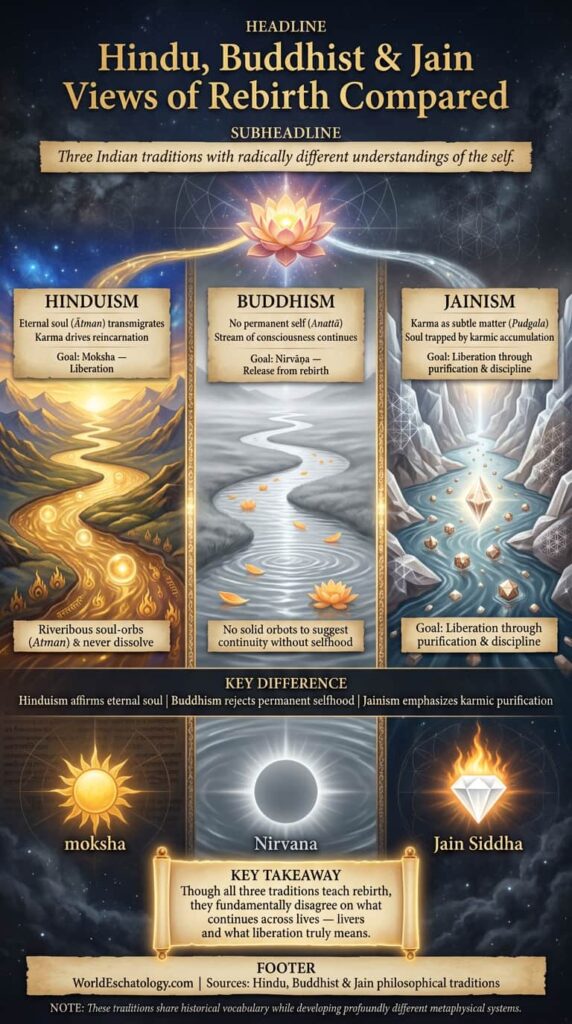
Hindu and Buddhist Reincarnation
Hindu karma reincarnation and the Buddhist understanding of karma and rebirth are often confused because they share much of the same vocabulary and general framework.
Both teach that actions have consequences that extend across multiple lives. Both teach that the goal is to escape the cycle of rebirth.
Both see attachment and desire as the fuel that keeps the cycle going. But the differences are theologically fundamental.
Hinduism teaches that there is an eternal individual soul, the Atman, that transmigrates between lives.
Buddhism teaches anatta, the doctrine of no-self, which holds that there is no permanent, unchanging self or soul.
In Buddhism, what continues between lives is not a soul but a stream of consciousness and karmic tendency without a fixed self at the center.
Buddhist rebirth is therefore mechanistically very different from Hindu reincarnation even when the surface language looks similar.
The Hindu soul carries its individual identity across lives and ultimately achieves liberation as either a recognized expression of Brahman (Advaita) or a fully realized individual in relationship with God (Vaishnava).
The Buddhist stream of karma achieves liberation in the recognition that there was never a fixed self to begin with.
Jain Karma Theory
Jainism treats karma not as a moral force but as actual subtle matter that adheres to the soul through action.
Samsara in Jainism continues until this karmic matter is shed through right knowledge, right faith, right conduct, and austerity.
The liberated Jain soul then ascends in pure omniscient consciousness, entirely free. This contrasts with Hinduism’s understanding of karma as a cosmic moral law rather than a physical substance.
KARMA AND REINCARNATION IN MODERN HINDUISM AND WESTERN THOUGHT
The Western world’s encounter with karma reincarnation Hinduism came primarily through three channels.
The Theosophical Society, founded by Helena Blavatsky in 1875, popularized a version of karma and reincarnation drawn from Hindu and Buddhist sources but heavily modified by Western occult thought.
Swami Vivekananda’s extraordinary address at the Parliament of World Religions in Chicago in 1893 introduced the classical Hindu understanding to a massive Western audience for the first time, framing it in terms that were accessible to modern Western philosophical sensibilities.
And the many teachers who followed in Vivekananda’s path, from Paramahansa Yogananda to Maharishi Mahesh Yogi to Srila Prabhupada, each brought specific versions of the karma and reincarnation framework to Western seekers.
The popular Western understanding of karma differs from classical Hindu teaching in important ways.
Instant karma is not the Hindu understanding. Karma reincarnation in Hinduism operates across multiple lifetimes through complex causal chains rarely visible in the short term.
Liberation from samsara and the reincarnation cycle, not optimizing the next incarnation, is the classical goal.
Contemporary Hindu teachers engaging with past-life memories, karma and modern psychology, and moksha in relation to modern consciousness studies are doing serious work at the edge of the tradition’s encounter with modernity.
FREQUENTLY ASKED QUESTIONS
What is karma in Hinduism?
Karma in Hinduism is the natural law of cause and effect applied to human action. Every action, thought, and intention leaves an impression on the soul that shapes future experience.
Karma is not divine punishment but a description of the cosmic moral structure.
The three types are sanchita (accumulated past karma), prarabdha (karma active in this life), and kriyamana (new karma being created now).
Karma fuels samsara and binds the soul to reincarnation until the liberating insight of moksha burns it away.
What is samsara?
Samsara is the cycle of birth, death, and rebirth that all souls undergo until they achieve moksha.
Samsara means flowing together or wandering. Hindu philosophy describes samsara as characterized by impermanence, because even the best conditions within samsara cannot provide the lasting fulfillment the soul seeks.
Karma is the fuel that keeps samsara going, desire and attachment generate new karma, and moksha is the only permanent exit from samsara’s cycle.
What is moksha and how do you achieve it?
Moksha is liberation from samsara and reincarnation, the ultimate goal of Hindu spiritual life.
Moksha is achieved through jnana yoga (knowledge), bhakti yoga (devotion), karma yoga (selfless action), or raja yoga (meditation).
In Advaita Vedanta, moksha is the recognition that Atman is Brahman. In Vaishnava traditions, moksha means reaching the divine realm in eternal loving relationship.
All traditions agree that moksha ends karmic binding and closes the samsara cycle permanently.
Do Hindus believe in reincarnation?
Yes, reincarnation is universally held across Hindu traditions. The doctrine that the soul takes on successive physical bodies, driven by karma through the samsara cycle, is foundational to Hindu eschatology.
It is affirmed in the Upanishads, the Bhagavad Gita, and across all schools from Advaita Vedanta to Vaishnavism.
All schools agree that reincarnation continues until moksha is achieved and samsara ends.
What determines what you reincarnate as?
The quality and character of accumulated karma, combined with the dominant desires and attachments at the moment of death, determines the conditions of the next incarnation.
Good karma, selfless actions, and spiritual practice move the soul toward more favorable conditions for continued spiritual development.
Negative karma and deep attachments can result in conditions of greater suffering or, in some texts, in incarnation in non-human forms.
The human birth is considered particularly precious because it is the form best suited for making genuine progress toward moksha.
What is the difference between karma and fate?
Karma is not fate. Fate implies a fixed predetermined outcome that cannot be changed by present choice.
Karma includes kriyamana karma, the karma of free present action, which explicitly means that your present choices genuinely shape your future.
You are living within conditions shaped by past karma, but you are not locked into a script.
The tradition teaches that spiritual practice, selfless service, and genuine devotion can transform karmic conditions and accelerate progress toward liberation in ways that pure fatalism cannot account for.
Can karma be erased or resolved?
Karma can be worked through and ultimately transcended rather than simply erased. Prarabdha karma must be lived through as it clears samsaric debt.
New karma is prevented through nishkama karma, action without attachment to results.
Accumulated sanchita karma is burned through spiritual practice, devotion, and divine grace.
The Bhagavad Gita teaches that genuine self-knowledge burns all karma as fire burns fuel, making moksha possible and ending the samsara cycle.
What happens between lives in Hindu belief?
After death the subtle body carries the karmic record between reincarnations. The soul travels to Svarga if karma is positive, or through Naraka for purification if negative.
Both stays are temporary. When the relevant karma is experienced the soul moves toward a new reincarnation in samsara matching its karmic state.
Advanced souls on the Devayana path achieve moksha and do not return to samsara.
What is the difference between Hindu and Buddhist reincarnation?
The key difference is whether there is a soul. Hinduism teaches that an eternal individual soul, the Atman, transmigrates between lives.
Buddhism teaches anatta, the doctrine of no permanent self. In Buddhism, what continues between lives is a stream of karma and consciousness without a fixed soul at its center.
Both traditions see desire as what fuels the cycle of rebirth and both seek liberation from that cycle.
But what achieves liberation and what liberation means differ significantly because of this foundational disagreement about the existence of a permanent individual self.
What does the Bhagavad Gita say about reincarnation?
The Bhagavad Gita presents the clearest statement of reincarnation in Hindu literature.
Krishna tells Arjuna the soul is eternal and simply moves from one body to another as a person changes clothes.
The Gita teaches that the last thought at death shapes the next reincarnation, and that genuine devotion leads to moksha rather than further samsara.
Karma yoga, selfless action without attachment, is the path that does not create new binding karma and therefore opens the way to moksha.
Conclusion
The karma and reincarnation framework in Hinduism is one of the most coherent accounts of moral responsibility and ultimate human destiny that any religious tradition has produced.
It is also deeply hopeful. Every soul caught in samsara will eventually achieve moksha. No soul is permanently lost.
The consequences of karma are real and serious, but samsara itself is temporary, correctable through wisdom, devotion, and divine grace.
What karma reincarnation Hinduism ultimately teaches is that you matter. Your choices matter.
Your actions have genuine consequences that extend far beyond what you can see in one lifetime.
The human birth you have right now is extraordinarily precious and should be used well.
And the goal toward which all of this is pointing, moksha, liberation from samsara, the recognition of the soul’s true nature as infinite consciousness and bliss, is not something reserved for a spiritual elite.
It is the birthright of every soul. The tradition’s whole purpose in teaching karma and reincarnation so carefully and so persistently is to help each person understand what they are doing with their life and where they are trying to go.
WorldEschatology.com
Sources: Bhagavad Gita; Chandogya Upanishad; Brihadaranyaka Upanishad; Katha Upanishad; Garuda Purana; Bhagavata Purana; Adi Shankaracharya, Vivekachudamani; Patanjali, Yoga Sutras; Ramanuja, Sri Bhashya; A.C. Bhaktivedanta Swami Prabhupada, Bhagavad Gita As It Is; Swami Vivekananda, Jnana Yoga