Most people in the modern world carry an assumption about time so deep they have never thought to question it.
Time moves forward. The past was primitive and the future will be better. Science advances. Technology improves. Civilisation progresses.
The arrow of history points upward, from the cave to the smartphone, from superstition to reason, from darkness toward an ever-brightening light.
This is the story the Western world tells about itself, and it is so thoroughly woven into modern education, politics, and culture that questioning it feels almost strange.
Hindu cosmology looks at this idea and gently, thoroughly disagrees.
According to the ancient Vedic tradition, time is not a line. It is a wheel. Humanity does not move from a primitive past toward an enlightened future.
It moves through four great ages, each one shorter and darker than the one before it, until the wheel completes its turn and the cycle begins again.
And here is the part that should make you pause: according to this framework, we are currently living in the darkest quarter of the wheel.
The iron age. The age of conflict, deception, and spiritual decline. The age the ancient texts called Kali Yuga.
What is extraordinary about this is not just the claim but the specifics.
Texts written thousands of years ago described the characteristics of this dark age in a level of detail that makes a modern reader genuinely uncomfortable.
Rulers who exploit rather than protect their people. Wealth mistaken for virtue. Family bonds dissolving. The earth producing less.
Seasons becoming unpredictable. Truth becoming something rare and slightly ridiculous in public life.
The descriptions do not read like vague prophecy. They read like a report from the present day.
This article goes through all of it. We begin with how Hindu cosmology understands time itself, move through each of the four ages in depth, cover the avatars of Lord Vishnu who descend into each age, look at the signs of Kali Yuga and how they compare with our world, address the fascinating debate about how long this age actually lasts, and end with the prophecy of the Kalki avatar and what comes after the darkness finally breaks.
This is a long read. The subject demands it.
Understanding Vedic Time — Why Hindu Cosmology Thinks Differently
Before the four yugas can make sense, you need to understand the framework they sit inside.
And that framework requires a complete shift in how you think about time itself.
The modern Western model of time, which most of us have absorbed without realising it, comes from two sources:
The Abrahamic religious tradition, which presents history as a single line moving from Creation toward Judgment Day, and the Enlightenment scientific tradition, which replaced the religious story with an evolutionary one but kept the basic direction: upward and forward, from simple to complex, from ignorant to knowing.
Vedic cosmology does not share this assumption. In the Vedic framework, time is cyclical at every scale.
Days cycle into nights into days. Seasons cycle through their sequence and return. Lives cycle through birth and death and rebirth.
And at the cosmic level, ages of the world cycle through their sequence and return.
There is no final destination at the end of the line because there is no line. There is only the wheel, turning endlessly.
The scale of this cycling is almost impossible for the human mind to properly hold.
At the largest level, there is the lifespan of Brahma, the creator god, which spans 311 trillion and 40 billion human years.
Brahma’s life is divided into days and nights. Each day of Brahma is called a Kalpa and lasts 4.32 billion years.
Each night of Brahma is the same length, during which creation rests in dissolution.
Within each day of Brahma there are fourteen Manvantaras, or reigns of Manu, the progenitor of humanity.
And within each Manvantara, there are seventy-one complete Mahayugas, or great yuga cycles.
The four yugas that this article explores are one Mahayuga. One complete turn of the wheel. One cycle of 4,320,000 years.
In the context of Brahma’s full day, this is a relatively short unit of cosmic time, roughly the way a single hour fits inside a full human day.
And yet within that single Mahayuga, the entire history of a human civilisation is born, rises, falls, and dissolves.
Within this vast structure, where do we currently sit? We are in the fourteenth Manvantara of the current day of Brahma, and within that, we are roughly 5,127 years into the fourth and final yuga of the current Mahayuga.
We are, in other words, at the beginning of the very last phase of the current cycle.
The wheel has nearly completed its darkest turn and has a long way still to go before the light returns.
What Does the Word Yuga Mean? Origins and Textual Sources
The word yuga comes from Sanskrit and carries the root meaning of joining or yoking together.
The same root gives us the English word yoke and is related to the Latin jugum.
In its cosmological usage, a yuga is an age or epoch of the world, a period in which a particular quality of existence predominates.
The concept of the four yugas is not found in the earliest Vedic literature, the four Vedas themselves.
It developed in the later literature: the Mahabharata, particularly its Vanaparva section; the Manusmriti; and most completely in the various Puranas, including the Vishnu Purana, the Bhagavata Purana, the Brahma Purana, and the Matsya Purana.
These texts describe the yugas in considerable detail, giving their durations, their characteristics, the quality of human life within them, and the spiritual practices most appropriate for each.
There is an interesting theory about the names of the four ages that connects them to an ancient Indian game of dice.
The four yugas are named Krita (another name for Satya), Treta, Dvapara, and Kali, which correspond to the four throws of a long dice marked 4, 3, 2, and 1.
The highest throw, four, is the golden age. The lowest throw, one, is the dark age. Time itself plays a game of chance across the ages, and the score descends.
The Bull of Dharma: The Most Vivid Symbol
The most powerful image the scriptures use to describe the declining quality of the ages is the bull of Dharma.
Dharma, the principle of righteous order and moral law, is depicted as a white bull.
In Satya Yuga, this bull stands firmly and proudly on all four legs. With each subsequent age, it loses one leg.
In Treta Yuga it stands on three legs, in Dvapara on two, and in Kali Yuga it barely maintains its balance on a single trembling leg.
The four legs of the bull represent the four foundations of Dharma: Tapas, which is austerity and self-discipline; Shauca, which is purity and cleanliness; Daya, which is compassion; and Satya, which is truth.
Kali Yuga stands on Satya alone. And even that single remaining leg, the texts tell us, comes under increasing attack as the age progresses.
The Architecture of the Yuga Cycle — Duration, Ratio, and the Sandhyas
Before we look at each age individually, it is worth setting out the mathematical structure of the cycle clearly, because numbers matter here and they are often presented confusingly.
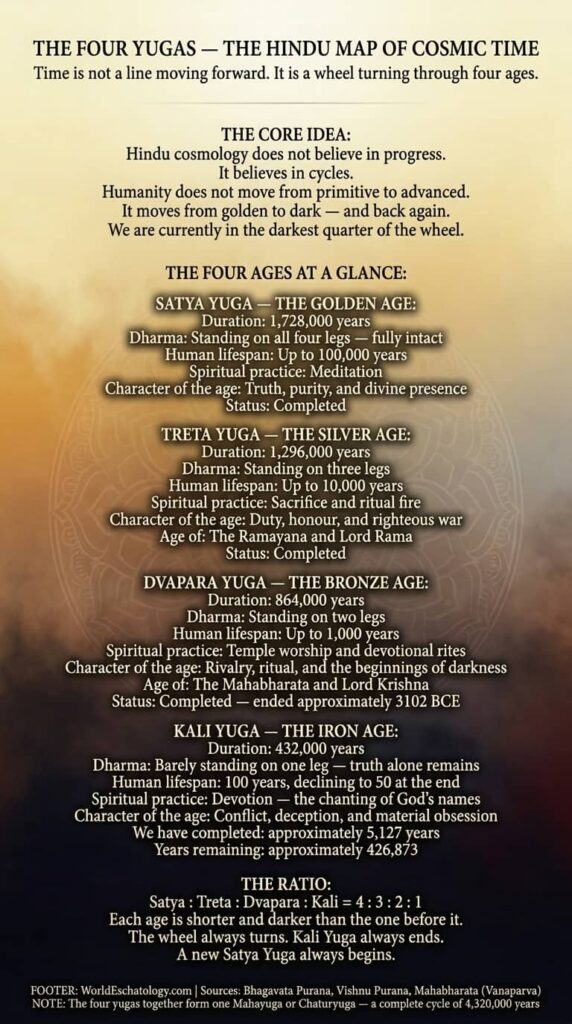
The four yugas follow a precise ratio of duration: 4:3:2:1. Satya Yuga is the longest, Kali Yuga the shortest, and the intervening ages decrease proportionally.
Here are the durations according to the Puranic reckoning:
Satya Yuga: 1,728,000 human years
Treta Yuga: 1,296,000 human years
Dvapara Yuga: 864,000 human years
Kali Yuga: 432,000 human years
Total Mahayuga: 4,320,000 human years
Between each pair of ages, the texts describe transitional periods called Sandhyas and Sandhyamshas, the dusk and dawn of each age.
These are periods of intermediate quality, neither fully of one age nor yet of the next.
The Sandhya of Satya Yuga spans 400 divine years, Treta Yuga 300, Dvapara 200, and Kali Yuga 100.
When you add both the opening and closing Sandhyas to each yuga, the total Mahayuga comes to 12,000 divine years, with each divine year equalling 360 human years.
This distinction between divine years and human years is the source of enormous confusion in the literature and in popular discussions.
When some texts say Kali Yuga lasts 1,200 years, they are using divine years.
When others say 432,000 years, they are using human years. Both are referring to the same duration. Keeping this conversion in mind clears up many apparent contradictions.
One additional note on how we know where we are: the traditional Puranic reckoning places the beginning of Kali Yuga at midnight between the 17th and 18th of February in 3102 BCE.
This date corresponds to the departure of Lord Krishna from the world, which the texts treat as the moment Dvapara Yuga ended and Kali began.
By this reckoning, Kali Yuga began approximately 5,127 years ago, and has 426,873 years yet to run.
Satya Yuga — The Golden Age of Truth
Satya Yuga is the first and longest of the four ages, and reading the ancient descriptions of it produces a particular kind of longing, the way you feel when you hear about a place you have never been but somehow recognise.
Everything about it sounds right in a way that makes the world we currently live in feel slightly off by comparison.
The name means the age of truth. The Mahabharata’s Vanaparva section provides one of the most complete descriptions.
In Satya Yuga, men neither bought nor sold. There were no poor and no rich.
There was no need to labour because all that human beings required was obtained by the power of will. There was no hatred, no vanity, no evil thought.
There was no disease. There was no lessening with the years. There was no sorrow and no fear.
The primary spiritual practice was meditation, and it worked, because the distance between human consciousness and divine consciousness was at its thinnest.
Human beings in Satya Yuga are described in the Puranas as being of enormous stature, with skin described as luminous or golden.
They lived for periods of up to 100,000 years. They did not need cooked food.
They were born already knowing the Vedas, the way we are born already knowing how to breathe.
The four legs of Dharma were fully intact: austerity, purity, compassion, and truth all governed human life without effort, because the pull toward righteousness was simply the path of least resistance.
There was only one caste in Satya Yuga, one Veda, and one form of spiritual understanding.
Social divisions had not yet emerged because the diversity of spiritual capacity that gives rise to them had not yet appeared. Everyone was, in some sense, equally close to the source.
How Satya Yuga Ends
The transition from Satya to Treta Yuga is not described as a sudden catastrophe but as a gradual dimming.
The Puranas describe how human beings, over vast stretches of time, begin to develop individual desires and ego.
The will that was used for creation begins to be used for personal acquisition. The first seeds of differentiation are planted.
The harmony of Satya Yuga does not break so much as it slowly loses its grip, the way winter comes not in a single moment but through ten thousand small degrees of cooling.
The avatars of Vishnu associated with Satya Yuga reflect the character of the age.
Matsya, the fish, rescues the Vedas and the progenitor Manu from the cosmic flood, preserving the sacred knowledge for the next cycle.
Kurma, the tortoise, provides the stable foundation that allows creation’s most turbulent work, the churning of the cosmic ocean, to take place.
Varaha, the boar, dives to the cosmic depths to rescue the earth from the demon who has hidden it there.
And Narasimha, the man-lion who is neither fully man nor fully beast, appears at twilight, the time that is neither day nor night, to defeat the demon Hiranyakashipu and protect his devoted child Prahlada.
Each of these avatars is a story about restoring what is at risk of being lost, a divine response to the first stirrings of the forces that will eventually drag the world into darkness.
Treta Yuga — The Silver Age of Sacrifice
The word Treta means three in Sanskrit. The age is named for three things: the three remaining legs of the bull of Dharma, the three sacred fires used in Vedic sacrifice, and the three gunas or qualities that now govern human life in a more complicated mixture than the predominant sattva of Satya Yuga.
Treta Yuga is still a noble age. Human beings are still largely righteous, still long-lived by our standards, still capable of extraordinary spiritual achievement.
But the effortlessness of Satya Yuga is gone. In Satya Yuga, everything came through the power of will and meditation. In Treta Yuga, things must be worked for.
The primary spiritual practice is sacrifice, which requires effort, materials, procedures, and the guidance of specialists.
The four castes have now emerged, a social structure reflecting the different degrees and kinds of spiritual capacity that human beings have developed.
This is the age of the Ramayana. And it is the Rama avatar, the seventh of Vishnu’s descents, that defines Treta Yuga in the Hindu imagination more completely than any other single thing.
Lord Rama: The Ideal of Treta Yuga
Rama is described in the Valmiki Ramayana as the embodiment of perfect virtue in human form.
He is the ideal son who honours his father’s word even when it costs him everything.
The ideal husband who loves Sita with a faithfulness that does not waver through the longest separation and the most devastating tests.
The ideal king whose reign, Ram Rajya, became the standard against which all governance is measured in the Hindu tradition.
And the ideal warrior who defeats the demon king Ravana, the embodiment of ego, power, and lust, not through supernatural shortcuts but through sustained effort, courage, and righteousness.
The Ramayana is not merely a story of divine intervention. It is a story of what a human being can be when Dharma is allowed to rule completely.
Rama’s exile to the forest for fourteen years at his father’s request, his patient search for Sita after her abduction, his building of the bridge to Lanka with an army of devoted allies, and his final victory over Ravana are all stories about Dharma in action in conditions of genuine difficulty and suffering.
This is appropriate for Treta Yuga: righteousness is still possible, but it must now be fought for.
The other avatars of Treta Yuga reinforce this theme. Vamana, the dwarf, reclaims the three worlds from the powerful but overreaching demon king Bali through an act of humble deception that is simultaneously profound cosmic justice.
And Parashuram, the Brahmin warrior who takes up an axe to cleanse the earth of tyrannical kings, is the avatar of righteous fury, the divine response to the abuse of power.
How Treta Yuga Ends
The transition from Treta to Dvapara is again gradual. The qualities of compassion and purity, two of Dharma’s legs, begin to weaken.
The Vedas, which in Satya Yuga existed as a single undivided unity and in Treta Yuga as three branches, must now be formally taught rather than simply known.
Human lifespan, which reached tens of thousands of years in Treta, begins to contract toward thousands.
The distance between human beings and the divine is widening, and the effort required to close it is increasing.
Dvapara Yuga — The Bronze Age of Ritual
Dvapara means two in Sanskrit, for the two remaining legs of Dharma: compassion and truth.
By this age, austerity and purity, the first two legs, have been substantially eroded.
Human beings are still capable of great nobility, but hatred, jealousy, warfare, and deception have now entered the world in earnest.
The texts say these evils originated in Dvapara Yuga, not before.
The Vedas, unable to be held in the memory of declining human minds, are divided into four by the great sage Vyasa, and this act of division is itself a symptom of the age’s character: what was once a unified whole must now be broken into manageable parts.
Other sacred texts, including Ayurveda, Jyotisha, and Arthashastra, are composed in this age because the natural knowledge of Satya Yuga has been lost and must now be recovered and systematised.
The primary spiritual practice of Dvapara Yuga is temple worship: elaborate, beautiful, deeply felt devotional ritual directed toward the divine through physical form.
The simplicity of meditation and the fire of sacrifice have given way to the complexity and artistry of puja, the decorating of sacred images, the offering of flowers and food and light.
Lord Krishna: The Complete Avatar
If Treta Yuga belongs to Rama, Dvapara Yuga belongs entirely to Krishna. And Krishna is something different in kind from the avatars that preceded him.
He is called the Purna Avatar, the full or complete avatar, the manifestation in which the divine does not hold anything back but descends into human form with its full capacity intact and expressed.
The scope of Krishna’s life as told in the Bhagavata Purana and the Mahabharata is extraordinary.
He is born in a prison cell to parents imprisoned by a tyrant. He is smuggled across a flooding river in the dead of night.
He grows up in a village of cowherds, plays the flute, dances with the young women of Vrindavan in a spiritual ecstasy that the tradition has meditated on for thousands of years, and defeats a series of demons sent to kill him with an effortlessness that communicates something important: for Krishna, evil is not a serious opponent. It is an irritation.
But the defining act of Krishna’s presence in the world is not the miracles of his childhood.
It is the Bhagavad Gita, spoken on the battlefield of Kurukshetra at the outset of the great war between the Pandava and Kaurava clans.
Arjuna, the greatest warrior of his age, sits in his chariot between the two armies and refuses to fight.
He sees his relatives, teachers, and friends on the opposing side and is overwhelmed by grief and confusion. He turns to his charioteer, who is Krishna, and asks: what should I do?
What follows is eighteen chapters of the most concentrated spiritual teaching in Hindu literature.
Krishna addresses not just Arjuna’s immediate dilemma but every fundamental question about the nature of reality, the self, duty, action, devotion, and liberation.
The Gita does not answer the question of what to do in this specific battle and leave it there. It answers the question of how to be in the world entirely.
Bhagavad Gita 4:7-8
“Whenever there is a decline of righteousness and a rise of unrighteousness, I manifest myself. For the protection of the good, for the destruction of the wicked, and for the re-establishment of Dharma, I am born from age to age.”
The Mahabharata and the End of Dvapara
The Kurukshetra War, which forms the central event of the Mahabharata and the context for the Bhagavad Gita, takes place at the junction between Dvapara and Kali Yuga.
The texts describe it as a Yuga-Sandhi, a transitional moment between ages, and the scale of the destruction it involved reflects the character of that transition.
Nearly the entire warrior class of the subcontinent is destroyed in eighteen days. The Kauravas and their allies are annihilated.
Even the Pandava victors are bereaved beyond celebration. The war ends not with triumph but with grief.
When Krishna completes his purpose on earth and departs from the world, that departure marks the official beginning of Kali Yuga.
The Puranas give the date as the night between the 17th and 18th of February in 3102 BCE, when Krishna returned to his eternal abode at Vaikuntha.
The moment he left, the text says, the dark age began its long, slow, inexorable unfolding.
Kali Yuga — The Iron Age We Are Living In
This is the section that matters most to every person reading this article, because Kali Yuga is not history. It is now.
It is the air we breathe, the news we read, the world we navigate every day of our lives.
Understanding what the ancient texts say about this age is not an exercise in ancient theology. It is an attempt to understand the present.
The name Kali does not refer to the goddess Kali, the fierce divine mother of the Shakta tradition.
It refers to a demon named Kali, the personification of strife, discord, and the degenerate tendencies of the dark age.
Kali the demon rules this age, not as a king rules a kingdom, but as a mood rules a mind: pervasively, subtly, constantly pulling everything toward conflict, deception, and the forgetting of what matters.
Kali Yuga lasts 432,000 years. We have completed approximately 5,127 of them. We are, in other words, barely at the beginning of this age.
The texts describe conditions that will deteriorate significantly from where they currently stand before the cycle reaches its nadir.
If our present world looks like an accurate match for some of Kali Yuga’s symptoms, the texts suggest we should not mistake early-stage symptoms for the full expression of the disease.
The Character of the Age
The Bhagavata Purana’s twelfth book contains the most detailed description of Kali Yuga’s qualities, and reading it is a strange experience for anyone living in the modern world.
Not because it is unfamiliar but because so much of it is not.
In Kali Yuga, rulers are no longer protectors. They become exploiters.
They tax their people without serving them, make laws that benefit themselves, and govern through fear rather than legitimacy.
The wealthy are treated as righteous simply by virtue of their wealth, and the poor are dismissed as morally deficient.
The relationship between leadership and service that defined the earlier ages is reversed.
Human relationships follow the same pattern of reversal. Marriages are contracted on the basis of superficial attraction and dissolved when that attraction fades.
Family bonds weaken. Parents are treated as burdens by their children rather than as honoured elders. Friends are valued only for their usefulness.
The networks of genuine mutual care and obligation that held communities together in earlier ages are replaced by transactions.
The spiritual landscape is equally transformed. Genuine saints and holy people become rare, and then rarer still.
Those who present themselves as spiritual teachers increasingly do so for profit, prestige, or power rather than out of genuine realisation.
Rituals are performed without understanding. Scriptures are quoted without being lived.
The outer forms of religion multiply while the inner reality they were designed to point toward becomes harder and harder to find.
And truth itself becomes a kind of eccentricity. In Kali Yuga, says the Vishnu Purana, those who speak truth will be considered fools.
Deception is not just widespread; it becomes the expected norm, and the person who refuses to participate in it is treated as naive or dangerously idealistic.
The Physical Decline
The texts also describe a physical deterioration across the age. Human bodies become smaller and weaker than in previous ages.
Memory shortens. Life spans contract. Disease multiplies. Food loses its nutritional power. The earth itself becomes less generous, producing less from the same effort and care.
The natural world reflects the same disorder. Seasons become irregular. Rains fail in some places and flood in others.
The predictable rhythms of the natural year, which were so reliable in earlier ages that agriculture barely required planning, become unreliable enough to threaten survival.
The Paradox That Changes Everything
Here is the thing about Kali Yuga that the ancient teachers returned to again and again, because they knew it was the most important thing to say about this age and also the least intuitive: Kali Yuga is simultaneously the worst age to live in and the easiest age in which to make real spiritual progress.
The Bhagavata Purana states this explicitly. What requires ten thousand years of meditation in Satya Yuga, what requires thousands of fire sacrifices in Treta Yuga, what requires elaborate temple worship in Dvapara Yuga, can be achieved in Kali Yuga through simple, sincere devotion.
The chanting of the divine names with genuine feeling is said to carry, in this age, a merit that would have required lifetimes of austere practice in the golden age.
Why? Because the contrast. In Satya Yuga, everything inclines toward the divine naturally.
There is nothing particularly remarkable about a person who lives righteously in an age where righteousness is simply the path of least resistance.
But in Kali Yuga, every genuine act of devotion, every sincere reaching toward truth, every moment of real compassion in an age that pulls constantly in the opposite direction, carries an intensity that the easier ages cannot produce. The darkness makes the candle matter more.
The Signs of Kali Yuga — What Was Written and What We See
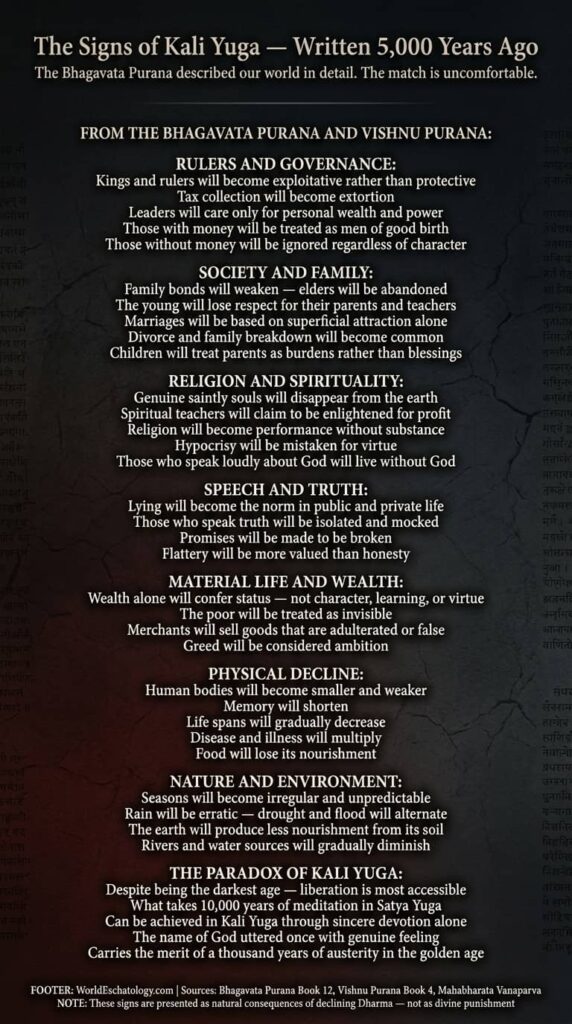
Reading the Bhagavata Purana’s list of Kali Yuga symptoms is an experience that sits somewhere between ancient scholarship and contemporary journalism.
The match between what was written and what we see is close enough to be genuinely striking, and far enough from perfect to remind us that the age is still in its early stages.
Let us go through the major categories.
Leadership and Governance
The texts say that in Kali Yuga, a man will be considered fit for leadership based on his ability to project power and accumulate wealth, not based on his character, knowledge, or genuine service to others.
Rulers will collect taxes without providing the protection those taxes are supposed to fund. They will make laws primarily to enrich themselves. And those who challenge them will be suppressed rather than heard.
The ancient texts also predict that rulers of Kali Yuga will constantly wage war on each other, not for righteousness or the protection of their people but for territory, resources, and personal prestige.
Citizens of the same nation will be treated as enemies if they belong to the wrong faction.
Society and Family
The family, which the earlier ages treated as the primary unit of human flourishing and the first school of Dharma, comes under severe pressure in Kali Yuga.
The Puranas predict that children will stop honouring their parents, that parents will stop genuinely caring for their children, and that marriages will be contracted and dissolved based on temporary emotional states rather than sustained commitment.
They also predict a reversal in the relationship between youth and experience.
In the earlier ages, elders were valued because they had accumulated wisdom and because the community’s wellbeing depended on the transmission of that wisdom to the next generation.
In Kali Yuga, the texts say, the young will dismiss the old as irrelevant, and experience will be treated as a deficit rather than an asset.
Religion and Spiritual Life
The spiritual predictions are perhaps the most uncomfortable for anyone embedded in the religious landscape of the modern world.
The texts predict that in Kali Yuga, people will have a form of religiosity without its substance.
Temples will be built and rituals performed, but the inner transformation that religion is supposed to produce will increasingly be absent.
Those who speak most loudly about God will live most clearly without God.
The texts also predict that genuine spiritual teachers will become extraordinarily rare.
Those who present themselves as enlightened will mostly be doing so for the rewards that spiritual status brings in this age: followers, money, and social prestige.
The ability to tell the genuine from the counterfeit will itself become a rare spiritual gift.
Truth and Communication
Satya, truth, is the single remaining leg of Dharma in Kali Yuga, and the texts describe it as under constant and increasing pressure.
The Puranas say that in this age, those who speak truth will be mocked, isolated, or punished, while those who tell people what they want to hear will be rewarded and celebrated.
Flattery becomes more valuable than honesty. The ability to manage appearances becomes more important than the reality those appearances are supposed to represent.
There is also a predicted degradation in language itself. Words in the earlier ages were considered sacred because they were understood as vehicles of truth.
In Kali Yuga, language becomes primarily a tool of persuasion and manipulation, and the gap between what is said and what is meant widens steadily.
A Note on How to Read These Signs
It would be easy, reading through this list, to do one of two things: either force every current event into the Kali Yuga template in a way that makes the prophecy look more precisely fulfilled than it actually is, or dismiss the parallels entirely as the kind of vague social criticism that could apply to any age.
Neither is honest. The honest position is that the match between the ancient descriptions and the contemporary world is genuinely striking in some areas and clearly incomplete in others.
The texts describe conditions that will worsen significantly as the age progresses.
What we are experiencing now may be the early symptoms of a process whose full expression lies centuries or millennia ahead.
The purpose of knowing the signs is not to check them off a list but to understand the nature of the time we are living in and respond accordingly.
The Great Duration Debate — 432,000 Years or Something Much Shorter?
The traditional Puranic calculation says we have over 426,000 years of Kali Yuga still ahead of us.
But there is a serious and well-developed alternative interpretation that says the traditional calculation contains an error, and that the ages are far shorter and cycling far more rapidly than the Puranas suggest.
This debate is not trivial, and it deserves honest treatment.
Sri Yukteswar’s Alternative Calculation
In 1894, the Indian sage Sri Yukteswar Giri, the guru of Paramahansa Yogananda, published a small book called The Holy Science that contained, among other things, a detailed reinterpretation of the yuga system.
Yukteswar argued that the traditional Puranic calculation was based on a scribal error committed when the original texts were being transmitted.
The error, he said, was in treating the 12,000-year duration of a Mahayuga as years of the gods rather than as human years.
On Yukteswar’s reading, the full yuga cycle is 24,000 human years, not 4.32 million. The individual yugas are 4,800, 3,600, 2,400, and 1,200 years in duration.
Kali Yuga, on this calculation, lasted only 1,200 years, from approximately 701 BCE to 499 CE.
We have already passed through it and are currently in an ascending Dvapara Yuga, moving toward Treta and eventually back to Satya.
Yukteswar connected this cycle to the precession of the equinoxes, the roughly 25,920-year cycle by which the orientation of the earth’s axis traces a slow circle through the sky.
He argued that the yuga cycle represents the movement of our solar system in an elliptical orbit around a companion star, moving closer to and further from a source of cosmic intelligence that raises or lowers the quality of human consciousness depending on the distance.
On this model, the darkness of the apparent Kali Yuga is already behind us.
Sadhguru, the contemporary Indian mystic and teacher, has spoken in similar terms, connecting the yuga system to astronomical cycles and suggesting that the notion of a 432,000-year Kali Yuga may represent a misunderstanding of the original system.
Why the Traditional View Holds
The traditional Puranic position, maintained by most orthodox Hindu scholars, the Shankaracharyas, and the major monastic institutions, is that the longer durations are correct and that Yukteswar’s reinterpretation, however elegant, is not supported by the textual tradition.
The 432,000-year Kali Yuga is explicitly stated in multiple Puranas with no ambiguity about the unit of measurement, and the astronomical and historical markers given in the texts align with the longer rather than the shorter reckoning.
They also note that Yukteswar’s model, while intellectually appealing, requires him to have identified a scribal error that no previous commentator in thousands of years of unbroken scholarship noticed.
This is possible but requires a significant degree of confidence in one’s own reading over the accumulated weight of the tradition.
What Both Views Agree On
The disagreement about duration should not obscure the deep agreement on everything that actually matters for living.
Both the traditional view and Yukteswar’s view agree that the yugas are real, that human consciousness and society decline in a pattern that the yuga framework describes accurately, and that the prescribed response in whatever dark period we find ourselves is the same: live with devotion, seek truth, practice whatever form of spiritual discipline you are capable of, and trust that the wheel turns.
Whether you have 426,000 years of darkness ahead or are already in the ascending phase of the cycle, the advice the ancient teachers gave to people living in a dark age remains the same. And it is advice worth taking regardless of which calculation proves correct.
The Avatars Across the Yugas — Vishnu’s Descents Into Time
One of the most beautiful aspects of the yuga framework is the way the avatars of Lord Vishnu, the great divine descents, are distributed across the ages in a pattern that reflects the specific character and need of each period.
The ten principal avatars, known as the Dashavatara, are not random interventions. They are responses to the particular form that the decline of Dharma takes in each age.
The theological basis for the avatars is stated most directly in the Bhagavad Gita by Krishna himself, and it is one of the most frequently quoted verses in all of Hindu literature.
Whenever righteousness declines and unrighteousness rises, he says, I manifest myself.
For the protection of the good, for the destruction of the wicked, and for the re-establishment of Dharma, I am born from age to age.
The key phrase is from age to age. The divine does not intervene once and consider the problem solved.
It returns, in whatever form the need of the moment requires, as often as necessary. And the form changes with the age.
The Satya Yuga Avatars: Cosmic Preservation
The avatars of Satya Yuga are the most elemental and the most cosmic in scale.
Matsya, the great fish, carries Manu and the seven sages and the seeds of all creation safely through the waters of dissolution, preserving the sacred knowledge across the boundary between cycles.
Kurma, the tortoise, becomes the support of the cosmos itself during the churning of the cosmic ocean, the great cooperative project of gods and demons to extract the nectar of immortality from the depths of existence.
Varaha, the boar, dives into the cosmic waters to rescue the earth goddess Bhudevi, lifting the entire world from the depths on his tusks.
And Narasimha, the man-lion who defeats Hiranyakashipu to protect the boy saint Prahlada, appears in a form that transcends every condition the demon thought would protect him: neither man nor beast, neither inside nor outside, neither day nor night.
These are avatars that operate at the level of cosmic structure. They are not responding to the social or moral problems of a civilisation.
They are maintaining the very framework within which civilisation can exist.
The Treta Yuga Avatars: Establishing Order
As the ages progress and the divine enters closer relationship with the human world, the avatars take increasingly human form and address increasingly social problems.
Vamana takes the form of a small Brahmin boy to reclaim the three worlds from a powerful but overreaching demon through wit and cosmic justice.
Parashuram, a Brahmin who takes up the kshatriya’s weapon, addresses the corruption of the warrior class specifically, a problem whose social dimension is already apparent.
And Rama takes fully human form to live out the ideal of Dharmic life in the most demanding circumstances imaginable, setting a standard for human behaviour that the tradition has measured itself against ever since.
The Dvapara Yuga Avatars: The Full Expression
Krishna is the defining avatar of Dvapara Yuga, and he is described as the Purna Avatar, the complete manifestation, for a reason.
By the time of Dvapara Yuga, the world needs not just a rescuer or an exemplar but a teacher.
And what Krishna teaches in the Bhagavad Gita is not a simple code of behaviour but a complete philosophy of existence: how to act without attachment to outcomes, how to understand the nature of the self, how to approach the divine through devotion, knowledge, and selfless action, and how to maintain spiritual equanimity in the middle of the greatest possible chaos.
The Buddha avatar, listed in many Puranic traditions as the ninth avatar, is more complex in its interpretation.
Some traditions see it as Vishnu manifesting in the form of Siddhartha Gautama to redirect humanity away from the misuse of Vedic ritual that had become widespread.
Others interpret it differently. The inclusion of the Buddha in the Dashavatara is one of the more theologically interesting aspects of the Hindu tradition’s self-understanding.
The Coming Avatar: Kalki
The tenth avatar has not yet come. And that absence is itself a fact about where we are in the yuga cycle.
The Kalki Avatar — The Prophecy at the End of Kali Yuga
Every age ends. Even Kali Yuga ends. And the agent of its ending, according to the Vishnu Purana, the Bhagavata Purana, and the dedicated Kalki Purana, is the tenth and final avatar of Vishnu in this Mahayuga: Kalki.
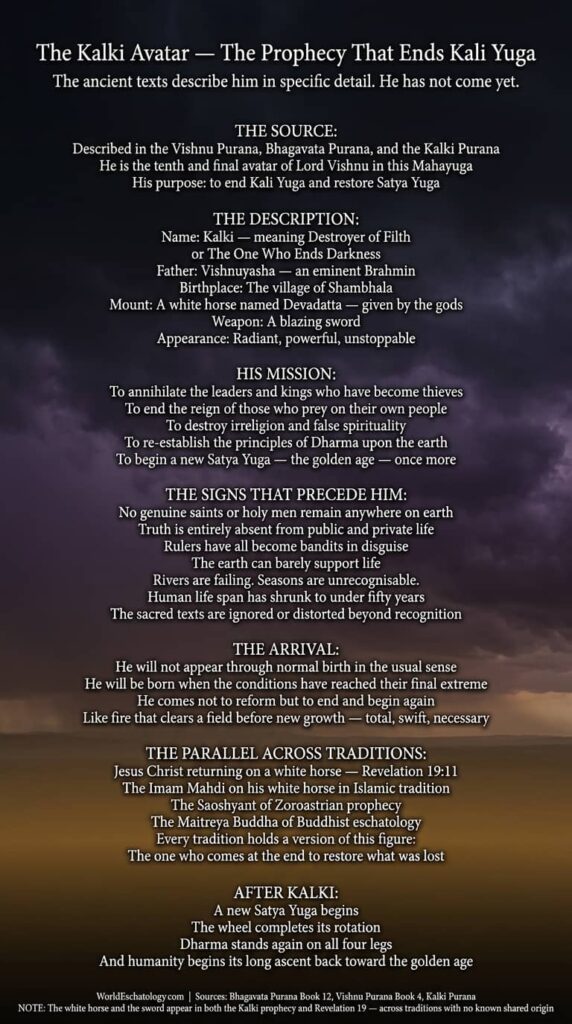
The name Kalki carries multiple interpretations. Some translate it as Destroyer of Filth, referring to the moral corruption of the dark age.
Others translate it as the Eternity or White Horse. The image most consistently associated with him across the Puranas is that of a young Brahmin riding a white horse named Devadatta, given to him by the gods, wielding a blazing sword, and traveling across the earth with devastating speed.
The Conditions That Precede Him
The Puranas are specific about the conditions that will prevail just before Kalki appears, and reading them gives a sense of how far Kali Yuga has still to run.
The signs include the following: no genuine saints or holy people remain anywhere on the earth, the sacred texts have been forgotten or distorted beyond recognition, rulers have universally become bandits and thieves, wealth has been concentrated in the hands of a few who use it entirely for personal pleasure, the earth can barely support life, rains have failed, rivers are diminishing, human life spans have contracted to fifty years or less, and truth has completely vanished from public and private life.
These are not the conditions of the present world. They are the conditions of the world as Kali Yuga approaches its nadir.
The appearance of Kalki does not come at the first signs of darkness. It comes when the darkness has run its full course.
The Description from the Kalki Purana
The Kalki Purana describes him as born in the village of Shambhala to a Brahmin named Vishnuyasha and his wife Sumati.
He will receive divine weapons and a divine horse from the gods.
He will travel across the earth, destroying the corrupt rulers who have made themselves into tyrants, cutting through deception and evil with the sword of truth, and restoring the conditions necessary for Dharma to re-establish itself.
His purpose is not primarily destruction, though destruction is part of it. His purpose is renewal. The Kalki avatar does not come to judge and condemn.
He comes to clear the field so that the new Satya Yuga can take root.
He is the fire that burns through the dead growth of the long dark age so that fresh life can emerge from the ground that was always there beneath it.
The Cross-Traditional Parallel
The Kalki prophecy is one of the most striking examples of convergence across religious traditions.
The image of a divine figure arriving on a white horse to end a period of overwhelming darkness and restore justice and righteousness appears not just in the Vishnu Purana but across traditions with no known historical contact with each other.
In Revelation 19, the returning Jesus Christ arrives on a white horse with the armies of heaven behind him.
The Imam Mahdi of Islamic tradition is associated with a white horse. The Saoshyant of Zoroastrian prophecy comes to restore Asha, righteousness, after the final battle between good and evil.
The Maitreya, the future Buddha of Buddhist tradition, is expected to appear in a world that has reached its moral nadir and to restore the Dharma.
Whether these convergences represent independent parallel insights into the deep structure of cosmic time, or shared ancestral traditions that spread across cultures in the ancient world, or something else entirely, is a question that the comparative study of religion has not resolved.
But the pattern itself is remarkable and worth sitting with.
The Pralaya — Cosmic Dissolution and the Turn of the Wheel
What happens when Kali Yuga ends is not simply that a new Satya Yuga begins the way a new day begins after a night.
The end of a Mahayuga involves a period of dissolution, a Pralaya, before the new cycle can emerge.
Hindu cosmology describes several levels of Pralaya corresponding to different levels of the cosmic structure.
The dissolution that occurs at the end of each Mahayuga is a Naimittika Pralaya, a partial dissolution.
It does not destroy the universe completely. It is more like a deep sleep than a death: the world is withdrawn into a state of latency, the souls and the karmas and the tendencies of the previous cycle are held in suspension, and then the new Satya Yuga emerges from this state of rest like a world waking from dreamless sleep.
A more complete dissolution, the Prakritika Pralaya, occurs at the end of each day of Brahma, when all fourteen Manvantaras have run their course and the entire material creation is absorbed back into the primordial nature from which it emerged.
And the ultimate dissolution, the Maha Pralaya, occurs at the end of Brahma’s entire life, when even the subtlest forms of material existence return to the Brahman from which all things ultimately arise.
The yuga system, seen in this context, is not a story of inevitable destruction and hopelessness.
It is a story of a universe that breathes in and out on timescales so vast that human history occupies less than a blink.
The dissolution is real. But so is the renewal that follows it. And the renewal, in every cycle, begins with a Satya Yuga, a golden age of truth, light, and divine proximity. The wheel does not stop at the darkest point. It turns.
The Yuga Cycle in Other Ancient Traditions
One of the most compelling facts about the four-age cosmological framework is that versions of it appear independently across cultures that had no known contact with each other.
This convergence is not proof of anything in particular, but it is the kind of fact that serious thinkers about comparative religion return to repeatedly, because it suggests that something in the human experience of historical time consistently produces a four-stage framework of decline from a golden origin.
The Greek Ages of Man
The Greek poet Hesiod, writing around 700 BCE, described a sequence of five ages of humanity in his Works and Days.
The first was the Golden Age, when men lived like gods, free from toil and grief, with the earth producing abundantly without effort, and death coming as gently as sleep.
The second was the Silver Age, lesser in every way, when men were less noble and lived shorter lives. The third was the Bronze Age, an age of war and hardness.
The fourth was the Age of Heroes, sometimes inserted between the Bronze and Iron as an exception to the pattern of pure decline.
And the fifth was the Iron Age, Hesiod’s own time and ours, characterised by toil, injustice, the breakdown of family bonds, and the gradual departure of the gods from human affairs.
The structural parallel with the four yugas is striking. The names are different but the sequence is the same: gold, silver, bronze, iron.
The direction is the same: downward. The symptoms are the same: diminishing virtue, shortening lives, the erosion of social bonds, and the increasing distance between humanity and the divine.
The Zoroastrian Cosmic Ages
Zoroastrian tradition divides cosmic time into four periods of three thousand years each, a total of twelve thousand years corresponding to the timeline of the current world.
The first age is one of spiritual creation. The second is the period before the assault of evil. The third is the mixed age of struggle between good and evil.
And the fourth is the age of increasing degradation leading to the final renovation of the world by the Saoshyant, the saviour figure, and the triumph of Asha, truth and righteousness.
Again the structure is four stages, the last being the darkest and leading to a final renewal by a messianic figure.
The name of the saving figure is different. The theological framework is different. But the deep structure is remarkably parallel.
The Norse Ages
The Norse cosmological tradition describes a sequence of ages leading from the original creation to Ragnarok, the final destruction of the world by ice, fire, and the conflict of cosmic forces.
What is particularly interesting in the Norse tradition is that Ragnarok is not the final word.
After the destruction, a renewed world rises from the sea, green and fertile, populated by the surviving gods and two human beings who have sheltered in the world tree.
The wheel turns here too, from creation through decline through destruction to renewal.
What the Convergence Suggests
These traditions did not share scriptures or teachers. They developed on different continents over different centuries.
And yet they converged on a framework that shares the same basic structure: four stages from light to darkness, a nadir of total degradation, and then a renewal that begins the cycle again.
One interpretation is that these frameworks reflect a genuine insight into the nature of historical time, that civilisations really do cycle through these patterns and that ancient observers, wise enough and patient enough to study the very long arc of human affairs, arrived independently at the same description.
Another interpretation is that the framework is a projection of the natural seasons onto cosmic time, a way of making sense of the world by seeing it as cyclical at every scale.
A third is that these traditions share a common ancestral origin deeper in antiquity than our current historical records reach.
What is difficult to argue is that the convergence is meaningless.
What the Yuga System Means for How to Live Right Now
Everything up to this point has been looking outward and backward: at the structure of the cycle, at the characteristics of each age, at what happened in the past and what is written about the future.
This section turns inward and asks the question that matters most for anyone reading this article: if we are in Kali Yuga, what should we actually do?
The ancient teachers were not primarily interested in satisfying cosmological curiosity.
They described the yugas because they believed the description had practical implications for how to live. And their practical guidance is not pessimistic. It is, in some ways, extraordinarily encouraging.
The Special Mercy of the Dark Age
The Bhagavata Purana praises Kali Yuga explicitly and without irony. It says that in this age, simply by chanting the names of God with sincerity, human beings can attain liberation.
Not through years of difficult austerity. Not through complex sacrificial rituals requiring exact precision.
Not through elaborate temple worship that demands sustained concentration and significant resources.
Simply by devotion, by turning the attention of the heart toward the divine with genuine feeling, the goal that previous ages required lifetimes of effort to approach becomes accessible.
The teachers explain this with two related arguments. The first is the principle of proportionality: the effort required for any given spiritual achievement is calibrated to the difficulty of the age.
In an age when everything supports spiritual life, a great deal is required to demonstrate genuine commitment.
In an age when everything opposes spiritual life, very little is required, because the little that is offered against such resistance is genuinely extraordinary.
The second argument is the paradox of contrast. In Satya Yuga, truth was simply the texture of existence.
Nobody deserved particular credit for being truthful because it was not possible to be otherwise.
In Kali Yuga, truth is an act of will against a powerful current moving in the opposite direction.
Each moment of genuine truthfulness, each act of real compassion, each sincere turning toward the divine in a world that is pulling constantly away from these things, carries a quality of intensity and authenticity that the easier ages simply cannot produce.
The Prescribed Path for This Age
Every age has its primary spiritual path, calibrated to what is actually accessible given the capacities of the age.
In Satya Yuga it was meditation, which works when consciousness is naturally serene and concentrated.
In Treta Yuga it was sacrifice, which works when people have the discipline and resources for elaborate ritual.
In Dvapara Yuga it was temple worship, which works when people can sustain the focus and devotion required for formal religious practice.
In Kali Yuga, the prescribed path is Bhakti, devotion. And the specific form of Bhakti recommended most consistently is the kirtan, the communal singing of divine names.
This is not a lesser path chosen because no better option is available. It is a path perfectly calibrated to the condition of the age.
In a time when the mind is scattered, when sustained meditation is difficult, when the resources and training for elaborate ritual are hard to access, when the social structures that once supported formal religious education have weakened, the simple act of gathering with others and singing the names of God with genuine feeling is accessible to everyone, costs nothing, requires no expertise, and, the texts say, works.
The Qualities That Protect
Beyond the specific spiritual practices, the texts identify certain qualities that protect a person navigating Kali Yuga.
Satya, truthfulness, is the first: speaking truth in an age of universal deception is both a spiritual practice and a form of resistance to the age’s characteristic degradation.
Daya, compassion, is the second: maintaining genuine care for others in an age that rewards selfishness is a form of Dharmic heroism.
Tapas, some form of self-discipline, however modest, creates an internal space that the chaos of the age cannot easily colonise.
And Shaucha, cleanliness, interpreted broadly to include clarity of mind and conscience, maintains the inner quality that the outer world is constantly working to muddy.
The teachers are not asking for the heroic austerities of Satya Yuga. They are asking for sincerity.
They are saying: in this age, a little goes a long way. Whatever you can honestly give, give it. The darkness is real but it is not the final word. The wheel turns.
Frequently Asked Questions
What are the four yugas in Hinduism?
The four yugas are Satya Yuga, Treta Yuga, Dvapara Yuga, and Kali Yuga, four successive ages of the world that form a complete cycle known as a Mahayuga or Chaturyuga.
Each age is shorter and characterised by lower spiritual quality than the one before it, following a ratio of 4:3:2:1 in duration. Together they span 4,320,000 human years.
How long does each yuga last?
According to the traditional Puranic calculation, Satya Yuga lasts 1,728,000 years, Treta Yuga 1,296,000 years, Dvapara Yuga 864,000 years, and Kali Yuga 432,000 years.
These durations follow a 4:3:2:1 ratio. An alternative interpretation by Sri Yukteswar gives much shorter durations, with a full cycle of only 24,000 years, arguing that the traditional figures use divine years rather than human years.
What yuga are we in right now?
According to the traditional Puranic reckoning, we are currently in Kali Yuga, the fourth and darkest of the four ages.
Kali Yuga is said to have begun at midnight between the 17th and 18th of February in 3102 BCE, corresponding to the departure of Lord Krishna from the world.
As of 2026, we are approximately 5,127 years into Kali Yuga. According to Sri Yukteswar’s alternative calculation, Kali Yuga ended around 499 CE and we are currently in an ascending Dvapara Yuga.
When does Kali Yuga end?
On the traditional calculation, Kali Yuga has 426,873 years remaining as of 2026.
It will end when the conditions described in the Puranas reach their nadir and the Kalki avatar appears to end the age and begin a new Satya Yuga.
On Yukteswar’s calculation, Kali Yuga has already ended and we have been in an ascending Dvapara Yuga since approximately 499 CE.
What are the signs of Kali Yuga?
The Bhagavata Purana and Vishnu Purana describe numerous signs including: rulers becoming exploitative rather than protective, wealth determining social status, family bonds weakening, elders being abandoned, genuine spiritual teachers disappearing, hypocrisy being mistaken for virtue, truth becoming unpopular, human life spans and physical strength declining, seasons becoming irregular, and natural resources diminishing.
These signs are understood as natural consequences of declining Dharma rather than divine punishment.
Who is the Kalki avatar?
Kalki is the tenth and final avatar of Lord Vishnu in the current Mahayuga. He has not yet appeared.
According to the Vishnu Purana, Bhagavata Purana, and Kalki Purana, he will be born in a village called Shambhala to a Brahmin named Vishnuyasha, will ride a white horse named Devadatta, and will carry a blazing sword.
His mission is to end Kali Yuga by destroying the corrupt rulers and forces of irreligion that have taken complete control of the world, and to usher in a new Satya Yuga.
What happens at the end of Kali Yuga?
At the end of Kali Yuga, the Kalki avatar appears and destroys the forces of adharma that have overwhelmed the world.
This is followed by a period of Pralaya, or cosmic dissolution, described as a partial withdrawal of the world into a state of latency.
From this state, a new Satya Yuga emerges, beginning the cycle again. The end of Kali Yuga is not the end of existence. It is the turn of the wheel.
What is the difference between Satya Yuga and Kali Yuga?
Satya Yuga is the golden age in which Dharma stands on all four legs, human beings live for up to 100,000 years, the primary spiritual practice is meditation, and the divine presence is directly accessible.
Kali Yuga is the iron age in which Dharma stands on a single leg, human life spans are measured in decades, truth is endangered, and spiritual achievement requires sincere devotion rather than austere practice.
The two ages are at opposite ends of the cosmic cycle.
Is Kali Yuga the same as the Hindu apocalypse?
Not exactly. Kali Yuga is not an apocalypse in the sense of a singular catastrophic ending.
It is the darkest phase of a cyclical process that has occurred and will occur again.
The end of Kali Yuga involves the Kalki avatar and a period of dissolution, but this is followed by renewal, not permanent destruction.
The concept is closer to winter in a cosmic season than to an apocalypse in the Abrahamic sense.
What is a Mahayuga or Chaturyuga?
A Mahayuga, also called a Chaturyuga, is one complete cycle of all four yugas: Satya, Treta, Dvapara, and Kali.
It spans 4,320,000 years in the traditional reckoning. Seventy-one Mahayugas make one Manvantara, and fourteen Manvantaras make one day of Brahma.
Did Yukteswar say Kali Yuga has already ended?
Yes. Sri Yukteswar Giri, the guru of Paramahansa Yogananda, argued in his 1894 book The Holy Science that the traditional Puranic calculation contains a scribal error and that the yuga durations are human years, not divine years.
On his calculation, Kali Yuga lasted only 1,200 years and ended around 499 CE. He argued that we are currently in an ascending Dvapara Yuga moving toward Treta.
This remains a minority view compared to the traditional Puranic reckoning.
How does the yuga system compare to the Greek ages?
The parallel is striking. Hesiod’s Greek ages are Gold, Silver, Bronze, and Iron, descending in quality in the same sequence as the four yugas.
Both frameworks describe humanity moving from a golden age of effortless virtue and divine proximity to an iron age of toil, injustice, and spiritual decline.
The two traditions had no known historical contact, making the convergence one of the more interesting facts in comparative mythology.
Conclusion — The Wheel That Never Stops Turning
There is a particular kind of wisdom that can only come from looking at things from a very great height and a very great distance.
The yuga system is that kind of wisdom. It asks you to step back from the daily news, from the latest crisis and the current outrage, from the feeling that things have never been this bad or that the world is uniquely broken in this particular moment, and to look at where we actually are in the long arc of cosmic time.
What it shows you, from that height and distance, is both sobering and liberating.
Sobering, because the framework says that yes, this is a dark age, and yes, the darkness is real, and yes, there is a great deal more to run before the cycle completes.
The ancient descriptions of Kali Yuga are not describing someone else’s world. They are describing ours. That is worth sitting with honestly rather than explaining away.
But also liberating, because the framework says that the wheel turns. Kali Yuga is not the permanent condition of the universe.
It is a phase, like winter, like night. Every single Kali Yuga in the unimaginably long history of this cosmic cycle has ended in a new Satya Yuga.
The darkness is not the last word. It never has been. It is not possible for it to be the last word, because the structure of time itself is cyclical and the cycle always completes.
And perhaps most liberating of all is the paradox that the ancient teachers kept returning to: this is simultaneously the worst age to be born in and the most accessible for genuine spiritual progress.
You do not need to be extraordinary in Kali Yuga. You need to be sincere. In a world where sincerity itself has become rare, sincere practice burns with a brightness disproportionate to its apparent size.
The yuga system is one of the most internally consistent and cosmologically complete frameworks for understanding time, human history, and the place of the individual within both, that the human tradition has produced.
Whether you approach it as revelation, as philosophy, as a model worth testing against experience, or simply as a remarkably detailed and thought-provoking way of asking the oldest question in human culture, where are we and where are we going, it repays the attention you give it.
The wheel turns. It has always turned. It will turn again.
5 thoughts on “The four Yugas explained | Satya, Treta, Dvapara and Kali Yuga”