
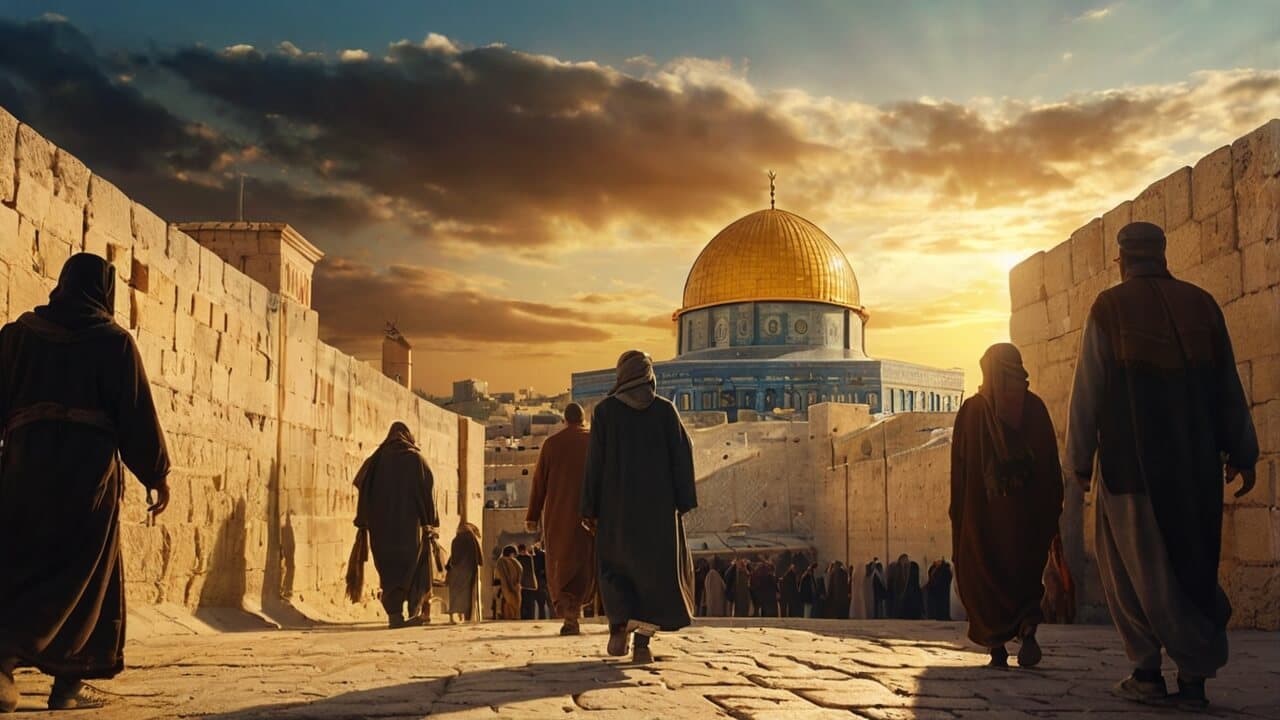
What Is Jewish Eschatology?
If you have ever wondered what Jews believe about the end of the world, you are not alone.
It is one of the most searched religious topics on the internet, and for good reason.
Jewish eschatology, which is the study of what Judaism teaches about the end of days, is a rich, layered, and often misunderstood subject.
Most people come to it through the lens of Christianity or Islam, expecting to find something similar. What they find is something far older, often surprising, and deeply human.
The word eschatology comes from the Greek word ‘eschaton,’ meaning ‘last things.’
In Jewish thought, it refers to everything connected to the ultimate destiny of the world: the coming of the Messiah, the resurrection of the dead, the final judgment, the ingathering of the Jewish people to their homeland, and the arrival of a perfected age known as the World to Come.
Here is what makes Jewish eschatology genuinely unique: it is not a single fixed doctrine.
Judaism has been thinking about these questions for over three thousand years, and different generations, different rabbis, and different movements within Judaism have arrived at very different answers.
The Orthodox Jew davening in Jerusalem and the Reform Jew in Manhattan may share the same scripture but hold very different visions of what the end of history looks like.
This guide covers all of it. We will walk through the biblical foundations, the Talmudic elaborations, the Kabbalistic mysticism, the denominational disagreements, and the contemporary relevance of these ancient ideas.
We will also show how Jewish eschatology connects to, and differs from, Islamic and Christian end-times beliefs, which is where the most fascinating comparisons live.
Whether you are Jewish, curious about comparative religion, doing academic research, or just trying to understand what your Jewish friends believe about the end of days, this is the most complete guide you will find.
Where It All Began: The Historical Development of Jewish End-Times Thought
Judaism eschatology did not appear out of nowhere. It developed over centuries, shaped by wars, exiles, persecutions, and the endless human longing to believe that history has a direction and a destination.
To understand where these beliefs stand today, you need to understand where they came from.
The Biblical Foundations: Torah and the Prophets
The earliest Jewish eschatological ideas are scattered throughout the Hebrew Bible. They are not organized into a neat theology.
They appear as prophetic visions, poetic imagery, and divine promises woven into the narrative of a people trying to make sense of their relationship with God.
The prophet Isaiah contains some of the most powerful end-times imagery in all of religious literature.
In chapter 2, Isaiah describes a future day when all nations will stream to the mountain of God, swords will be beaten into plowshares, and war will cease across the earth.
In chapters 11 and 12, he speaks of a shoot growing from the stump of Jesse, which Jewish tradition reads as a reference to the Davidic Messiah, a king who will usher in a reign of justice and peace where the wolf lives with the lamb.
Chapters 65 and 66 describe a transformed creation where death itself is diminished and Jerusalem becomes the center of the world.
Ezekiel contributes two of the most dramatic passages in all of eschatological literature.
The famous dry bones vision of chapter 37, where the prophet watches a valley of dead bones come back to life as a unified people, is read by Jewish tradition as a promise of national restoration and, by many, as a reference to the physical resurrection of the dead.
Then chapters 38 and 39 introduce the terrifying war of Gog and Magog, a great apocalyptic battle that will shake the earth before the final redemption arrives.
We will cover Gog and Magog in depth later, because this concept has extraordinary reach across Judaism, Christianity, and Islam.
Daniel, written during the persecution of Antiochus IV Epiphanes in the second century BCE, gives us the most explicitly apocalyptic material in the Hebrew Bible.
Chapter 12 contains the clearest reference to resurrection in the entire Hebrew Bible: ‘Many of those who sleep in the dusty earth will awaken, some to everlasting life and some to shame and everlasting contempt.’
Daniel also introduces the concept of a fixed timetable for history, with seventy weeks of years leading to a final redemption.
Zechariah, Joel, Amos, and Malachi all add pieces to the picture: the Day of the Lord, the return of the exiles, the ingathering of nations, and Malachi’s famous promise that Elijah the prophet will return before the great and awesome day arrives.
The Second Temple Period: When Apocalypticism Caught Fire
Between roughly 500 BCE and 70 CE, Jewish apocalyptic literature exploded.
This was a period of political suffering: first under Persia, then Greece, then Rome.
The more Jewish independence was crushed, the more Jewish writers turned to visions of a dramatic divine intervention that would overturn the current world order.
The Book of Enoch, which never made it into the Hebrew Bible but was enormously influential, describes heavenly journeys, fallen angels, the coming judgment, and the arrival of a mysterious figure called the Son of Man.
Four Ezra and Second Baruch, written after the destruction of the Temple in 70 CE, wrestle with the agony of that catastrophe and find comfort in visions of a coming Messianic era and resurrection.
The Dead Sea Scrolls, discovered near Qumran in 1947, gave us an extraordinary window into a Jewish sect that believed it was living in the last days.
Their War Scroll describes a forty-year apocalyptic battle between the Sons of Light and the Sons of Darkness, with divine intervention deciding the outcome.
The community at Qumran was intensely focused on calendar, ritual purity, and preparation for the end they believed was imminent.
This period is important because it shows that Jewish end-times thinking was never monolithic.
Even two thousand years ago, there were competing visions and intense debates about what the end would look like and when it would arrive.
The Rabbinic Period: After the Temple Falls
The destruction of the Second Temple in 70 CE was the defining catastrophe of Jewish history before the Holocaust.
It forced a complete rethinking of Jewish religious life and, along with it, Jewish eschatology timeline.
The rabbis who shaped Talmudic Judaism were deeply ambivalent about apocalypticism.
They had seen what messianic enthusiasm could do: the Bar Kokhba revolt of 132-135 CE, endorsed by none other than Rabbi Akiva as a messianic war, ended in catastrophic defeat and the deaths of hundreds of thousands of Jews. The rabbis became cautious.
The Talmud, especially tractate Sanhedrin, contains extensive discussions of the end of days.
The rabbis debated the signs that would precede the Messiah’s coming, the conditions of the resurrection, and the nature of the World to Come.
But they also repeatedly warned against trying to calculate the exact time, with the famous Talmudic saying: ‘May the spirit of those who calculate the end expire.’
The rabbis shifted the emphasis away from waiting for the end and toward living a righteous life in the present.
Two key concepts dominate rabbinic eschatology. The first is Olam Ha-Zeh, meaning ‘this world,’ which refers to the current imperfect age we live in.
The second is Olam Ha-Ba, meaning ‘the World to Come,’ which refers to the perfected age after the Messiah and the resurrection.
These two concepts structure all rabbinic thinking about what comes next.
Medieval Jewish Philosophy: From Maimonides to the Kabbalah
In the medieval period, Jewish thinkers brought philosophical rigor and mystical depth to the inherited tradition of eschatological thought.
Moses Maimonides, the twelfth-century philosopher and legal authority, is the single most important figure for understanding how traditional Judaism thinks about the Messiah and resurrection.
In his Thirteen Principles of Faith, which most traditional Jews still recite daily, two of the principles deal directly with eschatology: the coming of the Messiah and the resurrection of the dead.
Maimonides was a rationalist: he described the Messianic era in naturalistic terms, as a politically transformed world rather than a supernaturally altered one, and he downplayed the physical resurrection in favor of spiritual immortality.
His positions were controversial in his own time and remain debated today.
Nachmanides, the thirteenth-century Spanish mystic, disagreed sharply with Maimonides.
He insisted on a literal physical resurrection and a far more miraculous vision of the Messianic era.
This tension between the rationalist and mystical approaches has never been fully resolved in Jewish tradition, and that is actually one of its most appealing qualities: Judaism has always tolerated disagreement on these questions.
The most dramatic development in medieval judaism eschatology came from the Kabbalah, especially the Lurianic school of the sixteenth century, named after Rabbi Isaac Luria of Safed.
Luria developed an entire cosmic drama to explain why the world is broken and how it will be repaired. We will cover this in its own section because it deserves full attention.
The Core Concepts: What Judaism Actually Teaches About the End of Days
This is the heart of the article. These are the doctrines, concepts, and beliefs that form the backbone of Jewish eschatological thought.
Some of them are almost universally held across Jewish denominations. Others are hotly debated. All of them are worth understanding in depth.
The Messiah (Mashiach): What Judaism Actually Expects
No topic in Jewish eschatology generates more confusion, more searches, and more interfaith tension than the question of the Messiah.
This is where Jewish and Christian theology diverge most sharply, and understanding the Jewish concept on its own terms is essential.
The Hebrew word Mashiach simply means ‘anointed one.’ In ancient Israel, both kings and priests were anointed with oil as part of their installation ceremonies.
The eschatological Messiah is a future king, anointed in the line of King David, who will bring about a specific set of changes in the world.
According to mainstream Jewish tradition, the Messiah is a human being, not a divine figure.
He is not pre-existent, not born of a virgin, not part of a divine trinity.
He is an exceptional human leader who rises to accomplish what no previous leader has managed.
The criteria for identifying the Messiah are spelled out clearly in Jewish law and tradition, and they are all external, verifiable, and historical:
He must be a direct descendant of King David through the male line. He must gather all Jews from exile back to the Land of Israel.
He must rebuild the Temple in Jerusalem. He must bring all of humanity to a recognition of the one God.
And perhaps most importantly, he must usher in a lasting era of peace, ending war across the earth.
Any person who fails to accomplish these things in his lifetime has not fulfilled the criteria of the Messiah.
This is the core reason that mainstream Judaism does not accept Jesus of Nazareth as the Messiah: the Temple was not rebuilt in his lifetime, the Jewish people were not gathered to Israel, and the world did not enter a period of universal peace.
The Christian response to this, which involves a ‘second coming’ to complete unfinished tasks, is simply not a framework that Judaism recognizes.
One of the lesser-known but fascinating aspects of Jewish Messianic doctrine is the existence of two Messiahs in some traditions.
The first is Mashiach ben Yosef, the Messiah son of Joseph, who appears before the final redemption and leads a military struggle.
According to most traditions, he dies in battle, specifically in the war of Gog and Magog.
The second is Mashiach ben David, the Messiah son of David, who arrives after that death and brings the final, complete redemption.
Not all Jewish traditions accept this two-Messiah framework, but it appears in important rabbinic sources and is taken seriously by many traditional authorities.
The Messianic Era (Yemot HaMashiach): What Changes When He Comes
The Messianic era is not the same thing as the World to Come. This distinction confuses many people who are new to Jewish thought.
The Messianic era, called Yemot HaMashiach in Hebrew, is a this-worldly period of peace and flourishing that begins when the Messiah arrives and accomplishes his mission.
It is followed later by the resurrection and the World to Come.
What does the Messianic era look like? The prophets describe it in beautiful terms: nations will no longer go to war.
The knowledge of God will fill the earth as the waters cover the sea. Poverty and oppression will end.
The Jewish people will live in security in their homeland. All of humanity will recognize the one God.
There is a famous debate between Maimonides and the mystical tradition about whether the Messianic era will involve supernatural changes to the natural world.
Maimonides took the position that the world will look basically the same: it will be a political and social transformation, not a cosmic one.
‘The world will continue in its accustomed course,’ he wrote. The wolf will not literally lie down with the lamb: that is poetry describing a peaceful world, not a prophecy of zoological transformation.
The mystical tradition, on the other hand, expected miraculous changes: the dead rising, the land of Israel flowing with abundance beyond natural limits, the very nature of creation shifting. Both positions have serious defenders in Jewish tradition.
Olam Ha-Ba: The World to Come
Olam Ha-Ba, the World to Come, is one of the most central and most misunderstood concepts in Jewish afterlife and eschatological belief.
The confusion arises because the phrase is used in two related but distinct ways in Jewish sources.
In one usage, Olam Ha-Ba refers to the state that the souls of the righteous enter after death, before the resurrection.
This is something like what other traditions might call heaven, though Judaism is characteristically vague about its specifics.
The Talmud says: ‘No eye has seen it, O God, except you, what you have prepared for those who wait for you.’
In its broader eschatological usage, Olam Ha-Ba refers to the perfected world that will exist after the Messianic era, after the resurrection of the dead, and after the final judgment.
This is the ultimate destination of Jewish eschatology: not an escape from the physical world into a purely spiritual realm, but a transformed and perfected physical world where life is lived in full closeness to God.
This is a deeply important point: Judaism’s vision of the ultimate future is not disembodied souls floating in heaven.
It is resurrected bodies living in a transformed world. The physical world is redeemed, not escaped.
This is one of the ways that Jewish eschatology most clearly shapes the traditions that descended from it.
Between death and the World to Come, Jewish tradition describes an intermediate state.
The righteous enter Gan Eden, a paradise of spiritual delight. Those who require moral refinement pass through Gehenna, a place of purification.
Crucially, Gehenna in Jewish thought is not hell in the Christian sense: it is a place of temporary purification, not eternal punishment. The maximum traditional stay is twelve months.
Techiyat HaMeitim: Resurrection of the Dead
The physical resurrection of the dead is one of Maimonides’ thirteen principles, which means it holds a central place in traditional Jewish faith.
But what does resurrection actually mean in Jewish thought, and when does it happen?
The clearest biblical basis for resurrection comes from Daniel 12:2, as mentioned earlier.
Ezekiel’s dry bones vision in chapter 37 is also read as a resurrection text by many authorities, though others read it as a metaphor for national restoration.
Isaiah 26:19 adds: ‘Your dead will live; my corpse, they will rise. Awake and sing, you who dwell in the dust.’
In the Talmud, the resurrection becomes a clearly defined doctrine. Tractate Sanhedrin devotes considerable discussion to it.
The rabbis debate who will be resurrected: all of Israel, the righteous of all nations, or everyone who ever lived.
They debate where the resurrection will begin, with a tradition that it begins in the Land of Israel, which led some pious Jews in earlier centuries to request burial on the Mount of Olives to be close to the site when it happens.
The question of timing is also debated. Does the resurrection happen at the beginning of the Messianic era, midway through it, or after it?
Most authorities place it toward the end of or after the Messianic period, as part of the transition to Olam Ha-Ba.
It is worth noting that the Sadducees of the Second Temple period denied the resurrection entirely, while the Pharisees affirmed it vigorously.
This internal Jewish debate appears in the New Testament, where Paul cleverly exploits the division between Sadducees and Pharisees in the Sanhedrin by declaring himself on trial for belief in resurrection (Acts 23).
Gog and Magog: The Apocalyptic War Before the End
Few concepts in judaism eschatology capture the imagination like Gog and Magog.
It is also one of the most fascinating examples of a concept shared across three major religious traditions, each with its own interpretation.
The primary source is Ezekiel 38 and 39. Gog is described as a prince from the land of Magog, who leads a coalition of nations against Israel in the final days.
The attack is devastating, but God intervenes directly, defeating Gog’s forces through earthquake, plague, torrential rain, hailstones, and fire.
The defeat is so complete that it takes seven months to bury the dead and seven years to collect all the weapons.
Jewish tradition, especially the Talmud and later midrashim, elaborated extensively on this war.
The war of Gog and Magog became associated with the terrible tribulations that precede the Messiah’s arrival, the birth pangs mentioned in the following section.
Some sources describe one war of Gog and Magog, others describe two or three, with the final one being the last confrontation before the final redemption.
Who is Gog? Throughout history, Jews have identified Gog with whichever empire most threatened them at the time: Rome, the Crusaders, Turkey, Russia, Nazi Germany.
In more recent times, some religious Zionists have connected Gog and Magog to modern geopolitical conflicts involving Israel.
The text’s lack of specific historical identification has made it endlessly adaptable.
The parallel in Islam is the figure of Yajuj and Majuj, mentioned twice in the Quran.
In Islamic eschatology, they are a destructive people who will be released near the end of time, spreading devastation across the earth before being destroyed by God.
The Islamic tradition is much more concerned with Yajuj and Majuj as a cosmic destructive force, while the Jewish tradition keeps the focus on the military assault on Israel specifically.
In Christian eschatology, Gog and Magog appear in the book of Revelation (chapter 20), but in a completely different context: they are gathered for the final battle against God after the thousand-year reign of Christ, making them figures from the very end of the end-times narrative rather than from the beginning.
The same names carry very different narrative weight in each tradition.
Kibbutz Galuyot: The Ingathering of the Exiles
One of the clearest and most frequently mentioned signs of the Messianic era in the Hebrew prophets is the gathering of all Jews from exile back to the Land of Israel.
Isaiah speaks of it repeatedly. Jeremiah promises it. Ezekiel describes it. Deuteronomy 30 seems to make it conditional on repentance.
In Jewish tradition, this ingathering, called Kibbutz Galuyot in Hebrew, is not just a political event. It is a cosmic sign that the redemption process has begun.
The rabbis teach that the Messiah will not come until the Jewish people are gathered in their land.
The establishment of the State of Israel in 1948 created one of the most intense theological debates in modern Jewish history.
Religious Zionists, led by figures like Rabbi Abraham Isaac Kook and later his son Rabbi Tzvi Yehuda Kook, argued that the founding of Israel and the subsequent immigration of millions of Jews was the beginning of the fulfillment of this prophecy.
They called it Atchalta D’Geulah, the beginning of the redemption, and saw the modern state as a divinely guided step toward the Messianic era.
Ultra-Orthodox anti-Zionists, particularly the Satmar Hasidic movement following the teachings of Rabbi Yoel Teitelbaum, argued the opposite with equal passion.
Drawing on a Talmudic passage about three oaths, including a divine oath that the Jewish people would not return to Israel en masse before the appointed time, they argued that the Zionist project was a rebellion against God’s plan and would bring catastrophe rather than redemption.
The history of the twentieth century has given both sides ammunition for their arguments.
The Third Temple (Beit HaMikdash): The Most Politically Charged Topic in Jewish Eschatology
According to mainstream traditional Jewish belief, one of the Messiah’s central tasks will be the rebuilding of the Temple in Jerusalem.
This is not a fringe belief or a historical curiosity: it is central to daily traditional Jewish prayer.
Three times a day, observant Jews pray for the restoration of the Temple service.
The Temple Mount in Jerusalem, where the First and Second Temples stood, is currently occupied by two of Islam’s holiest sites: the Dome of the Rock and the al-Aqsa Mosque.
This makes the eschatological expectation of a Third Temple one of the most politically explosive religious beliefs in the world.
Jewish law presents additional requirements for the Temple’s restoration. One of the most extraordinary is the red heifer, Parah Adumah in Hebrew.
A ritually perfect red cow must be sacrificed and its ashes used to purify those who have come into contact with the dead.
Without this purification, the Temple service cannot resume. The birth of red heifers in Israel has periodically generated enormous media attention because some religious Jews see it as a potential fulfillment of this precondition.
There is also a mystical tradition that the Third Temple will not be built by human hands but will descend from heaven in a completed, miraculous form.
This view, found in certain rabbinic sources, resolves the political impossibility by removing the construction question from human agency entirely.
The Day of Judgment (Yom HaDin)
The concept of a final judgment is woven throughout Jewish eschatological thought, though it is less dramatically emphasized than in Christian or Islamic traditions.
The idea of God judging human beings is deeply embedded in Jewish ritual life.
Rosh Hashanah, the Jewish New Year, is called Yom HaDin, the Day of Judgment, each year: it is the annual day when, according to tradition, God inscribes each person’s fate for the coming year in the Book of Life.
Yom Kippur, the Day of Atonement, seals that judgment.
In the eschatological sense, Yom HaDin refers to a final, ultimate accounting at the end of history.
All souls will be judged according to their deeds. Jewish tradition, unlike Christian tradition, does not emphasize a binary heaven-or-hell outcome.
The judgment is more nuanced, with the righteous entering fully into Olam Ha-Ba, the wicked facing a final dissolution or a more severe period of purification, and many in between receiving measured outcomes based on their actual lives.
The Talmudic concept of merit and judgment is also more collective than individualistic in some respects.
The righteous of all nations have a share in the World to Come, according to the Talmud. Judaism does not require non-Jews to convert to Judaism to be ‘saved.’
Observing the seven Noahide laws, which are the basic moral laws that Jewish tradition says God gave to all of humanity, is enough to earn a share in the World to Come.
This is a remarkably inclusive eschatological position.
The Signs of the End Times: What Jewish Tradition Says to Watch For
People have always wanted to know whether the end of days is near.
Jewish tradition provides a detailed list of signs, and reading them in the original Talmudic sources is a genuinely remarkable experience, because some of them sound unsettlingly contemporary.
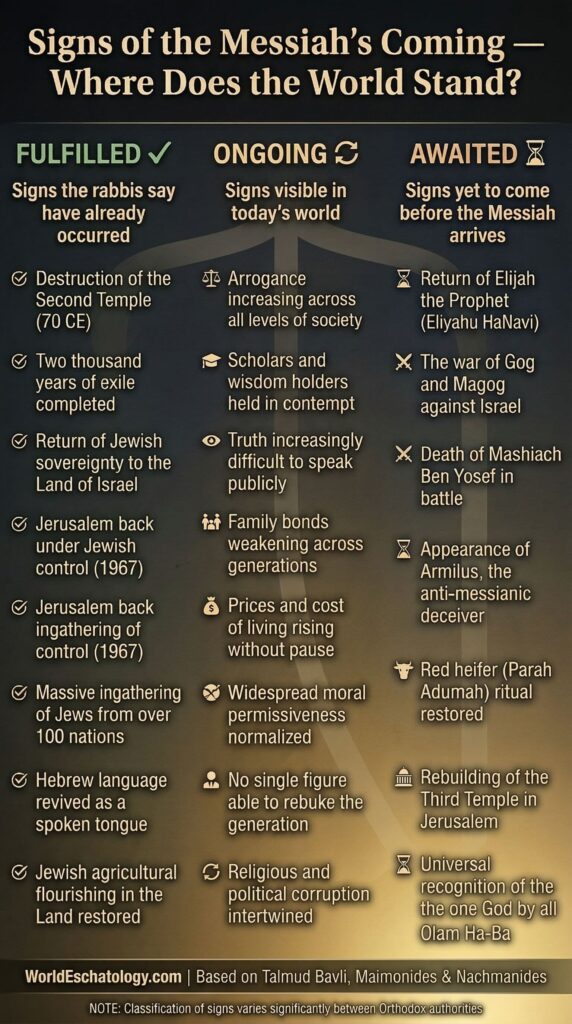
Chevlei Mashiach: The Birth Pangs of the Messiah
The Talmud in tractate Sanhedrin, particularly pages 97 through 99, contains the most detailed list of what will happen in the generation before the Messiah arrives.
The rabbis called these events Chevlei Mashiach, the birth pangs of the Messiah, using the metaphor of labor pains before birth: intense suffering that precedes new life.
The signs listed include a sharp increase in arrogance and disrespect for elders. Young people will shame the faces of old people.
Scholars will be despised. Truth will become increasingly rare. The Galilee will be laid waste.
The Golan will be desolated. Border dwellers will wander from city to city and find no mercy.
The wisdom of scholars will become corrupted. Those who fear sin will be held in contempt.
One particularly striking Talmudic passage from Sanhedrin 97a describes a time when arrogance will increase, prices will soar, the vine will yield its fruit but wine will be expensive, the government will turn to heresy, and no one will be able to rebuke another person without facing social punishment.
Several rabbis, when asked what one should do during this period, answered simply: ‘Go and hide.’
Another famous passage from Rabbi Eliezer describes the era before the Messiah’s arrival: ‘In the generation of the Messiah’s coming, audacity will increase and distinction will diminish. The vine will give its fruit but wine will be costly.
The government will turn to heresy. There will be no rebuke. The meeting houses will become houses of immorality. The Galilee will be destroyed.’
Whether these descriptions match any particular era in history is, of course, a matter of interpretation.
Every generation since these words were written has had adherents who believed they were living in the fulfillment of these signs.
What the signs do reveal is that the rabbis expected a period of moral and social deterioration before the redemption, a kind of historical low point just before the dawn.
Elijah the Prophet: The Great Announcer
One of the clearest biblical promises about the end times comes from the very last verses of the Hebrew Bible, the book of Malachi: ‘Behold, I will send you Elijah the prophet before the coming of the great and awesome day of the Lord.
He will turn the hearts of fathers to their children and the hearts of children to their fathers.’
Elijah’s role in the end times is one of the most beloved and emotionally resonant elements of Jewish eschatology timeline.
He is not just a messenger: he is the great reconciler, the one who will heal the fractured relationships between generations before the final transformation arrives.
In the Talmud, Elijah accumulates even more responsibilities. He will resolve all the legal questions that the rabbis could not definitively settle during the rabbinic period.
The Talmud uses the acronym Teku, placed at the end of unsettled legal debates, which tradition explains as shorthand for ‘Elijah the Tishbite will answer all questions and difficulties.’
When the Messiah comes and Elijah arrives before him, the accumulated legal uncertainties of centuries will be resolved.
The connection between Elijah and the Passover Seder is one of the most touching expressions of this belief in everyday Jewish life.
At every Seder table across the world, a cup of wine is poured for Elijah and the door is opened for him.
The ritual embodies a living expectation: any Passover night, in any year, could be the night Elijah arrives to announce the redemption.
The Seder’s concluding words, ‘Next year in Jerusalem,’ give voice to the same hope.
Elijah also appears at every Jewish circumcision ceremony.
A special chair, called the Chair of Elijah, is set aside because the prophet is said to be present as a guardian and witness at every bris.
He is, in Jewish tradition, the most present and most beloved of the eschatological figures.
The Cosmic Clock: Shemitah, Jubilee, and the Six-Thousand-Year Plan
Jewish tradition contains a remarkable parallel between the biblical calendar and the structure of history itself.
Just as the week has six days of work followed by a Sabbath of rest, so history itself is structured as six thousand years followed by a cosmic Sabbath.
The Talmud in tractate Sanhedrin 97a makes this explicit: ‘The world will exist for six thousand years: two thousand years of desolation, two thousand years of Torah, two thousand years of the Messianic era.’
This framework comes from reading the six days of creation as six thousand years of history, with each divine ‘day’ corresponding to a thousand human years, based on the verse ‘a thousand years in your sight are like a day gone by.’
According to the traditional Hebrew calendar, we are currently in the year 5785, meaning we are in the latter part of the sixth millennium.
The year 6000 on the Hebrew calendar corresponds to approximately 2240 CE on the Gregorian calendar.
Jewish tradition holds that by that point, the Messianic era should be well established, and the cosmic Shabbat, a millennium of divine rest and perfection, would follow.
The seven-year Shemitah cycle, during which agricultural land in Israel is supposed to lie fallow, and the fifty-year Jubilee, during which slaves are freed and land returns to its original owners, are seen as smaller-scale rehearsals of this cosmic rhythm.
In recent years, there has been significant popular interest in the Shemitah cycle and its supposed correlation with major world events, particularly financial crises.
This popular interest reflects the enduring human desire to find the end-times calendar hidden in plain sight.
What Different Jewish Movements Believe: From Orthodox to Reform
Judaism is not monolithic. The word ‘Jewish eschatology’ covers an enormous range of belief, from the most literal reading of every Talmudic passage about the Messiah and resurrection to a completely metaphorical interpretation of the same texts.
Understanding where the major Jewish movements stand is essential for anyone trying to understand Jewish end-times belief as a whole.
Orthodox Judaism: The Full Traditional Package
Orthodox Judaism holds the traditional eschatological doctrines in their most literal form.
A personal Messiah descended from David will come, gather the Jews to Israel, rebuild the Temple, and usher in an era of universal peace.
The dead will physically rise from their graves. The final judgment will occur. The World to Come will arrive.
Within Orthodoxy, however, there are significant differences.
Chabad Hasidism, the most prominent outreach-oriented Orthodox movement, has developed an intense messianic focus especially after the death of its last Rebbe, Menachem Mendel Schneerson, in 1994.
A significant faction within Chabad maintains that Schneerson himself is the Messiah and will return. This position is controversial even within Orthodox Judaism.
Religious Zionist Orthodoxy, represented by figures like the late Rabbi Zvi Yehuda Kook and continued today in the settler movement and parties like Religious Zionism in Israel, sees the modern State of Israel as a divinely guided step in the unfolding of redemption.
They read events like the 1967 Six-Day War and the return of Israeli sovereignty over Jerusalem and Judea as fulfillments of prophetic promises.
The Satmar Hasidic movement and related ultra-Orthodox groups reject Zionism entirely on eschatological grounds.
They argue that only the Messiah can legitimately bring the Jews back to Israel, and that the secular Zionist project represents a forbidden ‘forcing of the end.’
Their eschatology is equally traditional but leads to radically different political conclusions.
Conservative Judaism: The Messianic Age Over a Personal Messiah
Conservative Judaism occupies a middle position. Traditionally, it retained the liturgical language of personal Messianic hope while allowing a range of interpretation.
The Conservative movement’s prayer books generally speak of a ‘messianic age’ rather than emphasizing a single Messianic figure, though different congregations and individual rabbis land in different places.
Resurrection of the dead is formally affirmed in Conservative liturgy, with the second blessing of the Amidah prayer praising God as ‘who gives life to the dead.’
But the movement allows significant interpretive latitude, and many Conservative Jews understand this as metaphorical or as referring to spiritual immortality rather than literal physical resurrection.
Reform Judaism: Rewriting the Script
The Reform movement, which emerged in early nineteenth-century Germany and became the dominant form of American Judaism, made the most dramatic departures from traditional eschatology.
The Pittsburgh Platform of 1885, the foundational document of American Reform Judaism, explicitly rejected the belief in a personal Messiah, bodily resurrection, and the return to the Land of Israel.
It replaced these with a vision of progressive human moral development bringing about a messianic age through ethical action.
God would work through human history and human moral effort, not through supernatural intervention.
The Columbus Platform of 1937 partially walked back some of these positions, especially on the Land of Israel, and more recent Reform documents have further restored some traditional eschatological language.
But the typical contemporary Reform understanding remains: the Messiah is a symbol of human potential, resurrection is either metaphorical or not a core belief, and the messianic age is something humans build together rather than wait for God to deliver.
Reconstructionist and Renewal Movements
The Reconstructionist movement, founded by Rabbi Mordecai Kaplan in the twentieth century, sees Judaism as an evolving civilization rather than a revealed religion.
Its eschatology, to the extent it has one, is entirely naturalistic.
The concept of Tikkun Olam, repairing the world, becomes the primary end-times framework: there is no supernatural redemption coming, only the redemption that human beings build through justice, compassion, and ecological responsibility.
The Jewish Renewal movement, influenced by Kabbalah, feminism, and contemplative spirituality, takes a more mystical but still often non-literal approach.
The transformation of consciousness, the healing of human relationships with each other and with the earth, replaces the traditional expectation of divine intervention.
The Mystical Dimension: Kabbalistic Eschatology
If the Talmudic tradition provides the legal and narrative framework for jewish eschatology end times messianic age, the Kabbalistic tradition provides the cosmic drama.
Kabbalah, the Jewish mystical tradition, has developed the most elaborate and visually striking eschatological cosmology in all of Jewish thought.
Lurianic Kabbalah: The Cosmic Drama of Brokenness and Repair
Rabbi Isaac Luria, known as the Ari or the Holy Lion, lived in Safed in the Galilee in the sixteenth century and died at the age of thirty-eight.
In his short life, he developed a system of thought so original and so compelling that it transformed Jewish mysticism permanently.
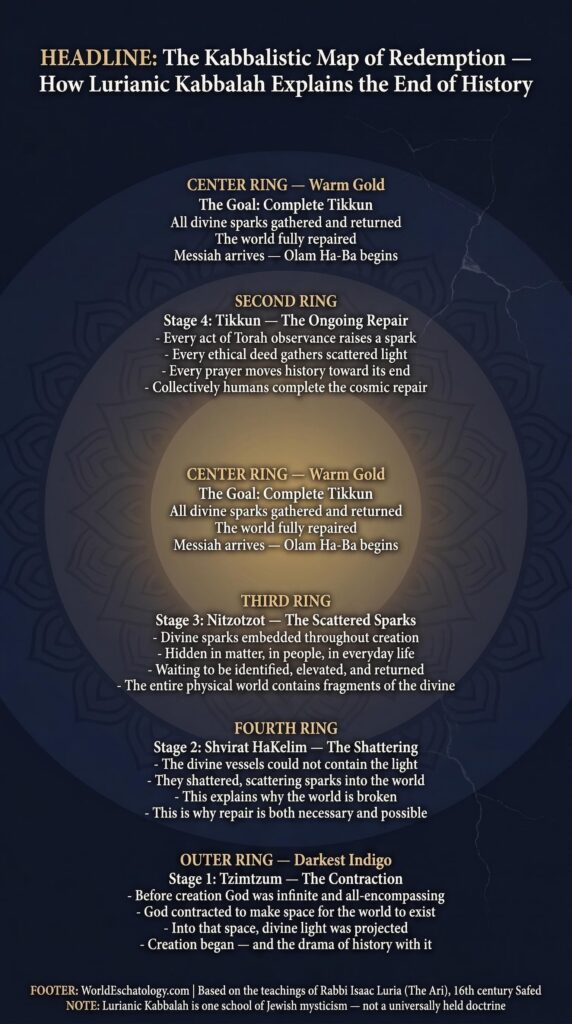
Luria’s cosmology begins before creation with a concept called Tzimtzum, the contraction. Before the universe existed, God was infinite and all-encompassing.
To make space for creation, God contracted Godself, pulling back to create a void in which the world could exist. Into this void, God projected divine light through a system of ten vessels, the Sefirot.
But the vessels shattered. Unable to contain the divine light, they broke, a cosmic catastrophe called Shvirat HaKelim, the breaking of the vessels.
The divine light scattered into countless sparks, Nitzotzot, which fell into the created world and became embedded in matter, trapped in the realm of the physical and the impure.
Here is where eschatology enters: the purpose of human existence, and especially the purpose of the Jewish people’s mission, is to find and liberate these scattered divine sparks.
Every act of Torah observance, every prayer, every ethical deed raises sparks of divine light from where they have fallen and returns them toward their source.
This process of cosmic repair is called Tikkun, and the full version is Tikkun Olam, the repair of the world.
The end of history, in Luria’s framework, is the moment when all the divine sparks have been gathered and returned.
At that point, the cosmic brokenness is healed, the divine light flows freely again, and the world is ready for the final redemption.
The Messiah can only come, in this view, when the collective spiritual work is complete.
This framework has had an enormous influence on Jewish ethics and social activism, because it gives cosmic significance to every moral action.
Feeding a hungry person, speaking truth, acting with integrity, these are not just nice things to do. They are acts of cosmic repair that move history toward its redemption.
The Zohar and the Timing of Redemption
The Zohar, the central text of Jewish mysticism traditionally attributed to the second-century sage Rabbi Shimon bar Yochai but actually composed in thirteenth-century Spain, contains numerous passages about the coming redemption.
Some of these passages contain specific references to timeframes and conditions.
These have been interpreted and reinterpreted by every generation of Kabbalists, and every generation has found reason to believe the redemption was imminent.
The history of failed Kabbalistic timelines is a reminder that the rabbis’ warning against calculating the end has not always been heeded.
Gilgul Neshamot: Reincarnation and the End of Days
One of the more surprising elements of Kabbalistic eschatology is the doctrine of Gilgul Neshamot, the transmigration of souls.
Unlike reincarnation in Hindu or Buddhist thought, which is an impersonal process driven by karma, Gilgul in Kabbalistic thought is a purposeful divine provision for souls that did not complete their spiritual mission in a previous life.
A soul may return to complete an unfinished obligation, repair a wrong done in a previous life, or accomplish a specific spiritual task it failed to complete.
The Ari was famous for his ability to read the spiritual history of souls and identify their previous lives and the tasks they had come back to accomplish.
The eschatological question that Gilgul raises is fascinating: if a soul has lived in many bodies, which body is resurrected at the end of days?
The Kabbalistic answer is that all the spiritual work of all the incarnations is gathered into the final resurrection body, which is perfected by all of it.
It is a beautiful theological solution to what would otherwise be a logistical impossibility.
Where the Traditions Meet: Jewish Eschatology in Comparison
Jewish eschatology does not exist in isolation. It is the root from which both Christian and Islamic end-times belief grew, and comparing the traditions reveals both their shared foundations and their remarkable divergences.
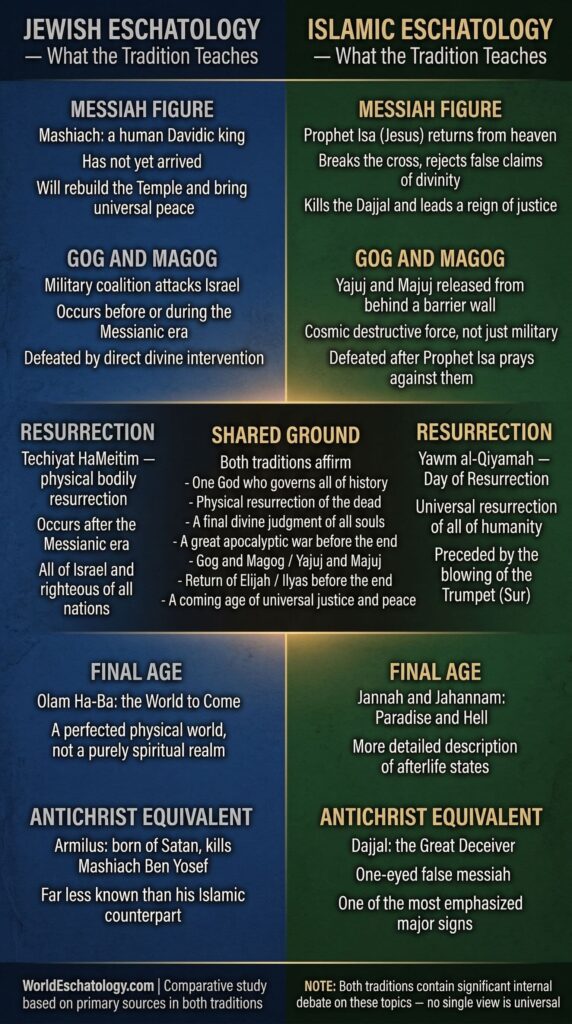
The Jewish Messiah Versus the Christian Jesus: The Heart of the Disagreement
This is the most searched and most emotionally freighted comparison in comparative eschatology. It deserves a careful, honest treatment.
Christianity emerged from first-century Jewish soil and accepted the Jewish scriptures as authoritative.
The earliest Christians were Jews who believed that Jesus of Nazareth had fulfilled the messianic prophecies. The Jewish community, by and large, disagreed.
From a traditional Jewish perspective, the disagreement is not primarily about theology but about verifiable history.
The criteria for the Messiah, as defined by the prophets and elaborated by the rabbis, are not spiritual or mystical but political and historical.
Has universal peace arrived? Has the Temple been rebuilt? Have all Jews returned to their land? Has all of humanity come to recognize the one God?
If the answer to these questions is no, as Jews believe it plainly is, then the messianic task is incomplete.
The Christian response, as noted earlier, is the doctrine of the Second Coming: Jesus accomplished the spiritual dimensions of the messianic task in his first coming, and will complete the political and historical dimensions at his return.
The Jewish response is that the concept of a Second Coming is not present in the Hebrew Bible and represents a significant modification of the original messianic concept.
It is worth noting that this debate has been conducted, historically, often under conditions of severe coercion.
Forced debates in medieval Europe, threats, expulsions, and violence have all been part of the history of this theological disagreement.
A respectful comparative understanding requires acknowledging that history.
Gog and Magog Across Three Traditions
Gog and Magog is one of the clearest examples of a shared eschatological concept that has developed very differently in its three major host traditions.
In Judaism, as covered above, Gog and Magog represents a specific military coalition that attacks Israel before the final redemption, and is defeated by divine intervention.
The focus is on the land of Israel and the Jewish people.
In Islam, Yajuj and Majuj are a massive, destructive people who are currently contained behind a great wall built by Dhul-Qarnayn.
Near the end of times, they will break free and flood the earth, destroying everything in their path.
They will be defeated by divine intervention after Jesus (Isa) prays against them.
The Islamic version is more cosmically destructive and less specifically focused on Israel.
In Christianity, particularly in the book of Revelation, Gog and Magog appear at the very end of the eschatological sequence, gathered for the final rebellion against Christ’s kingdom after the thousand-year millennium, and destroyed by fire from heaven.
The names are the same, but the narrative placement and the theological function are completely different.
All three traditions share the underlying structure: a great anti-divine force is gathered for a final confrontation, and is ultimately defeated by God.
The differences in detail are where each tradition’s distinctive theology most clearly shows.
Armilus: Judaism’s Answer to the Antichrist
Most people know that Christianity has the Antichrist and Islam has the Dajjal.
Far fewer people, even among educated Jews, know that there is a Jewish equivalent: Armilus.
Armilus appears in late midrashic literature, particularly in texts like Sefer Zerubbabel and the later midrash called Otot HaMashiach.
He is described as a being born from Satan’s encounter with a beautiful marble statue, a figure of impossible beauty and demonic power who will rise to global dominance in the period before the final redemption.
Armilus will proclaim himself God and demand to be worshipped. He will persecute Israel with particular ferocity.
Most significantly, he will kill Mashiach ben Yosef, the first of the two Messiahs, in battle.
This death will plunge the Jewish people into the deepest despair before Mashiach ben David arrives, defeats Armilus, and brings the final redemption.
The parallels to the Christian Antichrist are striking: a supremely powerful being of satanic origin who demands worship, persecutes the faithful, and is ultimately defeated by the final redeemer.
The parallel to the Islamic Dajjal, a false messiah of extraordinary power who will be defeated by Jesus, is equally clear.
The three traditions seem to share a structural need for a great deceiver who represents the ultimate test before the ultimate victory.
Armilus never achieved the same cultural prominence in Jewish tradition as the Antichrist in Christianity or the Dajjal in Islam, perhaps because the rabbis were cautious about focusing attention on dramatic jewish eschatology end times beliefs.
But he is there in the tradition, and understanding him illuminates the deep structural parallels between these three eschatological systems.
Jewish Eschatology and the Hindu Concept of Kali Yuga
The comparison between Jewish eschatology and Hindu traditions is less direct but genuinely interesting.
The Hindu concept of Kali Yuga, the final and most degraded of the four cosmic ages, shares with Jewish eschatology the idea that history moves through cycles and that the present age is characterized by moral decline before a renewal.
In Hindu cosmology, the Kali Yuga is an age of darkness, conflict, and spiritual ignorance.
It will eventually end when Kalki, the tenth avatar of Vishnu, appears to destroy the wicked and restore righteousness, beginning the next cycle of Satya Yuga, the age of truth.
The structural parallel with Jewish eschatology timeline is notable: a degenerate final age characterized by the signs described in the Chevlei Mashiach tradition, a redemptive figure who arrives to end it, and a new era of righteousness that follows.
The specific content is completely different, but the pattern of cosmic decline followed by divine intervention followed by renewal appears in both traditions with remarkable consistency.
This consistency across unconnected traditions has fascinated scholars of comparative religion and suggests something deep about how human beings think about time, history, and hope.
Modern Jewish Thought: Eschatology in the Contemporary World
Jewish end-times thinking did not stop in the medieval period.
The catastrophes and transformations of the twentieth century forced a thorough rethinking of eschatological belief, and the questions raised by the Holocaust and the founding of Israel are still being worked through by Jewish thinkers today.
Israel and the State of Messianic Expectation
No event in modern Jewish history has done more to energize eschatological thinking than the founding of the State of Israel in 1948 and the subsequent developments, especially the 1967 war and the return of Israeli sovereignty over Jerusalem and the West Bank.
For Religious Zionists, these events are not merely political. They are the beginning of the divinely promised ingathering of the exiles.
The establishment of Jewish sovereignty in the Land of Israel after two thousand years of exile, culminating in control over Jerusalem and its holy sites, is read as the unmistakable fulfillment of prophetic promises.
The establishment and growth of the State of Israel is, in this reading, part of the unfolding messianic process.
The October 7, 2023 Hamas attack and the subsequent war in Gaza have added another layer of intensity to this eschatological discourse in Israel.
Some voices in the Religious Zionist world see the conflict as connected to the tribulations expected before the redemption.
The debate about the Temple Mount, Israeli sovereignty, and the surrounding geopolitical situation is discussed in explicitly messianic terms by significant portions of the Israeli religious public in a way that would have been unusual even thirty years ago.
False Messiahs: The Most Fascinating Stories in Jewish Eschatological History
The history of false messiahs is one of the most gripping and humanly devastating chapters in all of Jewish history.
It tells the story of a people’s longing for redemption colliding with the willingness of charismatic individuals to exploit that longing.
The first great false messiah was Bar Kokhba, who led the Jewish revolt against Rome in 132-135 CE.
Rabbi Akiva, perhaps the greatest Talmudic sage of his generation, endorsed him as the Messiah, applying the verse ‘a star has come out of Jacob’ to him.
The revolt ended in catastrophic defeat. The Romans killed hundreds of thousands of Jews, renamed Jerusalem Aelia Capitolina, and banned Jews from entering it.
Rabbi Akiva was martyred. Bar Kokhba’s movement became a cautionary tale about the danger of messianic enthusiasm.
The most consequential false messiah in Jewish history was Sabbatai Zevi, who declared himself the Messiah in 1665 and attracted an almost unbelievable following across the entire Jewish world.
From Amsterdam to Yemen, from Poland to Persia, Jews sold their homes and prepared to follow him to the Land of Israel.
The great rabbi Nathan of Gaza served as his prophet. The whole Jewish world was electrified.
In 1666, the Ottoman sultan had Sabbatai Zevi arrested and offered him a choice: convert to Islam or die. He converted.
The devastation this caused across the Jewish world was almost impossible to describe.
Many followers refused to believe it and developed various theological explanations for why his conversion was part of the messianic plan.
The Sabbatean movement left a deep and troubled mark on Jewish life for over a century.
Jacob Frank, who arose in Poland in the eighteenth century claiming to continue Sabbatai Zevi’s mission, led another false messianic movement that eventually converted to Christianity under pressure.
The most contemporary and sensitive case is the Lubavitcher Rebbe.
Rabbi Menachem Mendel Schneerson was the seventh leader of the Chabad-Lubavitch Hasidic movement and one of the most remarkable Jewish leaders of the twentieth century.
He died in 1994 without designating a successor. A significant faction within Chabad, called the Meshichists, maintains that he was and is the Messiah and that his death is temporary or illusory.
The majority of Chabad officialdom does not endorse this position but has not formally condemned it either. The question remains intensely contested within the movement.
Post-Holocaust Eschatology: When the World Did Not Make Sense
The Holocaust did not just kill six million Jews. It killed the theological frameworks that many of them had relied on.
How do you maintain belief in a God who guides history toward redemption after Auschwitz?
How do you talk about the ingathering of the exiles and the coming of the Messiah when a third of the Jewish people were systematically murdered?
Jewish thinkers have wrestled with this question in deeply different ways.
Some, like Rabbi Menachem Zemba of Warsaw, who was murdered in 1943, maintained traditional faith and traditional eschatology throughout.
Others, like Elie Wiesel, emerged with a faith that was battered, questioning, even accusatory toward God, but not abandoned.
The concept of Hester Panim, the hiding of God’s face, drawn from Deuteronomy 31:18, has been used by many Jewish thinkers to grapple with the Holocaust:
God’s presence was in some sense concealed during this period, not absent, but hidden in a way that allowed human evil to operate without divine restraint.
This is not a satisfying answer to the enormity of the Holocaust, but it is an honest acknowledgment of the theological crisis it created.
The philosopher Emil Fackenheim articulated what he called the 614th commandment: ‘Jews are forbidden to hand Hitler posthumous victories.’
This means maintaining Jewish identity, raising Jewish children, and continuing to believe in the possibility of redemption, not because the theological questions are resolved, but because abandoning Jewish life would complete the work that the Nazis began.
It is eschatology as an act of defiant hope.
Frequently Asked Questions About Jewish Eschatology
These are the questions most commonly searched by people trying to understand jewish eschatology end times beliefs. Here are clear, honest answers to each.
Do Jews believe in heaven and hell?
Yes and no. The Jewish equivalents are Gan Eden and Gehenna. Gan Eden, or the Garden of Eden, refers to a state of spiritual delight and closeness to God that righteous souls experience after death.
Gehenna is a place or state of purification that souls requiring moral refinement pass through. Crucially, Gehenna in Judaism is not the eternal hell of Christian tradition.
Most authorities limit its duration to twelve months. After purification, souls enter Gan Eden. The idea of eternal damnation for ordinary sinners is not a mainstream Jewish doctrine.
What do Jews believe happens after death?
Traditional Jewish belief describes the soul leaving the body and entering the world of souls, where it either enters Gan Eden or passes through a period of purification in Gehenna.
The body returns to the earth. At the time of resurrection, the soul reunites with the body in a transformed state.
Between death and resurrection, the soul exists in an intermediate state. Different authorities describe this intermediate state differently, and Judaism has never required a single definitive answer on the specifics.
What is the Jewish version of the end of the world?
Judaism does not quite envision the ‘end of the world’ in the way that phrase is often understood.
The Jewish vision is not of a world destroyed but of a world transformed and perfected.
History moves toward the Messianic era, when the Messiah arrives and ushers in universal peace, followed by the resurrection of the dead and the World to Come.
The physical world continues, but it is healed of all that has broken it.
In the Kabbalistic tradition, all the scattered sparks of divine light are gathered and returned, completing the cosmic repair that began with creation.
Do Jews believe the Messiah has come?
Mainstream Judaism, across all denominations, believes the Messiah has not yet come.
The criteria for the Messiah, drawn from the Hebrew prophets, include the rebuilding of the Temple, the ingathering of all Jews to Israel, universal peace among nations, and the universal recognition of the one God.
Since none of these conditions have been fully met, traditional and most liberal Jewish theology holds that the Messiah has not yet arrived.
Reform Judaism reinterprets the Messiah as a symbol of a messianic age that humanity is working toward, but even in this framework, the messianic era has not arrived.
What is Tikkun Olam and how does it relate to eschatology?
Tikkun Olam literally means ‘repair of the world’ in Hebrew. In Kabbalistic thought, it refers to the cosmic process of gathering the scattered divine sparks and returning them to their source, a process that will eventually bring about the final redemption.
In contemporary Jewish usage, especially in the Reform and non-Orthodox world, Tikkun Olam has come to mean social justice work, environmental activism, and ethical action aimed at improving the world.
In both its mystical and ethical forms, Tikkun Olam carries an eschatological dimension: it is work that moves history toward its goal.
What does the Talmud say about the end times?
The Talmud, especially tractate Sanhedrin, contains extensive material on the end of days.
It describes the signs that will precede the Messiah’s arrival, including a period of moral decline, arrogance, and political corruption.
It discusses the two Messiahs, Mashiach ben Yosef and Mashiach ben David. It elaborates on the resurrection of the dead, the World to Come, and the judgment of souls.
It also repeatedly warns against trying to calculate the exact time of the end, with the famous teaching that the spirit of those who make such calculations will expire.
Do Jews believe in the Rapture?
No. The concept of the Rapture, understood as the sudden miraculous removal of believers from the earth before a period of tribulation, is a Christian doctrine with no basis in Jewish tradition.
It originates in a particular Protestant reading of the New Testament, especially First Thessalonians 4 and First Corinthians 15, combined with the book of Revelation.
Jewish eschatology has no concept of the righteous being ‘raptured’ away from earthly tribulation.
The Chevlei Mashiach, the birth pangs of the Messiah, are a period that the Jewish people pass through on earth, not a period from which they are removed.
What is Gehenna in Judaism?
Gehenna, also called Gehinnom, takes its name from the Valley of Hinnom south of Jerusalem, where, according to the Hebrew Bible, some ancient Israelites practiced the horrific ritual of passing children through fire as an offering to the god Moloch.
In rabbinic literature, Gehenna became the name for the place of purification that souls undergo after death. It is not the eternal hell of much Christian tradition.
The standard teaching is that the maximum stay in Gehenna is twelve months, after which the soul is purified and moves to Gan Eden. Only the most extreme sinners face a more permanent consequence.
Does Judaism believe in reincarnation?
This is not a mainstream belief in all of Judaism, but it is a significant belief within the Kabbalistic and Hasidic traditions.
The doctrine of Gilgul Neshamot, the transmigration of souls, holds that souls may be reincarnated multiple times to complete unfinished spiritual tasks or to repair wrongs done in previous lives.
Maimonides did not accept this doctrine. It is more associated with the mystical tradition, particularly Lurianic Kabbalah.
Mainstream non-Hasidic Orthodoxy and liberal Jewish movements generally do not emphasize or accept reincarnation as a doctrine.
How is the Jewish Messiah different from Jesus?
The core difference lies in the criteria. Traditional Jewish messianism requires verifiable historical accomplishments: the Temple rebuilt, all Jews returned to Israel, universal peace established, all nations recognizing the one God.
These are external, historical events that anyone can observe. Jesus did not accomplish these things in his lifetime.
Christians developed the doctrine of the Second Coming to explain this gap, but this concept has no basis in the Hebrew Bible as Jews read it.
Additionally, the Jewish Messiah is understood to be a human being, not a divine figure, making the Christian theological understanding of Jesus as God incarnate a fundamental departure from Jewish messianism.
Conclusion: Why Jewish Eschatology Still Matters
Jewish eschatology is not a relic of the ancient world. It is a living set of beliefs that shapes the daily prayers of millions of Jews, informs political decisions in the modern State of Israel, drives social activism in Jewish communities across the world, and continues to generate intense theological discussion in every branch of Jewish life.
It is also the root from which two of the world’s other great religions drew their own jewish eschatology end times beliefs.
Understanding what Judaism teaches about the Messiah, the resurrection, Gog and Magog, and the World to Come is essential for understanding Christianity and Islam as well.
The three traditions are in constant conversation with each other, even when that conversation takes the form of disagreement.
What strikes anyone who studies this material carefully is its persistent, stubborn hope.
Three thousand years of exile, persecution, catastrophe, and disappointment have not extinguished the Jewish conviction that history has a direction and a destination, that the world as it is is not the world as it must be, and that the work of repair, whether understood as Tikkun Olam in a Kabbalistic sense or as social justice in a progressive sense, is the most important work a human being can do.
That hope, however it is expressed, is the beating heart of Jewish eschatology.
5 thoughts on “Jewish Eschatology: A Complete Guide to Judaism’s End Times Beliefs”