
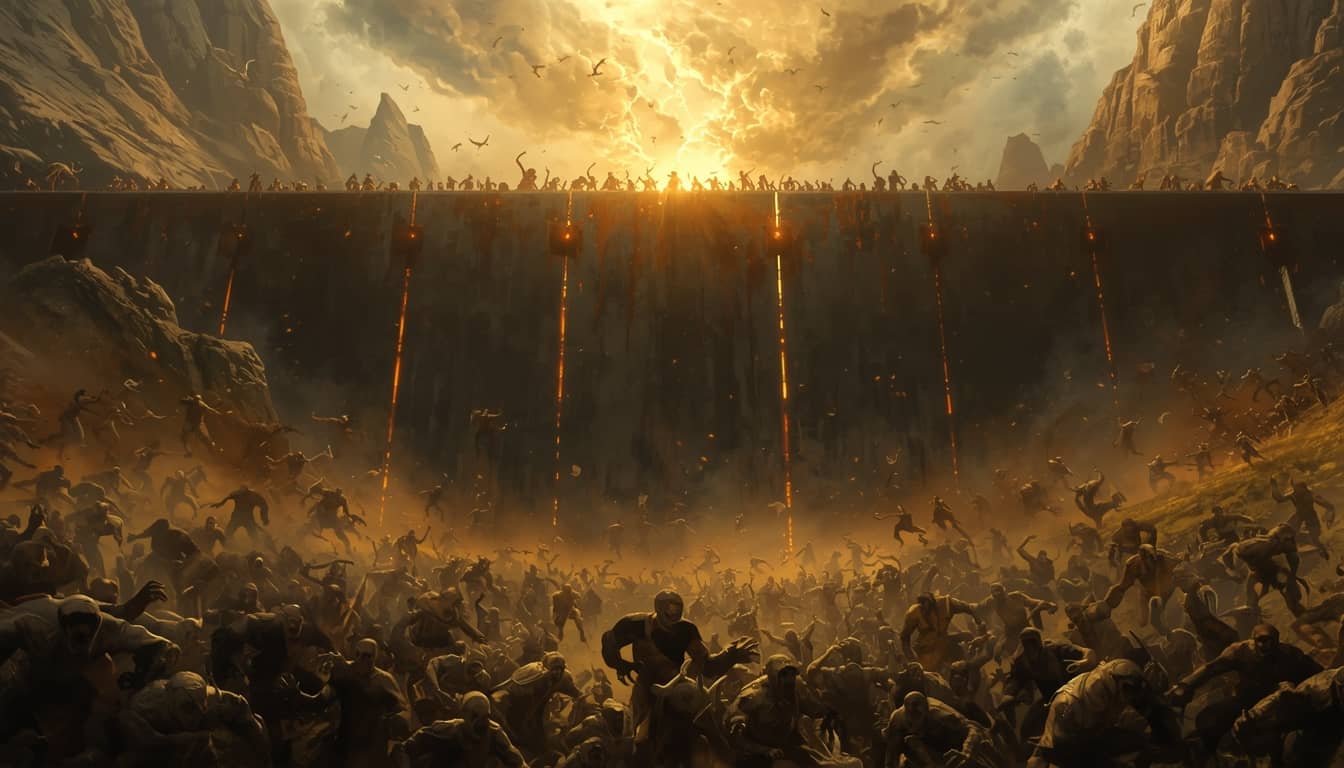
Two names. Three thousand years of interpretation. Three of the world’s major religions. And still, after all that time and all that scholarship, nobody agrees on who Gog and Magog actually are.
They begin as a single man and the territory he rules, introduced in a prophetic vision by the biblical prophet Ezekiel sometime in the sixth century BCE.
Within a few centuries, Jewish tradition transforms them into two separate nations.
The New Testament’s Book of Revelation picks them up and makes them the nations of all four corners of the earth, gathered by Satan himself in history’s final battle.
The Quran describes a great barrier built to contain them, and the hadith literature describes their eventual emergence as one of the ten major signs of the Day of Judgment, an event that will dwarf almost everything that has come before.
In the two and a half millennia between Ezekiel and the present day, Gog and Magog have been identified with the Scythians, the Khazars, the Mongols, the Turks, the Ten Lost Tribes of Israel, the Ottoman Empire, the Soviet Union, Russia, China, and, in various combinations, almost every threatening military power that has ever appeared on the edge of the civilised world.
Each generation that has encountered these names has seen its own worst fears reflected in them.
This article traces the full journey of Gog and Magog through all three Abrahamic traditions.
It covers the original Hebrew text, the Jewish eschatological development, the New Testament’s radical reinterpretation, the Islamic Quranic passages and the detailed hadith descriptions, the story of Dhul-Qarnayn and Alexander’s Gate that runs through all three, the long history of identifications and why they have consistently been wrong, and finally a direct side-by-side comparison of what the three traditions actually agree and disagree on.
The comparison reveals something worth sitting with. Three traditions working with the same names across independent lines of development have produced strikingly similar deep structures beneath their different details.
The overwhelming force from beyond the boundaries of the known world. The divine intervention that no human army can provide.
The era of peace that follows the destruction. The shared conviction running through all three is that the worst violence in history is not the last word.
The Names Themselves: What Do Gog and Magog Mean?
Before any text can be read carefully, the linguistic foundation matters, because neither name has a clear settled meaning in Hebrew and this linguistic ambiguity has been one of the driving forces behind centuries of reidentification.
Both Gog and Magog resist confident etymology. No clear Hebrew root explains either name with scholarly consensus.
Gog has been connected by some scholars to Gyges, the seventh century BCE king of Lydia in modern western Turkey, on the basis of phonetic similarity and the fact that Gyges was known as an aggressive power on the edge of the Israelite world.
If this identification is correct, Ezekiel was taking the name of a specific contemporary or near-contemporary king and projecting it onto an eschatological figure. The connection is plausible but cannot be proved.
Magog has been proposed to derive from an Akkadian phrase meaning the land of Gog, which would make it simply a geographical designation, the territory ruled by whoever Gog is.
If this is correct, the two names are not two separate entities but one name and the territory associated with it.
This reading is consistent with the earliest use of the names in Ezekiel, where Gog is a person and Magog is his land.
The Septuagint, the ancient Greek translation of the Hebrew Bible made in the last few centuries before the common era, occasionally substitutes one name for the other in passages where they appear, suggesting that even ancient translators working close to the original text did not always know which was which.
This interchangeability is itself significant: the names were understood as related and in some sense equivalent rather than as clearly distinct entities.
The absence of clear meaning is not a deficiency of the text. It is part of what makes Gog and Magog so structurally useful as eschatological categories.
A name whose meaning is fixed and whose referent is clear can only describe what it describes.
A name without a settled meaning can be reattached to each new threat as it arises, carrying the full prophetic weight of the tradition with it. This is precisely what has happened across three millennia.
The First Appearance: Genesis 10 and the Table of Nations
The first appearance of these names in the Bible is entirely undramatic, which is itself revealing.
In Genesis 10, the Table of Nations traces the genealogical descent of all the peoples of the known world from the three sons of Noah.
Japheth, the eldest son, is listed as the ancestor of the northern and western peoples. His sons include Gomer, Magog, Madai, Javan, Tubal, Meshech, and Tiras.
Magog appears here simply as one of the grandsons of Noah and the ancestor of a people who lived somewhere to the north or northeast of the ancient Israelite world.
There is no dramatic context. There is no threat. There is no eschatology. Magog is listed between Gomer and Madai as part of the genealogical accounting of human diversity after the flood.
Gog does not appear in this passage at all. The Gog of Ezekiel who rules the land of Magog is not the same figure as any character in Genesis 10.
He appears for the first time as a prophetic figure in Ezekiel, and his connection to Magog from Genesis 10 is the connection between a ruler and his territory, not a genealogical link.
There is, however, a brief and easily overlooked mention of a man named Gog in 1 Chronicles 5:4, where he appears in the genealogy of the prophet Joel as one of his descendants.
This Gog has nothing to do with eschatology and is clearly a common personal name used in ancient Israel rather than a reference to the eschatological figure.
What this tells us is that before Ezekiel gave the name its prophetic weight, Gog was simply a name, and Magog was simply a people.
Ezekiel 38 and 39: The Foundation of Everything
Ezekiel 38 and 39 are the foundation on which all subsequent Jewish, Christian, and Islamic Gog and Magog theology is built.
Without these two chapters, neither the New Testament’s use of the names nor the Quranic references would have the context that gives them their meaning.
Reading them carefully is not optional for understanding any of the three traditions.
The Vision and Its Characters
The word of the Lord comes to Ezekiel: set your face toward Gog, of the land of Magog, the chief prince of Meshech and Tubal.
God addresses Gog directly, as if summoning him, telling him that in the latter days he will be brought against the mountains of Israel after the people of Israel have been gathered from the nations and are living in security.
Gog comes with a vast coalition. Persia, Cush, and Put are among the nations riding with him. So are Gomer and Beth-togarmah from the far north.
The force that descends on Israel is described as a great horde, many peoples, like a cloud covering the land.
“You will come from your place out of the far north, you and many peoples with you, all of them riding on horses, a great horde, a mighty army. You will come up against my people Israel, like a cloud covering the land. In the latter days I will bring you against my land, that the nations may know me, when through you, O Gog, I vindicate my holiness before their eyes.”
The Divine Response
The invasion is not stopped by any human army. At the moment Gog comes against the mountains of Israel, God intervenes directly and catastrophically.
A great earthquake shakes the land so violently that mountains are thrown down and cliffs collapse.
Torrential rain, hailstones, fire, and sulfur rain down on Gog and his forces.
In the confusion and terror, the soldiers turn their swords against each other. Five-sixths of the invading army is destroyed.
The aftermath is described with unusual specificity: it will take seven months for the house of Israel to bury all the dead, and dedicated teams will be set up to search the land systematically to find and bury whatever remains.
The weapons will provide enough fuel to burn for seven years, so great is their quantity.
Birds and wild animals feast on the fallen, in what Ezekiel calls the sacrificial feast of God.
The purpose of all this, stated explicitly in the text, is that the nations will know that God is the Lord. Gog is not an accident or a tragedy.
He is an instrument of divine self-revelation, a force that God summons precisely so that his defeat can demonstrate to the watching world what divine sovereignty actually looks like.
The Interpretive Questions Ezekiel Raises
Three questions dominate the scholarly discussion of these chapters and directly shape how the three traditions have interpreted them.
The first is whether Gog was a historical figure Ezekiel expected to appear in his near future or an eschatological figure whose appearance is indefinitely distant.
The phrase in the latter days in 38:16 is the primary anchor for the eschatological reading.
But the phrase is ambiguous: in Hebrew prophecy it does not necessarily mean the end of all things. It can simply mean at a future time or in days to come.
The eschatological reading became dominant in all three traditions, but it is not the only reading the text supports.
The second question is whether the prophecy has already been fulfilled, and by whom.
Some Jewish commentators have identified the Babylonian invasion, the Seleucid invasion under Antiochus, or various other historical conflicts as partial fulfilments.
But the scale of the divine intervention described, the earthquake, the fire, the seven months of burial, has never clearly matched any historical event, which is why the strictly futurist reading, that this is entirely yet to come, has remained dominant across all three traditions.
The third question is the relationship between Ezekiel 38-39 and the battle described in Revelation 20.
They share the names and the basic pattern but differ in timing, scope, and certain details.
Whether John was deliberately reinterpreting Ezekiel or drawing on a shared apocalyptic tradition is a question that has significant consequences for how both passages are read.
Gog and Magog in Jewish Tradition: The Rabbinic Development
The transformation of Ezekiel’s Gog from Magog into the Gog and Magog of later Jewish tradition is one of the most interesting processes in the history of Jewish eschatological thought.
The names are the same, but what they carry has been substantially enriched across the centuries of Talmudic and midrashic engagement.
From One Name to Two Nations
In Ezekiel, Gog is a person and Magog is his land. The shift to treating Gog and Magog as two names for the same nation, or as two nations who together constitute the eschatological enemy, is a development of later Jewish tradition.
The aggadah, the non-legal interpretive literature of the Talmud, treats Gog and Magog as two names for the same nation who will come against Israel in the final war.
This consolidation of the two names into a single threatening force became the standard rabbinic understanding.
The shift happens partly through the influence of Revelation and partly through the internal logic of Jewish eschatological development during and after the Roman period.
When the Bar Kokhba revolt against Rome failed in 135 CE and the dream of military liberation proved impossible, Jewish eschatology moved increasingly toward supernatural categories.
The defeat of God’s enemies would not come through human military success. It would come through divine intervention, and the enemies to be defeated would be not merely human powers but forces of cosmic opposition to God’s sovereignty.
The Messianic Sequence
In the rabbinic development, the war of Gog and Magog becomes embedded in the messianic sequence as a penultimate event.
The pattern that emerged from various Talmudic and midrashic sources describes the following structure: first comes a period of terrible tribulation, the birthpangs of the Messiah, characterised by wars, famines, and moral collapse.
Then comes the Messiah ben Joseph, a forerunner figure who will lead Israel against its enemies and be killed in battle.
Then comes the war of Gog and Magog, which is stopped by divine intervention.
Then the Messiah ben David arrives, the dead are resurrected, divine judgment is rendered, and the messianic era of universal peace and knowledge of God begins.
The war of Gog and Magog is therefore not the end of history in the Jewish framework.
It is the transition event, the catastrophic conflict that clears the ground for the arrival of the Messiah and the establishment of the age of universal divine sovereignty.
This placement is significantly different from the New Testament’s placement of Gog and Magog at the very end of history after the millennium, and the difference has real theological implications.
The Sukkot Connection
One of the most remarkable details in the rabbinic Gog and Magog tradition is the connection with the festival of Sukkot, the Feast of Tabernacles.
The Talmud teaches that in the messianic era, all the nations of the world will come to Jerusalem to observe Sukkot and to acknowledge the sovereignty of God.
But Gog and Magog will refuse. Their refusal will be met with a specific punishment, the withholding of rain, which is the particular blessing associated with Sukkot in the Jewish liturgical calendar.
This connection places the final confrontation with Gog and Magog within the specific ritual calendar of Jewish practice, rooting the eschatological in the liturgical in a way that is characteristically Jewish.
The war of Gog and Magog is not an abstraction. It is the refusal of those nations to join in the worship that the entire world is invited to offer, and the consequence of that refusal is the withdrawal of the blessing that the worship was meant to secure.
The Historical Identifications in Jewish Tradition
Jewish tradition identified Gog and Magog with various threatening peoples at different historical moments.
Josephus, writing in the first century CE, identified Magog with the Scythians, the ferocious nomadic warriors of the northern steppes who had been a source of fear in the ancient Near East.
This identification was not merely geographically convenient. The Scythians represented precisely the kind of overwhelming force from beyond the civilised world that Ezekiel’s imagery evoked.
In the medieval period, the identification shifted as new threats emerged.
The Khazars, a Turkic people of the Caspian steppe region who famously converted to Judaism in the eighth or ninth century, were identified with Gog and Magog by several medieval writers.
The irony of a people who had converted to Judaism being identified with the eschatological enemies of Israel was not lost on everyone, and some commentators specifically distinguished between the Khazars and Gog and Magog.
The Mongol invasions of the thirteenth century produced the most intense wave of identification:
the sudden appearance of an apparently unstoppable force from the far north and east, destroying everything in its path, seemed to many Jewish observers in the communities devastated by the Mongols to be precisely what Ezekiel had described.
Gog and Magog in the New Testament: Revelation 20
The New Testament mentions Gog and Magog exactly once, in a passage that is simultaneously brief and of enormous eschatological weight.
It comes at the very end of the thousand-year reign described in Revelation 20, just before the final judgment and the new creation.
And it differs from Ezekiel in several significant ways that have shaped two thousand years of Christian interpretation.
“When the thousand years are ended, Satan will be released from his prison and will come out to deceive the nations at the four corners of the earth, Gog and Magog, to gather them for battle; their number is like the sand of the sea. And they marched up over the broad plain of the earth and surrounded the camp of the saints and the beloved city, but fire came down from heaven and consumed them, and the devil who had deceived them was thrown into the lake of fire and sulfur where the beast and the false prophet were, and they will be tormented day and night forever and ever.”
What Is New in Revelation
The differences from Ezekiel are substantial and deliberate. In Ezekiel, Gog is a named individual from a named territory, leading a named coalition of nations.
In Revelation, Gog and Magog are the nations at the four corners of the earth: the entire human population that has survived the millennium is potentially gathered in this final attack.
The scope has expanded from a regional military coalition to a global uprising.
In Ezekiel, God summons Gog and uses him as an instrument of divine self-revelation.
The initiative, however paradoxically, is God’s. In Revelation, Satan is released from his imprisonment and immediately goes out to deceive the nations and gather them.
The initiative belongs to Satan, who is acting as he always acts, as a deceiver and a gatherer of opposition to God.
In Ezekiel, the location of the final confrontation is the mountains of Israel.
In Revelation, Gog and Magog march across the broad plain of the earth and surround the camp of the saints and the beloved city, a phrase most interpreters identify with Jerusalem.
The geographical detail shifts from the specific landscape of northern Israel to a more schematic cosmic confrontation.
In both texts, no human army resists or defeats the invaders. In Ezekiel, God’s direct supernatural intervention through earthquake, fire, and sulfur destroys the force.
In Revelation, fire simply comes down from heaven. The passivity of the saints is complete: they do not fight back.
They are surrounded, they are in the beloved city, and then God acts. The message in both texts is the same: this is beyond human capacity to resolve.
The Four Interpretive Frameworks for Revelation 20
How a reader understands Revelation 20’s Gog and Magog depends almost entirely on which interpretive framework they bring to the millennium that precedes it.
Futurists understand the millennium as a literal future thousand-year reign of Christ on earth.
On this reading, the Gog and Magog attack is a future post-millennial event, a final rebellion of those who have survived the tribulation and lived through the millennium but ultimately refuse to surrender their hearts to Christ’s rule.
This is the dominant framework in modern American evangelicalism.
Preterists understand Revelation as substantially fulfilled in the events of the first century, particularly the destruction of Jerusalem in 70 CE.
On this reading, Gog and Magog represent the nations that opposed the early church, understood as the fulfilment of Ezekiel’s prophecy in the new covenant context.
Amillennialists understand the millennium as the present church age, during which Christ reigns through his church.
On this reading, the Gog and Magog attack represents the final assault of evil at the very end of the current age, just before Christ’s physical return and the final judgment.
Idealists treat Revelation as a timeless symbolic portrayal of the conflict between good and evil rather than a predictive map of specific historical events.
On this reading, Gog and Magog are a symbol of the final futile attempt by evil to overthrow the divine order, a symbol that is always true rather than being tied to specific events.
The Christian Historical Identifications: Sixteen Centuries of Candidates
Christianity developed an extraordinarily rich tradition of identifying Gog and Magog with specific threatening peoples and political forces, and the history of those identifications is one of the most instructive chapters in the entire story.
The Scythians and the Early Church
The earliest significant Christian identification followed Josephus in connecting Magog with the Scythians.
For the early church, the Scythians served as the template for what Gog and Magog looked like: ferocious, numerous, coming from beyond the known world, resistant to civilised order.
Jerome in the fourth century wrote that the Scythians represented the peoples who would one day be gathered against the people of God.
Alexander’s Gate: The Legend That Shaped the Medieval World
One of the most influential stories in the entire history of Gog and Magog is not a biblical story at all.
It is the legend of Alexander’s Gate, the claim that Alexander the Great built a great wall or gate in the passes of the Caucasus Mountains to imprison Gog and Magog, the savage peoples of the north, until the appointed time of their release at the end of days.
This story has no historical basis in Alexander’s actual campaigns. But it became one of the most widely circulated stories in medieval Christendom and spread into Islamic literature as well.
It gave Gog and Magog a concrete geographical location in the Caucasus, a historical imprisoner in Alexander, and a mechanism for their eventual release consistent with apocalyptic expectation.
The Syriac Christian Alexander Romance, which predates Islam and circulated widely in the late antique world, is the earliest clear literary source for the story of the great king building a barrier against the savage peoples of the north.
Scholars including Emeri van Donzel and Andrea Schmidt have traced the influence of this Syriac tradition on early Islamic treatments of Dhul-Qarnayn, making the Alexander story a critical link between Christian and Islamic versions of the Gog and Magog narrative.
The Mongols: The Identification That Convinced Everyone
The thirteenth-century Mongol invasions produced the most intense and most geographically widespread identification of Gog and Magog in history.
In a matter of decades, the Mongols had destroyed the Abbasid Caliphate, devastated Russia and Eastern Europe, and created a transcontinental empire whose military effectiveness seemed supernatural to those in its path.
Jewish communities in Eastern Europe and the Middle East, Christian communities across the continent, and Muslim scholars in the devastated regions of Central Asia and Persia all independently identified the Mongols as Gog and Magog at roughly the same time.
Marco Polo noted the Mongol folk tradition that they were descended from Gog and Magog. Matthew Paris, the English chronicler, wrote of the Mongols in language that explicitly recalled Ezekiel.
The Baghdad scholar Abu Hamid Muhammad al-Gharnati had identified the Tatars as Yajuj and Majuj years before the full Mongol invasion.
The Mongol identification is the clearest case in the entire history of these names where all three Abrahamic traditions simultaneously looked at the same historical force and reached the same prophetic conclusion.
The consensus was wrong in the sense that the Mongols were not the final eschatological Gog and Magog.
But the consensus tells us something important about how the names function: they are available to any generation that encounters an overwhelmingly threatening force from beyond the boundaries of the familiar world.
Russia and the Rosh Question
The identification of Russia as the prophetic Gog became the dominant reading in evangelical dispensationalist prophecy from the late nineteenth century onward and reached mass popular culture through Hal Lindsey’s The Late Great Planet Earth in 1970.
The argument rests on a transliteration of the Hebrew word rosh in Ezekiel 38:2-3, where Gog is described as the chief prince of Meshech and Tubal.
Some translations, including a literal rendering of the Hebrew, read this as the prince of Rosh, Meshech, and Tubal, and interpreters identified Rosh with Russia, Meshech with Moscow, and Tubal with Tobolsk.
Mainstream biblical scholarship has consistently rejected this identification on linguistic grounds: rosh in the relevant Ezekiel passages is a common adjective meaning chief or head, not a proper noun referring to a specific people.
The identification of Meshech with Moscow and Tubal with Tobolsk is also phonetically strained and without historical support.
But the Russia identification became embedded in popular evangelical eschatology and survived the Soviet Union’s dissolution.
The continuing identification of Russia as Gog in contemporary evangelical prophecy teaching is one of the clearest contemporary examples of the pattern that has repeated throughout history: the prophetic names attach to the most threatening geopolitical force of each era.
Yajuj and Majuj in the Quran: Two Passages, Two Angles
The Quran mentions Yajuj and Majuj in two separate passages, each providing a different perspective on what they represent in the Islamic eschatological framework.
Surah Al-Kahf: The Barrier
“They said: O Dhul-Qarnayn, indeed Yajuj and Majuj are corrupters in the land. So may we assign for you an expenditure that you might make between us and them a barrier? He said: That in which my Lord has established me is better, but assist me with strength, I will make between you and them a dam. Bring me sheets of iron, until when he had leveled between the two mountain walls, he said, blow, until when he had made it a fire, he said, bring me, that I may pour over it molten copper.”
The scene in Surah Al-Kahf is remarkable for its specificity. A great ruler travelling the earth reaches a people who are being devastated by the corruption of Yajuj and Majuj, invisible to the reader but evidently nearby.
The ruler builds not merely a wall but an engineering feat: sheets of iron between two mountains, heated to fire, then sealed with molten copper.
It is a construction of iron and copper, the hardest materials the ancient world knew, making it impenetrable.
Dhul-Qarnayn’s acknowledgment that this barrier is from God’s provision rather than his own strength, and his statement that when the promise of his Lord comes the barrier will be levelled to dust, establishes the fundamental Islamic theological framing: the barrier is divinely maintained, and its eventual breach is divinely appointed.
No human force holds Yajuj and Majuj back. God holds them back, through a divinely appointed instrument.
Surah Al-Anbiya: The Release
“Until when Yajuj and Majuj are let loose and they hasten from every mound, and the true promise has approached, and suddenly the eyes of those who disbelieved are fixed in horror, saying: Woe to us, we had been unmindful of this, but we were wrongdoers.”
This passage places the emergence of Yajuj and Majuj explicitly within the eschatological timeline as a sign that the True Promise, the Day of Judgment, is drawing near.
The image of them hastening from every mound is one of the most vivid images of overwhelming mass movement in the entire Quran: they do not march in organised formation but swarm from every direction simultaneously, a force of pure number and momentum.
The response of the disbelievers in this passage is significant: they are horrified not by Yajuj and Majuj themselves but by the realisation that the signs they dismissed have proven real.
The emergence of Yajuj and Majuj does not itself devastate the disbelievers. What devastates them is the recognition that the divine promise was true all along and they were not paying attention.
Who Is Dhul-Qarnayn?
The Quran identifies the builder of the barrier only as Dhul-Qarnayn, meaning the one with two horns or the one of two ages, a title rather than a name.
The text does not identify him with any historical figure, and the three major scholarly identifications each have supporting arguments.
Alexander the Great is the most historically popular identification in Muslim scholarship.
The convergence of the Quranic description with the Syriac Alexander legend is the primary evidence, and medieval Muslim geographers and historians generally accepted this identification.
However, the theological difficulty is significant: Alexander was a Greek polytheist who worshipped the traditional Greek gods.
Several scholars have found it unlikely that the Quran would present a polytheist as the divinely guided builder of the barrier.
Cyrus the Great of Persia is favoured by several modern scholars, including Abul Kalam Azad.
Cyrus was a monotheist in the general sense, an early champion of religious tolerance, and his empire did span from east to west and reach toward the Caucasus region.
His designation in the Hebrew Bible as God’s anointed in Isaiah 45:1 gives him a status in the Abrahamic tradition that Alexander does not have.
A Himyarite king of ancient Yemen has been proposed by scholars who note that Dhul-Qarnayn was a common title in Yemeni royal inscriptions and that the pre-Islamic Arabian context would make a Yemeni king more immediately recognisable to the Quran’s first audience.
No consensus has been reached, and Muslim scholars generally hold that the question is legitimately open.
Yajuj and Majuj in the Hadith: The Detailed Picture
The Quran establishes the framework. The hadith literature fills in the details, and it does so with the kind of specificity that has shaped Muslim popular imagination about Yajuj and Majuj far more than the Quranic passages alone.
The Barrier and Its Daily Renewal
One of the most striking hadith details about Yajuj and Majuj is the description of their relationship with the barrier while they are still contained behind it.
The hadith collected in the major canonical collections describes Yajuj and Majuj digging and scratching at the barrier every day until they can see light through the thinning wall, at which point they stop and say they will finish it tomorrow.
The next day they return and find it fully restored, as if they had never started. This cycle repeats day after day.
The final breach occurs when one of them says insha’Allah, God willing, we will finish it tomorrow. The next day they return and the wall is not restored: they break through.
The inclusion of insha’Allah in this hadith has been noted by scholars as theologically significant.
The acknowledgment of divine will as the condition of any human plan is what allows the barrier to fail at the divinely appointed time.
The barrier is not breached by superior force or engineering skill. It is breached at the moment of God’s choosing, when the conditions He set are met.
Their Emergence and What They Do
The hadith describes the emergence of Yajuj and Majuj as occurring after the defeat of the Dajjal, during the time of Prophet Isa’s reign on earth.
They come in numbers that dwarf all previous military forces in history.
One of the most cited hadith descriptions says that the first of them will drink the Sea of Galilee dry, and the last of them will pass the dried lakebed and say there must have been water here once.
They spread across the earth consuming and destroying everything in their path. Their arrogance reaches a specific scriptural expression: they shoot their arrows into the sky, and the arrows return stained with what appears to be blood.
They declare that they have killed the inhabitants of the heavens. This detail, which appears in several hadith narrations, communicates the theological character of their rebellion:
they are not merely destructive but blasphemous, not merely powerful but arrogant against the divine.
Their Destruction
Prophet Isa takes the believers to Mount Tur for protection. No human army can stop Yajuj and Majuj: the hadith is explicit on this point.
The response to their devastation is supplication. Prophet Isa prays to Allah, and Allah responds by sending a worm or small creature, described in various narrations as a naghaf, that enters the necks of Yajuj and Majuj and kills them all in a single night.
The morning comes and the earth is covered with their bodies.
The aftermath described in the hadith is extraordinary: the earth’s surface is so covered with bodies that it is uninhabitable.
Allah sends birds to carry the corpses away. He then sends rain that washes the earth clean, producing soil so fertile that a single pomegranate is enough to provide shade for a group of people, and the horn of a single bull provides food for a family for a year.
The destruction of Yajuj and Majuj is followed immediately by a period of abundance that reverses all the deprivation their devastation had caused.
Are They Human?
The question of whether Yajuj and Majuj are human beings has generated discussion in Islamic scholarship, partly because some of the physical descriptions in certain narrations seem to suggest non-human characteristics.
The overwhelming scholarly consensus, based on the strongest authenticated hadith, is that Yajuj and Majuj are human beings from the children of Adam.
The Sahih Bukhari and Sahih Muslim narrations affirm this. Several Quranic verses referring to them use language most naturally applied to human peoples rather than supernatural creatures.
The consensus position of mainstream Sunni Islamic scholarship is unambiguous: they are human beings of extraordinary numbers and ferocity, not supernatural entities.
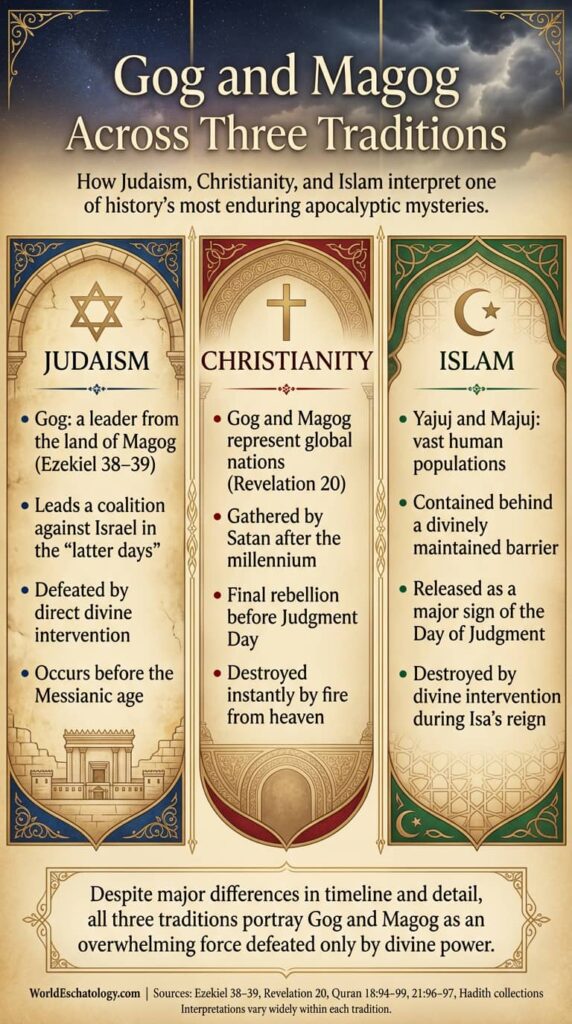
The Three Traditions Compared: A Direct Analysis
Having examined each tradition on its own terms, a direct comparison can now be made honestly and specifically.
The comparison covers four dimensions: timing, nature, the force that destroys them, and the aftermath.
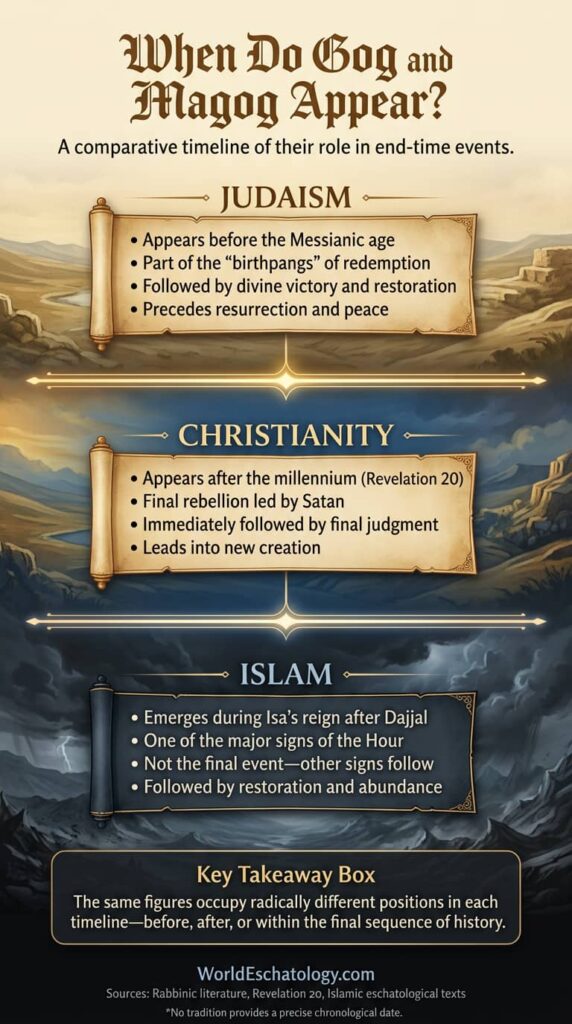
Timing: When Do Gog and Magog Appear?
This is the most structurally significant difference between the three traditions.
In normative Jewish eschatology, the war of Gog and Magog precedes the arrival of the Messiah.
It is among the birthpangs of the messianic era, the catastrophic conflict that clears the ground for the restoration of Israel and the establishment of universal divine sovereignty. The Messiah arrives in the aftermath, not before.
In Revelation 20, the attack of Gog and Magog comes after the millennium, after the thousand-year reign of Christ, after the binding of Satan.
It is the last event before the final judgment and the creation of the new heaven and new earth.
In the Christian futurist timeline, Gog and Magog come after everything else, as the final assault before history ends.
In Islamic eschatology, Yajuj and Majuj emerge during the time of Prophet Isa’s post-Dajjal reign on earth.
Their emergence is Sign Four in the sequence of major signs, after the Mahdi, the Dajjal, and the descent of Isa, and before the remaining signs.
They are not the last event. Several major signs follow their destruction before the Hour itself.
These three placements are genuinely different. They are not minor variations in a single timeline.
They represent three different understandings of where the final overwhelming battle fits in the structure of history’s end.
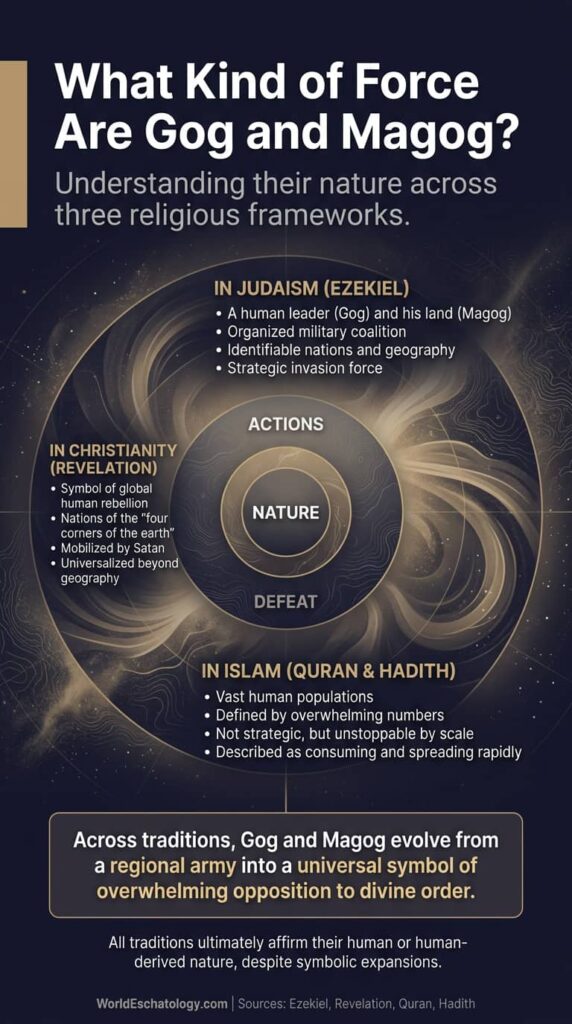
Nature: What Kind of Force Are They?
In Ezekiel, Gog is a named human king leading a named human coalition of nations.
The forces are military and geographical: they come from identifiable places with identifiable weapons.
In Revelation 20, Gog and Magog are the nations of all four corners of the earth, gathered by Satan.
They have become the totality of human resistance to God, universalised beyond any specific geography or culture.
In Islamic hadith, Yajuj and Majuj are human beings, confirmed as descendants of Adam, but their defining characteristic is number rather than military sophistication.
They do not conquer through strategy. They overwhelm through sheer mass.
What all three share is the quality of being beyond ordinary human capacity to resist. In no version of the story does a human army stop them.
This is the theological point that all three traditions are making with different imagery: the ultimate threat to the divine order is not something that can be handled by human means alone.
The Force That Destroys Them
In Ezekiel, God sends earthquake, torrential rain, hailstones, fire, and sulfur on Gog’s forces. The army also turns on itself in confusion.
In Revelation, fire comes down from heaven. In Islam, Allah sends a worm that kills them overnight.
The variation in mechanism is less significant than the constant: in every case, the destroying force is divine rather than human, sudden rather than gradual, and disproportionately small relative to the threat.
A worm kills the force that drank a sea dry. Fire from heaven destroys the army that was as numerous as the sand of the sea.
This disproportion is the theological point: the power that destroys Gog and Magog is not impressive human military force.
It is the simplest possible divine act. The contrast between the overwhelming scale of the threat and the simplicity of the divine response is itself the revelation.
The Aftermath
Ezekiel describes seven months of burial and seven years of burning weapons, a period of restoration through the slow work of cleaning up the catastrophe.
Revelation moves immediately from the destruction of Gog and Magog to the great white throne judgment: there is no restoration period in this world because the new creation follows directly.
Islamic hadith describes birds carrying away the bodies, cleansing rain, and then extraordinary agricultural abundance, a world renewed and made fertile by the passing of the worst thing that ever happened to it.
The shared element in all three is a positive transformation following the destruction: restoration in Ezekiel, final justice and new creation in Revelation, abundance and renewal in Islam.
Gog and Magog are not the end of the story in any tradition. They are the threshold event that separates the age of struggle from the age of resolution.
The Barrier and What It Represents
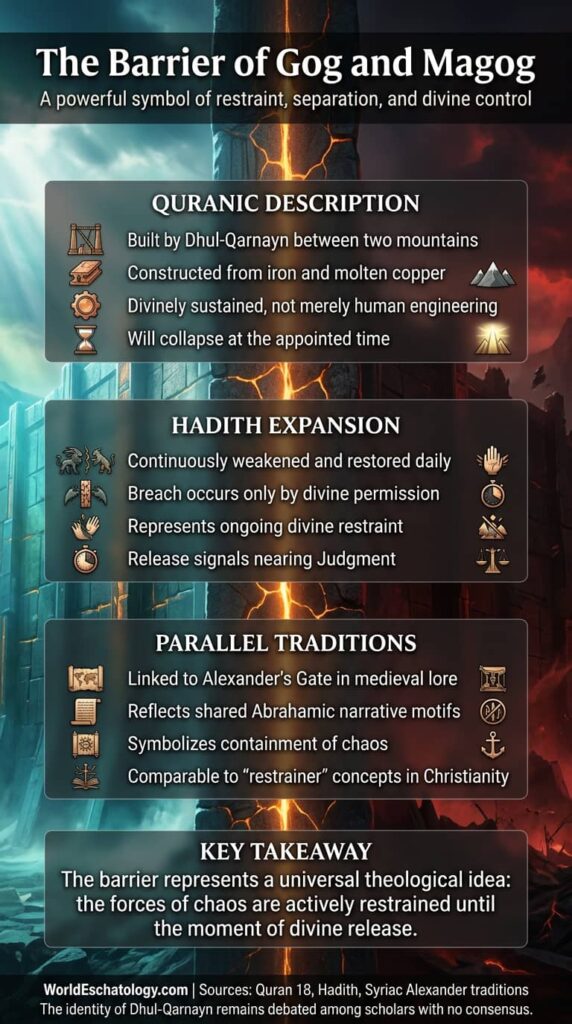
The barrier built by Dhul-Qarnayn to contain Yajuj and Majuj is one of the most theologically generative images in the entire Gog and Magog tradition, and it appears in both the Quran and in the long tradition of Christian and Jewish legends about Alexander’s Gate.
At its most basic level, the barrier is a structure that separates the ordered world from the chaotic force that would overwhelm it if released.
The world as it currently exists, with its imperfect but real order, its limited but genuine conditions for human moral and spiritual development, depends on the barrier holding. When the barrier fails, the age of ordinary history ends.
In the Islamic hadith, the barrier is maintained by daily divine intervention: Yajuj and Majuj come close to breaching it every day, and every night it is restored.
This detail communicates something important: the restraint of the forces of chaos is not automatic or mechanical.
It is active, ongoing, and dependent on divine will at every moment. The barrier is not a self-sustaining structure. It is a daily miracle.
The connection to Paul’s restrainer in 2 Thessalonians 2, the mysterious force that holds back the man of lawlessness until the appointed time, is structural rather than textual: both the barrier and the restrainer serve the same theological function.
They are divinely maintained conditions that allow history to continue until the moment of their removal, at which point the final events are triggered.
This structural parallel, across traditions that developed largely independently, is one of the most interesting features of the comparative eschatological landscape.
The allegorical and spiritual readings of the barrier have developed particularly in Sufi Islamic thought, where the barrier is understood as the spiritual disciplines and divine grace that contain the forces of ego and desire within the human soul.
On this reading, the inner Yajuj and Majuj are the unrestrained appetites of the self, and the barrier is the practice of remembrance and self-discipline that prevents them from overwhelming the spiritual life.
The eschatological event becomes simultaneously a description of the human interior landscape and of cosmic history.
Who Are They? The History of Identifications
The history of attempts to identify Gog and Magog with specific peoples and nations is one of the longest and most consistently unsuccessful projects in religious scholarship.
It is also one of the most revealing, because the pattern of identification tells us something important about how eschatological prophecy functions in human communities.
The Scythians were the first major identification, proposed by Josephus and accepted widely in early Jewish and Christian interpretation.
Ferocious nomadic warriors from the northern steppes, they matched the physical description well.
They never appeared as the final enemy of God, and the identification was eventually abandoned.
The Khazars were identified across Jewish, Christian, and Islamic sources in the eighth through tenth centuries.
Their conversion to Judaism gave the identification an ironic twist, but the theological pressure toward identifying the threatening Turkic steppe power with the eschatological enemy was stronger than the irony.
The Mongols produced the most globally synchronised identification in the history of the names.
Jewish, Christian, and Muslim scholars and communities all made the identification independently during the thirteenth century, drawn by the apparent impossibility of stopping the Mongol advance. The Mongols were not the eschatological Gog and Magog.
The Turks were the most common Islamic identification in the hadith commentary tradition. Several companions and early scholars made this identification.
The Ottoman Empire, at its peak, seemed to many observers to fulfil the description. The Empire rose and fell without fulfilling the eschatological role assigned to it.
The Ten Lost Tribes of Israel were identified with Gog and Magog in medieval Christian tradition beginning around the twelfth century, a striking inversion in which the ultimate eschatological threat came from within Israel rather than from outside it.
This identification reflected the anxieties of medieval Christendom about the nature of Jewish communities within European society and has no serious scholarly support.
Russia, from the nineteenth century onward, became the dominant identification in evangelical dispensationalist Christianity, based on the rosh equals Russia reading of Ezekiel 38.
The Soviet Union version of this identification was particularly intense during the Cold War.
The Soviet Union’s dissolution tested but did not kill the identification. Russia continues to be the primary candidate in this tradition.
The pattern is consistent across all three traditions and across all identifiable periods: in every generation, Gog and Magog are identified with whoever represents the greatest military and civilisational threat at that moment.
The identification is always made with great confidence. It is always eventually shown to be premature.
The texts’ resistance to definitive historical identification is itself theologically significant: they function as categories of meaning rather than as predictions of specific actors, and their meaning is renewed with each generation that encounters a new threatening force.
Modern Interpretations and Contemporary Relevance
The twentieth and twenty-first centuries have produced their own wave of identifications and interpretations, some of scholarly interest and some of purely popular character.
The dispensationalist identification of Russia as Gog, popularised by Hal Lindsey and subsequently by a generation of prophecy writers, reached its widest audience during the Cold War.
The Soviet Union as Gog, with its atheistic ideology and its military confrontation with the Western world, seemed to many evangelical Christians to match the prophetic description with unusual precision.
The Soviet Union’s dissolution in 1991 required adaptation but did not eliminate the Russia identification.
The subsequent resurgence of Russian geopolitical ambition in the twenty-first century has given the Russia identification a second wave of popularity in evangelical prophecy circles.
In Islamic contexts, contemporary scholars have produced their own identifications of Yajuj and Majuj.
Some have identified them with specific modern nations based on their geographical position relative to the Caucasus region.
Others, including some respected scholars, have resisted specific identification and maintained that Yajuj and Majuj are a future people not yet identifiable from present conditions.
The broader scholarly consensus across all three traditions advises significant caution about any specific modern identification.
The historical record is too consistent in its pattern of premature identification to support confidence in any current candidate.
The texts themselves provide no timeline, and the specific conditions they describe, numbers like the sand of the sea, the drinking of a sea dry, the overnight destruction of an army, are described in terms that make premature identification difficult to justify.
Frequently Asked Questions
Who are Gog and Magog in the Bible?
In the Hebrew Bible, Gog is a prophetic figure described in Ezekiel 38-39 as the chief prince of Meshech and Tubal in the land of Magog, who leads a great coalition of nations against Israel in the latter days.
In the New Testament, Gog and Magog appear in Revelation 20 as the nations at the four corners of the earth gathered by Satan for a final attack after the millennium.
What does the Quran say about Gog and Magog?
The Quran mentions Yajuj and Majuj in two passages. In Surah Al-Kahf 18:94-99, the great ruler Dhul-Qarnayn builds an iron and copper barrier between two mountains to contain them at the request of a people they were devastating.
In Surah Al-Anbiya 21:96-97, their release is described as occurring when the True Promise of Judgment Day draws near, and they hasten swiftly from every mound.
Who are Yajuj and Majuj in Islam?
Yajuj and Majuj are the Islamic names for Gog and Magog, described in the Quran and extensively in the hadith as a vast human force currently contained behind a divinely maintained barrier.
Their emergence is one of the ten major signs of the Day of Judgment in Islamic Eschatology.
They emerge during the time of Prophet Isa’s reign on earth, devastate the world, and are destroyed by a worm sent by Allah that kills them all overnight.
Are Gog and Magog mentioned in all three Abrahamic religions?
Yes. Gog and Magog appear in the Hebrew Bible in Ezekiel 38-39 and Genesis 10, in the Christian New Testament in Revelation 20, and in the Quran under the names Yajuj and Majuj in Surah Al-Kahf and Surah Al-Anbiya, with extensive further description in the hadith literature.
What is the wall of Gog and Magog?
The barrier or wall is described in the Quran as a structure of iron and copper built by Dhul-Qarnayn between two mountains to contain Yajuj and Majuj.
In the hadith, the wall is renewed by Allah daily as Yajuj and Majuj dig at it. It will eventually be breached at the divinely appointed time.
The medieval Alexander legend identified this barrier with a gate in the Caucasus Mountains said to have been built by Alexander the Great.
Who is Dhul-Qarnayn in the Quran?
Dhul-Qarnayn, meaning the one with two horns, is a great ruler described in Surah Al-Kahf who travels across the earth and builds the barrier against Yajuj and Majuj.
The Quran does not identify him with any historical figure.
The three main scholarly identifications are Alexander the Great, Cyrus the Great of Persia, and a pre-Islamic Himyarite king of Yemen. No consensus has been reached.
Are Gog and Magog human beings?
In all three traditions, Gog and Magog are understood as human or human-derived beings rather than supernatural creatures.
In Ezekiel, they are named human peoples from identified territories. In Revelation, they are the nations of the earth. In Islam, the overwhelming scholarly consensus based on authentic hadith is that Yajuj and Majuj are human beings from the children of Adam.
When will Gog and Magog appear?
In Jewish tradition, the war of Gog and Magog precedes the Messiah’s arrival.
In the dominant Christian futurist reading, Gog and Magog attack after the millennium, just before the final judgment.
In Islam, the emergence of Yajuj and Majuj is one of the ten major signs of the Day of Judgment, occurring during Prophet Isa’s time on earth after the defeat of the Dajjal.
Precise timing is unknown and is regarded by scholars as beyond human ability to predict.
Have Gog and Magog already appeared?
No major tradition holds that the final appearance of Gog and Magog has already occurred.
Various historical peoples including the Scythians, Mongols, Turks, and others have been identified with them at different points in history, but none of these identifications have been vindicated as the fulfilment of the eschatological prophecy.
The events described in Ezekiel, Revelation, and the Islamic hadith have not occurred at the scale described.
What country is Gog today?
No scholarly or denominational consensus identifies a specific modern country definitively as the prophetic Gog.
The identification of Russia as Gog is popular in evangelical dispensationalist Christianity based on the interpretation of rosh as Russia in Ezekiel 38:2.
However, mainstream biblical scholarship has challenged this reading on linguistic and historical grounds.
The consistent historical pattern of confident identifications turning out to be premature counsels caution about any specific modern identification.
What is the difference between Gog and Magog in the Bible and in Islam?
In Ezekiel, Gog is an individual king from the land of Magog leading a human military coalition.
In Revelation 20, Gog and Magog are the nations of all four corners of the earth gathered by Satan.
In Islamic texts, Yajuj and Majuj are vast human populations behind a divinely maintained barrier, whose emergence floods the earth with numbers beyond any military resistance and who are destroyed by a divine act rather than a human one.
The timing also differs: the Islamic emergence occurs during the reign of Prophet Isa, while the Jewish and Christian placements differ from each other and from the Islamic.
What happens after Gog and Magog are destroyed?
In Ezekiel, seven months of burial and seven years of burning weapons are followed by a period of restoration and divine recognition.
In Revelation 20, the destruction of Gog and Magog is immediately followed by the great white throne judgment and the creation of the new heaven and earth.
In Islamic tradition, the earth is cleansed by birds carrying away the bodies and rain washing the land, followed by extraordinary agricultural abundance.
In all three, the destruction of Gog and Magog marks a transition from the age of conflict to a positive new state.
Is Russia Gog and Magog?
This identification is popular in evangelical dispensationalist Christianity based on a reading of rosh in Ezekiel 38:2 as referring to Russia.
Mainstream biblical scholarship has generally rejected this reading as linguistically unsupported, noting that rosh in context is a common adjective meaning chief rather than a proper noun.
The consistent historical pattern of similar confident identifications proving premature applies here as well. Whether Russia plays any role in future events described in Ezekiel remains a matter of significant theological disagreement.
Conclusion: Three Traditions, One Shape
Three thousand years is a long time for two names to travel. Gog and Magog began as a territorial designation in a prophetic vision written in Babylon by a Jewish priest in the sixth century before the common era.
They have since passed through the entire span of Abrahamic religious history, acquiring new identifications in every generation, accumulating interpretive layers in three distinct theological traditions, and consistently resisting any definitive identification that would fix their meaning once and for all.
What the three traditions share is more structurally important than what separates them.
In all three, Gog and Magog represent the ultimate overwhelming force, the threat that no human army can stop, the chaos that cannot be contained by political or military means.
In all three, the response to this force is divine intervention, sudden, disproportionate, and decisive.
In all three, the destruction of Gog and Magog marks the beginning of a transformed age rather than the end of everything: a restoration in Judaism, a new creation in Christianity, an abundance in Islam.
The differences in timing, mechanism, and specific detail are real. The Jewish Gog and Magog precede the Messiah.
The Christian Gog and Magog follow the millennium. The Islamic Yajuj and Majuj emerge during the reign of Prophet Isa and before several subsequent signs.
These are not minor variations. They reflect genuinely different understandings of how eschatological events are structured and what they mean for the people who await them.
But the shared deep structure is also real, and it is worth attending to.
Each tradition, working largely independently in its development of this material, arrived at the same theological core:
that the worst possible concentration of destructive power is not the last word of history, that divine intervention reverses the apparently irreversible, and that the era of universal peace and justice that all three traditions anticipate is reached not despite the worst thing that happens to the world but through it.
Two names. Three traditions. One enduring conviction: the story does not end with the overwhelming force. It ends with the fire from heaven.
Sources: Ezekiel 38-39, Genesis 10, 1 Chronicles 5:4, Revelation 20:7-10 | Surah Al-Kahf 18:94-99, Surah Al-Anbiya 21:95-97 | Sahih Muslim, Sahih Bukhari
Classical scholarship: Josephus, Jerome, Origen, Ibn Kathir, al-Tabari | Modern scholarship: Britannica, Emeri van Donzel and Andrea Schmidt on Syriac Christian tradition
WorldEschatology.com | All scriptural citations drawn from canonical sources within each tradition
3 thoughts on “Gog and Magog in Judaism, Christianity and Islam Explained”