

There is a feeling that many people carry around without quite being able to name it. A sense that the world is not going in the right direction.
That something has been lost. That human beings are capable of so much more than what they actually do, and yet the gap between that potential and the daily reality of life on earth seems to be growing wider, not narrower.
Wars, corruption, environmental collapse, the breakdown of families and communities, leaders who cannot be trusted, religious institutions that seem more interested in money than in God. Anyone paying attention can see it.
The ancient Hindu tradition had a name for this condition. It called it Kali Yuga, the Age of Darkness, the final and most degraded chapter in the great cycle of cosmic time.
And what is remarkable is not simply that this name exists, but that the texts that describe Kali Yuga, some of them written over two thousand years ago, describe our current moment with a level of detail that can feel genuinely unsettling.
The Bhagavata Purana, one of the most important texts in all of Hindu literature, lists the specific characteristics of Kali Yuga in language that reads less like ancient prophecy and more like this morning’s newspaper.
This article is a complete guide to what Kali Yuga meaning actually is, where the idea comes from, what the ancient texts say about it, and what all of this might mean are we in Kali Yuga.
We will go through the primary sources, look at the scholarly debates about timing and interpretation, compare the Kali Yuga concept with similar ideas from other world traditions, and explore what the tradition itself recommends as a way of living through this dark age with as much wisdom and spiritual clarity as possible.
This is a long article because the subject deserves length. Kali Yuga is not a simple idea that can be summarized in a paragraph.
It sits at the intersection of cosmology, philosophy, history, and spirituality, and doing it justice requires actually engaging with the depth of the tradition rather than giving you the answer to the question of what do Hindus call the dawning of a new age.
So settle in. What follows is an attempt to give you the real Kali Yuga meaning.
What Is Kali Yuga Meaning? Understanding the Basics
The Meaning of the Word: What Kali Actually Means
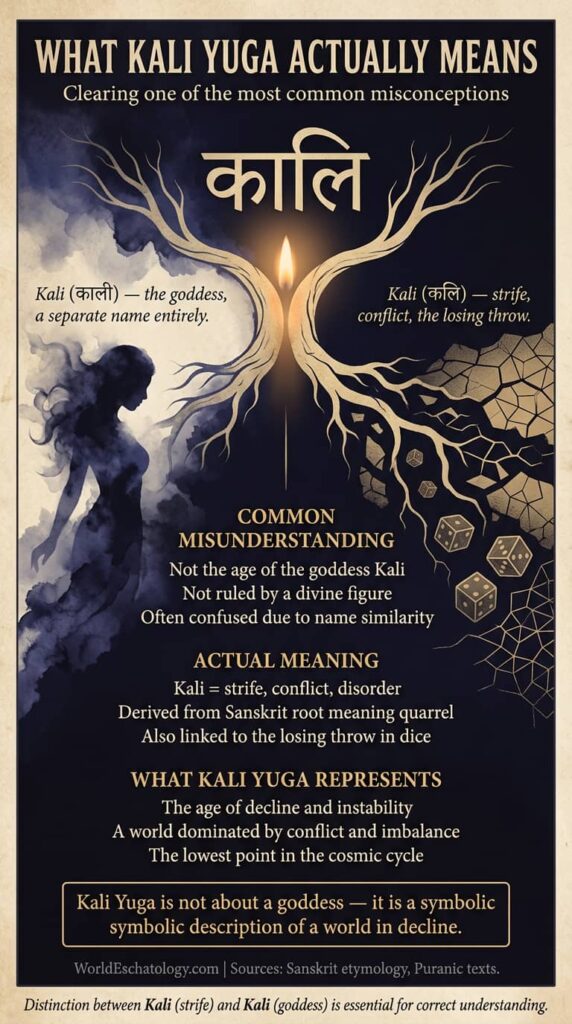
The first thing most people get wrong about Kali Yuga is the meaning of the word Kali itself.
Because the goddess Kali is so prominent in popular images of Hinduism, many people assume that Kali Yuga is somehow connected to her, that it is the Age of Kali the goddess, an age ruled over by that fierce, dark, time-destroying divine mother. This is understandable, but it is incorrect.
The word Kali in Kali Yuga comes from a completely different Sanskrit root than the name of the goddess.
In the context of the Yuga system, Kali comes from the Sanskrit word kal, which means to quarrel, to fight, to be in a state of strife and conflict.
There is also a connection to the word for the losing throw in a dice game. In ancient Indian dice games, the kali was the worst possible roll, the one that brought misfortune and loss.
So when the ancient texts name this age the Kali Yuga, they are describing it as the age of the losing throw, the age of strife, the age in which the dice of cosmic fortune have fallen in the worst possible configuration.
The goddess Kali, by contrast, has a name derived from the Sanskrit word kala, which means time and also means black or dark.
Her name means the dark one, the one who is time itself, the one who devours everything.
She is a complex and powerful figure in her own right, and her mythology is rich and multilayered.
But she is not the ruler of Kali Yuga in any direct sense, and conflating the two meanings leads to confusion about what the Yuga system is actually describing.
The word “Yuga” itself means “age” or “era,” coming from the Sanskrit root meaning to join or to yoke.
A Yuga is a joined period of time, a defined epoch in the cosmic cycle.
So Kali Yuga meaning is the Age of Strife, the era defined by conflict, quarreling, and the dominance of the worst qualities in human nature and in the world at large.
The Four Yugas: The Complete Cosmic Cycle
To understand Kali Yuga properly, you have to understand the larger cycle of which it is a part.
Hindu cosmology describes time as moving in vast cycles called Mahayugas or Chaturyugas, each consisting of four successive ages.
These four ages are named, in order from best to worst, Satya Yuga, Treta Yuga, Dvapara Yuga, and Kali Yuga. Together they form one complete cycle of cosmic time before the whole sequence begins again.
The first age, Satya Yuga, is also called the Golden Age or the Age of Truth. The Sanskrit word satya means truth, and this age is characterized by it.
In Satya Yuga, dharma, the cosmic principle of righteousness and right order, is said to stand on all four of its legs, fully intact and fully expressed in the world.
Human beings in Satya Yuga live extraordinarily long lives, sometimes measured in tens of thousands of years.
They are physically powerful, spiritually awake, free from disease and suffering.
Knowledge of the divine is direct and immediate rather than something that has to be learned from texts or sought through difficult practices.
The world itself cooperates with human flourishing. The texts describe it as a paradise age, though not a static one.
The second age, Treta Yuga, marks the first decline. The word treta means three, indicating that dharma now stands on three of its four legs rather than all four.
Someone has been lost. Human lifespans begin to shorten, though they are still vastly longer than what we experience today.
Some qualities of Satya Yuga remain, but virtue must now be cultivated more deliberately; it is no longer the automatic condition of existence.
The great hero Ram, one of the central figures of Hindu sacred history, is associated with Treta Yuga.
The third age, Dvapara Yuga, represents a further deterioration. Dvapara means two, signaling that dharma is now standing on only two of its four legs.
Conflict becomes more common. The Vedic knowledge, once universally accessible, begins to become fragmented and harder to access.
The great epic of the Mahabharata is set at the transition between Dvapara and Kali Yuga.
Krishna himself, one of the most important figures in all of Hindu tradition, lived and acted in Dvapara Yuga.
His departure from the world is traditionally understood as the event that triggered the beginning of Kali Yuga.
Then comes Kali Yuga, our current age. Dharma stands on only one leg. The great qualities of the earlier ages have diminished to a fraction of what they once were.
Human beings live short lives, are prone to disease, are spiritually confused, and are easily distracted from what actually matters.
The dominant forces are greed, desire, dishonesty, and the worship of material things. This is the age we are in.
How Long Is Kali Yuga? The Numbers Behind the Cycle
The question of how long Kali Yuga lasts is one of the most genuinely debated questions in the whole field of Hindu chronology, and the debate is not between modern skeptics and traditional believers but between two completely different readings of the traditional texts themselves.
The mainstream traditional account, which is the one most pandits and orthodox scholars accept, works with what are called divine years.
According to this system, one human year equals one day in the life of the gods. A divine year therefore consists of 360 human years.
Kali Yuga is said to last 1,200 divine years, which when converted into human years gives you 432,000 human years.
This is a staggering length of time. On this calculation, since Kali Yuga is generally held to have begun around 3102 BCE, we are currently only about 5,126 years into an age that will last 432,000 years.
We are, in other words, barely past the opening pages of Kali Yuga.
The ratio of the four Yugas also follows a specific mathematical pattern. Satya Yuga lasts 4,800 divine years (1,728,000 human years).
Treta Yuga lasts 3,600 divine years (1,296,000 human years). Dvapara Yuga lasts 2,400 divine years (864,000 human years).
And Kali Yuga lasts 1,200 divine years (432,000 human years). The total Mahayuga therefore spans 12,000 divine years or 4,320,000 human years.
Note the recurring pattern of the number 432, which appears in various forms across many ancient traditions worldwide, a fact that has fascinated researchers from multiple fields.
The alternative timeline comes from the work of the nineteenth-century Indian saint and scholar Sri Yukteswar Giri, who published a book called The Holy Science in 1894.
Yukteswar argued that the traditional scholars had made a mathematical error by taking the divine year figure literally when it was actually meant to be read differently.
He proposed a much shorter cycle of 24,000 years, in which each Yuga is measured in ordinary human years rather than divine ones.
On this calculation, Kali Yuga lasts only 2,400 years, and we are actually not deep inside it but rather moving through the ascending phase of it and approaching Dvapara Yuga again.
The difference between these two interpretations is not academic. If the traditional 432,000-year timeline is correct, then we are near the very beginning of Kali Yuga and the worst is still enormously far ahead.
If Yukteswar’s shorter cycle is correct, then we may be approaching the end of this dark age and moving back toward a period of greater light.
Both interpretations have serious and learned defenders, and we will return to this debate when we discuss modern thinkers on the subject.
Where the Kali Yuga Doctrine Comes From: The Primary Sources
The concept of the four Yugas and the specific characteristics of Kali Yuga are found across multiple major texts of the Hindu tradition.
Understanding which texts say what is important for anyone who wants to engage seriously with this subject rather than simply repeating second-hand summaries.
The most detailed and famous description of Kali Yuga appears in the Bhagavata Purana, also known as the Srimad Bhagavatam.
This text, which devotional Hindu tradition regards as the crown jewel of all the Puranas, devotes the twelfth book largely to a description of Kali Yuga.
It lists specific social, political, moral, and environmental characteristics of the age in language that is remarkably precise and, as many readers have noted, strikingly applicable to the modern world.
The Vishnu Purana is another foundational source, containing one of the earliest systematic descriptions of the Yuga cycle.
The Mahabharata, the massive epic that narrates the great war at the transition point between Dvapara and Kali Yuga, also contains extensive passages about the nature and characteristics of Kali Yuga scattered throughout its enormous length.
The Manusmriti, the ancient law code attributed to Manu, discusses the Yugas in the context of how proper conduct changes across the ages.
For the astronomical calculations that establish the start date of Kali Yuga, the primary technical source is the Surya Siddhanta, one of the oldest surviving texts of Indian astronomy.
The great mathematician and astronomer Aryabhata, writing in the fifth century CE, also worked with the Kali Yuga chronology and calculated specific astronomical positions associated with its beginning.
It is worth noting that these texts do not all say exactly the same things about Kali Yuga.
They share a common framework and many common characteristics, but there are variations in detail and emphasis.
Treating any single text as the final word on every aspect of the subject would be a mistake. The tradition is rich enough to contain real internal diversity.
The Mahayuga and the Manvantara: Kali Yuga in the Larger Cosmic Architecture
Kali Yuga does not exist in isolation. It is one small piece of an almost incomprehensibly large structure of cosmic time that Hindu cosmology has worked out with impressive mathematical precision.
The four Yugas together form one Mahayuga, sometimes called a Chaturyuga (four-age cycle), lasting 4,320,000 human years.
But even a Mahayuga is not the fundamental unit of cosmic time. Seventy-one Mahayugas constitute one Manvantara, named after Manu, the progenitor figure of each cosmic era.
Fourteen Manvantaras make up one Kalpa, which is understood as a single day in the life of Brahma, the creator god.
One Kalpa lasts 4,320,000,000 years, a figure that corresponds very closely to modern science’s estimate of the age of the Earth (about 4.5 billion years), a coincidence that has been noted with some interest by scholars interested in the intersection of ancient cosmology and modern science.
Two Kalpas, a day and a night of Brahma, make up one full day-night cycle of 8,640,000,000 years.
Three hundred and sixty such day-night cycles make one year of Brahma’s life. And Brahma is said to live for one hundred such years, giving the total lifespan of the current universe as 311,040,000,000,000 years.
After Brahma’s life is complete, the entire universe dissolves back into the unmanifest divine ground before a new Brahma and a new universe come into being.
Within this structure, we are currently believed to be in the seventh Manvantara of the current Kalpa, in the twenty-eighth Mahayuga of that Manvantara, in the Kali Yuga phase of that twenty-eighth Mahayuga.
We are, to put it in human terms, somewhere in the middle of this cosmic day, in a recurring dark phase of a recurring cycle that has happened many times before and will happen many times again.
This context matters. Kali Yuga, in the traditional understanding, is not a unique catastrophe but a regular part of the cosmic rhythm, as inevitable and as temporary as winter in the yearly cycle of seasons.
The Bull of Dharma: Understanding the Core Metaphor
One of the most powerful and memorable images used across the Puranas to describe the Yuga cycle is that of a great white bull representing dharma, the principle of cosmic righteousness and right order.
This image deserves more attention than it usually gets, because it captures something essential about how the tradition understands the progressive degradation of each age.
In Satya Yuga, the bull of dharma stands on all four legs, fully upright, perfectly balanced, representing the complete and undivided expression of cosmic order in the world.
All four of the qualities that dharma requires, truthfulness, compassion, austerity, and cleanliness, are present in their fullness.
Life is ordered according to its deepest nature. Things are as they should be.
As Treta Yuga begins, the bull loses one leg. It now stands on three. One quarter of dharma’s full expression has been lost from the world.
The imbalance is manageable but real. In Dvapara Yuga, another leg is gone. The bull now stands on two legs, wobbling, straining to maintain balance.
Half of what dharma should be has disappeared from the world.
And in Kali Yuga, only one leg remains. The great bull of dharma is standing on a single foot, trembling, barely upright, doing everything it can simply not to fall.
Three quarters of cosmic righteousness has been lost from the world.
What remains is a fragment, and even that fragment is under constant attack from the forces of adharma, the forces of disorder, selfishness, and spiritual blindness that characterize this age.The metaphor is both vivid and precise.
It communicates the idea that the degradation of each age is not a sudden collapse but a progressive, measured decline, that each age contains real traces of the goodness that came before it even as it loses more and more of that goodness, and that even in Kali Yuga, when dharma is at its weakest, it has not completely disappeared.
The one remaining leg of the bull is real, even if it is fragile.
The Traditional Start Date: 3102 BCE and the Departure of Krishna
The most widely accepted traditional date for the beginning of Kali Yuga is 3102 BCE, specifically the 18th of February in that year according to one common reckoning, though different calculation systems give slightly varying dates within the same general period.
This date corresponds to what the tradition describes as the moment when Krishna departed from the world.
In Hindu sacred history, Krishna is understood as an avatar of Vishnu, one of the most complete manifestations of the divine in human form.
His presence in the world during Dvapara Yuga was understood to hold back the forces of Kali Yuga, to keep the dark age at bay through the sheer power of his divine presence.
When Krishna left the world, that protective force was removed, and the age of strife was free to begin.
The Bhagavata Purana describes this transition explicitly. It says that when Brahma saw that Krishna had departed from the world, he understood that the time of Kali had come.
The transition was not gradual. At the moment of Krishna’s departure, Kali Yuga began. This is the traditional understanding.
The date of 3102 BCE also corresponds to what astronomers identify as a significant planetary alignment, which ancient Indian astronomical texts used as a kind of cosmic timestamp.
The planets were arranged in a specific configuration at that time that the ancient Indian astronomers used to anchor their calendar system, the Kali Ahargana, the day-count of Kali Yuga, which has been used to calculate astronomical positions ever since.
The coincidence of the mythological event and the astronomical marker is understood in the tradition not as a coincidence at all but as confirmation of the same underlying cosmic reality described in two different languages, one mythological and one mathematical.
The Astronomical Argument: What the Stars Said About 3102 BCE
The astronomical foundation of the Kali Yuga start date is not merely a matter of tradition and faith.
It rests on calculations that are mathematically sophisticated and that have been taken seriously by historians of science even when they have disagreed about how to interpret them.
The Surya Siddhanta, one of the oldest surviving astronomical texts in the world, states that at the beginning of Kali Yuga all the major planets were in mean conjunction, meaning they were aligned at a single point in the sky.
This is an extraordinary event and a useful astronomical marker because it can be checked against modern calculations of planetary positions.
When modern astronomers and historians of science have checked this claim, they have found that while the planets were not in perfect conjunction at 3102 BCE (they never are, strictly speaking), they were unusually close together in the sky, particularly from the perspective of ancient observational astronomy.
This is remarkable for a text that was composed long before modern computational methods existed.
The great Indian mathematician and astronomer Aryabhata, who lived from 476 to 550 CE, confirmed the 3102 BCE date using his own calculations and used it as the baseline for his astronomical work.
His treatise, the Aryabhatiya, is one of the great achievements of ancient mathematics, and his use of the Kali Yuga epoch as a computational anchor has been studied extensively by historians of Indian mathematics.
The astronomer John Playfair, writing in the early nineteenth century, examined the Indian astronomical records and found that the planetary positions given for the beginning of Kali Yuga were consistent with actual astronomical data for around 3102 BCE.
This was one of the first serious Western scholarly engagements with the Indian calendar system, and it raised genuine respect for the precision of the ancient Indian astronomical tradition, even among scholars who were otherwise skeptical of Hindu claims.
The Alternative Timeline: Sri Yukteswar’s Shorter Cycle Theory
In 1894, an Indian saint named Sri Yukteswar Giri, who would later become the guru of Paramahansa Yogananda (author of the famous Autobiography of a Yogi), published a remarkable little book called The Holy Science.
In it, he made a bold and carefully argued claim: that the traditional Hindu calculation of the Yuga cycle lengths was the result of a mathematical error made by scholars during a period of particular confusion and ignorance, and that the actual cycle was far shorter.
Yukteswar’s argument began with a textual observation. He pointed out that the traditional texts specify Kali Yuga as lasting 1,200 years of the gods, not 1,200,000 human years.
The error, he argued, came from scholars who forgot that they were supposed to multiply by 360 to convert divine years to human years only within a specific computational context, and instead applied that multiplier incorrectly across the board.
When you remove what Yukteswar identified as this error, the four Yugas total 12,000 human years (not divine years multiplied), giving a complete cycle of 24,000 years.
In Yukteswar’s shorter cycle, Kali Yuga lasts 2,400 years. And crucially, he proposed that the Yuga cycle is not simply a descending spiral but an ascending and descending cycle, like a great cosmic breath.
The sun, he argued, revolves around another star (a theory that has some modern scientific backing in the concept of a hypothetical binary companion to our sun), and as it does so, the earth alternately moves closer to and farther from the galactic center of spiritual influence.
When closer, the ages ascend toward Satya. When farther away, they descend toward Kali.
On this model, the most recent Kali Yuga descended from approximately 700 BCE to 1700 CE, and we are now in an ascending Dvapara Yuga, moving back toward greater light and understanding.
This would explain, Yukteswar argued, why the modern world shows both signs of deep degradation (consistent with Kali Yuga) and signs of remarkable progress in knowledge and technology (consistent with the beginning of Dvapara Yuga).
Both things are happening at once because we are in a transitional period.
Yukteswar’s theory has been enormously influential in Western and New Age engagements with the Yuga concept, and it has also found defenders among some serious scholars of Indian philosophy.
Traditional Hindu pandits, however, largely reject it, maintaining that the long timeline of 432,000 years for Kali Yuga is what the texts actually say and what the tradition has always understood.
The Debate Between Traditional Pandits and Modern Researchers
The disagreement between the traditional long timeline and Yukteswar’s shorter cycle is more than an academic dispute about numbers.
It reflects genuinely different ways of reading the tradition and genuinely different understandings of what the Yuga system is trying to describe.
Traditional pandits who defend the long timeline argue that the mathematical precision of the traditional numbers is itself part of their authority.
The numbers 432,000 and 4,320,000 and 4,320,000,000 are not arbitrary.
They appear, in various forms, across many ancient cultures (the Norse Valhalla was said to have 432,000 warriors; the Babylonian king list before the flood gives reigns totaling 432,000 years; there are 43,200 seconds in twelve hours).
These recurring numbers, they argue, point to a genuine cosmic harmonic that was discovered independently by the ancient tradition, not invented by scholars making arithmetic errors.
Critics of the traditional long timeline, including not just Yukteswar but also various modern researchers, point to what they see as an obvious practical problem.
If we are only about 5,000 years into a 432,000-year Kali Yuga, then the increasingly dramatic signs of Kali Yuga that the texts predict, including the virtual disappearance of dharma and the extreme brevity of human life, should not be visible for hundreds of thousands of years yet.
But the texts seem to describe conditions that are clearly recognizable in the world today.
This suggests either that the numbers are not meant to be taken literally, or that we are much deeper into Kali Yuga than the standard timeline implies.
There is no consensus resolution to this debate, and it is unlikely that one will emerge.
What matters for our purposes is understanding that both positions exist, that both have serious defenders, and that the question of how long Kali Yuga lasts has significant implications for how we interpret everything else the tradition says about it.
Kali Yuga and Other Ancient Chronologies: Convergence Near 3100 BCE
One of the most genuinely fascinating aspects of the Kali Yuga start date is that several other ancient civilizations also experienced major transitions or upheavals around the same general period of 3100 to 3000 BCE.
This convergence has attracted significant scholarly attention, though it remains controversial in terms of its interpretation.
In ancient Egypt, the period around 3100 BCE corresponds roughly to the unification of Upper and Lower Egypt under the first pharaoh, traditionally identified as Narmer or Menes.
This is the beginning of what Egyptologists call the Early Dynastic Period and is considered the foundational moment of Egyptian civilization as a unified state.
In Mesopotamia, the same period sees the emergence of early writing and the foundations of the Sumerian city-state system.
In the Indus Valley, this period corresponds to the beginning of the Mature Harappan phase of the Indus Valley Civilization.
Some researchers, including those who work in the field of comparative mythology and ancient chronology, have suggested that these simultaneous transitions across multiple civilizations point to a real event or series of events of cosmic or environmental significance around 3100 BCE.
This could include a significant astronomical event, a period of rapid climate change following the end of the African Humid Period, or some other large-scale disruption that was interpreted in different cultural frameworks as the end of one age and the beginning of another.
Graham Hancock, Randall Carlson, and other alternative history researchers have used this convergence as evidence for their broader thesis that human civilization is much older than mainstream archaeology acknowledges and that a global catastrophe around this period (or somewhat earlier) reset the developmental trajectory of multiple ancient cultures simultaneously.
Traditional Hindu scholars, of course, do not need alternative archaeology to explain the convergence;
they understand 3102 BCE as the actual beginning of Kali Yuga, established by sacred authority and astronomical calculation, and the transitions in other civilizations are simply the natural consequences of the cosmic change that the departure of Krishna set in motion.
What the Ancient Texts Actually Predict
The Bhagavata Purana’s Detailed Prophecies
The twelfth book of the Bhagavata Purana is the primary source for the most specific and detailed account of Kali Yuga’s characteristics.
It is worth reading carefully, because the level of specificity is genuinely extraordinary.
These are not vague prophetic generalizations of the kind that can be applied to any period of human history.
They are particular, concrete, and often surprisingly modern in their description.
The Bhagavata Purana describes Kali Yuga as an age in which men will be motivated almost entirely by material desires.
Wealth will become the primary measure of a person’s worth, and those without money will be considered as having no virtues at all, regardless of their actual character or learning.
Religious performance will be reduced to outward show. Marriage will no longer be a sacred institution but will be contracted simply on the basis of physical attraction and convenience.
Women’s chastity will cease to be a respected virtue. The distinctions between social classes that structured earlier ages will break down, but not in the direction of genuine equality; rather, the breakdown will produce confusion, conflict, and exploitation.
Leaders and kings, the text says, will become little better than bandits.
They will tax their subjects without mercy, spend the revenues on their own pleasures, and offer no genuine protection or service in return.
The powerful will prey upon the weak. Those with authority will use it exclusively for personal gain. Courts of justice will be corrupted by bribery and favoritism.
The texts are quite specific about all of this, and it reads, to anyone familiar with the history and current state of politics in most of the world, with uncomfortable familiarity.
The natural world, too, will deteriorate. Rains will become erratic and insufficient. The earth will not yield its produce as generously as it once did.
Trees will grow smaller and produce less fruit. Rivers will become shallower and narrower. Natural disasters will become more frequent.
The climate, in the broadest sense, will become hostile to human flourishing in ways that were not the case in earlier ages.
The Decline of Dharma: How Righteousness Weakens
Dharma is one of those Sanskrit words that does not have a clean English equivalent.
It means something like cosmic order, righteous conduct, the natural law of things, duty in accordance with one’s nature and position, and the way the universe works when it is working correctly.
All of these meanings are present simultaneously in the word, and all of them are relevant to understanding what the texts mean when they say that dharma declines in Kali Yuga.
The decline of dharma in Kali Yuga is not simply a decline in moral behavior, though it includes that.
It is a decline in the cosmic ordering principle itself, the force that aligns human life with the deeper patterns of existence.
When dharma weakens, everything that depends on it weakens with it. Social structures become unstable.
Natural systems become disordered. Individual human beings lose their sense of purpose and direction.
The connection between action and its appropriate consequences, what the tradition calls the law of karma, becomes harder to see and understand in a world where adharma is dominant.
The practical manifestations of dharma’s decline in Kali Yuga, according to the texts, include the breakdown of traditional family structures, the loss of respect for elders and for learning, the corruption of religious institutions, the rise of fraudulent spiritual teachers, the increasing prevalence of selfishness as the primary motivating force in human life, and the gradual disappearance of the qualities that make genuine community possible: trust, generosity, patience, and care for others.
The important point is that the texts do not describe this decline as the result of human choices alone, though human choices are certainly part of it.
The decline of dharma in Kali Yuga is understood as a cosmic process, driven by the position of the age in the great cycle.
It is analogous to the way that the seasons change not because of anything any particular person decides but because of the movement of the earth around the sun.
Individuals can choose to embody dharma even in Kali Yuga, and the tradition strongly encourages this.
But the overall current of the age runs in the direction of adharma, and this makes dharmic living harder than it was in earlier ages.
The Shortening of Human Lifespan
One of the most quantitatively specific predictions the Bhagavata Purana makes about Kali Yuga concerns human lifespan.
In Satya Yuga, the texts say, human beings lived for 100,000 years. In Treta Yuga, the lifespan fell to 10,000 years.
In Dvapara Yuga, it fell to 1,000 years. And in Kali Yuga, human lifespan starts at 100 years and, as the age progresses, will continue to decline until the average human life lasts only twenty to thirty years by the time we reach the deepest phase of the dark age.
The shortening of lifespan is accompanied, in the texts, by a general weakening of physical and mental capacities.
People in Kali Yuga are smaller, weaker, and less intelligent than their counterparts in earlier ages, not because they are inherently inferior as souls but because the cosmic environment in which they are developing does not support the full expression of human potential.
The comparison the texts make is something like the difference between a plant grown in rich, well-watered soil with full sunlight (Satya Yuga) and a plant grown in thin, dry soil under partial shade (Kali Yuga).
The seed may be the same, but the conditions produce a very different result.
This is one of the points where the tradition comes into interesting dialogue with modern scientific findings.
Archaeological and historical evidence does suggest that average human height and, in some measures, brain size have fluctuated over long periods of human prehistory.
The lifespans attributed to the patriarchs in the Hebrew Bible (Adam living 930 years, Noah living 950 years) and to the kings of Sumer in the ancient king lists (some reigning for tens of thousands of years) are often dismissed as myth or exaggeration,
but they find a structural parallel in the Hindu tradition’s claim that very long lifespans characterized earlier cosmic ages.
The Degradation of Rulers and Governments
The Bhagavata Purana’s description of political leadership in Kali Yuga is one of its most painfully recognizable passages.
The text says, with remarkable directness, that rulers in Kali Yuga will be more like thieves than like kings.
They will extract wealth from the population through taxation and various forms of coercion without providing genuine protection or service in return.
They will favor those who pay them rather than those who are just. They will punish the innocent and reward the guilty when it serves their interests.
The text goes further, saying that in the advanced stages of Kali Yuga, rulers will openly take the property of their subjects, claiming justification in law that they themselves have made.
The distinction between government and criminal enterprise will gradually blur.
Power will be the only real qualification for leadership, and those who hold power will use it primarily to acquire more power and wealth.
The Mahabharata adds to this picture by describing how the social compact between rulers and the governed will break down completely in Kali Yuga.
The great duty of a king, in the earlier understanding, was to protect dharma, to maintain the cosmic order, to be a servant of righteousness rather than its exploiter.
In Kali Yuga, this understanding will be forgotten or, worse, will be cynically invoked as rhetoric by leaders who actively practice its opposite.
What makes this description so striking is its universality. The degradation of political leadership described in these texts is not specific to any single culture or political system.
It describes a pattern that appears across cultures and throughout recorded history, but which the tradition claims will be particularly intense and nearly universal in Kali Yuga.
The Collapse of Family Structures and Social Bonds
The texts are specific about what will happen to the family in Kali Yuga. Marriage will no longer be understood as a sacred covenant between two souls, witnessed by God and society, with responsibilities and duties attached.
Instead, it will be contracted on the basis of physical attraction alone and will last only as long as that attraction persists.
The idea that a marriage involves obligations that extend beyond personal feeling, that it creates responsibilities to children, to extended family, to the broader community, will fade and eventually disappear.
The Bhagavata Purana describes a world in Kali Yuga in which the bond between a man and a woman will be considered legitimate only if they live together, regardless of whether any formal ceremony or social recognition has occurred.
Children will no longer feel bound by duties to their parents. Parents will no longer feel an unconditional responsibility for their children beyond a certain age.
The extended family network that once provided care, support, meaning, and identity across generations will fragment into isolated nuclear units and then fragment further into isolated individuals.
Social trust, the basic confidence in the reliability and good intentions of strangers that makes complex societies possible, will also erode.
The texts describe a Kali Yuga world in which people are suspicious of one another, in which relationships are primarily transactional, and in which the concept of a neighbor who can be relied upon in times of need is increasingly foreign.
Community life, in the traditional sense of people who share a place and a fate and who are genuinely responsible for one another, will give way to a collection of individuals who happen to occupy the same physical space while remaining essentially strangers.
The Corruption of Religious Institutions
The Bhagavata Purana’s description of religious life in Kali Yuga is, if anything, even more pointed than its description of political life.
The text says explicitly that in Kali Yuga, people will pretend to be religious without actually following any religious discipline.
They will wear the external marks of various traditions while their inner life remains governed by desire, anger, and greed. Religious authority will be claimed on the basis of external appearance alone.
Priests, the text says, will not know the Vedas, or if they do, will not practice what the Vedas teach.
Rituals will be performed incorrectly, reduced to empty performances that maintain the form while losing the substance.
Religious institutions will compete with one another for followers and resources.
The Guru-disciple relationship, which in earlier ages was the primary vehicle for transmitting genuine spiritual knowledge, will be corrupted.
False teachers will multiply, claiming divine authority and collecting followers on the basis of their charisma or their wealth or their ability to tell people what they want to hear.
The Bhagavata Purana is also specific about one of the consequences of this religious corruption.
When genuine spiritual guidance becomes hard to find, people will turn to whoever seems most convincing, whoever speaks most confidently about ultimate things.
And in Kali Yuga, those who speak most confidently about spiritual matters will often be precisely those who understand them least, because genuine understanding produces humility, and humility does not project the certainty that people desperately seeking guidance are looking for.
Money as the Sole Arbiter of Status
This is one of the predictions of the Bhagavata Purana that reads most startlingly like a description of the contemporary world.
The text says, without qualification, that in Kali Yuga, wealth will be the only measure of a person’s social standing, virtue, or worth.
A person who is rich will be assumed to be good and worthy of respect. A person who is poor will be assumed to be inferior, regardless of their actual qualities.
The ancient framework against which this prediction stands as a degradation was one in which multiple different kinds of excellence were recognized and honored.
Learning, righteousness, courage, generosity, spiritual wisdom, these were all forms of status that existed alongside economic status and in many contexts outranked it.
A poor but learned scholar was respected more than a rich but ignorant merchant. A courageous warrior who protected the community was honored regardless of his personal wealth.
In Kali Yuga, all of these alternative hierarchies collapse into a single one: the hierarchy of money.
The text goes further. Not only will wealth determine respect, but the means by which wealth is acquired will become irrelevant.
In earlier ages, how you got your money mattered enormously. Wealth acquired through dishonesty, exploitation, or violence was considered spiritually polluting and socially dishonorable.
In Kali Yuga, the Bhagavata Purana says, this distinction will disappear. The only question will be whether you have money, not how you got it.
The Degradation of Food, Agriculture, and the Natural World
The environmental predictions of the Bhagavata Purana are among the most specific and, from a modern perspective, among the most recognizable.
The text describes a world in which the earth becomes less generous. Rains become unreliable.
Seasons become unpredictable. The soil produces less food for the same amount of effort.
Trees become smaller and bear less fruit. Droughts and floods become more frequent. Rivers dry up or become polluted.
The food that is produced in Kali Yuga will also, the texts suggest, be of lower quality than what was available in earlier ages.
It will nourish the body less fully, and the people who eat it will be weaker and more prone to disease as a result.
The great diversity of plants and animals that sustained human civilizations in earlier ages will diminish.
What remains will be increasingly controlled by powerful interests who care more about profit than about the quality or safety of what they are producing.
From a modern perspective, this passage reads as an almost eerily accurate description of industrial agriculture, the climate crisis, biodiversity loss, and the dominance of processed food in modern diets.
Whether one reads this as evidence of the texts’ prophetic accuracy or as evidence that these kinds of environmental degradation are a natural consequence of human organizational patterns that the ancient authors recognized through observation of their own time is a genuinely open question.
The Rise of Mlecchas and the Changing of Political Dominance
The term mleccha is one of the more culturally specific and contested terms in the traditional description of Kali Yuga.
In Sanskrit, mleccha referred to those outside the Vedic cultural framework, people considered to be ritually unclean, speaking foreign or unintelligible languages, following customs that violated Vedic norms.
In the context of the Kali Yuga predictions, the texts say that mlecchas will become kings and will dominate political life.
Traditional commentators have interpreted this in various ways.
Some understand it literally as a prediction that non-Hindu peoples will rule over India, which they point to as fulfilled in the periods of Islamic and then British rule over the subcontinent.
Others understand it more broadly as a prediction that the culturally and spiritually refined will lose political power to those who are culturally and spiritually coarser, regardless of their ethnic or religious background.
On this reading, a mleccha ruler is not necessarily a foreign ruler but any ruler who governs without reference to dharmic principles.
It is important to note that the traditional use of the word mleccha does not necessarily imply what modern readers might understand as racial or ethnic prejudice.
The Vedic tradition has always held that dharma transcends birth and that a person of any background can embody it or fail to embody it.
The prediction about mlecchas gaining power in Kali Yuga is better understood as a sociological observation about the kinds of values and qualities that tend to succeed in the political arena of a dark age rather than as a claim about the inherent qualities of any particular ethnic or cultural group.
Questions About Women’s Status in the Kali Yuga Texts
Some of the most challenging passages in the Bhagavata Purana and related texts concern the role and status of women in Kali Yuga.
The texts describe a world in which women become less chaste, less modest, and more independent in ways that the traditional authors clearly regarded as negative.
In the context of the values that shaped these texts, the ideal woman was defined primarily by her devotion to her husband and family, and the texts see the breakdown of this ideal as one of the signs of Kali Yuga’s degradation.
This is a genuinely difficult subject for modern readers, and it deserves honest engagement rather than either uncritical acceptance or defensive dismissal.
The scholarly conversation around these passages is complex.
Some traditional commentators argue that the texts are simply describing what will happen in Kali Yuga, not prescribing what should happen, and that the changes in women’s roles they describe are presented as symptoms of social degradation rather than as causes of it.
The real cause, in this reading, is the breakdown of dharmic social structures as a whole, and the changes in women’s lives are downstream consequences.
Modern Hindu feminist scholars have pointed out that the texts’ descriptions of Kali Yuga often collapse the distinction between genuine moral deterioration (such as the breakdown of trust and care within families) and social changes that actually represent progress (such as women’s access to education, economic independence, and legal protection).
These are not the same thing, and treating them as equivalent reflects the limitations of the ancient authors’ social framework rather than the timeless truth of the Vedic revelation.
What can be said with confidence is that the tradition’s description of Kali Yuga includes the observation that gender relations will be disrupted and that this disruption will have consequences, positive and negative, that are still working themselves out in the modern world.
Engaging with this honestly is more useful than either dismissing the texts as hopelessly patriarchal or using them to resist legitimate progress in human rights.
The Signs of Kali Yuga’s Advanced Stage: The Deepest Darkness
The Bhagavata Purana does not simply describe Kali Yuga as a uniform condition. It describes a progressive deepening, in which conditions worsen as the age advances.
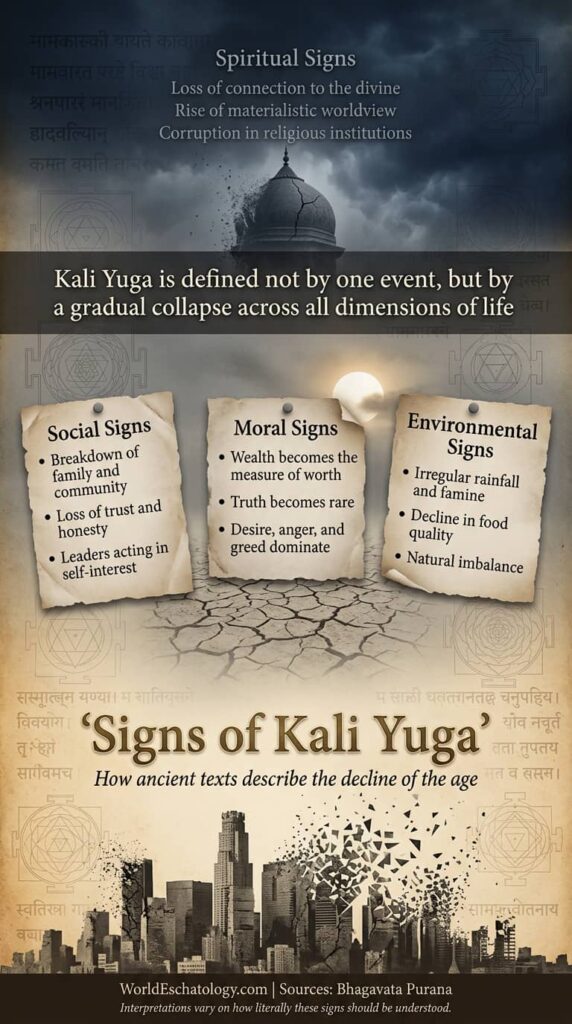
The signs it lists for the most advanced and deteriorated phase of Kali Yuga are particularly extreme and serve as a kind of marker for when the age has reached its nadir.
In the deepest phase of Kali Yuga, the text says, human lifespan will have decreased to the point where people are considered old at the age of five.
Diseases will be so common and so severe that they will be regarded as normal rather than exceptional. Rainfall will have become so unreliable that famine will be widespread.
The moral codes that once regulated human behavior, even in the earlier phases of Kali Yuga, will have completely dissolved. Might will be the only right.
The text describes this period as one in which even the basic conditions for human civilization, reliable food production, social cooperation, the transmission of knowledge across generations, will have broken down. People will live in small, scattered groups, barely surviving.
The accumulation of knowledge that earlier generations built will be largely lost.
It is at this point, when conditions have reached their absolute worst, that the tradition places the appearance of Kalki, the final avatar of Vishnu, who will destroy what remains of the corrupt order and create the conditions for a new Satya Yuga to begin.
The darkest moment of Kali Yuga is thus also, paradoxically, the moment closest to the dawn of a new golden age.
The Evidence Examined
Mapping the Bhagavata Purana’s Predictions Onto the Modern World
The question of whether the Bhagavata Purana‘s description of Kali Yuga accurately describes the contemporary world is one that any honest reader of the text has to grapple with.
The answer, if we take the text seriously on its own terms, is complicated by the timeline debate we discussed earlier.
But setting that aside and looking purely at the qualitative description of Kali Yuga, the match between what the texts describe and what the modern world looks like is, at minimum, thought-provoking.
Let us go through the major predictions systematically. The texts say that wealth will be the primary measure of human worth.
This is clearly true of contemporary consumer societies, where a person’s value is routinely assessed by their income, their possessions, and their economic productivity.
The texts say that the means by which wealth is acquired will not matter.
Look at the social acceptance of industries that cause obvious harm, or the celebration of billionaires regardless of how their wealth was accumulated.
The texts say that rulers will behave like bandits. The history of governance in most of the world in the twentieth and twenty-first centuries provides abundant evidence for this.
The texts say that religious institutions will be corrupted by the pursuit of money and power.
A review of major religious scandals, financial improprieties, and the proliferation of commercially motivated spiritual teachers across all traditions in the modern period does not suggest that this prediction has missed its mark.
The texts say that family structures will break down. Divorce rates, the decline of extended family networks, the epidemic of loneliness and social isolation documented across the developed world, these all speak to something real.
The texts say that the natural world will deteriorate. Climate change, soil degradation, water scarcity, mass extinction events, these are not marginal concerns but defining features of the current historical moment.
The texts say that food will nourish less fully. The modern epidemic of diet-related chronic disease, the dominance of ultra-processed food, the decline of nutritional diversity, these fit the picture.
The Political Signs: Corruption and the Collapse of Justice
Perhaps the clearest area of convergence between the Bhagavata Purana’s description of Kali Yuga and the observable modern world is in the domain of politics.
The text’s prediction that rulers will be like bandits, that they will use their power primarily for personal enrichment while claiming to serve the public, and that courts of justice will be corrupted by money and favoritism, is a description that fits the actual condition of political life in most countries at most points in modern history.
This is not a partisan political observation. It applies across ideological lines, across geographical regions, across different types of political systems.
Authoritarian regimes use state power to enrich ruling families and suppress dissent.
Democratic systems are captured by financial interests that use campaign contributions and lobbying to bend legislation to their advantage.
Judicial systems that are supposed to provide equal justice under the law are demonstrably more favorable to those with money and connections than to those without.
The Mahabharata adds a particularly pointed prediction. It says that in Kali Yuga, the language of dharma will be used to justify adharma.
Leaders will invoke the public good, justice, divine mandate, and the needs of the people in order to pursue their own interests.
This cynical use of moral language to justify immoral action, what scholars sometimes call ideological legitimation, is one of the defining features of political life in the modern world.
The Spiritual Signs: False Gurus and Commercialized Religion
The proliferation of what the Bhagavata Purana calls false teachers is one of the most visible spiritual signs of Kali Yuga in the contemporary world.
The modern spiritual marketplace offers an almost bewildering variety of teachers, traditions, practices, and systems, many of them sincerely held, some of them transparently fraudulent, and a great many of them somewhere in the complicated middle territory where sincere but limited understanding meets genuine commercial motivation.
The tradition does not say that all teachers in Kali Yuga are false. It says that genuine teachers become rare and that the conditions of the age make it very difficult for ordinary seekers to distinguish the authentic from the counterfeit.
The qualities that make a genuine spiritual teacher genuine, humility, patience, freedom from financial and sexual exploitation of students, transmission of wisdom from an authentic lineage, willingness to challenge students rather than simply to please them, are precisely the qualities that do not market well in a culture dominated by the values of Kali Yuga.
The commercialization of meditation, yoga, mindfulness, and various forms of healing and therapy in the modern West is a complex phenomenon that is neither entirely negative nor entirely benign.
At its best, it has made practices that genuinely reduce suffering more widely accessible than they have ever been before.
At its worst, it has produced a spiritual consumer culture in which depth is sacrificed for accessibility, tradition is stripped of its difficult elements to make it more appealing, and the primary relationship between teacher and student is financial.
The Environmental Signs: The Earth in Kali Yuga
The environmental predictions of the Bhagavata Purana read with particular force in the context of the climate and ecological crisis that has emerged as perhaps the defining challenge of the early twenty-first century.
The text’s predictions of erratic rainfall, reduced agricultural productivity, shorter and more disease-prone lives, and the general hostility of the natural environment to human flourishing match, in broad outline, the picture that climate scientists and ecologists are describing with growing urgency.
The sixth mass extinction currently underway, in which species are disappearing at rates estimated to be between 100 and 1,000 times the natural background rate, represents a degradation of the natural world on a scale that would have been almost inconceivable to earlier generations.
The pollution of major rivers and bodies of water that were once clean and life-sustaining, the degradation of agricultural soil through industrial farming practices, the increasing unpredictability of weather patterns that farmers and communities have relied upon for millennia, these are the kinds of environmental deterioration that the texts associate with the dark age.
Whether one understands these environmental changes as caused by human activities that are themselves expressions of the Kali Yuga mindset (the dominance of short-term greed over long-term stewardship) or as independent cosmic processes that the Yuga cycle describes, the overlap between the predictions and the reality is striking.
The Economic Signs: The Concentration of Wealth
The Bhagavata Purana’s prediction that wealth will become the sole measure of social value in Kali Yuga is matched by its description of economic patterns that also correspond closely to observable modern realities.
The concentration of wealth in fewer and fewer hands, the disappearance of a stable middle class, the increasing precarity of economic life for the majority of people even in wealthy societies, these are all features of the current economic landscape that match the Kali Yuga description.
Modern economic statistics paint a stark picture. The wealthiest 1% of the global population owns more than half of all global wealth.
The gap between the very rich and everyone else has grown steadily in most economies over the past four decades.
The conditions that once allowed ordinary people with ordinary abilities to live stable, dignified lives through honest work have been eroded by a combination of technological change, financialization of the economy, and political capture by wealthy interests.
The text’s specific prediction that the means by which wealth is acquired will cease to matter socially is also borne out in the modern world.
The celebration of billionaires regardless of how their wealth was accumulated, the social acceptance of business practices that externalize costs onto communities and the natural world, the lack of serious accountability for financial crimes while poverty-related offenses are prosecuted aggressively, these all reflect a world in which money has become the primary social value in exactly the way the texts describe.
Counterarguments: What the Critics of the Kali Yuga Narrative Say
Any honest treatment of the Kali Yuga framework has to engage seriously with the counterarguments, and they are not trivial.
The most powerful counterargument is also the simplest: in many measurable ways, human life has improved dramatically over the past several centuries, and particularly over the past hundred years.
Extreme poverty, defined as living on less than two dollars a day, has declined from roughly 90% of the world’s population in 1800 to less than 10% today.
Average human lifespan, which the tradition says should be declining in Kali Yuga, has actually increased dramatically, from an average of around thirty-five years in 1800 to over seventy years globally today.
Child mortality, once the great scourge of human existence, has declined spectacularly.
Diseases that once wiped out entire populations have been eliminated or brought under control. Literacy, access to education, and access to information have all expanded enormously.
Interpersonal violence, studied seriously by scholars like Steven Pinker, appears to have declined sharply as a proportion of the population over the past several centuries, despite the horrors of the two world wars.
Democratic governance, despite all its failures and distortions, has spread to a much larger share of the world’s population than at any earlier historical moment.
The formal legal status of women, enslaved people, and other historically marginalized groups has improved significantly, even if practice lags far behind principle.
These are real achievements. They represent genuine progress in the conditions of human life, and any framework that simply denies them in favor of a narrative of pure decline is not being honest about the complexity of the situation.
The Question of Perspective: Is Kali Yuga a Universal or a Personal Lens?
There is a perennial philosophical problem with Kali Yuga thinking, and it is worth naming directly.
Human beings in every historical period have tended to believe that their own time was uniquely degraded, that the generations before them were wiser and more virtuous, and that things were better in the old days.
This tendency is so consistent and so cross-cultural that it seems to reflect something about human psychology rather than about historical reality.
The ancient Greek poet Hesiod, writing in the eighth century BCE, described five ages of man in terms that closely parallel the Hindu Yuga system, and he believed he was living in the worst of them, the Iron Age.
Medieval Christian thinkers believed the end times were at hand. Ancient Egyptians wrote laments about the decay of their civilization.
Roman philosophers mourned the decline of virtue from the days of the Republic. The nostalgia for a golden age that never quite existed is one of the most consistent features of human historical consciousness.
This does not necessarily mean that the Kali Yuga framework is wrong.
It may mean that what the tradition is describing is not an external objective cosmic condition but a perennial inner condition of human consciousness, the tendency to be cut off from the depth and fullness of reality, to live on the surface of things, to mistake appearances for substance.
Kali Yuga, on this reading, is not a period in cosmic history so much as a description of the ordinary human condition, available in every age but dominant in some.
The tradition itself is aware of this interpretive possibility. It acknowledges that Kali Yuga conditions can be experienced by individuals within any era, and it insists that freedom from those conditions, the capacity to live with dharmic clarity and spiritual depth, is always available to those who earnestly seek it.
The darkness of Kali Yuga is real, but it is not absolute. Within it, light is possible. This is perhaps the most important thing the tradition has to say.
What the Texts Say Will Signal Its Conclusion
The Bhagavata Purana’s End of Kali Yuga Signs
The Bhagavata Purana provides a list of signs that mark the very end of Kali Yuga, the period when conditions have reached their absolute worst before the great reset that ushers in a new Satya Yuga.
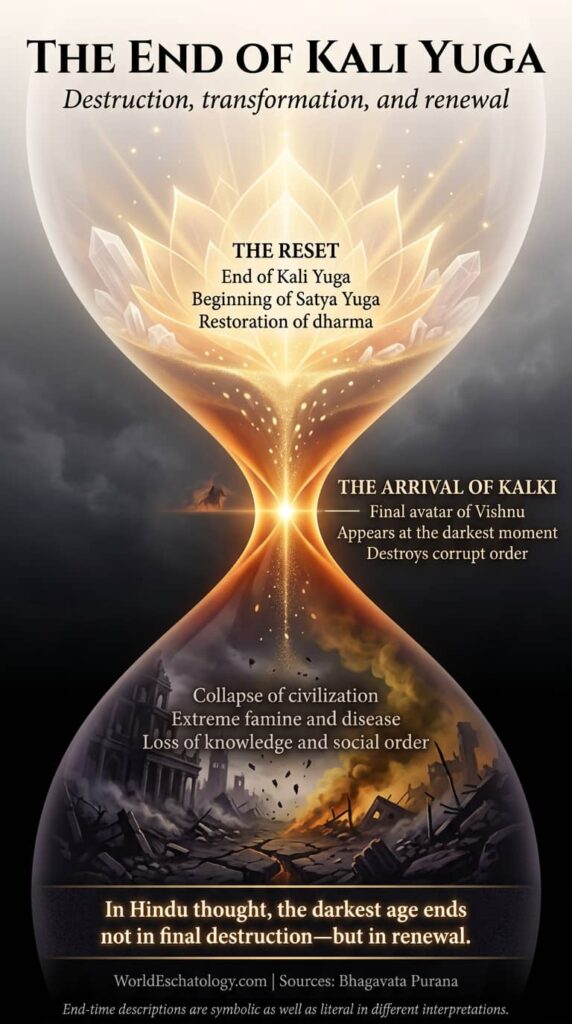
These signs are extreme even by the standards of ordinary Kali Yuga, representing a kind of final intensification of all the age’s worst characteristics.
The text describes a time when the rains have virtually ceased, when famine is widespread and chronic, when people live on meat and whatever else they can find because agricultural production has collapsed.
Human lifespan will have shortened to the point where a person of twenty years is considered old.
Disease will be ubiquitous. People will live in mountain caves and forests, having abandoned cities that are no longer functional.
Most people will be unable to read or write, because the conditions necessary for the transmission of knowledge will no longer exist.
Social structures will have dissolved entirely. There will be no kings, no governments, no functioning judicial systems, no religious institutions, no markets.
People will form small bands based on kinship or simple proximity, and the primary law governing these bands will be the law of strength: those who are stronger will take from those who are weaker.
The boundary between human civilization and the simple survival mode of our most ancient ancestors will have essentially disappeared.
It is at this nadir, the absolute lowest point of the cosmic cycle, that the appearance of Kalki is expected.
The tradition positions this intervention not as a gradual improvement but as a sudden decisive transformation: the clearing away of everything that has become irredeemably corrupted, followed by the emergence of genuinely new conditions in which the cycle can begin again.
Who Is Kalki? The Final Avatar and His Mission
Kalki is the tenth and final avatar of Vishnu, the divine preserver.
While the earlier avatars, including Ram and Krishna, appeared at crucial moments within the cycle of cosmic time to restore balance and uphold dharma without fundamentally disrupting the age they appeared in, Kalki’s role is different.
He appears at the very end of Kali Yuga not to restore balance within the existing order but to bring that order to an end.
The Bhagavata Purana describes Kalki as a great warrior who will be born in a village called Shambhala to a brahmin family.
He will receive divine weapons from the celestial beings and will ride a magnificent white horse named Devadatta, a gift from the gods. Armed with a blazing sword, he will ride through the world destroying the corrupt kings and leaders who have exploited the population throughout Kali Yuga.
He will travel the earth with great speed, clearing away the accumulated corruption of the age.
After this destruction, Kalki will establish the conditions for the new Satya Yuga.
Some texts describe him as gathering the righteous people who have survived the end of Kali Yuga and providing them with the foundation for a new civilization.
Others describe the appearance of new beings, born with Satya Yuga qualities, spontaneously emerging after Kalki’s work is complete.
The white horse is a central image in the Kalki mythology, and it is one that appears in similar eschatological contexts in other traditions.
The Norse tradition describes the god Odin riding an eight-legged horse named Sleipnir into the final battle.
The Book of Revelation describes a rider on a white horse who appears at the end of time.
Whether these parallels indicate diffusion of the same underlying image across cultures, independent discovery of the same symbolic logic, or something even more interesting is a question that comparative mythologists have not settled.
How Kali Yuga Ends and Satya Yuga Begins
The transition from Kali Yuga to the next Satya Yuga is not described in the texts as a gradual improvement.
It is described as a rupture, a break, a clearing away of the old followed by the emergence of something genuinely new.
This understanding of cosmic change, as involving both destruction and creation, is deeply rooted in the Hindu theological framework.
The god Shiva, the destroyer in the Hindu trinity alongside Brahma the creator and Vishnu the preserver, is the divine principle associated with this necessary destruction.
From a Shaiva perspective, the end of Kali Yuga is not something to be feared but something to be welcomed, because destruction is the prerequisite for genuinely new creation.
What cannot be transformed must be dissolved, and what emerges from that dissolution will be fresh and full of the potential that the old world had lost.
The Puranas describe a great flood and a great fire at the end of certain cosmic cycles, echoing similar traditions from Mesopotamian, Hebrew, Greek, Norse, and other ancient sources.
The land itself will be transformed. New rivers will emerge. The geography of the world will change.
And into this renewed world, the souls that have accumulated sufficient spiritual merit will be reborn under conditions that allow the full expression of the dharmic potential that Kali Yuga suppressed.
The new Satya Yuga that emerges after the end of Kali Yuga will not be a return to the exact conditions of the previous Satya Yuga, according to some interpretations.
It will be a new beginning within the same cosmic cycle, carrying forward whatever wisdom and spiritual development has been preserved from the age of darkness.
If Kali Yuga Lasts 432,000 Years, How Are End Signs Here Already?
This is perhaps the most practically important question about Kali Yuga for anyone who takes the traditional long timeline seriously.
If Kali Yuga began in 3102 BCE and lasts 432,000 years, we are currently only about 5,126 years into it, which means we are roughly 1.2% of the way through the age.
The extreme end-of-Kali-Yuga conditions described in the Bhagavata Purana, including people living only into their twenties, the complete collapse of civilization, and the appearance of Kalki, should not be expected for hundreds of thousands of years.
And yet the Bhagavata Purana’s descriptions of Kali Yuga’s characteristics, even the quite advanced and extreme ones, seem to many readers to describe conditions that are already present or clearly developing in the modern world. How do we reconcile this?
One traditional answer is that Kali Yuga’s degradation is not linear. It does not proceed at a constant rate from beginning to end.
Instead, it deteriorates in waves, with the early period of Kali Yuga seeing a rapid initial decline that then plateaus before beginning the next downward step.
On this reading, the early Kali Yuga can exhibit many of the characteristics of a deep Kali Yuga without this meaning that the end is near.
The conditions we see today are simply the natural condition of being in Kali Yuga, not necessarily signs that its end is approaching.
Another answer, of course, is Yukteswar’s shorter timeline, which places us much closer to the end of Kali Yuga and explains the advanced characteristics of the age as evidence that we are in fact in the final phases of the cycle.
But as we have discussed, this reading requires rejecting the traditional mathematical framework that most pandits consider authoritative.
The Shorter Cycle Argument Revisited: Are We Near the End?
Returning to Yukteswar’s shorter cycle with the specific question of end signs, his framework has one significant advantage over the traditional long timeline:
it can explain why the world looks so much like an advanced Kali Yuga without requiring us to wait 427,000 more years for the situation to resolve.
On Yukteswar’s reckoning, Kali Yuga in the current cycle lasted from approximately 700 BCE to 1700 CE, a period of 2,400 years.
We are now, he argued, in an ascending Dvapara Yuga, moving back toward greater light.
This would mean that the conditions of maximum Kali Yuga darkness were experienced between roughly 200 BCE and 500 CE, a period that includes the dissolution of many classical civilizations, the fall of Rome, widespread political instability across Eurasia, and what some historians call the Crisis of the Third Century.
From Yukteswar’s perspective, the challenges of the modern world are not signs of a deepening Kali Yuga but rather the residual momentum of the Kali Yuga we have just exited, combined with the disruptive effects of the transition into a new ascending age.
Progress in science, technology, and certain aspects of human rights would, on this reading, be the first fruits of the ascending Dvapara Yuga, while the persistence of war, corruption, and social breakdown would be the lingering effects of the Kali Yuga we have recently left.
The Yuga Sandhya: The Twilight Periods Between Ages
One of the more nuanced aspects of the Yuga system that often gets overlooked in popular accounts is the concept of the Sandhya and the Sandhyamsha, the twilight and the dawn periods that precede and follow each Yuga.
Each Yuga does not begin or end abruptly; there are transitional periods in which the characteristics of the outgoing age and the incoming age overlap.
According to the traditional mathematical framework, each Yuga has a Sandhya at its beginning (a twilight or dawn period before the age fully establishes itself) and a Sandhyamsha at its end (a dusk period in which the age is winding down before the next one begins).
These twilight periods are each one-tenth the length of the Yuga itself. For Kali Yuga with its 1,200 divine years, the Sandhya and Sandhyamsha are each 100 divine years, or 36,000 human years.
The concept of the Yuga Sandhya opens an interesting interpretive possibility for those who want to ask whether the signs of transition are already visible in the world.
If we are not in the heart of Kali Yuga but in its Sandhyamsha, the dusk period before the next age begins, then the combination of extreme Kali Yuga characteristics and the first signs of something new and different that many people observe in the modern world might make sense.
Twilight contains both the darkness of the night and the first hints of the coming dawn.
The Shaiva Perspective: Destruction as Transformation
Shaivism, the tradition that centers on Shiva as the supreme divine reality, understands Kali Yuga in a distinctive way that draws on its specific theological framework.
For Shaivas, the universe itself is a continuous dance of creation and destruction, maintained by the dynamic energy of Shiva’s cosmic activity.
The five divine actions of Shiva, creation, maintenance, dissolution, concealment, and grace, are not sequential but simultaneous and eternal.
From this perspective, Kali Yuga is not primarily a time of loss but a time of Shiva’s dissolving activity becoming more dominant in the cosmic cycle.
The dissolution that characterizes Kali Yuga is not a failure of the divine plan but an expression of it.
Everything that has become fixed, rigid, or spiritually dead must be dissolved so that genuine renewal can occur.
The darkness of Kali Yuga is, in Shaiva terms, the darkness before the dawn of a new creation.
The Shaiva traditions also tend to place greater emphasis on the transformative power available within Kali Yuga through certain practices, particularly the practices associated with Shakti, the divine feminine energy that Shaiva tradition regards as Shiva’s inseparable partner.
When external forms of dharma have collapsed, the inner fire of Shakti, cultivated through specific practices, can sustain the practitioner and even become a vehicle for unusual levels of spiritual realization.
The Vaishnava Perspective: Bhakti as the Gift of Kali Yuga
The Vaishnava traditions, which center on Vishnu and his avatars as the supreme divine reality, have developed the most elaborate and positive theology of Kali Yuga.
Far from simply lamenting the dark age, the Vaishnava traditions, particularly those influenced by the Bhagavata Purana, teach that Kali Yuga contains a unique spiritual gift that makes it, in a specific and surprising sense, the best of all ages for the purpose of liberation.
The Bhagavata Purana itself articulates this teaching explicitly.
It says that while Satya Yuga practitioners had to perform intensive meditation for thousands of years to achieve liberation, while Treta Yuga practitioners had to perform elaborate and expensive fire sacrifices, while Dvapara Yuga practitioners had to maintain sophisticated and demanding forms of temple worship, the practitioners of Kali Yuga can achieve the same liberation simply by chanting the divine names.
Kali Yuga, the text says, has one saving grace: the power of the Name.
This teaching reached its most expansive expression in the Bhakti movement that swept across India between roughly the twelfth and seventeenth centuries CE, producing some of the most beloved poetry, music, and spiritual teaching in any world tradition.
Saints like Mirabai, Tukaram, Kabir, and Chaitanya Mahaprabhu taught that devotional love for the divine, expressed through singing the divine names and practicing constant remembrance, was the complete spiritual path for the age of Kali.
This was not a consolation prize for those too weak for real practice. It was the supreme gift of the dark age, the practice perfectly calibrated for the conditions that Kali Yuga creates.
The Shakta Perspective: The Goddess and the Dark Age
The Shakta traditions, which understand the supreme divine reality as the goddess in her many forms, bring yet another perspective to Kali Yuga.
For Shaktas, the current age is in a meaningful sense the age of the goddess herself.
Kali, the fierce dark mother who devours time, who dances on the corpse of form, who represents the transformative power of dissolution and renewal, is understood in Shakta theology as the presiding deity of this dark age.
This is, of course, not the same as saying that the goddess Kali rules Kali Yuga in the sense of causing its degradation. The Shakta understanding is more subtle.
The qualities of Kali Yuga, the dominance of darkness, the dissolution of established forms, the stripping away of comfortable illusions, are precisely the qualities through which the goddess Kali teaches and transforms.
Her work is not comfortable, but it is ultimately compassionate. She destroys what must be destroyed so that what is genuine and essential can survive.
The Shakta traditions also hold that the dark age is, paradoxically, a particularly favorable time for certain forms of Tantric practice.
When the external supports of dharmic civilization are weakened, the practitioner is thrown back on inner resources in a way that can accelerate genuine transformation.
The goddess, in this understanding, uses the challenges of Kali Yuga as instruments of her grace, pressing her devotees toward levels of surrender and inner work that would not be necessary in more comfortable times.
The Advaita Vedanta Perspective: Kali Yuga Within Maya
Advaita Vedanta, the school of non-dualist Hindu philosophy associated with Adi Shankaracharya and regarded by many as the philosophical summit of the Hindu tradition, offers a perspective on Kali Yuga that is both the most inclusive and the most challenging.
From the Advaita standpoint, the entire Yuga cycle, including Kali Yuga in all its darkness, exists within the domain of Maya, the divine creative power that produces the appearance of a world of multiplicity, change, and suffering.
From the absolute perspective of Advaita, which identifies the deepest self of every being with Brahman, the unchanging infinite consciousness that is the sole ultimate reality, the Yuga cycle is a drama playing out within the dream of the divine.
Brahman itself is untouched by Kali Yuga or any other condition. The awareness that you ultimately are is not darkened by the dark age.
It remains as luminous, as complete, as free as it has always been.
This does not mean, from the Advaita perspective, that Kali Yuga conditions are irrelevant.
They are real within the domain of relative experience, and they create real obstacles to the kind of inquiry, reflection, and inner stillness that the Advaitic path requires.
But the Advaita tradition also holds that Kali Yuga, precisely because it strips away so many of the distractions and false certainties that more comfortable ages make available, can create an unusual readiness for the deepest inquiry.
When everything you relied on in the external world has proven unreliable, the question of what cannot fail, what is always already present and can never be lost, becomes urgent in a way it might not be in more comfortable times.
Tantric Readings: The Dark Age as Spiritual Opportunity
The Tantric traditions of Hinduism offer one of the most counterintuitive readings of Kali Yuga.
While most perspectives, whether traditional or modern, treat the dark age primarily as a problem, Tantric philosophy sees it as a distinctive opportunity, not despite its darkness but because of it.
The core Tantric insight relevant here is that the very forces that bind and degrade in ordinary experience can become, when approached with the right understanding and the right practices, vehicles of liberation.
This is the famous principle of using poison as medicine: what kills in the wrong dose and context heals in the right one.
Kali Yuga, in the Tantric reading, is a time when the energies of desire, aggression, and dissolution that characterize the age are particularly accessible and particularly powerful.
The practitioner who knows how to work with these energies, rather than simply being swept away by them, has access to an accelerated path.
Some Tantric texts go so far as to say that the practices that were forbidden in earlier ages, because they were too dangerous for the level of refinement those ages required, become not merely permissible but recommended in Kali Yuga.
This is not a justification for licentiousness or moral abandonment.
It is a claim about the relationship between the practitioner’s inner development and the cosmic conditions in which that development occurs.
In an age when everything is being dissolved anyway, the practitioner can use that dissolution intentionally rather than suffering it passively.
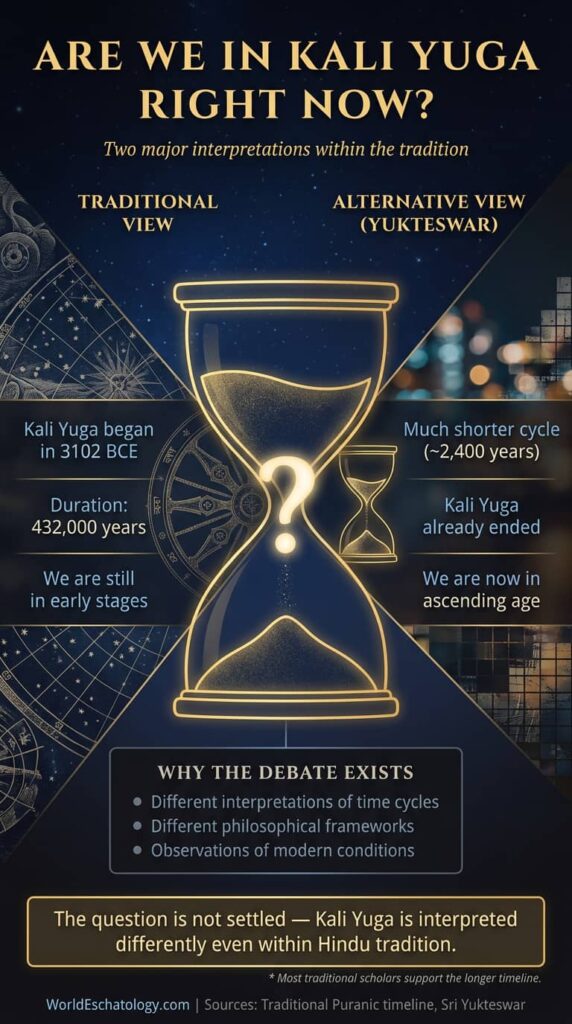
Kali Yuga and Other World Traditions
Kali Yuga and the Iron Age of Hesiod
The parallels between the Hindu Yuga system and the Greek poet Hesiod’s description of the five ages of man are so striking that scholars have debated for centuries whether one tradition borrowed from the other or whether both independently discovered the same underlying pattern.
Writing in the eighth century BCE in his poem Works and Days, Hesiod described five successive ages: the Golden Age, the Silver Age, the Bronze Age, an Age of Heroes, and the Iron Age.
The structure is not identical to the four Yugas (Hesiod adds the Age of Heroes, which has no clear Vedic parallel), but the basic pattern of progressive decline from a golden perfection through successive stages of deterioration to a dark iron age of labor, suffering, and moral confusion is clearly parallel.
In Hesiod’s Iron Age, which he believed he was living in, people are born already old, meaning they come into the world with the burdens of a degraded time already upon them.
There is no relief from labor and grief. Parents and children will conflict. Hospitality will disappear.
The only values that will be respected are brute strength and power. The gods will eventually abandon the earth entirely.
The sense of cosmic abandonment and moral exhaustion that characterizes Hesiod’s Iron Age is essentially identical in feeling to the Hindu description of Kali Yuga.
The most parsimonious explanation for this parallel is probably that both traditions were responding to a genuine and widely perceived human experience:
the sense that the current time is less good than the time that came before it, that something has been lost, that the world is moving in the wrong direction.
This experience, which seems to be genuinely universal across human cultures, found expression in the mythological language of cosmic ages.
Kali Yuga and the Norse Fimbulwinter and Ragnarok
The Norse tradition offers one of the most dramatic parallels to the Kali Yuga end-time scenario in its concept of Fimbulwinter and Ragnarok.
Fimbulwinter is a great winter of three years without summer that precedes Ragnarok, the final battle between the gods and the forces of chaos.
During Fimbulwinter, all the social bonds that hold civilization together break down. Brothers fight brothers.
Fathers and children betray each other. The distinction between humans and beasts collapses.
Ragnarok itself, the final battle, involves the death of many of the major gods, including Odin, Thor, and Tyr, and the destruction of the current world by fire and flood.
But crucially, as in the Hindu tradition, this destruction is not the end of everything. After Ragnarok, a new world rises from the sea, green and fertile.
The survivors, both divine and human, begin again. The world ends in order to be reborn.
The structural parallel with Kali Yuga is clear. A period of intensifying social breakdown and moral chaos (Fimbulwinter corresponds to the end of Kali Yuga).
A great catastrophic battle involving divine intervention (Ragnarok corresponds to the appearance of Kalki).
The destruction of the corrupt world and its replacement by something new and better (the new world rising from the sea corresponds to the dawn of the new Satya Yuga).
The parallel is not exact in every detail, but the underlying pattern of decline, intervention, destruction, and renewal is the same.
Kali Yuga and Zoroastrian Cosmic Time
Zoroastrianism, the ancient Persian religion founded by the prophet Zarathustra, has its own sophisticated vision of cosmic time that shows interesting parallels with the Kali Yuga framework.
The Zoroastrian cosmic history is divided into a series of periods, each of 3,000 years, totaling 12,000 years, a number that will be familiar from our discussion of Yukteswar’s shorter cycle.
In the Zoroastrian account, the original creation of Ahura Mazda, the supreme wise lord, was perfect and spiritual.
The arrival of Angra Mainyu, the destructive spirit, introduced corruption and deterioration into the world.
Each successive period of 3,000 years sees the struggle between these two cosmic principles, with the forces of Angra Mainyu becoming temporarily dominant before being overcome.
At the end of the 12,000 years comes Frashokereti, the Renovation of the world, when Ahura Mazda finally and completely defeats Angra Mainyu, the dead are resurrected, and the world is restored to its original perfect state.
The parallels with Kali Yuga are multiple. A cosmic cycle of time marked by progressive deterioration (Zoroastrianism’s later periods in the 12,000-year cycle correspond to the descending Yugas).
The struggle between divine and demonic forces for dominance in the world (the conflict between dharma and adharma in the Yuga framework).
A final eschatological event involving divine intervention, resurrection of the dead, and restoration of the world to perfection (Frashokereti parallels the close of Kali Yuga and the dawn of the new Satya Yuga).
Kali Yuga and the Jewish Concept of Ikveta DiMeshicha
In Jewish eschatological tradition, the period immediately preceding the coming of the Messiah is called Ikveta DiMeshicha, literally the footsteps of the Messiah, or sometimes the birthpangs of the Messiah.
This period is characterized by a darkening of moral and spiritual conditions, a collapse of social trust, the degradation of religious institutions, and the rise of impious leadership, all conditions that are strikingly similar to the characteristics of late Kali Yuga.
The Talmud’s description of the generation in which the Messiah will come, found in tractate Sanhedrin, includes the prediction that insolence will increase, prices will soar, the vine will bear fruit but wine will be costly, government will turn to heresy, and young people will shame their elders.
Students will not respect their teachers. Truth will become rare. The face of the generation will be like the face of a dog (meaning leaders will be shameless).
These are remarkably similar to the Bhagavata Purana’s list of Kali Yuga characteristics.
The shared structural insight of the Jewish and Hindu traditions is striking: the darkest time comes immediately before the dawn.
The worst conditions precede the arrival of the redeemer. The intensity of darkness is a sign not of permanent defeat but of imminent rescue.
This is a genuinely consoling theological insight, and the fact that it appears independently in traditions with no direct historical connection to each other is worth noting.
Kali Yuga and the Islamic Signs of the Hour
Islamic eschatology has its own detailed account of the signs that will precede the Day of Judgment, and many of these signs bear comparison with the characteristics of Kali Yuga.
The Hadith literature (the sayings of the Prophet Muhammad) lists numerous signs of the approaching Hour, divided into minor signs (which appear gradually over a long period) and major signs (which appear in rapid succession near the end).
The minor signs include the spread of ignorance, the decrease of knowledge, widespread adultery and fornication, the prevalence of music and wine, the decrease of honesty, the increase of lying, the building of very tall structures (skyscrapers), the spread of killing, and the situation where the slave woman gives birth to her master (interpreted as social upheaval where the lower classes dominate).
Many of these are structurally similar to the Bhagavata Purana’s Kali Yuga characteristics.
The major signs are more dramatic: the appearance of the Mahdi (a divinely guided leader), the descent of Jesus, the appearance of the Dajjal (a great deceiver), the rising of the sun from the west, and various cosmic events.
The Mahdi’s role in particular, gathering the righteous, fighting against corruption and injustice, preparing the way for a final divine intervention, shows structural similarities to Kalki’s role at the end of Kali Yuga.
Kali Yuga and the Mayan Long Count Calendar
No discussion of comparative eschatology in the modern era can ignore the Mayan Long Count calendar and the enormous popular interest that surrounded the end of the 13th Baktun on December 21, 2012.
The 2012 phenomenon attracted worldwide attention and produced a remarkable range of interpretations, from predictions of apocalyptic catastrophe to announcements of a great spiritual awakening, many of them connecting the Mayan calendar to the Kali Yuga concept.
The basic facts are important to establish clearly. The Mayan Long Count calendar counted time in units called Baktuns, each lasting approximately 394 years.
One Great Cycle, consisting of 13 Baktuns, lasted approximately 5,125 years, a period that began in 3114 BCE and ended on December 21, 2012.
It is worth noting the remarkable proximity of 3114 BCE to the traditional Kali Yuga start date of 3102 BCE, a coincidence that has naturally attracted attention.
What the ancient Maya themselves believed would happen at the end of the 13th Baktun is actually quite uncertain.
The popular narrative of apocalypse or spiritual transformation has very limited support in actual Mayan texts.
Most Mayan scholars agree that the end of the Long Count cycle was understood as the completion of one great cycle and the beginning of another, not as an apocalyptic endpoint.
The Maya used multiple overlapping calendar systems, and the completion of one cycle within one system did not necessarily imply the end of time.
What the Convergence of These Traditions Suggests
Having surveyed the parallels between Kali Yuga and similar concepts in Greek, Norse, Zoroastrian, Jewish, Islamic, and Mayan traditions, what can we actually conclude from this convergence?
The question is genuinely interesting and the honest answer is that we cannot conclude too much with certainty, but there are several possibilities worth taking seriously.
The first possibility is independent discovery of the same underlying pattern.
Human beings in every culture observe that things change, that change is often experienced as deterioration (because we tend to idealize the past and fear the future), and that there are cyclic patterns in natural and social phenomena.
It is not surprising that multiple cultures developed narratives of cosmic ages, a golden age, a progressive decline, a dark age, and a renewal, because this narrative maps onto the basic human experience of time in a way that feels intuitively right.
The second possibility is diffusion, the transmission of ideas along trade and migration routes.
There is good evidence that ideas traveled between ancient India, Persia, Greece, and the Near East in the millennium before the Common Era.
The parallels between the Hindu Yuga system and Hesiod’s ages of man may reflect this kind of contact rather than independent invention.
The third possibility, which is the most speculative but the most interesting, is that all of these traditions are pointing to a real feature of cosmic time, a genuine rhythmic pattern in the conditions under which conscious beings develop, that the ancient traditions of multiple cultures independently discovered or received.
This is, of course, not a claim that modern science is in a position to evaluate. But it is the claim that the traditions themselves make, and it deserves to be taken seriously as a possibility rather than dismissed without engagement.
What the Texts Recommend
The Hidden Gift of Kali Yuga: Why This Dark Age Is Actually the Easiest for Liberation
This is perhaps the most surprising teaching in the entire Kali Yuga tradition, and it is one that deserves to be taken seriously rather than dismissed as pious consolation.
Multiple major Hindu texts explicitly state that Kali Yuga, despite being the most degraded of all ages, is also the age in which liberation is most easily achieved.
The Bhagavata Purana says that those who are born in Kali Yuga are actually fortunate, because the path to liberation available in this age requires far less effort than the paths required in earlier ages.
The reasoning behind this counterintuitive claim has several layers. First, the very intensity of suffering in Kali Yuga creates a particular kind of readiness for liberation.
When the external world offers less and less genuine satisfaction, when the structures that once provided meaning and belonging collapse one by one, when the futility of looking for permanent happiness in impermanent things becomes increasingly obvious, a genuine spiritual orientation becomes easier, not harder.
Kali Yuga, by stripping away so many of the comfortable illusions that keep human beings attached to the surface of things, creates the conditions for a genuine search for what lies deeper.
Second, the practices that lead to liberation in Kali Yuga are described as far simpler and more accessible than those of earlier ages.
In Satya Yuga, the practice was intense, prolonged meditation. In Treta Yuga, it was elaborate, expensive, and technically demanding fire sacrifices.
In Dvapara Yuga, it was complex forms of deity worship requiring specific knowledge, materials, and conditions.
In Kali Yuga, the supreme practice is simply to chant the divine names with sincere devotion.
This practice requires no special knowledge, no expensive materials, no specific location, no elaborate preparation. It can be done by anyone, anywhere, at any time.
Nama Sankirtana: Chanting the Divine Names as the Practice for Kali Yuga
The Bhagavata Purana is explicit and emphatic on this point.
The prescribed practice for Kali Yuga, the spiritual technology most suited to the conditions of the dark age, is Nama Sankirtana: the communal singing and chanting of the divine names.
The text says that what the sages of Satya Yuga achieved through thousands of years of intense meditation, what the practitioners of Treta Yuga achieved through the performance of great fire sacrifices, and what the worshippers of Dvapara Yuga achieved through elaborate temple rituals, the practitioners of Kali Yuga can achieve simply by chanting the names of God.
This is not a second-best option offered to those who are too weak or too ignorant for real practice.
The Bhagavata Purana presents Nama Sankirtana as the supreme practice for this age precisely because it is perfectly suited to the conditions of Kali Yuga.
In an age when concentration is difficult, elaborate ritual is inaccessible, and genuine spiritual community is rare, the practice of chanting together provides a way for ordinary people to connect directly with the divine without requiring extraordinary personal qualities or material resources.
The practice of Nama Sankirtana has found expression across multiple Hindu traditions in different forms.
In the Vaishnava traditions, it appears as the kirtana, the communal singing of devotional songs and the chanting of names like the Maha-Mantra (Hare Krishna, Hare Rama).
In Shaiva traditions, it appears as the chanting of Om Namah Shivaya and similar formulas. In Shakta traditions, it appears as the singing of hymns to the goddess.
The specific names and formulas differ across traditions, but the principle is the same: the sincere and loving repetition of the divine names is the highway to liberation in the age of Kali.
The Hare Krishna Movement and Kali Yuga
No modern religious movement has made the Kali Yuga concept more central to its mission and identity than the International Society for Krishna Consciousness, commonly known as the Hare Krishna movement, founded by A.C. Bhaktivedanta Swami Prabhupada in 1966.
For Prabhupada, the entire purpose of his remarkable late-life mission, traveling to New York at the age of seventy with almost no money or institutional support to spread Vedic wisdom in the heart of the modern West, was explicitly a response to the condition of Kali Yuga.
Prabhupada taught that Kali Yuga’s defining spiritual challenge was the dominance of what he called the bodily conception of life:
the mistaken identification of the self with the physical body.
When human beings think they are their bodies, they naturally pursue bodily pleasures as their primary goal, and this pursuit produces exactly the qualities the Bhagavata Purana associates with Kali Yuga: greed, anger, envy, pride, and the exploitation of other beings.
The remedy, in Prabhupada’s teaching, was the direct experience of the distinction between the soul and the body that comes through the practice of Bhakti yoga, particularly through chanting the Hare Krishna Maha-Mantra.
Prabhupada was also fond of pointing out the specific prediction in the Bhagavata Purana that in Kali Yuga, the divine names would be spread throughout the world and would save the age.
He understood his own mission as the fulfillment of this prediction: the Hare Krishna movement’s spread of the Maha-Mantra to every country on earth was not an accident but a divinely ordained response to the particular spiritual crisis of the dark age.
The Role of the Guru in Kali Yuga
If the darkness of Kali Yuga makes the spiritual path simultaneously more necessary and more difficult, and if the conditions of the age make it harder to find genuine teachers, then the question of the Guru becomes particularly urgent and particularly fraught.
The tradition is clear that in Kali Yuga, the genuine teacher, the one who has realized what they teach and who can transmit that realization to students, is rare.
But the tradition is equally clear that such a teacher is not impossible, and that finding one is the single most important thing a spiritual seeker in Kali Yuga can do.
The Guru-disciple relationship, in the traditional Hindu understanding, is not simply a relationship between a teacher who knows things and a student who does not know them.
It is a relationship of transmission, in which the Guru’s realized state of consciousness is somehow communicated to the disciple through sustained contact, through service, through the practice of the teachings, and through the grace that flows from the Guru’s own connection to the lineage of realized teachers that stretches back through time.
In Kali Yuga, this relationship is complicated by several factors. The proliferation of false teachers makes discernment crucial and difficult.
The dominance of the consumer mentality means that even genuine seekers often approach the spiritual path as consumers looking for products that will provide an agreeable experience, rather than as students willing to submit to a genuine transformational process.
And the degradation of the tradition means that even those who sincerely wish to teach may be working from an incomplete or distorted understanding of what they have received.
Meditation and Yoga in Kali Yuga: What the Texts Say About Modern Practices
The Bhagavata Purana makes an interesting and challenging claim about the spiritual practices of earlier ages.
It says that the meditation practices of Satya Yuga required practitioners to maintain unwavering concentration for periods that are incomprehensibly long by modern standards: thousands of years of unbroken contemplation.
Even in Treta Yuga, the practices required levels of concentration and sustained attention that are far beyond what ordinary people in Kali Yuga can achieve.
This has implications for how we understand the modern enthusiasm for meditation and yoga.
On one hand, the tradition is clear that these practices have genuine value and are appropriate for Kali Yuga practitioners; they are recommended as supports for the primary practice of devotion and name-chanting.
On the other hand, the tradition is also clear that expecting to achieve through meditation in Kali Yuga what the sages of Satya Yuga achieved through meditation is unrealistic.
The minds of Kali Yuga practitioners are too unstable, too distracted, too pulled by desires and distractions to achieve the sustained depth of concentration that the ancient practices assumed.
This is not a counsel of despair. It is simply a recalibration of expectations.
The Bhagavata Purana’s teaching is that Kali Yuga practitioners who practice sincerely, whatever practices they engage in, with genuine devotion and longing for the divine, will achieve results appropriate to their age and their practice.
The grace available in Kali Yuga through devotional practice is genuinely extraordinary, even if it works differently than the grace of earlier ages.
How to Live Well in Kali Yuga: Practical Guidance from the Tradition
The tradition does not simply describe Kali Yuga and then leave you to manage it on your own.
It offers specific practical guidance for how to live with wisdom, dignity, and spiritual depth in the conditions of the dark age.
Drawing from the Bhagavata Purana, the teachings of the Bhakti saints, and the wisdom of various lineages, several themes emerge consistently.
Simplicity is a recurring recommendation. In an age dominated by desire for wealth and sensory pleasure, the deliberate cultivation of a simpler life, wanting less, consuming less, and finding satisfaction in less, is both a spiritual practice in its own right and a protective measure against the deepest forms of Kali Yuga’s degradation.
The person who genuinely needs little is far harder to exploit than the person who is driven by desires that can always be manipulated.
Devotion, in whatever form it takes within one’s own tradition, is the central practice. The specific form matters less than the sincerity and consistency of the practice.
Daily prayer, chanting, meditation, service, all of these work together to maintain connection with the divine amid the noise and distraction of the dark age.
Satsang, the community of truth-seekers, is emphasized consistently across traditions as essential in Kali Yuga.
Because the general atmosphere of the age pulls toward adharma, maintaining regular contact with others who are genuinely oriented toward dharma and spiritual depth is a powerful counter-current.
The tradition says that even a brief moment of genuine satsang is of inestimable value in Kali Yuga.
The cultivation of discrimination, the capacity to distinguish between what is real and what is merely apparent, between genuine spiritual teaching and its counterfeit, between lasting satisfaction and temporary pleasure, is the intellectual practice the tradition most emphasizes for Kali Yuga.
In an age saturated with misinformation, manipulation, and false teachers, the ability to see clearly is a survival skill as much as a spiritual one.
Sri Yukteswar Giri and the Ascending Arc Theory
We have already discussed Yukteswar’s shorter cycle theory in the context of Kali Yuga’s timeline.
Here it is worth looking more closely at the man himself and at the deeper philosophical framework behind his mathematical revision.
Swami Sri Yukteswar Giri (1855-1936) was a Kriya Yoga master, a mathematician, an astronomer, and a man of remarkable spiritual depth.
His student Paramahansa Yogananda described him as a jnanavatar, an avatar of wisdom, and Yogananda’s Autobiography of a Yogi, which brought Yukteswar’s teaching to a vast Western audience, devotes considerable space to describing his extraordinary qualities.
Yukteswar’s model of the Yuga cycle as an ascending and descending arc driven by the solar system’s movement in relation to another star or center of higher consciousness has influenced a remarkable range of thinkers from Yogananda to contemporary researchers interested in the relationship between cosmic cycles and human development.
His argument that we are currently in an ascending phase of the cycle, moving from Kali Yuga into Dvapara Yuga, offers a more optimistic framework than the traditional long timeline, and this optimism has obvious appeal in a time of genuine challenges.
The philosophical depth of Yukteswar’s framework deserves more attention than it usually receives.
He was not simply trying to make people feel better about the state of the world.
He was making a serious argument about the relationship between cosmic conditions and the development of human consciousness, and his model has a coherence and a precision that reward careful study even for those who do not ultimately accept its conclusions.
Rene Guenon and the Traditionalist School
The French metaphysician Rene Guenon (1886-1951) made the Kali Yuga concept central to his enormously influential critique of Western modernity.
Guenon, who converted to Sufi Islam later in his life, developed a comprehensive philosophical framework called the Traditionalist or Perennialist school, which held that all genuine religions are expressions of a single primordial spiritual truth, and that modernity represents a catastrophic deviation from this truth.
Guenon’s key work on this subject, The Crisis of the Modern World, published in 1927, used the Kali Yuga framework as his primary analytical tool for diagnosing what had gone wrong with Western civilization.
He argued that the modern West had not progressed beyond traditional civilizations but had rather descended to an unprecedented level of spiritual degradation, precisely the kind of degradation that the Hindu tradition associates with the advanced phase of Kali Yuga.
For Guenon, the specific features of Western modernity that were most characteristic of Kali Yuga were its materialism (the denial of any reality beyond the physical), its individualism (the elevation of the isolated ego above the cosmic order), its quantitative thinking (the reduction of all quality to quantity, all being to matter, all meaning to measurable utility), and its denial of tradition (the revolutionary rejection of inherited wisdom in favor of novelty and change).
These, he argued, were not accidental features of the modern world but the natural expression of a consciousness that had cut itself off from the metaphysical roots that give human life its depth and meaning.
Julius Evola’s Reading of Kali Yuga
Julius Evola (1898-1974) was an Italian philosopher, artist, and esotericist who developed one of the most controversial uses of the Kali Yuga concept in the twentieth century.
Evola drew heavily on Guenon’s Traditionalism but pushed it in directions that Guenon himself rejected, including into explicit sympathy with fascism and with what Evola called the aristocratic values of the warrior caste.
Evola’s major work on this subject, Revolt Against the Modern World, published in 1934, used the Kali Yuga framework to diagnose and condemn virtually every aspect of modern liberal democratic culture.
He argued that the modern emphasis on equality, democracy, human rights, and the sovereignty of the masses was the natural expression of the Kali Yuga’s inversion of the cosmic hierarchy, in which the lowest castes (in Evola’s reading, merchants and then workers) come to dominate the higher castes (warriors and then priests-sages).
It is important to note this interpretation clearly and critically. Evola’s use of the Kali Yuga framework to justify political authoritarianism and express hostility toward equality and human dignity is a serious misuse of the tradition.
The Bhagavata Purana does not sanction violence, political oppression, or the denial of human dignity as responses to Kali Yuga.
The tradition’s recommended response to the dark age is devotion, simplicity, and the cultivation of inner dharma, not the imposition of a hierarchical social order by force.
Evola’s reading is cited here because it is historically significant and because understanding its errors is important for anyone who encounters his work.
Paramahansa Yogananda on the Yugas
Paramahansa Yogananda (1893-1952) brought the Yuga concept to a vast Western audience through his Autobiography of a Yogi, one of the most widely read spiritual books of the twentieth century, and through his work as a teacher of Kriya Yoga in America from 1920 until his death.
Yogananda accepted and taught Yukteswar’s shorter cycle model, and he integrated it into a broader vision of humanity’s spiritual evolution that was both deeply rooted in the Vedic tradition and explicitly inclusive of insights from Western science and Christianity.
He taught that the advancing Dvapara Yuga that Yukteswar said we were entering would be characterized by the development of atomic energy (which he predicted), space travel, and the gradual awakening of human intuitive and spiritual capacities that had been dormant during the Kali Yuga period.
Yogananda’s optimism about the trajectory of the current age was genuine and grounded in specific predictions.
He taught his students that while the challenges of the transitional period would be real and serious (he did not minimize the dangers of the atomic age he was living in), the overall direction of cosmic time was upward, toward greater light, and that the spiritual practices he transmitted were ideally suited to help people align themselves with that upward movement rather than being overwhelmed by the turbulence of the transition.
David Frawley and Contemporary Hindu Scholarship on the Yugas
David Frawley, also known by his Sanskrit name Vamadeva Shastri, is one of the most prolific and widely read contemporary scholars writing in the Vedic tradition.
An American by birth who has studied with Indian masters and been recognized by traditional Hindu institutions, Frawley occupies an interesting position between traditional orthodoxy and modern Western scholarship.
Frawley has written extensively on the Yuga system and has proposed his own interpretation that draws on both the traditional texts and modern astronomical and archaeological findings.
He has been particularly interested in the relationship between the Yuga cycles and what he calls the Vedic age, the period he argues saw the composition of the Vedas and the flowering of the Vedic civilization in ancient India.
Frawley takes seriously both the traditional long timeline and the evidence from Vedic texts of a high civilization that appears to predate what mainstream archaeology assigns to ancient India.
He sees the Yuga framework as providing a cosmological context for understanding why advanced civilizations might arise and then decline, and why the historical record seems to show a more complex and in some ways more ancient human story than the standard model acknowledges.
Graham Hancock, Randall Carlson, and the Alternative History Connection
The Kali Yuga concept has attracted significant interest from researchers in the alternative history community, particularly those associated with the work of Graham Hancock and Randall Carlson.
These researchers argue that a major cosmic catastrophe, likely involving one or more comet impacts, caused the rapid end of a highly developed human civilization at the close of the last Ice Age, approximately 12,000 years ago, and that the world’s ancient mythologies, including the Yuga system, preserve memories of this catastrophe.
Hancock, in particular, has drawn attention to the convergence of start dates around 3100 BCE across multiple ancient civilizations and has connected this to his broader argument that the civilizations we identify as the oldest, Egypt, Mesopotamia, the Indus Valley, were not the first sophisticated civilizations but were inheritors of wisdom from an older civilization that was destroyed in the catastrophe.
In this framework, the decline from the Golden Age to the current dark age is understood not purely as a cosmic or spiritual process but as a consequence of real physical events that literally destroyed advanced knowledge and forced humanity to begin again at a lower level.
Traditional Hindu scholars are generally skeptical of this framework, not because they deny that catastrophes can occur but because they see the Yuga system as a cosmic truth that does not require catastrophe theory to explain.
The decline from Satya Yuga to Kali Yuga is, in the traditional view, driven by cosmic factors, not by asteroid impacts.
The New Age Appropriation of Kali Yuga
The concept of Kali Yuga has been widely adopted and often significantly transformed in Western New Age spirituality.
In this popular context, the term is sometimes used loosely to refer to any dark or difficult period, sometimes conflated with the concept of the Kali goddess in ways that confuse the etymology, and sometimes stripped of its traditional mathematical framework and specific characteristics to serve as a vague symbol of contemporary malaise.
More concerning, from the perspective of the tradition, is the tendency in some New Age circles to combine the Kali Yuga concept with ideas from very different traditions in ways that dilute or distort the specific teaching.
Mixing Kali Yuga with Mayan calendar prophecy, with Atlantis mythology, with various channeled teachings, and with Western astrology produces a syncretic brew that may be emotionally appealing but is intellectually incoherent and loses the specific wisdom that the original tradition contains.
Traditional Hindu scholars have generally been critical of these appropriations, not from a spirit of exclusivity but from a genuine concern that the diluted versions of the teaching are less useful to people than the real thing.
If someone comes to the Kali Yuga concept through New Age sources and then discovers the actual depth and precision of the original teaching, the contrast is often striking enough to inspire serious engagement with the tradition.
But if the New Age version is taken as the real thing, something genuinely valuable has been lost in the translation.
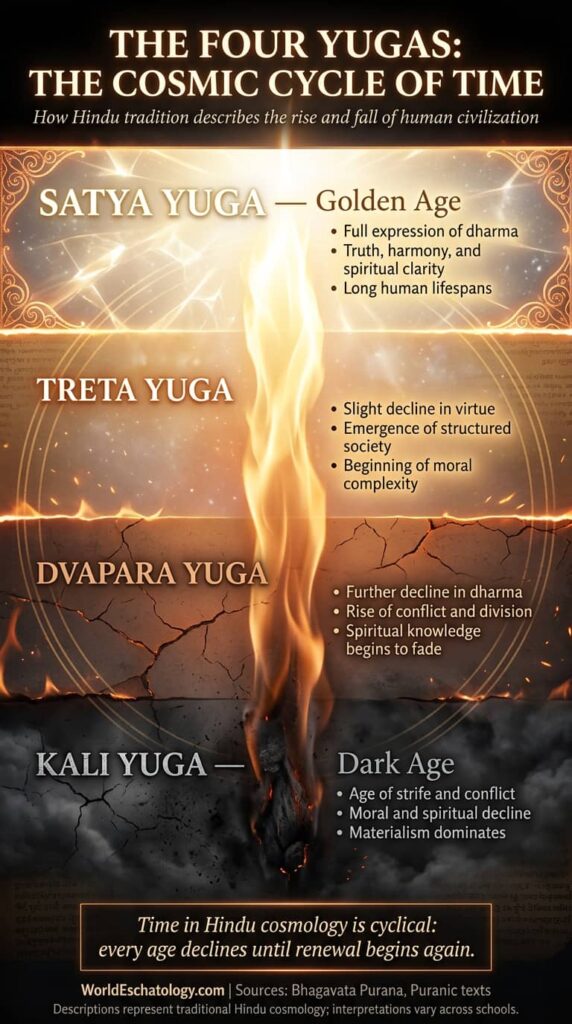
What does Kali Yuga mean?
Kali Yuga is the name the ancient Hindu tradition gives to the current cosmic age, the fourth and most degraded phase of a great cycle of time.
The word Kali means strife, conflict, or the losing throw of a die, and Yuga means age or era. So Kali Yuga is simply the Age of Strife, the time in the cosmic cycle when the forces of disorder, selfishness, and spiritual blindness are at their strongest.
It is the winter of the cosmic year, the lowest point in the great cycle before a new golden age begins.
How long does Kali Yuga last?
According to the traditional Hindu calculation, Kali Yuga lasts 432,000 human years.
This is based on a unit called a divine year, in which one divine year equals 360 human years, and Kali Yuga is said to last 1,200 divine years.
However, an alternative calculation proposed by the nineteenth-century sage Sri Yukteswar holds that the cycle is far shorter, with Kali Yuga lasting only 2,400 ordinary human years.
These two calculations give very different pictures of where we are in the cycle and when the age might end, and both have serious defenders within the tradition.
When did Kali Yuga start?
The traditional date for the beginning of Kali Yuga is 3102 BCE, specifically tied to the departure of Krishna from the world.
This date is also associated with a significant planetary alignment that ancient Indian astronomers used as the starting point for their calendar calculations.
On this date, the cycle of Kali Yuga is said to have begun, following immediately on the end of Dvapara Yuga. The great mathematician and astronomer Aryabhata confirmed this date using his own calculations in the fifth century CE.
What are the signs of Kali Yuga?
The Bhagavata Purana lists many specific signs of Kali Yuga.
These include: wealth becoming the sole measure of a person’s worth and virtue; rulers and leaders behaving like bandits, taking from the population without offering genuine protection;
religious institutions becoming corrupt and focused on money rather than genuine spiritual development; the breakdown of family and community bonds; erratic and insufficient rainfall; the degradation of food and agriculture;
the prevalence of lying as a normal feature of social and political life; the dominance of desire, anger, and greed as the primary motivating forces in human life; and the progressive shortening of human lifespan and deterioration of physical and mental health.
Are we in Kali Yuga right now?
According to the traditional Hindu calculation, yes, we are in Kali Yuga, and we have been since 3102 BCE.
On the traditional timeline, we are only about 5,126 years into an age that will last 432,000 years.
On Sri Yukteswar’s shorter timeline, we have actually recently exited Kali Yuga and are now in an ascending Dvapara Yuga.
Most traditional Hindu scholars and pandits hold the traditional long timeline and say yes, we are clearly in Kali Yuga, and the characteristics of the age as described in the Bhagavata Purana are plainly visible in the modern world.
What are the signs of Kali Yuga ending?
The Bhagavata Purana describes extreme conditions marking the very end of Kali Yuga: human lifespan reduced to twenty or thirty years, widespread famine, the complete collapse of social structures and governance, the disappearance of the written transmission of knowledge, and people living in scattered bands surviving on whatever they can find.
The appearance of Kalki, the tenth avatar of Vishnu riding a white horse and wielding a blazing sword, signals the actual end of Kali Yuga. He destroys the corrupt order and creates conditions for the new Satya Yuga to begin.
Who is Kalki and when will he come?
Kalki is the tenth and final avatar of Vishnu, expected to appear at the very end of Kali Yuga.
The Bhagavata Purana and other texts describe him as a warrior born to a brahmin family in a village called Shambhala, who will receive divine weapons and ride a magnificent white horse.
His mission is to destroy the corrupt rulers and leaders who have oppressed humanity throughout Kali Yuga and to create the conditions for the next Satya Yuga.
As for when he will come, on the traditional timeline he would not be expected for hundreds of thousands of years.
On Yukteswar’s shorter timeline, we may have already passed through Kali Yuga entirely.
What comes after Kali Yuga?
After Kali Yuga ends, a new Satya Yuga, the golden age, begins. The cycle of four Yugas then repeats from the beginning.
The new Satya Yuga is not simply a return to the conditions of the previous Satya Yuga; it is a genuinely new beginning within the ongoing cosmic cycle.
The traditions describe this new golden age as characterized by the full expression of dharma, very long human lifespans, direct knowledge of the divine, and the complete absence of the strife, dishonesty, and degradation that define Kali Yuga.
Is Kali Yuga the same as the apocalypse?
Kali Yuga shares some features with what people usually mean by the apocalypse, particularly the idea that the current world will end and be replaced by something fundamentally different.
But there are important differences. The Hindu tradition does not teach that Kali Yuga ends in a final, unrepeatable judgment and the creation of an eternal afterlife state.
It teaches that Kali Yuga ends as part of a cycle, that the destruction at the end of the age is followed by a new golden age within the same ongoing cosmic story.
The end of Kali Yuga is more like the end of winter than the end of all time.
What is the difference between Kali Yuga and Kali the goddess?
They share a similar sound in English but come from different Sanskrit roots.
The word Kali in Kali Yuga comes from the root kal, meaning to quarrel or to be in a state of strife, and refers also to the losing throw of a die.
The goddess Kali’s name comes from the root kala, meaning time and also black or dark. She is the goddess who is time itself, the one who devours all things.
While Kali the goddess is associated with the transformative power of destruction and with the dissolution that is one of the qualities of Kali Yuga, she does not rule or cause the dark age in any direct sense.
The confusion between the two Kalis is common but worth clearing up.
Can you escape Kali Yuga’s effects through spiritual practice?
Yes, and this is one of the most important teachings of the tradition.
The conditions of Kali Yuga represent the general atmosphere and direction of the age, but they do not determine the destiny of every individual within it.
The tradition insists that spiritual practice, particularly the practice of sincere devotion and the chanting of divine names, can protect the practitioner from the worst effects of Kali Yuga and can actually accelerate their spiritual development in a way that the comparatively comfortable conditions of earlier ages did not.
The darkness of Kali Yuga does not have to determine your own inner life.
What does Kali Yuga say about the role of women?
This is a complex and contested question. The Bhagavata Purana describes changes in women’s social roles and behaviors as signs of Kali Yuga’s degradation, reflecting the social framework of the ancient authors.
Traditional commentators understand these passages as describing what will happen, not necessarily what should happen, and as symptoms of deeper social collapse rather than independent causes.
Modern Hindu scholars and feminist thinkers within the tradition point out that many of what the texts describe as signs of degradation are actually ambiguous; some represent genuine moral deterioration, while others represent social progress toward greater equality and freedom.
The tradition’s relationship with gender is evolving, and there is genuine diversity of interpretation on this question.
What did Srila Prabhupada say about Kali Yuga?
Prabhupada, the founder of ISKCON (the Hare Krishna movement), wrote and spoke extensively about Kali Yuga throughout his life.
He taught that the defining feature of Kali Yuga is what he called the bodily concept of life, the mistaken identification of the self with the physical body, which leads to the pursuit of material pleasure as the primary goal of existence.
He saw virtually every aspect of modern culture, its materialism, its sexual permissiveness, its addiction to intoxicants, its factory farming, its addiction to gambling in the financial markets, as direct expressions of Kali Yuga’s degradation.
His prescribed remedy was the Bhakti yoga path, centered on chanting the Hare Krishna Maha-Mantra, which he taught could deliver anyone from Kali Yuga’s influence regardless of their background or current condition.
What is the Kali Yuga in Buddhism?
Buddhism does not use the term Kali Yuga as part of its core cosmological vocabulary.
However, Buddhism does have its own concept of declining ages, particularly the teaching of the three ages of the Dharma:
Shosho (the age of the correct Dharma, when the Buddha’s teaching is practiced correctly), Zoho (the age of the counterfeit Dharma, when the form is maintained but the inner substance has weakened), and Mappo (the age of the end of the Dharma, when the teaching exists but can no longer be practiced effectively).
This Buddhist three-age framework has structural parallels to the Hindu Yuga system.
Some Japanese Buddhist traditions, particularly Pure Land Buddhism, explicitly teach that we are now in Mappo, the equivalent of Kali Yuga, and that the appropriate practice for this age is simple devotion and the recitation of the Buddha’s name, a striking parallel to the Hindu teaching about Nama Sankirtana in Kali Yuga.
Does science support the idea of Kali Yuga?
Modern science does not directly confirm or refute the Kali Yuga framework, because the two operate in different domains and use different methods.
Science can tell us things about the current state of the environment, the trajectory of political and social conditions, and the history of human lifespan and health, and as we have discussed, many of these findings are consistent with the Kali Yuga description in a broad sense.
What science cannot do, by its nature, is confirm or deny the metaphysical and cosmological claims about the Yuga cycle being driven by cosmic forces beyond the physical universe.
The relationship between the Kali Yuga tradition and modern science is therefore one of interesting and sometimes provocative dialogue rather than confirmation or refutation.
What is the Yuga Sandhya?
The Yuga Sandhya is the twilight period that precedes the full establishment of each Yuga.
Just as twilight contains elements of both the outgoing day and the approaching night, the Yuga Sandhya is a transitional period in which the characteristics of the outgoing age are still present while those of the incoming age are beginning to emerge.
Each Yuga also has a Sandhyamsha, a dusk period at its end, in which the outgoing age is winding down and the next one is beginning to establish itself.
These twilight periods are each one-tenth the length of the Yuga itself, and understanding them helps explain why transitions between ages are gradual rather than abrupt.
What is the relationship between Kali Yuga and the Iron Age?
The Greek poet Hesiod’s Iron Age, described in his poem Works and Days around the eighth century BCE, shows striking structural parallels with Kali Yuga.
Both describe the current age as the worst in a series of descending ages, characterized by moral confusion, the dominance of selfishness and greed, the breakdown of social bonds, and the difficulty of accessing divine wisdom.
Hesiod describes five ages (Gold, Silver, Bronze, Heroes, Iron) while the Hindu system has four (Satya, Treta, Dvapara, Kali), and the parallel is not exact in every detail.
But the underlying pattern of decline from a golden perfection through successive stages to a dark, difficult age of strife is the same in both traditions.
Is the 2012 Mayan calendar the same as Kali Yuga?
These are different systems from different traditions, but there are interesting points of comparison.
The Mayan Long Count calendar’s Great Cycle of approximately 5,125 years began in 3114 BCE, remarkably close to the traditional Kali Yuga start date of 3102 BCE.
The end of the 13th Baktun on December 21, 2012 attracted worldwide attention as a possible eschatological marker, though Mayan scholars are clear that the ancient Maya did not predict apocalypse on that date.
Rather, it marked the completion of one great cycle and the beginning of another, which is more analogous to a Yuga transition than to an absolute end of time.
The popular conflation of the 2012 date with Kali Yuga end times was a New Age phenomenon with limited support in either the Mayan or Hindu traditions themselves.
The Enduring Power of the Kali Yuga Framework
The concept of Kali Yuga has survived thousands of years, crossed cultural boundaries, and continues to speak to people in the twenty-first century for a reason that goes beyond mere tradition or habit.
It speaks to something that many people genuinely feel when they look honestly at the world: that something important has been lost, that the conditions of the current age are in some deep way hostile to the full expression of human potential, and that the darkness of the present time is not simply the way things have to be.
The framework is also honest in a way that much contemporary thought is not. It does not offer the progressive optimism of the view that human beings are steadily improving and that the future will inevitably be better than the past.
Nor does it offer the paralytic pessimism of the view that everything is getting worse and there is nothing to be done.
It offers instead a cosmic realism: the acknowledgment that we are in a difficult phase of a larger cycle, that this difficulty is real and serious, and that within this difficulty both genuine challenges and genuine opportunities exist.
The Choice the Tradition Offers
One of the most important things the Kali Yuga tradition insists on, across all of its variants and interpretive schools, is that the cosmic conditions of the age do not determine the spiritual destiny of the individuals within it.
The darkness of Kali Yuga is the general atmosphere. But each person, in each moment, retains the capacity to choose how to relate to that atmosphere.
One can be swept along by the currents of the age, carried in the direction of greed, distraction, dishonesty, and spiritual blindness.
Or one can deliberately orient toward the light, cultivating the practices and the qualities that the tradition recommends, maintaining connection with whatever is most real and most enduring amid all that is transient and illusory.
This is not a small choice or an easy one. The tradition is clear that going against the current of the age is genuinely difficult, that the forces pulling toward adharma in Kali Yuga are powerful and pervasive, and that even sincere practitioners will face challenges that practitioners in earlier ages did not face in the same way.
But the tradition is equally clear that the choice is real, that the capacity for genuine spiritual life is not destroyed by Kali Yuga even at its worst, and that the grace available to those who seek it sincerely in this age is, in its own way, extraordinary.
The Sunrise Within the Dark Age
The final word of the Kali Yuga tradition is not darkness but dawn. The great cycle turns. Kali Yuga is not the last chapter in a story with no ending.
It is one phase in a rhythm that has repeated before and will repeat again, winter before spring, night before morning, dissolution before a new creation that will be, in some important sense, more beautiful for everything it has passed through.
The Bhagavata Purana holds something remarkable in reserve for those who pay attention to it closely.
It says that the souls born in Kali Yuga, precisely because of the conditions of the age, have a particular quality of longing, a spiritual hunger that the comfortable souls of the golden age do not develop in quite the same way.
The suffering of Kali Yuga, when it is met with awareness rather than simply endured, can become the most powerful teacher of all.
It shows, with a clarity that no comfortable age can provide, that what the heart most deeply seeks cannot be found in anything the world of Kali Yuga has to offer.
And when that recognition is genuinely made, when the soul turns from the world that cannot satisfy to the source that always can, the tradition says that the grace available in this dark age is immediate, abundant, and freely given.
The name of the divine on the lips and in the heart, the ancient teachers say, is the sun that rises in the middle of the night of Kali Yuga.
It does not wait for the age to end. It shines now, for whoever has the eyes to see it and the courage to turn toward its light.
WorldEschatology.com
Sources: Bhagavata Purana (Srimad Bhagavatam), Book 12; Vishnu Purana; Mahabharata; Manusmriti; Surya Siddhanta; Sri Yukteswar, The Holy Science; Maimonides, Mishneh Torah; Rene Guenon, The Crisis of the Modern World; Paramahansa Yogananda, Autobiography of a Yopada, Srimad Bhagavatam Commentariesgi; A.C. Bhaktivedanta Swami Prabhu
1 thought on “Kali Yuga Explained: Are We Living in the Age of Darkness Right Now?”