Introduction
There is a question that has lived in the back of human minds since the very beginning of civilization.
It does not go away no matter how busy life gets, no matter how much technology advances or how much the world changes. The question is simple: how does this all end?
Every culture, every religion, every civilization has tried to answer it. But few have done so with the level of detail, the depth, and the sheer specificity that Islam provides.
Islamic eschatology, the Islamic study of the end times, does not speak in vague generalities. It names the people who will appear. It describes the events that will unfold.
Eschatology in Islam gives us a sequence, a rough order in which these events will happen.
The Prophet Muhammad (peace be upon him) warned his companions about what was coming in such careful, specific terms that the scholars of hadith filled entire volumes just recording and analyzing what he said.
The Quran, on its own, mentions the Day of Judgment more than almost any other subject.
If you read through the Quran with attention, you will find that the reminder of Yawm al-Qiyamah: the Day of Standing, appears on virtually every few pages.
This is not a coincidence. In Islam, belief in the Day of Judgment is not optional theology. It is one of the six pillars of faith.
A person who denies it is not considered a Muslim, because that denial cuts at the very root of why we are here, what we are accountable for, and what meaning our choices have in this life.
This article is a complete introduction to Islamic eschatology timeline.
We are going to cover the minor signs of Qiyamah; the ten major signs; the great figures who will appear: the Mahdi, the Dajjal, and the return of Isa (Jesus).
What happens in the grave; what the Day of Judgment actually looks like step by step; and what ultimately awaits humanity at the end of it all.
Whether you are a Muslim looking to deepen your knowledge or someone from another faith tradition trying to understand what Islam teaches about the end, this article will give you the most comprehensive picture possible. Let’s begin.
Why Islam Places Such Heavy Emphasis on the End Times
Before we get into the signs and the events, it helps to understand why Islamic eschatology exists in the first place and why the Prophet (peace be upon him) spoke about it so extensively.
In Islam, the concept of Akhirah (the afterlife) is not an add-on to the religion. It is the foundation.
The reason we fast in Ramadan, the reason we pray five times a day, the reason we are honest in our dealings and kind to our neighbors: all of it ultimately points back to the belief that this life is not the end.
That there is an accounting coming. That every single thing we do is being recorded.
The Day of Judgment, or Yawm al-Qiyamah, is the moment when that account is settled.
It is when the ledger of every soul’s life is opened, when every injustice is addressed, and when every person receives exactly what their deeds deserve. This is why the Quran says:
|
Understanding this gives the end times a completely different feel than how it is often portrayed in popular culture.
In Islam, the end times are not about apocalyptic horror for its own sake. They are about justice.
They are about the resolution of a story that began with Adam and Eve and will conclude with every soul standing before their Creator.
The two main sources for Islamic eschatology are the Quran and the hadith: the recorded sayings and actions of the Prophet Muhammad (peace be upon him).
The most important hadith collection for end-times material is Sahih Muslim, particularly the chapter known as Kitab al-Fitan wa Ashrat al-Sa’ah (The Book of Tribulations and the Signs of the Hour).
Other major collections: Sahih Bukhari, Sunan Abu Dawud, Sunan Ibn Majah, and the Musnad of Imam Ahmad also contain significant material on this subject.
When scholars discuss Islamic eschatology timeline, they always distinguish between two categories of signs: Ashraat al-Sa’ah al-Sughra (the minor signs) and Ashraat al-Sa’ah al-Kubra (the major signs).
Think of the minor signs as the early tremors before a great earthquake, and the major signs as the earthquake itself. We will cover both in detail.
It is also important to note a key Islamic principle here before we go further: No one knows when the Day of Judgment will actually arrive.
Not the angels. Not the Prophet. Not any scholar, sheikh, or self-proclaimed saint. The Quran is explicit:
|
Knowing the signs is not about predicting a date. It is about being prepared. It is about recognizing where we are in the story of creation and adjusting our lives accordingly.
The Big Picture: Islam’s Timeline of the End
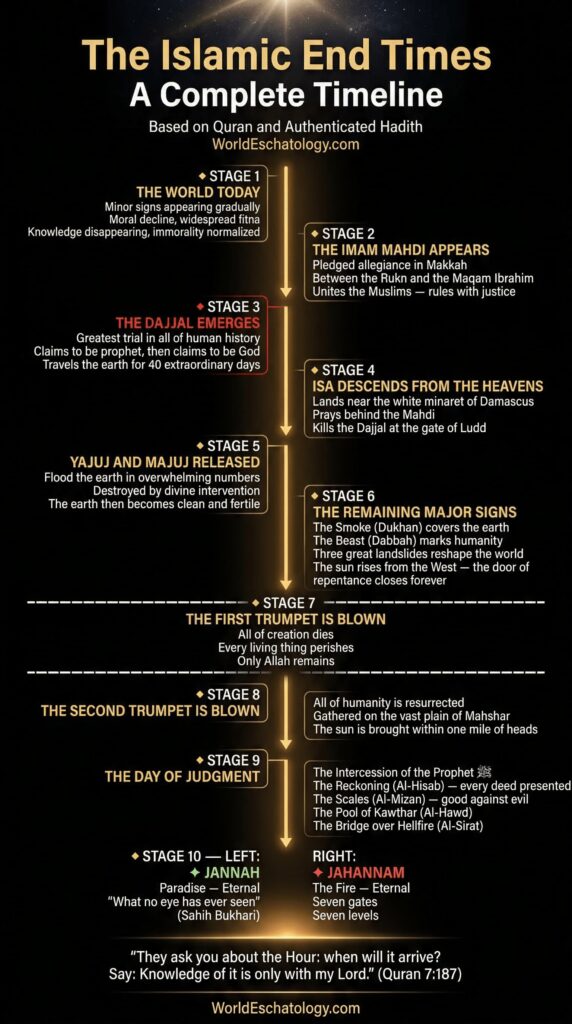
One of the most useful ways to approach the Islamic eschatology timeline is to first see the entire timeline laid out before you.
Once you have the map, the individual details make far more sense and are far easier to remember. Here is how the story of the end unfolds in Islamic end times:
- The world continues in its current state, with the minor signs of Qiyamah appearing gradually over time: some already fulfilled, many ongoing, and a few still to come.
- A series of major upheavals begins. The Imam Mahdi appears. Society is in a state of deep turmoil. Muslims rally around him.
- The Dajjal: the greatest deceiver and the greatest trial humanity will ever face: emerges and spreads his fitna (tribulation) across the earth.
- Isa ibn Maryam (Jesus, peace be upon him) descends from the heavens and joins the Muslims. He kills the Dajjal. The world enters a period of peace and justice.
- Yajuj and Majuj (Gog and Magog) are released. They spread across the earth in overwhelming numbers. They are destroyed by divine intervention through the supplication of Isa.
- The remaining major signs unfold in relatively rapid succession: the great landslides, the smoke, the beast of the earth, the sun rising from the west.
- The Trumpet is blown for the first time by the angel Israfil. All of creation (every living thing) dies. Only Allah remains.
- The Trumpet is blown a second time. All of humanity is resurrected from their graves and gathered on the vast plain of Mahshar.
- The Day of Judgment begins in earnest: the reckoning, the weighing of deeds on the scales, the crossing of the Sirat bridge over Jahannam.
- The final destinations are reached. Believers enter Jannah (paradise). Disbelievers and the irredeemable enter Jahannam (hellfire). Both are eternal.
Keep this map in mind. Everything that follows is a deeper look at each part of this timeline.
The Minor Signs of Qiyamah
Islamic scholars have counted somewhere between 70 and 100 minor signs of Qiyamah based on authenticated hadith.
These are signs that appear before the major events begin: they are, in a sense, the world’s moral and social condition deteriorating to the point where the Hour draws near.
What makes the minor signs fascinating is that many of them describe social, moral, and geopolitical conditions with remarkable specificity.
And when you read through them carefully, many feel uncomfortably familiar to the world we are living in today.
The minor signs fall into three broad groups in islamic eschatology timeline:
Signs That Have Already Occurred
Some minor signs were fulfilled within the lifetime of the companions or in the early centuries of Islam. These include:
- The death of the Prophet Muhammad (peace be upon him). The Prophet himself said his death was among the first signs. This was simultaneously the greatest blessing to have come to humanity and the first sign of the Hour: a reminder that even the greatest of creation is not permanent in this world.
- The conquest of Jerusalem (Bayt al-Maqdis). The Prophet (peace be upon him) mentioned the conquest of Jerusalem as one of the early signs, and this was fulfilled during the caliphate of Umar ibn al-Khattab (RA) in 637 CE.
- The great plague of Amwas. A devastating plague that struck the Levant in 638-639 CE, killing tens of thousands including many senior companions of the Prophet.
- The widespread fitna and splitting of the Muslim community. The civil strife (fitna) that began after the murder of Uthman (RA) and the subsequent conflicts between the companions was prophesied as a sign: and it broke Muslim unity in ways that still echo today.
- The vast expansion of wealth in the Muslim world. The Prophet foretold that wealth would become so abundant that people would struggle to find anyone willing to accept their charity. This was experienced during the golden periods of the Umayyad and Abbasid caliphates.
Signs We Are Witnessing Today
This is the category that tends to stop people in their tracks. The Prophet (peace be upon him) described conditions that, when you read them against the backdrop of the 21st century, feel less like ancient prophecy and more like a description of tomorrow’s news.
- The widespread prevalence of zina (fornication and adultery). The Prophet warned that when immorality becomes open and widespread: not just practiced in private but celebrated publicly — it is a sign. We live in an era where sexual immorality is not just commonplace but actively promoted in media and mainstream culture across the world.
- Music and intoxicants becoming widespread and normalized. The Prophet (peace be upon him) mentioned that music, musical instruments, and the drinking of alcohol would become so common that people would see nothing wrong with them. This description fits almost every major society on earth today.
- Widespread killing where the killer does not know why he kills. Mass shootings, random acts of terrorism, wars with no clear moral objective: the Prophet described a time when killing would be so prevalent and so senseless that even the perpetrator would not be able to explain his reasons. It is difficult to read this and not think of the world we live in.
- Knowledge disappearing and ignorance taking its place. This does not mean ignorance of worldly facts: we have more information available than at any point in human history. It refers to religious knowledge and wisdom. The Prophet (peace be upon him) said that knowledge would be lifted not by being erased from books, but by the scholars dying and people replacing them with ignorant leaders who give rulings without knowledge.
- Time passing more quickly. There is a famous hadith in which the Prophet (peace be upon him) said: ‘The Hour will not be established until time passes quickly: a year will be like a month, a month will be like a week, a week will be like a day, and a day will be like an hour.’ This is widely understood to refer to the subjective experience of time accelerating. Ask any adult and they will tell you that time feels like it moves faster as they grow older, and that this sensation seems to be intensifying.
- Barefoot, destitute shepherds competing in constructing tall buildings. This is one of the most discussed minor signs among Muslim scholars. In the famous hadith of Jibreel, when the angel asked the Prophet to describe the signs of the Hour, he replied that among them was that ‘you will see the barefoot, naked, destitute shepherds competing in constructing tall buildings.’ Many scholars specifically point to the rapid development of cities like Dubai, Riyadh, and Doha: regions that were desert and Bedouin land within living memory, now home to some of the tallest buildings on earth.
- An increase in earthquakes, tremors, and natural disasters. The Prophet (peace be upon him) said the Hour would not be established until earthquakes became frequent. Geologists confirm that the frequency and intensity of recorded seismic activity has increased significantly over the past century.
- The proliferation of markets and excessive love of trade. The Prophet described a time when markets would be everywhere and people would be obsessed with buying and selling. The global consumer economy and the rise of e-commerce and digital markets have made commerce the central activity of modern civilization.
Signs Still to Come
Some minor signs are clearly yet to be fulfilled, and they serve as a warning about what is still ahead in islamic eschatology timeline:
- The Euphrates revealing a mountain of gold. The Prophet (peace be upon him) said: ‘The Hour will not come until the Euphrates uncovers a mountain of gold, over which people will fight. Ninety-nine out of every hundred will be killed, but each man among them will say: Perhaps I will be the one who survives.’ (Sahih Muslim) The Euphrates flows through Turkey, Syria, and Iraq. As water levels in this river have dropped dramatically due to dams and drought, the possibility of something of extraordinary value being revealed from the riverbed or surrounding land is no longer difficult to imagine.
- The land of Arabia returning to rivers and greenery. The Prophet said: ‘The Hour will not be established until the land of Arabia returns to being meadows and rivers.’ Current climate and hydrological data shows the Arabian peninsula experiencing increased rainfall and some greening in recent years: a trend that, while currently modest, is moving in the direction this prophecy describes.
- The appearance of Al-Mahdi. The Imam Mahdi has not yet appeared. His emergence is the first of the major signs and will mark the transition from the age of minor signs to the end game.
- The sun rising from the west. One of the later major signs: when this occurs, the door of repentance closes permanently. Anyone who was not a believer before this sign will find their belief no longer accepted.
The Ten Major Signs of Qiyamah
The major signs are different in nature from the minor signs. They are not gradual trends or social conditions: they are dramatic, unmistakable, world-altering events.
When the major signs begin, there will be no room for doubt. Here they are, largely in the sequence mentioned in hadith:
- The Imam Mahdi. The emergence of the Mahdi is the first major sign and the catalyst for everything that follows. He is a leader from the family of the Prophet (peace be upon him) who will unite the Muslims, establish justice, and lead them in the battle against the Dajjal. We will cover him in detail in the next section.
- The Dajjal (the False Messiah / the Deceiver). The single greatest trial in all of human history. A figure who will appear claiming divinity, performing false miracles, and leading the majority of humanity astray. His appearance immediately follows or coincides with the Mahdi’s emergence.
- The descent of Isa ibn Maryam (Jesus). Jesus, who in Islamic belief was raised to the heavens alive by Allah, will return to earth near the end of days. He will descend near Damascus, join the Mahdi, and ultimately kill the Dajjal. His return is one of the most anticipated events in all of Islamic eschatology.
- Yajuj and Majuj (Gog and Magog). Two immense groups of people, imprisoned behind a great barrier built by Dhul-Qarnayn, will break free and flood the earth. Their release comes after the death of the Dajjal and will bring massive destruction before they are destroyed by divine intervention.
- The Dabbah (the Beast of the Earth). A creature that will emerge from the earth and mark the believers and disbelievers in a way that makes their status clear and permanent.
- The Dukhan (the Smoke). A great smoke will cover the entire earth, bringing a painful affliction to the disbelievers while affecting the believers less severely.
- Three great landslides. One in the east, one in the west, and one in the Arabian Peninsula, three massive geological events that will reshape the earth’s surface.
- A fire from Yemen. A great fire will emerge from the direction of Aden (in present-day Yemen) that will drive all people toward the plain of Mahshar: the gathering place for the Day of Judgment.
- The sun rising from the west. The day the sun rises from the west, the door of repentance closes forever. No new belief will be accepted after this point. This is the final warning to humanity.
- The blowing of the Trumpet. The angel Israfil will blow the Trumpet (Sur) and all of creation will die. Then it will be blown again, and all will be resurrected. This is the beginning of the Day of Judgment.
| Important note: Islamic scholars differ on the precise order of some of these signs. What is agreed upon is that the Mahdi comes first among the major signs and that the Trumpet marks the definitive end of the world as we know it. |
The Major Figures of Islamic End Times
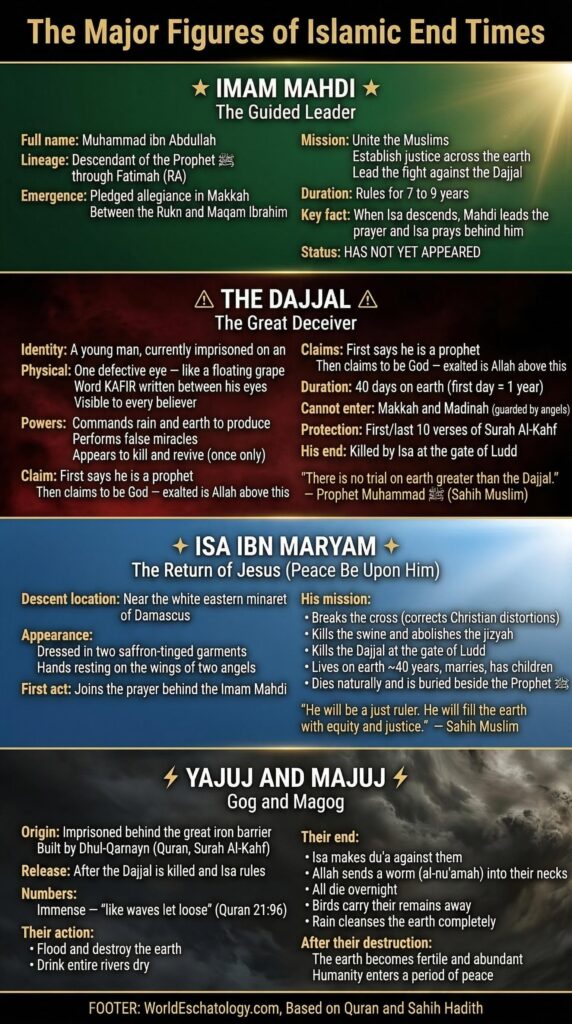
No aspect of Islamic eschatology timeline generates more curiosity than the major figures who will appear at the Islamic end of time.
Let’s look at each one carefully, based on what the authenticated sources actually say: not speculation or cultural myth.
Imam Mahdi — The Guided Leader
The word ‘Mahdi’ means ‘the guided one.’ He is not a prophet, the Prophet Muhammad (peace be upon him) was the last of the prophets.
The Mahdi is a Muslim leader, a righteous man from the family of the Prophet, who will appear at a time of widespread oppression and injustice.
Here is what the authentic hadith tell us about him:
- His lineage: He is from the descendants of the Prophet Muhammad (peace be upon him), specifically through his daughter Fatimah (RA). His name will be Muhammad ibn Abdullah: the same name as the Prophet himself.
- How he appears: He will not seek power. In fact, he will be somewhat reluctant. He will be pledged allegiance (given bay’ah) by the Muslims between the Rukn (the Black Stone corner) and the Maqam Ibrahim in Masjid al-Haram in Makkah.
- His rule: He will rule for seven, eight, or nine years (different hadith give slightly different numbers) and will fill the earth with justice just as it had previously been filled with oppression.
- His role in the end times: He will lead the Muslim armies. He will be the commander-in-chief during the confrontation with the Dajjal. When Isa (peace be upon him) descends from the heavens, the Mahdi will be leading the prayer, and Isa will join him as a follower, not replacing him.
One important point that often confuses people: the Sunni and Shia understandings of the Mahdi are different.
In Sunni Islam, the Mahdi is a future figure who has not yet been born or identified.
In Shia Islam, the Mahdi is believed to be Muhammad al-Mahdi, the twelfth Imam, who has been in occultation (hiding) since 874 CE and will return at the Islamic end of time timeline.
Both traditions believe deeply in a Mahdi — the disagreement is about his identity, not his existence.
| The Prophet (peace be upon him) said: ‘The Mahdi is from my family, from the descendants of Fatimah.’ (Sunan Abu Dawud, authenticated) |
The Dajjal — The Greatest Trial in Human History
If there is one figure in Islamic eschatology who demands the most careful attention, it is the Dajjal.
The Prophet Muhammad (peace be upon him) warned about him more than almost any other single subject in his teachings about the end times.
He warned about the Dajjal in Friday sermons. He made the seeking of refuge from the Dajjal a part of the prayer itself (the final tashahhud). He described him in vivid, specific detail.
And the reason for this extraordinary emphasis is simple: the Dajjal’s fitna (trial and tribulation) will be unlike anything humanity has ever faced.
The Prophet (peace be upon him) said there has been no creation from Adam until the Hour greater in harm than the Dajjal.
Here is what we know about him from the hadith in eschatology islam:
- His physical description: He is a young man with a ruddy complexion, curly hair, and one defective eye: some hadith say the eye is like a floating grape, protruding and damaged. The word ‘kafir’ (disbeliever) will be written between his eyes, visible to every believer, whether literate or not.
- He is already alive and imprisoned: There is a fascinating hadith narrated by Fatimah bint Qays (RA) involving Tamim al-Dari, a Christian who later became Muslim. He described encountering a chained figure on an island who identified himself as the Dajjal, waiting to be released. The Prophet (peace be upon him) confirmed this account. The Dajjal exists right now, in a state of imprisonment, waiting for his appointed time.
- His false miracles: The Dajjal will have powers that appear miraculous. He will command the sky to rain and it will rain. He will command the earth to bring forth its produce and it will. He will seemingly kill a person and bring them back to life (though in reality he can only do this once, with one specific person, and that person’s real soul will not return). He will travel the earth rapidly. He will have a mountain of food and rivers of water accompanying him during a time of great drought.
- His claim: He will first claim to be a prophet. Then he will claim to be God. The fact that he claims divinity is perhaps the greatest indication to the believer that this is the great deceiver, because Allah is far above and beyond any such claim.
- His duration: He will remain on earth for 40 days. But these will not be normal days, the first day will be like a year, the second like a month, the third like a week, and the rest normal days. This means his effective time will be considerably longer than 40 of our standard days.
- His reach: He will travel to every corner of the earth except two places he cannot enter: Masjid al-Haram in Makkah and Masjid al-Nabawi in Madinah. Angels guard these two sanctuaries from his entry.
- Protection from the Dajjal: The Prophet gave specific guidance on protection. Memorizing the first ten or last ten verses of Surah Al-Kahf (Chapter 18 of the Quran) offers protection. Seeking refuge in Allah from the Dajjal in every prayer is recommended. And physically staying in Makkah or Madinah if possible when he appears.
- His end: He will be killed by Isa ibn Maryam at the gate of Ludd (modern-day Lod, near Tel Aviv in present-day Israel).
| “There is no prophet who did not warn his people about the one-eyed Dajjal. He is one-eyed, and your Lord is not one-eyed. Written between his eyes is: Kafir (disbeliever).” — Prophet Muhammad (peace be upon him), Sahih Muslim |
Isa ibn Maryam — The Return of Jesus
For Muslims, the return of Isa (peace be upon him) is not a secondary belief. It is a Quranic fact.
The Quran says explicitly that Isa did not die on the cross (he was raised alive by Allah) and that before the Day of Judgment, he will return.
His return is mentioned in multiple authenticated hadith with remarkable detail.
Here is what the sources tell us:
- His descent: Isa will descend near the white eastern minaret of Damascus, dressed in two garments lightly dyed with saffron, with his hands resting on the wings of two angels. When he lowers his head, drops fall from it. When he raises it, jewel-like drops scatter from it.
- His first act: When he lands, the Muslims will be preparing for the Fajr (dawn) prayer, led by the Mahdi. Isa will be invited to lead the prayer, but he will gesture for the Mahdi to continue, and will pray behind him. This is understood to mean that he comes as a follower of the law of Muhammad (peace be upon him), not as a new prophet with a new law.
- Breaking the cross, killing the swine, abolishing the jizyah: These are three symbolic actions that are described in the hadith. They represent the correction of the distortions that entered Christianity after Isa’s time — the cross as a symbol of worship, the permission of pork, and the system of taxing non-Muslim minorities as a permanent arrangement.
- Killing the Dajjal: Isa will pursue the Dajjal and kill him at the gate of Ludd. The Dajjal will begin to dissolve when he sees Isa, just as salt dissolves in water, but Isa will catch him and kill him with a spear.
- His life on earth: After killing the Dajjal, Isa will live on earth. He will marry, have children, and live for approximately 40 years before dying a natural death. He will be buried next to the Prophet (peace be upon him) in Madinah, where a space is said to have been reserved for him.
The return of Isa is perhaps the greatest bridge between Islamic and Christian eschatology. Both traditions expect him to return.
The differences lie in what role he plays and what theological significance he carries, but the expectation of his return is shared.
Yajuj and Majuj — The Release of Gog and Magog
Yajuj and Majuj are two vast groups of people mentioned in both the Quran and hadith. The Quran describes how Dhul-Qarnayn (a great and righteous ruler) traveled the earth and found a people trapped between two mountains who asked him for protection from Yajuj and Majuj, who were spreading destruction. He built a great iron and copper barrier to contain them.
| “[Dhul-Qarnayn] said: This is a mercy from my Lord. But when the promise of my Lord comes to pass, He will level it to dust. And the promise of my Lord is ever true.” (Quran, Surah Al-Kahf, 18:98) |
That promise — the leveling of the barrier — is one of the major signs of the end.
- Their release: After the Dajjal is killed and the world enters the peaceful era of Isa’s rule, Yajuj and Majuj will break through their barrier. They are described as being in immense numbers — ‘like waves let loose’ (Quran 21:96).
- Their destruction: They will spread across the earth causing massive havoc. Isa and the Muslims with him will be driven to higher ground. Isa will pray to Allah against them, and Allah will send a worm (al-nu’amah) that will enter their necks and kill them all overnight. Their bodies will then be removed by divine will: some hadith mention birds carrying them away, others mention rain washing the earth clean.
- Who are Yajuj and Majuj? This is one of the most debated questions in Islamic scholarship. Classical scholars like Ibn Kathir identified them as Turkic or Mongolic peoples. Others see them as a more spiritual or metaphorical description. The Quran and hadith are clear on their reality: the question of their precise identity today remains open. What is certain is that their release signals the near end of human civilization as we know it.
Death, the Grave, and the World of Barzakh
Before we reach the cosmic events of Qiyamah, there is a deeply personal dimension of Islamic eschatology that affects every single one of us, without exception: death, and what happens afterward.
Most people think of Islamic end times only in terms of the grand apocalyptic events. But Islam is actually equally concerned with what happens to you, personally, from the moment you die until the Day of Judgment.
This is the realm of Barzakh — the intermediate world between this life and the next.
The Moment of Death
In Islam, death is not the random mechanical shutdown of biological systems. It is an event carried out by the Angel of Death, known as Malak al-Mawt or Azrael.
He comes at the appointed hour: not a moment early, not a moment late.
The hadith describe the very different experiences of the believer and the disbeliever at the moment of death.
For the believer whose soul is pure, the Angel of Death draws the soul out gently, like water flowing from a vessel.
Angels with white, radiant faces come to greet the soul, and it is wrapped in fragrant shrouds.
For the disbeliever or the wicked, the soul is dragged out with great difficulty, like tearing iron hooks through wet wool. Dark-faced angels come and the soul is wrapped in a coarse garment that carries a terrible smell.
The soul then begins its journey: ascending or descending through the heavens, or cast back down: before returning to be placed back with the body in the grave.
The Questioning in the Grave — Munkar and Nakir
Every person who is buried will be visited in their grave by two angels: Munkar and Nakir.
These two angels are described as black and blue in appearance, with thunderous voices and faces that inspire awe. They will ask the deceased three questions:
- ‘Who is your Lord?’ The believer answers: ‘My Lord is Allah.’ The disbeliever or the hypocrite says: ‘I don’t know’ or ‘I heard people saying something and I said the same.’
- ‘What is your religion?’ The believer answers: ‘My religion is Islam.’ The others cannot answer correctly.
- ‘Who is this man who was sent among you?’ Referring to the Prophet Muhammad (peace be upon him). The believer says: ‘He is the Messenger of Allah.’ Others cannot answer.
Based on these answers, one of two things happens:
For the believer: a door to Jannah is opened, and the grave expands as far as the eye can see.
The grave becomes a garden of peace and comfort. The soul is shown its place in Jannah every day until the resurrection.
For the disbeliever or the wicked: a door to Jahannam is opened. The grave contracts and squeezes the body.
The soul is shown its place in Jahannam every day until the resurrection.
| The Prophet (peace be upon him) used to regularly seek refuge from the punishment of the grave (adhab al-qabr) in his prayers. He said: ‘Seek refuge with Allah from the punishment of the grave, for it is real.’ |
Barzakh — The World Between Worlds
Barzakh literally means a barrier or partition: it is the state between death and the Day of Judgment.
The souls remain in their respective states of either comfort or punishment in this realm, awaiting the great event.
An important point: the righteous dead are not simply unconscious or ‘asleep’ in a metaphorical sense.
Their souls are alive in Barzakh, aware of their state, and capable of knowing when the living visit their graves or pray for them.
The Prophet (peace be upon him) described the souls of martyrs as being in green birds that fly freely in paradise.
Then comes the First Blowing of the Trumpet, and everything ends.
The First Blow of the Trumpet
When Israfil blows the Trumpet for the first time, every living thing dies.
The mountains crumble. The seas overflow. The stars fall. The earth is flattened. Everything in the heavens and the earth perishes, except Allah.
There is then a gap between the two blowings (Allah alone knows its length) before Israfil blows again and the resurrection begins.
Yawm al-Qiyamah — The Day of Judgment, Step by Step
When the second Trumpet is blown, every human being who has ever lived: from Adam (peace be upon him) to the last person born on earth, is resurrected.
Bodies are reconstituted. Souls are reunited with their bodies. And all of humanity stands together on a vast, flat plain under conditions unlike anything the world has ever known.
This is Yawm al-Qiyamah — the Day of Standing. The Day of Judgment. Let’s walk through it carefully.
The Resurrection and the Gathering at Mahshar
The bodies of the dead are reconstituted from a bone at the base of the spine (the ‘ajb al-dhanab) which never decays. From this seed, the full body is rebuilt.
People rise from their graves in different states. Some are bright-faced and upright. Others are in states that reflect the nature of their lives and their deaths.
All are gathered on the plain of Mahshar: a white, flat expanse where there are no landmarks, no shade, and no relief.
The sun is brought to within a mile of people’s heads. The heat is extreme.
People sweat according to their deeds, the most wicked are drowning in their own sweat, while the righteous are barely affected.
On this day, no one is focused on anyone but themselves. The Prophet (peace be upon him) said that on this day, a man will be so concerned with his own state that he will not even spare a thought for his spouse, his children, or his parents.
The Intercession — Shafa’ah
The people of Mahshar will be standing for what feels like an eternity.
They will go first to Adam (peace be upon him), the father of humanity, and ask him to intercede with Allah to begin the reckoning, because the waiting itself is unbearable. Adam will say he is not in a position to do so.
They will then go to Nuh (Noah), then Ibrahim (Abraham), then Musa (Moses), then Isa (Jesus).
Each will say the same thing, that they are not in a position for this intercession. Finally they will come to the Prophet Muhammad (peace be upon him).
He will say: ‘I am for it. I am for it.’ He will prostrate before Allah and praise Him in ways he has never done before, and Allah will inspire him with words of praise.
Then Allah will grant him this great intercession, to begin the reckoning for all of humanity.
This intercession is known as Al-Maqam al-Mahmud (the Praiseworthy Station) mentioned in the Quran (17:79). It is the highest honor bestowed upon any created being.
The Reckoning — Al-Hisab
The reckoning of every single soul begins. Every deed, every word, every intention, every moment of a person’s life is presented to them.
Nothing is omitted. The Quran says the scrolls of deeds are spread open and even the mountains and the earth will testify.
People will try to deny their deeds. And then their own bodies will testify against them: their hands, their feet, their skin.
The Prophet (peace be upon him) said the disbeliever will argue and say ‘I didn’t do it,’ and his mouth will be sealed and his limbs will speak.
The scrolls of deeds are then handed out. Those given their scroll in their right hand (the people of Jannah) will cry out with joy: ‘Here, read my record!’ Those given their scroll behind their back or in their left hand will wish for death and cry out in despair.
Al-Mizan — The Scales
The deeds of every soul are then placed on an immense scale: Al-Mizan. The weight of good against the weight of evil.
And the weights are real — no deed, no matter how small, escapes this weighing.
The Prophet (peace be upon him) said that on the Day of Judgment, a single word: ‘Subhan Allah wa bi hamdih’ (Glory be to Allah and His praise): will be placed on the scale and will be heavier than the mountains.
The hadith describes the scale as having two pans, and the believer who has lived a life of genuine goodness will find that when their deeds are placed on the scale, the pan of good deeds sinks so heavily that the believer will be amazed.
Conversely, the wicked will find their pan of evil overwhelming their good.
| “So whoever does an atom’s weight of good will see it, and whoever does an atom’s weight of evil will see it.” (Quran, 99:7-8) |
Al-Hawd — The Prophet’s Pool
Before or alongside the crossing of the bridge, the believers will gather at the Hawd, the pool of the Prophet Muhammad (peace be upon him).
This pool is called Al-Kawthar. Its water is whiter than milk, colder than ice, and sweeter than honey. Its vessels are like the stars of the sky in number.
Whoever drinks from it will never be thirsty again.
The Prophet (peace be upon him) said he will be waiting at the Hawd and will recognize his ummah (community) by the brightness of their faces, hands, and feet: the marks left by their wudu (ablution) in this life.
But he also warned that some people who call themselves his followers will be turned away because they innovated in the religion after his time.
Al-Sirat — The Bridge Over Jahannam
The final passage before reaching Jannah is the Sirat: a bridge that is stretched over the back of Jahannam.
The Prophet (peace be upon him) described it as being thinner than a hair and sharper than a sword.
People cross it at speeds that correspond to their deeds. The most righteous among them cross it like a flash of lightning.
Others like the wind. Others like fast horses. Others walking. Others crawling.
And some fall, caught by hooks on the bridge that snatch those whose deeds warrant it, falling into the fire below.
The Prophet (peace be upon him) said he will stand on the Sirat and make du’a (supplication) for his ummah: ‘O Allah, grant safety. O Allah, grant safety.’
Those who successfully cross the Sirat find themselves at the gate of Jannah. They have made it.
Jannah and Jahannam — The Final Destinations
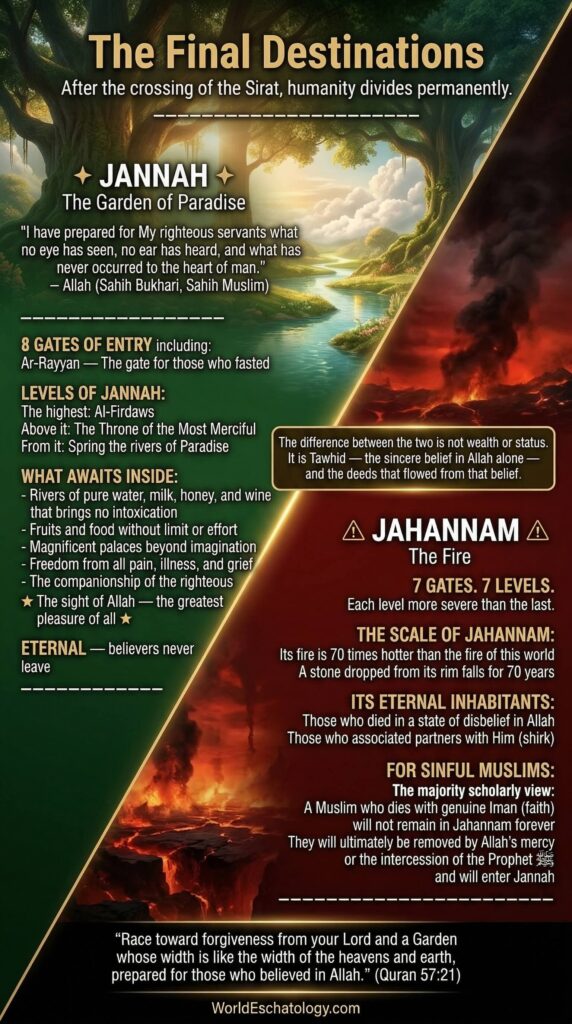
After the crossing of the Sirat, humanity divides permanently into two groups. Those who enter Jannah, and those who enter Jahannam. Let us look at both.
Jannah — The Garden of Paradise
Jannah is not a metaphor. It is a real place, created and waiting. The Prophet (peace be upon him) said that Jannah has been prepared and decorated for its inhabitants since before creation. And it is vast: vast beyond any human ability to comprehend.
Jannah has eight gates. Each gate is named for a deed that primarily earns entry through it: the gate of fasting (Ar-Rayyan), the gate of prayer, the gate of charity, the gate of jihad, and so on.
A person who excels in multiple deeds will be called from all of the gates simultaneously.
Jannah has levels (higher and lower) and the highest level is Al-Firdaws.
The Prophet (peace be upon him) specifically said: ‘When you ask from Allah, ask for Al-Firdaws, for it is the center and highest part of Jannah, and above it is the Throne of the Most Merciful, and from it spring the rivers of Jannah.’
What is inside Jannah? The Quran and hadith describe:
- Rivers of water that never becomes stagnant, rivers of milk whose taste never changes, rivers of wine that brings no intoxication, and rivers of pure honey
- Fruits and foods of every kind, available without effort or limit
- Magnificent palaces and gardens
- The companionship of the angels and the righteous
- Freedom from all pain, illness, sadness, envy, and conflict
- The believers will see Allah — directly, with their own eyes: described in hadith as the greatest, most overwhelming pleasure of Jannah, making everything else pale in comparison
And here is the extraordinary statement from the hadith that puts it all in perspective: Allah says about Jannah: ‘I have prepared for my righteous servants what no eye has ever seen, what no ear has ever heard, and what has never occurred to the heart of man.’ (Sahih Bukhari, Sahih Muslim)
Everything the Quran and hadith describe about Jannah is real: but it is only a shadow, only a hint, of what actually awaits. The full reality is beyond the capacity of the human imagination while we are still in this world.
Jahannam — The Fire
Jahannam is real, and the Quran describes it extensively. It has seven levels or gates, each more severe than the last. Its fuel is people and stones.
Its heat is described as being 70 times greater than the fire of this world. Its depth is so great that if a stone were dropped from its rim, it would fall for 70 years before reaching the bottom.
It is important to address a nuance here that is often misunderstood: Islamic theology (specifically the majority scholarly view) holds that the punishment of Jahannam is not the same for all people who enter it.
Muslims who enter Jahannam as a result of major sins, but who died with their fundamental faith in Allah and the Prophet intact, will not remain there forever.
They will eventually be removed by the mercy of Allah or by the intercession of the Prophet, and will ultimately enter Jannah.
The scholars refer to this as the difference between the fuel of Jahannam and its eternal inhabitants.
The Quran is explicit that the mushrikeen (those who associated partners with Allah) and the kafiroon (disbelievers who rejected the truth) will remain in Jahannam permanently.
The question of sinful Muslims who die with iman (faith) is where this nuance applies.
This is why the Prophet (peace be upon him) was so urgent about the importance of Tawhid (the pure oneness of Allah) above all things.
It is not that a person’s good deeds don’t matter. It is that the foundation of those good deeds (the belief in Allah alone) is the factor that determines whether a person has any hope beyond this world.
Islamic Eschatology and the Modern World
We live in a genuinely remarkable moment in history. Wars are being fought over land that the Prophet (peace be upon him) specifically mentioned in Islamic eschatology timeline.
Technologies exist that would have been impossible to imagine in any previous era of history.
The moral landscape of the world has shifted in ways that closely match the conditions the Prophet described as signs of the approaching Hour.
It is natural and actually encouraged in Islamic tradition: to look at current events through the lens of what the Prophet taught about the end times.
The scholars of Islam have always done this. The question is not whether we should make this connection, but how we should make it: carefully, humbly, and without the arrogance of claiming certainty where there is none.
Here are some observations that contemporary Islamic scholars have made about the connection between the minor signs of Qiyamah and the world of today:
- The Prophet’s description of people competing in constructing tall buildings in the Arabian Peninsula is so precise that it is difficult to dismiss as coincidence when one looks at the skylines of Dubai, Riyadh, and Doha: cities that were desert villages within living memory.
- The global decline of religious authority and its replacement with celebrity culture and social media influencers closely matches the hadith about knowledge disappearing and people taking ignorant leaders.
- The proliferation of usury and interest-based economics worldwide mirrors the Prophet’s warning that a time would come when no one could escape the effects of riba (interest).
- The extreme ease of zina (fornication) in the digital age: through apps, platforms, and the normalization of casual relationships: matches the Prophet’s description of immorality becoming widespread and open.
- The water crisis building around the Euphrates River in Iraq, Syria, and Turkey, as dams like Ataturk in Turkey drastically reduce flow: connects to the famous hadith about the Euphrates revealing something of extraordinary value.
But here is the crucial caveat, and it must be stated clearly: none of this means the end is tomorrow. None of this means we can calculate a date.
Allah has hidden the time of the Hour for wisdom: because if people knew when it was coming, they would simply postpone their repentance and their obedience.
The entire point is that we must live as if today could be our last day, because for any of us, it actually could be.
| “Verily, the knowledge of the Hour is with Allah alone.” (Quran, 31:34) |
The response to studying Islamic eschatology is not fear and paralysis — it is urgency and action. Urgency to fix our relationship with Allah.
Urgency to treat people with justice. Urgency to pray our prayers, pay our zakat, maintain our family ties, and live a life that we would not be ashamed to present on the Day of Judgment.
Frequently Asked Questions
We have compiled answers to the most common questions people have about eschatology in Islam.
These are the questions, i.e., what is Islamic eschatology, and the Islam end-of-times timeline that come up most often, and they deserve clear, direct answers.
Q1: What are the 10 major signs of Qiyamah in Islam?
The ten major signs of Qiyamah, as compiled from hadith literature, are
(1) The appearance of the Imam Mahdi, (2) the emergence of the Dajjal, (3) the descent of Isa ibn Maryam (Jesus), (4) the release of Yajuj and Majuj (Gog and Magog), (5) the Dabbah: the Beast of the Earth, (6) the Dukhan: the great smoke, (7) three major landslides (east, west, and Arabian Peninsula), (8) a fire from Yemen driving people to the gathering place, (9) the sun rising from the west, and (10) the blowing of the Trumpet.
Scholars generally agree that the Mahdi’s appearance is the first of these signs and the trumpet blowing is the last.
Q2: Has any sign of Qiyamah already occurred?
Yes, many of the minor signs have already occurred. The death of the Prophet (peace be upon him), the conquest of Jerusalem, the great plague of Amwas, and the early fitna of the Muslim community were all fulfilled in the first century of Islam.
Many other minor signs, the spread of immorality, the increase in killing, the decline of Islamic knowledge, and the construction of tall buildings in Arabia: are considered by many contemporary scholars to be signs being fulfilled in the modern era. None of the ten major signs have occurred yet.
Q3: What is the difference between Qiyamah and Akhirah?
Akhirah is the broad concept of the afterlife in Islam everything that comes after this world, including Barzakh (the intermediate state after death), the Day of Judgment, and the eternal destinations of Jannah and Jahannam.
Qiyamah refers specifically to the Day of Judgment the event itself when all souls are resurrected and held accountable before Allah.
Think of it this way: Akhirah is the whole chapter, and Qiyamah is one defining event within it, albeit the most important one.
Q4: Who is the Dajjal in Islam?
The Dajjal is the greatest deceiver and the greatest trial in human history. He is a real, physical person a young man with a defective eye, on whose forehead the word ‘kafir’ is written.
He currently exists in a state of imprisonment on an island, as described in the hadith of Tamim al-Dari.
He will be released near the Islamic end of times, will claim first to be a prophet and then to be God, will perform false miracles, and will lead the majority of people astray.
He will be killed by Isa ibn Maryam at the gate of Ludd. The Prophet (peace be upon him) warned about the Dajjal more urgently than almost any other figure in the end times.
Q5: What happens in the grave after death in Islam?
According to Islamic belief, after burial, every person is visited by two angels Munkar and Nakir who ask them three questions: Who is your Lord? What is your religion? Who is this man (the Prophet Muhammad)? The believing Muslim answers correctly and the grave expands, becoming a garden of peace.
A door to Jannah is opened and the soul sees its future home every day until resurrection.
For the disbeliever or the hypocrite, they cannot answer the questions correctly, the grave contracts and squeezes them, a door to Jahannam is opened, and they experience the punishment of the grave (adhab al-qabr) until the Day of Judgment.
Q6: Will all Muslims eventually enter Jannah?
The majority scholarly view in Sunni Islam is that a sinful Muslim who dies with genuine faith (iman) in Allah and the Prophet will not remain in Jahannam forever.
They may be punished for their sins for a period, but will ultimately be removed by Allah’s mercy or the intercession of the Prophet (peace be upon him) and will enter Jannah.
The key factor is Tawhid the sincere belief in the oneness of Allah. The Quran clearly states that Allah does not forgive shirk (associating partners with Him) but may forgive anything else for whom He wills.
This is not a license to sin: rather, it reflects Allah’s infinite mercy toward those who hold onto their faith.
Q7: Is the Day of Judgment mentioned in the Quran?
Extensively. The Day of Judgment is one of the most frequently recurring themes in the entire Quran.
It is referred to by many names: Yawm al-Qiyamah (Day of Rising), Yawm al-Din (Day of Judgment/Religion), Yawm al-Hisab (Day of Reckoning), Yawm al-Hashr (Day of Gathering), As-Sa’ah (the Hour), Al-Qari’ah (the Calamity), Al-Haqqah (the Inevitable), and more.
Entire Surahs are dedicated to it Surah Al-Qiyamah, Surah Az-Zalzalah, Surah Al-Haqqah, Surah Al-Ghashiyah, and others.
Scholars have noted that barely a page of the Quran passes without some reference to the accountability of the Day of Judgment.
Q8: What should Muslims do to prepare for the Day of Judgment?
The Prophet (peace be upon him) gave clear and practical guidance.
First and most important: purify your Tawhid ensure your belief in Allah is sincere, free of shirk and hypocrisy.
Second: pray your five daily prayers on time, consistently and attentively.
Third: account for yourself before you are held to account take regular stock of your deeds and your spiritual state.
Fourth: increase in du’a (supplication), especially seeking refuge from the punishment of the grave and the trial of the Dajjal.
Fifth: give in charity, as it extinguishes sins the way water extinguishes fire.
Sixth: maintain family ties and treat people with justice and kindness.
And seventh: study the signs as we have done in this article not to become obsessed with the apocalypse, but to stay awake and spiritually alert in a world that encourages us to forget what is coming.
WorldEschatology.com — Decoding the End
This eschatology islam article is based on authenticated sources from the Quran and hadith literature. All hadith referenced are from the major accepted collections: Sahih Bukhari, Sahih Muslim, Sunan Abu Dawud, Sunan Ibn Majah, and Musnad Ahmad.
3 thoughts on “Islamic Eschatology Timeline: A Only Guide to End Times in Islam”