
Two Faiths, One Story They Almost Share
Here is something that surprises almost everyone the first time they encounter it. Islam and Christianity share the same prophets. They worship the same God.
They recognize the same Satan. They both await the physical return of Jesus to earth. They both describe a great deceiver who will mislead the world before that return.
They both teach a physical resurrection of the dead. They both describe a final judgment where every soul faces God and is assigned an eternal outcome.
And they both believe history is not random but is moving, with divine purpose, toward a specific and permanent end.
These are not minor similarities. These are the structural bones of Islamic eschatology vs Christian eschatology.
The two largest religions on earth, representing roughly four billion people between them, share a remarkably similar architecture for their beliefs about the end of history.
And yet the details of that shared architecture tell two stories that arrive at completely opposite conclusions about the most important questions: Who is Jesus?
What does his return mean? What is humanity’s fundamental problem and what is God’s solution? What does paradise look like, and who gets there?
The similarities and differences between Islamic eschatology vs christian eschatology are the most important comparative topic in all of religious studies precisely because the similarities are deep enough to demand explanation and the differences are absolute enough to preclude easy reconciliation.
Understanding both is essential for anyone who wants to make sense of the two traditions on their own terms, for anyone doing interfaith work, and for anyone trying to understand the geopolitical conflicts that these eschatological beliefs help drive in the twenty-first century world.
This guide covers every major point of comparison systematically.
We begin with the surprising common ground, move through each major eschatological figure and event, examine where the traditions part ways completely, and close with a direct side-by-side comparison of every major concept.
By the end, you will understand not just what each tradition teaches but why the differences are so deep and so consequential.
A quick answer for searchers
For readers who want the short version before reading in depth: Islam and Christianity share a linear view of history moving toward a final judgment, belief in the physical resurrection of the dead, the return of Jesus, a great deceiver before the end, the figures of Gog and Magog, and real eternal consequences in paradise and hell.
Their fundamental differences center on who Jesus is (God incarnate vs. a prophet), what his return accomplishes (divine kingship vs. correction of theological error), whether there is a Millennium or a Mahdi, and the theological meaning of the cross.
Everything else flows from those root differences.
The Shared Foundation: Eight Surprising Similarities
Before examining where Islam and Christianity diverge, it is worth spending real time on what they share.
Not because the differences are unimportant, they are enormous, but because the shared foundation is genuinely unexpected and genuinely significant.
Most members of both faiths are unaware of just how much common eschatological ground their traditions occupy.
Similarity 1: Both believe history is linear and purposeful
The most foundational shared element of Islamic and Christian eschatology is one that only becomes visible when you compare both traditions to something outside them.
Both Islam and Christianity hold that time moves in a straight line from creation to a final, permanent, unrepeatable end. History is not a cycle.
It does not reset. It does not run in endless repeating loops as it does in Hindu and Buddhist cosmology.
It moves forward toward a specific destination that God has appointed, and when it arrives there, the current order ends for good.
This shared linear framework is the direct inheritance of both traditions from the Jewish prophetic tradition, which first articulated the idea that history has a direction and a destination.
The God of the Hebrew Bible is a God who acts in history, who makes promises and keeps them, who drives events toward a conclusion.
Both Islam and Christianity inherit this framework completely, and it is the soil in which all their specific eschatological beliefs grow.
The practical implication of this shared linearity is that both communities read current events as potentially eschatologically significant.
Both ask whether the signs of the end are appearing. Both have always been tempted to identify their own troubled times as the beginning of the final chapter.
This shared orientation toward history as a story with an imminent ending has shaped both communities in ways that have no parallel in cyclic cosmological traditions.
Similarity 2: Both believe in the physical resurrection of the dead
Both Islam and Christianity teach that every human being who has ever lived will be physically raised from the dead at the appointed time.
This is not a metaphor in either tradition. It is a core doctrinal commitment that has been affirmed by the mainstream of both faiths from their beginnings to the present day.
In Christianity, the resurrection is grounded in the resurrection of Jesus himself, which Paul calls the firstfruit of all who will rise (1 Corinthians 15:20).
Jesus’s resurrection body was physical: he ate fish, was touched by Thomas, was recognized by his disciples.
Yet it was also transformed: he could appear in locked rooms, he was not immediately recognized on the road to Emmaus, he ascended into heaven.
Paul in 1 Corinthians 15 describes the resurrection body as a spiritual body, meaning not non-physical but animated and governed by the Spirit of God rather than by the limitations of mortal flesh.
The dead will be raised imperishable and changed in a moment, in the twinkling of an eye, at the last trumpet.
In Islam, the resurrection (Ba’ath) is triggered by the blowing of the Trumpet by the angel Israfil.
At the first blast, all living things die. At the second blast, all the dead are raised simultaneously.
The Quran describes this in multiple places: And the Trumpet will be blown, and whoever is in the heavens and whoever is on the earth will fall dead except whom Allah wills.
Then it will be blown again, and at once they will be standing, looking on (Quran 39:68).
The Islamic resurrection is just as physical and literal as the Christian one: the same body that died will be reconstituted and raised to face judgment.
This shared conviction that the body matters, that physical existence is not something to be escaped but something to be redeemed and raised, is one of the deepest points of agreement between the two traditions and one of the sharpest points of difference from Hindu and Buddhist frameworks that seek liberation from physical existence.
Similarity 3: Both believe in a final judgment of all humanity
After the resurrection, both traditions teach that every human soul will stand before God and face a comprehensive accounting of their life.
Nothing will be hidden. Nothing will be forgotten. Every deed, every intention, every word spoken will be present in that judgment.
In Christianity, the New Testament describes the final judgment in multiple places.
Jesus in Matthew 25 describes the separation of the sheep from the goats based on how they treated the hungry, the thirsty, the stranger, the naked, the sick, and the prisoner.
Revelation 20 describes the Great White Throne Judgment at which the dead are raised and judged according to what was written in the books.
The Book of Life determines who enters eternal life and who faces the second death.
Paul in Romans 2 affirms that God will render to each one according to his works, and that this includes both Jews and Gentiles judged by whether they followed the law written on their hearts.
In Islam, the Day of Judgment (Yawm al-Qiyamah or Yawm al-Din) is the central event of Islamic eschatology and one of the six articles of faith that every Muslim must affirm.
The Quran returns to this day hundreds of times with urgency and specificity.
Every soul will be given its book of deeds, those who receive it in their right hand will face ease and those who receive it behind their back or in their left hand will face punishment.
The Scales (Mizan) will weigh every deed with perfect accuracy. The Bridge (Sirat) must be crossed, and its ease or difficulty depends on the soul’s record.
Intercession is possible, with the Prophet Muhammad having the highest station of intercession (Maqam Mahmood), but no soul can bear the burden of another.
Both traditions insist on the absolute justice of this judgment. God is not capricious, not tribal, not partial.
The judgment is perfectly accurate and perfectly fair. Both traditions also allow for divine mercy, though they differ on its scope and the conditions for receiving it.
Similarity 4: Both teach real eternal consequences in paradise and hell
Both Islam and Christianity affirm that the outcome of the final judgment is permanent and of infinite consequence.
The righteous enter a state of eternal joy and closeness to God. The wicked face a state of punishment and separation from God.
In both traditions, these are not temporary conditions. They are the final, irrevocable destinations of every soul.
The Quran’s descriptions of Jannah (paradise) are extraordinarily vivid: gardens through which rivers flow, shade and cool breezes, fruits of every kind, companionship, peace, and above all the pleasure and closeness of God.
The Quran also describes the highest pleasure of Jannah as seeing the face of Allah, the Beatific Vision, which Islamic theology calls Ru’yat Allah.
The descriptions of Jahannam (hell) are equally vivid: fire, boiling water, garments of liquid pitch, chains, and the absence of God’s mercy.
Christian descriptions of heaven center on the New Jerusalem of Revelation 21 and 22: a transformed creation where God dwells directly with humanity, where there is no more death or mourning or crying or pain, where the tree of life is accessible to all.
As with Islam, the highest joy of Christian heaven is the direct experience of God.
Christian descriptions of hell range from eternal conscious torment (the traditional majority view) to annihilation (the view that the wicked cease to exist) to universal reconciliation (the view held by a minority that all will eventually be saved).
Islam’s mainstream position is that hell for the wicked is genuinely eternal, though there are some hadith that suggest that believers who enter hell will eventually be removed.
Similarity 5: Both describe a period of moral and social decline before the end
Both traditions teach that the world will experience a dramatic deterioration of moral and social conditions in the period leading up to the final events.
The signs in both traditions describe a world that looks remarkably similar: rulers who steal, scholars who sell their knowledge, the breakdown of family bonds, the normalization of sexual immorality, the proliferation of false religious teachers, widespread violence, and the replacement of truth with power as the measure of what is right.
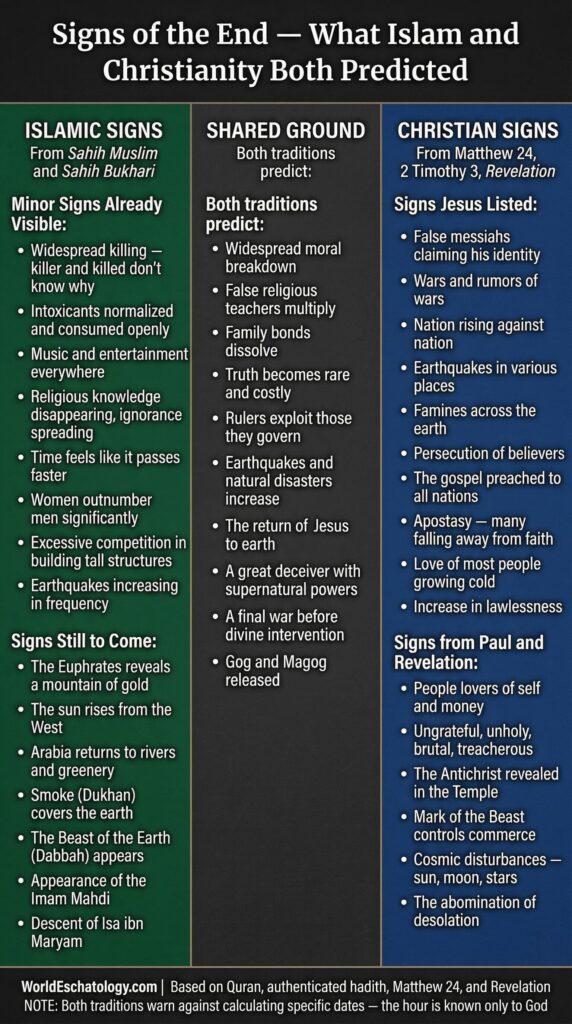
Jesus in Matthew 24 describes false messiahs, wars and rumors of wars, nations rising against nations, earthquakes, famines, persecution of believers, the love of most people growing cold, and lawlessness increasing.
Paul in 2 Timothy 3 describes the last days as times of great stress in which people will be lovers of themselves, lovers of money, boastful, arrogant, abusive, disobedient to parents, ungrateful, unholy, unloving, irreconcilable, slanderous, without self-control, brutal, not loving good, treacherous, reckless, swollen with conceit, lovers of pleasure rather than lovers of God.
The Islamic minor signs of Qiyamah from the authentic hadith collections describe: widespread killing where neither the killer nor the killed knows why, the drinking of wine becoming widespread, the disappearance of religious knowledge and the increase of ignorance, women outnumbering men, time seeming to pass more quickly, tall buildings appearing in Arabia, earthquakes increasing in frequency, and the Euphrates revealing a treasure of gold that will cause great strife.
Both traditions are describing what happens to a civilization that has progressively abandoned its relationship with God, and the descriptions are similar enough to suggest deep structural truth about how moral disintegration manifests in any society.
Similarity 6: Both prominently feature the physical return of Jesus
This is the similarity that surprises people most, and it deserves its own full section later in this article, but it belongs on this list because it is genuinely one of the most remarkable points of agreement between the two traditions.
Both Christianity and Islam teach that Jesus of Nazareth physically departed from the earth, is currently in a heavenly state, and will physically return to earth at a decisive moment before the final judgment to play a central role in the end-times events.
The specific nature of that return, what Jesus does when he arrives, what his identity is, and what his return accomplishes, differs fundamentally between the two traditions.
But the bare fact of his return is affirmed by both. For Muslims encountering this for the first time, it can seem puzzling: if Jesus was not crucified and is not divine, why does he return at all?
For Christians encountering it for the first time, it is equally puzzling: if Islam insists Jesus was only a prophet, why does it give him such a decisive eschatological role?
Both questions have answers, and exploring them takes you to the heart of what each tradition is really saying.
Similarity 7: Both describe a great deceiver before the end
Both traditions describe a figure of extraordinary power and deception who will appear in the end times, perform miracles, claim divine authority, and lead the majority of humanity astray before being defeated by the returning Jesus.
In Christianity this composite figure is called the Antichrist. In Islam he is called the Dajjal, the False Messiah or the Great Deceiver.
Both figures are satanically empowered, both perform signs and wonders that appear miraculous, both demand to be treated as divine, both target believers with persecution, and both are ultimately defeated and killed by Jesus.
The parallel is close enough that scholars have long debated whether one tradition borrowed this concept from the other, or whether both independently developed the same archetypal figure.
The Dajjal does not appear in the Quran itself, only in the hadith literature, while the Antichrist composite figure builds up gradually across several New Testament books.
What is clear is that both traditions feel the theological need for a supreme deceiver as the culminating test before the final divine intervention.
Similarity 8: Both feature Gog and Magog
Both the Bible and the Quran reference a destructive force called Gog and Magog (Yajuj wa Majuj in Arabic).
The Quran mentions them in two places: in Surah Al-Kahf (18:94-98) in the story of Dhul-Qarnayn who builds a great iron and copper wall to contain them, and in Surah Al-Anbiya (21:96) which refers to their release as a sign of the approaching hour.
In the Bible, they appear in Ezekiel 38-39 as a military coalition attacking Israel in the end times, and again in Revelation 20 as nations gathered for the final rebellion against God’s kingdom after the Millennium.
In both traditions, they represent a force of mass destruction that will be unleashed near the end of the world and then defeated by divine intervention.
The specific narratives differ significantly, as we will explore, but the shared presence of these figures in both scriptures is one of the clearest examples of the common prophetic heritage that both traditions draw from.
The Return of Jesus: The Most Important Comparison
Of all the comparisons between Islamic eschatology vs christian eschatology, none is more important, more nuanced, or more theologically revealing than the question of Jesus’s return.
Both traditions affirm it. Both give it central eschatological importance.
And both arrive at conclusions so different that understanding both is essentially understanding the theological heart of each religion.
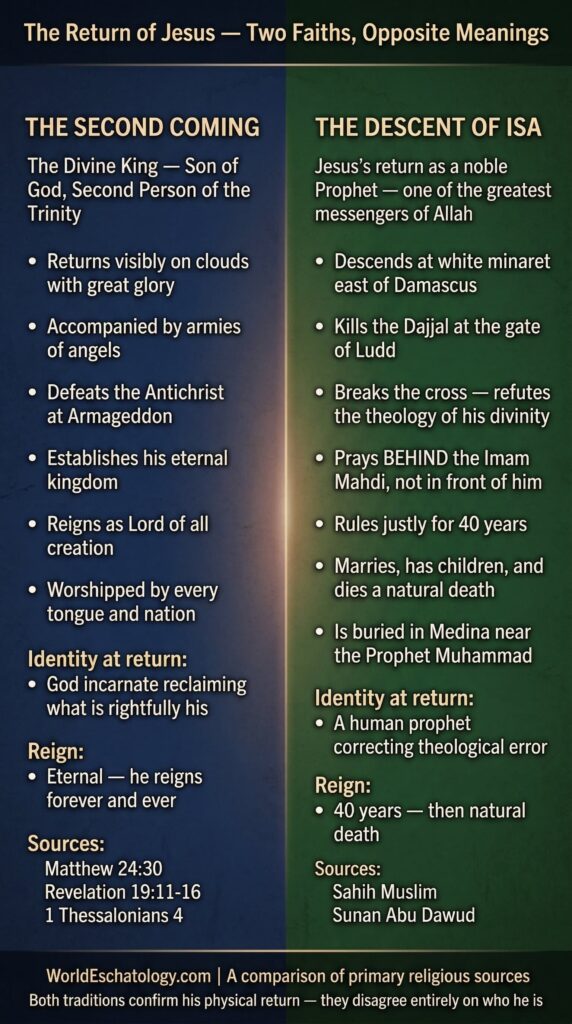
What Christianity teaches about the Second Coming
In Christian theology, the Second Coming of Jesus Christ is the central event of all eschatology.
The Nicene Creed, shared by Catholic, Orthodox, and most Protestant Christians and representing the broadest possible Christian consensus, states plainly: he will come again in glory to judge the living and the dead, and his kingdom will have no end.
Jesus returns not as a prophet completing unfinished business but as the divine Lord and King claiming his rightful sovereignty over creation.
The New Testament describes his return in the most dramatic cosmic terms: he will come on the clouds of heaven with power and great glory (Matthew 24:30), every eye will see him (Revelation 1:7), he will be accompanied by his holy angels (Matthew 25:31), the dead will be raised at the sound of the trumpet, and he will sit on his glorious throne to judge all the nations (Matthew 25:31-32).
In dispensational Protestant theology, the Second Coming is actually divided into two stages.
The first is the Rapture, a secret return in which Jesus meets believers in the air and takes them to heaven before the seven-year Tribulation begins.
The second is the public, visible return at the end of the Tribulation to defeat the Antichrist at Armageddon and establish his millennial kingdom.
In Catholic, Orthodox, and most other Protestant theologies, there is only one Second Coming, a single visible, public event that ends history and begins the eternal state.
The identity of the returning Christ is theologically indispensable in Christianity.
He returns as God incarnate, the second person of the Trinity, the one through whose death humanity was redeemed and through whose resurrection eternal life was secured.
His return is not merely a political or judicial event. It is the completion of the redemptive mission that began at the Incarnation.
The kingdoms of this world become the kingdom of our Lord and of his Christ, and he shall reign forever and ever (Revelation 11:15).
What Islam teaches about the return of Isa
Islam’s account of Jesus’s return begins with a foundational claim that Christianity entirely rejects: Jesus was not crucified.
The Quran states in Surah An-Nisa (4:157-158) that the Jews did not kill Jesus, nor did they crucify him, but it was made to appear so to them.
Instead, God raised Jesus up to himself. Jesus is currently alive in a heavenly state, having never tasted death, and he will return to earth near the end of times.
The hadith literature describes the circumstances of his descent in specific detail.
He will descend at the white minaret east of Damascus in Syria, dressed in garments of a light yellow-orange, placing his hands on the wings of two angels.
When he lowers his head, drops of water will fall from it. When he raises it, jewels will scatter.
His first and most urgent task will be to kill the Dajjal, who will flee from him and dissolve like salt in water when Jesus approaches.
Jesus will pursue him to the gate of Ludd (Lod, near modern Tel Aviv) and kill him there.
Then Jesus will break the cross and kill the pig. These actions are deeply symbolic in Islamic theology.
Breaking the cross means rejecting and refuting the Christian theological understanding of Jesus as a crucified divine savior.
Killing the pig means abolishing the permission to eat pork that distorted Christianity had allowed.
Both acts are statements of Islamic theological truth against what Islam sees as Christian theological error.
Jesus will abolish the jizyah, the tax paid by non-Muslims living under Islamic rule, because there will no longer be any justification for non-Islamic religion.
All people will be called to Islam. He will pray his daily prayers behind the Imam Mahdi, a deeply significant act of deference: even Jesus, the great prophet, submits to the Islamic order that the Mahdi has established, rather than establishing a new religion or claiming a special status above the Islamic community.
Under Jesus’s just rule, the world will experience a period of extraordinary peace and prosperity. He will marry, have children, live for 40 years, and then die a natural death.
He will be buried in Medina, near the tomb of the Prophet Muhammad.
After his death, a pleasant wind will take the souls of all remaining believers, leaving only the wicked. Then the final events will unfold quickly.
The comparison of Islamic and Christian eschatology
The contrast could not be more complete. Both traditions agree that Jesus physically left the earth, is currently in a heavenly state, and will physically return.
Beyond that, the stories diverge absolutely.
Christianity’s returning Jesus is God incarnate reclaiming his divine sovereignty.
Islam’s returning Isa is a human prophet correcting a theological error. Christianity’s Jesus is worshipped by the nations at his return.
Islam’s Isa prays behind a human imam. Christianity’s Jesus reigns eternally from his heavenly throne. Islam’s Isa lives for 40 years, dies, and is buried.
Christianity’s Second Coming is the culmination of a story about divine redemption through sacrificial death.
Islam’s return of Isa is the climax of a story about divine guidance through prophetic correction.
Understanding why these two portraits of the same person diverge so completely requires understanding the foundational theological difference between the two traditions:
Christianity’s conviction that Jesus was God incarnate, whose death was the atonement for human sin, and Islam’s conviction that Jesus was a great prophet but only a prophet, whose apparent crucifixion never happened, and whose message was subsequently distorted by his followers.
Every eschatological difference that follows flows from this single root.
The Great Deceiver: Antichrist vs Dajjal
If the return of Jesus is the point of greatest structural agreement between the two traditions, the great deceiver is the point of greatest structural parallel in the specific details.
The Christian Antichrist and the Islamic Dajjal are so similar in their role, their powers, their trajectory, and their ultimate fate that scholars have long debated whether one tradition borrowed the concept from the other.
The Christian Antichrist: what the texts actually say
The first thing to understand about the Antichrist is that the word itself appears only in the letters of John, not in Revelation or in Paul’s letters. John uses it to describe a spirit of deception already at work in the first century, and he says that many Antichrists have already come.
The composite figure of the Antichrist familiar from popular culture is built by combining three separate New Testament figures: the spirit of Antichrist from John’s letters, the Beast of Revelation 13, and the Man of Lawlessness from 2 Thessalonians 2.
The Man of Lawlessness described by Paul in 2 Thessalonians 2 is a figure who will be revealed before the Day of the Lord: he opposes and exalts himself above every so-called god or object of worship, so that he takes his seat in the Temple of God, proclaiming himself to be God.
He performs signs and wonders by the power of Satan. Something is currently restraining him, and he will be revealed when the restrainer is removed.
The Beast of Revelation 13 rises from the sea with ten horns and seven heads, receives his power from the Dragon (Satan), is given authority over every tribe, people, language, and nation, and is worshipped by all whose names are not in the Book of Life.
His number is 666. He is joined by a second beast, the False Prophet, who performs miracles and forces everyone to receive a mark on their right hand or forehead without which no one can buy or sell.
Together, these figures describe a person or system of supreme political, economic, and religious power that forces humanity to worship something other than God, persecutes those who refuse, and ultimately faces defeat at the hands of the returning Christ.
He is destroyed at Armageddon by the sword that comes from the mouth of the rider on the white horse.
The Islamic Dajjal: what the hadith say
The Dajjal, whose full title is Al-Masih ad-Dajjal meaning the False Messiah or the Deceiving Christ, does not appear in the Quran itself.
He is described in great detail in the authentic hadith collections, particularly Sahih Muslim and Sahih Bukhari.
The Prophet Muhammad reportedly said there is no prophet sent by God who did not warn his community about the Dajjal, from Noah onward.
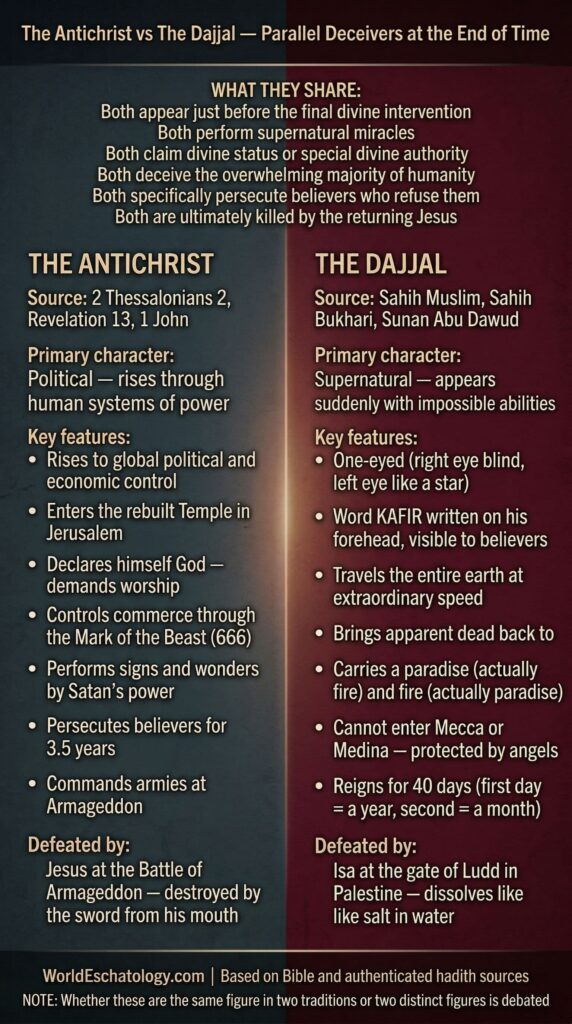
The Dajjal’s physical description is specific and memorable: he is one-eyed, with his right eye described as resembling a floating grape, swollen and protruding, while his left eye is said to be like a shining star.
The word Kafir (disbeliever) is written on his forehead and will be readable by every believing Muslim, literate or not. He is a young man with curly hair and a stocky build.
His powers are extraordinary. He will perform miracles that appear supernatural: he will bring rain, cause crops to grow, bring apparent life to the dead, and command a paradise and a hell that travel with him.
Crucially, his paradise is actually fire and his hell is actually paradise in reality, a test of whether people follow appearances or truth.
He will travel the earth at terrifying speed, reaching every land except Mecca and Medina, which are protected by angels.
He will reign for 40 days, but these are unusual days: the first day will be as long as a year, the second as long as a month, the third as long as a week, and the remaining days will be normal length.
The Prophet Muhammad was asked whether prayer should be calculated normally during that first day-as-long-as-a-year, and he confirmed that it should be estimated proportionally, showing the practical concern of Islamic jurisprudence even within apocalyptic narrative.
The Dajjal will be killed by Jesus at the gate of Ludd in Palestine. His killing marks the turning point of the end-times drama.
The parallel and the debate
The structural parallels between the Antichrist and the Dajjal are remarkable enough to list directly:
both appear at the climax of the tribulation period, both perform supernatural miracles, both claim divine status, both deceive the overwhelming majority of humanity, both specifically target and persecute believers, both are killed by the returning Jesus figure, and both are explicitly identified as the supreme test of faith before the final divine intervention.
The differences are equally instructive. The Antichrist is primarily a political figure in Christian tradition: he rises through human political processes, controls the global economy through the mark of the Beast, and establishes a geopolitical empire.
The Dajjal is a more explicitly supernatural figure who appears suddenly and travels the entire earth in a supernaturally short period.
The Antichrist demands worship in a rebuilt Jerusalem Temple. The Dajjal’s arena is the entire world rather than a specific location.
One of the most intriguing questions in contemporary comparative eschatology is whether the Antichrist and the Dajjal are the same figure appearing in two traditions, or whether Islamic eschatology expects both figures to appear: the Antichrist as a political system and the Dajjal as a supernatural individual.
Some Islamic scholars have identified the Antichrist/Dajjal system with Western civilization or with specific modern institutions, while others treat the Dajjal as a literal individual yet to appear.
The diversity of interpretation within each tradition mirrors the diversity within the other.
The Imam Mahdi: Islam’s Figure With No Christian Counterpart
If the similarities between the Antichrist and the Dajjal are the most structurally parallel elements of the two eschatologies, the Imam Mahdi is the clearest example of a concept that is entirely unique to one tradition and has no real equivalent in the other.
Understanding the Mahdi is essential for understanding Islamic eschatology as a whole, and understanding why Christianity has no equivalent illuminates a fundamental difference in what each tradition thinks the end of history requires.
Who is the Mahdi and what does he do?
The Mahdi, meaning the Guided One, will appear near the end of times as a leader of the Muslim community.
The authentic hadith describe him as a descendant of the Prophet Muhammad through the lineage of his daughter Fatima, with the given name Muhammad and his father’s name Abdullah, so his full name will be Muhammad ibn Abdullah.
He will have a broad forehead, a prominent nose, and a gap between his front teeth. He will be recognized and pledged allegiance to as the leader of the Muslims between the Rukn and the Maqam in the Masjid al-Haram in Mecca.
His reign will last between seven and nine years, with different authentic hadith giving slightly different numbers, and during this period he will fill the earth with justice and equity after it had been filled with oppression and injustice.
He will distribute wealth without counting it, a phrase that indicates extraordinary abundance and generosity. He will lead the Muslim armies in the battles against the Dajjal.
The most theologically significant moment involving the Mahdi comes when Isa descends.
The Mahdi will be leading the Muslim community in prayer at the time of Jesus’s descent. When Jesus arrives, the Mahdi will step back to invite Jesus to lead the prayer.
Jesus will decline, saying that the prayer has been established for the Mahdi and his community, and will pray behind the Mahdi instead.
This act of deference is profound in Islamic theology: it establishes that Jesus does not come to supersede the Islamic community and its leadership but to fulfill his role within and in support of it.
Sunni and Shia: two very different Mahdi beliefs
The question of the Mahdi’s identity is one of the most important points of difference between Sunni and Shia Islam, and understanding both positions is necessary for any complete treatment of Islamic eschatology.
In Sunni Islam, the Mahdi is a future figure who has not yet been born. He will emerge from the Muslim community near the end of times, fulfilling the descriptive criteria of the hadith.
No current person or historical person is identified as the Mahdi. Claims to be the Mahdi have been made throughout Islamic history (the Sudanese leader Muhammad Ahmad declared himself the Mahdi in the 1880s, as did numerous others), but all such claims are rejected by mainstream Sunni scholarship.
In Twelver Shia Islam, by contrast, the Mahdi has already been born and is currently alive.
He is Muhammad ibn al-Hasan al-Askari, the twelfth Imam, who was born in 869 CE and entered a state of occultation (ghaybah, meaning hiddenness) in 941 CE.
He has been present but hidden from ordinary human perception for over a thousand years and will return at the appointed time to establish justice on earth.
The belief in the Twelfth Imam’s ongoing hidden existence and anticipated return is one of the most distinctive features of Shia Islam and shapes its theology, its political philosophy, and its eschatological expectations fundamentally.
Does Christianity have anything equivalent?
Christianity has no theological figure that directly parallels the Imam Mahdi, and understanding why reveals something important about the structure of Christian eschatology.
The Mahdi is necessary in Islamic eschatology because Islam’s returning Jesus is not the divine King who establishes his own kingdom.
Isa returns as a prophet to a world that still needs human leadership under God. The Mahdi provides that leadership, establishes the Islamic order, and then steps aside for Isa to play his specific prophetic role.
In Christian eschatology, this problem does not arise because the returning Christ is himself the King.
He does not need a human leader to prepare the kingdom for him: he establishes the kingdom himself through his own divine authority.
There is no structural slot in Christian eschatology for a figure who precedes Christ and establishes the conditions for his arrival in the way the Mahdi precedes and prepares for Isa’s return.
Some Christian commentators have drawn loose parallels between the Mahdi and John the Baptist, who preceded Jesus and prepared the way for him.
Others have noted structural similarities with the millennial governance of resurrected saints described in Revelation 20. But neither parallel is precise.
The Mahdi is a product of a specifically Islamic theological framework, and his presence in Islamic eschatology and absence in Christian eschatology tells you something important about the different ways each tradition understands what God’s end-times agenda requires.
Where the Traditions Part Ways Completely: The Fundamental Differences
Having established the surprising common ground between Islamic and Christian eschatology, we now turn to the differences.
These are not minor variations in detail. They are fundamental divergences that reflect the deepest theological disagreements in islamic eschatology vs christian eschatology.
Difference 1: The identity of Jesus is the root of everything
Every significant difference between Islamic and Christian eschatology flows from a single theological source: what each tradition believes about who Jesus is.
This is not an eschatological question in the first instance. It is a question about the nature of God, the nature of humanity, and the nature of divine-human relationship.
But its eschatological consequences are total and pervasive.
Christianity teaches that Jesus is the second person of the Trinity, fully God and fully human, whose incarnation was the direct entry of God into human history to accomplish the redemption of a fallen humanity through his death and resurrection.
The resurrection is not merely a demonstration of divine power. It is the reversal of death itself, the first installment of the resurrection that awaits all who believe.
The Second Coming is therefore the return of the Divine King, the Son of God, the Lord of creation, to claim the kingdom that is rightfully and ontologically his.
Islam teaches that there is no trinity and that God does not take on human form.
To associate partners with God, called shirk, is the one unforgivable sin in Islamic theology.
Jesus, Isa, was a great prophet and messenger of God, born of a virgin through a miraculous divine act, given the ability to perform miracles by God’s permission, and honored with the title Kalimatullah, the Word of God, and Ruhullah, the Spirit of God.
But he was not God, was not the Son of God in any ontological sense, and was not crucified.
His return is therefore the return of a noble prophet, not a divine King. His mission on his return is to correct the theological error of those who worshipped him.
This difference is absolute. No amount of goodwill or theological creativity can make it disappear.
It shapes every aspect of the eschatological narrative: the meaning of the return, the nature of the kingdom established, the ultimate destiny of those who accepted or rejected each tradition’s claims.
Difference 2: The Millennium has no Islamic equivalent
The concept of a thousand-year reign of Christ on earth after his return and before the final judgment, described in Revelation 20, has no counterpart in Islamic eschatology.
In the dominant dispensational Protestant framework, Christ returns, binds Satan, raises the righteous dead, and reigns on earth for exactly 1,000 years from Jerusalem, after which Satan is released for a final rebellion, defeated, and then the final judgment occurs and the eternal state begins.
In Islamic eschatology, there is no such Millennium. After Isa kills the Dajjal, the world enters a period of peace and justice under his rule.
Gog and Magog are then released and cause catastrophic destruction. They are killed by divine intervention (God sends worms that enter their necks).
The earth is cleansed. Then a pleasant wind takes the souls of all believers. A fire drives the remaining wicked toward their final gathering.
The Trumpet is blown and the resurrection and judgment follow.
It is worth noting that most of the world’s Christians also do not believe in a literal Millennium.
Catholic, Orthodox, and most mainline Protestant theologies are amillennialist, meaning they interpret the thousand years of Revelation 20 symbolically rather than literally.
On this specific question, Islam and the majority global Christian position actually agree more than Islam and dispensational American evangelicalism.
Difference 3: The Rapture exists only in one tradition
The Pre-Tribulation Rapture, the doctrine that all Christians will be secretly removed from the earth before the tribulation period begins, is a concept unique to a specific strand of Protestant Christianity and has no equivalent in Islamic eschatology.
It also, as we have noted, has no equivalent in Catholic, Orthodox, or most mainline Protestant Christianity.
In Islamic eschatology, believers are not removed from the earth before the tribulation.
They live through the trials of the end times. The Dajjal will be the greatest test the Muslim community has ever faced.
Believers will be counseled to recite the opening verses of Surah Al-Kahf as protection against his deceptions.
Those who stand firm will be on the right side of history when Jesus descends and kills the Dajjal.
The Islamic community is preserved through the crisis, not removed from it.
This difference reflects a deeper theological difference about the relationship between the people of God and historical suffering.
Islamic theology does not offer the community an exit from tribulation. It offers guidance, protection, and ultimate victory through tribulation.
Difference 4: The role of Israel and Jerusalem is diametrically different
Jerusalem sits at the center of both traditions’ end-times geography, but with opposite valences.
In dispensational Christian eschatology, the modern State of Israel is identified as the fulfillment of biblical prophecy.
The return of the Jewish people to the Land of Israel is a precondition of the Second Coming. Jerusalem is the city from which Christ will reign during the Millennium.
The rebuilt Jewish Temple in Jerusalem is the site where the Antichrist’s final outrage occurs and where Christ’s return is most directly anticipated.
In Islamic eschatology, Jerusalem is the holy city of Al-Quds, the third holiest site in Islam, and the city toward which the Dajjal is heading when he is killed by Jesus.
Some hadith describe the Dajjal as being unable to enter Jerusalem because it is protected. The battle that ends the Dajjal’s reign has its climax at Ludd, near modern Tel Aviv.
Many Islamic scholars interpret the end-times narrative as involving the liberation of Palestine as part of the eschatological events before or during the time of the Mahdi and Isa.
Both traditions place Jerusalem at the eschatological center of the world. Both believe that the ultimate ownership and governance of Jerusalem is a matter of profound divine concern.
But one tradition sees its Jewish-Christian character as prophetically determined and the other sees its Islamic character as divinely mandated.
This theological disagreement is one of the direct eschatological roots of the contemporary Israeli-Palestinian conflict.
Difference 5: The nature of paradise differs in theological emphasis
Both traditions promise paradise to the righteous, and both include as the highest joy of paradise the direct experience of God.
But the emphasis in their descriptions of paradise differs in ways that reflect deeper theological differences.
Christian descriptions of heaven, especially in the New Testament, center on relationship: being with God, seeing God face to face, being known by God, being at home in the Father’s house.
The New Jerusalem of Revelation 21 and 22 is where God himself will be their God and they will be his people.
The physical pleasures of the renewed creation are present but secondary to the relational reality of life in God’s immediate presence.
Islamic descriptions of Jannah give significant and detailed attention to physical pleasures of a perfected and supernaturally enhanced kind: rivers of pure water, milk, wine, and honey that cause no intoxication, fruits of every kind, companionship, beauty, and rest from all suffering.
These pleasures are not presented as trivial or merely sensory. They are understood as fitting rewards for a life of obedience and sacrifice.
The Beatific Vision, Ru’yat Allah, is also present in Islamic descriptions of Jannah and is described as overwhelming all other pleasures of paradise.
But the balance of emphasis in Quranic and hadith descriptions of Jannah is notably more sensory and concrete than in most New Testament descriptions of heaven.
Difference 6: The theological meaning of the end is fundamentally different
The deepest difference between Islamic and Christian eschatology is not about the sequence of events but about what the entire story means.
The eschatological narrative of each tradition is the conclusion of a larger story, and the conclusions of those two stories are not the same.
In Christianity, the story of history is a story of redemption. Humanity fell into sin, death, and separation from God.
God entered human history as Jesus Christ to undo that fall through his death and resurrection.
The Second Coming is the completion of that redemptive work: the full reversal of the fall, the permanent defeat of sin and death, the establishment of the new creation where God and humanity dwell together in unobstructed intimacy.
The cross is the pivot of all history, the event around which creation’s entire meaning turns.
In Islam, the story of history is a story of guidance and submission.
God created humanity as his vicegerent on earth and has sent prophets and revelations throughout history to guide humanity back to its proper relationship of submission (Islam) to God.
Every prophet brought the same essential message. Every community distorted it.
Muhammad was the final and definitive prophet, whose message is preserved completely and will remain so until the end of time.
The end of history is the final establishment of that submission on earth, the correction of all theological error, the universal acknowledgment of God’s oneness and sovereignty.
The cross is not the pivot of this story. The revelation to Muhammad is.
These are not two versions of the same story. They are two different stories, with two different problems (sin and rebellion vs.
forgetfulness and disobedience), two different solutions (redemptive sacrifice vs. prophetic guidance), and two different ultimate outcomes (reunion with a redeeming God vs. complete submission to a sovereign God).
Everything else in the comparison flows from this fundamental difference.
The Master Comparison: Islamic vs Christian Eschatology at a Glance
Side-by-side comparison of every major eschatological concept
| Concept | Islamic Teaching | Christian Teaching | Shared or Different |
| View of time | Linear — history moves to a final end | Linear — history moves to a final end | Shared completely |
| Physical resurrection | Yes — Ba’ath, all humanity raised at Trumpet blast | Yes — raised at last trumpet; Christ is the firstfruit | Shared — different mechanism |
| Final judgment | Yawm al-Din — scales, books, Sirat bridge | Great White Throne — books opened, Book of Life | Shared structure, different imagery |
| Paradise | Jannah — sensory richness plus Beatific Vision | Heaven / New Earth — relational, Beatific Vision | Shared destination, different emphasis |
| Hell | Jahannam — eternal for unbelievers (majority view) | Hell — eternal conscious torment (majority), or annihilation | Shared concept, some debate on duration in both |
| Return of Jesus | Isa descends as prophet, corrects theology, rules 40 yrs, dies | Christ returns as Divine King, reigns eternally | Same person — opposite meaning and identity |
| Great deceiver | Al-Dajjal — one-eyed, supernatural, killed by Isa at Ludd | Antichrist — political, mark of Beast, killed at Armageddon | Structurally parallel, different specifics |
| Imam Mahdi | Future just ruler who prepares for Isa (Sunni) / Twelfth Imam (Shia) | No equivalent figure | Islam only |
| Rapture | No equivalent — believers live through tribulation | Pre-Trib (dispensational only); not in Catholic/Orthodox | Protestant dispensationalism only |
| Millennium | No equivalent — Isa rules 40 years then dies | 1,000-year reign (dispensational); symbolic (amillennial) | Dispensational Christianity only |
| Gog and Magog | Yajuj Majuj — released after Isa, destroyed by divine plague | Attack Israel (Ezekiel); final rebellion (Revelation 20) | Both traditions, different narrative role |
| Role of Israel | Al-Quds center of eschatological battle; liberation focus | Israel’s return = prophetic sign (dispensational view) | Diametrically different readings |
| Cross and atonement | No crucifixion; no atonement doctrine | Cross is the pivot of all history and redemption | Absolute difference — root of all other differences |
| Ultimate meaning | Submission to God established globally — Islam as final order | Redemption completed — new creation, God with humanity | Different stories with different endings |
How These Beliefs Shape Today’s World
Eschatological beliefs are not merely matters of private theological conviction.
They shape political behavior, geopolitical alliances, military conflicts, and the way billions of people interpret current events.
Understanding how Islamic and Christian end-times beliefs operate in the contemporary world is not optional for anyone who wants to make sense of the twenty-first century.
Christian Zionism and American foreign policy
Dispensational eschatology’s identification of the modern State of Israel as a fulfillment of biblical prophecy has created one of the most politically consequential religious movements of the past century: Christian Zionism.
The belief that supporting Israel is a divine obligation connected to end-times prophecy, that the Jewish people’s return to their land is a precondition of the Second Coming, and that American support for Israel brings divine blessing on America, is a major force in American evangelical Christianity.
Organizations like Christians United for Israel, founded by pastor John Hagee, claim millions of members and lobby Congress directly on Middle East policy.
The political support that American evangelical Christians provide for Israeli government positions is driven substantially by eschatological conviction rather than ordinary geopolitical calculation.
Presidents and secretaries of state have had to factor this constituency into their Middle East policy decisions for decades.
The movement of the American embassy to Jerusalem in 2018 was greeted by many Christian Zionists as a prophetically significant event.
This is a striking example of eschatological theology producing concrete, measurable political outcomes.
The belief that specific current events fulfill specific ancient prophecies is not confined to the private sphere. It enters the political sphere with real force.
Islamic eschatology and jihadist ideology
Islamic eschatological beliefs have also been weaponized by extremist groups in the twenty-first century, most notably by the Islamic State (ISIS/ISIL) in Syria and Iraq from 2013 onward.
ISIS drew explicitly on a specific hadith about a great apocalyptic battle at a place called Dabiq in northern Syria.
The hadith describes Dabiq as the site of a final confrontation between Muslims and their enemies near the end of times.
ISIS occupied Dabiq, named their online magazine after it, and used the prophecy as a recruitment tool under the slogan remaining and expanding, presenting their caliphate as the fulfillment of end-times prophecy.
This use of Islamic eschatology by ISIS represents a deliberate distortion of the tradition for extremist purposes.
Mainstream Islamic scholarship universally condemned ISIS’s interpretation and its violence.
The vast majority of Muslim scholars and communities reject the idea that any current group or leader can claim to be fulfilling specific end-times prophecy and use that claim to justify violence.
The Islamic eschatological tradition, rightly understood, emphasizes justice, the protection of civilians, and the requirement to follow legitimate Islamic legal and scholarly authority, none of which ISIS observed.
Understanding the difference between authentic Islamic eschatological tradition and its extremist distortion is essential for any serious engagement with this topic.
The fact that ISIS weaponized eschatology does not make Islamic eschatology violent any more than the Christian identification of various political leaders as the Antichrist makes Christian eschatology violent.
Why this comparison matters for interfaith understanding
Both the Christian Zionist political movement and the ISIS eschatological distortion demonstrate that end-times beliefs are not merely private religious convictions.
They shape how communities interpret present events, how they relate to other communities, and what political and military actions they consider justified or even obligatory.
This is precisely why careful, accurate, balanced comparative study of Islamic and Christian eschatology matters.
Both communities are better served by understanding exactly where their traditions agree, where they genuinely disagree, and where popular understandings of their own tradition are distortions of its actual teaching.
A Muslim who accurately understands what Christianity teaches about the Second Coming is better equipped for genuine dialogue than one who dismisses it without engagement.
A Christian who accurately understands what Islam teaches about the return of Isa is better equipped to recognize both the shared conviction and the deep theological difference.
Both communities believe that God is sovereign over history. Both believe that history is moving toward a just and permanent conclusion.
Both believe that the choices made in this life have eternal consequences. These shared convictions are the foundation on which genuine conversation is possible, even across the deepest theological disagreements.
Frequently Asked Questions
These are the questions most commonly searched by people comparing Islamic and Christian end-times beliefs.
Do Islam and Christianity believe in the same end times?
Not exactly. They share a remarkable amount of structural common ground: both believe in the physical resurrection of the dead, a final judgment, real eternal consequences, the return of Jesus, a great deceiver before the end, and the figures of Gog and Magog.
But their end-times narratives arrive at very different conclusions, particularly regarding who Jesus is, what his return accomplishes, and what the theological meaning of the end of history is.
The similarities and differences between islamic and christian eschatology end times are deeper than most people realize, and the differences are more fundamental than most people expect.
Does Islam believe Jesus will return?
Yes. Islam affirms that Isa (Jesus) did not die on the cross but was raised bodily to heaven by God, and that he will physically return to earth near the end of times.
He will descend at a white minaret east of Damascus, kill the Dajjal, break the cross, establish justice, pray behind the Imam Mahdi, live for 40 years, marry, have children, die a natural death, and be buried in Medina.
His return is not the Second Coming of a divine King as in Christianity, but the return of a great prophet to correct theological error and establish God’s order.
Is the Dajjal the same as the Antichrist?
They are structurally parallel figures playing similar roles in their respective traditions: both are great deceivers who appear before the final divine intervention, perform supernatural miracles, claim divine status, deceive the majority of humanity, and are killed by the returning Jesus figure.
However, they have different specific characteristics, different arenas of operation, and different narratives of defeat.
Whether they represent the same figure appearing in two traditions, or whether Islamic eschatology expects both to appear, is a matter of ongoing discussion among scholars.
Do Muslims believe in the Rapture?
No. The Rapture, particularly the Pre-Tribulation Rapture doctrine that all believers will be secretly removed from the earth before the tribulation begins, is a concept unique to a specific strand of Protestant Christianity developed by John Nelson Darby in the nineteenth century.
It has no equivalent in Islamic eschatology. Muslim believers are expected to live through the tribulation of the end times, including the trial of the Dajjal, and be preserved through it rather than removed from it.
It is worth noting that the majority of the world’s Christians, including Catholics and Orthodox Christians, also do not believe in the Pre-Tribulation Rapture.
Who is the Mahdi in Islam?
The Mahdi, meaning the Guided One, is a future Muslim leader who will appear near the end of times as a descendant of the Prophet Muhammad.
He will establish justice across the earth after a period of great oppression, lead the Muslim community in the battles against the Dajjal, and step back to allow Isa to pray when Jesus descends.
In Sunni Islam, the Mahdi is a future figure not yet born. In Twelver Shia Islam, he is identified as the Twelfth Imam Muhammad ibn al-Hasan, who was born in 869 CE and is currently in a state of occultation, awaiting the appointed time to return.
What does Islam say about the Day of Judgment?
The Day of Judgment (Yawm al-Qiyamah) is one of the six articles of Islamic faith and one of the most frequently addressed topics in the Quran.
Every human soul will be resurrected after death and will stand before God for a comprehensive accounting of their deeds.
Their records will be given to their right or left hands, indicating their outcome. The Scales (Mizan) will weigh every deed with perfect accuracy.
The Bridge (Sirat) over hell must be crossed, with its ease reflecting the soul’s deeds. The Prophet Muhammad holds the highest station of intercession. The outcome is real, permanent, and perfectly just.
Is Gog and Magog in both the Bible and the Quran?
Yes. Gog and Magog appear in the Bible in Ezekiel 38-39 as a military coalition attacking Israel in the end times, and in Revelation 20 as nations gathered for a final rebellion.
In the Quran, they appear in Surah Al-Kahf (18:94-98) in the story of Dhul-Qarnayn who builds a wall to contain them, and in Surah Al-Anbiya (21:96) as a sign of the approaching hour.
In Islamic eschatology, their release occurs after Isa has killed the Dajjal and established justice, and their destruction comes through a divine plague rather than military defeat.
Both traditions share the figures but place them differently in their eschatological sequences.
What is the difference between Jannah and Christian heaven?
Both Jannah and Christian heaven are real, permanent destinations of joy and closeness to God for the righteous.
Both include the Beatific Vision, the direct experience of God, as the highest joy.
The difference lies in emphasis: Islamic descriptions of Jannah in the Quran and hadith give significant detailed attention to physical pleasures of a supernaturally perfected kind, including rivers of wine that causes no intoxication, fruits, companionship, and extraordinary sensory beauty.
Christian descriptions of heaven in the New Testament center more on relational and spiritual realities: being with God, knowing and being known, dwelling in God’s presence.
Both describe real places of real joy, but the balance of emphasis in their primary texts differs.
What happens after death in Islam vs Christianity?
Both traditions teach that the soul survives physical death and faces divine judgment.
In Islam, after death the soul enters the Barzakh, an intermediate state where it experiences a foretaste of its ultimate destiny until the general resurrection at the blowing of the Trumpet on Judgment Day.
In Christianity, after death the soul is in the presence of God (for believers, in an intermediate state of joy awaiting the resurrection) or faces separation from God.
Both traditions affirm that the ultimate destiny of the soul involves the resurrected body and not merely a disembodied spirit, and that the final judgment determines permanent eternal consequences.
Which religion has more detailed end times beliefs?
Islamic eschatology is considerably more specific and detailed in certain areas, particularly in the descriptions of the signs of Qiyamah, the physical appearance and actions of the Dajjal, the descent of Isa, and the mechanics of Judgment Day.
This level of detail comes from the extensive hadith literature that supplements the Quran.
Christian eschatology has more developed symbolic and theological treatment of the end times in texts like Revelation and Daniel, but the specific details of sequence and individual figures vary enormously between Christian traditions.
Overall, the hadith literature gives Islamic eschatology a specificity of narrative detail that is unusual in any religious tradition.
Do Muslims and Christians agree on heaven and hell?
Both agree that heaven and hell are real, that they are the permanent destinations of the righteous and the wicked respectively, and that what determines one’s destiny is the combination of one’s faith and deeds as assessed in divine judgment.
Both traditions have internal debates about the precise nature and duration of hell.
The content and character of paradise differs in emphasis as described above. Both traditions identify the direct experience of God as the highest joy of paradise.
The fundamental agreement is on reality and permanence. The differences are in the specific content and emphasis.
Conclusion: What This Comparison Reveals
Comparing Islamic and Christian eschatology does something that few other intellectual exercises can:
it shows you where two of the world’s great traditions genuinely touch and where they genuinely part, and it does this with enough specificity that you cannot flatten the differences or exaggerate them.
The shared ground is real and significant. Two traditions representing four billion people agree that history has a destination, that the dead will rise, that every soul will face a perfectly just judgment, that there is real and eternal consequence for how we live, that Jesus will physically return, that a great deceiver will precede that return, and that Gog and Magog play a role in the final drama.
This shared framework is not a coincidence. It is the inheritance of a common prophetic tradition rooted in the God of Abraham, Isaac, and Jacob, the God of the Hebrew prophets, the God whom both communities claim to know and serve.
The differences are equally real and equally significant. The identity of Jesus is not a secondary detail. Whether he is God incarnate or a great prophet determines the entire meaning of his return, the nature of the kingdom he establishes, and the ultimate story of what God is doing in history.
The cross is not a minor point of disagreement. Whether the death of Jesus was the central redemptive event in all of history or an event that did not happen at all is as fundamental a theological difference as any two traditions can have.
What this comparison does not allow is the comfortable middle position that both traditions are really saying the same thing in different language.
They are not. They are two traditions with enough shared vocabulary and shared ancestors to create the appearance of near-agreement, and enough fundamental theological difference to make genuine agreement on the deepest questions impossible without one tradition abandoning its core claims.
That is not a counsel of despair for interfaith relations. Two people can disagree at the deepest level and still find genuine common ground, still work together on shared concerns, still treat each other with respect and curiosity.
What they cannot do is pretend the disagreement does not exist. Understanding it clearly, as this comparison has tried to do, is the prerequisite for any honest and productive conversation.
2 thoughts on “Islamic vs Christian Eschatology: Key Similarities and Differences”