

Here is a number that tends to stop people cold when they hear it for the first time.
In the Bible, references to the Second Coming of Jesus Christ outnumber references to his first coming by eight to one.
Scholars who have counted them place the total at around 1,845 individual references spread across both the Old and New Testaments.
That is not a footnote. That is not a minor theme tucked away in an obscure corner of scripture. That is one of the most heavily documented subjects in the entire Bible.
So why does so much of the world, including many lifelong Christians, have only a vague idea of what the Bible actually says about it?
Part of the answer is that the subject has been buried under layers of denominational debate, sensationalist prophecy books, failed predictions, and frankly confusing theological vocabulary.
The rapture, the tribulation, the millennium, premillennialism, dispensationalism — these words get thrown around in ways that leave ordinary readers more confused after the conversation than before it.
This article cuts through all of that. We are going back to the source. What did Jesus himself say about his return?
What did the angels say at his ascension? What does Paul say? What does Revelation describe? And how do different Christian traditions understand all of it?
This is a long article because the subject deserves length. Grab a coffee, settle in, and let us go through it carefully.
What Is the Second Coming? The Simplest Explanation
Before anything else, let us establish what we are actually talking about.
Jesus of Nazareth was born in Bethlehem, lived in first-century Palestine, was crucified under Pontius Pilate, and according to Christian belief, rose from the dead and ascended bodily into heaven. That is what Christians call the first coming.
The Second Coming is the belief that he will physically return to earth again. Not spiritually. Not symbolically.
Not in the hearts of believers. But actually, visibly, bodily return, in the same way he left, to bring human history to its close and establish his kingdom permanently.
The original Greek word for this event is Parousia. It was a term the ancient world used when a king or emperor arrived in person to visit a city or province.
The whole city would come out to meet him. There would be a procession. His presence transformed whatever space he entered.
That is the word early Christians chose to describe what they were waiting for. Not a metaphor. A royal arrival.
In his first coming, Jesus came as what theologians call the suffering servant.
He was born in a stable, lived without a home he could call his own, was rejected by the religious establishment of his day, and died the death of a criminal.
In his second coming, the same Jesus returns as the conquering King. The contrast is deliberate and total.
What Did Jesus Himself Say About His Return?
This is the place to start because for Christians, the words of Jesus carry a weight that no other source can match. And Jesus spoke about his return more than most people realise.
The most concentrated block of his teaching on the subject is what scholars call the Olivet Discourse, found in Matthew 24, Mark 13, and Luke 21.
Jesus sat on the Mount of Olives overlooking the temple in Jerusalem, and his disciples asked him two questions: when will the temple be destroyed, and what will be the sign of his coming and the end of the age?
His answer runs for an entire chapter in Matthew. It is the longest recorded teaching Jesus gave on any single subject in the Gospels.
The Olivet Discourse: What He Warned
He warned them first about what would come before his return: false messiahs claiming to be him, wars and rumours of wars between nations, famines, earthquakes in various places.
He described these as the beginning of birth pains, painful and disruptive but not yet the end itself.
He spoke of persecution coming for his followers, of the gospel being preached to every nation on earth, and then of a specific event he called the abomination of desolation, a phrase borrowed from the prophet Daniel, which would signal the beginning of the worst period of tribulation the world had ever seen.
And then he described his actual return. He was not vague about it.
“For as lightning that comes from the east is visible even in the west, so will be the coming of the Son of Man… they will see the Son of Man coming on the clouds of heaven, with power and great glory.”
Notice what he did not say. He did not say his return would be quiet, or private, or invisible.
He specifically compared it to lightning crossing the entire sky. He used the most dramatic, visible, unmissable image he could think of. When he comes back, nobody is going to miss it.
He also said something that has generated centuries of debate, and we will cover it in its own section: he said that no one knows the day or the hour.
Not the angels. Not even himself, in his human nature. Only the Father. He said this and then immediately told his followers to stay awake and be ready anyway.
John 14: The Promise He Made at the Last Supper
The night before his crucifixion, at the Last Supper, Jesus made a promise to his disciples that has become one of the most quoted verses in Christian history.
John 14:2-3
“My Father’s house has many rooms; if that were not so, would I have told you that I am going there to prepare a place for you? And if I go and prepare a place for you, I will come back and take you to be with me that you also may be where I am.”
This is a personal promise. Not a theological position statement. He spoke to them the way someone leaving on a long journey speaks to people they love.
I am going. I am coming back. And when I come back, I am bringing you with me. The disciples were devastated that night. This was what he left them with.
The Promise the Angels Made at His Ascension
Forty days after the resurrection, Jesus gathered his disciples on the Mount of Olives and was lifted up before their eyes into a cloud.
The book of Acts records what happened next in a way that is almost cinematic.
Acts 1:10-11
“They were looking intently up into the sky as he was going, when suddenly two men dressed in white stood beside them. ‘Men of Galilee,’ they said, ‘why do you stand here looking into the sky? This same Jesus, who has been taken from you into heaven, will come back in the same way you have seen him go into heaven.’”
Three words in that angelic promise carry the whole weight of the doctrine. This same Jesus. Not a different Jesus.
Not a spiritual version of Jesus. The same one who ate fish with them on the beach after his resurrection.
The same one whose scars Thomas touched. The same one who just rose into the sky while they watched. He is coming back.
And the phrase in the same way is equally significant. He left visibly, bodily, in a physical location, going upward from the earth. He will return the same way.
The angels were not speaking in poetry. They were making a factual statement about a future event that would mirror what had just happened in reverse.
The disciples stood there staring at the sky. You can hardly blame them. Two angels had to pull them out of the moment and send them back to Jerusalem.
They had just watched their rabbi disappear into a cloud with a promise ringing in their ears that he would come back the same way.
That promise has been the central hope of Christianity ever since.
What Paul Wrote: The Letters That Built the Church
The Apostle Paul wrote most of the New Testament letters while churches were young, scattered, and frequently being persecuted.
In almost every letter he wrote, the return of Christ shows up. Not as a detached theological idea but as a living, practical reality that shaped how he thought people should behave, grieve, work, and hope.
1 Thessalonians 4: The Most Detailed Description of the Return
The church in Thessalonica was troubled. People they loved had died since Paul left, and they were anxious about whether those who had already died would miss out on the return of Christ.
Paul wrote to settle their fears, and in doing so, gave us one of the most detailed descriptions of the Second Coming in the entire Bible.
“For the Lord himself will come down from heaven, with a loud command, with the voice of the archangel and with the trumpet call of God, and the dead in Christ will rise first. After that, we who are still alive and are left will be caught up together with them in the clouds to meet the Lord in the air.”
This is the passage that gave rise to the concept of the rapture. The Greek word for caught up is harpazó, which the Latin Bible translated as rapturo, from which we get the English word rapture.
We will discuss the theology of the rapture in its own section, but here it is worth noting what Paul was actually trying to do.
He was comforting grieving people. He was telling them that their loved ones who had died were not going to be left behind.
The dead in Christ rise first. Then everyone together is gathered to meet the Lord.
Paul’s tone here is not speculative. He writes with the quiet confidence of someone describing something he genuinely believes is going to happen.
2 Thessalonians 2: The Man of Lawlessness
In his second letter to the same church, Paul addressed a different problem. Some people were claiming that the Day of the Lord had already come and they had missed it. Paul corrected this sharply.
He told them that before the return of Christ, two things must happen: a great falling away from faith and the revelation of the man of lawlessness, a figure who sets himself up in God’s temple and declares himself to be God.
This figure is restrained for now by something or someone Paul calls the restrainer, but when that restraint is removed, the man of lawlessness will be revealed, and the Lord Jesus will destroy him with the breath of his mouth at his coming.
This passage became the foundation for much of the later discussion about the Antichrist and the tribulation period that precedes the Second Coming. We will return to it.
Titus 2: The Blessed Hope
Of all the ways Paul talked about the Second Coming, this phrase from his letter to Titus is perhaps the most beloved in Christian tradition.
Titus 2:12-13
“…to live self-controlled, upright and godly lives in this present age, while we wait for the blessed hope — the appearing of the glory of our great God and Savior, Jesus Christ.”
The blessed hope. Paul was not describing a fearful anticipation or an anxious waiting.
He was describing something that Christians look forward to, the way you look forward to the arrival of someone you love.
The Second Coming, in Paul’s framing, is not a threat. It is the thing that makes everything else bearable.
What Revelation Describes: The Most Dramatic Account
The Book of Revelation is the last book of the Bible, and it is the most detailed, most symbolic, and most debated piece of Christian eschatological writing in existence.
People have spent entire careers arguing about what it means and how literally to read it.
We are not going to settle all of those arguments here. But we can walk through what it actually says about the return of Christ.
Revelation 1:7 — The Opening Declaration
Before anything else happens in the book, before any of the seals are opened or any trumpets blown, John writes a single sentence that sets the tone for everything that follows.
Revelation 1:7
“Look, he is coming with the clouds, and every eye will see him, even those who pierced him; and all peoples on earth will mourn because of him.”
Every eye will see him. This is not an event that happens in a corner or that requires inside knowledge to perceive.
The return of Christ in Revelation is a universal, unmissable moment. Every person alive on the earth will witness it.
And the reaction, at least initially, is mourning. The world will recognise, in that moment, the weight of what it has rejected.
Revelation 19: The Return on a White Horse
Chapter 19 of Revelation contains the most dramatic depiction of the Second Coming in the entire Bible.
After all the judgments of the tribulation period, after the fall of Babylon, after the great multitude in heaven praises God, heaven opens and a rider appears on a white horse.
Revelation 19:11-13, 16
“I saw heaven standing open and there before me was a white horse, whose rider is called Faithful and True. With justice he judges and wages war. His eyes are like blazing fire, and on his head are many crowns. He has a name written on him that no one knows but he himself. He is dressed in a robe dipped in blood, and his name is the Word of God… On his robe and on his thigh he has this name written: KING OF KINGS AND LORD OF LORDS.”
This is not the image most people have when they picture Jesus. This is not the gentle teacher by the lake or the man who blessed little children.
This is a warrior king arriving to end a war. His robe is dipped in blood. He carries a sharp sword.
He comes with the armies of heaven behind him. The language is intense and deliberately so.
What follows is the defeat of the beast, the false prophet, and the kings of the earth who had gathered against him.
The battle described in Revelation 19 is strikingly one-sided. There is no prolonged conflict. The beast is captured.
The false prophet is captured. They are thrown into the lake of fire. The armies of the beast are destroyed by the sword that comes from the mouth of the rider. It is swift and total.
Revelation 20: The Thousand-Year Reign
Immediately after this victory, Revelation 20 describes Satan being bound and thrown into the abyss for a thousand years, and then describes the reign of Christ and the saints for that same thousand-year period, which theologians call the Millennium.
We will look at the different ways Christians interpret this passage in the section on the millennial debate.
The Signs of the Second Coming of Jesus Christ
One of the most searched questions related to this subject is: what are the signs that Jesus is about to return?
The Bible gives a substantial answer to this, spread across the Olivet Discourse, the letters of Paul, the book of Daniel, and Revelation.
It is worth being honest about something at the start of this section.
Christians in every single century since the first have identified signs around them and concluded that the return of Christ was imminent.
The Roman persecutions looked like the tribulation. The fall of Jerusalem in 70 AD looked like the end. The Black Death looked like judgment.
Both World Wars generated enormous end-times speculation. Every generation has had its reasons.
That does not make the signs meaningless. It means we should hold them with some humility.
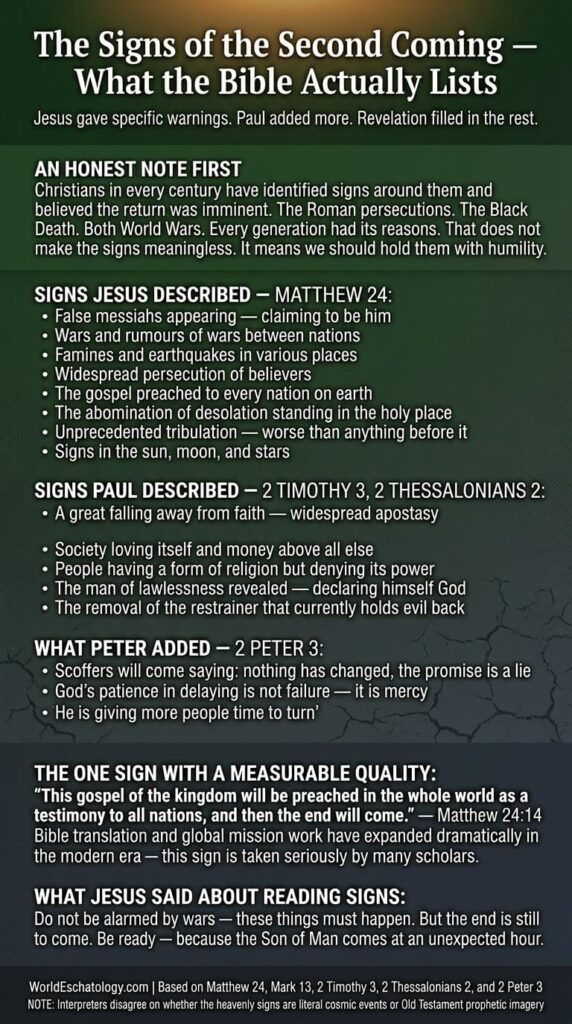
Signs Jesus Described in Matthew 24
False messiahs and false prophets appearing and leading many astray.
Jesus said this would happen and that it would be so convincing that even the elect would be at risk of being deceived if that were possible.
This is not a sign to dismiss lightly in an age of social media and global communication.
Wars and rumours of wars between nations. Jesus said not to be alarmed by this because these things must happen but the end is still to come.
He was telling his followers not to mistake every conflict for the final signal.
Famines and earthquakes in various places. These he called the beginning of birth pains.
The imagery of childbirth is important: the pains are real, they get more intense as the time draws closer, and they exist for a purpose.
The gospel being preached to every nation on earth. Jesus said this must happen before the end comes.
This is one of the few signs that has a somewhat measurable quality to it. Bible translation and missionary work have expanded dramatically in the modern era.
The abomination of desolation, which Jesus tied to the prophet Daniel’s writings, standing in the holy place.
Most interpreters connect this to the desecration of a rebuilt temple in Jerusalem, though what that looks like precisely is debated.
Heavenly signs: the sun darkened, the moon failing to give its light, stars falling from the sky.
Whether these are literal cosmic events or apocalyptic imagery borrowed from Old Testament prophetic language is one of the interpretive questions the sections on Preterism and Dispensationalism will explore.
Signs from Paul and the Rest of the New Testament
Paul described a great apostasy, a large-scale falling away from the faith, as a precondition of the end.
He also described a society in the last days that would be characterised by people loving themselves and money above everything else, being boastful, proud, abusive, and having a form of godliness but denying its power.
Peter wrote that in the last days, scoffers would come saying that everything continues as it always has and the promise of his coming is a lie.
Peter used this as a setup for one of the most important reminders in the New Testament: that with God, a day is like a thousand years and a thousand years like a day.
The delay in Christ’s return is not a failure of the promise. It is patience, giving more people time to turn.
Nobody Knows the Day or the Hour
This section deserves its own space because this single statement by Jesus has been ignored, explained away, or forgotten so many times throughout church history that it bears repeating clearly and loudly.
Matthew 24:36
“But about that day or hour no one knows, not even the angels in heaven, nor the Son, but only the Father.”
Jesus said this himself. Not the angels. Not even the Son in his human state of knowledge at that moment.
Only the Father knows when this will happen. This is one of the most unambiguous statements in the entire Olivet Discourse and yet it has been set aside more often than almost any other teaching of Jesus.
The list of people who have predicted specific dates for the Second Coming and been wrong is extraordinarily long.
William Miller predicted 1844. Jehovah’s Witnesses have set and revised dates multiple times.
Harold Camping predicted May 21, 2011, to enormous media coverage, and when it did not happen, revised to October of the same year. He was wrong both times.
None of this is to mock sincere believers. Many of the people who set these dates were genuinely motivated by love for God and urgency about the gospel.
But the track record is perfect. Every single prediction has been wrong. And Jesus told us this would be the case.
His instruction was not to calculate a date. His instruction was to be ready at all times, because the Son of Man will come at an hour when you do not expect him.
The posture he called for was not prophetic speculation but daily faithfulness.
The Rapture — What Is It and Where Does It Come From?
Few topics in Christian eschatology generate more heat than the rapture.
Depending on who you talk to, it is either one of the clearest doctrines in the New Testament or a relatively recent theological invention that has no solid biblical foundation.
The truth, as is often the case, is more nuanced than either extreme.
Where the Word Comes From
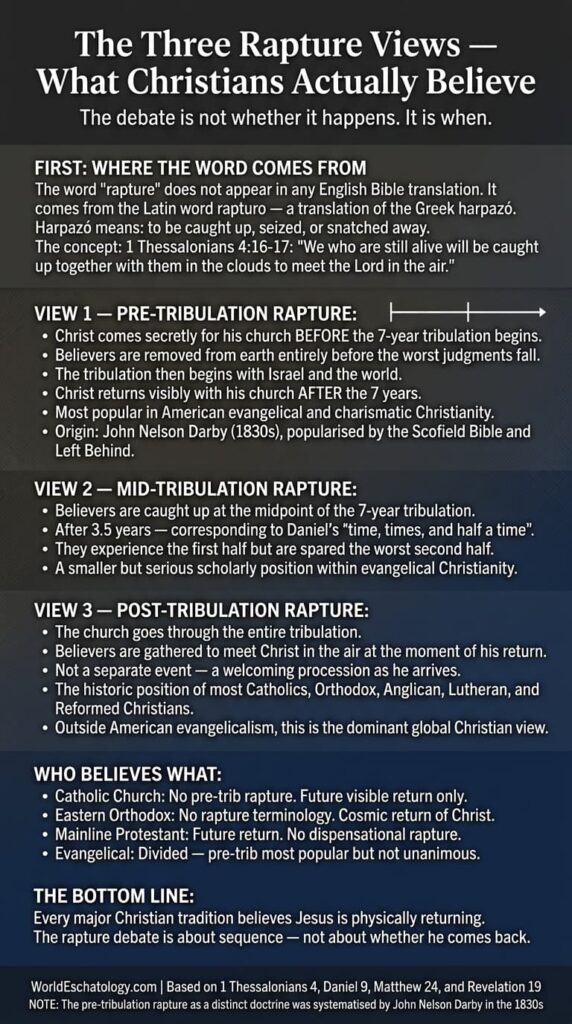
The word rapture does not appear in any standard English Bible translation. This surprises a lot of people.
The concept derives from 1 Thessalonians 4:17, where Paul describes believers being caught up to meet the Lord in the air.
The Greek word he used is harpazó. When Jerome translated the New Testament into Latin in the fourth century, he rendered harpazó as rapturo. From rapturo we get rapture.
The word entered English theology through the Latin Bible tradition, not directly from the Greek.
So the concept is biblically grounded. The specific English word is a translation artifact. This distinction matters for having an honest conversation about it.
The Three Main Rapture Positions
Pre-tribulation rapture: This is the view most associated with popular evangelical Christianity in America, especially through books like Left Behind and preachers like Billy Graham and John MacArthur.
It holds that Christ will come secretly for his church before the seven-year tribulation begins, removing believers from the earth before the worst of the judgments fall. Believers are spared the tribulation entirely.
Mid-tribulation rapture: This view places the rapture at the midpoint of the seven-year tribulation period, after three and a half years, which corresponds to Daniel’s reference to a time, times, and half a time.
Believers experience the first half of the tribulation but are removed before the worst of it.
Post-tribulation rapture: This view holds that the church goes through the entire tribulation and is gathered to meet Christ in the air at the very moment of his visible return, essentially as a welcoming procession rather than a separate event.
This has been the historic position of most of Christianity outside of American evangelicalism.
It is worth knowing that outside of American evangelical Protestantism, the pre-tribulation rapture as a distinct event separated from the Second Coming is a minority position globally.
Catholic, Eastern Orthodox, Anglican, Lutheran, and most Reformed traditions do not teach a pre-tribulation rapture and in many cases do not use the word rapture as a specific theological term at all.
This does not make it wrong, but it contextualises how recent and how regionally specific the pre-trib rapture view is.
Where the Pre-Tribulation View Came From
The pre-tribulation rapture as a distinct, systematised doctrine is generally traced to John Nelson Darby, an Irish theologian working in the 1830s, who developed it as part of a broader theological framework called dispensationalism.
Through the Scofield Reference Bible published in 1909, this framework became enormously influential in American evangelicalism throughout the twentieth century.
This does not make it wrong. New theological formulations are not automatically invalid simply because they are newer.
But it does mean that when someone presents the pre-tribulation rapture as the obvious, straightforward reading of scripture that every Christian has always believed, that is not historically accurate.
It is a specific interpretation with a traceable history.
The Great Tribulation — Seven Years of What Exactly?
The tribulation period is one of those subjects where the popular imagination has run well ahead of what the Bible actually says.
Movies, novels, and YouTube prophecy channels have painted such vivid pictures of this period that people sometimes come to the Bible expecting to find descriptions that simply are not there in the form they expected.
Let us go back to the sources.
Daniel’s Seventy Weeks: The Foundation
The primary Old Testament foundation for the seven-year tribulation is found in Daniel 9:24-27, where the angel Gabriel tells Daniel about seventy weeks of years decreed for his people and his holy city.
Most prophecy interpreters in the dispensational tradition understand these as weeks of years rather than literal weeks, making each week represent seven years, and the entire period 490 years.
They then argue that 69 of those weeks have been fulfilled historically, culminating in the first coming of Christ, and that one final week of seven years remains to be fulfilled in the future.
This final seven-year period, they argue, is what the New Testament refers to as the great tribulation or the time of Jacob’s trouble.
Not all interpreters read Daniel this way. Covenant theologians and preterists understand the 70 weeks as already fulfilled, with no gap between the 69th and 70th weeks.
But the dispensational reading has been dominant in popular Christian prophecy literature.
What the Tribulation Involves
Jesus described the great tribulation as a time of distress unmatched from the beginning of the world until now, and never to be equalled again.
Revelation describes it in terms of the seven seal judgments, the seven trumpet judgments, and the seven bowl judgments, a cascading series of increasingly severe catastrophes affecting the earth.
During this period, a figure called the beast, widely identified with the Antichrist of 1 John and the man of lawlessness of 2 Thessalonians, rises to global power and demands worship.
A second figure, the false prophet, enforces that worship and introduces the mark of the beast, without which no one can buy or sell.
The number of the beast, 666, has become one of the most recognised symbols in Western culture even among people with no particular Christian conviction.
The tribulation ends with the battle of Armageddon, described in Revelation 16 as a gathering of the kings of the earth at a place called Har-Megiddo in Hebrew, which is the Jezreel Valley in modern Israel.
It is not so much a long battle as an arrival, because when Christ returns at Revelation 19, the conflict is over almost immediately.
The Millennium: What Is the Thousand-Year Reign?
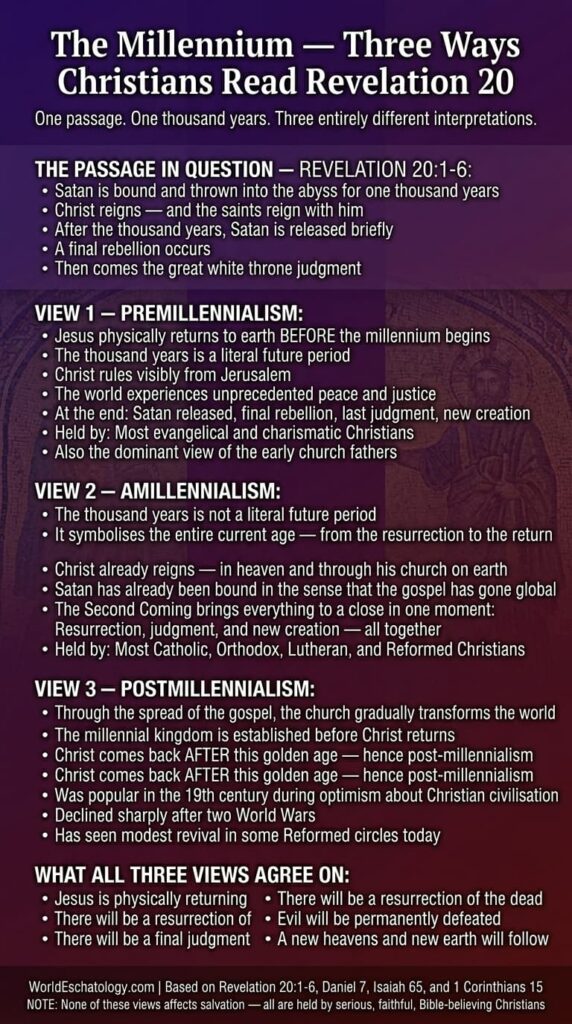
Revelation 20 describes a period of a thousand years during which Satan is bound, Christ reigns, and the saints rule with him.
This passage has generated three distinct theological positions that have divided Christian thinkers for centuries.
Premillennialism: Christ Returns Before the Thousand Years
Premillennialists believe that Jesus physically returns to earth before the millennium begins and that the thousand years is a literal future period of his visible, bodily reign on earth.
The world during this period will experience unprecedented peace and justice, with Christ himself ruling from Jerusalem.
At the end of the millennium, Satan is released briefly, a final rebellion occurs, and then comes the final judgment and the creation of the new heavens and new earth.
This was the dominant view of the early church fathers, and it remains the most popular position in evangelical and charismatic Christianity today.
Amillennialism: The Thousand Years Is Symbolic
Amillennialists argue that the thousand years in Revelation 20 is not a literal future period but a symbolic representation of the current age, the entire span of time between the first and second comings of Christ.
In this view, Christ already reigns, in heaven and through his church on earth, and Satan has already been bound in the sense that the gospel has gone out to all nations and he can no longer deceive them the way he once did.
The Second Coming in amillennial theology brings history to its close in a single climactic moment: resurrection, judgment, and the new creation, all together.
There is no intervening earthly millennium. This is the position of most Catholic, Orthodox, and Reformed theologians.
Postmillennialism: The Church Brings In the Millennium
Postmillennialists believe that through the spread of the gospel, Christian influence will gradually transform the world to such an extent that the millennial kingdom will be established before Christ returns.
Christ’s return comes after this golden age, hence post-millennialism.
This view was more popular in the nineteenth century when optimism about Christian civilisation was at its height, and it declined significantly after two World Wars.
It has seen a modest revival in some Reformed and reconstructionist circles.
Dispensationalism vs. Covenant Theology: The Big Debate Behind the Debates
Most of the disagreements about the rapture, the tribulation, and the millennium are not really standalone arguments.
They are symptoms of a deeper disagreement about how to read the Bible and how God’s plan of salvation relates to the history of Israel and the church.
That deeper disagreement is the one between dispensationalism and covenant theology.
What Dispensationalism Teaches
Dispensationalism is a system of biblical interpretation developed primarily by John Nelson Darby in the nineteenth century and popularised in America through the Scofield Reference Bible, Hal Lindsey’s The Late Great Planet Earth in 1970, and the Left Behind novel series by Tim LaHaye and Jerry Jenkins in the 1990s and 2000s.
The core idea is that God has dealt with humanity through a series of distinct dispensations or administrations, each with its own rules and responsibilities.
Crucially, dispensationalism maintains a sharp distinction between Israel and the church. They are two separate peoples of God with two separate destinies.
Old Testament prophecies about Israel must be fulfilled literally with ethnic Israel, not spiritually in the church.
This is why dispensationalism requires a literal rebuilt temple in Jerusalem, a literal seven-year tribulation, a literal earthly millennium with Christ reigning from Jerusalem, and so on.
The pre-tribulation rapture makes sense within this framework because the church must be removed from the scene before God resumes his distinct program with Israel during the tribulation.
What Covenant Theology Teaches
Covenant theology, which is the foundation of most Catholic, Orthodox, Anglican, Lutheran, and Reformed thinking, sees the Bible as structured around a series of covenants rather than dispensations.
More importantly, it sees the church as the continuation and fulfilment of Israel, not a separate entity.
The promises made to Abraham are inherited by all who share Abraham’s faith, both Jewish and Gentile believers. The church is not a parenthesis in God’s plan. It is the plan.
In covenant theology, the Old Testament prophecies about Israel find their fulfilment in Christ and his church, not in a future literal earthly kingdom.
This eliminates the need for a pre-tribulation rapture, a rebuilt temple, or a literal thousand-year earthly reign, at least in the dispensational form.
Neither system has a monopoly on intelligent, sincere, Bible-believing Christians. Both have produced extraordinary theologians, missionaries, and saints.
The debate between them is real and worth understanding, but it should not be treated as a salvation issue.
What the Old Testament Said — Long Before the New Testament Was Written
The Second Coming did not originate as a New Testament idea. It was rooted in a long tradition of Old Testament prophecy about a coming king, a restored world, and a day of divine reckoning.
The New Testament writers saw themselves as not inventing something new but announcing the fulfilment of what had been promised for centuries.
Isaiah: The Prince of Peace and His Kingdom
Isaiah 9:6-7 is one of the most quoted Old Testament passages in the Christmas season, but its second half is entirely about the Second Coming, not the first.
Isaiah 9:6-7
“For to us a child is born, to us a son is given, and the government will be on his shoulders. And he will be called Wonderful Counselor, Mighty God, Everlasting Father, Prince of Peace. Of the greatness of his government and peace there will be no end. He will reign on David’s throne and over his kingdom, establishing and upholding it with justice and righteousness from that time on and forever.”
A child is born, a son is given — that is the first coming. The government on his shoulders, the endless reign of justice and righteousness from David’s throne — that is the second coming.
Isaiah saw both in the same vision and wrote them side by side.
Zechariah 14: The Mount of Olives Splits in Two
Zechariah 14 is one of the most specific and striking Old Testament prophecies about the Second Coming.
It describes the Lord standing on the Mount of Olives, the exact location from which Jesus ascended, and the mountain splitting in two from east to west.
It describes him coming with all his holy ones, the abolition of night, and the establishment of his kingship over all the earth.
The early Christians read this and saw in it a precise description of what the angels had promised at the ascension: he will return to the same place he left from.
The Mount of Olives is not incidental geography. It is a prophetic destination.
Daniel 7: The Son of Man Coming on the Clouds
This passage matters enormously because Jesus quoted it about himself during his trial, which was one of the reasons the high priest accused him of blasphemy.
Daniel 7:13-14
“In my vision at night I looked, and there before me was one like a son of man, coming with the clouds of heaven. He approached the Ancient of Days and was led into his presence. He was given authority, glory and sovereign power; all nations and peoples of every language worshipped him. His dominion is an everlasting dominion that will not pass away, and his kingdom is one that will never be destroyed.”
Son of Man was the title Jesus used most often to describe himself. He was deliberately connecting his identity to this vision in Daniel.
And Daniel’s vision describes exactly what the New Testament describes: a coming on the clouds, a universal kingdom, authority that never ends.
Preterism: Did the Second Coming Already Happen?
This is the view that most people outside theological circles have never heard of, and it deserves an honest hearing because it has serious scholars behind it and raises genuine exegetical questions.
Preterism comes from the Latin word for past. It is the view that most or all of the prophecies Jesus made in Matthew 24, and much of Revelation, were fulfilled in 70 AD when the Roman general Titus besieged Jerusalem, destroyed the temple, and scattered the Jewish population.
The arguments for this are more serious than popular dismissals of it suggest.
The Partial Preterist Position
Partial preterists believe that the prophecies of Matthew 24 were indeed fulfilled in 70 AD, including the abomination of desolation, the great tribulation, and the signs in the heavens.
However, they maintain that the physical, bodily return of Christ at the end of history is still a future event. Most partial preterists hold to a standard amillennial or postmillennial eschatology.
The strongest argument for partial preterism is the phrase this generation will certainly not pass away until all these things have happened in Matthew 24:34.
If Jesus meant the generation he was speaking to, then the fulfilment of Matthew 24 had to happen within roughly forty years of his death, which is exactly when Jerusalem fell.
This is the exegetical hinge on which the entire partial preterist argument turns.
Full Preterism
Full preterists take the argument further and conclude that even the Second Coming, the resurrection, and the final judgment took place spiritually in 70 AD.
They interpret these events non-physically and see the entire prophetic programme of the New Testament as already complete.
This view is considered outside the bounds of orthodox Christianity by virtually every major denomination, because it requires abandoning the historic creeds’ affirmation of a future bodily resurrection and a future visible return of Christ.
But it is worth knowing it exists and understanding the argument it makes.
The mainstream Christian position, held across Catholic, Orthodox, Protestant, and evangelical traditions, is that whatever was fulfilled in 70 AD, the bodily, visible, physical return of Christ to judge the living and the dead is still a future event.
The Nicene Creed, recited by Christians across traditions for over sixteen centuries, says: he will come again in glory to judge the living and the dead, and his kingdom will have no end.
What Different Christian Denominations Believe
One of the most useful things this article can do is give readers an honest map of where different Christian traditions stand on the Second Coming, because the picture is far more diverse than popular end-times culture suggests.
The Catholic Church
The Catholic Church affirms a future, visible, bodily return of Jesus Christ at the end of history. This is defined dogma, not optional opinion.
What the Catholic Church does not teach is the pre-tribulation rapture, a literal thousand-year earthly millennium before the final judgment, or the dispensational distinction between Israel and the church.
The Catholic understanding is amillennial: the Church is the continuation of Israel, and the millennium represents the current age of Christ’s reign through his church.
Eastern Orthodoxy
The Orthodox churches share the Catholic affirmation of a future bodily return of Christ and the general resurrection, but approach the subject with a notable emphasis on mystery.
Orthodox theology tends to resist the precise calendrical mapping of end-times events that characterises dispensationalism, preferring to dwell on the cosmic renewal of all creation that the Second Coming inaugurates.
The resurrection of the body and the transformation of the entire created order are central to Orthodox eschatology.
Mainline Protestantism
Most mainline denominations, including Methodist, Presbyterian, Lutheran, and Anglican churches, affirm the bodily return of Christ as a future historical event but do not endorse a pre-tribulation rapture.
Methodist teaching, for example, connects the Second Coming with the Last Judgment in accordance with the historic creeds, without specifying a rapture timeline or a literal millennium.
The United Methodist Church has explicitly stated that it does not teach a dispensational rapture.
Evangelical and Charismatic Christianity
This is where the picture becomes most diverse. Within evangelical Christianity, you will find premillennial dispensationalists who hold firmly to the pre-tribulation rapture, covenant premillennialists who expect Christ to return before a literal millennium but without a pre-trib rapture, amillennialists, and postmillennialists.
Charismatic and Pentecostal traditions tend toward premillennialism but vary widely on the rapture question.
The shared conviction across all of these is the physical, visible return of Jesus Christ. The debate is about the sequence and nature of events surrounding that return.
The Second Coming in Islam: The Shared Belief
For readers who have been following this series on world eschatology, this section connects the dots between the Christian and Islamic end-times narratives in a way that is genuinely illuminating.
Islam teaches that Prophet Isa ibn Maryam, Jesus the son of Mary, peace be upon him, will return to earth near the end of times.
This is not a minor or peripheral belief in Islamic eschatology. The return of Isa is listed as one of the major signs of the Day of Judgement and is described in considerable detail across the hadith literature.
What Islam and Christianity Agree On
Both traditions affirm a physical, visible, bodily return. Both agree that his return is connected to the defeat of a great deceiver, the Dajjal in Islam and the Antichrist in Christianity.
Both agree that his return brings an era of extraordinary justice and peace to the earth.
Both agree that he will die a natural human death after his return and that the world will continue briefly before the final judgment.
The parallels in the physical details are striking. In Islamic narrations, Isa descends near a white minaret in Damascus, dressed in garments dyed with saffron, with his hands on the wings of two angels.
In Revelation, the heavens open and the rider on the white horse appears with the armies of heaven behind him.
Different imagery, but the same structural event: heaven opens and the true messiah arrives to end the reign of the false one.
Where the Two Traditions Differ
The theological frameworks surrounding the return are very different.
In Christianity, the returning Jesus is the eternal Son of God, the second person of the Trinity, returning in divine glory to establish his eternal kingdom.
In Islam, the returning Isa is a prophet, an extraordinary one, but a human prophet sent back to fulfil a specific mission.
He does not come as God or as the King of Kings in the Christian sense.
In Islam, Isa returns to a world already led by the Mahdi, the guided leader who has been fighting the Dajjal. Isa defers to the Mahdi for the prayer and then kills the Dajjal himself.
In Christianity there is no equivalent of the Mahdi figure. Jesus arrives and takes charge immediately and completely.
These differences are real and theologically significant. But the fact that two major world religions, coming from different historical contexts and different scriptural traditions, both expect the same figure to return to the same region of the world to defeat the same enemy is one of the most remarkable convergences in the study of comparative eschatology.
What the Second Coming Should Change About How You Live Right Now
Every section so far has been looking forward, examining what the Bible says will happen in the future.
This section looks at the present, because the New Testament writers were not primarily interested in satisfying theological curiosity.
They talked about the Second Coming because they believed it should change the way people live today.
Peter put it bluntly.
2 Peter 3:11-12
“Since everything will be destroyed in this way, what kind of people ought you to be? You ought to live holy and godly lives as you look forward to the day of God and speed its coming.”
This is not a gentle suggestion. Peter is using the certainty of the Second Coming as a direct argument for how to live.
If this world is temporary and a new one is coming, what are you building your life around?
Paul made the same move in Titus 2, using the blessed hope of Christ’s appearing as the motivation for self-controlled, upright, godly living in the present age.
And in 1 Corinthians 15, after his most extended argument for the resurrection, he closes with: Therefore, my dear brothers and sisters, stand firm.
Let nothing move you. Always give yourselves fully to the work of the Lord, because you know that your labour in the Lord is not in vain.
The Second Coming, in the New Testament’s hands, is not fuel for speculation. It is fuel for perseverance. It is the reason you keep going when things are hard.
It is the reason you treat other people with dignity, because you believe they will stand before the same judge you will.
It is the reason you hold the things of this world loosely, because you believe they will all be remade.
James told suffering believers to be patient and stand firm, because the Lord’s coming is near.
The author of Hebrews told a discouraged community not to give up meeting together but to encourage each other all the more as you see the Day approaching.
In almost every case, the Second Coming is brought up in the New Testament not to feed curiosity about the future but to strengthen faithfulness in the present.
Frequently Asked Questions
What does the Bible say about the second coming of Jesus?
The Bible teaches that Jesus Christ will physically and visibly return to earth at the end of history, in the same bodily form in which he ascended.
This is taught in the Gospels, in the letters of Paul, in the book of Revelation, and is anticipated throughout the Old Testament.
It is one of the most extensively documented doctrines in the Bible with approximately 1,845 references across both testaments.
When will Jesus return?
Jesus himself said that no one knows the day or the hour, not the angels, not even himself in his human nature, but only the Father.
Every attempt to set a specific date has been wrong. The instruction Jesus gave was not to calculate a timeline but to remain ready at all times.
What are the signs of the second coming?
Jesus described false messiahs and prophets, wars, famines, earthquakes, persecution of believers, the gospel reaching every nation, and specific astronomical and earthly signs.
Paul described a great falling away from faith and the rise of the man of lawlessness. Revelation adds the seal, trumpet, and bowl judgments as signs within the tribulation period preceding his return.
What is the rapture and is it in the Bible?
The rapture refers to the event described in 1 Thessalonians 4:16-17, where believers are caught up to meet the Lord in the air at his coming.
The concept is biblical. The specific English word rapture comes from the Latin translation of the Greek word harpazó, meaning caught up or seized.
The debate among Christians is not whether this event happens but when it happens relative to the tribulation.
What is the difference between the rapture and the second coming?
In pre-tribulation dispensationalism, these are two separate events separated by seven years. The rapture is a secret coming of Christ for his church before the tribulation.
The Second Coming is his visible return with his church at the end of the tribulation. In amillennial and post-tribulation views, they are the same event or occur simultaneously.
What will happen when Jesus returns?
The New Testament describes the resurrection of the dead, the gathering of all believers to meet Christ, the judgment of the living and the dead, the defeat of evil and the devil, and the establishment of the new heavens and new earth.
The sequence and nature of these events is where different traditions disagree, but all affirm that they happen.
Did the second coming already happen?
Full preterists argue that the Second Coming occurred spiritually in 70 AD. Partial preterists argue that Matthew 24 was fulfilled in 70 AD but a future bodily return remains.
The mainstream Christian position, affirmed in the Nicene Creed and held across Catholic, Orthodox, and Protestant traditions, is that the visible, bodily return of Christ is still a future event.
What do Catholics believe about the second coming?
The Catholic Church teaches a future visible, bodily return of Jesus Christ at the end of history, followed by the resurrection of the dead and the final judgment.
The Catholic Church does not teach the pre-tribulation rapture or a literal thousand-year earthly millennium as dispensationalism describes them.
What does Islam say about the return of Jesus?
Islam teaches that Prophet Isa ibn Maryam will physically return near the end of times as one of the major signs of the Day of Judgement.
He will descend from heaven, defeat the Dajjal, establish justice on earth, and eventually die a natural death.
The Islamic tradition shares with Christianity the belief in a physical, visible return of Jesus but understands his nature and role differently.
What is the millennium in the Bible?
The millennium refers to the thousand-year period described in Revelation 20. Premillennialists believe it is a future literal reign of Christ on earth after his return.
Amillennialists believe it symbolises the current age between the first and second comings.
Postmillennialists believe the church will establish this era of Christian influence before Christ returns.
Conclusion: The Hope That Has Outlasted Everything
Christianity has been declared dead many times. The Roman emperors tried to kill it. Medieval corruption nearly smothered it.
Enlightenment rationalism was supposed to make it intellectually untenable. Twentieth-century atheism was supposed to finish the job. None of it worked.
One of the reasons, though not the only one, is this: Christianity is a faith built around a promise that has not yet been fulfilled.
The tomb is empty, the Spirit has been given, but the story is not finished. Jesus said he was coming back. The angels confirmed it.
The whole New Testament breathes with that expectation. And every generation of Christians since the first has lived with the same forward-leaning posture, not knowing when, but believing it is coming.
That is a remarkably durable kind of hope. It has survived empires. It has survived heresies and schisms and failures and scandals.
It has carried people through persecution and grief and exile. Not because they had a precise timeline but because they believed, as simply and as seriously as anything they had ever believed, that the one who promised is faithful.
The debates about the rapture and the tribulation and the millennium are real and worth having.
But they are debates about the shape and sequence of a hope that all serious Christians share. He is coming back.
The same Jesus who walked out of the tomb, who ascended from the Mount of Olives while his friends watched with their mouths open, who promised he was going to prepare a place and come back for them. That same Jesus.
What you do with that promise, how seriously you take it, how much it shapes the way you spend your days, is perhaps the most important question this article can leave you with.
The next article in this series will examine what the Islamic tradition teaches about the return of Prophet Isa ibn Maryam and how it both overlaps with and diverges from the Christian account we have explored here.
Sources: The Holy Bible (NIV, ESV, KJV) | Book of Revelation | Daniel | Isaiah | Zechariah
Theological references: The Nicene Creed | John Nelson Darby | The Scofield Reference Bible
WorldEschatology.com | All scripture citations are drawn from canonical scripture across both testaments
7 thoughts on “The Second Coming of Jesus Christ”