Most people who have heard the phrase Olam Ha-Ba believe they know what it means.
They imagine something roughly equivalent to the Christian heaven or the Islamic Jannah: a positive afterlife destination for the righteous, contrasted with Gehinnom as a place of punishment for the wicked.
This understanding is not entirely wrong, but it captures only a fraction of what this concept actually contains.
The truth is that Olam Ha-Ba is one of the most carefully qualified, deliberately restrained, and genuinely complex discussions in the entire history of religious thought.
The phrase does not appear anywhere in the Hebrew Bible.
The concept developed over more than two thousand years of Talmudic reasoning, medieval philosophical debate, and mystical elaboration, and the streams of Jewish tradition that engage with it do not all agree on what it is, when it begins, who enters it, or even what kind of existence it involves.
Maimonides, the greatest legal codifier in Jewish history, understood the ultimate Olam Ha-Ba as a purely spiritual existence of disembodied souls basking in divine intellect.
Nachmanides, equally authoritative, understood it as embodied life in a transformed physical world.
Kabbalistic tradition introduced the concept of Gilgul, soul transmigration, as the mechanism by which souls approach their final destination through multiple lifetimes.
And throughout all of this, the tradition maintained that the details of what Olam Ha-Ba is actually like are ultimately beyond the capacity of any living person to know.
This article goes through all of it. The language and its two distinct meanings. The roots in the Hebrew Bible and how limited those roots actually are.
The Pharisee-Sadducee debate that made resurrection a central doctrine. The rabbinic portraits of Gan Eden and Gehinnom.
The great medieval debate between Maimonides and Nachmanides. The Kabbalistic doctrine of Gilgul Neshamot.
Who gets in and on what basis. The mourning customs that the afterlife beliefs shaped. What the four major denominations believe today.
And the deeper theological question underneath all of it: why a tradition so focused on this world developed such a rich and contested conversation about the next one.
What the Words Actually Mean
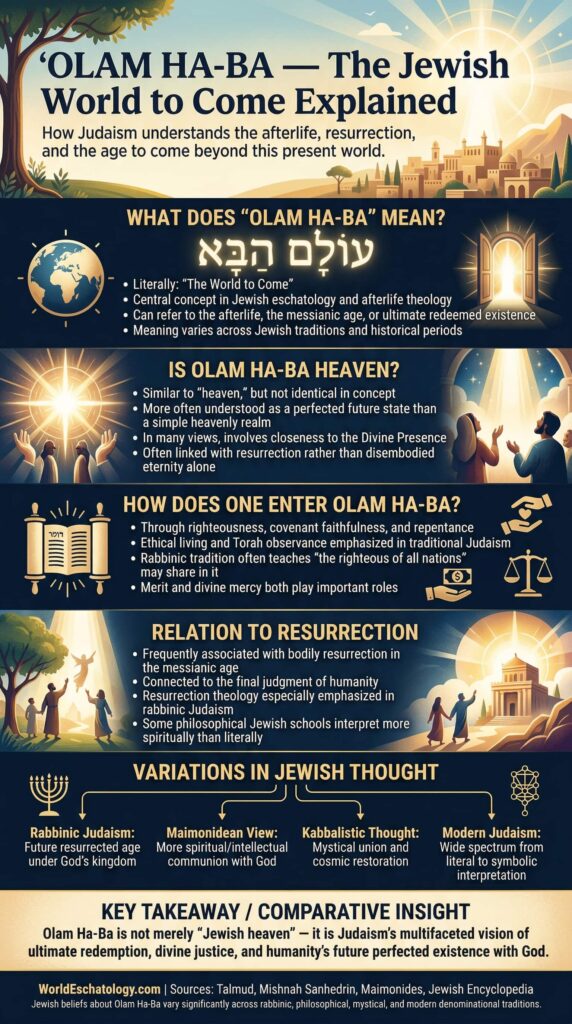
Before anything else can be properly understood, the language itself deserves attention, because Olam Ha-Ba is more nuanced as a phrase than its standard translation suggests.
The word Olam carries two meanings that in English require two different words.
It means world in the sense of a place, a realm of existence, a space one can inhabit.
It also means eternity, the dimension of endless time. A single Hebrew word holds both the spatial and temporal dimensions of what we mean when we talk about the afterlife.
This is not accidental. The tradition understood that the coming realm is different from our current one not merely as a different place but as a different kind of time.
Ha-Ba is the participial form of the verb to come. It means the coming one, the arriving one, something perpetually in the process of approaching.
Olam ha ba meaning is therefore not simply the world that will come but the world that is always coming, the world that is on its way.
This linguistic quality reflects something important: the destination is not a fixed warehouse waiting to be opened but a living reality moving toward us even as we move toward it.
The counterpart phrase is Olam Ha-Zeh, This World, the world currently inhabited.
In the Mishnah, a first-century rabbi offered an image that has been quoted for two thousand years. This world is like a lobby before Olam Ha-Ba.
Prepare yourself in the lobby so that you may enter the banquet hall. The image is deliberately ordinary. A lobby is not unimportant.
It is where the preparation happens. But nobody builds their permanent home in a lobby. Nobody treats the lobby as the destination.
A Critical Ambiguity: Two Meanings of One Phrase
One of the most important things to understand about Olam Ha-Ba is that Jewish literature uses it to mean two quite different things, and these meanings have never been fully harmonised.
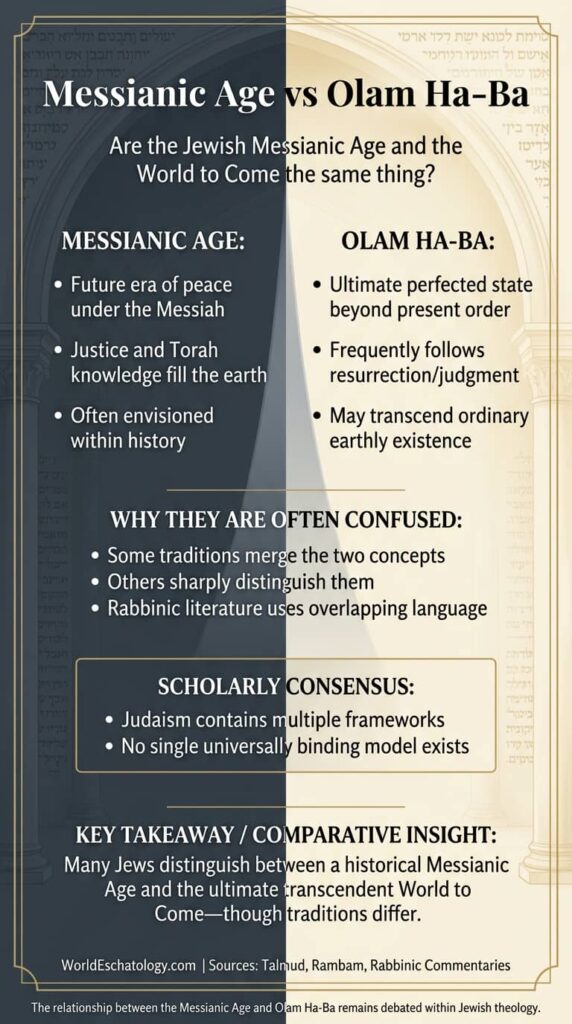
The first meaning is collective and historical: Olam Ha-Ba as the messianic age, the transformed world that will follow the coming of the Jewish Messiah, the resurrection of the dead, and the final judgment.
In this reading, olam ha-ba sheol gehinnom jewish eschatology is something the entire world will enter together, a cosmic renewal rather than an individual destination.
The second meaning is individual and immediate: Olam Ha-Ba as the spiritual realm entered by the soul of the righteous person upon dying.
In this reading, Olam Ha-Ba is where your grandmother went when she died, a personal and present reality for the individual soul, not a collective future event.
These two meanings coexist in the sources. The Talmud uses Olam Ha-Ba in both senses without always distinguishing between them, and different rabbis writing at different periods clearly had different things in mind.
Scholars have tried to clarify the relationship, and some have proposed that Gan Eden is the intermediate individual afterlife while Olam Ha-Ba proper is the final collective state after the resurrection.
But the honest answer is that many questions remain unresolved. If judgment follows immediately at death, what is the point of the judgment that follows the resurrection?
If the soul is already in Gan Eden, what exactly happens at the resurrection and how does that relate to the state the soul was already in?
The tradition has not found a way to fully reconcile all the texts on these questions, and it has generally been comfortable with that.
The unknowability of the precise details of the afterlife is itself a principle: the widely accepted position in Jewish theology is that it is impossible for living human beings to know what the World to Come is actually like.
The descriptions given in the texts are understood as approximations, as the tradition pointing toward something it acknowledges exceeds its ability to describe precisely.
Sheol: Where It All Started in the Hebrew Bible
The Hebrew Bible has considerably less to say about life after death than most readers assume.
Before jewish views on olam ha-ba sheol gehinnom resurrection existed, the primary afterlife concept in the biblical text was Sheol, and Sheol is not what most people think it is.
Sheol appears throughout the Hebrew Bible as the place where the dead go.
Jacob, weeping over his apparently dead son Joseph, says he will go down mourning to his son in Sheol.
The Psalms speak of God delivering the faithful from Sheol. Job, in the depths of his suffering, describes Sheol as a place of rest that he longs for.
Ecclesiastes observes with characteristic bleakness that the dead know nothing, that there is no wisdom or knowledge or planning in Sheol, and that everything humans do under the sun will eventually be swallowed by it.
Sheol is not a place of reward and punishment. It is simply the realm of the dead, a shadowy existence beneath the earth experienced as diminishment and silence.
The righteous and the wicked go to the same Sheol. There is no differentiation of fate based on the quality of one’s life.
This is precisely why the Book of Psalms sometimes sounds so urgent in its appeals to God for rescue: death means going to Sheol, and in Sheol one cannot praise God.
Two late passages in the Hebrew Bible introduce something different. Daniel 12:2 says that many of those who sleep in the dust of the earth shall awake, some to everlasting life, and some to shame and everlasting contempt.
Isaiah 25:8 and 26:19 speak of God swallowing up death forever and of the dead living and rising.
These are the earliest clear references to something like resurrection and differentiated afterlife in the Jewish scriptures, and their lateness in the canon is itself significant: the differentiated afterlife of what would become normative Judaism was a development, not a starting point.
Pharisees and Sadducees: The Birth of a Doctrine
The doctrine of resurrection and the differentiated afterlife became central to Jewish theology through a specific historical process, and that process was shaped by a profound internal debate within Second Temple Judaism.
The Sadducees were the aristocratic, priestly, temple-centred party of late Second Temple Judaism.
They were textual literalists in a specific sense: if a doctrine was not explicitly stated in the Torah, the five books of Moses, they rejected it.
Since the Torah contains no clear statement of resurrection or individual afterlife reward and punishment, the Sadducees denied these beliefs.
They were not materialists in the modern sense. They believed in God and in the covenant.
But they believed that covenant faithfulness was rewarded in this life and this world, through national prosperity and the flourishing of the community, not through individual posthumous destinations.
The Pharisees, the party from which Rabbinic Judaism descends, found resurrection implied in the text through interpretation rather than explicit statement.
They argued from verses in Deuteronomy and the Psalms that pointed, in their reading, toward a relationship with God that death could not interrupt.
They argued from the justice of God: if the righteous suffer in this life, as they manifestly sometimes do, then a just God must have arranged for a reckoning beyond this life.
They argued from the nature of the covenant: a relationship with the living God must be a living relationship, not one terminated by death.
The destruction of the Second Temple in 70 CE settled the argument by historical default.
The Sadducees, whose identity and authority were centred on the temple and its worship, largely ceased to exist as a movement when the temple was destroyed.
The Pharisaic tradition survived, became Rabbinic Judaism, and carried with it the full apparatus of resurrection belief and afterlife theology.
The Mishnah, compiled around 200 CE, enshrined this in its most famous statement on the subject.
“All Israel have a portion in the World to Come. But the following have no portion therein: one who maintains that resurrection is not a biblical doctrine, one who maintains that the Torah was not divinely revealed, and an apikoros.”
The generosity of the opening clause, all Israel have a portion, is immediately qualified by the three exceptions.
And crucially, the first exception is denial of resurrection itself. Belief in the resurrection of the dead was made a prerequisite for participation in the very afterlife it describes.
Gan Eden: The Jewish Heaven in Rabbinic Literature
Having established the historical and doctrinal foundation, we can turn to what the Talmud and Midrash actually describe as the positive afterlife destination.
Gan Eden in the afterlife context is not the same as the Garden of Eden where Adam and Eve lived.
The name is shared, but the tradition is clear that this is a different, higher place.
The connection is symbolic: the Garden of Eden was a state of perfect harmony between the human being and God, and the heavenly Gan Eden represents the restoration of that harmony at its highest possible level.
The Talmud’s descriptions of Gan Eden are deliberately restrained compared to the vivid physical descriptions of paradise found in Islamic texts.
The most famous Talmudic description comes from Tractate Berakhot 17a: in the World to Come there is no eating, no drinking, no procreation, no commerce, no jealousy, no hatred, no competition.
Instead, the righteous sit with their crowns on their heads and bask in the radiance of the divine presence.
The metaphor of sitting with a crown communicates dignity, reward, and rest without specifying physical content.
The basking in the divine radiance, the Shekhinah, points toward an experience that is fundamentally about proximity to God rather than about pleasure in any form we would recognise from this world.
One source in the Talmud says that one-sixtieth of the pleasure of the afterlife is experienced by a person who properly observes Shabbat.
This ratio is striking: Shabbat at its most profound, the most elevated spiritual experience of Jewish weekly practice, is only one-sixtieth of what Gan Eden contains.
The tradition is pointing toward something that exceeds the capacity of current human experience to measure.
The Midrash provides more elaborate descriptions. Legends collected by Louis Ginzberg describe Gan Eden as having a double gate of carbuncle guarded by 600,000 shining angels, a place where the righteous shine with light corresponding to their level of righteousness.
Different chambers correspond to different categories of the righteous.
The Talmud also teaches that not all shares in Gan Eden are equal: a particularly righteous person has a greater share than the average person, and the tradition speaks of the righteous in the lower levels seeing those in the upper levels the way one sees the stars, as brilliant points of light in a higher realm.
Gehinnom: Purification, Not Eternal Punishment
No aspect of Jewish afterlife belief is more frequently misunderstood, particularly by readers coming from Christian backgrounds, than the Jewish concept of Gehinnom.
The name comes from Ge-Hinnom, the Valley of Hinnom, a ravine outside Jerusalem’s western wall.
In biblical times this valley was associated with the Canaanite practice of child sacrifice, a practice condemned with horror throughout the prophetic literature.
By the Second Temple period it had become the city’s refuse dump, where fires burned continuously to consume waste.
The name accumulated associations of burning and defilement and became attached to the concept of post-mortem consequence.
But what actually happens in Gehinnom is not what the word hell, in Christian popular theology, suggests.
Gehinnom in the rabbinic tradition is above all else a process of purification. The soul that arrives in Gehinnom is not condemned to endless torture.
It undergoes an experience of self-confrontation, a stripping away of the self-deceptions and accumulated moral damage of a lifetime, a process that the tradition describes as painful precisely because it involves the soul fully seeing and acknowledging the truth about itself and the effects of its choices.
“The spiritual pain of Gehinnom is the soul’s pain in facing the truth of its life. This cleanses and heals the soul of the spiritual stains and blemishes that its failings and misdeeds have attached to it. Freed of this husk of negativity, the soul is able to fully enjoy the immeasurable good that its life engendered.”
The maximum duration of Gehinnom is twelve months for most souls.
This is the normative rabbinic position, and it is absolutely fundamental to understanding the Jewish afterlife: even the most sinful ordinary person spends at most twelve months in Gehinnom, after which they proceed to their portion in Gan Eden.
This twelve-month ceiling is so established in the tradition that it shapes one of the most distinctive features of Jewish mourning practice.
The Ashkenazi custom is to recite the mourner’s kaddish for only eleven months following a close relative’s death, not twelve.
The reason is that kaddish is understood as an act of the living that benefits the soul of the deceased, helping to ease and shorten the Gehinnom process.
If one were to say kaddish for a full twelve months, one would be implying that the deceased required the maximum period of purification, which would be a slight to their memory.
So eleven months became the standard: long enough to ensure the deceased receives the benefit, short enough to avoid the implication of maximum sinfulness.
The exceptions to the twelve-month maximum are rare and carefully specified.
The tradition describes certain categories of the exceedingly wicked, those who denied God entirely while leading others astray, who are understood as having their souls ultimately extinguished rather than purified and elevated.
The precise definition of who falls into this category has been debated across centuries, and the tradition has generally been reluctant to assign specific historical figures to permanent destruction, preferring to leave such judgments to God.
The philosopher’s question inevitably arises: what about someone like Hitler, whose crimes were so monstrous that twelve months seems entirely inadequate as a response to the suffering he caused?
The tradition has no single answer. Some authorities point to the category of those whose souls are extinguished.
Others argue that the justice of God exceeds what any human framework can capture, and that the ultimate fate of historical monsters is God’s business rather than ours to calculate.
What the tradition is clear about is that Gehinnom is not a place of eternal conscious torment in the sense that much of Christian popular theology has described hell, and this makes the Jewish afterlife among the most humane in the Abrahamic family.
The Soul and What Happens to It: The Jewish Understanding of Neshamah
Any serious discussion of the Jewish afterlife requires understanding what the Jewish tradition says the soul is, because the fate of the soul after death depends entirely on what kind of thing the soul is to begin with.
The Hebrew word neshamah, usually translated as soul, literally means breath.
It is taken from the creation account in Genesis: God formed Adam from the dust of the ground and breathed into his nostrils the breath of life, and the human being became a living soul.
The neshamah is divine breath: not something separate from God that God created and implanted, but a portion of God’s own life breathed into the human being.
This is why the soul is understood to be immortal: God’s breath cannot simply cease.
The Kabbalistic tradition developed a multi-layered understanding of the soul that became highly influential, particularly in Hasidic thought.
The lowest level is the nefesh, the animating life force shared with all living creatures.
Above it is the ruach, the moral and emotional dimension, the seat of character. Above that is the neshamah proper, the specifically human divine spark.
Beyond these three are two higher levels attained through spiritual development: the chayah, connected to the divine will, and the yechidah, the completely unified spark described as indistinguishable from its divine source.
What happens to these levels at death differs between sources.
The nefesh remains in proximity to the body for some period after death, which is one reason why Jewish law requires prompt burial and prohibits embalming: the body retains a residual connection to the soul and deserves to be treated with dignity.
The higher soul levels begin their journey through the post-mortem realms immediately.
Kabbalistic texts describe a process by which the different soul levels eventually separate, with each level undergoing its own process of purification and elevation before the ultimate reunion in the World to Come.
One of the most practically significant teachings about the neshamah is the belief that it existed before the body.
The tradition describes souls as created before the physical world, waiting in a divine treasury called the Otzar Ha-Neshamot before their descent into physical bodies.
This pre-existence explains a number of otherwise puzzling features of Jewish thought, including the Talmudic teaching that every Jewish soul in history was present at Sinai when the Torah was given, and the intuition many people have of meeting someone for the first time but feeling they have known them before.
Hibbut Ha-Kever: The Experience of the Grave
Between the moment of death and the eventual arrival at Gan Eden or Gehinnom, Jewish mystical and later Talmudic literature describes a transitional experience that has shaped the customs around death and mourning in ways that most Jewish people practice without necessarily knowing the theology behind them.
Hibbut Ha-Kever, the pangs of the grave, refers to a difficult process of disentanglement by which the soul separates from the physical body after death.
The tradition describes this as painful because the soul has spent a lifetime woven into the physical, developing attachments and habits and dependencies that do not simply dissolve at the moment of biological death.
The process of fully separating from the body is described as taking some days, during which the soul hovers near the body in a kind of liminal state, uncertain of its new condition.
This understanding informs the Jewish requirement for rapid burial, ideally within twenty-four hours of death. Keeping the body unburied prolongs the transitional period for the soul, and is therefore not a kindness to the deceased.
It also informs the prohibition on embalming, which preserves the body in a way that some authorities have argued interferes with the natural separation process.
The tradition cares about what happens to the soul in those first hours and days after death, and its mourning laws reflect that care.
The angel Dumah, whose name means silence, is described in some sources as the angel who oversees the dead and comes to the soul in the grave.
Some texts describe a process in which the soul is questioned about its life, its deeds, and its faith, an initial accounting that precedes the full judgment.
The experience of Hibbut Ha-Kever varies according to the soul’s level of spiritual refinement: for those who lived righteously and practiced proper mourning customs, the process is relatively smooth.
For those with stronger attachments to the physical or greater unresolved moral debt, it is more difficult.
The Great Medieval Debate: Maimonides and Nachmanides
The most important theological debate in the history of Jewish afterlife doctrine is the one that unfolded across the twelfth and thirteenth centuries between two giants of medieval Jewish thought:
Moses ben Maimon, known as Maimonides or Rambam, and Moses ben Nachman, known as Nachmanides or Ramban.
Their disagreement was not peripheral. It concerned the ultimate nature of the highest good the Jewish tradition could offer.
Maimonides: The Purely Spiritual World to Come
Maimonides was the greatest rationalist philosopher in the history of Judaism.
He was also, paradoxically, among the most influential legal codifiers.
His Thirteen Principles of Faith, which include belief in resurrection as the twelfth principle, became something close to a Jewish creed, recited in the Yigdal hymn and the Ani Maamin affirmation.
Yet his philosophical understanding of what the ultimate afterlife consists of was strikingly different from popular belief.
For Maimonides, the ultimate Olam Ha-Ba is a purely intellectual, spiritual existence.
Freed from the body, the perfected soul exists as what he calls a disembodied intellect, a being of pure knowledge that experiences the divine through direct intellectual apprehension.
There is no body in this ultimate state, no physical sensation, no social interaction in any form we would recognise.
The pleasure of Olam Ha-Ba is entirely intellectual, the unimpeded contemplation of divine truth.
Maimonides understood the resurrection of the dead as a real future event but not the climax of the process.
The resurrected will live for a period in the messianic age and will then die again.
After this second death, their souls will exist purely spiritually in the ultimate Olam Ha-Ba.
The resurrection is real and important but is not itself the highest destination. It is, in his framework, a penultimate stage.
This position generated controversy both in his own time and afterward. Samuel ben Ali, head of the Baghdad Academy, accused Maimonides of effectively denying the resurrection by reducing it to a temporary episode rather than the permanent final state.
Maimonides wrote his Treatise on Resurrection in response, reasserting that resurrection is a cornerstone of Torah while maintaining that the ultimate reward is the spiritual existence he had described.
Nachmanides: The Embodied World to Come
Nachmanides disagreed fundamentally with Maimonides’s vision of the ultimate afterlife, and the Kabbalistic and Hasidic traditions have largely followed Nachmanides rather than Maimonides on this question.
For Nachmanides, the ultimate judaism views on olam ha-ba sheol gehinnom resurrection is a world that includes embodied souls.
The resurrection is permanent, not temporary. The ultimate reward involves the soul reunited with the body, not escaping from it, in a transformed physical world where the spiritual and material are harmonised rather than separated.
The body is not an obstacle to spiritual fulfilment that must be shed. It is an essential dimension of the complete human being, and the complete human being is what the World to Come is designed to redeem.
This position is more consistent with the prophetic vision of the messianic age as a transformed earth, with the imagery of the resurrection as something the body participates in, and with the popular Jewish imagination of heaven as involving feasting, study, and communal life rather than disembodied intellectual contemplation.
It is also, as Nachmanides himself acknowledged, more consistent with the simple meaning of the texts that promise life in the World to Come to the righteous.
The Zohar and the Lurianic Kabbalists generally follow Nachmanides.
The ultimate Olam Ha-Ba in the Kabbalistic framework is a state of perfect integration between the spiritual and the physical, when the human being participates in the divine life with both dimensions of its nature fully expressed.
The body is not abandoned but transfigured.
Gilgul Neshamot: Reincarnation in the Kabbalistic Tradition
One of the most surprising aspects of Jewish afterlife belief for those encountering it for the first time is the presence within the tradition of a form of reincarnation.
This is not a fringe belief. It is a central element of Kabbalistic thought and is widely accepted in Hasidic communities and among Sephardic Jews influenced by the Lurianic Kabbalah of sixteenth-century Safed.
Gilgul Neshamot, the cycling or rolling of souls, holds that a soul may return to earth in successive physical bodies if it has not completed its necessary tikkun, its rectification or repair, in a single lifetime.
The soul has a specific mission and set of spiritual tasks to accomplish. If it leaves a lifetime without having completed them, it returns for another attempt.
The concept does not appear in the Talmud. Saadia Gaon, one of the great authorities of the Gaonic period, explicitly rejected it as incompatible with Judaism.
Several other medieval philosophers, including Yehuda Halevi and Joseph Albo, ignored it or dismissed it.
It enters mainstream Jewish thought through the Kabbalistic tradition, appearing initially in the Sefer Ha-Bahir, written in twelfth-century Provence, and developing substantially in the Zohar of thirteenth-century Spain before becoming central in the Lurianic Kabbalah of sixteenth-century Safed.
Isaac Luria, known as the Arizal, was the most systematic developer of the doctrine of Gilgul.
His student Rav Chaim Vital collected his teachings in Sha’ar Ha-Gilgulim, the Gate of Reincarnations, which became the primary textual reference for this concept.
Luria taught that souls could require many incarnations to complete their tikkun, that the different levels of the soul might reincarnate at different rates and in different ways, and that certain historical figures were gilgulim, reincarnations, of earlier figures:
David and Bathsheba as the reincarnations of Adam and Eve, for example, returning to repair what had been damaged in the Garden.
The original understanding of Gilgul was as a form of divine judgment: reincarnation was a consequence of unresolved sin, a form of correction.
The later Kabbalistic tradition, particularly from the time of the Zohar onward, reframed it as an expression of divine mercy:
the soul is given additional opportunities to complete its mission rather than being denied the chance to fulfil its purpose because a single lifetime proved insufficient.
The relationship between Gilgul and Gehinnom created a theological tension that was never fully resolved.
If a soul is reincarnated after death, when does it experience Gehinnom?
The Kabbalistic response is that the soul may undergo Gehinnom between incarnations, with each return to earth preceded by a period of purification.
But the exact mechanics were debated across centuries and different Kabbalistic schools developed different solutions.
Gilgul also intersected with the tradition’s concern for the souls of animals.
Some later Kabbalistic texts taught that souls could be reincarnated into animals as a form of punishment or correction, a position that Saadia Gaon would have found entirely foreign to Judaism.
The dybbuk, the possessing spirit of folk tradition, was understood in some Kabbalistic frameworks as the soul of someone so burdened by unresolved karma that it could not proceed through the normal afterlife process and instead attached itself to a living person.
The Messianic Age: Olam Ha-Ba as Collective Transformation
The other major meaning of Olam Ha-Ba, the collective messianic transformation of the world, deserves its own treatment because it represents the heart of Jewish eschatological hope and is in many ways more central to Jewish religious imagination than the individual afterlife.
The prophetic vision that underlies this understanding is one of the most beautiful in all of scripture.
Isaiah imagines a world in which the nations no longer make war, beating their swords into ploughshares and their spears into pruning hooks.
He imagines a world in which justice is not a contested value but the very texture of existence, in which the earth is full of the knowledge of God as the waters cover the sea.
Jeremiah speaks of a new covenant written not on stone tablets but on the human heart, internalized so thoroughly that no one needs to teach their neighbour about God because everyone will know God directly.
Ezekiel speaks of dry bones coming to life, of the scattered people of Israel gathered and restored to their land, of a new heart and a new spirit given to replace the heart of stone.
The Jewish Messiah in this framework is a human being, a descendant of the Davidic line, who will accomplish specific historical tasks:
restoring the Davidic kingdom, gathering the Jewish exiles from the four corners of the earth, rebuilding the Temple, and establishing an era of universal peace and justice.
The Messiah is not a divine figure in the Jewish understanding.
He is the greatest human leader in history, the one through whom God’s purposes for the world are finally accomplished at the national and cosmic level.
Maimonides, in his Mishneh Torah, offered one of the most restrained and intellectually demanding descriptions of the messianic age in Jewish literature.
He wrote that the difference between this world and the days of the Messiah is only with respect to servitude to foreign kingdoms.
In the messianic era there will be neither hunger nor war, neither jealousy nor strife. Goodness will be abundant and all delicacies will be available as dust.
The sole occupation of the entire world will be to know God.
Maimonides was deliberately stripping the messianic hope of its miraculous and supernatural elements to reveal its essential moral and spiritual core:
a world in which the conditions for human flourishing exist fully, and in which the knowledge of God is universal and freely accessible.
The relationship between the messianic age and the resurrection of the dead is one of the most debated structural questions in Jewish eschatology.
Some authorities hold that the resurrection occurs at the beginning of the messianic era.
Others hold that it occurs at the conclusion of the messianic era, after the world has been transformed.
Maimonides, as noted above, placed the resurrection during the messianic period but understood it as temporary, with the ultimate Olam Ha-Ba following the second death of the resurrected.
Nachmanides understood the resurrection as inaugurating the permanent final state.
The Resurrection of the Dead: Cornerstone and Controversy
The belief in techiyat ha-metim, the resurrection of the dead, is one of the most fundamental doctrines of traditional Judaism and simultaneously one of the most philosophically contested.
Maimonides included it as the thirteenth of his Thirteen Principles of Faith.
The second blessing of the Amidah, the standing prayer recited three times daily, praises God as Mekha’yeh Ha-Metim, the one who revives the dead, and includes multiple references to resurrection.
In Orthodox liturgy, these references are recited exactly as written. In Reform and some Conservative liturgy, they have been modified or reinterpreted to refer to spiritual renewal rather than bodily resurrection.
The Talmud contains a fascinating detail about the physical mechanism of resurrection: the luz bone.
This small, indestructible bone located at the base of the skull or spine, depending on the source, is described as the seed from which the entire body will be rebuilt at the resurrection.
The bone is said to be indestructible, resisting fire, water, and the grinding of a millstone.
Long before the discovery of genetics and DNA, the tradition was intuiting that something in the physical body carries a permanent identity that can be the basis for reconstruction.
The philosophical challenge of resurrection is significant: if the body completely decomposes and its constituent matter is redistributed throughout the biosphere, becoming part of other organisms, other people, the soil, the water, and the air, in what sense is the rebuilt body the same body?
Maimonides addressed this by locating the continuity in the soul rather than the matter: what is rebuilt at the resurrection is a body belonging to that soul, not necessarily composed of the exact same atoms.
Nachmanides accepted a more literal material continuity. The Kabbalists generally focused on the soul’s continuous identity across its various states rather than on the physical mechanics of reassembly.
The doctrine of resurrection also raised the question of those who would not be resurrected.
The tradition generally held that the wicked would not be resurrected, or at least would not share in the positive World to Come.
But exactly who counted as wicked enough to be excluded from resurrection was a question the tradition handled with considerable reluctance to make definitive pronouncements, preferring to leave that determination to the judgment of God.
Who Gets In: Righteous Gentiles and the Seven Laws of Noah
One of the most theologically distinctive and often overlooked features of the Jewish afterlife framework is its remarkable generosity toward non-Jews.
This generosity is not a modern liberal innovation. It is a position firmly established in the medieval period and attributed by the tradition to Maimonides himself.
The Talmud teaches that any non-Jew who lives according to the Seven Laws of Noah is regarded as a righteous gentile and is assured of a place in the World to Come.
These seven laws are the minimum moral code that the tradition understands as binding on all of humanity:
the prohibitions against idolatry, blasphemy, murder, theft, sexual immorality, and eating flesh torn from a living animal, plus the positive requirement to establish courts of justice.
They derive from the covenant with Noah, understood as establishing a universal moral framework binding on all descendants of Noah, which is to say all human beings.
The principle that the righteous of all nations have a share in Olam Ha-Ba became the normative Jewish position.
It means that salvation in the Jewish framework is not contingent on membership in the Jewish people, knowledge of the Torah, or acceptance of any specific theological doctrine.
A person of any background or faith who lives with basic moral seriousness and genuine righteousness has a place in the World to Come.
This stands in sharp contrast to many versions of Christian theology, which have traditionally required explicit faith in Christ for salvation, and to versions of Islamic theology, which have required explicit submission to God through the revelation of Islam.
The Jewish tradition’s openness on this point is a significant feature of its afterlife theology that deserves to be clearly stated.
The corollary question is what determines the quality or extent of a person’s portion in Olam Ha-Ba.
The tradition teaches that not all portions are equal. A particularly righteous person has a greater share than an average person.
Study of Torah and the performance of mitzvot are understood to affect the quality of one’s experience in Olam Ha-Ba, though the tradition is also careful to insist that one should not perform mitzvot for the sake of the reward but out of love of God and genuine ethical commitment.
The statement from Pirkei Avot, the Ethics of the Fathers, makes this explicit: be not like servants who serve their master for the sake of receiving a reward.
Kaddish and Mourning: When Theology Becomes Practice
The afterlife beliefs of the Jewish tradition are not merely abstract theological positions.
They are woven directly into the most immediate human experience of loss, the mourning customs that have accompanied Jewish death and grief for centuries.
The mourner’s kaddish is one of the most well-known Jewish prayers, recited by the bereaved in every synagogue service for a period following the death of a close relative.
It is also one of the most theologically mysterious. The kaddish prayer does not mention death. It does not mention the deceased. It does not mention the afterlife.
It is a prayer of praise to God, of affirmation of divine greatness and holiness, recited in the Aramaic that was the vernacular of the Jewish world when it was composed.
Yitgadal ve-yitkadash shemei raba. May God’s great name be exalted and sanctified.
Reciting this prayer in memory of the deceased is understood as the greatest gift the living can give the dead.
An act of public sanctification of God’s name, performed by the child in memory of the parent, demonstrates that the parent raised a person who continues to honour God even in grief.
This ongoing sanctification is understood to benefit the soul of the deceased, helping to ease and potentially shorten the period spent in Gehinnom.
The Ashkenazi custom of reciting kaddish for eleven months rather than twelve reflects the theology directly.
If kaddish is meant to help the soul through Gehinnom, and Gehinnom lasts a maximum of twelve months, then saying kaddish for a full twelve months implies that the deceased needed every month of the maximum period.
Eleven months is therefore the standard: long enough to provide maximum benefit, short enough to avoid the implication that the deceased was among the worst of sinners.
The shiva, the seven-day initial mourning period, also reflects afterlife beliefs.
The tradition teaches that during this period the soul of the deceased is still in proximity to the home and the family, uncertain of its new condition and comforted by the presence of those who loved it.
The customs of covering mirrors, sitting on low chairs, and receiving visitors who bring food and comfort are all shaped by the understanding that this week is a liminal time not only for the mourners but for the soul of the deceased as well.
The yahrzeit, the annual anniversary of the death, involves the recitation of kaddish once more and the lighting of a memorial candle.
It is understood as a day when the soul’s connection to the living is particularly strong and when the prayers of the living can be most effective in elevating the soul’s position in its afterlife journey.
What Four Denominations Believe Today
Contemporary Judaism is not a monolithic tradition, and the internal diversity on questions of afterlife is substantial.
Understanding where different streams of the tradition stand is essential for anyone trying to have an accurate picture of what Jews actually believe.
Orthodox Judaism
Orthodox Judaism maintains the full traditional framework of afterlife beliefs, including bodily resurrection, Gehinnom as temporary purification, Gan Eden as the positive afterlife destination, and in Hasidic and Sephardic communities the Kabbalistic doctrine of Gilgul.
The Thirteen Principles of Maimonides, which include resurrection of the dead, are recited as part of daily prayer through the Yigdal hymn and the Ani Maamin affirmation.
The second blessing of the Amidah, which praises God as the reviver of the dead, is recited in its traditional form.
Orthodox Jews across the full spectrum from strictly haredi to modern Orthodox affirm these doctrines, though individual believers vary in the depth and specificity of their engagement with the details.
Conservative Judaism
Conservative Judaism occupies a carefully maintained middle position.
It affirms belief in the World to Come, retaining the traditional liturgical references including the blessing that praises God as the reviver of the dead.
At the same time, it explicitly acknowledges that human understanding of the afterlife is limited and that the precise nature of the World to Come cannot be known by the living.
Conservative rabbinical authorities have generally taught that the tradition’s afterlife beliefs are important and meaningful without requiring acceptance of the specific details as literally accurate in every respect.
This allows Conservative Jews to affirm the tradition’s framework while holding genuine intellectual uncertainty about its content.
Reform Judaism
The Reform movement’s relationship with afterlife belief has undergone significant evolution.
The classical Reform movement of the nineteenth century, shaped by the Pittsburgh Platform of 1885, explicitly rejected bodily resurrection, Gehinnom, and Gan Eden as ideas not rooted in authentic Judaism.
This rejection was partly driven by Enlightenment rationalism and partly by a desire to distinguish Judaism from what was seen as an excessive other-worldly focus.
Contemporary Reform Judaism has moved substantially back toward engagement with these themes.
The Union for Reform Judaism affirms belief in an afterlife and holds that the righteous of any faith have a place in it.
It does not affirm a concept of hell in any form analogous to the Christian eternal hell.
The emphasis remains strongly on Olam Ha-Zeh, this world, and on ethical action and social justice, but the complete dismissal of afterlife belief that characterised classical Reform has softened considerably.
Reconstructionist and Renewal Judaism
Mordecai Kaplan, the founder of Reconstructionism, developed a naturalistic theology that understood God as the Power that makes for salvation rather than as a personal divine being.
In this framework, traditional afterlife beliefs were understood as poetic and mythological expressions of the human aspiration toward meaning and transcendence rather than as descriptions of actual post-mortem realities.
The afterlife language is reinterpreted as pointing toward the ongoing impact of a person’s life in the community, the way in which those who lived righteously continue to shape the world after their death.
Jewish Renewal, influenced by neo-Hasidism, has been more open than Reconstructionism to mystical and Kabbalistic approaches to the afterlife, including Gilgul.
The This-World Focus: Understanding Judaism’s Distinctive Emphasis
The most common characterisation of Judaism’s relationship with the afterlife is that Judaism is uniquely this-world focused, that it cares primarily about how to live in the present rather than about posthumous destinations.
This characterisation contains genuine truth but needs careful unpacking to avoid distorting what the tradition actually teaches.
It is true that the overwhelming emphasis of Jewish prayer, text study, and practice falls on this world.
The Torah is primarily concerned with how to live: how to treat one another, how to structure a just community, how to relate to God through specific practices in the specific context of actual life.
The Talmud is primarily concerned with the same questions. The great halakhic codes are concerned with practical conduct.
The prophets called for justice in this world, not preparation for the next one. And the tradition’s most characteristic ethical concept, tikkun olam, the repair of the world, is addressed entirely to what happens here.
But this this-world focus is not the same as denial of the afterlife or indifference to what comes after death.
It is a theological statement about where the primary arena of human agency lies. You cannot repair the next world. You can only repair this one.
The afterlife is the context in which this world’s repair is ultimately vindicated and completed, not a replacement for the work of living well.
The tradition made this explicit through the instruction not to serve God for the sake of reward.
If the primary motivation for Jewish practice were the afterlife, the practice would be fundamentally self-interested in a way incompatible with genuine love of God and genuine love of neighbour.
The tradition insists on practice that is motivated by the intrinsic value of righteousness and relationship with God, not by the calculation of posthumous benefit.
The afterlife is real and important, but it is not the point of the exercise.
Irving Greenberg, one of the most thoughtful contemporary Orthodox thinkers on these questions, has argued that the two extremes are both dangerous.
Over-emphasis on the afterlife leads to otherworldliness, asceticism, and a diminishment of the sacred significance of this life.
Under-emphasis on the afterlife deprives people of the consolation of eternal life and of the conviction that divine justice will ultimately prevail even where it obviously does not prevail in this world.
The tradition’s achievement is to hold this world and the next in a tension that gives both their full weight.
Olam Ha-Ba in Comparison: Jewish, Christian, and Islamic Perspectives
Since this series covers comparative eschatology across traditions, placing Olam Ha-Ba in comparative context serves both the article’s intellectual completeness and its readers following the broader conversation.
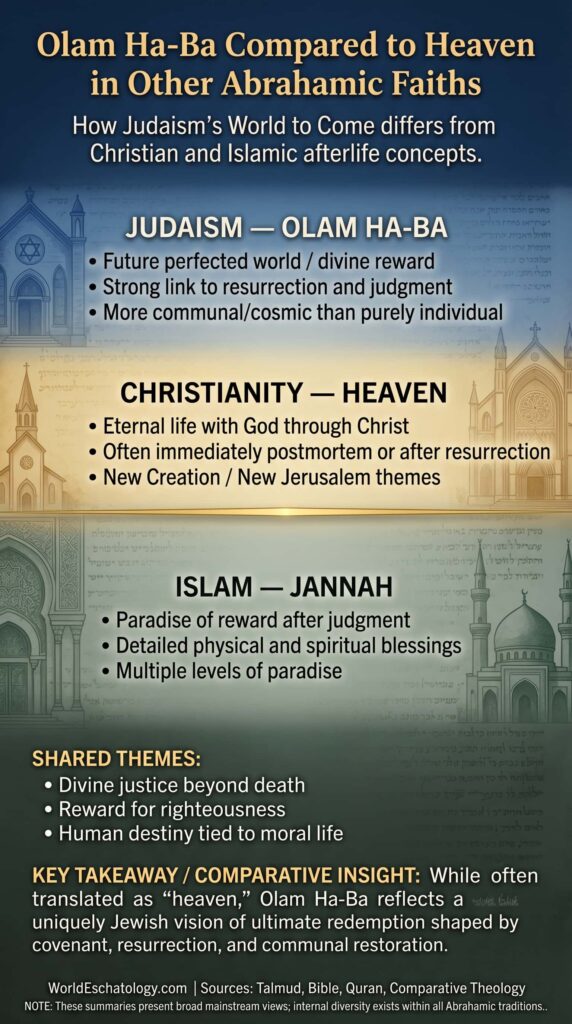
The most striking similarity between the Jewish, Christian, and Islamic afterlife frameworks is the shared conviction that this life is not all there is, that moral actions have consequences that outlast the moment of death, and that the highest human destiny involves proximity to the divine.
These three traditions are in profound agreement on the deep structure of the afterlife even as they differ significantly on its content.
The most striking difference between the Jewish framework and the Christian and Islamic frameworks lies in the temporary nature of Gehinnom.
The Jewish twelve-month maximum on post-mortem purification has no equivalent in traditional Islamic teaching on Jahannam or in the traditional Christian doctrine of eternal hell.
The Catholic teaching on purgatory provides the closest parallel: a temporary purification process before heaven.
But purgatory in Catholic teaching is not available to those who are ultimately damned, while Gehinnom in the Jewish framework is available to virtually everyone.
The Jewish tradition’s universalism regarding righteous non-Jews also stands in contrast to stricter versions of Christian and Islamic soteriology, which have traditionally required explicit faith in Christ or explicit submission to God through Islam respectively.
The Seven Laws of Noah framework represents a minimum moral standard that admits people of all backgrounds to the World to Come without requiring religious conversion or theological agreement.
The Kabbalistic concept of Gilgul Neshamot introduces a structural element that has no equivalent in mainstream Christianity or Islam:
the soul’s multiple opportunities across successive lifetimes to complete its tikkun.
This feature of the Kabbalistic tradition gives the Jewish afterlife framework a flexibility and expansiveness that is distinctive.
Every soul has not one chance but as many chances as it needs.
This is either a profoundly merciful vision or, as its critics within Judaism have argued, a diffusion of moral urgency that the tradition’s emphasis on the seriousness of this life was designed to prevent.
Frequently Asked Questions
What is Olam Ha-Ba in Judaism?
Olam Ha-Ba, meaning the World to Come, is the primary Jewish concept of the afterlife and the messianic future.
The phrase carries two related meanings: the collective transformed world that will follow the coming of the Messiah and the resurrection of the dead, and the individual soul’s experience after death in the spiritual realm of Gan Eden.
Jewish theology holds that it is impossible for living human beings to know precisely what Olam Ha-Ba is like.
Do Jews believe in heaven?
Yes, though the Jewish concept is different from popular Christian or Islamic images of heaven.
The positive afterlife destination in Jewish tradition is called Gan Eden, the Garden of Eden, and is described primarily as an experience of spiritual proximity to the divine presence rather than as a place of physical pleasure.
The tradition teaches that the peace of a properly observed Shabbat is only one-sixtieth of the pleasure of Gan Eden.
Do Jews believe in hell?
The Jewish equivalent of hell is Gehinnom, but it functions very differently from the eternal hell of traditional Christian theology.
Gehinnom is a temporary purification process lasting a maximum of twelve months for most souls, after which they proceed to Gan Eden.
It is more similar to the Catholic concept of purgatory than to Christian hell. Judaism does not generally teach eternal conscious torment as a destination for sinners.
What is Gan Eden in Judaism?
Gan Eden, the Garden of Eden, is the name used in Jewish tradition for the positive afterlife realm.
The Talmud describes it as a state in which there is no eating, drinking, commerce, jealousy, or hatred, but the righteous sit with crowns on their heads and bask in the radiance of the divine presence.
It is understood as a spiritual rather than a physical environment, though the precise nature of the experience is acknowledged to be beyond what living human beings can fully grasp.
What is Gehinnom in Judaism?
Gehinnom is the name of the post-mortem purification process in Jewish tradition, derived from the Ge-Hinnom valley outside Jerusalem.
It is a temporary experience of self-confrontation in which the soul fully sees the truth of its life and is purified of the moral and spiritual damage accumulated through its failures.
The maximum duration is twelve months for most souls. After Gehinnom, souls proceed to their portion in Gan Eden.
Do Jews believe in life after death?
Traditional Judaism affirms belief in life after death, including the immortality of the soul, the existence of Gan Eden and Gehinnom, and the eventual resurrection of the dead in the messianic era.
Survey research shows that many secular and liberal Jews do not share these beliefs, and denominational positions vary significantly, with Orthodox Judaism maintaining the full traditional framework and Reform Judaism placing greater emphasis on this-worldly concerns.
Do Jews believe in reincarnation?
Reincarnation, called Gilgul Neshamot in Hebrew, is a significant belief in the Kabbalistic and Hasidic traditions but is not present in the Talmud and was rejected by several medieval Jewish philosophers.
It is widely accepted in Hasidic and Sephardic communities influenced by the Lurianic Kabbalah of sixteenth-century Safed.
It is generally not accepted in mainstream Orthodox, Conservative, Reform, or Reconstructionist Judaism outside of Kabbalistic streams.
Who goes to Olam Ha-Ba?
The Mishnah teaches that all Israel has a portion in Olam Ha-Ba, with exceptions for those who deny resurrection, deny the divine origin of Torah, or are extreme heretics.
The Talmud also teaches that righteous non-Jews who live according to the Seven Laws of Noah are assured of a place in the World to Come.
The predominant view, firmly established by Maimonides, is that the righteous of all nations have a share in Olam Ha-Ba.
What does the Talmud say about the afterlife?
The Talmud contains extensive discussions of the afterlife across multiple tractates.
Key passages include Berakhot 17a’s description of the World to Come as a state of basking in the divine radiance, Sanhedrin 10:1’s declaration that all Israel has a portion in the World to Come, Eduyot 2:10’s teaching that the maximum stay in Gehinnom is twelve months, and Rosh Hashanah 17a’s teaching that there will be no Gehinnom in the future era.
The Talmud also acknowledges significant uncertainty about the details of the afterlife.
What is the mourner’s kaddish and why is it said for 11 months?
The mourner’s kaddish is a prayer of praise to God recited by the bereaved for the souls of the deceased.
It is said for eleven months rather than twelve because the maximum stay in Gehinnom is twelve months, and reciting kaddish is understood as benefiting the soul through that purification process.
Reciting it for a full twelve months would imply that the deceased needed every month of the maximum period, which would be a slight to their memory.
What is the difference between the Jewish and Christian afterlife?
Key differences include: Jewish Gehinnom is almost always temporary, while traditional Christian hell is eternal;
Jewish tradition openly affirms that righteous non-Jews have a place in the World to Come, while traditional Christianity often requires explicit faith in Christ;
the Jewish Messiah is a human being, while Christ in Christianity is divine; and the Jewish emphasis falls more heavily on the this-worldly arena of ethical action than on preparation for the next life.
Did Maimonides believe in resurrection?
Yes. Maimonides included the resurrection of the dead as the thirteenth of his Thirteen Principles of Faith and wrote an entire Treatise on Resurrection defending the doctrine.
However, his philosophical position was that the ultimate Olam Ha-Ba is a purely spiritual state of disembodied souls, and that the resurrection is a temporary rather than permanent phase leading to this ultimate spiritual existence.
This view was controversial and was challenged by Nachmanides and the Kabbalistic tradition.
What is gilgul in Judaism?
Gilgul, or Gilgul Neshamot, is the Kabbalistic concept of soul transmigration, often called reincarnation.
It holds that a soul may return to earth in successive lifetimes to complete the spiritual repair and rectification it did not accomplish in a previous life.
The concept is most fully developed in the Lurianic Kabbalah of sixteenth-century Safed and is widely accepted in Hasidic and Sephardic communities.
It is not present in the Talmud and was rejected by several major medieval authorities including Saadia Gaon.
Conclusion: The Lobby Before the Banquet Hall
Two thousand years after it was first spoken, the Mishnah’s image remains the most economical and most honest summary of the Jewish relationship between this life and what comes after.
This world is like a lobby before Olam Ha-Ba. Prepare yourself in the lobby so that you may enter the banquet hall.
The image is deliberately modest. A lobby is real space. It is not nothing. What you do in a lobby is genuinely consequential.
You can meet people there, make decisions there, become the kind of person who will enter the banquet hall with grace or stumble at the threshold.
But a lobby is not the destination. Nobody is supposed to spend their whole attention on the lobby furniture and forget that the door to the banquet hall exists.
Jewish afterlife belief, in all its complexity and internal debate, serves this function. It is not the primary content of Jewish religious life.
It is the framework within which that primary content, the practice of righteousness in this world, the study of Torah, the love of God and neighbour, the repair of what is broken, is understood to be permanently and ultimately meaningful.
The tradition’s restraint about describing the afterlife in detail is not agnosticism about what matters.
It is a theological statement that the specifics of Olam Ha-Ba lie beyond the capacity of living human beings to fully know, and that our energy is better spent on preparing for it than on mapping it.
The preparation is living well. The preparation is choosing truth over convenience, compassion over comfort, the repair of the world over the indulgence of the self.
Those choices matter permanently. They are the currency of the banquet hall.
Olam Ha-Ba is real, according to the tradition. But it is also, in the deepest sense, what this world becomes when it is finally what it was always meant to be.
Sources: Mishnah Sanhedrin 10:1, Talmud Berakhot 17a, Eduyot 2:10, Pirkei Avot 1:3, Maimonides Thirteen Principles
Maimonides: Mishneh Torah, Treatise on Resurrection | Nachmanides: Sha’ar Ha-Gemul | Rav Chaim Vital: Sha’ar Ha-Gilgulim
WorldEschatology.com | All citations drawn from canonical Talmudic and medieval Jewish sources
1 thought on “Olam Ha-Ba | The Jewish World to Come explained”