
Every civilisation in human history has looked at the darkness around it and asked whether something greater than human effort will eventually come to set things right.
The question is always the same, even when asked in different languages, in different centuries, in different temples and churches and mosques.
Are we alone in this? Is there a force that sees the suffering and the corruption and the collapse of everything good, and will that force act?
In Hinduism, the answer has been given with remarkable specificity. Yes. And his name is Kalki.
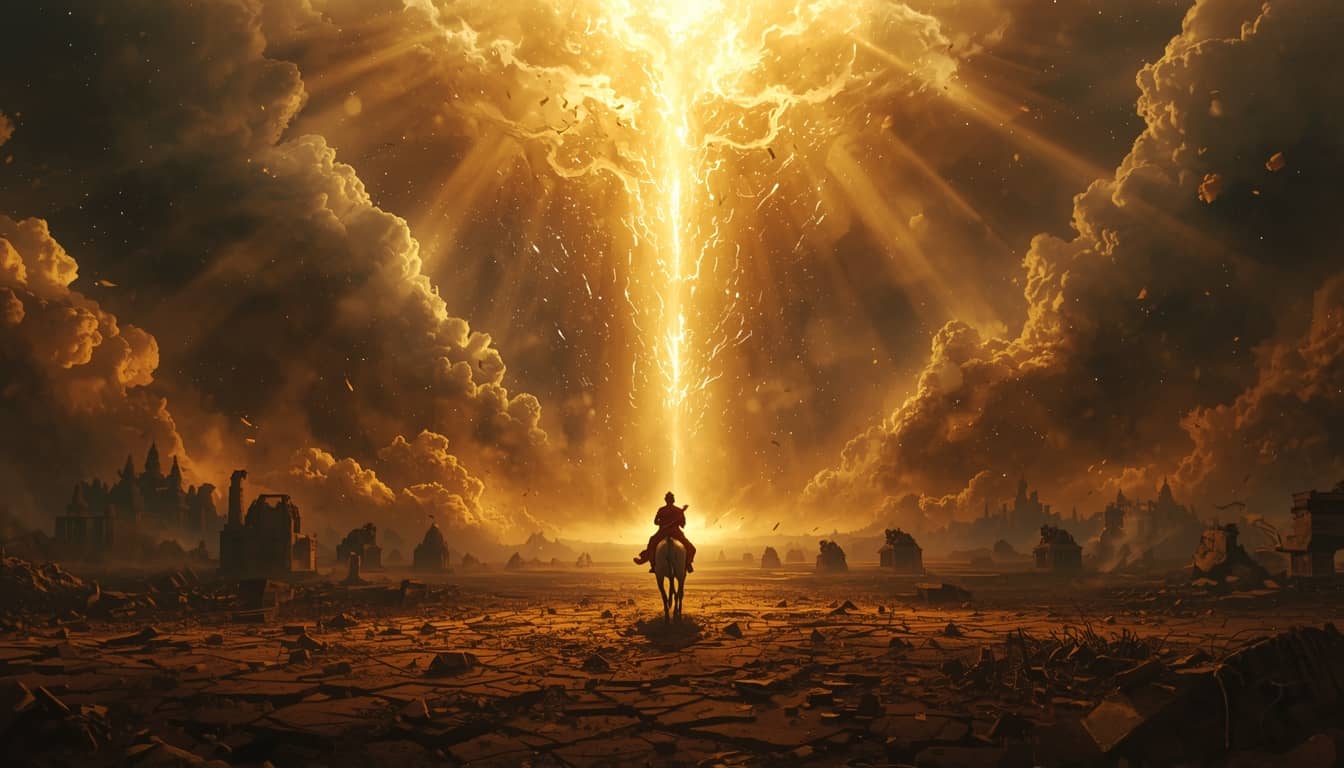
He will ride a white horse. He will carry a blazing sword. He will be born in a village called Shambhala to a Brahmin named Vishnuyasha and his wife Sumati.
He will train under Parashurama, the sixth avatar of Vishnu, and receive divine gifts from Lord Shiva himself.
And he will arrive at the precise moment when moral collapse is so complete, when the degeneration of the age has reached its furthest possible point, that no ordinary force can reverse it.
Kalki avatar is the tenth and final avatar of Lord Vishnu, the last voluntary descent of the divine into human form in the current cosmic cycle.
His arrival will mark not merely the end of an age but the end of everything this age has produced, and the beginning of something entirely new.
The Kali Yuga will close. The Satya Yuga will open. The cycle of time will begin again.
What makes Kalki unique among all ten avatars is a fact that most people who know his name do not fully consider.
Every other avatar of Vishnu came in response to a crisis that had already arrived. Matsya came when the primordial flood threatened the sacred Vedas.
Narasimha came when the demon Hiranyakashipu was already terrorising the three worlds.
Rama came when Ravana had already abducted Sita. Krishna came when the Kurukshetra war was already unfolding.
Every one of those arrivals was a response to a present emergency.
Kalki is different. He has not come yet. He is the only avatar who belongs entirely to prophecy, entirely to anticipation, entirely to hope directed at a future that has not yet arrived.
And this makes the question of what the texts actually say about him not merely interesting but urgent.
This article goes through all of it. The name and its meanings. The place of Kalki within the full Dashavatara.
The cosmic framework of the Yugas that makes his mission intelligible. The signs of Kali Yuga that the Puranas say will precede him.
The primary scriptural sources and what each one actually says. The detailed narrative of his birth, training, divine gifts, battles, marriages, children, and return to Vaikuntha.
The mystery of Shambhala. The remarkable parallels between Kalki and the eschatological figures of other world traditions.
And the deepest theological meaning the tradition intends the prophecy to communicate.
What the Name Kalki Actually Means
The name Kalki is more contested and more meaningful than most introductions to this figure acknowledge.
Three distinct derivations have been proposed, and each one reveals a different dimension of the avatar’s identity.
The most widely cited derivation connects Kalki to Kal, meaning time, specifically the time of the Kali Yuga.
On this reading, Kalki means the one who defeats or overcomes time, the one who brings the age to its completion.
There is a deep irony in this: the avatar is named for the very age he will end, as if the darkness itself carries within its name the promise of the light that will eventually dissolve it.
A second derivation proposes that the original Sanskrit term was not Kalki but Karki, meaning white, derived from the white horse that is the avatar’s most universally recognised symbol.
This proposal has genuine textual support. Two versions of Mahabharata manuscripts, including what scholars designate as the G3.6 manuscript, use the name Karki rather than Kalki in the relevant verses.
The shift from Karki to Kalki may reflect a gradual lexical evolution as the concept developed across different Puranic traditions.
A third interpretation understands Kalki as meaning destroyer of filth or remover of darkness, from the Sanskrit root kal combined with ki, pointing directly to the purification function that is the avatar’s primary cosmic mission.
He does not merely conquer enemies. He cleanses the world of everything that has accumulated in the darkest age.
All three meanings work together theologically. Kalki is simultaneously the one named for the age, the white rider who signals the dawn, and the purifier who removes what the age has produced.
The name itself is a compressed theological statement about what the tradition expects him to do and what he represents.
Kalki and the Dashavatara: The Ten Avatars of Vishnu
To understand Kalki’s place and significance, it is necessary to understand the full framework of the Dashavatara, the ten principal avatars or descents of Vishnu, because Kalki’s identity is inseparable from his position as the final one.
The concept of avatar is itself worth establishing carefully. The Sanskrit word avatara means descent, and it refers to the voluntary movement of the divine into the material realm of human existence.
Vishnu does not descend because he is compelled to or because the cosmos has exhausted his patience.
He descends because dharma requires it and because his fundamental nature is to preserve.
The Bhagavad Gita states the principle that governs all ten descents: whenever righteousness declines and unrighteousness rises, I manifest myself. I am born age after age.
The nine avatars who preceded Kalki each addressed a specific dimension of cosmic and historical crisis, and tracing their sequence reveals something about the tradition’s understanding of how the divine engages with the unfolding story of existence.
Matsya, the fish, saved the sacred Vedas and the sage Manu from the primordial flood that threatened to swallow all wisdom before humanity could begin.
His descent is the preservation of knowledge itself at the moment of absolute crisis.
Kurma, the tortoise, supported the cosmic mountain Mandara on his back during the churning of the cosmic ocean, allowing the gods and demons to draw out the nectar of immortality.
His descent is the foundation of cosmic order, the patient support of the process that produces life’s deepest gifts.
Varaha, the boar, rescued the earth goddess Bhudevi from the depths of the cosmic ocean after the demon Hiranyaksha dragged her down.
He dived into the depths and lifted her on his tusks. His descent restores the earth itself to its proper place in the cosmos.
Narasimha, the man-lion, destroyed the demon Hiranyakashipu who had obtained a boon making him immune to death by man, beast, god, weapon, inside or outside, by day or night.
Vishnu descended as a being who was neither man nor beast, at twilight, in a doorway, to close every loophole the demon had imagined.
His descent is the perfect divine response to human cleverness in the service of evil.
Vamana, the dwarf, reclaimed the three worlds from the demon king Bali, who had conquered them through extraordinary righteousness and generosity.
Vishnu descended as a small Brahmin boy, asked for only three paces of land, and then expanded to fill all of creation with two steps before placing the third on Bali’s head.
His descent is the reminder that genuine humility and surrender to the divine is the only foundation for legitimate authority.
Parashurama, the warrior-Brahmin, purged the earth of the corrupt Kshatriya ruling class twenty-one times over.
He was born into the priestly caste but took up arms to restore the dharmic order that the warrior class had violated through pride and oppression.
His descent is the divine insistence that no social or religious category exempts anyone from moral accountability.
Rama, the righteous king, is the ideal of human nobility: the devoted husband, the obedient son, the just ruler, the unconquerable warrior.
He destroyed the demon Ravana and demonstrated that dharma lived fully in a human life is the greatest force in the world.
His descent is the embodiment of righteous human existence as a form of divine worship.
Krishna, the divine charioteer, the lover of Vrindavana, the teacher of the Bhagavad Gita, is perhaps the most theologically complex of all the avatars.
His descent encompasses the full range of human experience, from childhood play to cosmic war, from intimate love to the impersonal wisdom of the eternal self.
He is simultaneously the most fully human and the most explicitly divine of the avatars.
Buddha, included in many traditional lists as the ninth avatar, is understood in some Vaishnava traditions as Vishnu descending to teach non-violence and compassion as a means of drawing the demonic away from the violent sacrificial practices that were causing harm.
The inclusion of Buddha in the Dashavatara reflects the tradition’s capacity to incorporate and interpret other spiritual movements within its own cosmological framework.
And then there is Kalki. He comes not to address any specific crisis that has already emerged but to complete the cycle itself.
Every previous avatar saved something or restored something within the ongoing world. Kalki ends the age.
The Four Yugas: Understanding the Cosmic Framework
The Kalki prophecy is unintelligible without understanding the Hindu conception of cosmic time, because Kalki’s entire identity is defined by his relationship to the Kali Yuga.
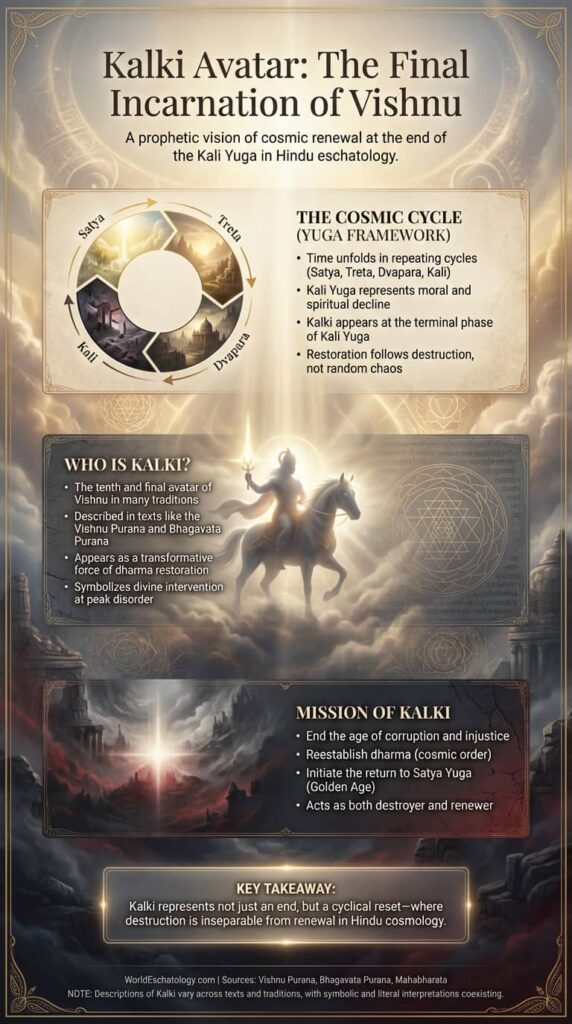
The tradition does not understand time as a straight line moving from a beginning toward an end. It understands time as a cycle of immense scale, repeating itself through four ages called Yugas.
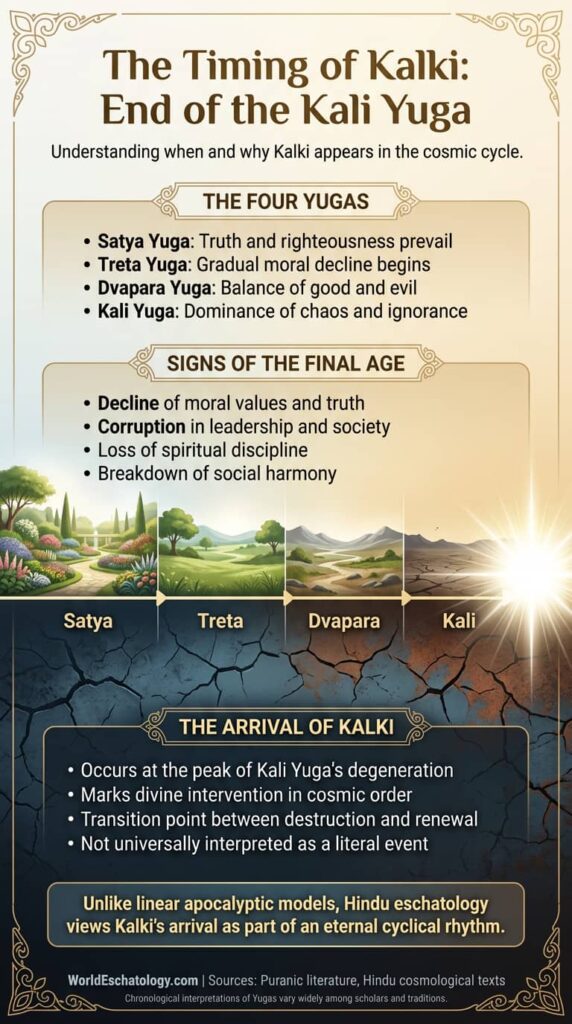
Satya Yuga, also called Krita Yuga, is the golden age. Dharma, righteousness, stands on all four of its legs.
Human beings live extraordinarily long lives, possess great spiritual wisdom, and practise the highest virtues naturally.
There is no conflict between knowing what is right and doing it. The duration of Satya Yuga is 1,728,000 years.
Treta Yuga is the silver age. One quarter of dharma is lost. Human virtue is still high but requires conscious effort in a way it did not in the golden age.
Great heroes and great epics emerge from the struggle to maintain what the golden age produced naturally. Rama belongs to the Treta Yuga. Its duration is 1,296,000 years.
Dvapara Yuga is the bronze age. Half of dharma is lost. Conflicts that were formerly resolved through wisdom now require war.
The Mahabharata war, the greatest conflict in Hindu mythology, belongs to the Dvapara Yuga. Krishna’s final departure from the world marks the transition from Dvapara into Kali. Its duration is 864,000 years.
Kali Yuga is the iron age. Three quarters of dharma are lost. It is the age of darkness, conflict, spiritual forgetting, and moral collapse.
It is also, according to the tradition, the age we currently inhabit. Kali Yuga began approximately 5,000 years ago, following Krishna’s departure from the world. Its total duration is 432,000 years.
This last figure is one that most popular treatments of Kalki quietly ignore, and intellectual honesty requires acknowledging it directly.
If Kali Yuga lasts 432,000 years and began approximately 5,000 years ago, then by the traditional calculation we are currently in the very early stages of this age.
More than 427,000 years remain before its conclusion. Kalki, by the most straightforward reading of the traditional timeline, will not arrive for a very long time.
Some scholars and devotional teachers argue that the timeline should be understood qualitatively rather than quantitatively.
On this reading, the descriptions of Kali Yuga in the Puranas, which describe a world of corrupt rulers, forgotten scriptures, sold spirituality, and broken families, are so recognisable in the present era that the age must be near its close regardless of the mathematical calculation.
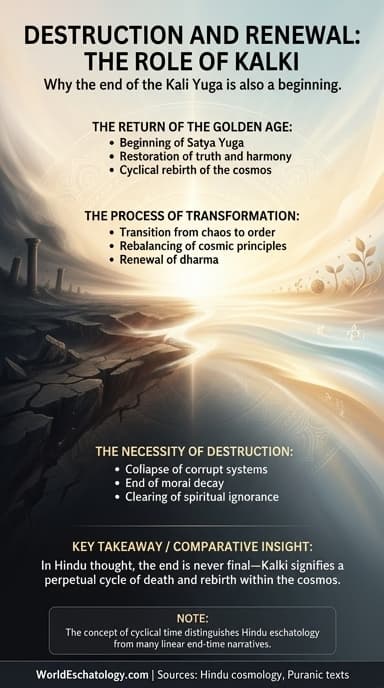
Others hold that the traditional numbers are precise and that the prophecy of Kalki refers to a genuinely distant future. Both positions exist within the tradition, and readers should be aware of the distinction.
What is not disputed is the structure of the cycle: Satya Yuga, Treta Yuga, Dvapara Yuga, Kali Yuga, and then with Kalki’s arrival the cycle resets.
A new Satya Yuga begins. The four-legged dharma stands again. And in due course the decline begins once more, because this is the nature of cyclic time.
The Signs of Kali Yuga: The World That Kalki Will Find
The Puranas do not merely announce that Kali Yuga will be dark. They describe the specific character of that darkness in terms that have struck readers across centuries as disturbingly recognisable.
Understanding these signs is essential for understanding Kalki’s mission, because what he comes to end is precisely what these signs describe.
The Bhagavata Purana’s twelfth canto contains the most sustained and detailed account of Kali Yuga’s character.
The language is direct and unsparing. Rulers will no longer protect their people but will plunder them as a thief plunders a house.
Wealth will be the only measure of a person’s worth. Those with money will be respected and those without it will be ignored regardless of their character, knowledge, or virtue.
Srimad Bhagavatam 12.2.3-6
“In the Kali age, wealth alone will be the criterion of lineage, morality, and merit. Power will be the only definition of virtue. Marriage will be based on bodily attraction, not dharmic compatibility. Bathing will be the measure of ritual purity. Deception will be the basis of success in business.”
The Vishnu Purana adds its own observations. When the practices taught in the Vedas and the institutions of law have nearly expired, a portion of the divine nature will descend and appear in the world.
The very conditions that signal the end of Kali Yuga are also the conditions that trigger Kalki’s arrival.
The darkness is not only a problem to be solved but a signal that the solution is approaching.
Specific social conditions the texts associate with the depth of Kali Yuga include: religious teachers selling spiritual knowledge for money;
the arts of sacrifice being performed incorrectly or forgotten entirely; women abandoning their relationships out of attachment to pleasure;
young people disrespecting elders; the earth producing less and less; and the natural world becoming hostile in ways it was not before.
One of the most striking details in the Bhagavata Purana is the shrinking of human lifespans. In Satya Yuga, human beings are said to live for one hundred thousand years.
By the Kali Yuga, the average human lifespan declines dramatically, and by its end, people are born, mature, reproduce, and die within a very short period.
The physical diminishment of the human being mirrors the spiritual diminishment of the age.
The condition that the texts describe as the specific trigger for Kalki’s arrival is the moment when there are no longer any topics on the subject of God discussed even at the residences of so-called saints and respectable gentlemen, and when the power of government is transferred to the hands of those who exploit those they govern.
It is when the darkness has become so complete that the very memory of the divine has been lost that the divine can no longer delay its return.
The Scriptural Sources: What the Texts Actually Say
Any serious article about Kalki must establish precisely where the prophecy comes from, because different sources provide different levels of detail and different degrees of scriptural authority.
Most popular treatments blur these distinctions in ways that create confusion.
The Mahabharata: The Earliest Appearance
Kalki appears for the first time in the Mahabharata at 3.188.85 through 3.189.6, in the section of the great epic called the Vana Parva or the forest book.
The mention is brief compared to what later Puranic texts will develop, but it establishes the fundamental identity of the figure: a future incarnation who will arrive at the end of the Kali Yuga to restore dharma.
The Mahabharata’s version actually uses the name Karki in some manuscript traditions, which supports the etymology connecting the name to the white horse rather than to the Kali Yuga.
The Vishnu Purana: The First Sustained Prophecy
The Vishnu Purana’s fourth book, chapter twenty-four, contains one of the most important sustained accounts of Kali Yuga and Kalki’s response to it.
The text describes in detail the degeneration of society and then announces the divine response.
It is in this text that the specific village of Shambhala and the father’s name Vishnuyasha first appear as fixed elements of the prophecy.
The Vishnu Purana is one of the eighteen Mahapuranas, the eighteen great Puranas of the tradition, and carries considerable authority.
The Bhagavata Purana: The Theological Heart
The Bhagavata Purana, also known as the Srimad Bhagavatam, is widely regarded as the most theologically rich and devotionally important of all the Puranas.
Its twelfth canto contains the most celebrated verses on Kalki. Two passages in particular are cited across virtually all treatments of the subject.
“At the junction of the two yugas, the Lord of creation will take His birth as the Kalki incarnation and become the son of Vishnuyasha. At this time the rulers of the earth will have degenerated into plunderers.”
Srimad Bhagavatam 12.2.18-19
“Lord Kalki will appear in the home of the most eminent Brahmin of Shambhala village, the great soul Vishnuyasha. Lord Kalki, the Lord of the universe, will mount His swift horse Devadatta and, sword in hand, travel over the earth exhibiting His eight mystic opulences and eight special qualities of Godhead. Displaying His unequalled effulgence and riding with great speed, He will kill by the millions those thieves who have dared dress as kings.”
The Kalki Purana: The Most Detailed Narrative
The Kalki Purana is the only sacred text entirely dedicated to the Kalki avatar.
It provides by far the most narrative detail about his birth, childhood, training, battles, marriages, children, and final departure from the earth.
It is important to know, however, that scholars classify the Kalki Purana as an Upapurana, a secondary Purana, rather than one of the eighteen Mahapuranas.
The scholar Wendy Doniger dates its composition to between 1500 and 1700 CE, likely in Bengal during the period of Mughal rule. Some manuscript evidence suggests a floruit of around 1726 CE.
This late composition does not invalidate the Kalki Purana as a devotional and theological source, but it is relevant context.
Much of what popular culture knows about the specific details of Kalki’s story, his three brothers, his two wives, his four children, the parrot Shuka, the specific battles against Koka and Vikoka, comes from this relatively late text rather than from the ancient Mahapuranas.
Other Puranic Sources
The Agni Purana, Matsya Purana, and Padma Purana all contain significant passages on Kalki.
The Agni Purana describes Kalki as the son of Vishnuyasha who will destroy those who misuse power and re-establish the proper social order after the corruption of Kali Yuga.
The Padma Purana provides the important backstory connecting Vishnuyasha to the figure of Svayambhuva Manu, explaining why the father of Kalki will be who he is.
The Mahabharata and the various Puranas together form the complete scriptural picture of the Kalki prophecy, with the Bhagavata Purana providing the authoritative core and the Kalki Purana providing the narrative detail.
The Birth of Kalki: Shambhala, His Parents, and the Celestial Signs
The scriptural accounts of Kalki’s birth are unusually specific for a figure who has not yet appeared, and this specificity has fascinated readers across centuries.
Shambhala: The Birthplace
Shambhala, the village of Kalki’s birth, is described in Sanskrit as a place of peace or a place of silence.
The Vishnu Purana and Bhagavata Purana both identify it as the location of his birth without providing geographical coordinates that can be definitively mapped.
The most common identification in the Indian devotional tradition places Shambhala at Sambhal in present-day Uttar Pradesh, where an ancient temple to Kalki exists and where a significant local tradition understands the town as the prophesied birthplace.
Other interpretations understand Shambhala not as a specific geographical location but as a sacred space that exists at a dimension of reality not fully accessible to ordinary perception.
This understanding is particularly prominent in the Tibetan Buddhist engagement with the Shambhala concept, discussed in detail in the comparative eschatology section below.
His Parents
The Bhagavata Purana identifies Kalki’s father as Vishnuyasha, a noble and virtuous Brahmin described as the most eminent Brahmin of Shambhala village.
The name Vishnuyasha means glory of Vishnu, a name that itself signals the father’s identity as someone whose entire life is oriented toward the divine.
The Padma Purana provides an extraordinary backstory. Vishnuyasha, it explains, is a reincarnation of Svayambhuva Manu, the first progenitor of humanity in the Hindu tradition.
In a previous age, Svayambhuva Manu performed intense austerities specifically to earn the blessing of having Vishnu as his son in three different lifetimes.
Vishnu was pleased and granted this, promising to appear as Rama, as Krishna, and as Kalki through successive births of the same soul.
Vishnuyasha is therefore not an ordinary Brahmin but the culminating incarnation of a soul that has been spiritually preparing for this specific privilege across cosmic ages.
Kalki’s mother Sumati represents purity and devotion in the texts.
Some traditions connect her to Shatarupa, the first woman in Hindu cosmological time, making the parents of Kalki a cosmic reunion of the first man and the first woman in their most spiritually elevated forms.
The Kalki Purana gives Kalki three brothers: Kavi, Prajna, and Sumantra. These figures appear in the narrative but receive less theological attention than the avatar himself.
The Celestial Signs at His Birth
The Puranas describe a heavenly conjunction that will mark Kalki’s arrival in the world.
When the Sun, Moon, and Jupiter align in the Pushya Nakshatra, a specific lunar mansion of particular auspiciousness in Vedic astrology, this celestial configuration will announce the birth of the final avatar.
The Kalki Purana specifies that he will be born in the month of Baisakh, which spans the period from mid-April to mid-May in the Gregorian calendar, on the twelfth day after the full moon.
The Training of Kalki: Parashurama, Shiva, and the Divine Gifts
One of the most theologically rich aspects of the Kalki narrative is the account of his preparation for his cosmic mission.
Unlike other avatars who arrive fully empowered and immediately operational, Kalki undergoes a period of training and receives specific gifts that equip him for what he must do.
The Teaching of Parashurama
The sixth avatar of Vishnu, Parashurama, is one of the seven Chiranjeevis, immortal beings who continue to exist across the boundaries of the Yugas and across the transitions between Kalpas.
He fought against the corrupt Kshatriya ruling class, purging the earth of oppressive warriors twenty-one times, and then retired into ascetic practice. He remains in the world, waiting.
The Kalki Purana describes Parashurama as Kalki’s primary teacher in both spiritual knowledge and the martial arts.
This is one of the most theologically meaningful details in the entire Kalki narrative. The sixth avatar teaches the tenth.
The warrior who purged the corrupt in a previous age prepares the warrior who will end the age itself.
There is a direct transmission of divine power and purpose across centuries of cosmic time, a continuity of Vishnu’s intention expressed through successive forms.
Under Parashurama’s guidance, Kalki is taught the sixty-four arts of traditional Indian learning and achieves mastery in Vedic texts.
He becomes proficient in every form of knowledge that the tradition regards as necessary for righteous governance and spiritual leadership.
The Gifts of Lord Shiva
After completing his training under Parashurama, Kalki worships Lord Shiva with such genuine devotion that Shiva is moved to grant him extraordinary gifts.
This detail is significant: even the avatar of Vishnu, the preserver, approaches Shiva, the destroyer, in humility and receives from him what is needed for the cosmic work ahead.
The two great streams of Hindu theology, Vaishnavism and Shaivism, meet in this gesture.
Shiva gives Kalki three primary gifts. The first is the divine white horse Devadatta, described as a manifestation of Garuda, Vishnu’s own vehicle and the king of birds.
The second is a powerful sword whose handle is set with jewels, a weapon forged not merely for military victory but for cosmic restoration.
The third is a parrot named Shuka, an all-knowing being who perceives the past, the present, and the future simultaneously and will serve as Kalki’s divine counsellor.
Additional gifts come from other devas, devis, saints, and righteous kings, who recognise the avatar and bring what they have to offer.
These contributions reflect the tradition’s understanding that the cosmic work of restoration is not a solo performance but a divine collaboration.
Devadatta and the Blazing Sword: The Iconography of Kalki
The two images most universally associated with Kalki in art, devotion, and popular imagination are the white horse and the blazing sword, and each carries more theological weight than its surface appearance suggests.
Devadatta, the white horse, is not an ordinary animal. His name means gift of the gods, and his identity as a manifestation of Garuda, Vishnu’s divine mount, means that the vehicle of the avatar is itself a divine being.
Garuda, the eagle king, is associated with speed, purity, the destruction of the serpentine forces of adharma, and the capacity to travel anywhere in the universe at will.
When Devadatta carries Kalki across the earth, it is Vishnu’s own vehicle bearing Vishnu’s own final form through the world he has come to restore.
The white colour carries layered meaning. It is the colour of purity, the colour of dawn breaking after the darkness of the age, the colour of the new Satya Yuga whose first light Kalki represents.
It is also the colour associated with the Brahmin class, the priestly and scholarly dimension of human society, which has been degraded and corrupted throughout the Kali Yuga and which Kalki will restore.
The blazing sword is described in the texts as shining with the light of a comet, a weapon not of ordinary metal but of divine fire.
The tradition understands this sword not primarily as a tool of violence but as the instrument by which adharma is cut away from the world, as a surgeon’s instrument cuts away diseased tissue to allow healthy tissue to regenerate.
The fire of the sword is the purifying fire of cosmic renewal.
Kalki is typically depicted in traditional art as a radiant warrior riding at full gallop, sword raised, his white horse moving across a landscape that is simultaneously being destroyed and renewed by his passage.
Temples dedicated specifically to Kalki are fewer than those dedicated to other avatars, reflecting his status as the avatar who has not yet come, but they exist and their iconography reflects these descriptions with considerable fidelity.
The Marriages of Kalki: Padmavati, Rama, and the Four Children
The Kalki Purana describes Kalki’s personal life with a specificity that goes well beyond what most treatments of the avatar include.
This narrative dimension of the Kalki story is worth covering carefully because it rounds out the theological portrait and reveals something important about how the tradition understands the relationship between the divine mission and the human life in which it is embodied.
Padmavati: The Earthly Lakshmi
Kalki’s first wife, Padmavati, is described in the Kalki Purana as the daughter of King Vrihadratha and Queen Kaumudi of Simhala, the island of the lion, widely identified with Sri Lanka.
The connection between the names Padmavati and the lotus, padma, is deliberate: Padmavati is understood as an earthly incarnation of Lakshmi, the goddess of beauty, abundance, and divine love who is Vishnu’s eternal consort.
Just as Vishnu descends as Kalki, so Lakshmi descends as Padmavati. The marriage of Kalki and Padmavati is not only a human event but a cosmic reunion, the reunification of the divine couple in their final earthly forms.
Some traditions elaborate an entire backstory for this relationship that runs through previous Yugas.
In the Treta Yuga, when Vishnu had taken the form of Rama, a maiden named Trikuta or Vaishno Devi performed intense austerities to win Rama as her husband.
Because Rama was completely devoted to Sita, he declined but promised to return for her in a future incarnation as Kalki.
According to the tradition of the Vaishno Devi shrine in the Trikuta Mountains of Jammu, this maiden currently resides in the cave awaiting that promised meeting.
Rama: The Second Wife
Kalki’s second wife, named Rama in the Kalki Purana, is the daughter of King Shashidhvaja and Queen Sushanta.
The dual marriage reflects the pattern of certain previous avatars and is understood in the tradition as honouring different aspects of the divine feminine energy that the avatar recognises and unites with in the course of his human life.
The Four Children
From Padmavati, Kalki has two sons named Jaya and Vijaya, meaning victory and conquest, names that carry the flavour of the triumphant conclusion of his cosmic mission.
From Rama, he has a son named Meghamaala, meaning garland of clouds, and a son named Balaahaka.
These four children appear in the narrative of the Kalki Purana as participants in the work of establishing the new Satya Yuga.
The Battles: Koka, Vikoka, and the Demon Kali
The heart of the Kalki Purana’s narrative is the series of battles through which Kalki fulfils his cosmic mission.
These are not ordinary wars. Each enemy Kalki faces represents a specific dimension of the darkness of the Kali Yuga, and each victory is simultaneously a military event and a cosmic restoration.
The Twin Demons: Koka and Vikoka
Koka and Vikoka are described in the Kalki Purana as the two most powerful generals of the demon Kali, twin asuras adept in the dark arts.
They represent the most concentrated and skilled manifestations of the unrighteousness that has accumulated throughout the Kali Yuga.
The texts describe them as simultaneously confronted and simultaneously killed by Kalki in a feat that communicates the scope of his martial and divine power: two masters of evil dispatched in a single engagement.
The Demon Kali: The Personification of the Age
The ultimate opponent in Kalki’s mission is the demon Kali himself, the personification of the Kali Yuga. This is a theologically extraordinary element of the narrative.
The age is not merely a period of time or a set of social conditions.
It is a being, with a lineage described in the Kalki Purana as beginning with Brahma himself through a chain of cosmic descent that eventually produces this embodiment of corruption and unrighteousness.
The killing of the demon Kali is not accomplished directly by Kalki.
The Kalki Purana describes Kali perishing from wounds inflicted by Dharma and Satya Yuga personified, by righteousness and truth themselves in their embodied forms.
This detail is among the most theologically significant in the entire narrative. Kalki creates the conditions in which the force of dharma can operate.
But it is dharma itself, truth itself, that ultimately destroys the personification of the dark age.
The avatar does not replace the cosmic moral order. He restores the conditions under which it can assert itself.
The Kings Who Have Become Plunderers
Beyond the named demonic opponents, the texts describe Kalki waging comprehensive war against the corrupt human rulers of the Kali Yuga, described consistently across multiple Puranas as kings who have degenerated into plunderers, men who hold political authority but use it for self-enrichment at the cost of those they govern.
The Bhagavata Purana says Kalki will kill by the millions those thieves who have dared dress as kings.
This aspect of his mission connects the cosmic and the political dimensions inseparably: he is not only ending a demonic age but restoring justice to the specific human institutions that have been corrupted within it.
The Inauguration of Satya Yuga: What Kalki Establishes
Kalki’s mission is not completed with the defeat of his enemies. It is completed only when the new age has been properly inaugurated and the conditions for renewed righteousness have been established.
This dimension of his work is as important as the battles that precede it.
After defeating the forces of adharma, Kalki returns to Shambhala to rule.
The Agni Purana describes him establishing the proper ordering of society in accordance with dharma, restoring the structures that Kali Yuga had dissolved.
The Padma Purana describes him gathering the distinguished Brahmins and propounding the highest truth, restoring the sacred knowledge that had been lost or corrupted during the dark age.
One of the most consistent elements across all the source texts is the restoration of the Vedas. The Kali Yuga is characterised by the forgetting and degradation of sacred knowledge.
One of the first acts of the new Satya Yuga is the revitalisation of that knowledge in its original form.
Kalki will know all the ways of life that have perished and will restore the prolonged hunger of the genuine Brahmanas and the pious.
The intellectual and spiritual tradition, not merely the military and political order, is returned to health.
The Kalki Purana describes what follows as a period of remarkable flourishing. Human lifespans begin to lengthen again.
The moral quality of character improves across the population. The earth becomes more generous.
The relationship between the human and the divine, which had grown distant and obscured during the Kali Yuga, is restored to the clarity and intimacy that characterises the Satya Yuga at its height.
Kalki himself rules for a period and then, when his dharma on earth is complete, departs for Vaikuntha, the eternal abode of Vishnu.
His parents Vishnuyasha and Sumati travel to Badrikashrama, one of the great sacred places of Hindu pilgrimage in the Himalayas, to continue their spiritual lives.
The avatar returns home. The world, refreshed and renewed, begins its next great cycle.
Shambhala: The Village, the Kingdom, and the Mystery
Shambhala is the one element of the Kalki narrative that has generated the most sustained fascination across the greatest number of traditions and cultures.
It is simultaneously a specific village in Uttar Pradesh, a hidden cosmic kingdom in Tibetan Buddhist teaching, and one of the most widely searched terms in the entire landscape of world mythology.
Shambhala in the Hindu Tradition
In the Hindu Puranic tradition, Shambhala is a village with a specific social and spiritual character.
The Kalki Purana describes it in terms that make it sound like an ideal community of the kind that can only survive at the edge of the Kali Yuga’s reach, a place where Brahminic learning and virtuous practice have been maintained when the surrounding world has largely abandoned them.
Shambhala is the place where dharma found its last refuge, and it is therefore the place from which dharma’s final champion will emerge.
The common identification of Shambhala with Sambhal in present-day Uttar Pradesh rests on both the phonetic similarity and the local tradition of the town, which includes an ancient temple to Kalki and a community that has maintained the belief that their town is the prophesied birthplace across many centuries.
Shambhala in the Buddhist Kalachakra Tradition
The Kalachakra Tantra, one of the most important texts in Tibetan Buddhism, describes Shambhala as a hidden kingdom from which the twenty-fifth Kalki King, called Rudra Chakrin or the Wrathful Wheel Turner, will emerge to defend the dharma in a final cosmic battle.
This Buddhist Shambhala is not a geographical location at all but a pure land existing at a dimension of reality beyond ordinary physical access, a realm of spiritual perfection that serves as the source from which the renewal of the world will emerge.
Scholars including John Newman have argued that the Buddhist incorporation of the Kalki concept into the Kalachakra tradition was a response to the specific historical and theological challenge posed by the spread of Islam into Central Asia and western Tibet during the tenth century CE.
The Buddhist Kalachakra text, dated to approximately the tenth century, adapts the Hindu Kalki framework to address the situation facing Buddhist communities threatened by forces hostile to the dharma.
The twenty-fifth Kalki King of Shambhala will lead the forces of dharma against these threats and inaugurate a new golden age.
The geographical descriptions in later Buddhist texts place Shambhala north of the River Shita, a river whose identification has been debated but which some scholars associate with the Syr Darya in Central Asia.
Regardless of the precise geographical identification, the Buddhist Shambhala tradition represents one of the most fascinating examples of inter-religious borrowing and adaptation in Asian religious history.
The Vaishno Devi Connection
One of the most emotionally resonant threads in the entire Shambhala tradition is the story of Vaishno Devi, whose shrine in the Trikuta Mountains of Jammu is one of the most visited pilgrimage sites in India.
According to the tradition of the shrine, the goddess originally appeared as a maiden named Trikuta who performed intense austerities to win the avatar Rama as her husband.
Rama, completely devoted to Sita, declined but promised that in his future incarnation as Kalki he would come for her.
According to this belief, Vaishno Devi currently dwells in the cave on the Trikuta mountain, waiting for the avatar whose arrival has been promised across the ages.
The cave’s perpetual presence, its millions of annual pilgrims, its atmosphere of patient devotion, all carry the weight of that long waiting.
Kalki in Comparative Eschatology: The Parallels Across Traditions
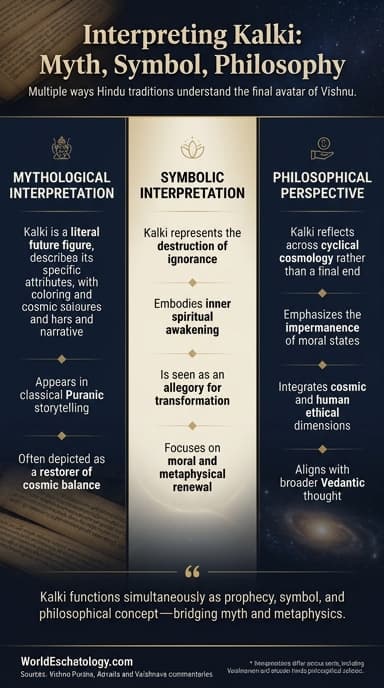
One of the most striking intellectual discoveries available to anyone who reads widely in comparative religious eschatology is how consistently the world’s major traditions have developed figures that correspond to Kalki in their structure, function, and imagery.
These parallels are too consistent to be dismissed as coincidence and too specific to be explained away as mere family resemblance.
Maitreya: The Future Buddha
In Buddhism, the figure who most closely corresponds to Kalki is Maitreya, the future Buddha, anticipated in both Theravada and Mahayana traditions as the one who will appear when the dharma of Gautama Buddha has been forgotten and will restore the teachings and inaugurate a new era of peace and spiritual flourishing.
The parallels with Kalki are structural and close. Both arrive after a period of maximum moral decline. Both restore the sacred teaching that has been lost.
Both inaugurate a new golden age. Both appear in connection with the sacred location of Shambhala, with Maitreya being prophesied in some Hindu texts as the king of Shambhala, the same location identified as Kalki’s birthplace.
The difference in character between the two figures is equally instructive. Kalki is primarily a warrior, arriving on a white horse with a blazing sword to defeat the forces of evil through combat.
Maitreya is primarily a teacher, arriving in a world where only the teaching is missing and restoring it through wisdom and compassion rather than military force.
These different emphases reflect the different philosophical frameworks of Hinduism and Buddhism: the Hindu cosmos requires an avatar who acts within it to restore its moral order, while the Buddhist cosmos requires a teacher who illuminates the path beyond it.
The Imam Mahdi: The Rightly Guided One
The structural resemblances between Kalki and the Islamic Imam Mahdi are striking enough to have generated significant comparative theological discussion.
Both arrive at a moment of maximum moral corruption and political injustice. Both establish a period of righteousness. Both are preceded by widespread moral and social collapse.
Both are understood as the culmination of a sacred lineage: Kalki as the tenth avatar of Vishnu, the Mahdi as either a righteous leader from the Prophet’s lineage in Sunni Islam or the hidden Twelfth Imam in Shia Islam.
The differences are theologically fundamental. Kalki is a direct descent of the divine into human form, an avatar in the strict Hindu sense.
The Mahdi in Sunni Islam is a righteous human being who does not possess divine attributes but is guided by God to accomplish a specific historical mission.
In Shia Islam, the Mahdi is a figure of greater eschatological weight but remains a human imam rather than a divine incarnation.
The theological gap between an avatar of Vishnu and a human successor to the Prophet is significant and should not be obscured by the structural parallels.
The tradition linking Kalki and the Mahdi through the concept of Shambhala is particularly interesting.
The Kalachakra Tantra, in its Buddhist adaptation of the Kalki concept, describes armies hostile to the dharma appearing from the direction associated with Islamic expansion, and the Kalki King of Shambhala defeating them.
This creates a textual tradition in which the Hindu and Buddhist Kalki figures are explicitly set in relationship to the Islamic historical context, though the nature of that relationship has been interpreted very differently by different scholars.
The Saoshyant: The Zoroastrian World Renovator
The Saoshyant is the saviour figure of Zoroastrian eschatology who will appear at the end of time to lead the forces of good against the forces of evil in a final cosmic battle.
The Avesta describes the Saoshyant bringing about the Frashokereti, the renovation of the world into its original perfect state, eradicating all evil and suffering.
The parallel with Kalki is close: both are warrior figures who defeat the embodiment of evil in a cosmic battle, and both inaugurate a renewed world rather than a different kind of existence altogether.
The Zoroastrian tradition may have influenced certain Hindu apocalyptic concepts through the significant cultural and commercial contact between the Persian and Indian civilisations across centuries.
The Returning Christ: The White Rider of Revelation
The figure of Kalki riding a white horse with a blazing sword has drawn sustained comparison to the figure described in Revelation 19:11-16, who also rides a white horse, is called Faithful and True, and whose weapon is a sharp sword that goes out of his mouth.
Both figures arrive to end an age of evil and establish a new order of righteousness. Both are explicitly associated with the restoration of sacred order rather than its mere reformation.
The parallels in imagery are striking: the white horse, the sword, the judgment of the wicked, the inauguration of a golden age.
The theological frameworks are genuinely different. The returning Christ in Christian eschatology is the second person of the Trinity, the divine Son, returning to complete what his first coming initiated.
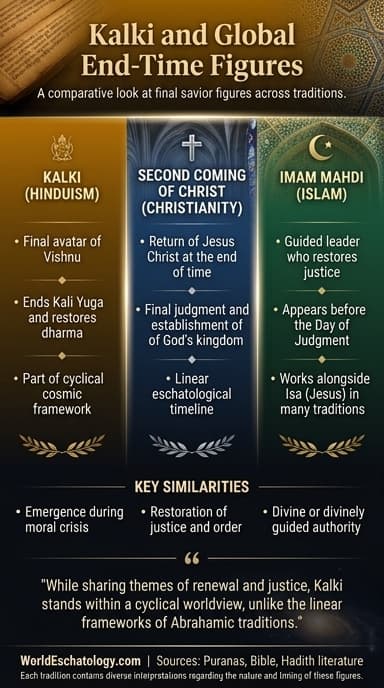
Kalki is the tenth avatar of Vishnu, the final descent in the current cycle. The Christian cosmic narrative is linear, moving from creation through fall through redemption toward a new creation that does not repeat the cycle.
The Hindu cosmic narrative is cyclical, with the new Satya Yuga eventually declining once more through Treta and Dvapara until another Kali Yuga requires another Kalki.
The Jewish Messiah: The Restorer of the World
The Jewish Messiah, expected as a human descendant of the Davidic line who will restore the kingdom of Israel, gather the exiles, rebuild the temple, and inaugurate an era of universal peace and knowledge of God, shares with Kalki the fundamental structure of a figure who arrives when human history has reached a moral nadir and whose coming transforms the world rather than merely reforming it.
The gathering of the righteous, the restoration of sacred knowledge and practice, and the inauguration of a golden age of universal righteousness are common to both expectations.
The theological difference is significant: the Jewish Messiah is entirely human, and his task is to accomplish specific historical events within the physical world, while Kalki is a divine avatar whose mission includes a cosmic cosmic dimension beyond ordinary historical action.
Is Kalki Already Here: Claims and the Tradition’s Response
In every generation that has experienced severe social and spiritual conditions matching the descriptions of Kali Yuga, individuals have claimed or been believed by their followers to be the Kalki avatar.
This is a predictable feature of any prophetic tradition associated with a period of darkness: the darker the times, the more urgent the desire for the promised deliverer, and the more that desire can be exploited or misdirected.
The tradition’s own texts provide a response to this phenomenon. The conditions of Kali Yuga are described as including the emergence of false teachers who claim divine status for personal gain.
The Puranas are therefore internally sceptical of claims of avatar-hood in precisely the age when such claims will be most common and most compelling.
The textual criteria against which any claim to be Kalki would need to be measured are specific and demanding.
Birth in Shambhala to parents named Vishnuyasha and Sumati. Formal training under Parashurama.
Reception of the specific divine gifts described in the Kalki Purana, including the horse Devadatta as a manifestation of Garuda, the jewelled sword, and the parrot Shuka.
The accomplishment of the specific cosmic missions described in the texts, including the simultaneous defeat of Koka and Vikoka, the comprehensive destruction of the corrupt rulers of the age, the death of the demon Kali, and the successful inauguration of a new Satya Yuga recognised by the full community as such.
No figure in history has met these criteria. The tradition’s honest position, rooted in the traditional calculation of the Kali Yuga’s duration, is that the avatar described in the Puranas will arrive in a genuinely distant future.
Readers should approach claims of contemporary Kalki avatars with the scepticism that the tradition itself recommends.
What Kalki Teaches: The Deeper Theological Meaning
Every avatar of Vishnu teaches something beyond the specific narrative of their incarnation, and the teaching of the Kalki prophecy is perhaps the most profound precisely because he has not yet come.
The tradition has had two and a half thousand years of Kali Yuga experience from which to distil what the promise of Kalki is actually meant to communicate.
The first and most fundamental teaching is about the nature of time. The Kalki prophecy is not primarily a prediction about a specific future event.
It is an expression of the Hindu understanding that time moves in great cycles of rise and fall, that darkness is never permanent, and that the divine is always ultimately victorious over what opposes it.
Every Kali Yuga ends. Every new Satya Yuga begins. This is not optimism based on evidence.
It is cosmological knowledge embedded in the structure of the tradition’s understanding of reality.
The second teaching concerns the proper response to living in a dark age. The tradition does not say: wait for Kalki, he will fix it.
The tradition says: live with greater personal integrity and commitment to dharma precisely because the times are dark.
The avatar will come when he comes. The individual’s responsibility is to be the kind of person who belongs to the new age that Kalki will inaugurate, to carry in their own conduct and character something of the Satya Yuga that has not yet returned collectively.
The third teaching concerns the unity of purpose across all ten avatars. Kalki is not a different Vishnu from the Vishnu who appeared as Rama or Krishna.
He is the same divine presence making its final gesture in the current cosmic cycle, completing what each previous avatar was already part of.
The Dashavatara is a single unfolding expression of one divine intention: that the world will not be abandoned to darkness, that righteousness will be protected and eventually restored, and that the descent of the divine into the human world is itself an act of love.
The Kalki Purana states that those who repeatedly hear the transcendental glories of the Kalki incarnation with devotion will find all inauspiciousness within their hearts reduced to nil.
This is the practical teaching the tradition offers: contemplation of the promised avatar is itself a form of spiritual practice.
Not because Kalki is already here, but because the hope he embodies is itself a spiritual reality, a way of orienting the soul toward the divine promise that the darkness will not last.
Frequently Asked Questions
Who is the Kalki avatar?
Kalki is the tenth and final avatar or incarnation of Lord Vishnu, prophesied to appear at the end of the Kali Yuga, the current dark age of the Hindu cosmic cycle.
He will ride a white horse named Devadatta, carry a blazing sword, be born in the village of Shambhala to a Brahmin named Vishnuyasha, train under Parashurama, and accomplish the destruction of the forces of adharma before inaugurating a new Satya Yuga, a golden age of righteousness and spiritual renewal.
What is the tenth avatar of Vishnu?
The tenth avatar of Vishnu is Kalki, the final incarnation of the divine preserver in the current cosmic cycle.
The full list of the ten principal avatars, the Dashavatara, consists of Matsya, Kurma, Varaha, Narasimha, Vamana, Parashurama, Rama, Krishna, Buddha, and Kalki.
Of these ten, Kalki is the only one who has not yet appeared and belongs entirely to future prophecy.
When will Kalki avatar come?
According to the traditional calculation, the Kali Yuga began approximately 5,000 years ago and has a total duration of 432,000 years.
On this timeline, Kalki will not arrive for more than 427,000 years. Some teachers argue that the moral conditions of the present era already match the descriptions of Kali Yuga’s final period and that the avatar may arrive sooner in a qualitative sense.
Only the divine knows the precise timing. The tradition is consistent that no currently living or recent figure has met the specific criteria described in the Puranic texts.
Where is Shambhala?
In the Hindu tradition, Shambhala is the village of Kalki’s birth, most commonly identified with Sambhal in present-day Uttar Pradesh, India, where an ancient temple to Kalki exists.
Some traditions understand Shambhala as a sacred space existing at a dimension of reality beyond ordinary physical geography.
In Tibetan Buddhism, Shambhala is a hidden cosmic kingdom from which the twenty-fifth Kalki King will emerge at the end of times.
The mystery of Shambhala has generated sustained fascination across multiple religious traditions.
What does the name Kalki mean?
The name Kalki carries three proposed meanings. The first derives from Kal, meaning time or the Kali Yuga, making Kalki the destroyer of time or the one who overcomes the age.
The second proposes that the original name was Karki, meaning white, referring to the white horse.
The third interprets Kalki as destroyer of filth or remover of darkness, pointing to the purification function of the avatar’s mission. All three meanings are present in the tradition.
What are the signs that Kalki is coming?
The Bhagavata Purana and Vishnu Purana describe the condition of the world at Kalki’s arrival as one where rulers have degenerated into plunderers, the Vedas have been forgotten, religious teachers sell spiritual knowledge for money, and even at the residences of supposed saints there is no longer any discussion of God.
These conditions describe the endpoint of the Kali Yuga. Some contemporary devotees believe the present era already shows many of these signs, though the traditional timeline places the actual arrival of Kalki in a very distant future.
Is Kalki avatar born yet?
According to traditional Hindu scholarship, no. The traditional calculation places Kalki’s arrival approximately 427,000 years in the future.
The specific criteria for identifying Kalki, birth in Shambhala to parents named Vishnuyasha and Sumati, training under Parashurama, the specific divine gifts from Shiva, and the accomplishment of the full cosmic mission including the inauguration of a new Satya Yuga, have not been met by any known figure.
What are the ten avatars of Vishnu?
The ten avatars of Vishnu, the Dashavatara, are Matsya the fish, Kurma the tortoise, Varaha the boar, Narasimha the man-lion, Vamana the dwarf, Parashurama the warrior-Brahmin, Rama the righteous king, Krishna the divine charioteer, Buddha the enlightened one, and Kalki the final warrior who will end the Kali Yuga. Of these, Kalki alone has not yet appeared.
How is Kalki different from other avatars of Vishnu?
Every other avatar came in response to a crisis that had already arrived. Kalki is the only avatar who has not yet come and whose arrival is entirely a matter of future prophecy.
He is also unique in that his mission is not to address a specific crisis within the ongoing world but to end an entire cosmic age and reset the cycle of time itself.
No previous avatar ended a Yuga. Kalki alone has this function.
How is Kalki similar to the Mahdi in Islam?
Both Kalki and the Imam Mahdi arrive at a moment of maximum moral corruption, both establish a period of righteousness, and both are understood as the culmination of a sacred lineage.
The theological frameworks are genuinely different: Kalki is a divine avatar, a direct descent of Vishnu into human form, while the Mahdi in Sunni Islam is a righteous human leader and in Shia Islam is the hidden Twelfth Imam.
The structural narrative parallels are striking but should not obscure the fundamental doctrinal differences.
How is Kalki similar to Maitreya in Buddhism?
Both arrive after a period of maximum moral decline and both restore the sacred teaching that has been lost or corrupted.
Both are associated with the sacred location of Shambhala.
The difference lies in method: Kalki is primarily a warrior who defeats evil through combat, while Maitreya is primarily a teacher who restores the dharma through wisdom and compassion.
These differences reflect the distinct philosophical emphases of Hinduism and Buddhism respectively.
What does Devadatta the white horse represent?
Devadatta, whose name means gift of the gods, is identified in the Kalki Purana as a manifestation of Garuda, Vishnu’s own divine vehicle, the king of birds.
The white horse is therefore not an ordinary animal but a divine being carrying the avatar through the world.
His white colour carries associations of purity, dawn, and the Satya Yuga whose first light Kalki represents.
His capacity to go anywhere at will reflects Vishnu’s omnipresence expressed through the avatar’s mount.
What is the Kalki Purana?
The Kalki Purana is the only Hindu sacred text entirely dedicated to the Kalki avatar.
It is classified as an Upapurana or secondary Purana rather than one of the eighteen Mahapuranas.
Scholars date its composition to between 1500 and 1700 CE, likely in Bengal during the period of Mughal rule.
It contains the most detailed narrative account of Kalki’s birth, training, divine gifts, battles, marriages, children, and final return to Vaikuntha, and is the primary source for many specific details of the Kalki story.
Will Kalki end the world?
No, not in the sense of permanent destruction. Kalki will end the Kali Yuga, the current dark age, and the corrupt civilisation it has produced, but this ending is immediately followed by the inauguration of a new Satya Yuga, a new golden age.
The Hindu tradition does not understand history as moving toward a final catastrophic ending but as cycling through recurring periods of rise and fall.
Kalki ends an age, not existence. What follows his work is renewal, not annihilation.
Conclusion: The Promise That Has Not Yet Been Kept
Of all the eschatological figures covered in this series, Kalki is the one whose distinctiveness is most easily missed. The Mahdi has not yet come.
Maitreya has not yet come. The Jewish Messiah has not yet come. In all these traditions, the great awaited figure remains future. So what makes Kalki different?
What makes Kalki different is the specific relationship his arrival has to the age in which we live.
The Dajjal, the Mahdi, and the signs of Qiyamah are described as events that will unfold relatively rapidly once the sequence begins.
The return of Christ is described as coming without warning, like a thief in the night. But Kalki is embedded in a cosmic timeline of a different order entirely.
He is not arriving soon. By the traditional calculation he is not arriving for hundreds of thousands of years.
The Kali Yuga itself, the age he will end, is younger than we are old in cosmic terms. We are five thousand years into an age of four hundred and thirty-two thousand years.
And yet the tradition does not treat this as cause for despair.
It treats it as cause for a specific kind of orientation: the recognition that the cosmic drama in which we participate is vastly larger than any individual life or any historical period, that the darkness we experience is real but not final, and that the divine intention for the world is not defeated by the current conditions of the world but is working through them toward an outcome that has always been certain.
The practical teaching is not: wait for Kalki. The teaching is: live now, in this lobby before the banquet hall, in this Kali Yuga that is moving toward its Satya Yuga, as the kind of person whose character belongs to the age that is coming rather than the age that is passing.
Carry some of the Satya Yuga in your own conduct. Protect dharma in the small sphere you inhabit. Be the kind of person that Kalki’s new world will be made of.
The avatar of the white horse will come when he comes.
The promise has been made in the Bhagavad Gita, in the Bhagavata Purana, in the Vishnu Purana, in the Kalki Purana, in the Mahabharata: whenever righteousness declines beyond a certain point, the divine will not leave it there. It will descend again. It always has. It will again.
Devadatta’s hooves have not yet touched the earth of Shambhala. But the earth is waiting.
Sources: Srimad Bhagavatam 1.3.25, 12.2.18-20 | Vishnu Purana Book Four Chapter 24 | Mahabharata 3.188.85-3.189.6
Kalki Purana | Agni Purana | Padma Purana | Matsya Purana | Bhagavad Gita 4.7-8
WorldEschatology.com | All Puranic citations drawn from canonical Sanskrit sources
2 thoughts on “Kalki Avatar | The final incarnation of Vishnu who ends the age”