
Ask most people what Judaism says about life after death and they will tell you one of two things: either that Judaism focuses on this world and does not really say much about the next one, or that it teaches the immortality of the soul.
Both answers miss what is actually one of the most striking and underappreciated doctrines in the entire Jewish tradition.
Judaism teaches the resurrection of the dead, bodily, physical resurrection, the actual restoration of the whole person to life on earth.
This is not a marginal or disputed idea imported from elsewhere. It is a declared article of Jewish faith, woven into the daily prayers of traditional Jews three times a day and stated plainly by Maimonides as one of the thirteen foundational beliefs of Judaism.
The doctrine is called Techiyat HaMeitim in Hebrew. It sits at the heart of Jewish eschatology and has shaped Jewish burial practices, Jewish prayer, Jewish theology, and Jewish debate for over two thousand years.
And yet it remains genuinely surprising to many people, Jews and non-Jews alike, who have simply never heard it taught clearly. This article sets out to do exactly that.
What does techiyat hameitim mean?
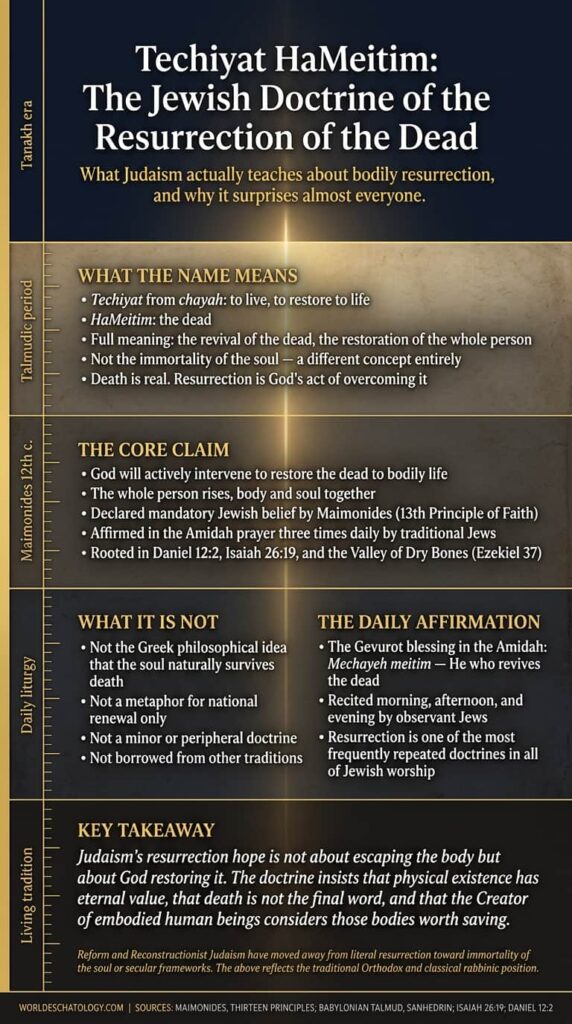
The Hebrew phrase Techiyat HaMeitim breaks down into three words. Techiyat comes from the root chayah, meaning to live or to restore to life.
Ha is simply the definite article. Meitim means the dead. So the phrase means literally the revival of the dead or the restoration of life to the dead.
This is not the immortality of the soul, which is a different concept entirely. It is not the idea that some part of a person survives death naturally because it is by nature deathless.
It is the claim that God will actively intervene to bring back to life people who have genuinely died. Death is real. The resurrection is a divine act that overcomes it.
The distinction between resurrection and immortality matters enormously in Jewish theology, and we will return to it in detail later.
For now the key point is simply this: Techiyat HaMeitim is about the body. It is about the whole person, not just a soul drifting off to a spiritual realm.
The God who created human beings as embodied creatures will restore them as embodied creatures. That is what the phrase means and that is what the tradition has consistently taught.
The biblical foundations
The Sadducees, the Pharisees, and a First-Century Debate
One of the clearest windows into how contested the resurrection was in ancient Judaism is the famous debate between the Pharisees and the Sadducees.
The Sadducees, the priestly aristocracy whose authority derived from the Temple establishment, denied the resurrection of the dead entirely.
They argued that it was not to be found in the Torah and therefore was not binding Jewish teaching.
The Pharisees, the rabbinic ancestors of normative Judaism, affirmed it emphatically and built it into the core of their theological program.
This debate surfaces in the New Testament too, confirming that resurrection was a live and contested question between identifiable Jewish factions in the first century.
After the Temple’s destruction in 70 CE the Sadducees disappeared, and Pharisaic Judaism carried the resurrection doctrine forward as the dominant Jewish position.
The Key Biblical Texts
The clearest resurrection text in the entire Hebrew Bible is Daniel 12:2, written in the second century BCE: Many of those who sleep in the dust of the earth will awake, some to everlasting life, others to shame and everlasting contempt.
This is as explicit as it gets in the Old Testament, describing a literal awakening of the dead from their graves to face distinct destinies.
It is the passage that anchors the resurrection doctrine most firmly in the Hebrew scriptures.
Isaiah 26:19 is also frequently cited: Your dead will live, Lord; their bodies will rise. Let those who dwell in the dust wake up and shout for joy.
This verse, from a passage sometimes called the Isaiah Apocalypse, describes what appears to be a bodily revival.
The word bodies is explicit. The rabbis read this as a direct prophecy of Techiyat HaMeitim.
Ezekiel 37, the famous Valley of Dry Bones vision, has a more complex interpretive history.
In its immediate context the vision is clearly a metaphor for the national restoration of Israel from exile.
God shows Ezekiel a valley of scattered bones that are reassembled, covered in flesh, and brought back to life, and then explicitly tells him this represents the house of Israel being restored to their land.
Most scholars read this as primarily a political metaphor. But the rabbis, and many subsequent Jewish interpreters, also read a secondary meaning into the vision, seeing in its imagery a literal promise of bodily resurrection.
The power of the vision is so vivid that it became one of the central images for Techiyat HaMeitim in Jewish liturgical and artistic tradition even when its primary reference was acknowledged to be national restoration.
The Torah itself, the Five Books of Moses, does not explicitly describe resurrection. This was the Sadducees’ main argument.
The rabbis responded with creative interpretive readings. One famous Talmudic passage finds a hint of resurrection in the verse from Exodus where God says to Moses that He is the God of Abraham, Isaac, and Jacob.
Since God speaks of the patriarchs in the present tense even though they have died, the rabbis argued this implied they would live again.
This kind of reasoning, finding implications in grammatical details rather than explicit statements, was characteristic of rabbinic biblical interpretation and represents the tradition’s effort to root a doctrine it considered central in the foundational text of Torah.
The talmudic and rabbinic development
Resurrection as a Legal and Theological Requirement
By the time of the Mishnah and Talmud, roughly from the second to the sixth centuries CE, the resurrection of the dead was treated not as one theological option among others but as a defining commitment of normative Judaism.
The Talmudic tractate Sanhedrin contains one of the most striking statements in all of rabbinic literature on this subject: a person who says that resurrection of the dead is not from the Torah has no share in the World to Come.
In other words, denying the resurrection is not just a theological error but a disqualifying failure to stand within the covenant community.
This is a remarkable statement and it reflects how central the doctrine had become.
The rabbis were not saying that every detail of how the resurrection would work was settled.
They disagreed about plenty of those details, as we are about to see. What they were saying was that the basic commitment to God’s eventual restoration of the dead was non-negotiable.
The Mechanics of Resurrection in Rabbinic Thought
Once the doctrine was established, the rabbis did what rabbis do: they asked detailed questions about how it would actually work.
These discussions in the Talmud and Midrash are fascinating both for their theological seriousness and for their willingness to engage with what might seem like extremely practical concerns.
Will people be resurrected with their physical defects? The rabbis debated this question with genuine care.
One view held that the dead would rise in exactly the condition they had at death, defects and all, so that they would be recognizable, and then God would heal them.
Another view held they would rise in their prime condition.
The underlying principle driving the discussion was the desire to affirm both continuity of personal identity, this must be the same person who died, and the goodness of God’s restoration.
What about people whose bodies were destroyed beyond recovery, whether by fire, by sea, or by being eaten by animals?
This was not an abstract worry in an era of persecution. The rabbis largely held that God’s power to resurrect was not limited by the condition of the remains.
If God could create human beings from nothing, He could restore them from whatever remained.
The Dew of Resurrection
Rabbinic literature introduces a beautiful and distinctive image for the mechanism of resurrection: a special divine dew that God will pour over the earth to revive the dead.
This image draws on Isaiah 26:19, which in its Hebrew reads literally your dead will live, my body they will rise, awaken and sing those who dwell in the dust, for a dew of lights is your dew.
The phrase dew of lights became a key image in the rabbinic imagination of resurrection.
Just as morning dew refreshes the earth and causes dormant seeds to sprout, the divine resurrection dew will refresh the bodies of the dead and cause them to spring to life.
The Luz Bone
One of the most distinctively Jewish traditions about the mechanics of resurrection is the luz bone, a small and supposedly indestructible bone that the rabbis identified as the seed from which the resurrection body will grow.
The exact location of this bone was debated, with suggestions ranging from a bone at the base of the skull to a vertebra in the lower spine.
What all versions of the tradition agree on is that this bone cannot be destroyed by any natural means. It survives fire and grinding and even the long decay of burial.
At the resurrection, God will use it as the starting point for rebuilding the complete human body.
The theological point is serious: it is an attempt to preserve personal identity across death and resurrection.
If something of the original body never disappears, then the resurrected person is genuinely the same person who died, not a copy.
Maimonides and the thirteen principles
The Thirteenth Principle
Moses Maimonides, the twelfth-century Spanish-born philosopher and legal scholar known as the Rambam, produced the most influential systematic statement of Jewish belief in the medieval period: the Thirteen Principles of Faith.
The thirteenth and final principle is the resurrection of the dead. Maimonides states it plainly: I believe with complete faith that there will be a resurrection of the dead at the time that the Creator wills it.
This formulation, or its summary form in the Ani Maamin prayer, became one of the most widely recited statements of Jewish belief in traditional communities.
The placement of resurrection as the final principle is significant. It represents the culmination of Jewish hope, the endpoint of the story God is telling with history.
After everything else, after God’s unity, after His incorporeality, after the authority of Torah, after the coming of the Messiah, the last word is resurrection. Death does not win.
The Maimonides Controversy
Here is where things get complicated.
Maimonides was a philosopher deeply influenced by Aristotelian thought as transmitted through Islamic philosophy, and in his philosophical works, particularly the Guide for the Perplexed, he seems to give much greater emphasis to the World to Come as a purely spiritual state of the soul than to a physical resurrection.
His critics noticed this tension and accused him of not really believing in bodily resurrection, of using it as a concession to popular belief while his true philosophical view was the immortality of the soul.
Maimonides wrote a specific Treatise on Resurrection reaffirming his belief in physical bodily resurrection and arguing the apparent tension came from his critics’ misreading.
However, he maintained that the resurrected dead would eventually die again, with resurrection as a temporary miraculous state before the soul’s destiny in the spiritual World to Come.
Most Jewish thinkers considered resurrection the beginning of permanent embodied life, not a second temporary lifespan.
Nahmanides and the kabbalistic view
Nahmanides, the thirteenth-century Catalan scholar also known as the Ramban, offered a very different account from Maimonides.
For Nahmanides, the bodily resurrection is not a temporary stage on the way to something more spiritual. It is the ultimate and permanent state of the righteous.
The resurrected body will be glorified and transformed, but it will be a real body, and the life lived in it will be the final and highest form of human existence, not a prelude to a disembodied spiritual condition.
The Kabbalistic tradition teaches that the human soul has multiple layers: the nefesh, the basic life force connected to the body; the ruach, the higher moral self; and the neshamah, the deepest spiritual dimension.
At death these separate. At the resurrection they are reunited with a restored body.
Resurrection is therefore not just restoration of the body but the complete reintegration of the whole person across all dimensions of their being.
Resurrection and the other afterlife concepts
Three Concepts That Often Get Confused
Jewish afterlife thinking involves three distinct concepts that people regularly confuse with one another, and getting them straight is essential for understanding Techiyat HaMeitim properly.
Olam Ha-Ba, the World to Come, is the broadest and most overarching concept.
It refers to the ultimate future reality that God is bringing into being, the final state of things after judgment and resurrection.
When the Talmud says a person has no share in Olam Ha-Ba, it means they are excluded from this ultimate divine future.
The term is sometimes used to describe the immediate post-death state of the soul and sometimes to describe the ultimate post-resurrection reality, which creates confusion.
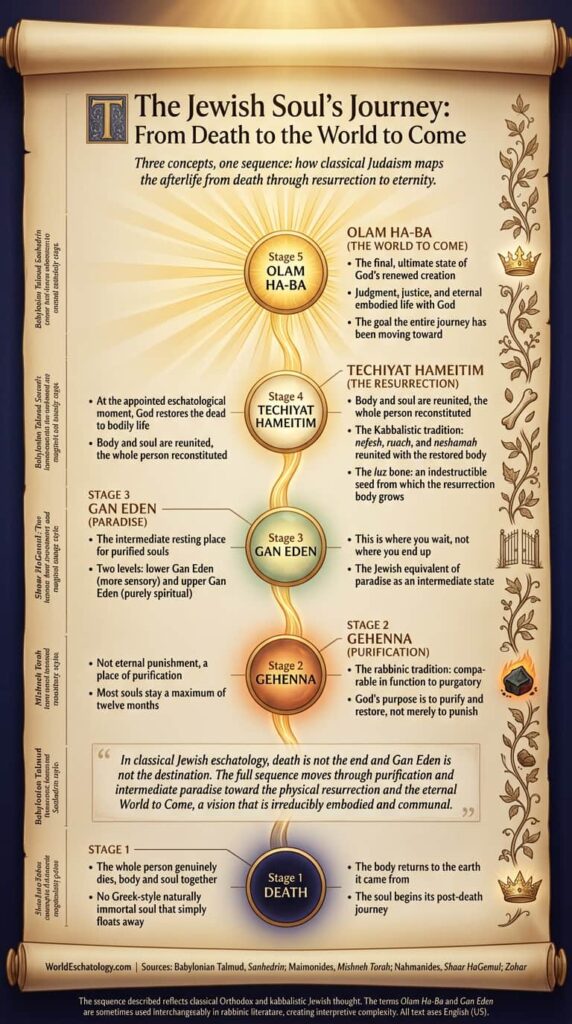
Gan Eden, the Garden of Eden, refers in post-biblical Jewish thought to the realm where the souls of the righteous dwell between death and resurrection.
It is sometimes described in two levels: a lower Gan Eden that is more physical and sensory in character, and an upper Gan Eden that is purely spiritual.
This is the Jewish equivalent of what other traditions might call paradise or heaven as an intermediate state. It is not the final destination. It is where you wait.
Techiyat HaMeitim is the resurrection itself, the moment when God restores the dead to bodily life and the full human person is reconstituted.
This is the goal, the endpoint, what Gan Eden is preparing souls for.
In the classic traditional framework, the sequence is: death, the soul’s journey to Gehenna for purification if needed, then Gan Eden, then at the appointed time resurrection and the judgment, then the eternal life of Olam Ha-Ba.
Gehenna and the Journey Before Resurrection
Gehenna in Jewish thought is not quite the same as the Christian concept of hell as a place of eternal punishment.
Most rabbinic sources describe Gehenna as a place of purification, analogous to a refining fire that burns away the impurities of a soul before it can enter the purity of Gan Eden.
The standard rabbinic view limits the maximum stay in Gehenna to twelve months, after which even the souls of those who were not fully righteous are purified and proceed to their rest.
Only the most wicked, those who rejected God and harmed others deliberately and without repentance, face a different outcome.
This understanding of Gehenna as purgatorial rather than punitive has deep implications for Jewish theology.
It reflects the tradition’s fundamental optimism about human nature and divine mercy, the conviction that God’s desire is to restore and purify rather than to punish for its own sake.
The same God who will resurrect the dead is the God who designed the intermediate state to prepare souls for that resurrection.
Denominational differences of Techiyat HaMeitim
Orthodox Judaism
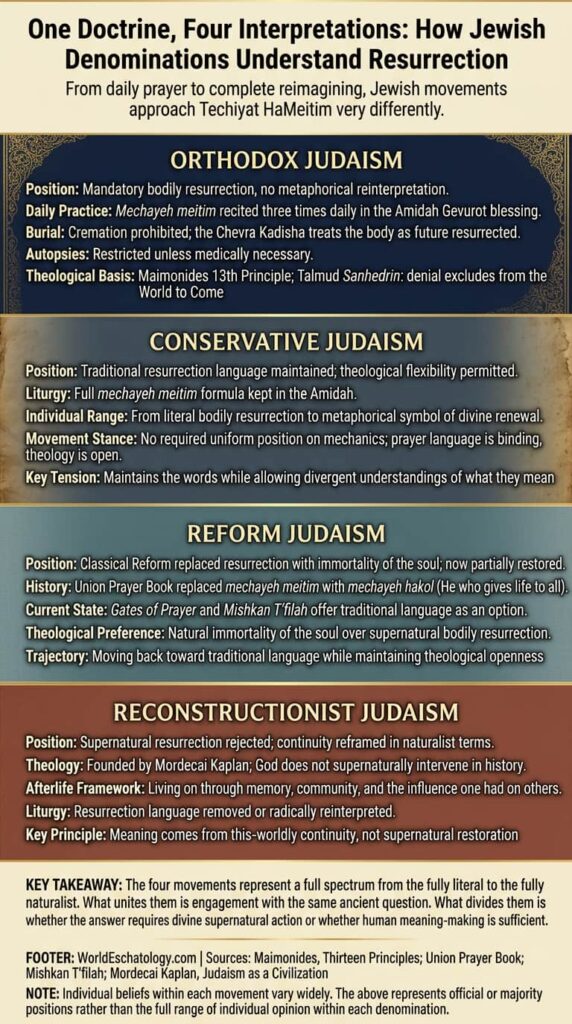
Orthodox Judaism affirms bodily resurrection as a mandatory article of faith with no room for metaphorical reinterpretation.
This commitment shows up most visibly in daily prayer: the second blessing of the Amidah, the central prayer recited three times daily, is called the Gevurot and praises God specifically as the one who resurrects the dead.
The traditional text uses the phrase mechayeh meitim, He who revives the dead, multiple times within the single blessing.
Every observant Jew who prays the traditional Amidah is affirming bodily resurrection at least three times a day, and more on Shabbat and holidays.
The commitment to resurrection also shapes Orthodox practice around death and burial in very practical ways.
The prohibition of cremation in Orthodox Judaism is directly connected to the resurrection hope: if the body is to be restored, then preserving the body in burial, returning it to the earth from which it came, is the appropriate way to treat what will one day be raised.
The Chevra Kadisha, the Jewish burial society, treats the deceased body with extraordinary care and dignity precisely because it is understood as a person who will live again. Autopsies are restricted unless absolutely necessary for the same reason.
Conservative Judaism
Conservative Judaism maintains the traditional resurrection language in its liturgy, including the mechayeh meitim formula in the Amidah.
However, it allows considerably more theological flexibility in how individual members and even rabbis understand what this language means.
Some Conservative Jews understand resurrection in a fully traditional bodily sense.
Others understand it metaphorically, as a symbol of divine renewal and the ultimate victory of life over death.
Still others hold various positions in between. The movement has generally not required a uniform theological position on the mechanics of resurrection while keeping the traditional words of prayer that affirm it.
Reform Judaism
Reform Judaism’s relationship with resurrection is one of the most interesting denominational stories in modern Jewish history.
The classical Reform movement of the nineteenth century, shaped by Enlightenment rationalism and the desire to bring Judaism into conversation with modern thought, deliberately removed resurrection language from the prayer book.
The Union Prayer Book, the standard Reform prayer book for most of the twentieth century, replaced the mechayeh meitim phrase in the Amidah with mechayeh hakol, He who gives life to all, a formulation that pointed to God as the sustainer of ongoing life rather than the resurrector of the dead.
The theology of natural immortality of the soul was preferred over the supernatural resurrection of the body.
More recently, Reform liturgy has partially walked this back.
The newer prayer books, Gates of Prayer and Mishkan T’filah, offer worshippers the option of the traditional mechayeh meitim language alongside alternative formulations.
This reflects a broader shift in Reform Judaism toward greater engagement with traditional texts and practices, even when full traditional theology is not required.
Reconstructionist Judaism
Reconstructionist Judaism, founded by Mordecai Kaplan in the twentieth century, takes the most thoroughgoing naturalist position.
Kaplan’s theology rejected the concept of a supernatural God who intervenes in history, which logically extended to rejection of a supernatural resurrection of the body.
Reconstructionist prayer books remove or radically reinterpret resurrection language.
The emphasis falls on continuity through memory, the way a person lives on in the community that remembers them and in the influence they had on those around them.
This is not the same doctrine as resurrection but rather a this-worldly reframing of what continuity after death might mean.
Resurrection in jewish liturgy
The most important liturgical expression of the resurrection doctrine in traditional Judaism is the second blessing of the Amidah, the Gevurot.
This short blessing is a sustained poem of praise to God as the master of life and death.
It praises God for sustaining the living, for being faithful to those who sleep in the dust, for reviving the dead with great mercy.
It uses the phrase mechayeh meitim not once but repeatedly.
In the winter season, when rain is prayed for in the land of Israel, the phrase mashiv haruach umorid hagashem, who causes the wind to blow and the rain to fall, is added to the Gevurot, creating a connection between the natural cycles of seasonal renewal and the ultimate renewal of bodily resurrection.
This is a daily, three-times-daily recitation for traditional Jews, making the resurrection one of the most frequently affirmed doctrines in all of Jewish religious life.
Jewish mourning practice also carries resurrection themes even when they are not always made explicit.
The Kaddish, the mourner’s prayer, does not mention death or resurrection directly but is a declaration of praise for God’s name, spoken by the bereaved precisely at the moment of loss.
The tradition interprets this as an act of faith: even in the face of death, even while grieving, the mourner declares that God is worthy of praise, that the story is not over.
The Yizkor memorial prayers, recited four times a year, remember the souls of the dead with the hope that their memory will be bound up in the bond of everlasting life, a phrase that points forward to the resurrection hope.
Resurrection versus immortality of the soul
The distinction between resurrection and immortality of the soul is one of the most important and most neglected in all of Jewish theology.
The Greek philosophical tradition, particularly as developed by Plato, taught that the soul is by nature immortal.
It does not need to be raised from the dead because it never truly died.
The body is a temporary prison or vessel that the soul inhabits for a while before death releases it to its natural eternal condition.
On this view, death is almost welcome, a liberation of the real self from the limitations of matter.
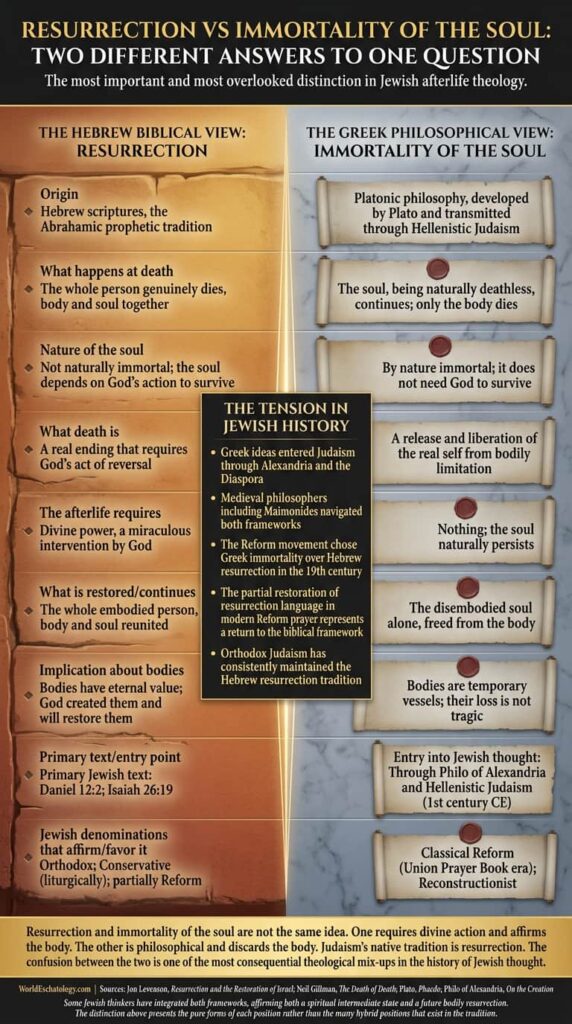
The Hebrew biblical tradition teaches something fundamentally different. The human being is a unity of body and soul.
There is no sharp dualism between a real spiritual self and an illusory physical body. When a person dies, they really die, the whole person, not just the body.
The soul is not naturally immortal in the Greek sense. If there is to be life after death, it must be because God acts to restore what was genuinely lost.
This is why resurrection is such a theologically loaded concept: it requires divine power, it affirms the goodness of bodily existence, and it says that the God who made human beings as embodied creatures considers those bodies worth saving.
Greek ideas about the soul’s immortality entered Jewish thought through Hellenistic Judaism and Philo of Alexandria, creating a long-running tension between Greek and Hebrew frameworks.
When Reform Judaism replaced resurrection language with immortality of the soul in its prayer book, it chose the Greek philosophical tradition over the Hebrew biblical one.
The subsequent partial restoration of resurrection language represents a reassertion of the biblical framework.
Comparative perspective
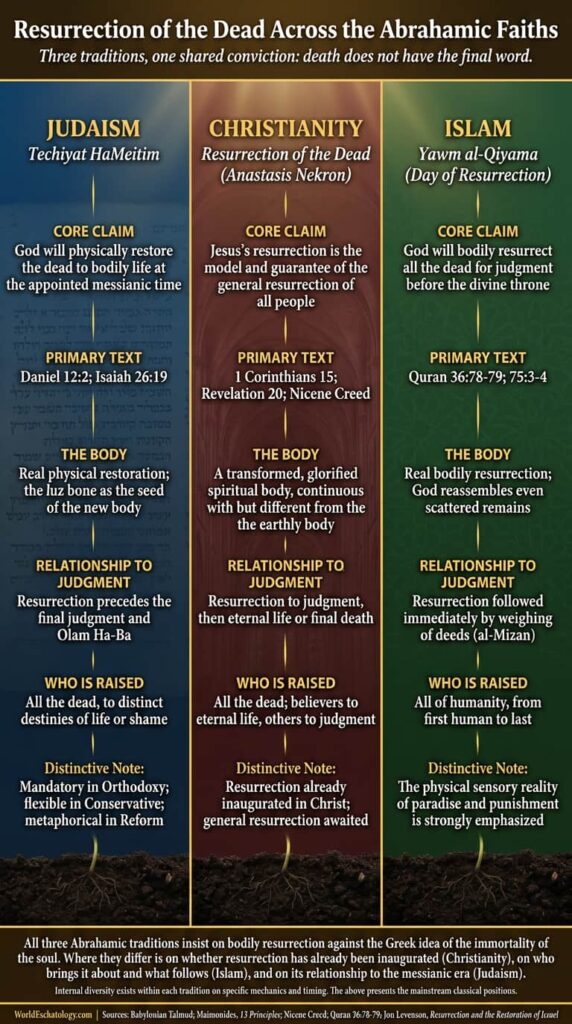
Judaism is not alone among the Abrahamic faiths in its resurrection hope. Islam’s doctrine of Yawm al-Qiyama, the Day of Resurrection, describes the bodily resurrection of all the dead for judgment before God.
The Islamic tradition, like the Jewish one, insists on the physical character of the resurrection: real bodies will be restored and stand before God.
The Quran describes this in vivid and specific terms.
The structural similarity between Jewish Techiyat HaMeitim and Islamic resurrection reflects their shared roots in the Abrahamic prophetic tradition, though the specific frameworks and the relationship of resurrection to judgment and the afterlife differ between the two traditions.
Christianity’s resurrection doctrine, expressed classically in the Nicene Creed with the phrase we look for the resurrection of the dead, also insists on bodily resurrection.
The resurrection of Jesus in Christian theology is understood as both the model and the guarantee of the general resurrection of all the dead.
What Jewish and Christian resurrection hopes share is the insistence that death is genuinely overcome, that bodies matter, and that God’s final word about human beings is life rather than extinction.
The key difference, of course, is that Christianity understands the resurrection as already inaugurated in the person of Jesus, while Judaism awaits the general resurrection as a future event connected to the messianic era.
Frequently asked questions
Do Jews believe in resurrection of the dead?
Yes, traditional and Orthodox Judaism affirms the resurrection of the dead as one of the thirteen mandatory articles of Jewish faith as stated by Maimonides.
It is affirmed in daily prayer through the Amidah’s Gevurot blessing. Conservative Judaism maintains the traditional language while allowing theological flexibility.
Reform and Reconstructionist Judaism have moved away from literal resurrection, preferring alternative frameworks for understanding life after death.
What does Techiyat HaMeitim mean?
Techiyat HaMeitim is Hebrew for the revival of the dead or the resurrection of the dead.
It refers specifically to the physical, bodily resurrection that Jewish tradition expects God to perform at the appointed eschatological moment.
The term emphasizes that whole persons will be restored to life, not merely that souls will survive death in a disembodied state.
Is resurrection of the dead in the Torah?
Not explicitly. The Torah itself does not describe resurrection in direct terms, which was the Sadducees’ main argument against the doctrine.
The clearest biblical resurrection texts are Daniel 12:2 and Isaiah 26:19.
The rabbis found hints of resurrection in the Torah through creative interpretation of specific verses, most famously through the present-tense reference to the patriarchs in God’s self-identification to Moses.
What is the difference between resurrection and immortality of the soul in Judaism?
Resurrection means the whole person dies and God acts to restore them to bodily life at a future time.
Immortality of the soul means the soul never truly dies and survives death naturally without needing divine restoration.
Judaism’s native biblical tradition teaches resurrection. The immortality of the soul concept entered Jewish thought from Greek philosophy, particularly through Hellenistic Judaism and Philo of Alexandria.
These are genuinely different ideas with very different implications for how we understand human beings and what God values.
What does the Amidah say about resurrection?
The second blessing of the Amidah, called the Gevurot, praises God specifically as the one who resurrects the dead.
It uses the Hebrew phrase mechayeh meitim, He who revives the dead, multiple times.
It also describes God as being faithful to those who sleep in the dust.
This blessing is recited as part of the full Amidah three times daily in traditional Jewish practice, making it one of the most frequently repeated doctrinal statements in all of Jewish worship.
Why do Orthodox Jews oppose cremation?
Orthodox Judaism prohibits cremation in part because of the resurrection hope.
If God will restore the body at the resurrection, then treating the body with care and burying it intact in the earth respects both the dignity of the person and the divine intention to raise it.
Cremation is understood as a violation of this principle.
The halacha also requires burial in the earth in part because of the verse from Genesis about returning to the dust from which we came, and in part because of the long tradition of Jewish burial practice connecting the community of the living to the hope of resurrection.
What did Maimonides say about resurrection?
Maimonides listed resurrection of the dead as the thirteenth and final of his Thirteen Principles of Faith, the most authoritative medieval statement of mandatory Jewish belief.
He affirmed bodily physical resurrection clearly in this context and in his Treatise on Resurrection, where he wrote it partly in response to critics who accused him of not really believing in it.
His distinctive position was that the resurrected dead would eventually die again, resurrection being a temporary state rather than the beginning of permanent embodied life.
Most other Jewish thinkers considered resurrection the start of permanent existence.
What is the World to Come in Judaism?
Olam Ha-Ba, the World to Come, is the Hebrew term for the ultimate future reality that God is bringing into being after the resurrection and judgment.
It refers to the final state of things when evil has been eliminated, the dead have been raised, and God’s kingdom is fully established.
The term is also sometimes used more loosely to describe the realm where souls dwell after death before the resurrection.
Understanding which sense is intended requires reading the context carefully.
What is Gehenna in Judaism?
Gehenna in Jewish thought is generally understood as a place of purification for souls after death rather than a place of eternal punishment.
Most rabbinic sources describe a maximum stay of twelve months, after which souls are purified and proceed to Gan Eden.
It is comparable in function to the Catholic concept of purgatory.
The most wicked individuals may face a different outcome, but the dominant Jewish view is that Gehenna exists to purify rather than simply to punish.
Is belief in resurrection required in Judaism?
In Orthodox Judaism, yes. The Talmud’s declaration that one who denies resurrection has no share in the World to Come, combined with Maimonides’ inclusion of it in the Thirteen Principles, establishes it as a mandatory belief in the Orthodox framework.
Conservative Judaism maintains the traditional language but allows more flexibility.
Reform and Reconstructionist Judaism do not treat it as required belief and have moved away from the traditional doctrine to varying degrees.
Conclusion:
The resurrection of the dead is one of the most distinctively Jewish ideas about the human future and one of the most overlooked.
It is woven into Jewish prayer, embedded in the Talmud, affirmed by the greatest medieval Jewish thinkers, and rooted in the Hebrew Bible’s insistence that the God who made human beings as embodied creatures considers those bodies worth saving.
What Techiyat HaMeitim reveals about Jewish theology is also what it reveals about Jewish anthropology.
Human beings are not souls trapped in bodies, waiting to be released into a purely spiritual condition.
They are integrated persons, body and soul together, whose full humanity requires embodiment.
The resurrection hope says that God takes this seriously, that the physical dimension of human life is not an obstacle to divine purposes but part of what God intends to redeem.
The Jewish tradition’s insistence on bodily resurrection is, at its deepest level, an insistence on the dignity and worth of the whole human person, and a refusal to let death have the final word.
WorldEschatology.com
Sources: Babylonian Talmud, Tractate Sanhedrin; Maimonides, Mishneh Torah and Treatise on Resurrection; Nahmanides, Shaar HaGemul; Zohar; Siddur (Traditional Prayer Book); Neil Gillman, The Death of Death; Simcha Paull Raphael, Jewish Views of the Afterlife; Jon Levenson, Resurrection and the Restoration of Israel
1 thought on “Resurrection of the Dead (Techiyat HaMeitim) in Judaism”