
Something measurable is happening right now. Searches for end times topics are climbing.
Eschatology and apocalyptic prophecy content on YouTube and social media is generating numbers that would have seemed impossible five years ago.
Churches, mosques, synagogues, and temples are reporting growing interest in prophetic and end times teaching.
Publishers are releasing more eschatology-focused books than at any point in recent memory.
Documentaries about apocalyptic prophecy and the end of history are finding mainstream audiences.
By every available metric, global interest in end times beliefs is surging in 2025 and 2026, and the growing pace of that surge is accelerating month by month.
Why is end times interest growing so fast? The current conditions of the world provide the answer.
This article takes that observable fact seriously and asks why.
Not to dismiss the trend as mass anxiety, but to engage honestly with the conditions driving it, the patterns it fits historically, and what serious thinkers across religious traditions and academic disciplines make of the end times interest growing around us.
End times beliefs surging globally in 2026 is not a fringe phenomenon. It is a cultural and spiritual signal worth paying genuine attention to.
Why is end times interest growing so fast, so broadly, and so intensely right now? The answer matters for believers and skeptics alike.
The data behind the surge of end times beliefs globally
Search Trends and Online Signals
The most immediate evidence that end times interest is growing comes from search data.
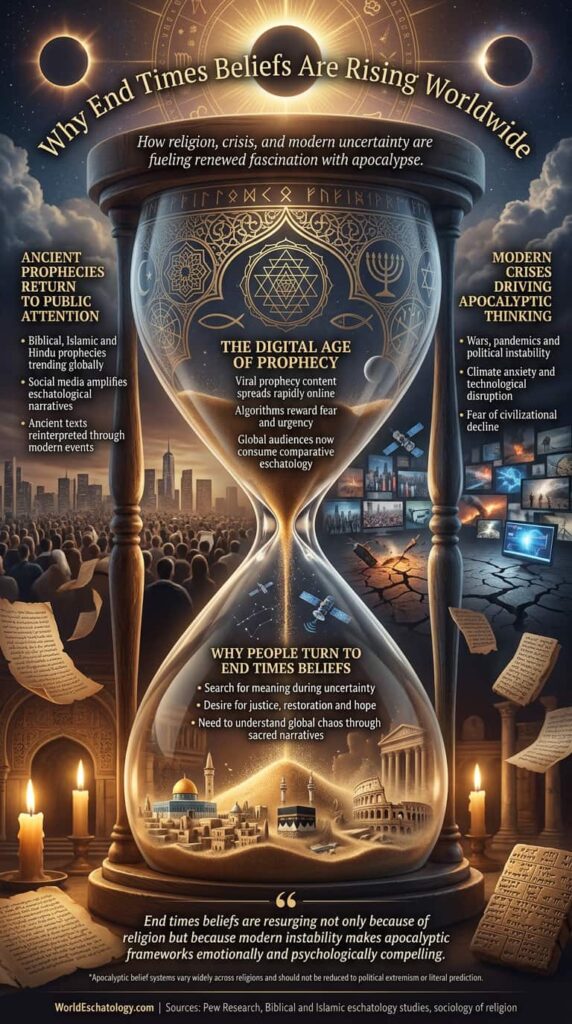
Terms like end times 2026, biblical prophecy current events, signs of the end, and eschatology, along with their equivalents in Arabic, Urdu, Spanish, and Portuguese, have shown sustained growth since 2020 with a sharp acceleration from late 2023 through 2026.
The searches are globally distributed, showing that the surge in end times beliefs is not a quirk of one country or one tradition but a worldwide phenomenon crossing language, geography, and denominational lines.
Social media amplifies what search data reveals. Eschatology channels on YouTube have accumulated tens of millions of subscribers.
Short-form apocalyptic content on TikTok and Instagram generates extraordinary engagement across demographics that traditional religious media rarely reached.
The comment sections of end times prophecy content are notable for their emotional intensity. People are not browsing this material casually.
They are bringing genuine personal urgency to questions about the end times, about current events and prophecy, and about what the traditions say about living in a world that feels increasingly unstable.
The surge in engagement is not slowing in 2026. It is growing.
Religious Communities and Publishing
Religious leaders across traditions report that eschatology topics are drawing their largest audiences.
Evangelical pastors note that end times prophecy sermons consistently outperform other content and are growing their congregations’ appetite for more.
Islamic scholars report that questions about the signs of the Hour, the Mahdi, and the Dajjal have multiplied significantly since 2023.
Jewish communities shaped by religious Zionism have seen a remarkable intensification of messianic conversation following October 2023.
Hindu teachers report growing interest in Kali Yuga apocalyptic analysis and Kalki prophecy.
The eschatology current events connection is being made across every tradition simultaneously, and it is growing stronger rather than fading.
The publishing and media landscape reflects the same pattern. End times themed books are appearing on bestseller lists.
Streaming platforms are commissioning documentaries about apocalyptic belief.
Mainstream news outlets that would not have touched eschatology as a serious subject five years ago are now running features on end times beliefs as a significant cultural and political phenomenon.
Why is end times interest growing so fast? The data points to real-world conditions rather than to theological fashion.
The conditions driving the surge for end times
The Post-COVID Psychological Shift
Any honest account of why end times interest is growing must begin with COVID-19.
The pandemic did something that no amount of eschatological preaching had fully achieved: it made the previously unthinkable feel normal. Borders closed.
Economies stopped. Societies that had operated on confident assumptions of stability discovered those assumptions were fragile.
Billions of people experienced in a visceral personal way that civilization can change completely and without warning.
That experience left a permanent mark on how people assess what is possible. The end times surge since 2020 is partly a direct and rational response to that evidence.
Geopolitical Instability in 2025 and 2026
Geopolitical chaos has historically been the single strongest driver of eschatological interest, and 2025 and 2026 are producing it in abundance.
The war in Ukraine has kept the possibility of large-scale conflict and nuclear escalation in daily public consciousness for years.
The Israel-Gaza conflict intensified from October 2023 onward and has pulled in multiple regional actors.
Rising tensions between major powers over Taiwan and the broader question of who shapes the coming global order are generating persistent anxiety about great-power conflict.
End times 2026 is a phrase people are searching because the world of 2026 looks the way end times traditions always said the world would look before the final crisis.
The breakdown of the post-Cold War international order that governed global relations from 1991 is a structural shift whose consequences are still unfolding.
That order provided predictability. Its erosion is leaving a vacuum that eschatological and apocalyptic frameworks are historically very good at filling.
Eschatology current events connections are being made precisely because current events in 2026 are generating exactly the kind of large-scale uncertainty that has always fueled end times prophecy thinking at scale.
The growing number of people making these eschatology current events connections is not a coincidence.
It reflects a genuine correspondence between what is happening in the world and what the traditions describe.
Artificial Intelligence and Existential Anxiety
The rapid development of artificial intelligence is generating a specific and novel existential anxiety that is feeding the end times surge in ways that have no clear historical parallel.
AI raises questions that touch directly on concerns at the heart of eschatological thinking: Who controls the future?
What happens when technology becomes more capable than human beings? Can we trust what we see and hear?
What does it mean to be human in a world shaped by non-human intelligence?
End times 2026 searches increasingly include AI-related terms precisely because these questions feel eschatologically charged.
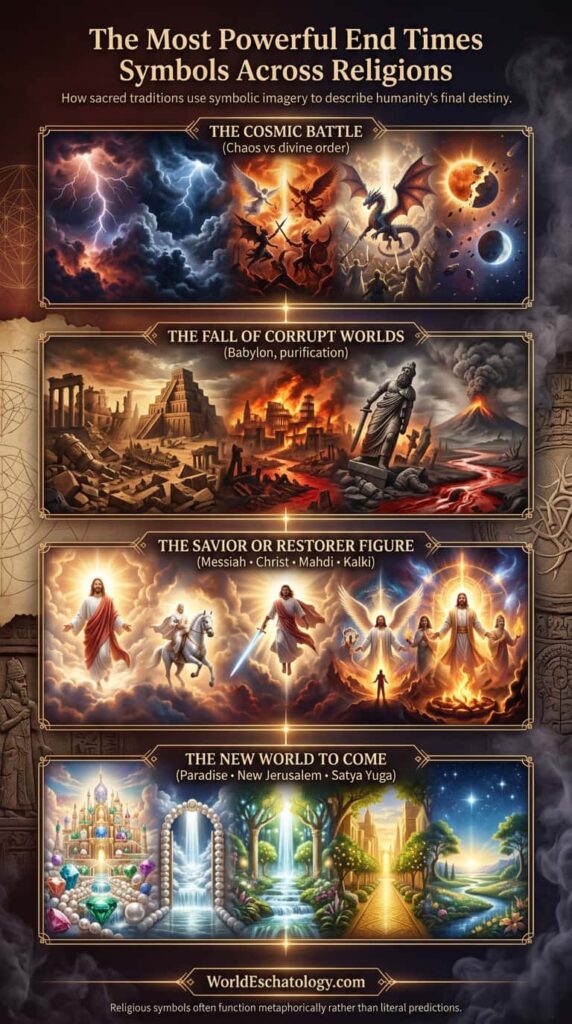
Christian communities are connecting AI to the mark of the Beast and to the surveillance and control systems described in Revelation.
Islamic scholars and popular commentators are connecting AI capabilities to qualities attributed to the Dajjal.
Secular technology critics frame the development of artificial superintelligence as a potential extinction-level event comparable to what eschatological traditions describe as the end of history.
The AI eschatology connection is not forced. It reflects genuine structural parallels between the concerns that end times frameworks have always addressed and what AI is actually becoming capable of in 2026.
Environmental Crisis, Economic Instability, and Institutional Collapse
Escalating extreme weather, biodiversity loss, water scarcity, and the visible consequences of climate change are being read through eschatological lenses across multiple traditions.
Biblical plagues, Islamic signs of the Hour that describe erratic rainfall and agricultural failure, Hindu Kali Yuga predictions about the earth yielding less produce: all of these ancient descriptions are being placed alongside modern climate data by believers who find the parallels specific enough to take seriously.
This convergence of religious end times imagery and secular environmental analysis is one of the more remarkable features of the current eschatological moment.
Economic conditions in 2025 and 2026 are also contributing directly to why end times interest is growing.
Housing unaffordability has locked a generation out of the stable life previous generations took for granted.
Inflation, debt crises, and visible wealth concentration generate a deeper questioning of whether the system itself is sustainable.
That questioning flows naturally toward eschatological frameworks.
And when institutional trust collapses, when governments, media, scientific bodies, and religious leadership are all viewed with suspicion by large portions of the population, end times frameworks offer a coherent alternative explanation:
the institutions are failing because this is what the tradition said would happen before the end.
The religious dimension of the surge for end of times
Christian and Islamic Eschatology in 2025 and 2026
Within Christianity, the sharpest end times surge is visible in evangelical and charismatic communities where dispensationalist prophecy has the deepest roots.
The Israel-Gaza conflict has energized Christian end times interest in ways not seen since the 1990s.
Specific events are being identified as fulfillments of specific biblical prophecy passages across thousands of online platforms, in churches, and in popular publishing.
Prophecy conferences are selling out. End times prophecy books are topping Christian bestseller lists.
End times 2026 in Christian contexts means a very specific set of prophetic expectations about the Middle East, the rebuilt Temple, and the return of Christ that are feeling urgently relevant to millions of believers right now.
The current surge is among the strongest prophecy surges in evangelical history.
The surge in Islamic eschatology current events discussions is particularly visible in Arabic, Urdu, Malay, and other Muslim-majority language media.
The Mahdi, the Dajjal, and the signs of the Hour are generating enormous content and conversation in Muslim communities worldwide.
The Israel-Gaza conflict plays a role here too, as hadith traditions describe specific events in the Levant as among the signs of the approaching Hour.
Social media has dramatically accelerated the spread of Islamic end times content, connecting Muslim communities across national boundaries around shared eschatological expectations in ways that were structurally impossible before the internet.
Jewish, Hindu, and Secular Surges
In Jewish communities, the events of October 7, 2023 and their aftermath have intensified messianic reflection in ways that catch many observers off guard.
The question of whether current events represent the beginning of the messianic process is being asked with genuine urgency.
Hindu communities are seeing renewed circulation of Kali Yuga analysis explicitly connecting Bhagavata Purana descriptions of the dark age to current global conditions.
End times beliefs surging globally in 2026 include this Hindu eschatological dimension, with teachers drawing remarkably specific parallels between ancient Sanskrit texts and contemporary headlines.
Secular end times thinking is also surging, fed by AI anxiety, climate dread, and the growing influence of collapsitarian analysis predicting the breakdown of industrial civilization.
This secular eschatology shares structural features with religious end times frameworks: a diagnosis of systemic failure, a warning that current trajectories are unsustainable, and a call for radical personal reorientation.
The secular and religious versions of the end times surge are more similar to each other than either camp typically acknowledges.
The psychology of end of times
Why Apocalyptic Frameworks Are Compelling
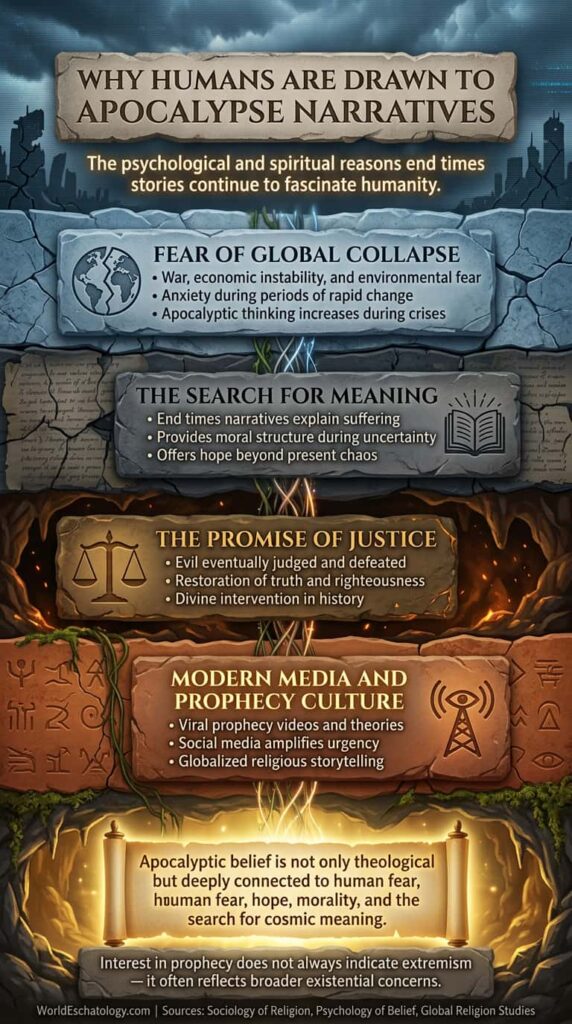
Psychological research on apocalyptic belief helps explain why end times interest grows in exactly the conditions we are currently living through.
Eschatological frameworks address several powerful psychological needs simultaneously:
they transform random and frightening events into a meaningful narrative, they provide a sense of cosmic significance, they offer community with fellow believers, and they give a sense of temporal orientation, a feeling of knowing roughly where in the story you are.
These are not trivial needs. The need to locate oneself within a meaningful story about history is a genuine human need, and dismissing people who find end times and apocalyptic frameworks compelling as simply anxious or irrational misses what is actually happening psychologically.
The appeal of prophecy and end times belief in 2026 is also partly an appeal to coherence.
In a fragmented information environment where every institution has been discredited and every narrative is contested, a prophetic framework that claims to explain everything, that says all the chaos and confusion is actually the fulfillment of ancient prophecy, offers a kind of cognitive relief that secular analytical frameworks rarely match.
This is not a new phenomenon. The growing end times interest we see in 2026 is the same impulse that produced apocalyptic surges in every previous generation, now amplified by tools that previous generations did not have.
Healthy vs Unhealthy Eschatological Engagement
Scholars of religion and psychologists who study end times belief distinguish between forms of eschatological engagement that are genuinely helpful and forms that cause harm.
Healthy engagement holds specific predictions with humility, uses end times frameworks to motivate genuine inner preparation and ethical living, and resists the temptation to identify specific real-world groups as the prophesied eschatological villain.
Unhealthy engagement treats specific predictions as certain, dehumanizes groups identified as end times enemies, abandons practical responsibility on the grounds that the end is imminent, and allows end times anxiety to override ordinary human compassion.
The question for the current end times surge in 2026 is which of these two forms it will predominantly produce.
We have been here before
The Historical Pattern of End times Surges
The current surge in end times interest is striking in its global scope and in the technological amplification that social media provides.
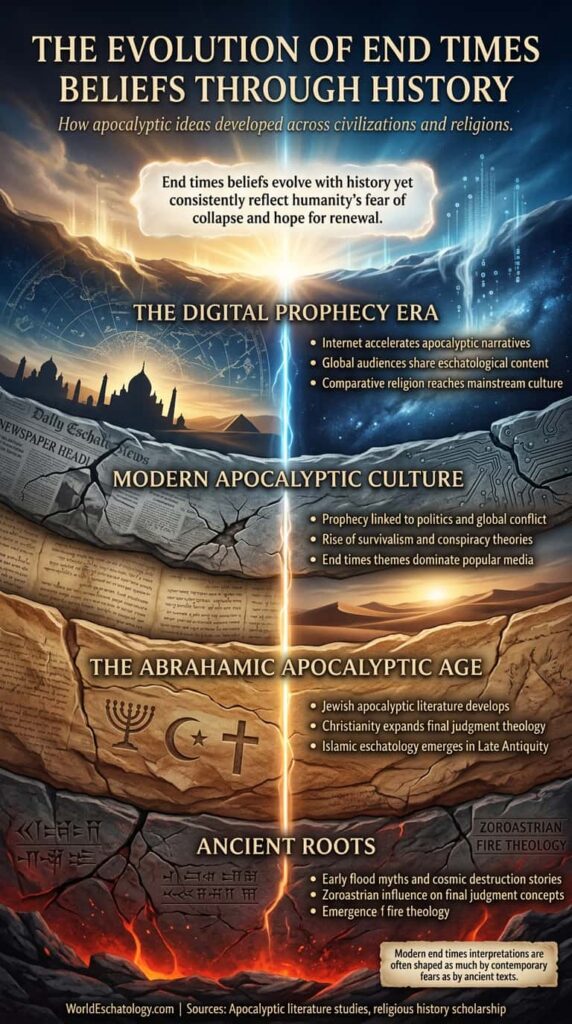
But the pattern itself is not new. Every major period of civilizational stress in recorded history has produced a surge in eschatological interest, and the structure of that surge is remarkably consistent across cultures and centuries.
The Black Death of the fourteenth century, which killed between a third and half of Europe’s population, produced one of the most intense periods of apocalyptic activity in history.
Flagellant movements marched across the continent performing public self-punishment in the belief that the end was imminent.
Jewish communities were massacred by populations convinced they were the agents of the apocalypse.
The widespread conviction that the Last Days had definitively arrived was not fringe opinion but mainstream religious expectation among ordinary people living through genuine catastrophe.
The World Wars of the twentieth century produced similar end times surges.
Specific political and military events were identified as biblical prophecy fulfillments with a confidence that seems extraordinary in retrospect.
Germany, Turkey, and then the Soviet Union were all inserted into prophetic frameworks as the predicted eschatological enemy.
End times prophecy books written during World War One were revised after that war ended, then revised again during World War Two, and revised yet again during the Cold War.
The pattern is consistent: every generation of prophecy writers adapts the available eschatological framework to the threats of their specific moment and presents the resulting identification as definitive.
The Cold War generated decades of end times content driven by genuine fear of nuclear annihilation.
The Soviet Union was inserted into dozens of different apocalyptic prophetic frameworks as the predicted northern enemy.
After the USSR collapsed in 1991, those frameworks had to be revised yet again.
The eschatological surge that followed September 11, 2001 produced a new generation of end times prophecy that framed Islamist terrorism as the fulfillment of biblical apocalyptic prophecy.
This history does not disprove the traditions’ claims about the end times.
It establishes that the traditions have always been intended to speak to conditions of maximum stress, and that their value lies not in providing an accurate prophetic timeline but in providing a framework for navigating crisis with wisdom and hope.
Every generation that thought it was the last one was also living through conditions that genuinely tested that conviction.
What do serious thinkers say about the end of times?
Scholarship, Leadership, and the Weaponization Risk
Academic scholars of religion who study apocalypticism observe the current end times surge with scholarly interest and genuine concern.
They note that the conditions for intense eschatological activity are all present, and they also note the particular danger that the current information environment creates:
Social media algorithms reward emotional intensity and amplify extreme claims, which means the most sensationalist and least careful forms of end times prophecy content consistently reach the largest audiences.
Responsible religious leadership across traditions is attempting to channel the genuine energy of eschatological interest toward constructive rather than destructive ends.
Mainstream Islamic scholars are emphasizing that the authentic response to living in a time of signs is spiritual preparation, not political radicalization.
Mainstream Christian leaders are reminding their communities that every generation has believed itself to be the last and that this belief should motivate faithful living rather than passive waiting or aggressive action.
The most serious concern scholars raise about the current end times surge is the risk of weaponized eschatology: the use of end times frameworks to justify violence, dehumanize groups, and mobilize political movements toward destructive ends.
In a highly polarized information environment where growing end times interest intersects with political tribalism and conspiracy thinking, the conditions for apocalyptic frameworks to be weaponized are unusually favorable.
The history of eschatologically motivated violence is extensive and sobering.
When prophecy is used to identify a real-world political or ethnic group as the fulfillment of the apocalyptic enemy, the consequences have historically been severe.
The current combination of global end times interest growing rapidly and social media amplification of extreme content deserves serious careful attention from both believers and observers.
Specific eschatology current events connections in 2026
The Israel-Gaza Conflict and Multiple Frameworks
The Israel-Gaza conflict is the single most eschatologically interpreted current event of the 2025 to 2026 period, and what is remarkable about it is that multiple entirely different eschatological frameworks are all finding their own prophetic significance in the same set of events.
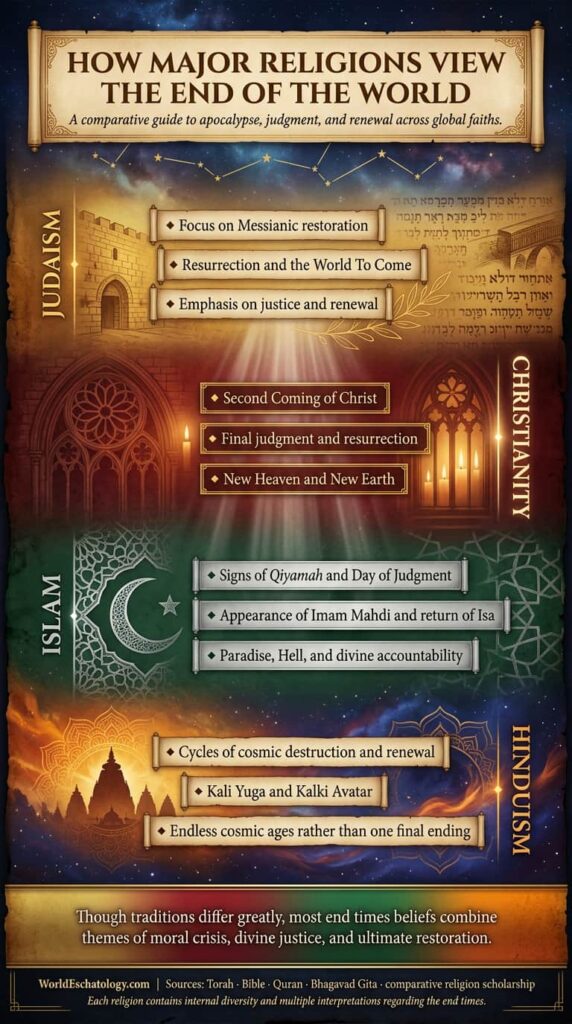
Christian dispensationalists see biblical prophecy about Israel and the wars preceding Christ’s return.
Islamic eschatologists see hadith traditions about events in the Levant as signs of the approaching Hour.
Jewish religious Zionists see messianic expectation about restored Jewish sovereignty.
Secular analysts see evidence of the collapse of the post-Cold War order.
These frameworks are not all saying the same thing, but they are all being activated simultaneously by the same eschatology current events.
AI, Climate, and Political Developments
Beyond the Middle East conflict, AI, climate, and political developments are the other most actively discussed eschatology current events connections in 2026.
AI is being connected to the mark of the Beast, the Dajjal, and the surveillance and control systems anticipated in multiple traditions’ end times scenarios.
The connection is not arbitrary: concerns about a deceptive, all-seeing, economically controlling force are precisely what these traditions have always described, and AI-enabled digital systems are becoming capable of exactly these functions.
Climate events are being read through prophetic frameworks by believers who find in floods, fires, and crop failures the fulfillment of ancient descriptions.
End times 2026 analysis consistently highlights these three areas, AI, climate, and the Middle East, as the primary current events driving the surge.
How to engage resposibily?
Virtues for Living in Eschatological Times
Every major religious tradition with a serious eschatological framework has also developed guidance on how believers should live during the period of waiting and uncertainty.
This guidance consistently emphasizes inner qualities rather than outward sign-watching.
The appropriate response to living in potentially end times conditions is genuine inner preparation through prayer and ethical practice, maintenance of hope without demanding certainty about timing, active care for others, and discernment that can distinguish genuine spiritual wisdom from sensationalist manipulation.
The growing end times interest of 2026 needs to produce these qualities in those who engage with it, not the anxiety and tribalism that sensationalist apocalyptic content generates.
The traditions are also consistent in warning against one specific failure mode that is particularly relevant in 2026: the error of treating the end times as an excuse to disengage from ordinary responsibility.
If the world is ending anyway, why pay the mortgage? Why maintain relationships? Why work for justice in society?
Every serious eschatological tradition explicitly rejects this logic. The Islamic tradition teaches that if a person is holding a seedling in their hand when the last trumpet sounds, they should plant it.
The Christian tradition teaches that faithful servants are found doing their master’s work when he returns unexpectedly.
The Hindu tradition teaches that karma yoga, righteous action in the world, is itself the path. Growing end times belief should produce people who are more engaged with life and more committed to justice and compassion, not less.
The Genuine Wisdom in the Surge
It would be a mistake to respond to the end times beliefs surging globally simply with reassurance and dismissal.
The surge is a signal worth hearing. Millions of people worldwide are experiencing a genuine rupture in their sense of normalcy and are reaching for the deepest frameworks available to make sense of it.
The fact that ordinary secular promises of progress and institutional protection are not providing sufficient reassurance is itself important information about the state of the world in 2026.
The eschatological traditions were built for moments of exactly this character, and engaging with their wisdom honestly is more useful than either uncritical amplification or dismissive skepticism.
End times 2026 may or may not be the actual end times. But it is unquestionably a time when the wisdom embedded in end times traditions is genuinely needed.
Frequently asked questions
Why is there so much end times talk right now in 2026?
End times interest is growing in 2026 because several major drivers are all active simultaneously: ongoing wars, post-COVID normalization of disruption, AI generating existential anxiety, escalating climate events, economic instability, and collapsed institutional trust.
Each of these alone has historically driven end times surges and apocalyptic prophecy interest.
All of them together, amplified by social media that rewards emotional intensity, are producing the current global surge in eschatology, prophecy, and end times content.
End times 2026 is not an accident or a cultural fashion. It is a rational response to genuine conditions, and it is still growing.
What events in 2025 and 2026 are being connected to end times prophecy?
The Israel-Gaza conflict and broader Middle Eastern instability are the most intensively discussed eschatology current events, being interpreted through Christian, Islamic, and Jewish prophetic frameworks simultaneously.
AI development is being connected to the mark of the Beast, the Dajjal, and control systems across traditions.
Climate events are being connected to prophetic descriptions of environmental deterioration.
Political polarization and institutional collapse are being connected to end times social deterioration described in the Bhagavata Purana, the hadith literature, and the Book of Revelation. End times 2026 discussions reliably center on these four areas.
Is the end times surge unique to one religion or is it global?
The end times surge in 2025 and 2026 is genuinely global and crosses religious boundaries.
It is visible in Christian evangelical communities tracking biblical prophecy, in Muslim communities discussing apocalyptic signs of the Hour, in Jewish religious Zionist communities, in Hindu communities engaging Kali Yuga discourse, and in secular communities where AI and climate collapse frameworks function as secular apocalyptic eschatology.
Why is end times interest growing across such different traditions simultaneously?
Because the underlying conditions driving the surge are global, real, and affecting all communities.
The growing end times interest is not generated by any single tradition’s internal dynamics but by shared real-world conditions.
Do scholars take end times beliefs seriously?
Academic scholars of religion take end times beliefs very seriously as significant social, psychological, and cultural phenomena.
Scholars of apocalypticism study the conditions producing eschatological surges, the psychological functions end times frameworks serve, the political uses and misuses of eschatological rhetoric, and the relationship between prophetic expectation and historical action.
The current end times surge has attracted significant scholarly attention because of its global scale and its intersection with AI, climate, and geopolitical developments that are genuinely unprecedented in their combination.
What does it mean that every generation thinks it is living in the end times?
The consistent pattern of each generation identifying its own era as the end times tells us two things.
First, the conditions producing eschatological and apocalyptic interest, large-scale suffering, institutional failure, geopolitical chaos, are recurring features of human history.
Second, specific prophetic identifications have a perfect historical record of failure. Every named Antichrist, every identified beast, every calculated prophecy date has so far been wrong.
This should produce genuine humility about specific predictions in the current end times surge while not eliminating the genuine wisdom that the traditions carry.
End times beliefs surging globally in 2026 fit this historical pattern precisely, and that pattern should inform how seriously we take specific prophetic claims.
Is the current eschatological surge more intense than previous ones?
In terms of raw numbers of people engaging with eschatology content, the current surge is probably the largest in human history because social media and internet access have given end times content a global reach that no previous technology provided.
In terms of underlying conditions, the current surge is comparable to major historical surges during the Black Death, the World Wars, and the Cold War.
What makes end times 2026 distinctive is the combination of multiple simultaneous drivers, the global reach of digital amplification, and the convergence of religious and secular eschatological frameworks around the same current events.
How do I tell the difference between serious eschatological engagement and fearmongering?
Serious eschatological engagement produces humility, hope, and practical wisdom. It acknowledges uncertainty about timing and specific prophetic fulfillments.
It motivates inner preparation and ethical living rather than paralysis or aggression. It does not dehumanize specific real-world groups as the prophesied apocalyptic enemy.
Fearmongering does the opposite: it generates growing anxiety, demands certainty about current events as prophecy fulfillments, identifies current political enemies with eschatological villains, and benefits the content creator’s platform more than the people receiving it.
In the current end times and apocalyptic prophecy surge, the volume of content is large and the ratio of genuine wisdom to fearmongering is uneven.
Growing discernment about what you consume is itself a form of spiritual preparation.
What do the major religions say about how to live during eschatological expectation?
All major religious traditions with developed end times frameworks give consistent advice:
Focus on genuine inner preparation rather than outward apocalyptic sign-watching, maintain faithful practice and ethical conduct, hold specific prophetic predictions humbly, avoid identifying living individuals or groups as the prophesied villain based on current events, and keep primary attention on your relationship with God and your immediate community.
The current growing end times interest of 2026 is an opportunity for exactly this kind of genuine engagement.
The traditions consistently say: the appropriate response to living in potentially end times conditions is to be the best version of the person your tradition asks you to be, not to become an expert in apocalyptic prophecy fulfillment.
THE SURGE IN NUMBERS AND WHAT COMES NEXT
The growing body of data on the current end times surge is worth summarizing before we close.
Searches for eschatology, biblical prophecy, apocalyptic signs, and end times current events have all shown sustained upward trends since 2020, with acceleration in 2024 and 2025 continuing into 2026.
The surge in YouTube eschatology content has been particularly dramatic: channels that had a few hundred thousand subscribers in 2020 now have millions, and the growth continues.
Podcast downloads for apocalyptic and prophecy-focused shows have grown at rates that outpace almost every other topic category. The growing end times interest is not plateauing. It is still climbing.
What comes next for the end times surge depends partly on world events and partly on whether the communities experiencing it channel it toward wisdom or toward harm.
If the current geopolitical, environmental, and technological conditions that are driving growing end times interest stabilize, the surge may moderate.
Historical precedent suggests that eschatological surges tend to peak during the period of maximum crisis and then gradually decline as conditions stabilize or as specific prophetic predictions fail to materialize on schedule.
But the current combination of simultaneous drivers, each independently capable of sustaining apocalyptic concern, makes a simple stabilization less likely than in previous surges.
The prophecy content, the apocalyptic frameworks, the current events connections, the growing community of end times believers across all traditions: all of these are now embedded in social media ecosystems that have their own momentum independent of the underlying conditions.
The end times surge of 2026 may well outlast the specific conditions that produced it.
Conclusion:
The end times beliefs surging globally in 2026 are not a sign of collective irrationality. They are a signal worth taking seriously.
They tell us that large numbers of people worldwide are experiencing a genuine and profound loss of confidence in the established order and are reaching for the deepest frameworks available to navigate that loss.
The conditions driving the surge are real: geopolitical instability, technological disruption, environmental crisis, economic inequality, and institutional collapse are all features of the current world that deserve serious attention from any framework that claims to address ultimate questions.
What the current end times surge most needs is exactly what the traditions themselves recommend at their best: honesty about uncertainty, humility about specific prophetic predictions, genuine inner preparation rather than outward sign-watching, and the maintenance of hope grounded in something deeper than any particular apocalyptic forecast.
The world in 2026 is genuinely difficult and genuinely uncertain. Why is end times interest growing?
Because the world looks and feels exactly the way eschatological and apocalyptic traditions have always said it would look and feel before the final crisis.
Whether that convergence is evidence of prophetic accuracy or simply of the tradition’s perennial relevance to times of stress is a question each person must ultimately answer for themselves.
What is not in question is that the growing surge of end times interest in 2026 is a phenomenon that deserves honest, serious, and compassionate engagement.
WorldEschatology.com
Sources: Pew Research Center; Google Trends; David Cook, Contemporary Muslim Apocalyptic Literature; Stephen O’Leary, Arguing the Apocalypse; Barbara Rossing, The Rapture Exposed; Lorenzo DiTommaso, The Architecture of Apocalypticism; Philip Jenkins, Crucible of Faith; Nova Religio; Journal for the Scientific Study of Religion