
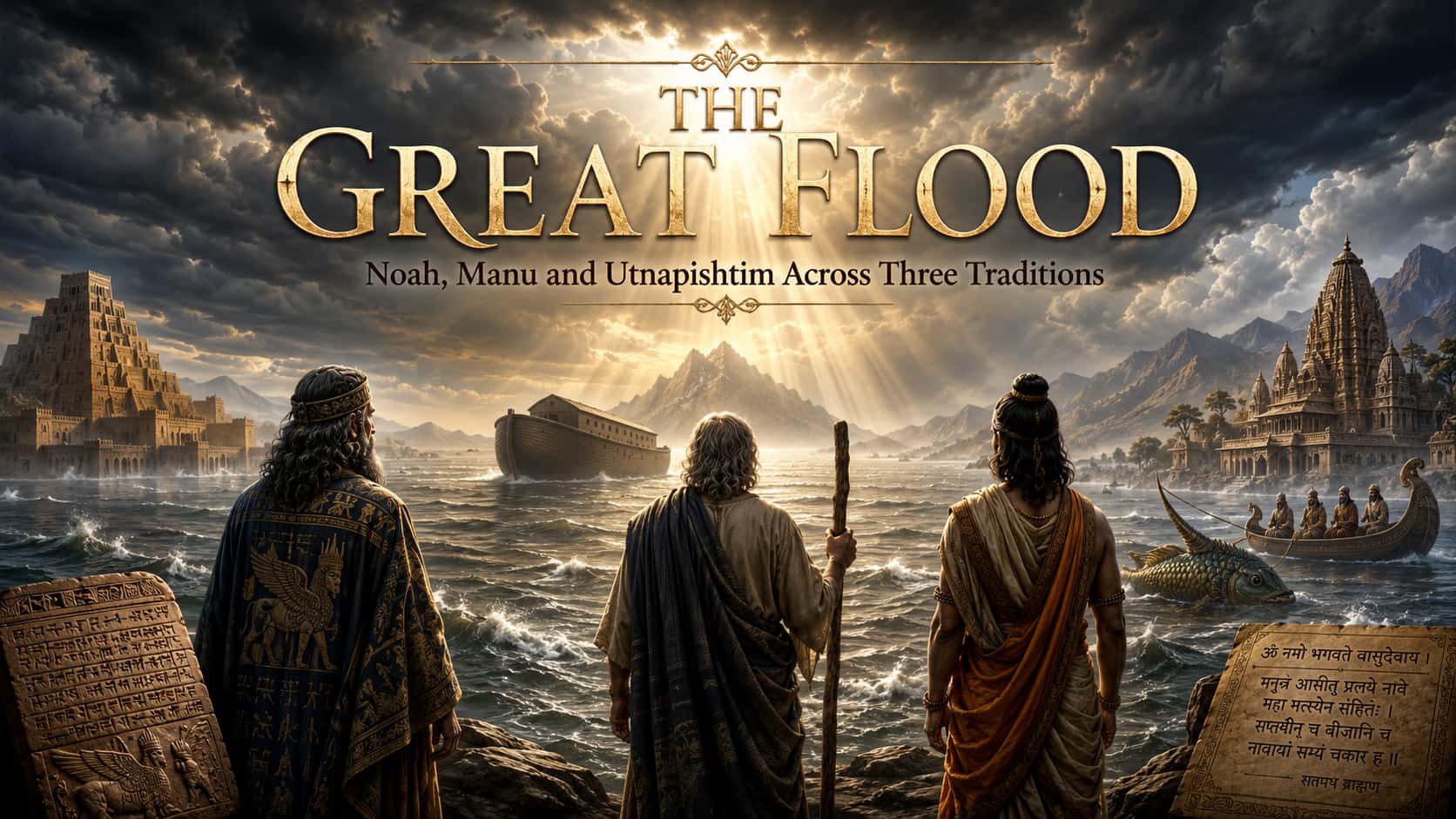
Picture this. Three men, living thousands of miles apart, separated by language, culture and religion, all receive the same warning: the great flood is coming. Build a boat.
Take your family. Take the animals. The rest of the world is going to be wiped clean.
One man is from the ancient Near East, somewhere in the land that we now call Iraq.
Another is from the Vedic tradition of ancient India. The third is the prophet we know from the Bible and the Quran.
The stories they left behind are not identical. The details are different. The gods giving the warning are different.
But the core of the story is so similar that scholars have spent centuries trying to figure out why.
This article is about those three stories, where they came from, what they share, and what makes each one unique.
It is also about the bigger question underneath all of it: is this a coincidence, a shared memory, or something else entirely?
Before We Begin: Why Do So Many Cultures Have a Flood Story?
This is the thing that grabs people when they first come across this topic. It is not just three traditions that have a flood story. It is hundreds of them.
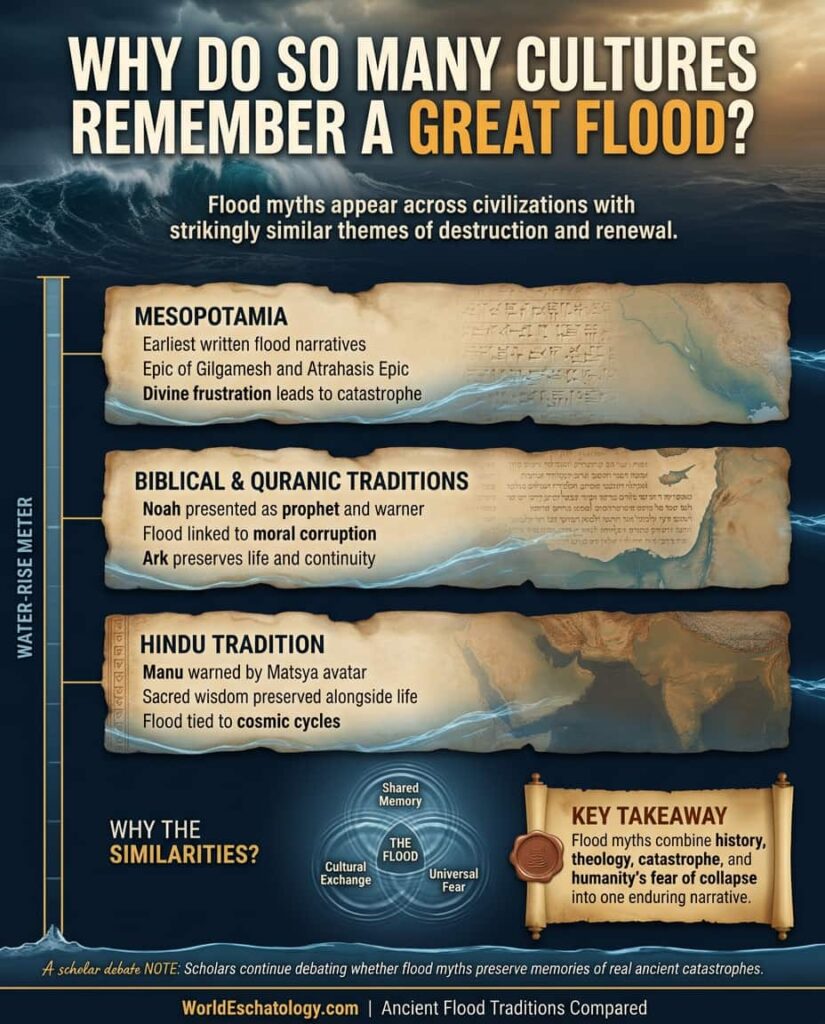
Flood myths exist in ancient Greece, in the oral traditions of indigenous peoples across North America, in the legends of Mesoamerica, in Chinese mythology, in Australian Aboriginal stories, in parts of Africa.
Almost every corner of the world has some version of it: the sky opened, the water rose, and most of humanity drowned. A small group survived.
There are a few ways to think about this.
One view is geological. At the end of the last ice age, around 10,000 to 12,000 years ago, sea levels rose dramatically across the globe as the massive ice sheets melted.
Coastal communities that had been thriving for generations were swallowed by the sea.
The Black Sea region, for example, is believed by some researchers to have experienced a catastrophic flood event that could have sent survivors scattering in every direction, carrying the memory with them.
Local floods, tsunamis, and river floods happening to different civilizations at different times would also leave the kind of scar on collective memory that turns into myth.
Another view is theological. Believers in the Abrahamic traditions hold that the flood actually happened, and the stories are different cultural echoes of the same real event.
A third view is psychological. Some scholars suggest that the flood myth taps into something deep in the human mind, a primal fear of nature’s power to erase everything, and that each culture independently gave that fear a story.
Most likely, the answer involves all three. But for the traditions we are about to look at, particularly the Mesopotamian and the Biblical, the connection is too specific and too detailed to be explained by psychology alone.
Utnapishtim: The Oldest Flood Story Ever Written
Let’s start with the oldest written version we have.
The Epic of Gilgamesh is an ancient Mesopotamian poem that is widely considered to be the oldest surviving piece of long-form literature in the world.
It was written in cuneiform on clay tablets, and versions of it have been found across the ancient Near East.
In it, a king named Gilgamesh goes on a quest for immortality after the death of his best friend. His search eventually leads him to a man named Utnapishtim, the only mortal who has been granted eternal life.
And the reason Utnapishtim was granted eternal life? Because he survived the great flood.
How the Story Goes
The gods held a council and decided to send a flood to destroy humanity.
The reasons given are somewhat vague in the text, but the word used to describe the problem is “noise” or “uproar”.
Humanity had become too loud, too troublesome. The god Enlil, one of the chief deities, wanted them gone.
But another god, Ea (also known as Enki), had a soft spot for Utnapishtim.
Ea could not directly disobey the council of the gods, so he spoke to a wall of a house, knowing that Utnapishtim was on the other side listening.
He told the wall to instruct the man to tear down his house, abandon his possessions, and build a boat. The boat had to be enormous, with specific measurements.
It had to have multiple decks. It had to be coated with bitumen to make it waterproof.
Utnapishtim was told to load the boat with his family, the craftsmen of his city, and all living creatures.
Then the flood came. The text describes it in terrifying detail. The storm was so fierce that even the gods were afraid.
They retreated to the highest heaven and crouched against the walls like dogs. The goddess Ishtar, who had agreed to the destruction, wept when she saw it actually happening.
After seven days and seven nights, the storm subsided. Utnapishtim’s boat came to rest on a mountain.
He sent out birds to test whether the land had dried: first a dove, which came back. Then a swallow, which also came back.
Finally a raven, which did not return, meaning it had found dry land. Utnapishtim opened the boat and offered a sacrifice to the gods.
They gathered around the offering, the text says, “like flies”, hungry after the flood.
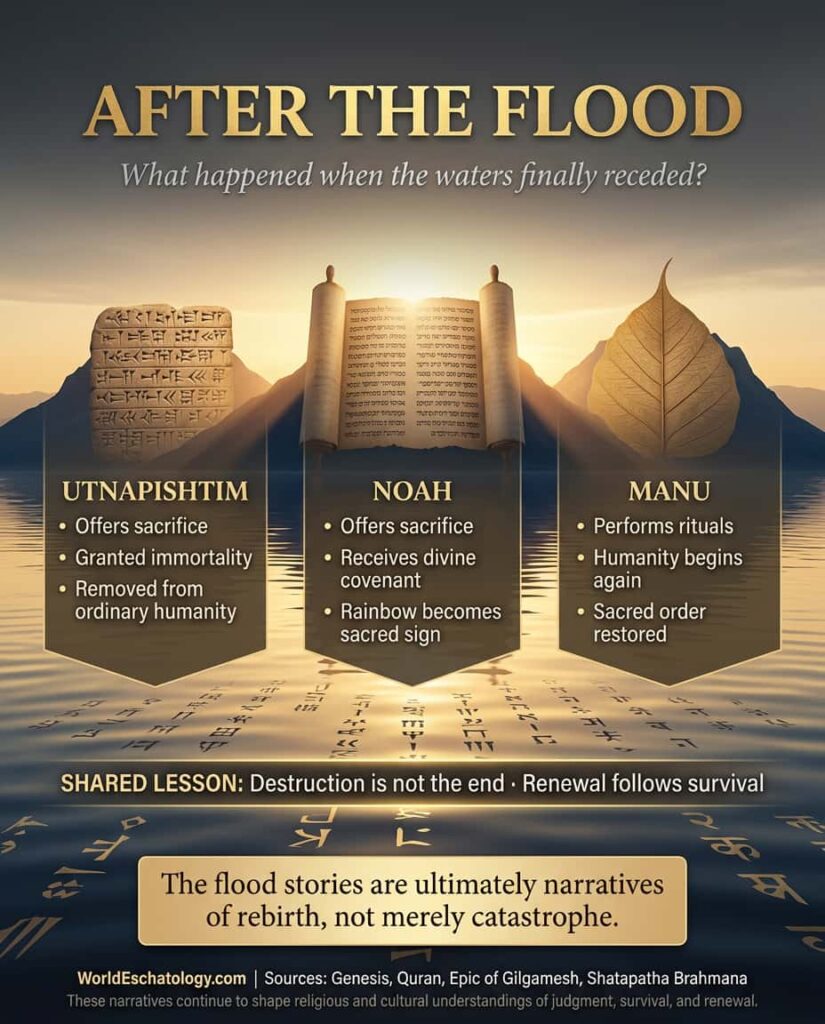
As a reward for his survival and his faithfulness, Utnapishtim and his wife were granted immortality and placed at the mouth of the rivers.
What Makes This Story Remarkable
The Epic of Gilgamesh predates the written form of the Biblical flood story by at least a thousand years.
Scholars discovered this in the 19th century when clay tablets were excavated from the ruins of the ancient library of Nineveh.
When the tablets were translated, people were stunned to find a flood narrative that mirrored the story of Noah so closely that it caused a public sensation.
There is also an even older Mesopotamian text called the Atrahasis Epic, which contains its own version of the flood story.
And then there is the Sumerian King List, which refers to the great flood dividing the era of the kings who ruled before it from those who ruled after.
In other words, the flood story was already old and well established in Mesopotamian culture long before the Biblical version was written down.
Noah: The Prophet Who Built a Boat When There Was No Rain
Most people reading this will know Noah’s story in some form, but it is worth walking through it carefully because the details matter when you compare it to the others.
In both the Bible and the Quran, Noah is a prophet, not simply a good man who got lucky.
He is chosen by God specifically because of his righteousness in a world that had gone deeply corrupt.
His job is not just to survive. His job is to warn his people, call them back to faith, and when they refuse, to be preserved as the seed of a new beginning.
The Biblical Account
In the Book of Genesis, God looks at humanity and sees that wickedness has become the norm.
The human heart is described as bent toward evil continually. God decides to send a flood, but tells Noah in advance and gives him specific instructions for building an ark.
The ark is enormous by any standard. Noah is told to take two of every animal, male and female, along with his wife, his sons, and their wives.
He builds the ark, loads it, and the flood comes. Rain falls for forty days and forty nights. The waters rise until even the mountains are covered. Everything on land dies.
After five months, the water begins to recede. The ark rests on the mountains of Ararat.
Noah sends out a raven and then a dove. The dove returns the first time with nothing.
The second time it comes back with an olive branch, telling Noah the water has gone down. The third time the dove does not return at all.
When Noah finally steps off the ark, he builds an altar and makes a sacrifice to God.
God makes a covenant with Noah and with all living creatures: never again will a flood destroy the earth. The rainbow is given as the sign of this promise.
The Quranic Account
The Quran tells Noah’s story across multiple chapters, and the focus is somewhat different from the Biblical version.
In the Quran, Noah is above all a prophet who preaches for a very long time.
The Quran says he called his people for nine hundred and fifty years, morning and night, publicly and privately, trying every approach he could think of.
They mocked him. They covered their ears when he spoke. They rejected him generation after generation.
Allah eventually tells Noah that no more of his people will believe, and instructs him to build the ark.
The Quran specifically mentions that Noah’s own son refused to get on the boat, convinced he could survive by climbing a mountain.
He drowned. Noah called out to Allah in grief over his son, and Allah reminded him that the son had not been a believer and therefore was not of Noah’s household in the way that mattered.
This is one of the most emotionally charged moments in the Quranic flood narrative. It is not just a story about water and survival.
It is a story about faith being more defining than blood, and about the pain of watching someone you love choose destruction.
After the flood, the ark rests on Mount Judi, which the Quran names specifically.
The earth is told to swallow its water and the sky to stop its rain. A new era begins.
What Is Different About Noah
The most important difference between Noah and the other flood survivors is his role as a prophet with a message.
Utnapishtim survives because a sympathetic god tipped him off privately. Manu, as we will see, is warned by a divine fish.
But Noah’s story is embedded in a long narrative of preaching, rejection and judgment.
The flood is not a random catastrophe or a divine accident. It is a moral verdict on a civilization that had every chance to change and refused.
Manu: The Hindu Flood and the Fish That Grew
The story of Manu comes from the ancient Hindu texts, and it is perhaps the least well known of the three in Western audiences.
But it is just as fascinating, and in some ways it is the most visually unique.
Manu is a figure in Hindu tradition who holds a role roughly similar to Adam in the Abrahamic traditions.
He is the ancestor of humanity, the first man, and the progenitor of the human race.
The flood story associated with him appears in both the Shatapatha Brahmana and later in the Mahabharata, though the versions differ in some details.
The Story of the Fish
One morning, Manu was washing his hands when a small fish swam into his hands and spoke to him.
The fish asked him to take care of it and promised that in return, it would save him from the great flood that was coming.
Manu put the fish in a jar. The fish grew until the jar was too small, so Manu moved it to a larger container.
The fish kept growing. He moved it to a pond, then to a river, then finally to the sea. Each time, the fish warned him: protect me and I will protect you.
When the fish had grown to a size no ordinary fish could reach, it revealed its identity.
It was Matsya, the fish avatar of the god Vishnu, or in some versions, the god Brahma.
It told Manu that the flood was imminent and instructed him to build a large boat and load it with seeds of all living things and with the seven great sages (the Saptarishi).
The flood came. Manu tied his boat to the horn of the great fish using a rope.
The fish towed the boat through the raging waters until they reached the highest northern mountain.
Manu was told to tie the boat to the mountain and to come down gradually as the waters fell.
After the flood, Manu was the only human left on earth. He performed rituals and sacrifices.
From these rituals, according to some versions, a woman was created who became his companion, and from them the human race was repopulated.
The Deeper Meaning in the Manu Story
What strikes you about the Manu story is the gradual nature of the warning. This is not a sudden message from the sky.
It is a long relationship with a creature that grows and reveals itself over time.
There is something in that image, the responsibility of caring for something small before it becomes something great, that feels very different from the urgency in the other stories.
In Hindu theology, the Matsya avatar is traditionally considered the first of the ten major avatars of Vishnu.
The flood story is therefore not just a flood story. It is also the beginning of the divine presence making itself known in the physical world.
Vishnu descends in the form of a fish specifically to preserve life and guide humanity through a catastrophe.
The inclusion of the seven sages alongside Manu is also significant. Seeds of plants and holy knowledge are both being preserved.
It is not just biological survival that matters. Spiritual and intellectual inheritance matters too.
Laying the Three Stories Side by Side
Now that we have walked through each tradition, it helps to bring them together and look at what they share and where they go their separate ways.
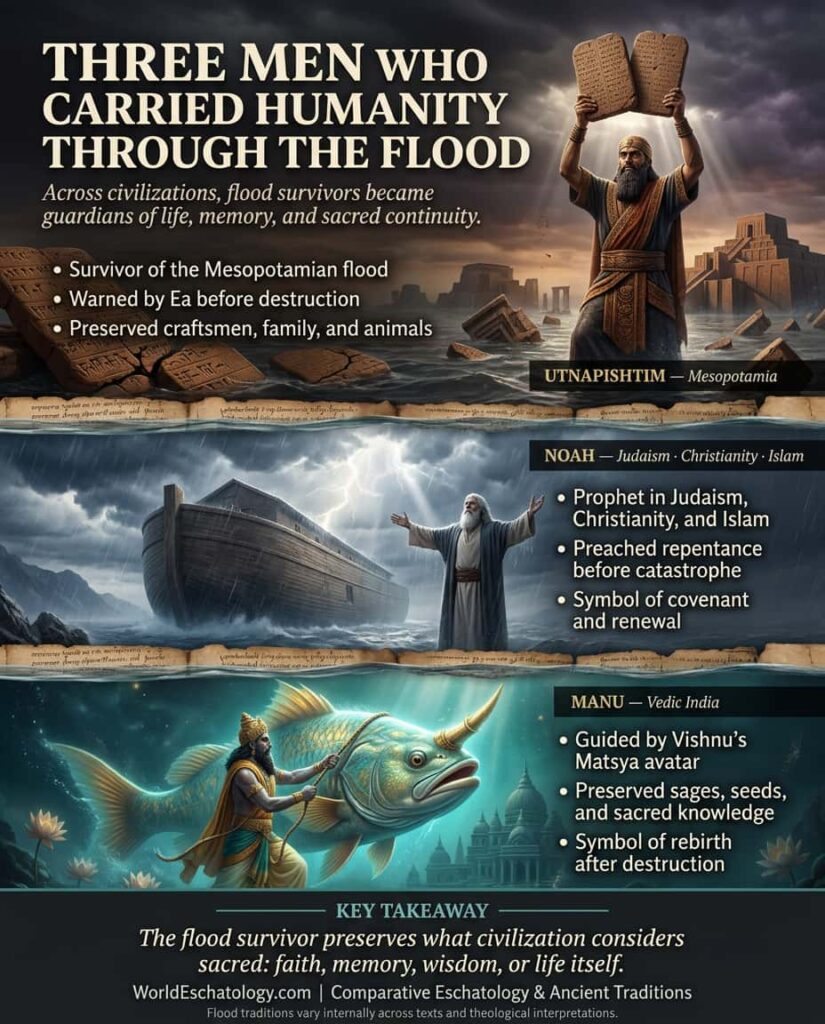
What All Three Have in Common
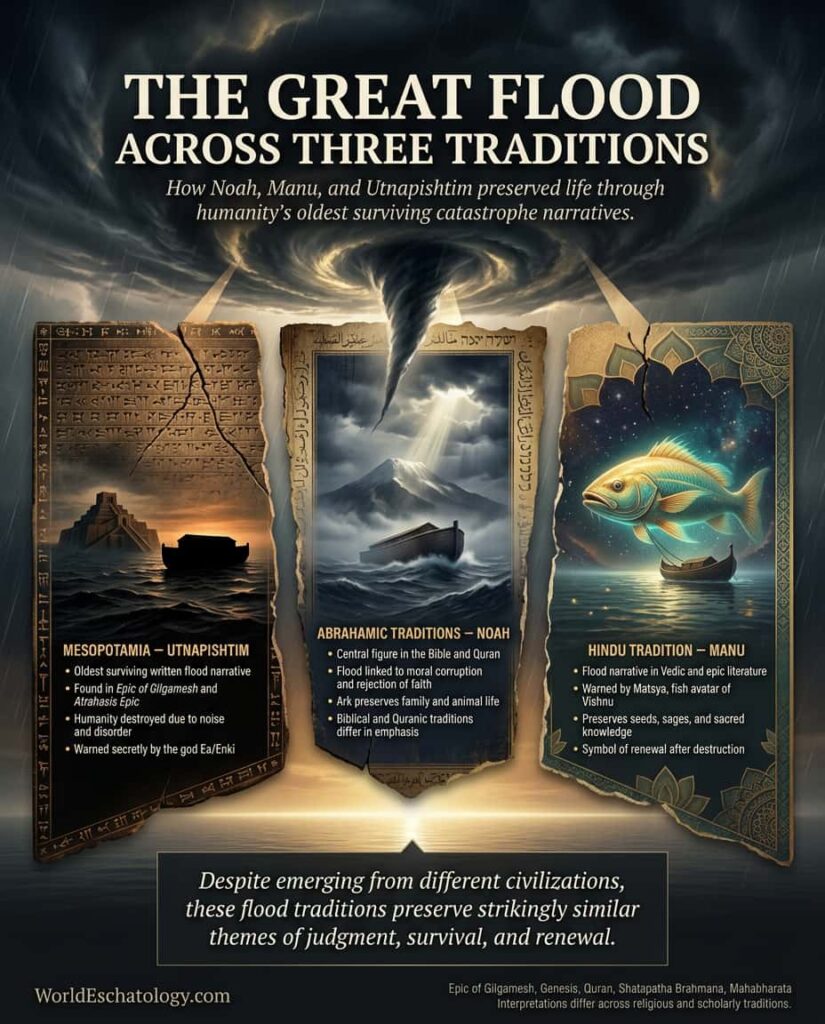
All three stories involve a flood sent by divine power that wipes out the vast majority of humanity.
In all three, one man receives a warning in advance that others do not receive. In all three, the man is described as righteous or faithful in some way.
In all three, he builds a vessel and loads it with living creatures or the seeds of life. In all three, he survives.
In all three, he makes some kind of offering after the flood. And in all three, the flood marks the end of one era and the beginning of another.
The sending of birds to test the receding of water appears in both the Mesopotamian and the Biblical accounts with striking similarity: the use of a dove and a raven or similar birds, sent out in sequence, is present in both.
Where They Differ
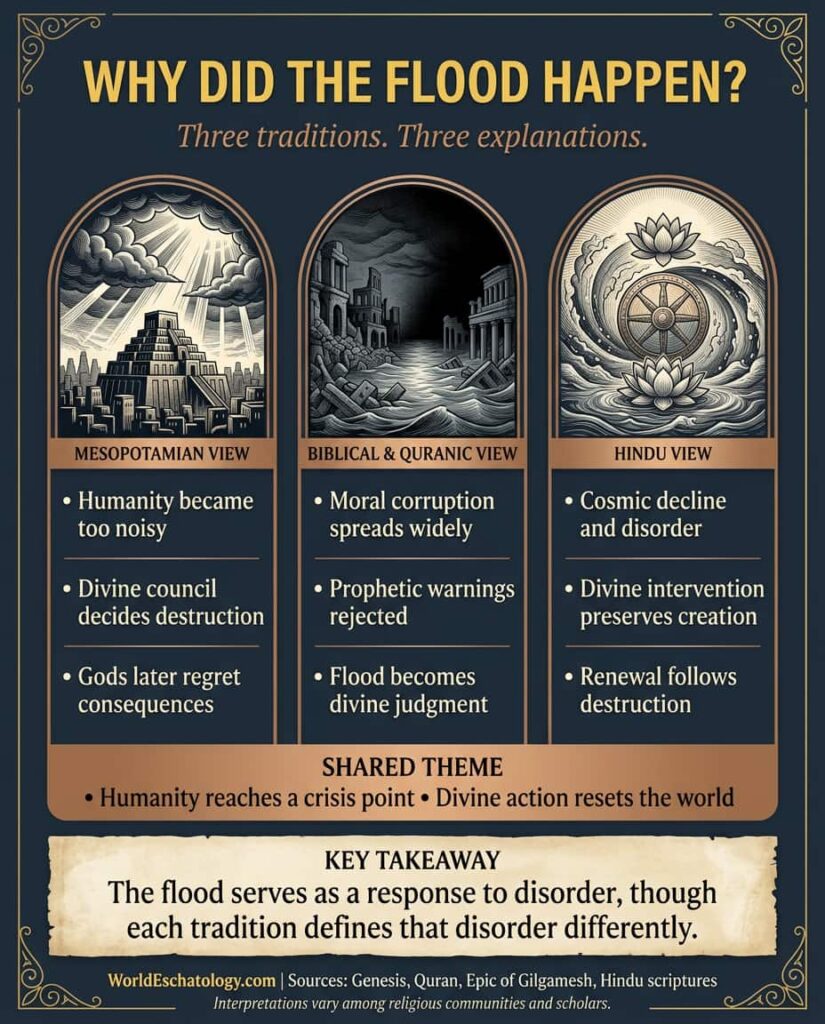
The nature of the divine is handled very differently. The Mesopotamian version has multiple gods who argue, weep, and even regret their decision.
The Biblical God acts with singular purpose and moral clarity. The Hindu version involves an avatar of Vishnu taking physical form as a fish, a completely different kind of divine-human interaction.
The reason for the flood also differs. In the Mesopotamian text, it is overpopulation and noise.
In the Biblical and Quranic accounts, it is moral corruption and the rejection of faith.
In the Manu story, the reasons are less specific, with some versions describing a general age of degradation rather than a particular moral failing.
The aftermath is different too. Utnapishtim is taken out of the human world entirely and given immortality.
Noah receives a covenant and a rainbow. Manu is left alone and must repopulate the world through ritual.
And the tone is different. The Mesopotamian version, despite its power, reads like a cosmic tragedy in which even the gods are overwhelmed.
The Quranic version reads like a final judgment after centuries of mercy and warning.
The Manu story reads almost like a fairy tale at its opening, with a little fish asking to be carried in the palm of a man’s hands.
Did These Stories Borrow from Each Other?
This is where things get interesting, and sometimes contentious.
The relationship between the Mesopotamian flood story and the Biblical one is fairly well accepted among scholars.
The similarities are too specific to be coincidence: the boat construction, the animals, the birds sent out to test the waters, the divine smell of the sacrifice, the reward to the survivor.
The likely explanation is that the ancient Israelites, who spent significant time in Babylon during the exile period, came into contact with Mesopotamian literature and that some of those stories influenced or merged with existing oral traditions.
This does not mean the Biblical account is simply copied. The theological content is completely transformed.
The morality is different, the nature of God is different, and the purpose of the story is different.
Even if the template was shared, what was built on it was something new.
The Manu story is a different matter. The parallels are real but the distance, both geographical and cultural, makes direct borrowing less likely, though not impossible.
Some scholars point to very ancient contact between Mesopotamian and Vedic cultures along trade routes.
Others believe the similarities reflect a shared ancient memory of real catastrophic floods that affected populations across a wide region. The debate is ongoing.
What nobody seriously argues is that these stories are all accidents. The parallels are too consistent across too many traditions for that.
What These Stories Are Really About
A flood story, when you strip it down to its bones, is a story about the end of one world and the beginning of another.
It is a story about what gets destroyed, what gets saved, and who decides which is which.
In each tradition, the survivor is not just a lucky person. He is a representative of something worth preserving.
Noah carries faith and prophecy. Manu carries sacred knowledge and the seeds of life.
Utnapishtim carries the memory of a time before, which is why Gilgamesh seeks him out.
There is also a theme of accountability running through all of them. The world before the flood was not good.
Something had gone wrong, whether it was moral corruption, spiritual blindness, or simply the weight of a civilization that had grown out of control. The flood is not random. It is a response.
For people of faith reading the Islamic or Biblical account, this is a reminder about the nature of divine justice and the real consequences of turning away from what is right.
For anyone reading these stories as literature or history, they raise genuine questions about what kind of people and what kind of knowledge is worth carrying forward when everything else is lost.
And for all of us, there is something quietly humbling about the image of one person in a boat, surrounded by water in every direction, waiting for the earth to become habitable again.
It is one of the oldest images of human vulnerability that we have.
Frequently Asked Questions
Q: Is the story of Noah mentioned in the Quran?
Yes, extensively. Noah (Nuh in Arabic) is one of the major prophets in Islam and his story is told across multiple chapters of the Quran, including Surah Hud (chapter 11) and an entire chapter named after him, Surah Nuh (chapter 71).
The Quran emphasizes his role as a preacher who called his people for 950 years before the flood came.
Q: How old is the Epic of Gilgamesh and its flood story?
The oldest known versions of the Gilgamesh flood narrative date to around 2100 BCE, with some fragments possibly older.
The most complete version we have comes from tablets found in the library of Ashurbanipal in Nineveh, dated to around 700 BCE.
Earlier flood accounts, like the Atrahasis Epic and the Sumerian King List, suggest the flood story was circulating in Mesopotamia as far back as 2700 BCE or earlier.
Q: Where does the Manu flood story appear in Hindu texts?
The most detailed version appears in the Shatapatha Brahmana, which is an ancient Sanskrit text that forms part of the Yajur Veda.
A later version appears in the Mahabharata, one of the great Hindu epics. The two versions agree on the core of the story but differ in some details.
The Shatapatha version identifies the fish as Brahma, while the Mahabharata version identifies it as Vishnu in the form of the Matsya avatar.
Q: Why do so many cultures around the world have flood myths?
Several explanations have been proposed. Geological evidence shows that sea levels rose dramatically after the last ice age, and major flood events would have left a powerful mark on collective memory.
Some researchers point to specific events like a catastrophic flooding of the Black Sea basin around 5600 BCE as a possible origin for Near Eastern flood traditions.
Others emphasize that floods are one of the most common and devastating natural disasters in human experience, making it natural for cultures everywhere to develop stories about a great one.
For believers in the Abrahamic traditions, the stories reflect a real historical event.
Q: Did the ancient Israelites borrow Noah’s story from the Mesopotamians?
Most scholars believe there is a significant relationship between the two traditions, particularly given the close parallels in specific details like the birds sent out to test the waters.
The theory is not that the Biblical account is simply copied, but that ancient oral traditions circulating in the Near East influenced each other over time, and that the Babylonian exile gave Israelite writers direct exposure to Mesopotamian texts.
However, the theological content of Noah’s story is fundamentally different from the Gilgamesh version, pointing to an independent religious tradition that reshaped whatever it borrowed.
Q: What is the significance of the rainbow in Noah’s story?
In the Biblical account, the rainbow is the sign of a covenant between God and all living creatures, a promise that a flood of this scale will never happen again.
It serves as a visible, recurring reminder of this promise. The rainbow does not appear in the Quranic version or in the Mesopotamian version, making it a distinctive element of the Biblical narrative.
Q: Who are the seven sages that Manu saved in the Hindu flood story?
The seven sages, known as the Saptarishi, are a group of divine or semi-divine wise men who appear throughout Hindu tradition as the keepers of sacred knowledge.
In the flood story, they represent the spiritual and intellectual heritage of humanity that needs to be preserved alongside biological life.
The specific names of the seven sages vary slightly between different Hindu texts.
Q: Is there any archaeological evidence for the great flood?
This is a topic with genuine ongoing discussion. Archaeologists have found evidence of large-scale flood events at ancient Mesopotamian sites like Shuruppak and Ur, with distinct layers of water-deposited silt separating occupation layers.
Leonard Woolley’s excavations at Ur in the 1920s famously uncovered what he called a flood layer, though later analysis suggested it was a local rather than a universal event.
On a larger scale, evidence of rapid sea level rise at the end of the ice age and studies suggesting a significant inflow of water into the Black Sea basin continue to fuel the debate about whether a real catastrophic flood lies behind the stories.
Final Thoughts
There is something worth sitting with after reading these three traditions side by side.
Each story comes from a different world. Different language, different theology, different culture.
And yet they all arrive at the same moment: one man, a boat, rising water, and the weight of carrying whatever is worth saving into whatever comes next.
Whether you read these stories as history, as spiritual truth, as collective memory or as great literature, they are asking something of you.
They are asking you to think about what kind of world leads to its own destruction.
What kind of person is worth preserving. What you would put in the boat if the water started rising.
Noah spent nine hundred and fifty years trying to wake people up. Utnapishtim had one night to build a boat.
Manu had a fish that grew in the palm of his hand until it filled the sea. Three warnings. Three survivors. Three versions of the same urgent message.
The flood always comes for the world that forgot what mattered.