
Few passages in the entire Bible have generated as much sustained theological debate as the twentieth chapter of the Book of Revelation.
In six verses, the text describes an angel binding Satan with a great chain and casting him into a bottomless pit for a thousand years, while the souls of martyrs and faithful believers come to life and reign with Christ for that same period.
At the end of the thousand years, Satan is released, defeated, and thrown into a lake of fire. Then comes the final resurrection, the last judgment, and the new creation.
That description of the thousand-year reign of Christ, referred to by scholars as the millennium in Revelation, has been read in radically different ways by theologians, preachers, and ordinary believers since the earliest centuries of the church.
Does it describe a literal future period in which Jesus Christ will physically rule the earth from Jerusalem?
Is it a symbolic picture of the current age of the church, already underway? Or does it represent a transformed state beyond ordinary history altogether?
The answer a Christian community gives to those questions shapes its entire approach to prophecy, politics, history, and hope.
The debate has sharpened in the twenty-first century.
Geopolitical instability in the Middle East, intense Christian interest in the state of Israel, and the global reach of prophecy-focused media have made the millennium in Revelation a live question for hundreds of millions of believers.
Understanding what the tradition actually teaches, in all its genuine diversity, is both intellectually necessary and spiritually valuable.
What Christian Theology Teaches About the 1,000 Year Reign of Christ
The Central Passage: Revelation 20:1-6
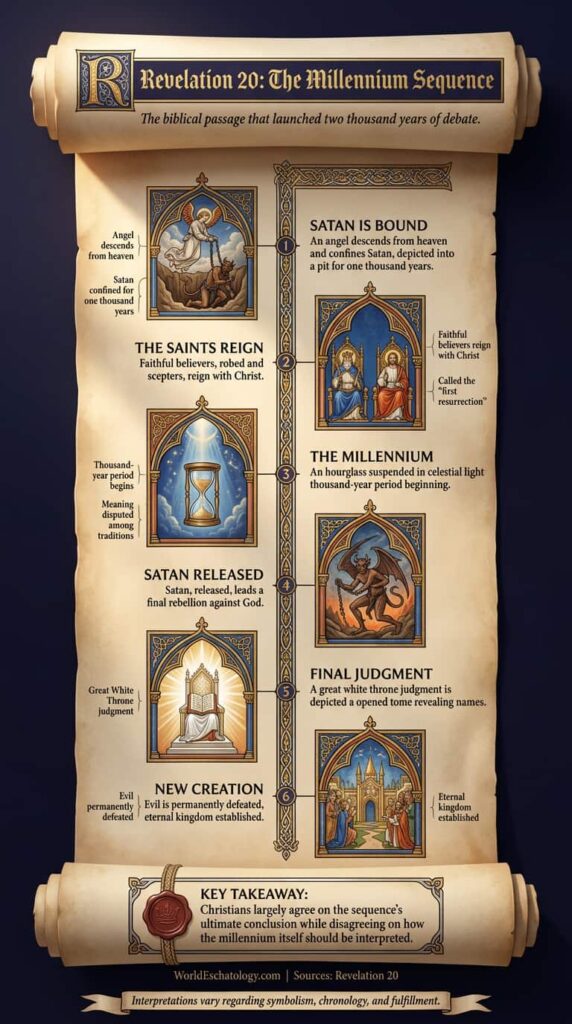
The entire Christian debate about the millennium is anchored in Revelation 20:1-6.
The text describes John seeing an angel descend from heaven holding a great chain.
The angel seizes the dragon, described as that ancient serpent who is the Devil and Satan, binds him for a thousand years, and locks him in the bottomless pit to prevent him from deceiving the nations during that period.
John then sees thrones, and those sitting on them are given authority to judge.
He sees the souls of those who had been beheaded for their witness to Jesus and for the word of God, and those who had not worshiped the beast or its image and had not received its mark on their foreheads or their hands.
They come to life and reign with Christ for a thousand years. The rest of the dead do not come to life until the thousand years are ended.
This is called the first resurrection. Those who share in the first resurrection are described as blessed and holy, and the second death has no power over them.
The passage continues past the millennium itself: after the thousand years, Satan is released, leads a final rebellion of the nations, is defeated by fire from heaven, and is thrown into the lake of fire where the beast and the false prophet already are.
Then comes the great white throne judgment, in which all the dead are judged according to their works, and death and Hades themselves are thrown into the lake of fire in what the text calls the second death.
Almost every element of this passage is contested: whether the thousand years is literal or figurative, whether the first resurrection is physical or spiritual, whether the binding of Satan is total or partial, whether the reign of the saints is earthly or heavenly, and whether these events are future or already underway.
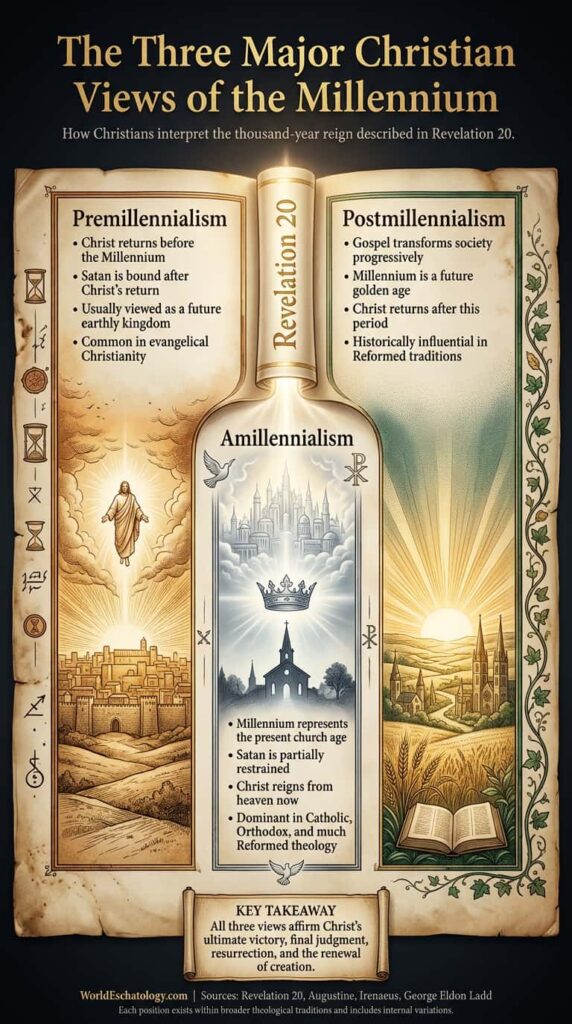
The three major positions that have developed in Christian theology are named premillennialism, amillennialism, and postmillennialism.
Premillennialism: The Literal 1,000 Year Reign of Christ on Earth
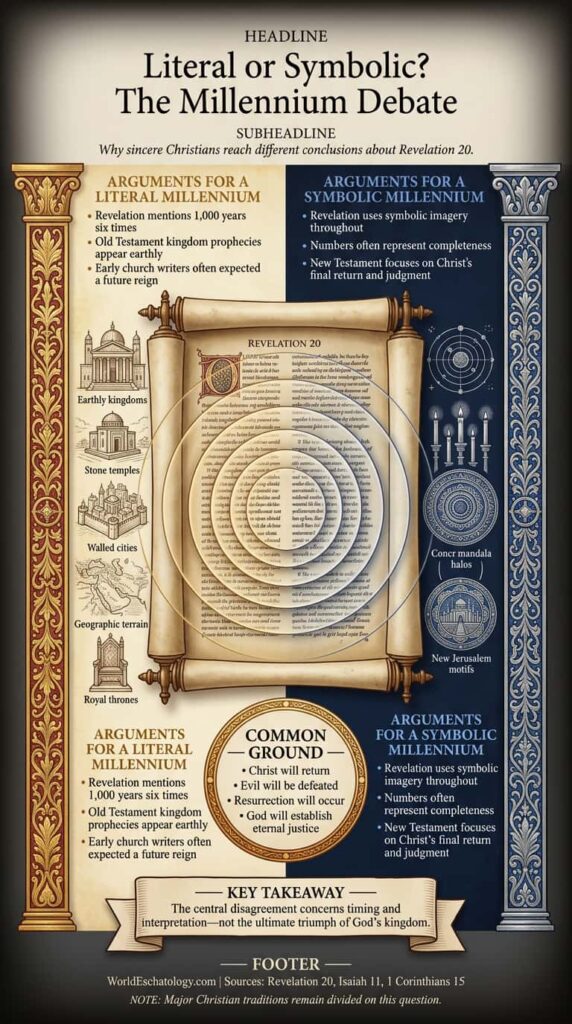
Premillennialism holds that the second coming of Jesus Christ will occur before the millennium, meaning that Christ will return physically to earth, defeat his enemies, bind Satan, and then establish a literal kingdom that will last a thousand years.
The 1,000 year reign of Christ, in this reading, is a future historical period of unprecedented peace, justice, and divine governance, with Christ reigning from Jerusalem and the resurrected saints ruling with him.
Within premillennialism, there is a further major division between historic premillennialism and dispensational premillennialism.
Historic premillennialism, associated with early church figures including Justin Martyr, Irenaeus, and Tertullian and in modern times with scholars such as George Eldon Ladd, holds that the church will pass through a period of great tribulation before Christ returns to establish the millennial kingdom.
The church is not removed from history before the tribulation but is preserved through it.
Dispensational premillennialism, which became enormously influential in evangelical and fundamentalist Protestant Christianity especially in North America from the nineteenth century onward, teaches a more complex sequence.
Associated with John Nelson Darby and popularized by the Scofield Reference Bible, the Left Behind series, and numerous prophecy teachers, it holds that the church will be secretly raptured before a seven-year period of great tribulation, after which Christ will return visibly to defeat the Antichrist at the Battle of Armageddon and establish the millennial kingdom.
A key feature of dispensationalism is its expectation that the modern state of Israel plays a central role in the end-times scenario, with the restoration of temple worship in Jerusalem during or after the tribulation period.
Amillennialism: The Millennium as the Present Age of the Church
Amillennialism, despite its name suggesting a denial of the millennium, does not deny the passage in Revelation 20 or the concept it describes.
It interprets the thousand years as a symbolic representation of the current age between the first and second comings of Christ, during which Satan is bound in the sense of being restrained from deceiving the nations in the way he did before the gospel spread throughout the world, and the souls of the faithful who have died reign with Christ in the heavenly realm.
In the amillennial reading, the first resurrection of Revelation 20 is spiritual rather than physical, referring to the new birth of believers or to the souls of the martyrs who are already with Christ in glory.
The binding of Satan is understood as partial and purposeful: Satan cannot prevent the gospel from reaching all nations, though he continues to cause harm in other ways.
The millennium ends not with a literal thousand years concluding but with the final return of Christ, who will raise all the dead, judge all humanity, and inaugurate the eternal new creation described in Revelation 21 and 22.
Amillennialism has been the dominant position in Roman Catholicism, in the Eastern Orthodox churches, and in much of the Reformed Protestant tradition including the churches most directly shaped by the theology of John Calvin and Augustine of Hippo.
Augustine’s enormously influential work The City of God, written in the early fifth century, developed the amillennial interpretation as a deliberate response to what he saw as an overly literal and materialistic reading of the millennium passage.
His interpretation shaped Western Christianity for over a thousand years and remains highly influential.
Postmillennialism: The Church Ushering in the Kingdom Before Christ Returns
Postmillennialism holds that the millennium represents a future golden age of Christian civilization that will be brought about through the Spirit-empowered preaching of the gospel and the progressive Christianization of human society.
On this view, Christ will return after the millennium, coming to receive a world that has been substantially transformed by the spread of Christian faith, justice, and values.
The 1,000 year reign of Christ is understood not as Christ personally and physically present on earth but as his reign through the church, his body, as it exercises growing influence in the world.
Postmillennialism was influential in the Reformed tradition during the seventeenth through nineteenth centuries, particularly in the English-speaking world, and is associated with theologians including Jonathan Edwards and Charles Hodge.
In more recent times it has been associated with Christian Reconstructionism and theonomy, movements that advocate the application of biblical law to civil society.
It was partially eclipsed in the twentieth century by the twin catastrophes of the two World Wars, which made optimistic visions of Christian civilization difficult to sustain, but has seen a revival among some Reformed and evangelical theologians.
Key Biblical Texts on the Millennium in Revelation
Revelation 20: The Primary Source
Revelation 20:1-6 is the only passage in the entire Bible that explicitly mentions a thousand-year period connected to the reign of Christ and the binding of Satan.
This fact is itself significant and shapes the debate: those who hold amillennial or postmillennial views often note that a doctrine of enormous historical and theological consequence rests on a single passage in the Bible’s most symbolic and contested book.
Those who hold premillennial views respond that the passage is straightforward enough to be taken at face value and that its teaching is consistent with the broader scriptural witness to a future earthly kingdom.
Old Testament Passages: The Kingdom Prophecies
Premillennialists in particular draw heavily on Old Testament prophetic passages that describe a future era of peace, justice, and divine rule on earth.
Isaiah 2:1-4 describes a time when the mountain of the Lord’s house will be established as the highest of the mountains, and all nations will stream to it, and God will judge between the nations so that they beat their swords into plowshares and their spears into pruning hooks.
Isaiah 11 describes a shoot from the stump of Jesse on whom the Spirit of the Lord will rest, under whose rule the wolf will dwell with the lamb, the nursing child will play over the hole of the cobra, and the earth will be full of the knowledge of the Lord as the waters cover the sea.
Zechariah 14 describes the Lord standing on the Mount of Olives, the nations gathering against Jerusalem, and ultimately the Lord becoming king over all the earth and being worshiped by all surviving nations annually at the Feast of Booths in Jerusalem.
Ezekiel 40 through 48 describes a detailed vision of a future temple in the land of Israel with specific measurements, priestly duties, and sacrificial offerings.
Premillennialists, and especially dispensationalists, read these passages as describing literal future conditions during the millennial kingdom.
Amillennialists and postmillennialists read them as poetic descriptions of the blessings of the gospel age or of the eternal new creation, not as blueprints for a literal future earthly kingdom.
New Testament Passages: The Kingdom Already and Not Yet
Beyond Revelation 20, New Testament passages bearing on the millennium include Acts 1:6-7, where the disciples ask the risen Jesus whether he will at that time restore the kingdom to Israel and Jesus responds that it is not for them to know the times or seasons that the Father has fixed by his own authority.
Matthew 19:28 and Luke 22:30 describe the disciples sitting on twelve thrones judging the twelve tribes of Israel in a coming renewal of all things.
First Corinthians 15:22-26 describes Christ reigning until he has put all his enemies under his feet, with the last enemy being death, and then delivering the kingdom to the Father.
Romans 11 describes the future salvation of Israel in terms that premillennialists connect to the millennial restoration of the Jewish people.
Different Scholarly Views: The Range of Christian Positions
The Early Church: Widespread Premillennialism and Its Critics
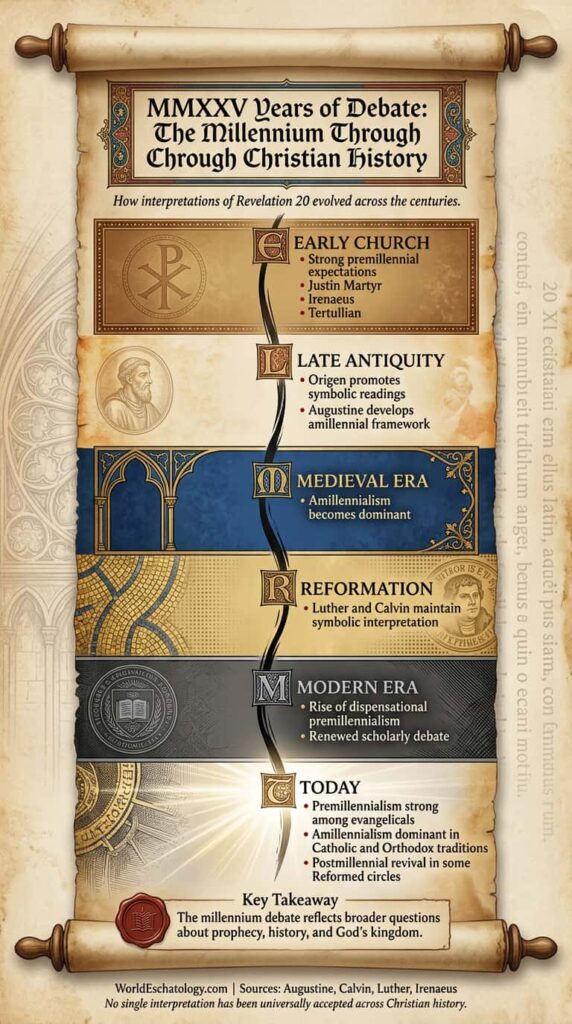
The earliest recoverable tradition in post-apostolic Christianity shows a strong current of premillennial expectation.
Justin Martyr in the second century affirmed that Christ would reign for a thousand years in Jerusalem in a rebuilt and enlarged city.
Irenaeus, one of the most important theologians of the second century, described the millennial kingdom in vivid terms: the earth would be extraordinarily fertile, one grain of wheat would produce ten thousand heads, and every creature would be at peace.
Tertullian shared these expectations. Papias, a bishop who claimed to have known the Apostle John himself, is reported to have taught an extremely literal and abundant millennial vision.
But even in the early period, there was significant opposition.
Origen of Alexandria, the greatest speculative theologian of the early church, opposed literal premillennialism vigorously and read the millennium allegorically as part of his broader tendency toward spiritual rather than literal interpretation of scripture.
Eusebius of Caesarea, the church historian, was sharply critical of Papias and of the premillennial tradition he represented.
And Augustine’s fifth-century synthesis, already described above, effectively established amillennialism as the dominant position in Western Christianity for the medieval period.
The Reformation and Post-Reformation Period
The Protestant Reformers, including Martin Luther, John Calvin, and their immediate successors, largely inherited the amillennial consensus of the medieval church on this specific question, even as they overturned many other theological traditions.
Calvin’s commentaries treat the millennium symbolically and are dismissive of what he called the fiction of the millennium.
Luther similarly interpreted the passage spiritually rather than as a prediction of a literal future reign.
The seventeenth century saw renewed interest in millennial expectations, partly driven by the intense eschatological atmosphere of the English Civil War and the broader Puritan movement.
Some in this period developed postmillennial visions of a coming age of gospel triumph.
The eighteenth and nineteenth centuries saw the development of the modern dispensational system, with its detailed prophetic timeline, rapture theology, and emphasis on Israel in the end times, which became enormously influential in English-speaking evangelical Protestantism.
Contemporary Scholarship and the State of the Debate
Contemporary biblical scholarship on the millennium in Revelation tends to be shaped heavily by one’s broader approach to apocalyptic literature.
Scholars who read Revelation primarily as a document addressed to first-century Christians under Roman persecution, such as Richard Bauckham, tend to interpret the millennium in terms of what it meant to that original audience:
a symbolic promise of vindication for the martyrs and ultimate divine sovereignty over the empire that was killing them.
Scholars who read Revelation primarily as future prophecy, such as Grant Osborne, engage with the millennial question as one of the central issues in a future eschatological sequence.
Within evangelical scholarship, premillennialism remains the most widely held position, though amillennialism has strong representation especially in Reformed circles.
Within mainline Protestantism and Roman Catholicism, amillennialism predominates.
Postmillennialism remains a minority position but has articulate contemporary defenders in the Reformed and theonomic traditions.
Eastern Orthodoxy: A Different Eschatological Emphasis
Eastern Orthodox Christianity has historically been less focused on the detailed sequential eschatology that has occupied much Western Christian theology.
The Orthodox tradition has generally not engaged in the premillennial versus amillennial versus postmillennial debate with the same intensity as Western Christianity, partly because it lacks the specific tradition of systematic eschatological speculation that developed in the Latin West and then in Protestantism.
Orthodox eschatology tends to emphasize the transfiguration and divinization of all creation, the resurrection of the dead, and the eternal kingdom, without placing significant theological weight on the specific question of a literal thousand-year period.
When Orthodox theologians do address the millennium passage directly, they generally read it along amillennial lines, treating the thousand years as a symbolic representation of the church age.
Why This Matters Today: The Millennium in Revelation and Current Events
The question of the 1,000 year reign of Christ is not merely an academic puzzle for theologians.
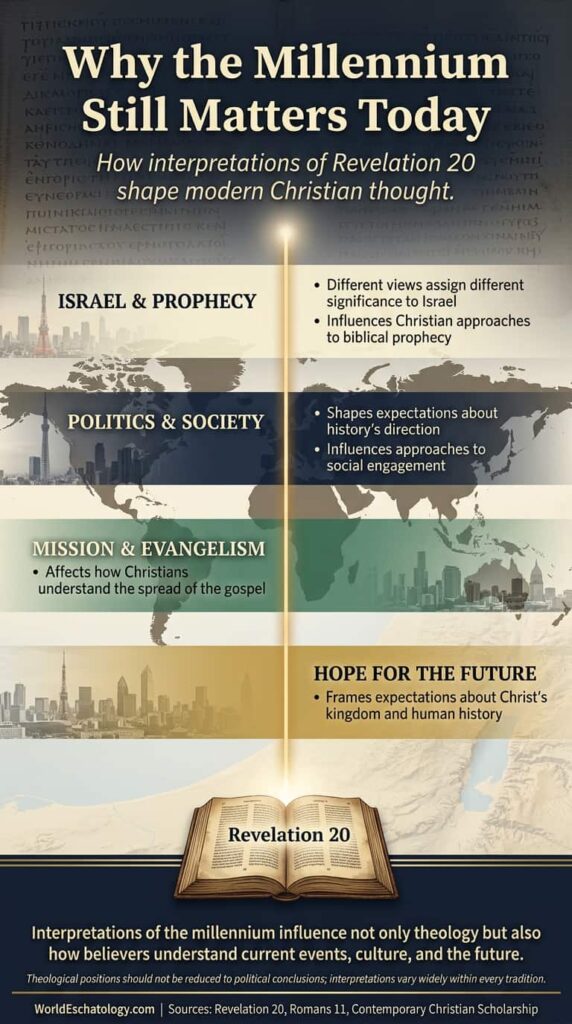
It shapes how millions of Christians understand current events, geopolitics, and the meaning of history itself.
The influence is most visible in the United States, where dispensational premillennialism shaped significant portions of evangelical and fundamentalist Christianity throughout the twentieth century and continues to do so.
The conviction that the modern state of Israel represents the fulfillment of biblical prophecy connected to the millennial kingdom has influenced American foreign policy debates significantly, because millions of Christian Zionists hold it as a matter of faith that supporting Israel is a biblical mandate connected to the end-times narrative.
The expectation of a future seven-year tribulation period, a literal Antichrist figure, and the Battle of Armageddon has shaped how many Christians in the premillennial tradition interpret international news, Middle Eastern politics, and the role of supranational institutions such as the United Nations.
Beyond geopolitics, the millennial question shapes attitudes toward social engagement.
If the world is inevitably deteriorating before Christ’s return, as classical dispensationalism tends to teach, there may be less motivation to invest heavily in long-term social transformation.
If, on the other hand, the church is called to extend the reign of Christ progressively through history, as postmillennialism teaches, or if the kingdom is already present in a real though incomplete way, as amillennialism affirms, the call to engage creatively and persistently with social, political, and cultural life looks rather different. These are not trivial differences.
Recent years have also seen a renewed scholarly and popular interest in what is sometimes called Christian nationalism in its various forms, and the millennial question is directly relevant to that conversation.
Some expressions of Christian nationalism draw on postmillennial or reconstructionist theology that envisions Christian cultural and political dominance as a step toward the coming kingdom.
Others draw on premillennial frameworks that locate divine blessing and curse in the treatment of Israel.
Understanding the eschatological underpinnings of these movements requires engaging seriously with the millennium in Revelation and the different ways it has been interpreted.
Frequently Asked Questions About the Millennium in Revelation
What is the millennium in Revelation?
The millennium in Revelation refers to the thousand-year period described in Revelation 20:1-6, during which Satan is bound and prevented from deceiving the nations, and the souls of the martyrs and the faithful reign with Christ.
The passage describes this as the first resurrection, after which the rest of the dead are raised, Satan is finally defeated, and the last judgment takes place.
The millennium is the subject of one of the most significant and long-running debates in the history of Christian theology, with three major positions, premillennialism, amillennialism, and postmillennialism, offering fundamentally different interpretations of what the passage means and when the events it describes take place.
What is the 1,000 year reign of Christ?
The 1,000 year reign of Christ is the period described in Revelation 20 during which Christ reigns and his faithful servants reign with him.
In premillennial Christianity, this is understood as a literal future period of one thousand years during which Jesus will physically rule the earth from Jerusalem after his second coming.
In amillennial Christianity, it is understood as a symbolic description of the present age of the church, in which Christ reigns from heaven and the souls of the departed faithful share in that heavenly reign.
In postmillennialism, it refers to a future golden age of Christian civilization that will be brought about through the gospel before Christ’s return.
The phrase 1,000 year reign of Christ is therefore interpreted very differently depending on one’s eschatological tradition.
What is premillennialism and what does it teach?
Premillennialism is the belief that Jesus Christ will return to earth before the thousand-year period described in Revelation 20, that his return will be physical and visible, and that he will then establish a literal kingdom on earth for a thousand years.
In this kingdom, Satan will be bound and unable to deceive the nations, resurrection believers will reign with Christ, and an era of unprecedented peace and justice will prevail.
At the end of the thousand years, Satan will be released for a final rebellion, defeated, and judged, after which the general resurrection and last judgment will occur.
Premillennialism was common in the early church and remains the most widely held position in evangelical Protestantism.
Its dispensational form, which adds the rapture and a detailed tribulation sequence, is particularly widespread in North American evangelical Christianity.
What is amillennialism?
Amillennialism is the interpretation of Revelation 20 that understands the thousand years as a symbolic figure representing the present age between the first and second comings of Christ.
In the amillennial view, Satan has been bound in the sense that his power to deceive the nations and prevent the spread of the gospel has been restrained since the first coming of Christ.
The first resurrection is understood as the spiritual new birth of believers or as the souls of the martyrs already reigning with Christ in heaven.
The millennium is therefore not a future period to be awaited but a present reality already underway.
Christ will return at the end of this age not to begin a thousand-year reign but to raise all the dead, judge all humanity, and inaugurate the eternal new creation.
Amillennialism has been the dominant position in Roman Catholicism, Eastern Orthodoxy, and much of Reformed Protestantism.
Does the Bible clearly teach a literal 1,000 year reign of Christ on earth?
The honest answer is that Christians who are equally committed to the authority of scripture have reached opposite conclusions on this question, which means it is not a question with a single obvious biblical answer.
Those who argue for a literal thousand-year reign point to the plain reading of Revelation 20, which mentions the thousand years six times, and to the many Old Testament prophecies of a future earthly kingdom that they believe require a literal millennial fulfillment.
Those who argue against a literal thousand-year earthly reign point out that Revelation is an apocalyptic book filled with symbolic numbers and imagery, that the number one thousand frequently functions in biblical literature as a symbolic figure for completeness or a very long period rather than a precise count, and that the New Testament as a whole does not describe a period between Christ’s return and the final judgment.
This is a question on which sincere, knowledgeable, and devout Christians have disagreed for two thousand years.
What do Catholics believe about the millennium?
The Roman Catholic Church’s official position is amillennial, though it does not use that specific term in its teaching.
The Catechism of the Catholic Church explicitly warns against what it calls a millenarianism, meaning the belief in a glorious earthly triumph of Christ before the last judgment, and states that this idea has a distorted form even in the softened secular forms it takes today.
Catholic theology, shaped primarily by Augustine’s interpretation, understands the millennium of Revelation 20 as representing the age of the church and the reign of Christ through his body the church in the world.
The Church does teach a future second coming of Christ, a general resurrection, and a final judgment, but places no literal thousand-year earthly kingdom between the return of Christ and the eternal state.
How do different Christian traditions view Israel in relation to the millennium?
This is one of the most practically significant points of division within millennial debates.
Dispensational premillennialism teaches that the modern state of Israel represents a fulfillment of biblical prophecy and that the Jewish people as a nation will play a central role in the millennial kingdom, including the restoration of temple worship in Jerusalem.
This view, held by many evangelical and fundamentalist Protestants especially in North America, shapes what is called Christian Zionism and significantly influences certain political attitudes toward the Middle East.
Amillennial and postmillennial Christians, including most Reformed, Catholic, and Orthodox believers, do not assign this prophetic significance to the modern state of Israel.
They typically read the Old Testament promises to Israel as fulfilled in Christ and in the church, which they understand as the new Israel composed of both Jewish and Gentile believers.
These are not peripheral disagreements but reflect deep differences in how the entire biblical story is understood.
Conclusion: Living With Eschatological Uncertainty
The question of the millennium in Revelation is one of the genuinely difficult questions in Christian theology, and it has resisted final resolution for two thousand years for good reasons.
The passage is brief, it is located in the most symbolically complex book of the Bible, and the broader scriptural witness can be read in ways that support different interpretations.
What is clear is that all three major positions take the passage seriously, are represented by careful and devout scholars, and have shaped the lives and communities of millions of Christians across history.
What is also clear is that the question matters beyond the academy.
How a community understands the 1,000 year reign of Christ shapes its political engagement, its relationship to Israel and the Jewish people, its sense of how history is moving, and its balance between hope for divine transformation and responsibility for present action.
These are not trivial consequences. They are part of why the millennium in Revelation continues to generate such passionate discussion, and why understanding it well, in all its genuine complexity, remains both a theological and a practical necessity.
Related Articles on WorldEschatology.com
- The Book of Revelation: An Introduction to Its Themes and Interpretation
- The Rapture: What the Bible Says and What Christians Disagree About
- The Antichrist in Christian Tradition: History, Theology, and Current Debate
- The Second Coming of Christ: What Different Traditions Teach
- Armageddon in Christian and Jewish Eschatology: A Scholarly Overview
- Islamic Eschatology and Christian Eschatology: A Comparative Study
Sources
Revelation 20:1-6; Isaiah 2, 11; Zechariah 14; Ezekiel 40-48; 1 Corinthians 15; Romans 11; Augustine of Hippo, The City of God; George Eldon Ladd, The Blessed Hope; Anthony Hoekema, The Bible and the Future; Richard Bauckham, The Theology of the Book of Revelation; Grant Osborne, Revelation (Baker Exegetical Commentary); John Walvoord, The Millennial Kingdom; Vern Poythress, The Return of Christ; Wayne Grudem, Systematic Theology; Catechism of the Catholic Church, paragraphs 676-677.