
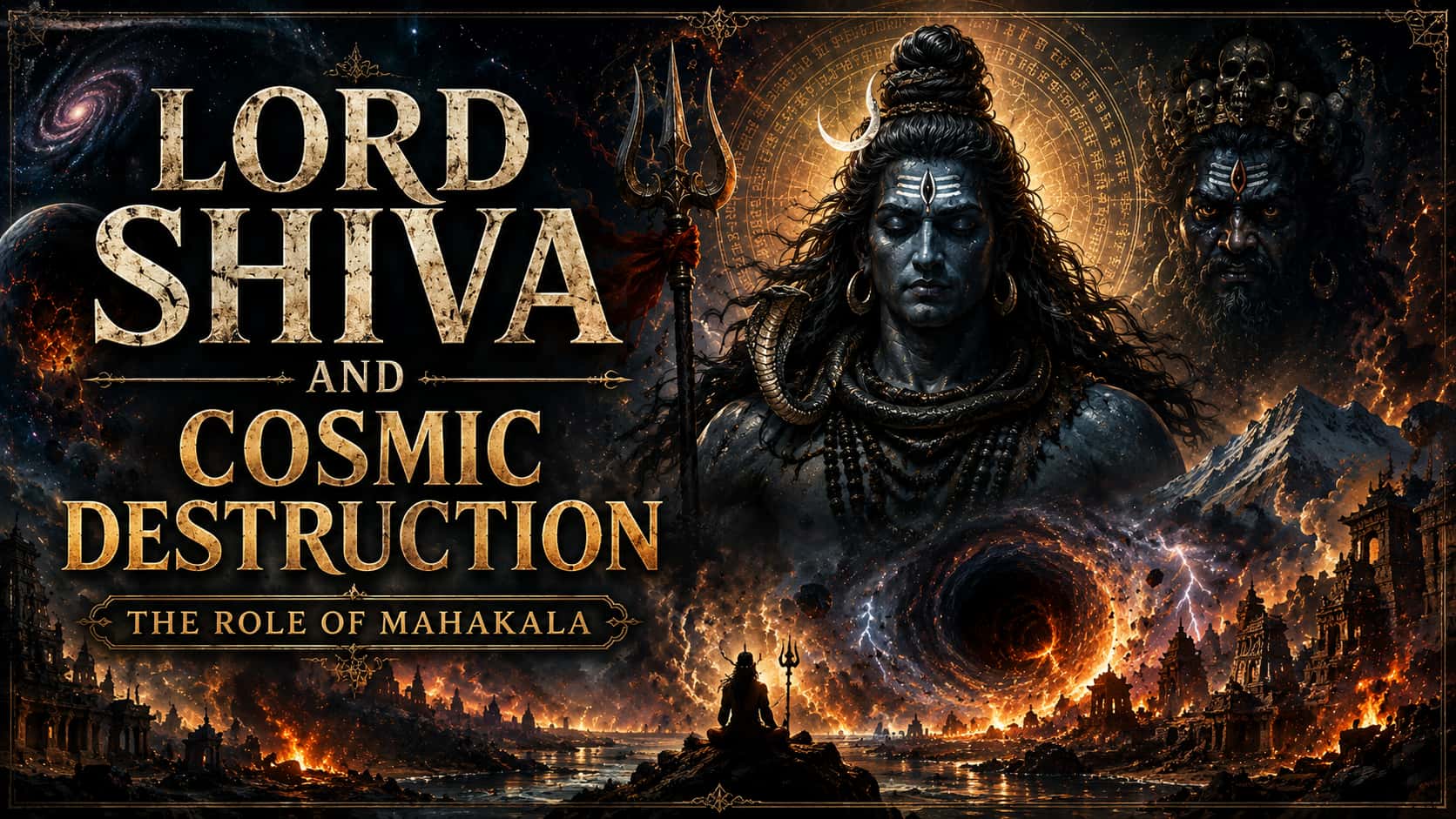
Most people, when they hear the word destruction, think of loss. Something ends. Something is broken. Something is gone.
The word carries weight, and almost always negative weight. But in Hindu cosmology, destruction is not the enemy of creation.
It is its partner. You cannot have a new beginning without an ending. You cannot plant a seed in ground that is already full.
Destruction, in this understanding, is not the problem. It is the solution.
No figure in world religion embodies this idea more completely than Lord Shiva.
He is one of the most worshipped deities in the Hindu tradition, with hundreds of millions of devoted followers across the world.
He is called the destroyer, but that title, taken alone, misses almost everything important about him.
Shiva destroys so that creation can begin again. He ends cycles so that new ones can start. He burns away what is false so that what is real can remain.
Within the vast range of Shiva’s forms and names, one stands above the rest in terms of raw cosmic power.
That form is Mahakala. The Great One Beyond Time. The Lord of Death and Dissolution.
The deity who does not just destroy individual things but destroys time itself at the end of every cosmic age.
Understanding Mahakala is understanding what shiva cosmic destruction actually means at its deepest level.
This article covers all of it.
Who Lord Shiva really is beyond the popular image, the Hindu understanding of cosmic cycles and dissolution, the meaning and iconography of Mahakala, the cosmic dance of Nataraja, the Vedic origins of Rudra, what actually happens at the end of the world in Hindu cosmology, the third eye and what it destroys, Mahakala in Buddhism, the relationship between Mahakala and Kali, how to worship Mahakala, and how all of this compares to other religious end-times traditions.
Who Is Lord Shiva? Beyond the Popular Image
In Hindu theology, the three primary functions of the universe, creation, preservation, and destruction, are personified as three great deities forming the Trimurti.
Brahma is the creator. Vishnu is the preserver. And Shiva is the destroyer.
But understanding Shiva as simply the destroyer, as though he were the cosmic equivalent of a wrecking ball, gets him almost completely wrong.
Shiva is Mahadeva, the greatest of gods, according to the Shaiva tradition, which is one of the largest branches of Hinduism.
For hundreds of millions of Shaivites, Shiva is not one god among many.
He is the Supreme Being, the source of all existence, the one from whom Brahma and Vishnu themselves arise and into whom they eventually return.
His role as destroyer is not a lesser function. It is the most essential one, because without dissolution there can be no renewal.
What makes Shiva genuinely fascinating is the combination of opposites he holds together.
He is the greatest ascetic, sitting in deep meditation on Mount Kailash, smeared with ash, matted hair piled high, completely withdrawn from the world.
And he is also a devoted husband and father, dancing with his wife Parvati and playing with his sons Ganesha and Kartikeya.
He is the god of yoga and inner stillness. And he is also the god of wild storms, ecstatic dance, and terrifying destruction.
He is gentle and he is fierce. He holds a trident and he holds a drum. He is the lord of death and the one who conquered death itself.
In the cycle of samsara, the endless turning of existence through birth, life, death, and rebirth, Shiva’s role is the pivot point.
Every soul, every universe, every cosmic age must eventually come to him. Not as punishment, but as completion.
Lord Shiva cosmic destruction is the mechanism through which the universe is returned to its source so that it can emerge again, fresh and full of possibility.
The Concept of Cosmic Destruction in Hinduism
To understand lord shiva cosmic destruction, you need to understand how Hinduism thinks about time.
In the Western traditions, time is generally seen as linear. History has a beginning, a middle, and an end.
But in Hindu cosmology, time is cyclical. It moves in vast circles, like seasons but on a scale that dwarfs anything the human mind can easily hold.
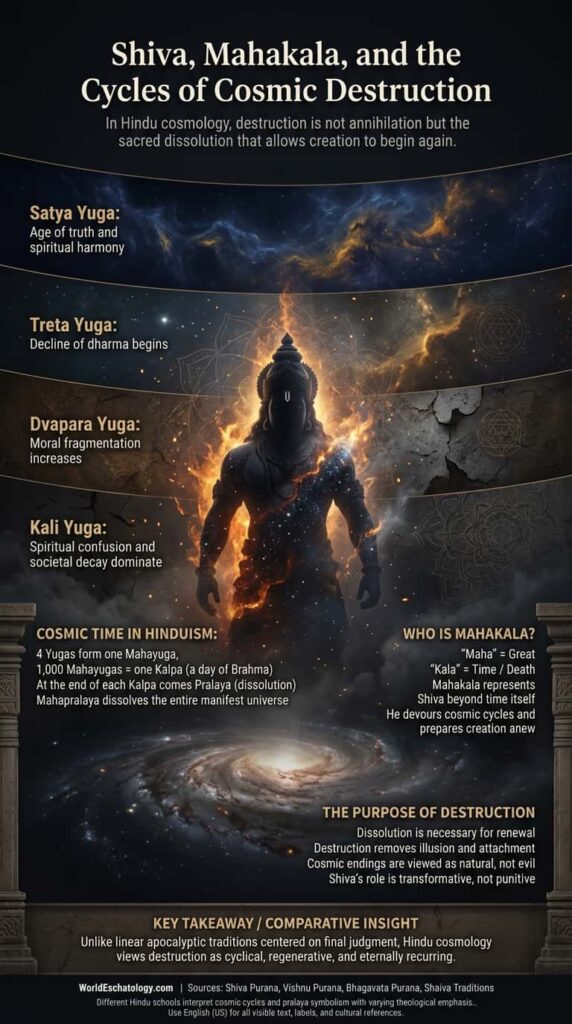
The basic unit of cosmic time is the Yuga. There are four Yugas in a cycle: the Satya Yuga, also called the golden age, when dharma is full and humanity lives in harmony and truth.
Then the Treta Yuga, when dharma begins to decline. Then the Dvapara Yuga, when it declines further.
And finally the Kali Yuga, the age we are currently living in, when dharma is at its lowest, moral confusion is widespread, spiritual darkness is common, and suffering increases.
The four Yugas together form a Mahayuga.
One thousand Mahayugas form a single day in the life of Brahma, which is called a Kalpa. At the end of each Kalpa, a partial dissolution called Naimittika Pralaya occurs.
The three worlds are temporarily destroyed, and Brahma rests for an equally long night before the next cycle begins.
This partial dissolution is like a deep sleep from which creation wakes again.
But there is something even larger. At the end of Brahma’s entire lifespan, which is 100 Brahma years, each year made up of 360 Brahma days and nights, the Mahapralaya occurs.
The great dissolution. Not just the three worlds but the entire manifest universe, everything that exists in any form, returns to the unmanifest source.
This is the full and final pralaya, and it is Shiva’s work.
There is also Atyantika Pralaya, the individual dissolution, which refers to the liberation of a single soul from the cycle of birth and death.
This too is associated with Shiva, because liberation in Shaiva theology is ultimately achieved through his grace.
What is crucial to understand is that none of these dissolutions are evil or catastrophic in a negative sense.
They are natural. They are necessary. They are the mechanism by which the universe breathes. Hinduism does not see pralaya as tragedy. It sees it as completion.
Mahakala: The Lord of Time and Death
Of all the forms that Lord Shiva takes, Mahakala is the one that deals most directly with shiva cosmic destruction at its most fundamental level.
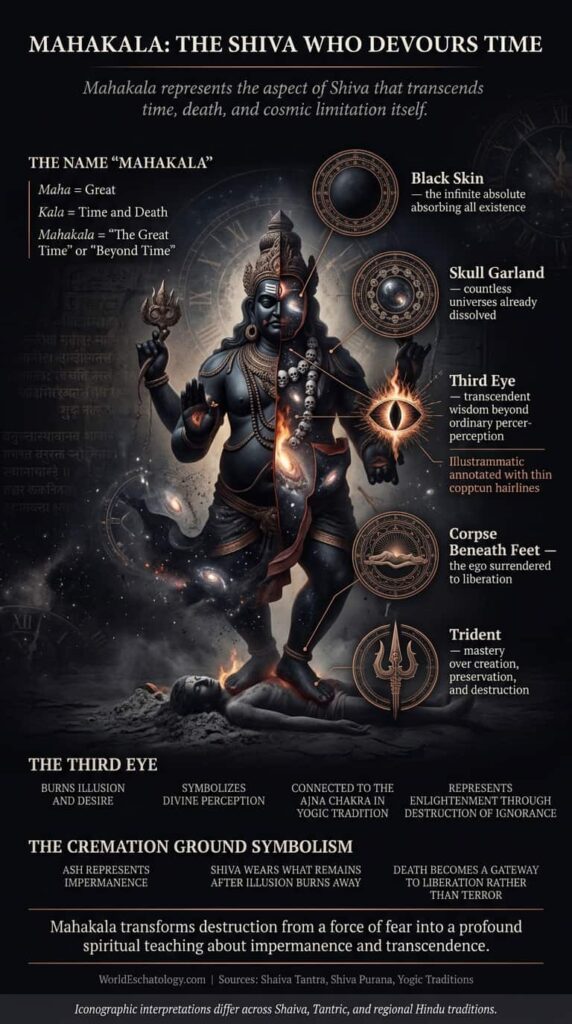
The name itself tells you everything. Maha means great. Kala means both time and death.
Mahakala is therefore the Great Time, or the One Who Is Greater Than Time, or the One Who Destroys Even Death.
All of these translations are legitimate and all of them point to the same truth: this is the aspect of Shiva that operates beyond the reach of ordinary existence.
While ordinary time governs everyone and everything, moving all things toward decay and death, Mahakala is the power that stands behind time and ultimately consumes it.
He is not subject to time. He is its master. At the end of each cosmic cycle, it is Mahakala who devours time itself, ending the age and preparing the ground for whatever comes next.
The iconography of Mahakala is deliberately overwhelming.
He is typically depicted with dark blue or completely black skin, black being the color that absorbs all other colors, representing the state that absorbs all of existence.
He has three eyes, the third being the eye of transcendent wisdom. He wears a garland of human skulls, each skull representing one of the countless universes that have ended before.
He carries weapons: a sword, a trident, a skull cup filled with blood.
He stands or dances upon a human corpse, which represents the ego, the limited sense of self that must be surrendered to achieve liberation.
His hair is wild and matted, decorated with snakes and the crescent moon.
Every element of this image has precise symbolic meaning. The skulls are not meant to be horrifying for their own sake.
They are a teaching: all of this has ended before, countless times, and all of it will end again.
The corpse beneath his feet is your ego, and the message is that Mahakala is inviting you to let it die.
The dark skin is not darkness as evil but darkness as the absolute, the state that contains and transcends all manifest things.
The most important temple of Mahakala in the world is the Mahakaleshwar Jyotirlinga in Ujjain, in the state of Madhya Pradesh in central India.
There are twelve Jyotirlingas in India, each considered a direct manifestation of Shiva’s infinite light, and Mahakaleshwar is considered the most powerful of all because it is the only one that is Dakshinamukhi, meaning it faces south, the direction of death and transformation.
The Bhasma Aarti performed here every morning before dawn is unlike any ritual anywhere in the world.
The deity is worshipped with sacred ash, bhasma, made from cremation grounds, and the ritual takes place while it is still dark, before the day begins, symbolizing worship at the threshold between death and dawn.
Shiva as Nataraja: The Cosmic Dance of Destruction
One of the most recognizable images in all of world religion is the Nataraja, Shiva as the Lord of the Cosmic Dance.
The bronze image, produced most famously in the Chola period of South Indian art, shows Shiva dancing within a ring of fire, one leg raised, one arm extended, surrounded by flames, balanced on a small figure being crushed beneath his foot.
It is one of the most beautiful and most symbolically dense images ever created by human hands.
The dance Shiva performs is called the Tandava. There are different forms of the Tandava.
The Ananda Tandava is the dance of bliss, associated with creation and the joyful outpouring of existence.
The Rudra Tandava is the dance of fury and destruction, the dance that ends cosmic cycles. Both are aspects of the same movement.
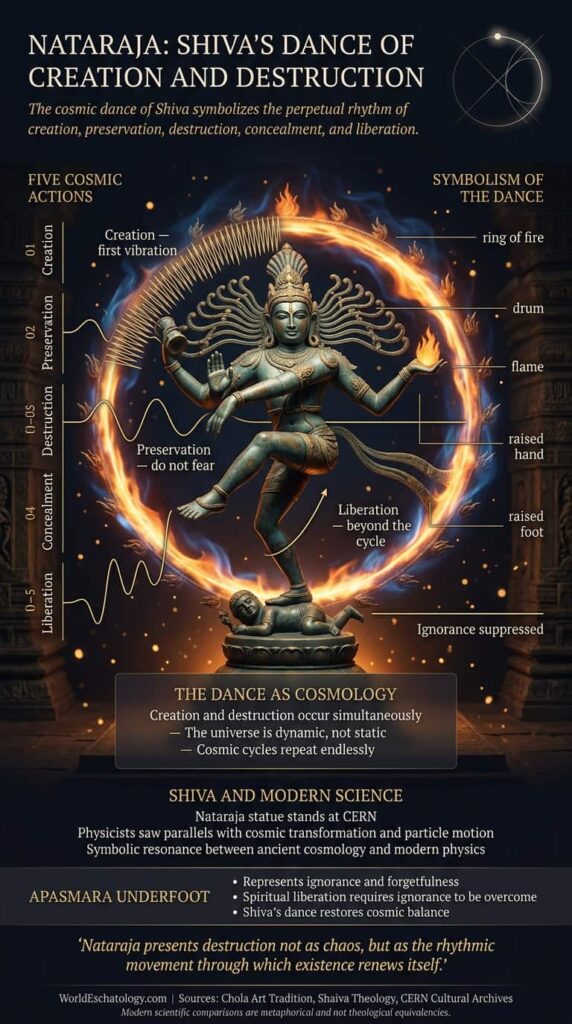
In the Nataraja image, theologians identify five simultaneous actions being performed through the dance, which are called the Panchakritya: creation, preservation, destruction, concealment, and liberation.
Lord Shiva is not doing one thing. He is doing everything at once.
The symbolism packed into the Nataraja image repays careful attention.
The ring of fire represents the cosmos, the universe of manifest existence that Shiva both creates and will eventually consume.
The small drum in one of his upper hands, the Damaru, represents creation, because it is the first sound, the pulse that initiates existence.
The flame in the other upper hand represents destruction. The lower right hand is raised in the gesture of protection and reassurance, saying do not be afraid.
The lower left hand points to his raised foot, which represents liberation, the escape from the cycle.
The figure beneath his standing foot is the demon Apasmara, representing spiritual ignorance and the forgetting of one’s true nature.
The fact that a Nataraja statue stands at the entrance to CERN, the European Organization for Nuclear Research and home of the Large Hadron Collider, is not accidental and not decorative.
It was a deliberate gift from the Indian government and CERN has written about its meaning.
The physicists there saw in the Nataraja image a profound metaphor for what they study: the endless dance of creation and destruction at the subatomic level, matter and energy transforming into each other in a ceaseless cosmic process that mirrors the Hindu vision of Lord Shiva’s dance.
Rudra: The Fierce Vedic Face of Lord Shiva
Before Lord Shiva was called Shiva, there was Rudra.
Rudra is one of the oldest deities in the Vedic tradition, appearing in the Rigveda, which is among the oldest religious texts in human history.
The name Rudra is often translated as the howler or the roarer, associated with storms, winds, lightning, and the wild, untamed forces of nature.
He is the god of the hunt and the storm, the one who rides the whirlwind.
In the Rigveda, Rudra is a complex and somewhat fearsome figure.
He is the god who sends disease and suffering, because the winds and storms he governs can destroy crops and bring illness.
But he is also the great healer, because the same winds that carry disease can carry medicine, and Rudra possesses a thousand remedies.
He is both the one who wounds and the one who heals. This paradox is essential to understanding the later development of Shiva: the power that can destroy is the same power that can liberate.
The Sri Rudram, found in the Krishna Yajurveda, is one of the most ancient and revered hymns in all of Hindu scripture.
It is a long and intricate prayer to Rudra, addressed to him in all his forms and in all the places where he dwells, in the forests, on the mountains, in the waters, in the crossroads, in the marketplace, in the army.
The hymn simultaneously praises Rudra, seeks his protection, and asks him to turn his fierce aspect away and show his benevolent face instead.
Over time, through the Puranic period and the development of Shaivism as a formal theological tradition, Rudra and Shiva merged into a single deity.
The fierce, storm-riding, disease-sending Rudra of the Vedas became the cosmic Mahadeva of the Puranas, whose destruction operates not just at the level of weather and illness but at the level of entire universes.
The eleven Rudras of later tradition represent different aspects of this destructive and transformative power operating throughout the cosmos.
Lord Shiva and the End of the World: Pralaya and Mahapralaya
When people search for shiva end of world, they are often looking for a specific narrative: what does Hindu scripture say actually happens at the end of the current age?
The answer is detailed, layered, and genuinely fascinating.
The current age, the Kali Yuga, is described in great detail in texts like the Vishnu Purana and the Bhagavata Purana.
Its characteristics are remarkably specific: truth and righteousness decline. People become driven by greed and desire.
Spiritual knowledge becomes rare and difficult to find. Family bonds weaken. Leaders become corrupt and oppressive.
Natural disasters increase. The lifespan of humans shortens. Moral confusion becomes the norm.
If this sounds familiar to a modern reader, that is not a coincidence. The Kali Yuga is the age of iron, the age of decline, and Hindu tradition is unanimous that we are living in it.
At the end of the Kali Yuga, the tradition describes a complete moral and civilizational collapse.
Then Kalki, the tenth avatar of Vishnu, arrives to destroy the corrupt and restore dharma, ending the Kali Yuga and beginning the Satya Yuga of the next cycle.
But this is only the end of one Mahayuga, not the full dissolution.
The deeper level of dissolution comes at the end of a Kalpa, a day of Brahma. At this point, the three worlds are destroyed and Brahma sleeps.
This is Naimittika Pralaya. It is associated with Shiva opening what the texts describe as the fires of dissolution, sometimes connected to his third eye, consuming the three worlds in flames before the next creative cycle begins with Brahma’s waking.
One of the most vivid mythological expressions of shiva cosmic destruction is the story of Tripurantaka.
The three demonic cities, Tripura, had become so powerful and so corrupt that they threatened the order of the cosmos.
Lord Shiva took a bow made from Mount Meru, used the sun and moon as wheels, Brahma as the charioteer, and with a single arrow, destroyed all three cities simultaneously.
Scholars read this as a cosmic metaphor: the three cities represent the three states of consciousness (waking, dreaming, deep sleep), the three bodies (gross, subtle, causal), or the three gunas (rajas, tamas, sattva), and their destruction by Lord Shiva is the dissolution of the entire structure of conditioned existence.
The Mahapralaya, the great dissolution at the end of Brahma’s lifespan, is the ultimate event. Everything dissolves.
Not just worlds but the elements themselves, not just the elements but the subtle matter behind them, not just that but the very principle of individual existence.
Everything returns to the unmanifest, the undifferentiated consciousness that underlies all of creation. Shiva’s drum, the Damaru, falls silent.
And then, when the time comes, it sounds again, and a new universe begins to emerge.
The Third Eye of Shiva: Destruction and Enlightenment
The third eye of Shiva is one of the most powerful symbols in all of Hindu iconography.
Located on his forehead between and slightly above his two ordinary eyes, it is simultaneously the most feared and the most sought-after aspect of his gaze.
When it opens in destruction, everything in its path is consumed by fire. When it opens in grace, it grants the vision that burns away all ignorance and leads to liberation.
Shiva’s three eyes are rich with symbolic meaning. His right eye represents the sun, the active principle, daytime consciousness, ordinary waking perception.
His left eye represents the moon, the receptive principle, the mind, the cycles of time and emotion.
His third eye represents fire, the principle of wisdom that transcends both ordinary perception and mental activity.
It is not limited to what can be seen in the world or thought about in the mind. It sees the truth behind appearances.
The most famous story associated with the third eye is the burning of Kamadeva, the god of desire and love.
While Lord Shiva sat in deep meditation after the death of his first wife Sati, the gods needed him to father a son who would defeat a powerful demon.
Kamadeva was sent to pierce Shiva with his arrows of desire and rouse him from his meditation.
The moment Kamadeva’s arrow struck, Lord Shiva opened his third eye and a beam of fire reduced Kamadeva to ash instantly.
Later, out of compassion for Kamadeva’s wife Rati, Shiva restored him, but the message of the story is clear: the third eye destroys desire.
It burns away the force that binds souls to the cycle of craving and suffering.
In the yogic tradition, the third eye corresponds to the Ajna chakra, located at the point between the eyebrows.
It is the seat of intuitive perception, inner vision, and the capacity to see beyond duality.
The practice of meditation, in many Hindu and yogic traditions, is precisely the practice of cultivating this inner eye, training the attention to see through the surface of things to their deeper reality.
Lord Shiva’s third eye is therefore not just a destructive weapon. It is the highest form of perception available to consciousness.
The cosmic application of the third eye connects directly to the pralaya theology.
When the time comes for a cosmic cycle to end, some texts describe Lord Shiva opening his third eye on the universe itself, the fire of divine knowledge consuming the illusion of separate existence and returning everything to the undivided source from which it came.
Mahakala in Buddhism and Tibetan Tradition
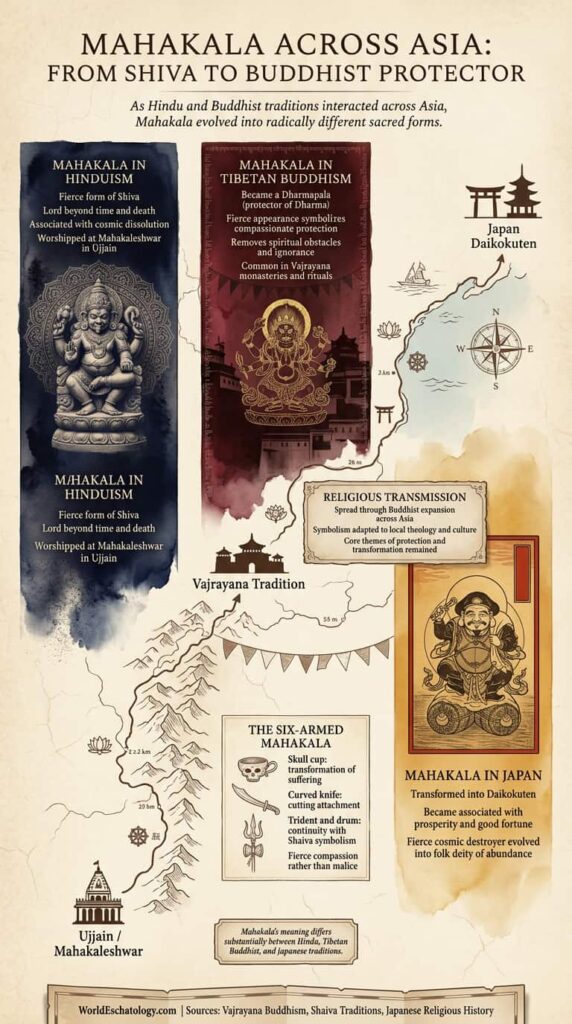
One of the most remarkable aspects of Mahakala is that he did not stay within the boundaries of Hinduism.
As Buddhism spread from India into Tibet, Central Asia, China, and Japan, Mahakala traveled with it and was absorbed into the Buddhist pantheon in a form that retained much of his original fierce character while taking on new meaning within a Buddhist framework.
In Tibetan Buddhism, Mahakala is one of the most important Dharmapalas, protectors of the Dharma.
His role is to defend the Buddhist teachings and practitioners from obstacles, both outer obstacles like enemies and circumstantial difficulties, and inner obstacles like mental obscurations and spiritual interference.
He is propitiated before and during retreats, before important undertakings, and as part of daily practice in many Tibetan monasteries.
The Tibetan Mahakala has several forms, with the six-armed Mahakala being among the most common and most revered.
Each arm carries a symbolic object: a skull cup, a curved knife, a mala of skulls, a trident, a drum, and a lasso.
His appearance is fierce and his gaze is intense, but his fierceness is understood as compassion in a fierce form, the kind of compassion that does not coddle but cuts through obstacles with the precision of a blade.
In Japan, through the long journey of transmission through China, Mahakala transformed into Daikokuten, one of the Seven Lucky Gods.
In this form, almost nothing of the fierce destroyer remains. Daikokuten is a cheerful, rotund deity of wealth and good fortune, smiling and carrying a sack of treasures.
The transformation is startling, but it illustrates something true about religious history: figures of enormous cosmic power often get domesticated as they travel across cultures, their wild edges smoothed into more comfortable shapes.
The cross-traditional presence of Mahakala from Shaiva Hinduism through Vajrayana Buddhism to Japanese folk religion points to something deeper than historical influence.
The archetype of the time-devouring, destruction-embracing, fear-transcending cosmic force seems to be something that human religious imagination returns to again and again, regardless of the specific theological framework in which it finds expression.
Kali and Mahakala: The Divine Feminine Partner of Destruction
You cannot discuss Mahakala without discussing Kali.
In Tantric Hindu theology, Shiva and Shakti, the masculine and feminine principles of the cosmos, are always understood as inseparable.
Lord Shiva without Shakti is a corpse. Shakti without Shiva has no ground to stand on. Together they form the complete picture of reality, consciousness and energy, the still and the dynamic, the formless and the formed.
Mahakala and Kali are the destructive, dissolution-oriented faces of these two principles.
Kali, whose name also means time and death just like Kala, is the fierce goddess who dances in the cremation ground, wears a garland of skulls, and drinks the blood of demons.
She represents the active, dynamic force of cosmic dissolution, the energy that actually moves and destroys and transforms.
Mahakala represents the still, unchanging consciousness beneath all of that activity, the ground of being that remains when everything has been dissolved.
The iconic image of Kali standing on the chest of Shiva is one of the most powerful and most theologically rich images in all of Hindu iconography.
In the story behind the image, Kali had destroyed the demon Raktabija and then fallen into a destructive frenzy, dancing wildly and threatening to destroy everything.
Lord Shiva lay down in her path, and when she stepped on him, the shock of touching her husband brought her to her senses and she stopped.
But the deeper theological reading is this: Kali, the dynamic force of destruction, can only be stilled by contact with the unchanging ground of Lord Shiva’s consciousness.
Her power operates within and because of his stillness. He is not defeated by being beneath her. He is the foundation without which her dance would have no stage.
Together, Mahakala and Kali represent the complete and total picture of what shiva cosmic destruction actually is. It is not blind annihilation.
It is the dynamic interplay of consciousness and energy, stillness and movement, being and becoming, at the point where the entire universe returns to its source.
Worshipping Mahakala: Practice, Temples, and Significance
The Mahakaleshwar temple in Ujjain is the heart of Mahakala worship in the world.
Ujjain itself is one of the holiest cities in Hinduism, one of the four sites of the Kumbh Mela, and it sits on what ancient Hindu astronomy considered the prime meridian of the world.
The Jyotirlinga here is Dakshinamukhi, facing south, which is the direction associated with Yama, the god of death and dharma, and with transformation and dissolution.
This orientation makes it uniquely powerful among all the Shiva shrines in India.
The Bhasma Aarti at Mahakaleshwar is performed in the early hours of the morning before dawn.
The word bhasma means sacred ash, and in Shaiva theology, ash represents what remains after everything that was not real has been burned away.
Lord Shiva smears himself with ash from the cremation ground as a constant reminder that the body is temporary, that what we are attached to will be destroyed, and that what remains when all else is gone is the real.
The ritual of the Bhasma Aarti anoints the deity with this ash while sacred mantras are chanted, in an act of worship that begins each day at the threshold between darkness and light, death and birth.
Other significant Mahakala shrines include the Pashupatinath temple complex in Kathmandu, Nepal, where Shiva is worshipped as the lord of all living beings and where Mahakala shrines are part of the larger complex.
In Tibet, Mahakala shrines are found in virtually every major monastery.
People worship Mahakala for specific purposes that are not the same as the reasons one worships other deities.
Mahakala is not approached for wealth or health or the success of worldly projects, though in popular practice these intentions exist.
At the deeper level, Mahakala is worshipped by those who want to overcome the fear of death, the fear of loss, the fear of change, and the grip of ego.
The teaching of Mahakala is this: everything you are afraid of losing will be lost. Everything that can be destroyed will be destroyed.
And what remains when all of that is gone is your true nature, which was never in danger to begin with.
The primary mantra associated with Mahakala is Om Mahakala Namah, a salutation to the great time-transcending power of Lord Shiva.
There are longer and more elaborate mantras in the Tantric tradition, but this simple one carries the essence of the teaching: I bow to the Great One who is beyond time, beyond death, beyond destruction, because that Great One is what I ultimately am.
Lord Shiva Cosmic Destruction Compared to Other Religious Traditions
The Hindu vision of shiva cosmic destruction sits in an interesting relationship to the end-times narratives of other major world religions.
A comparison reveals both striking similarities and profound differences that illuminate what is unique about each tradition’s understanding of how the cosmos ends.
The most obvious contrast is with the biblical and Islamic traditions.
In the Bible, the Battle of Armageddon and the events of Revelation describe an end of the current age that is linear, final, and connected to moral judgment.
History moves in one direction, toward a conclusion, after which there is a new heaven and a new earth but the same history does not repeat.
Similarly, in Islam, Yawm al-Qiyamah is the day of judgment, a singular event that closes the book on human history and results in the permanent separation of the righteous and the wicked.
Both of these are fundamentally linear and juridical: history proceeds, judgment arrives, the verdict is final.
The Hindu vision is fundamentally different. Mahapralaya is not a judgment. It is a dissolution.
Nobody is being evaluated and sorted. The entire universe, righteous and wicked alike, saints and sinners, gods and demons, all of it returns to the unmanifest source.
There is no punishment and no reward in the Mahapralaya, only the end of the dream of separate existence.
And then the dream begins again. The cyclical nature of Hindu cosmology means that destruction is never truly final. It is always followed, eventually, by a new creation.
The tradition that comes closest in spirit to the Hindu understanding is Norse mythology.
In the Norse vision of Ragnarok, the gods themselves are destroyed, the world is consumed by fire and water, and then a new world rises from the sea, fresh and green.
The pattern of destruction and rebirth is there. But even Ragnarok is a singular event in Norse cosmology, not part of an endless cycle, and it carries a tragic weight that is quite different from the serene inevitability of Hindu pralaya.
What is unique about the Hindu contribution, and specifically about Mahakala’s role in shiva cosmic destruction, is the framing of destruction as something to be embraced rather than feared or survived.
The devotee who truly understands Mahakala does not pray to escape the dissolution.
They pray to understand it, to be ready for it, and ultimately to recognize themselves as the consciousness that watches the dissolution from a place of complete stillness, the Lord Shiva beneath the dancing Kali, unchanged by the fire that consumes everything else.
Frequently Asked Questions About Lord Shiva and Mahakala
Who is Mahakala in Hinduism?
Mahakala is one of the most powerful and most theologically significant forms of Lord Shiva.
The name Mahakala combines Maha, meaning great, with Kala, which in Sanskrit means both time and death.
Mahakala is therefore the Great Time, the One Who Transcends Time, or the Destroyer of Death itself.
While Lord Shiva in general represents the principle of cosmic destruction and transformation, Mahakala specifically represents the aspect of Lord Shiva that operates at the very end of cosmic cycles, consuming not just individual beings or worlds but time itself.
His iconography, dark or black skin, garland of skulls, three eyes, standing on a corpse, is designed to teach a specific lesson: that all things end, that the ego must die, and that the true self is the deathless awareness that watches all dissolution from a place of unshakeable stillness.
He is worshipped primarily at the Mahakaleshwar Jyotirlinga in Ujjain, considered the most powerful of the twelve Jyotirlingas in India.
Why is Shiva called the destroyer?
Shiva is called the destroyer because within the Hindu theological framework of the Trimurti, he represents the force of dissolution that ends each cosmic cycle.
But the word destroyer carries connotations in English that are quite different from what Shiva’s role actually involves.
In Hinduism, destruction is not negative or catastrophic. It is the necessary completion of a cycle that makes the next cycle possible.
Lord Shiva does not destroy because he is cruel or opposed to life. He destroys because without the clearing away of what has run its course, nothing new can begin.
The analogy most often used is that of a forest fire, which appears destructive but actually clears the ground and releases nutrients that allow a new and more vital forest to grow.
Lord Shiva’s destruction is also deeply connected to liberation. The destruction of the ego, the burning away of illusion, the dissolution of the false sense of separate self, these are forms of Shiva’s destructive work that lead not to loss but to the discovery of one’s true nature.
What is Shiva’s role in the end of the world?
In Hindu cosmology, Shiva’s role in the end of the world operates at multiple levels.
At the level of the current age, the Kali Yuga, Shiva is associated with the increasing chaos and dissolution of dharma that characterizes the age’s end, though the direct agent of ending the Kali Yuga in most traditions is Kalki, the tenth avatar of Vishnu.
At the level of a full cosmic day, the Kalpa, Lord Shiva is the deity who performs the Naimittika Pralaya, the dissolution of the three worlds at the end of Brahma’s day, often described through the opening of his third eye or the unleashing of cosmic fire.
At the ultimate level, the Mahapralaya at the end of Brahma’s entire lifespan, Shiva’s role as Mahakala is the absorption of the entire manifest universe back into the unmanifest source.
His drum, the Damaru, whose sound initiated creation, falls silent during Mahapralaya, and sounds again when the next creation begins.
Shiva’s role in the end of the world is not punitive or arbitrary. It is the natural culmination of the cosmic cycle he governs.
What does Mahakala symbolize?
Mahakala symbolizes several interconnected truths that are at the heart of Hindu and Tantric philosophy.
First, he symbolizes the absolute impermanence of all things. His garland of skulls, each representing a universe that has ended, is a constant reminder that nothing in the manifest world lasts forever.
Second, he symbolizes the power of consciousness to transcend time.
While everything subject to time decays and dies, Mahakala himself is beyond time, and the teaching is that the deepest part of the human being shares this quality.
Third, he symbolizes the destruction of ego. The corpse beneath his feet is the ego-self, the limited identity that creates suffering by clinging to what cannot last.
Fourth, he symbolizes fearlessness. To truly worship Mahakala is to look directly at everything you fear, death, loss, impermanence, the ending of everything familiar, and to realize that none of it can touch the awareness that you fundamentally are.
In this sense, Mahakala is not a figure of terror but one of the deepest liberating teachings in all of religious history.
What is the difference between Shiva and Mahakala?
Shiva is the comprehensive name for one of the three primary deities of the Hindu Trimurti, encompassing his many forms, names, and aspects.
He is the deity of yoga, the husband of Parvati, the father of Ganesha and Kartikeya, the lord of Mount Kailash, the cosmic dancer, the great ascetic, and the supreme consciousness of Shaiva theology.
Mahakala is specifically one of Shiva’s forms, his most intense and cosmically powerful manifestation, representing the aspect of Lord Shiva that deals with the ending of time and the dissolution of cosmic cycles.
Think of it this way: all of Mahakala is Shiva, but not all of Shiva is Mahakala.
When you are speaking about Shiva’s gentle and nurturing aspects, his role as a devoted husband, his playfulness with his children, or his accessibility as a personal god, you are speaking about dimensions of Lord Shiva that are not Mahakala.
When you are speaking about the cosmic dissolution at the end of ages, the transcendence of time and death, the burning away of illusion at the most absolute level, that is Mahakala.
What happens during Mahapralaya?
Mahapralaya, the great dissolution, is the most total and comprehensive event in Hindu cosmology.
It occurs at the end of Brahma’s entire lifespan, which from the perspective of earthly time is an incomprehensibly vast period.
During Mahapralaya, the process of dissolution proceeds systematically and completely. The gross physical elements dissolve into the subtle elements.
The subtle elements dissolve into ego-consciousness. Ego-consciousness dissolves into the cosmic intellect.
The cosmic intellect dissolves into undifferentiated primal matter. And primal matter itself dissolves back into pure consciousness, the unmanifest Brahman or, in Shaiva theology, into Lord Shiva himself.
After Mahapralaya, there is no time, no space, no matter, no mind, no individual existence of any kind.
There is only the infinite, undivided, self-aware consciousness that is the ultimate ground of all existence. Lord Shiva’s drum falls silent.
This state persists for a period equal to the entire lifespan of the previous Brahma. And then, from the depths of that stillness, the first vibration of a new creation stirs, Shiva’s Damaru sounds, and a new universe begins to unfold.
Is Shiva good or evil?
The question of whether Shiva is good or evil reflects a framework that does not quite fit Hindu theology, because Hinduism does not operate with the same sharp binary of good versus evil that characterizes Abrahamic religious thought.
Lord Shiva is beyond both of those categories. He is the force of transformation and dissolution that operates at the cosmic level, and like all forces of nature operating at that scale, he cannot be evaluated by the same moral framework we use for human actions.
That said, within the context of Hindu theology and devotional practice, Lord Shiva is absolutely not an evil deity.
He is Bholenath, the innocent and generous one, the god who is most easily pleased and most quick to grant boons to his devotees.
He is the destroyer of demons, the protector of devotees, the source of liberation. His fierce aspects, including Mahakala, are not expressions of malice but of the raw, untamed power of ultimate reality.
They are terrifying in the way that a lightning storm or an ocean in full storm is terrifying: not because they wish you harm, but because they are vast and they are real and they remind you that you are not in control.
Conclusion
Lord Shiva and Mahakala represent one of the most sophisticated and courageous engagements with the reality of destruction anywhere in world religion.
Most religious traditions work very hard to comfort their followers in the face of endings, to promise continuity, to soften the edges of impermanence.
The Hindu tradition, through the figure of Mahakala, does something far more interesting. It takes destruction seriously. It looks at it without flinching.
It says yes, everything ends, yes, time devours all things, yes, the ego will be destroyed, and then it says: good.
Because the Hindu answer to destruction is not denial and not despair. It is recognition. Mahakala is not something outside you that will one day come for you.
Mahakala is the deepest truth of what you are. The awareness that watches every ending, unchanged.
The consciousness that was present before your body existed and will continue after it dissolves. The stillness beneath the dance of Kali. The drum before the first sound and after the last one.
Understanding Lord shiva cosmic destruction is not a morbid exercise. It is a liberating one.
When you truly understand that everything subject to time will end, you stop gripping so hard. You stop mistaking the temporary for the permanent.
You start to find the thing in yourself that is not temporary. And that thing, the part of you that can witness even your own dissolution without fear, that is what Mahakala is pointing to.
That is what the dark skin and the skulls and the dance in the cremation ground are all saying. The fire that burns everything away is also the light by which you finally see clearly.