
In 1948, something happened that had never happened before in recorded human history.
A people who had been scattered across the entire world for nearly 1,900 years came back to their ancestral homeland and declared a state. Not a new state.
Their old one. On the same land, in the same city, with the same language they had spoken before the exile.
The world watched it happen and mostly saw a geopolitical event. But for millions of people reading their Bibles and their prayer books, they were watching a prophecy come true.
That prophecy has a name. In Hebrew it is called Kibbutz Galuyot, and it means the ingathering of the exiles.
It is not a modern political idea. It is one of the oldest promises in the Hebrew Bible, repeated by prophet after prophet across more than a thousand years of Scripture.
And the argument that it is being fulfilled in real time, in the newspapers and the immigration statistics of modern Israel, is one of the most serious and detailed cases for prophetic fulfillment that exists anywhere in religious literature.
This article covers all of it. The meaning of Kibbutz Galuyot, the biblical prophecies behind it, the history of the Jewish exile, the modern waves of return, the significance of 1948, what Ezekiel’s valley of dry bones actually means, what Jewish theology and Christian theology say about it, what Islam says about Israel’s return, and where the ingathering stands today.
If you want to understand israel prophecy end times in any serious way, this topic is the place to start.
What Is Kibbutz Galuyot? The Meaning Behind the Phrase
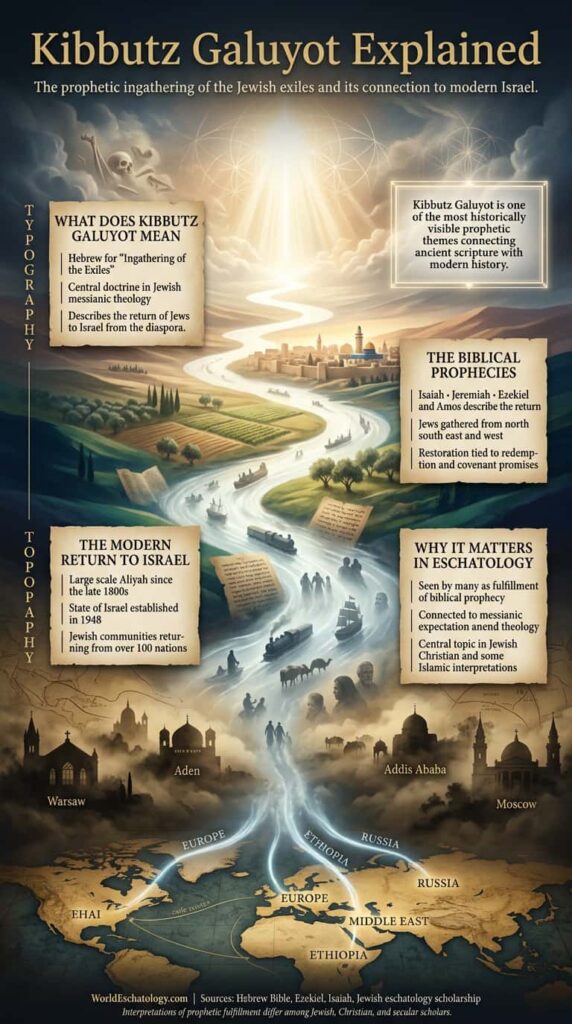
The Hebrew phrase Kibbutz Galuyot is made up of two words. Kibbutz comes from the root meaning to gather or to collect.
Galuyot is the plural of galut, which means exile. So the full phrase means the gathering of the exiles, or more poetically, the ingathering of the exiles.
It describes the act of God bringing the Jewish people back from their scattering among the nations to the land of Israel.
This is not a minor or peripheral concept in Jewish thought. It runs through the Torah, through the prophets, through the writings, and into Jewish prayer.
Three times every day, observant Jews recite the Amidah, a standing prayer made up of nineteen blessings.
The tenth blessing is dedicated entirely to Kibbutz Galuyot. It reads: “Sound the great shofar for our freedom, raise a banner to gather our exiles, and gather us together from the four corners of the earth into our land.”
For nearly two thousand years, while living in Spain, Poland, Yemen, Iraq, Ethiopia, and dozens of other countries, Jewish people prayed those words every single day.
The concept is also embedded in Maimonides’ Thirteen Principles of Faith, the closest thing Judaism has to a formal creed.
The ingathering of the exiles is inseparable from the coming of the Messiah in Jewish theology.
They are not two separate events. The return of the Jewish people to their land is one of the signs that the messianic age is at hand.
Understanding this helps explain why the establishment of the State of Israel in 1948 was not just a political event for Jewish people.
It was, and continues to be, a theological one. Whether a person is religious or secular, the concept of Kibbutz Galuyot sits at the heart of Jewish identity and Jewish hope.
The Biblical Prophecies: What Did the Prophets Actually Say?
The ingathering of exiles is not a vague or ambiguous prophecy. It is stated clearly, repeatedly, and in remarkable detail across the Hebrew Bible.
Here are the key passages that form the foundation of this doctrine.
Deuteronomy 30:3 through 5
Moses himself, speaking before the people entered the land of Canaan, predicted both the exile and the return.
He told the people that if they broke the covenant, God would scatter them to the ends of the earth.
But he also promised something else: “Then the Lord your God will restore your fortunes and have compassion on you and gather you again from all the nations where he scattered you.
Even if you have been banished to the most distant land under the heavens, from there the Lord your God will gather you and bring you back.
He will bring you to the land that belonged to your ancestors and you will take possession of it.”
This was written over three thousand years ago, before the exile had even happened.
Isaiah 11:11 through 12
Isaiah prophesied that God would gather his people a second time, a detail that is theologically significant because it implies the first return from Babylon was not the final fulfillment.
He wrote: “He will raise a banner for the nations and gather the exiles of Israel; he will assemble the scattered people of Judah from the four quarters of the earth.”
The phrase “four quarters of the earth” is strikingly consistent with the actual history of where Jewish communities ended up: east in Iraq and Iran, west in Spain and Morocco, north in Russia and Poland, south in Ethiopia and Yemen.
Isaiah 43:5 through 6
In another passage, God speaks directly: “Do not be afraid, for I am with you; I will bring your children from the east and gather you from the west.
I will say to the north, Give them up! And to the south, Do not hold them back. Bring my sons from afar and my daughters from the ends of the earth.”
This directional specificity matches the actual geography of the modern ingathering with a precision that is difficult to dismiss.
Jeremiah 16:14 through 15
Jeremiah made one of the most striking claims in all of prophetic literature.
He said that the day would come when the great act of redemption people talked about would no longer be the exodus from Egypt.
It would be the second gathering from the nations:
“The days are coming, declares the Lord, when it will no longer be said, As surely as the Lord lives who brought the Israelites up out of Egypt, but it will be said, As surely as the Lord lives who brought the Israelites up out of the land of the north and out of all the countries where he had banished them.
For I will restore them to the land I gave their ancestors.”
Jeremiah 31:7 through 10
“He who scattered Israel will gather them and will watch over his flock like a shepherd.” (Jeremiah 31:10)
This passage from Jeremiah describes a great gathering of people coming from the north country, from the ends of the earth, including the blind, the lame, and pregnant women.
It is a picture of a mass return of ordinary people, not just a military or political elite.
Ezekiel 36:24
God speaks through Ezekiel in some of the most direct language anywhere in the prophetic books:
“For I will take you out of the nations; I will gather you from all the countries and bring you back into your own land.”
This is stated not as a possibility or a conditional promise but as a first-person divine declaration with no qualifications attached.
Amos 9:14 through 15
The prophet Amos ends his book with a remarkable promise: “I will plant Israel in their own land, never again to be uprooted from the land I have given them.”
This phrase, “never again to be uprooted,” is seen by many scholars as distinguishing the modern return from all previous ones.
The return from Babylon ended in another exile. This one, according to Amos, will not.
Taken together, these prophecies describe a pattern: exile, scattering to all nations, suffering, and then a final, permanent regathering to the land of Israel.
The geographical detail, the scale, the direction, and the permanence described across these texts form a prophetic framework that the modern history of Israel maps onto with a closeness that no serious reader of both the texts and the history can ignore.
The Scattering: Why Were the Jewish People Exiled?
To understand the ingathering of exiles, you have to understand the exile itself.
The Hebrew Bible is clear that the scattering of the Jewish people was not a random historical accident.
It was a consequence, predicted in detail, of breaking the covenant relationship with God.
Deuteronomy 28 contains what is called the blessings and the curses, and the curses include a detailed description of exactly what happened: enemies coming from far away, siege, suffering, and eventually being driven out of the land and scattered among all nations.
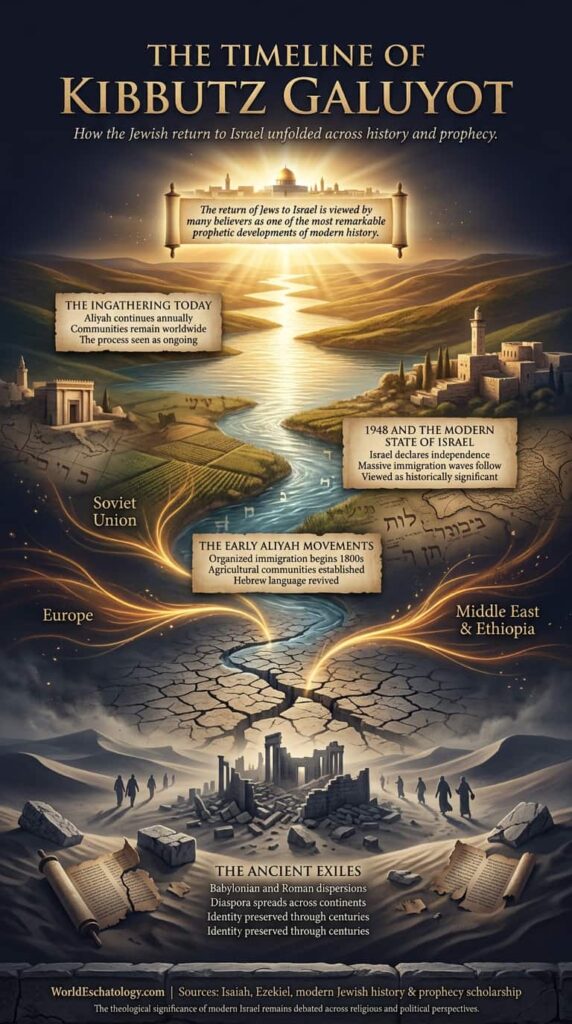
The first major exile was to Babylon in 586 BC, when Nebuchadnezzar destroyed the First Temple in Jerusalem and carried the leading citizens of Judah into captivity.
This exile lasted approximately seventy years, ending when the Persian king Cyrus the Great issued a decree allowing the Jews to return and rebuild.
This is the return described in the books of Ezra and Nehemiah, and many scholars consider it a partial fulfillment of the ingathering prophecies.
But it was incomplete. The majority of Jews who had been scattered did not return, and those who did return faced constant difficulty and foreign domination.
The second and more complete exile came through Rome. In 70 AD, the Roman general Titus destroyed Jerusalem and the Second Temple, killing hundreds of thousands and scattering survivors across the empire.
Then in 135 AD, after the failed Bar Kokhba revolt, the Emperor Hadrian went further.
He renamed the land Syria Palaestina, renamed Jerusalem as Aelia Capitolina, and banned Jews from entering the city entirely.
The systematic erasure of Jewish national identity from the land had begun.
What followed were nearly nineteen centuries of diaspora life. Jewish communities established themselves across the entire known world.
Spain, Portugal, France, Germany, Poland, Russia, Ukraine, Iraq, Iran, Egypt, Morocco, Tunisia, Libya, Yemen, Ethiopia, India, and eventually North and South America and Australia.
Each community maintained Jewish identity, Jewish law, and Jewish prayer, including the daily prayer for the ingathering of exiles.
But they were scattered. Exactly as the Bible said they would be.
The suffering during those centuries was immense. The Spanish Inquisition and eventual expulsion in 1492.
The pogroms of Eastern Europe in the nineteenth and early twentieth centuries.
And then the Holocaust, in which six million Jewish people were systematically murdered.
The exile was not peaceful or quiet. It was exactly what the prophets described it would be: a time of tremendous suffering among the nations.
The First Modern Wave: Early Zionism and the Aliyot
The modern story of the ingathering of exiles begins in the late nineteenth century, long before the State of Israel existed.
In Jewish tradition, the return to the land of Israel is called Aliyah, a Hebrew word meaning ascent or going up.
It is the same word used for being called up to read from the Torah in synagogue.
The choice of the word is deliberate. Returning to Israel is not just immigration. It is spiritually going up.
The First Aliyah, from 1882 to 1903, brought approximately 35,000 Jews to Ottoman Palestine, mostly from Russia and Romania fleeing persecution and pogroms.
They were not primarily driven by religious messianic expectation. They were driven by suffering and by a growing sense that Jewish life in Europe was not safe.
They came and began building agricultural settlements in a land that had been largely neglected for centuries.
The Second Aliyah, from 1904 to 1914, brought another 40,000 Jews, again mostly from Russia and Eastern Europe.
This wave included many of the ideological pioneers who would go on to found the institutions of what became the State of Israel.
Among them was David Ben-Gurion, who would become Israel’s first prime minister.
The Third, Fourth, and Fifth Aliyot continued through the 1920s and 1930s, bringing hundreds of thousands more, including a large wave fleeing the rise of Nazism in Germany and Europe in the 1930s.
By the time Israel declared statehood in 1948, the Jewish population of the land had grown from roughly 25,000 in 1882 to about 650,000.
Theodor Herzl, the father of modern political Zionism, was a secular journalist who had no particular religious motivation.
He saw Zionism as a political solution to antisemitism. Yet believers and scholars looking at the Zionist movement from a prophetic standpoint find it striking that this entirely secular movement ended up serving what the biblical prophets had described as a divinely orchestrated ingathering.
The agent of the prophecy did not have to be religious for the prophecy itself to be fulfilled.
1948: The Rebirth of Israel as a Prophetic Milestone
On May 14, 1948, David Ben-Gurion stood in Tel Aviv and read a declaration of independence. The State of Israel was born.
The following day, five Arab armies invaded. The new state survived.
The significance of this event for students of biblical prophecy is hard to overstate.
The prophet Isaiah wrote in chapter 66 verse 8: “Who has ever heard of such things? Who has ever seen things like this?
Can a country be born in a day or a nation be brought forth in a moment?”
Many scholars read this as a direct prophetic description of exactly what happened on May 14, 1948, a nation coming into formal existence in a single day after nearly two thousand years of non-existence.
What followed the declaration of statehood was an immediate and massive ingathering.
Within the first three years of Israel’s existence, the Jewish population nearly doubled. Jews who had survived the Holocaust in Europe came.
Jews from Arab countries began arriving in waves as their situation in those countries became impossible after 1948.
The Yemenite Jewish community, one of the oldest in the world, was airlifted to Israel in an operation called Operation Magic Carpet or On Wings of Eagles, between 1949 and 1950.
Nearly 49,000 Yemenite Jews, many of whom had never seen an airplane, boarded planes and flew to Israel.
Many of them quoted Isaiah 40:31, “They will soar on wings like eagles,” as they boarded.
For prophecy scholars, 1948 is the hinge point of modern history.
It is the year the prophetic clock, in their view, began ticking toward the events described in the end-times passages of Ezekiel, Daniel, Zechariah, and Revelation.
The reestablishment of Israel as a nation is considered by many to be the single most significant prophetic event in two thousand years because so many other end-times prophecies require the existence of a Jewish state in the land of Israel as a prerequisite.
The Valley of Dry Bones: Ezekiel 37 Explained
No passage in the entire Bible is more directly cited in discussions of the ingathering of exiles and israel prophecy end times than Ezekiel 37. It deserves careful attention.
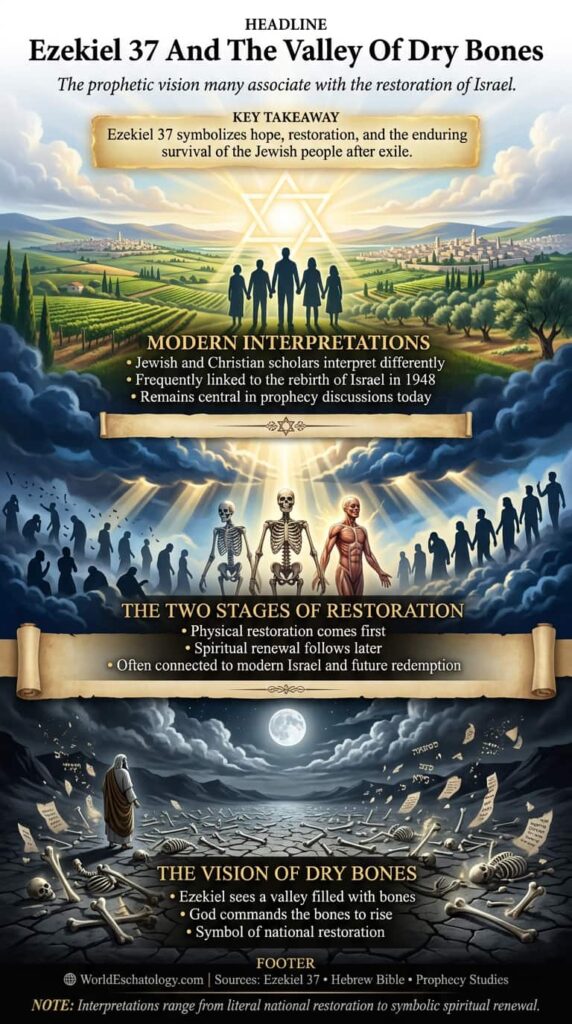
The prophet Ezekiel describes being brought by God to a valley filled with bones. They are dry, he says, meaning they have been dead for a long time.
God asks him: “Son of man, can these bones live?” Ezekiel answers carefully: “Sovereign Lord, you alone know.”
Then God commands Ezekiel to prophesy to the bones. As he does, something begins to happen.
The bones come together, bone to bone, forming skeletons. Then tendons and flesh appear on them.
Then skin covers them. But they have no breath. Then God commands Ezekiel to prophesy to the breath, and breath enters them. They stand up. A vast army.
God then explains the vision explicitly, which is unusual. He does not leave it as a mystery. He says:
“Son of man, these bones are the people of Israel. They say, Our bones are dried up and our hope is gone; we are cut off. Therefore prophesy and say to them: This is what the Sovereign Lord says: I am going to open your graves and bring you up from them; I will bring you back to the land of Israel.”
The vision has two stages, and this is important. In the first stage, the bones come together and flesh forms, but there is no breath.
The body is restored but there is no life in it. In the second stage, breath enters and the people live.
Many scholars, both Jewish and Christian, interpret these two stages as two distinct phases of the national resurrection of Israel.
Stage one, in this reading, is the physical return. A nation comes together, institutions are built, a language is revived, a state is established.
But it is largely secular, largely without the spiritual dimension that the prophets associate with the full restoration.
This corresponds to modern Israel as it has developed since 1948: a functioning democratic state, extraordinarily successful by any measure, but not yet characterized by the nationwide spiritual transformation the prophets describe.
Stage two, the breath entering the body, is understood as a coming spiritual revival among the Jewish people, a national turning toward God that many prophecy scholars believe is still ahead.
In Jewish Eschatology, this would involve the recognition of the Messiah. In Christian theology, it connects to Romans 11 and Paul’s teaching about Israel’s spiritual restoration in the end times.
Whether one accepts the full theological framework or not, the structural parallel between the Ezekiel 37 vision and the actual historical events of the twentieth and twenty-first centuries is one of the most discussed pieces of evidence in the case for biblical prophecy fulfillment.
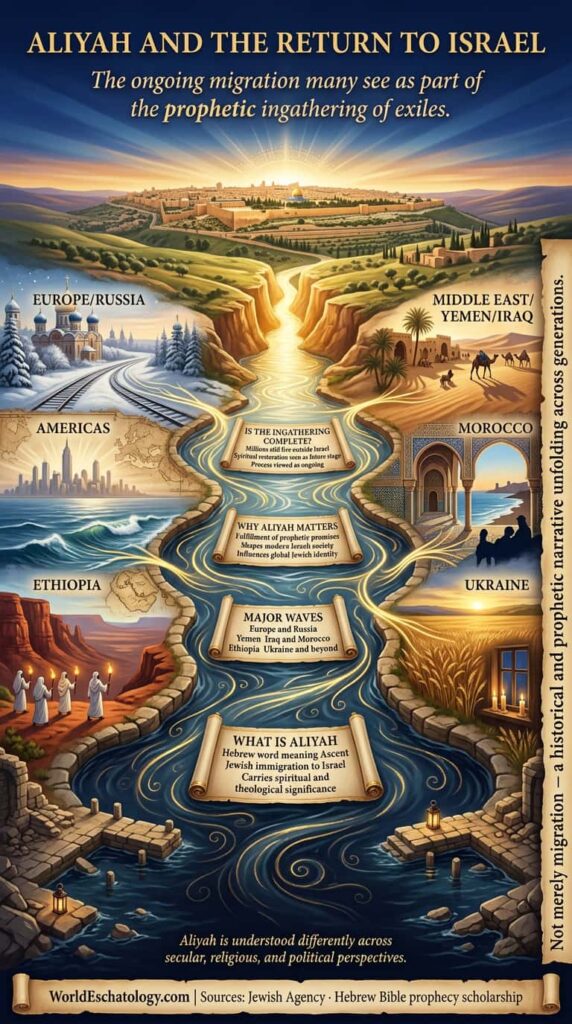
The Ingathering Continues: Major Aliyah Waves After 1948
The ingathering of exiles did not stop in 1948.
It has continued in waves ever since, drawing Jewish communities from every direction, fulfilling the “four corners of the earth” language of Isaiah 11:12 in a remarkably literal way.
Operation Ezra and Nehemiah, named after the biblical figures who led the return from Babylon, brought nearly 130,000 Iraqi Jews to Israel between 1950 and 1952.
The ancient Jewish community of Babylon, one of the oldest in the world, which had existed in Iraq for 2,600 years since the first exile, was essentially transplanted to Israel within two years.
Operation Yachin, between 1961 and 1964, brought over 90,000 Moroccan Jews to Israel.
The broader immigration from North Africa throughout the 1950s and 1960s brought hundreds of thousands more from Morocco, Tunisia, Algeria, Libya, and Egypt.
Then came one of the most dramatic fulfillments of the ingathering prophecy from an unexpected direction.
Ethiopia. The Beta Israel, the Jewish community of Ethiopia, had lived in isolation from the rest of the Jewish world for centuries.
Many scholars and rabbis debated whether they were genuinely Jewish. The Israeli government eventually recognized them as descendants of the tribe of Dan.
Operation Moses in 1984 secretly airlifted approximately 8,000 Ethiopian Jews to Israel.
Then in 1991, Operation Solomon completed the ingathering of Ethiopian Jews in a single 36-hour operation, flying over 14,000 people on 35 flights.
These were Black African Jews, coming from the south, completing another piece of Isaiah’s directional prophecy.
Then came the Soviet Union. When the USSR began to collapse in the late 1980s, the gates opened for Soviet Jews who had been trapped behind the Iron Curtain for decades.
Between 1990 and 2000, over one million Jews emigrated from the former Soviet Union to Israel.
It was the largest single wave of Aliyah in Israel’s history. These were Jews from the north, from Russia, Ukraine, Belarus, Georgia, and Central Asia, again matching the directional language of the prophets.
In more recent decades, French Jews have been making Aliyah in increasing numbers, driven by rising antisemitism in France.
In 2015, over 7,900 French Jews immigrated to Israel in a single year, the largest French Aliyah on record at that time.
The population numbers tell the story of the ingathering in stark terms. In 1882, there were roughly 25,000 Jews in the land of Israel.
In 1948, there were 650,000. Today, there are over 7 million. And they came from every direction, from over 100 countries, speaking dozens of languages, representing communities that had been separated for centuries.
The ingathering of exiles is not a theological abstraction. It is a demographic reality.
Kibbutz Galuyot in Jewish Theology and Prayer
The ingathering of exiles is not just a prophecy that Jews believe will happen.
It is something they have been actively praying for, every single day, for nearly two thousand years.
This is worth sitting with for a moment.
Through every century of the diaspora, through the Inquisition and the pogroms and the Holocaust and the ordinary difficulty of minority life in foreign lands, Jewish people recited the tenth blessing of the Amidah and asked God to gather them back.
The prayer reads: “Sound the great shofar for our freedom, raise a banner to gather our exiles, and gather us together from the four corners of the earth into our land.
Blessed are You, Lord, who gathers the dispersed of His people Israel.” This prayer was formalized by the rabbis after the destruction of the Second Temple in 70 AD.
It has been recited essentially unchanged for nearly two millennia.
In Jewish law and theology, the ingathering of exiles is one of the central markers of the messianic age.
Maimonides, the great medieval Jewish philosopher and legal authority, included in his Thirteen Principles of Faith the belief in the coming of the Messiah and associated with it the expectation of the ingathering.
The connection is not incidental. The Messiah’s arrival and the gathering of the exiles are bound together in Jewish expectation.
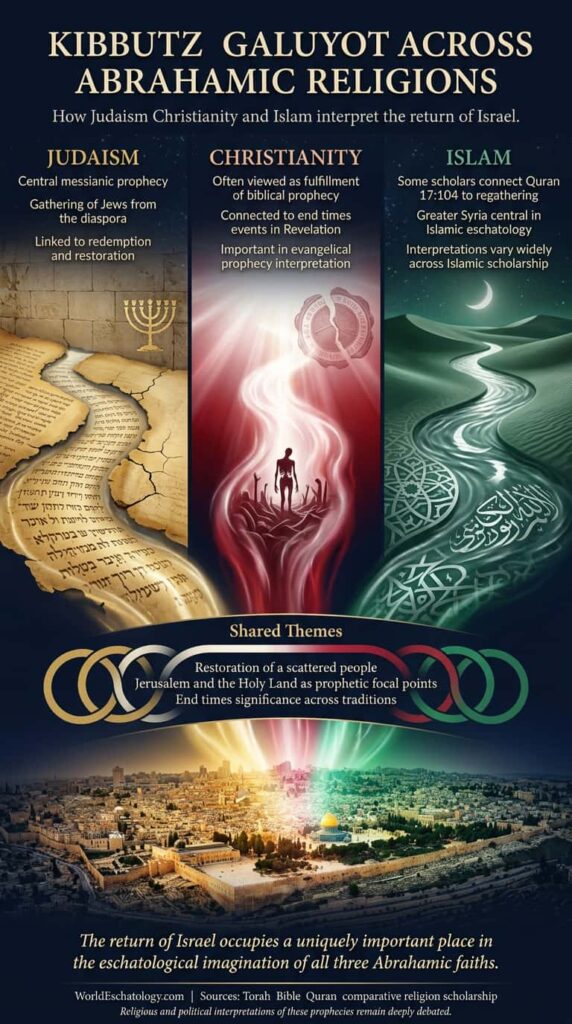
Within modern Jewish religious thought, there is a significant divide over how to interpret the current State of Israel in relation to Kibbutz Galuyot.
Religious Zionism, associated with figures like Rabbi Abraham Isaac Kook, holds that the modern State of Israel is the beginning of the divine redemption, the first flowering of the messianic age, even if the full spiritual dimension is not yet present.
This view sees the secular Zionist pioneers as unwitting instruments of divine providence, doing God’s work without knowing it.
On the other side, certain Ultra-Orthodox communities, particularly the Satmar Hasidic tradition, hold that the establishment of a Jewish state through political and military means rather than direct miraculous divine intervention is not the true ingathering of exiles.
They believe the authentic return will come only with the Messiah. This is a minority position within Orthodoxy today, but it represents a serious theological argument that has been debated for over a century.
Christian Perspectives on the Ingathering of Exiles
For evangelical and many Protestant Christians, the return of the Jewish people to the land of Israel is one of the most significant signs that the end times are approaching.
This is not a fringe view. It represents the theology of hundreds of millions of Christians worldwide, particularly in the United States, sub-Saharan Africa, Latin America, and South Korea.
The framework is rooted in what is called premillennial Dispensationalism, a system of biblical interpretation that understands history as divided into distinct eras or dispensations, with Israel playing a specific and irreplaceable role in God’s plan for the end times.
In this view, the regathering of Israel is not the church taking over Israel’s promises. It is a literal fulfillment of literal promises made to a literal people about a literal land.
The most important New Testament text for Christian engagement with the ingathering of exiles is Romans 11.
The Apostle Paul writes at length about the relationship between Israel and the church in the purposes of God.
He explicitly warns Gentile Christians not to be arrogant about Israel’s partial hardening, and he promises that this hardening is temporary: “All Israel will be saved,” he writes, and he connects this to the return of Christ.
The ingathering and the spiritual restoration of Israel are, in Paul’s framework, directly linked to the consummation of all things.
Christian Zionism, the political and theological movement of Christians who support the Jewish return to Israel, grew significantly in the twentieth century.
It has roots going back to the Puritan era in England and America, where scholars reading the Old Testament prophecies concluded that a literal return of the Jewish people to the land was part of God’s plan.
Today, Christian Zionism represents one of the most powerful forces of political support for the State of Israel on the global stage.
Islamic Perspectives: What Does Islam Say About the Jewish Return?
The Islamic tradition’s engagement with the question of Jewish return to the land of Israel is more complex and more varied than is often presented in popular discussions.
There is a Quranic verse that has become central to this conversation among Islamic scholars.
chapter 17, verse 104 of the Quran states:
“And We said to the Children of Israel after him: Dwell in the land, and when the promise of the Hereafter comes, We will bring you forth as a mixed assembly.”
Some Islamic scholars, particularly those engaged with end-times theology, read this verse as a Quranic acknowledgment that the Children of Israel would be gathered to the land in the end times before the final divine reckoning.
In this reading, the modern return of Jews to Israel is not something Islam opposes on theological grounds but something the Quran itself anticipates.
This interpretation is not universally accepted in Islamic scholarship.
Other scholars read the verse differently, and the political dimensions of the Israeli-Palestinian conflict mean that theological discussions about this passage are rarely conducted in isolation from intense political emotion.
But the scholars who engage with the verse in a purely eschatological framework often note that there is more overlap between the Quran’s end-times picture and the biblical prophetic picture than the current political climate tends to acknowledge.
In Islamic end-times theology more broadly, the land of greater Syria, including the region of Israel and Palestine, is described as a central stage for the final events before the Day of Judgment.
The return of Prophet Isa, described earlier in our article on Yawm al-Qiyamah, is connected to this region.
The great final battle, Al-Malhama al-Kubra, takes place here.
Whether one reads these texts as connected to the modern State of Israel or not, the geographic convergence of Islamic, Jewish, and Christian end-times expectation in this small piece of land is one of the most striking features of comparative eschatology.
Is the Ingathering Complete? What Comes Next?
A fair and honest look at the current numbers suggests that the ingathering of exiles is ongoing but not yet complete.
As of the mid-2020s, there are approximately 7.2 million Jewish people living in Israel. But there are also roughly 8 million Jewish people still living in the diaspora.
The single largest diaspora community is in the United States, home to approximately 6 million Jews, which means that just under half of the world’s Jewish population still lives outside the land of Israel.
The question of whether American Jews will make Aliyah is one that cuts across religious, cultural, and political lines.
American Jewish life is deeply established. Jewish communities in New York, Los Angeles, Chicago, and other major cities have been present for generations and have built rich institutional lives.
The motivation to leave is not obvious in the way it was for Jews in Yemen, Iraq, or the Soviet Union who faced persecution or state-sponsored antisemitism.
But scholars who follow the ingathering of exiles topic note that the historical pattern has been consistent: Jewish communities stay in their host countries until conditions force or strongly encourage departure, and then they come.
The rise of antisemitism in Europe over the past two decades has already driven French Aliyah to record levels.
Whether something similar will happen in the United States is a matter of ongoing discussion.
From a strictly prophetic standpoint, texts like Amos 9:15, which promises that the regathered Israel will “never again be uprooted,” and the Ezekiel 37 vision of the two stages, suggest that the full prophetic picture involves both a completed physical ingathering and a subsequent spiritual transformation.
Most prophecy scholars, both Jewish and Christian, would say that neither of these is complete yet.
The ingathering is well advanced. The spiritual revival that the prophets associate with the full redemption has not yet come.
What comes next, in the prophetic framework, is a sequence of events that connects directly to the other major end-times topics: the role of Israel in the events leading up to the Battle of Armageddon, the coming of the Messiah in Jewish expectation, the Second Coming of Christ in Christian expectation, and the events surrounding Yawm al-Qiyamah in Islamic expectation.
All three traditions converge on the land of Israel as the focal point of the final chapter of human history.
Frequently Asked Questions About Kibbutz Galuyot
What does Kibbutz Galuyot mean?
Kibbutz Galuyot is a Hebrew phrase meaning the ingathering of the exiles.
The word Kibbutz comes from a root meaning to gather or collect, and Galuyot is the plural of galut, meaning exile or diaspora.
Together the phrase describes the theological concept of God bringing the Jewish people back from their scattering among the nations to the land of Israel.
It is one of the central doctrines of Jewish messianic theology, embedded in the daily Amidah prayer, referenced in Maimonides’ Thirteen Principles of Faith, and supported by dozens of passages across the Hebrew Bible.
The modern agricultural communities in Israel that most people know as kibbutzim share the same root word, but the prophetic concept of Kibbutz Galuyot predates them by thousands of years.
Is the ingathering of exiles a fulfilled prophecy?
The honest answer is: partially, and it is still in progress. The broad outlines of the biblical prophecies about the ingathering of exiles have been fulfilled in remarkable ways.
Jews have returned to the land of Israel from over 100 countries, from every direction on the compass, in numbers that have grown from 25,000 in the nineteenth century to over 7 million today.
Specific details from prophetic texts, including the return from the north, east, west, and south, the rebirth of the nation, the revival of the Hebrew language, and the physical restoration of the land, have all occurred within the last 150 years.
However, approximately half of the world’s Jewish population still lives in the diaspora, and the spiritual transformation that the prophets associate with the full redemption, described in the second stage of Ezekiel 37 and in passages like Zechariah 12:10, has not yet occurred.
Most serious scholars describe the ingathering as substantially underway but not yet complete.
What does the Bible say about Israel being regathered?
The Bible contains dozens of direct statements about the regathering of Israel from among the nations.
Some of the most important include Deuteronomy 30:3 through 5, where Moses predicts both the exile and the return.
Isaiah 11:11 through 12 describes God gathering Israel a second time from the four corners of the earth.
Isaiah 43:5 through 6 speaks of God bringing his people from the east, west, north, and south.
Jeremiah 16:14 through 15 says the second gathering will be so significant it will eclipse the memory of the original exodus from Egypt.
Ezekiel 36:24 contains God’s direct statement that he will gather his people from all countries and bring them back.
Ezekiel 37 presents the vision of the valley of dry bones as an extended picture of national resurrection.
And Amos 9:14 through 15 promises that once regathered, Israel will never again be uprooted from its land.
Together these passages form one of the most detailed and repeated prophetic themes in all of Scripture.
What is the significance of 1948 in biblical prophecy?
May 14, 1948, the date on which the modern State of Israel declared independence, is considered by a very large number of prophecy scholars, both Jewish and Christian, to be the most significant prophetic event in approximately two thousand years.
The core reason is that so many end-times prophecies in both the Old and New Testaments require the existence of a Jewish state in the land of Israel as a prerequisite.
Without a restored Israel, there is no context for the events described in Ezekiel 38 and 39, Zechariah 12 and 14, Daniel 9, and the book of Revelation.
Additionally, Isaiah 66:8 contains a statement, “Can a country be born in a day or a nation be brought forth in a moment,” which many readers interpret as a direct prophetic reference to the single-day declaration of statehood.
The fact that Israel survived its immediate war for independence against five invading armies, despite being severely outmanned and outgunned, is also read by believers as consistent with the prophetic promise of divine protection during the regathering.
What is Ezekiel 37 about?
Ezekiel 37 is the famous valley of dry bones vision. In it, the prophet Ezekiel is taken by God to a valley filled with dry bones and commanded to prophesy to them.
As he does, the bones come together, flesh forms on them, and eventually breath enters them and they become a living army.
God then interprets the vision directly, identifying the dry bones as the house of Israel and explaining that this represents the national resurrection of the Jewish people from their scattered, hopeless state back to life in their own land.
The vision has two stages: physical restoration without breath, followed by the entry of breath and full life.
Many scholars interpret the first stage as the physical return of Jewish people to the land of Israel, corresponding to modern events since the late nineteenth century and especially since 1948, and the second stage as a future spiritual revival and national turning to God that has not yet taken place.
Ezekiel 37 is one of the most cited Old Testament passages in discussions of Israel prophecy end times.
What is Aliyah and why is it important?
Aliyah is the Hebrew word for immigration to Israel by Jewish people.
It literally means ascent or going up, and it carries deep spiritual significance in Jewish culture.
Just as one ascends to read the Torah in synagogue, making Aliyah is understood as a spiritual elevation, a going up to the holy land.
The word has been used in this sense since ancient times. In the modern context, Aliyah refers to the organized waves of Jewish immigration that have been bringing Jews to Israel since the 1880s.
These waves, or aliyot, include the early agricultural pioneers of the First and Second Aliyah in the late nineteenth and early twentieth centuries, the survivors of the Holocaust, the mass airlifts of Jewish communities from Yemen, Iraq, Morocco, Ethiopia, and the Soviet Union, and the ongoing trickle and occasional surges of Jews from Europe and other parts of the world today.
Aliyah is important in the context of Kibbutz Galuyot because each individual act of Aliyah is seen as a piece of the prophetic ingathering, a person responding to, or being moved by, the divine call described in the prophetic texts.
Is the ingathering of exiles still happening today?
Yes. Aliyah continues every year. According to the Jewish Agency, which facilitates Jewish immigration to Israel, tens of thousands of Jews make Aliyah annually.
The specific numbers fluctuate based on global conditions: rising antisemitism in a particular country, economic instability, political factors, and organized outreach by Zionist and religious organizations.
In years of heightened antisemitism in Europe or the former Soviet states, Aliyah numbers spike.
In 2022, largely due to the war in Ukraine, a significant number of Ukrainian Jews made Aliyah.
French Aliyah has remained elevated through the 2010s and 2020s.
There are also ongoing programs to facilitate the immigration of remaining diaspora communities in Ethiopia, India, and other parts of the world where small but ancient Jewish communities still exist.
From a prophetic standpoint, the fact that Aliyah is ongoing, that the ingathering is still actively continuing rather than having been completed and stopped, is consistent with the prophetic picture of a long and deliberate process of national restoration rather than a single dramatic event.
Conclusion
The ingathering of the exiles, Kibbutz Galuyot, is one of the most documented and historically verifiable prophetic narratives anywhere in religious literature.
It is not a vague spiritual metaphor. It is a specific prediction, made by multiple prophets across many centuries, that a specific people would be scattered to specific places and then gathered back to a specific land. And then it happened.
From 25,000 people in the 1880s to over 7 million today. From Yemen and Ethiopia to Iraq and Russia to France and Ukraine and Argentina.
The bones have come together. The flesh is on them.
The nation lives and breathes and builds and defends itself and plants vineyards and holds elections and argues with itself about what kind of country it wants to be.
All of that, from a prophetic perspective, is stage one of Ezekiel’s vision.
Stage two is still ahead. The spiritual dimension, the national turning, the full redemption that the prophets describe in their most exalted language, is something that Jews, Christians, and in some readings even Muslims are still waiting for.
The ingathering of exiles is not a finished story. It is a story in progress.
And the fact that it has advanced as far as it has, in the face of every obstacle that history could throw at it, is one of the most remarkable things that a serious reader of both ancient texts and modern history can contemplate.
Whatever one believes about prophecy and fulfillment, about God and history and the meaning of modern events, the story of Kibbutz Galuyot demands to be taken seriously. The prophets said it would happen. It is happening. The rest of the story is still being written.