
Something unusual is happening in mosques, living rooms, and online communities across the Muslim world.
Millions of people who would never have described themselves as interested in Islamic end-times theology are now watching videos, reading hadith commentaries, and asking a question that was once the preserve of specialized scholars:
are the signs of Qiyamah appearing in the world today?
The question is not new. Every era of Muslim history that has experienced major upheaval, whether the Mongol invasions of the thirteenth century, the fall of the Ottoman caliphate in 1924, or the convulsions of the late twentieth century, has produced a wave of eschatological reflection.
But the current world events feels different in intensity and in reach.
Wars in Palestine, Syria, and beyond, the erosion of traditional social and moral structures across much of the world, the rise of surveillance technology that some scholars connect to hadith descriptions of the end times, and a general sense that global civilization is under unusual strain have all contributed to a climate in which Islamic end times and current events feel, to many Muslims, deeply connected.
This article takes that feeling seriously while subjecting it to rigorous scrutiny.
It draws on the primary Islamic sources, the Quran and the authenticated hadith literature, to explain what the tradition actually teaches about the signs of the approaching Hour.
It examines how classical and contemporary scholars have understood those signs.
It presents the full spectrum of scholarly views, from those who see clear connections between current world events and prophetic descriptions to those who counsel caution and emphasize the dangers of hasty sign-reading.
And it offers a framework for thinking about signs of Qiyamah today that is grounded in knowledge rather than speculation.
What Islamic Tradition Teaches About the Signs of the Hour
The Concept of Ashraat al-Saa’ah
Islamic eschatology uses the term Ashraat al-Saa’ah, meaning the signs of the Hour, to refer to the events and conditions that will precede and accompany the Day of Judgment.
The tradition divides these signs into two broad categories.
The minor signs, of which there are many, began appearing in the early period of Islam and continue unfolding across history.
The major signs are ten specific events that will occur in rapid succession near the actual approach of the Final Hour, including the emergence of the Dajjal, the descent of the Prophet Isa (Jesus), the appearance of the Imam Mahdi, the release of Gog and Magog, the rising of the sun from the west, and others.
This distinction is important because it shapes how seriously any given event can be connected to eschatological prediction.
The minor signs are, by nature, things that happen repeatedly across history and that intensify over time.
The major signs are specific, unmistakable, miraculous events that have no historical precedent and will be recognized by all who witness them.
Most of the contemporary discussion connecting Islamic end times to current world events deals with the minor signs, and it is in that domain that the most careful scholarly reasoning is required.
The Minor Signs: Patterns That Have Already Begun
The hadith literature describes a large number of minor signs, and classical scholars compiled them in dedicated works.
Some of these signs were fulfilled during the lifetime of the companions and are considered completed historical events.
The death of the Prophet himself, the conquest of Jerusalem, and the spread of Islam beyond the Arabian Peninsula all fall into this category.
Other minor signs were described as conditions that would intensify gradually over time rather than appearing and disappearing as discrete events.
Among the signs that the tradition describes as conditions of the final era before the major signs begin, several are cited with particular frequency by contemporary scholars discussing signs of Qiyamah today.
The widespread appearance of immorality and the normalization of what the tradition considers forbidden.
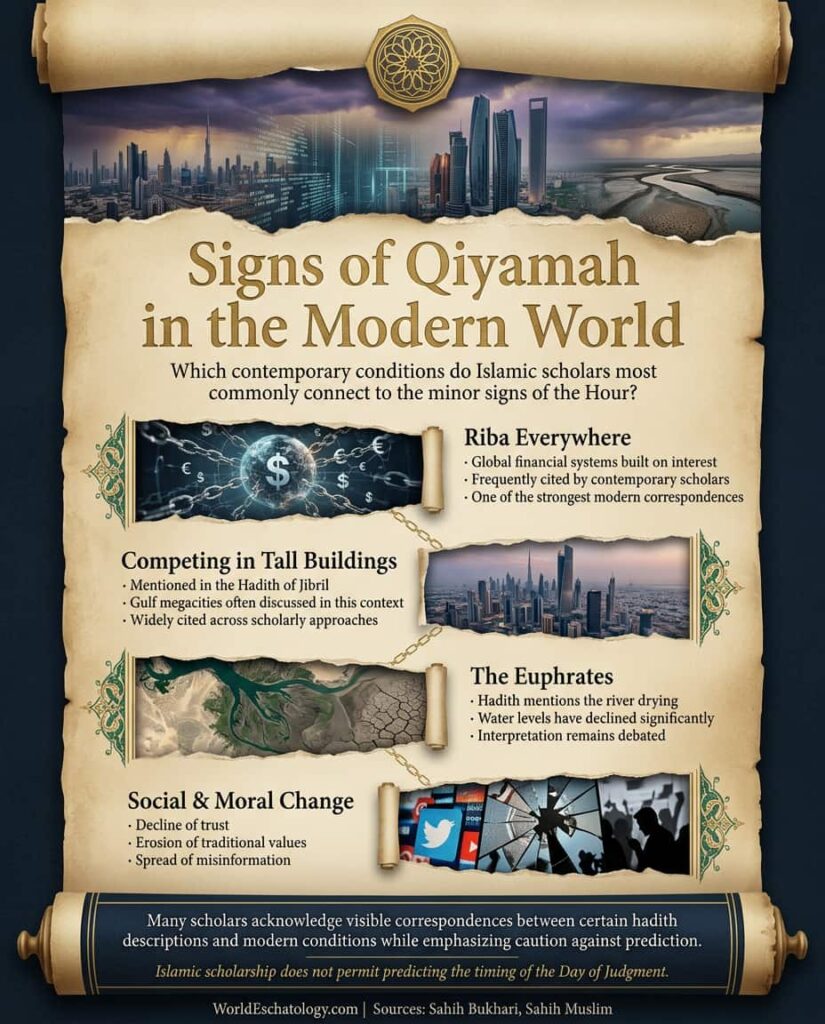
The prevalence of riba, meaning interest-based financial transactions, to the point where it becomes nearly impossible to avoid.
The drying up of the Euphrates river revealing a treasure of gold. A period of great fitna, meaning widespread civil strife and social breakdown.
The preponderance of killing to the point where the killer does not know why he kills and the killed does not know why he is being killed.
And a general condition in which religious knowledge diminishes while ignorance and false religious guidance spread.
The Near-Major Signs: The Cluster Before the Final Sequence
Between the general minor signs and the ten major signs, the hadith tradition describes a set of events that function as the immediate precursors to the major signs.
These include the collapse of the Kabul (some narrations interpreted as referring to central Asian governance), widespread conquest or liberation of Constantinople (already partially accomplished historically and debated by scholars as to whether a future fulfillment is also expected), and the emergence of the Imam Mahdi as the first of the major signs sequence.
The appearance of three great land collapses or sinkholes, one in the east, one in the west, and one in the Arabian Peninsula, is also mentioned as part of this transitional cluster.
Key Texts and Sources in Islamic Eschatology
The Quran on the Signs of the Hour
The Quran addresses eschatology extensively but in a way that emphasizes the certainty and the nearness of the Hour rather than providing a sequential list of signs.
Surah al-Anbiya (21:1) opens with the declaration that humanity’s reckoning has drawn near, while they remain in heedlessness turning away.
Surah al-Qiyamah (75) addresses the reality of resurrection directly and describes the terror of the Day itself.
Surah al-Kahf (18) contains what scholars regard as one of the Quran’s most important eschatological passages, including the story of Dhul-Qarnayn and the building of a barrier to contain Gog and Magog, who are described as being released when the time comes as a precursor to the end.
Surah al-Dukhan (44:10) refers to a day when the sky will bring forth visible smoke, which has been interpreted by many classical scholars as a major sign.
Surah al-Naml (27:82) describes the emergence of a creature from the earth that will speak to humanity, understood in the hadith commentaries as one of the ten major signs.
Surah al-Isra (17:4-8) contains a remarkable passage referring to the Children of Israel spreading corruption twice on the earth, which a number of contemporary scholars connect to current events in Palestine and the broader Middle East as a fulfillment of Quranic prophecy.
The Hadith Collections: Where the Detail Comes From
The detailed picture of Islamic end times and current world events connection comes primarily from the hadith literature.
The most important collections for eschatological content are Sahih Bukhari and Sahih Muslim, which contain rigorously authenticated traditions on the signs of the Hour.
Sunan Abu Dawud, Jami at-Tirmidhi, Sunan Ibn Majah, and the Musnad of Imam Ahmad ibn Hanbal contain additional material of varying reliability.
A dedicated work by Nu’aym ibn Hammad called Kitab al-Fitan, meaning the Book of Tribulations, compiled in the ninth century CE, is one of the earliest dedicated compilations of eschatological hadith and remains an important reference, though scholars note that it contains traditions of varying authenticity alongside the reliable ones.
The famous hadith of Jibril, narrated in both Sahih Bukhari and Sahih Muslim, is one of the most foundational texts for understanding the relationship between current conditions and eschatological awareness.
In it, the Angel Jibril asks the Prophet about the Hour, and the Prophet’s response describes the signs in broad terms: when the slave woman gives birth to her mistress, and when the barefoot, naked, destitute herders of sheep compete in the construction of tall buildings.
Classical scholars have understood this exchange as establishing that awareness of the signs is part of the definition of Islamic knowledge itself.
Classical Compilations on the Signs of Qiyamah
Several classical works are foundational for anyone approaching signs of Qiyamah today with scholarly seriousness.
Ibn Kathir’s Al-Bidaya wa al-Nihaya, meaning The Beginning and the End, contains one of the most comprehensive treatments of Islamic eschatology in the classical tradition.
Ibn Kathir brings together Quranic interpretation, hadith analysis, and historical commentary in a way that remains indispensable.
Al-Qurtubi’s Al-Tadhkira fi Ahwal al-Mawta wa Umur al-Akhira is another foundational reference, covering both the signs of the Hour and the conditions of the afterlife.
Al-Suyuti in the fifteenth century compiled multiple works on eschatological themes that synthesized the classical scholarship available to him.
How Different Scholars Approach Islamic End Times and Current World Events
The Cautious Traditional Approach
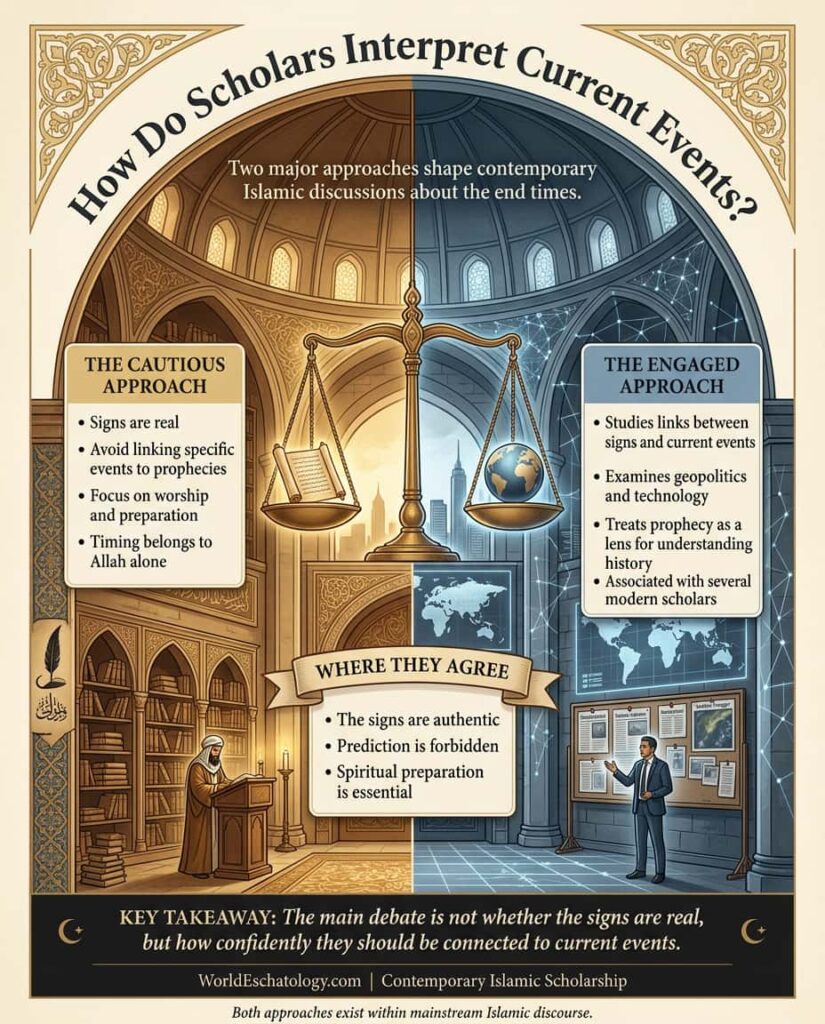
A significant strand of traditional Sunni scholarship approaches the question of Islamic end times and current world events with deliberate caution.
Scholars in this tradition, including many senior figures at Al-Azhar in Egypt and in the traditional scholarly establishments of Saudi Arabia, Jordan, and South Asia, acknowledge the reality of the eschatological signs while warning strongly against the identification of specific contemporary events with specific prophetic descriptions.
Their reasoning is both theological and historical.
Theologically, they emphasize that the Prophet himself when asked about the timing of the Hour repeatedly said that knowledge of the Hour belongs to Allah alone.
The Quran states this explicitly in multiple places, including Surah al-A’raf (7:187) and Surah al-Ahzab (33:63).
The proper response to eschatological awareness is not to calculate or predict but to increase in righteous action and personal preparation.
Historically, these scholars point to a long and well-documented record of Muslims in every era who believed, with what seemed like good evidence, that the major signs were imminent, and who were proven wrong.
The Mongol invasions, the Crusades, colonial devastation, and numerous political upheavals all generated confident end-times predictions that failed to materialize.
Sheikh Ibn Baz, the late Grand Mufti of Saudi Arabia, exemplified this approach.
He consistently affirmed the reality and importance of the minor signs while refusing to make specific connections between contemporary geopolitical events and prophetic descriptions.
He treated the study of eschatology as a motivation for personal piety rather than a framework for political analysis.
The Engaged Contemporary Approach
A different and equally serious strand of contemporary Islamic scholarship engages much more directly with the connection between signs of Qiyamah today and observable world events.
Scholars in this tradition argue that understanding the eschatological signs is not merely a matter of personal spiritual preparation but a practical necessity for Muslims navigating an extremely complex geopolitical and moral landscape.
Sheikh Imran Hosein is perhaps the most internationally prominent scholar in this tradition.
Drawing on the Quran, the hadith literature, and a deep engagement with Western political philosophy and international relations theory, he has spent decades arguing that the prophetic descriptions of the end times provide a uniquely accurate framework for understanding the modern world order.
He identifies what he describes as a Pax Americana and its relationship to the Biblical Gog and Magog as a key element of the current world situation.
He connects the current political condition of the Muslim world, and particularly the situation in Palestine and the Arabian Peninsula, to specific Quranic and hadith predictions.
His work has attracted both large followings and substantial scholarly criticism, but it represents a serious attempt to engage Islamic eschatology with current world events rather than treating the two as separate domains.
Sheikh Safar al-Hawali, the Saudi scholar whose 1980s doctoral dissertation on secularism attracted wide attention and whose later eschatological work has been enormously influential, represents another version of this engaged approach in the Sunni world.
His analysis of Gulf War politics and its eschatological implications, and his broader framework connecting Western political dominance to Islamic end-times prophecy, shaped a generation of Muslim political-eschatological thinking, even among those who disagreed with his specific conclusions.
Shia Scholarly Perspectives on Signs of the End Times
Shia Islamic eschatology, rooted in the doctrine of the Twelfth Imam’s occultation and awaited return, approaches the question of current events somewhat differently from mainstream Sunni scholarship.
In Twelver Shia theology, the return of the Hidden Imam, who is identified as the Imam Mahdi, is the central eschatological event around which all other signs are organized.
This gives Shia eschatological thinking a different orientation: rather than watching for a figure yet to be born, Shia Muslims understand themselves as awaiting the return of a specific individual who has been alive and in occultation since 874 CE.
Senior Shia scholars, including many within the traditional hawza seminary system in Najaf and Qom, maintain a cautious position on connecting current events to eschatological signs, parallel in many ways to the cautious Sunni position described above.
They affirm the doctrinal reality of the signs while warning against the kind of speculative sign-identification that has historically produced false movements.
The Islamic Republic of Iran’s political theology has a complex relationship with eschatology: the doctrine of wilayat al-faqih, the governance of the Islamic jurist as a deputy of the Hidden Imam, connects political action directly to eschatological expectation, but many senior Shia scholars have been critical of this connection.
Internal Diversity: Sufi and Traditionalist Perspectives
Sufi approaches to Islamic eschatology tend to emphasize the inner or spiritual dimension of the signs rather than their geopolitical expression.
In the Sufi reading, the Dajjal is not only a future physical individual but a present spiritual reality, a force of deception operating in the human heart and in the broader cultural environment of materialism, hedonism, and spiritual blindness.
The minor signs of the Hour are understood as descriptions of a spiritual condition that is already deeply present in modern civilization, regardless of how those signs map onto specific news events.
This perspective produces a different kind of engagement with Islamic end times and current world events than the geopolitical approach.
Rather than focusing on wars and treaties, the Sufi-influenced reading points to the condition of hearts, to the prevalence of distraction and forgetfulness of God, to the dominance of materialist values in both Muslim and non-Muslim societies, as the most significant expression of the signs in the present age.
These two readings are not mutually exclusive, and many scholars integrate both, but the emphasis is genuinely different.
Why This Matters Today: Signs of Qiyamah in the Current World Events
The Signs That Contemporary Scholars Highlight Most Often
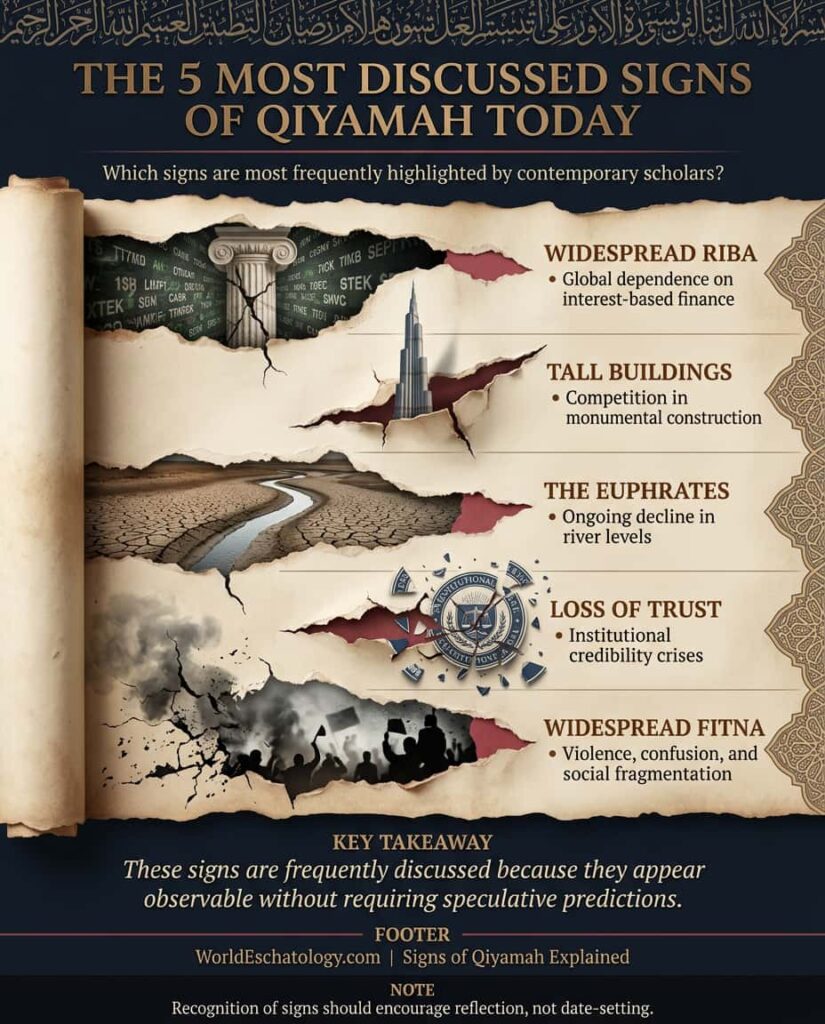
When serious contemporary scholars discuss signs of Qiyamah today, certain themes recur consistently.
It is worth addressing these directly, with appropriate scholarly honesty about both the strength of the prophetic evidence and the complexity of connecting it to current conditions.
The widespread prevalence of riba is one of the most unambiguous of the minor signs in the contemporary context.
Authentic hadith in Sahih Bukhari and other collections describe a time when riba will become so pervasive that even those who do not intentionally engage in it will be affected by it through its dust.
The modern global financial system, built on interest-based lending at every level from personal credit to sovereign debt, represents a condition that is genuinely difficult to describe in any other way.
Both Sunni and Shia scholars of Islamic finance have noted this connection, and it is one of the most scholarly defensible links between Islamic end times teachings and current world conditions.
The competition in building tall structures is a sign mentioned directly in the hadith of Jibril, where the Prophet describes the barefoot, naked, and destitute herders of sheep competing in the construction of tall buildings as one of the signs of the approaching Hour.
The emergence of the Gulf states, and particularly the extraordinary skylines of Dubai, Abu Dhabi, Riyadh, and Doha, built by the oil wealth of tribal societies that were, within living memory, nomadic, has struck many scholars as a remarkably close match for this prophetic description.
This connection is made by scholars across the spectrum, from the cautious traditionalists who cite it as an example of a fulfilled minor sign to the more engaged contemporary scholars who treat it as evidence of imminent major developments.
The drying of the Euphrates to reveal a mountain of gold is another frequently cited sign.
The hadith describing this, found in Sahih Muslim, says that the Euphrates will soon dry up and reveal a mountain of gold, over which people will fight such that ninety-nine out of every hundred will be killed.
Scholars note that the water level of the Euphrates has declined dramatically in recent decades due to dam construction upstream in Turkey and reduced rainfall, a trend that has been extensively documented by environmental scientists and reported in international media.
Whether the prophetic description refers to literal gold or to something of comparable value beneath the riverbed, and whether the current drying represents the beginning of the fulfillment or the fulfillment itself, is genuinely debated among scholars.
The fitna of widespread killing is perhaps the most broadly applicable of the minor signs, and it requires the most caution.
The hadith describes a time of such pervasive violence that killers cannot explain their motivations and victims cannot explain why they were targeted.
There is no shortage of violence in the modern world, and the twenty-first century has produced conflicts in Syria, Yemen, Iraq, Afghanistan, Sudan, and many other regions that have resulted in staggering civilian casualties with the kind of chaotic, sectarian, and often senseless character the hadith seems to describe.
However, careful scholars note that violence has been a constant of human history, and that the temptation to read one’s own era’s conflicts as uniquely eschatological should be resisted.
What can be said honestly is that the conditions the tradition describes are present in the world today in a way that warrants genuine reflection.
Palestine, Jerusalem, and the Question of Prophetic Geography
No current world situation generates more eschatological discussion in Muslim communities than the situation in Palestine and Jerusalem.
This is understandable given the central place of the Holy Land in Islamic eschatological geography.
The hadith literature places numerous key events of the end times in the Levant region. The Mahdi will have connections to the area.
The Dajjal will be confronted near Jerusalem. Isa will descend near Damascus.
The final gathering of believers before the defeat of Gog and Magog is connected to the Levant in several narrations.
The Quranic passage in Surah al-Isra (17:4-8), which describes the Children of Israel being permitted twice to spread great corruption on the earth and being punished twice, has been interpreted by a number of contemporary scholars as a prophecy whose second fulfillment is occurring in the present age.
Sheikh Imran Hosein has written extensively on this interpretation. It is important to note, however, that this is a contested reading.
Other classical and contemporary scholars interpret the passage as referring entirely to historical events in ancient and early medieval history, with no intended reference to the modern state of Israel.
The honest position is that this interpretation is possible and held by serious scholars, but it is not the consensus position of classical Islamic scholarship.
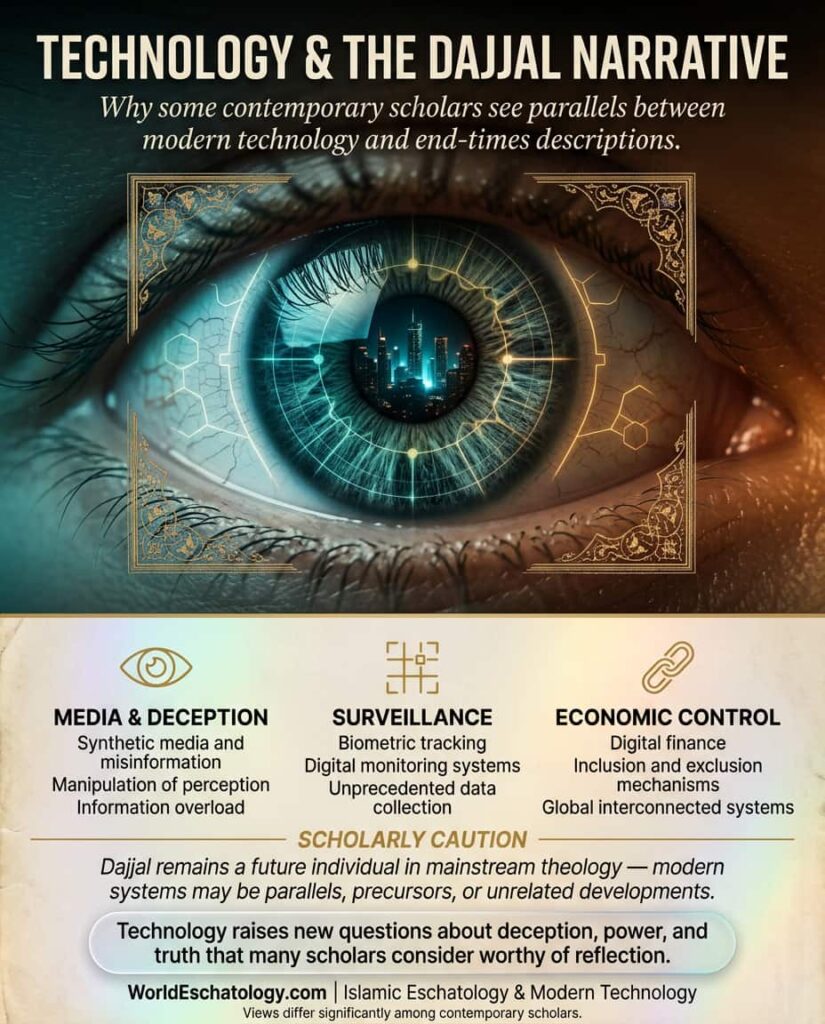
Technology, Surveillance, and the Dajjal Narrative
One of the most intellectually interesting areas of contemporary eschatological scholarship involves the connection between modern technology and the hadith descriptions of the Dajjal and the end times.
The Dajjal is described as having extraordinary powers that will lead people astray: the ability to appear to bring the dead to life, to produce food and water, to travel with supernatural speed, and to project an image of paradise while his paradise is actually fire.
Contemporary scholars, particularly those in the more engaged tradition, have noted that modern technology, and specifically the emerging technologies of artificial intelligence, virtual reality, mass media, and biometric surveillance, creates capacities that at least metaphorically match some of these descriptions.
The mass surveillance infrastructure built by major governments, combined with the capacity of modern media to create deeply immersive false realities, the global financial system’s ability to include or exclude individuals from economic participation, and artificial intelligence systems capable of generating convincing synthetic media, all represent conditions that were not present in any previous era of human history.
Whether these represent the Dajjal described in the hadith, are precursors to his emergence, or are simply unprecedented developments that happen to share some characteristics with prophetic descriptions is a question that scholars answer differently.
What is clear is that the current technological moment is genuinely without historical precedent and that the engagement between Islamic eschatological scholarship and these developments is a live and serious area of thought.
The Moral and Spiritual Signs: What Scholars Say About Current Society
Perhaps the most consistently cited category of signs among traditional scholars discussing signs of Qiyamah today involves the moral and spiritual condition of human society.
The hadith literature describes the end times as a period in which religious knowledge will diminish, immorality will become open and even celebrated, the institution of the family will come under severe pressure, trust between people will erode, and leadership will be given to those unqualified to hold it.
Scholars across denominational and methodological lines note that these descriptions match the current global condition with a precision that is difficult to dismiss.
The hadith in Sahih Bukhari that describes the lifting of trust from the hearts of people as one of the signs of the approaching Hour has attracted particular attention from scholars and from ordinary Muslims trying to make sense of a world in which institutional credibility has collapsed across virtually every domain, from governments and media to religious institutions and scientific bodies.
The erosion of basic social trust, documented by sociologists and political scientists as a defining feature of twenty-first century society, maps closely onto this prophetic description in a way that scholars find genuinely significant.
Frequently Asked Questions: Islamic End Times and Current World Events
What does Islam teach about the signs of the end times?
Islam teaches that the Day of Judgment, called Yawm al-Qiyamah, will be preceded by a sequence of signs that the Prophet Muhammad described across many authenticated hadith.
These signs are divided into minor signs, which are many and began appearing early in Islamic history, and ten major signs that will occur in rapid succession near the Final Hour itself.
The minor signs include conditions like the spread of immorality, the prevalence of interest-based transactions, widespread killing, the decline of religious knowledge, and the competition in constructing tall buildings.
The major signs include the emergence of the Imam Mahdi, the appearance of the Dajjal, the descent of the Prophet Isa, the release of Gog and Magog, the rising of the sun from the west, and others.
The tradition emphasizes that knowledge of the exact timing of the Hour belongs to Allah alone, and that the purpose of knowing the signs is spiritual preparation rather than calculation or prediction.
Are current world events signs of Qiyamah?
This is the question that millions of Muslims are asking, and honest scholarship requires a nuanced answer.
Several conditions described in the hadith literature as minor signs of the approaching Hour are clearly present in the contemporary world: the universal prevalence of riba, the competition in building tall structures, the decline of basic social trust, the widespread nature of violence and civil conflict, and the erosion of traditional moral and family structures.
These are genuine correspondences that serious scholars acknowledge.
However, the same caution should be applied: every major period of crisis in Muslim history has generated confident end-times predictions that proved premature.
The appropriate response to recognizing these signs is not to announce the imminent arrival of the Hour but to increase in righteous action, seek genuine Islamic knowledge, and maintain the kind of character that the tradition prescribes regardless of eschatological timing.
What are the signs of Qiyamah that are happening today?
Among the minor signs that contemporary scholars most commonly identify as clearly visible today, the following are most frequently cited.
The pervasiveness of riba in the global financial system matches the hadith description almost exactly.
The extraordinary skylines of the Gulf states, built by previously nomadic societies, corresponds closely to the hadith of Jibril’s description of barefoot herders competing in tall construction.
The declining water levels of the Euphrates match the hadith in Sahih Muslim about the river drying to reveal something of great value.
The widespread nature of violence without clear cause in multiple regions corresponds to the descriptions of end-times fitna.
The decline of authentic religious knowledge alongside the proliferation of false religious guidance, easily observable in the era of social media, matches multiple hadith descriptions.
These are the most defensible connections that contemporary scholars make between Islamic end times teachings and current world events.
How do Sunni and Shia scholars differ on Islamic eschatology?
Sunni and Shia scholars share the foundational framework of Islamic eschatology, including belief in the Day of Judgment, the Imam Mahdi, the Dajjal, the return of Isa, and the major signs.
The most important doctrinal difference concerns the Imam Mahdi: Sunni Islam holds that he is a future figure yet to be born, while Twelver Shia Islam holds that he was born in 868 CE as the Twelfth Imam and is currently in occultation.
This difference shapes how each tradition relates to the question of current world events and eschatological imminence.
In both traditions, cautious mainstream scholars warn against premature identification of current world events with specific prophetic signs, while more engaged scholars draw explicit connections to contemporary geopolitics and social conditions.
Both traditions share the view that the ultimate knowledge of timing belongs to Allah alone.
What do Islamic scholars say about the Dajjal in the modern world?
Islamic scholars are careful to distinguish between the Dajjal as a specific individual who will physically appear as one of the major signs of the Hour and the broader cultural, spiritual, or systemic reality that some scholars describe as Dajjalic, meaning characterized by the deception, false promises, and inversion of truth and falsehood that the Dajjal will embody.
Mainstream Sunni scholarship affirms that the Dajjal is a real future individual whose physical appearance will be one of the major signs.
At the same time, scholars including Sheikh Imran Hosein and others in the more engaged contemporary tradition argue that the current world order, with its pervasive media-driven deception, its capacity for mass surveillance and economic exclusion, and its inversion of traditional moral values, represents a Dajjalic system that is paving the way for the Dajjal’s eventual physical appearance.
Both positions are held by serious scholars and deserve engagement rather than dismissal.
Is it correct to predict when the Day of Judgment will come?
No. Islamic scholarship across all traditions is unanimous on this point: the timing of the Day of Judgment is known to Allah alone and is explicitly described in the Quran as one of the things that no created being has knowledge of.
Surah al-A’raf (7:187) states this directly, saying that knowledge of the Hour is with my Lord alone, and He will not reveal its time except at its appointed moment.
The Prophet himself, when asked about the timing of the Hour, referred the question back to Allah.
Any person or group that claims to predict when the Day of Judgment will arrive is contradicting a clear and explicit Quranic teaching.
What is appropriate is to know the signs in order to prepare, not to predict in order to calculate.
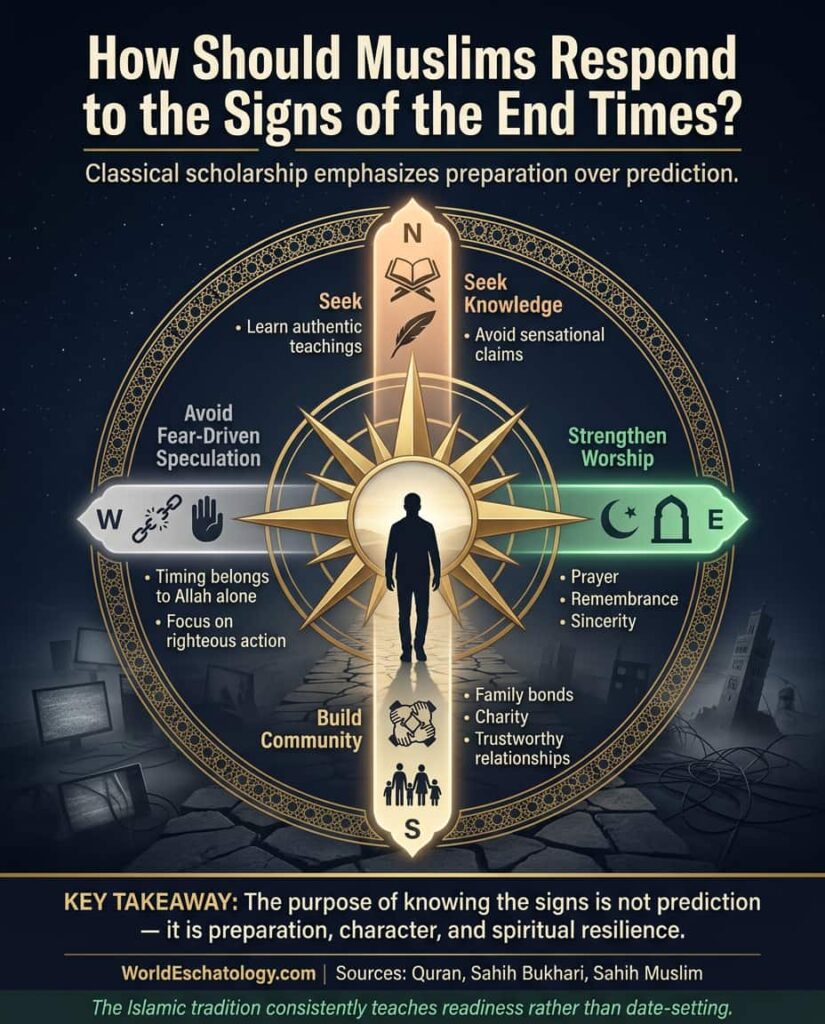
How should a Muslim respond to the signs of the end times?
The tradition’s guidance on this question is both clear and practically demanding.
When the Prophet described the signs of the Hour to his companions, the consistent lesson drawn from those descriptions was not political calculation or panic but heightened commitment to righteous action.
The famous hadith that says if the Hour comes while you are holding a seedling, plant it captures this spirit exactly: the correct response to eschatological awareness is not to stop working and wait but to intensify one’s commitment to doing what is right and good regardless of timing.
Specifically, scholars recommend maintaining regular prayer, seeking authentic Islamic knowledge, strengthening family and community bonds, avoiding the moral corruptions described as signs of the end times, performing acts of charity, and focusing on the quality of one’s relationship with Allah rather than on predicting events.
Conclusion: Knowledge as Preparation, Not Prediction
The relationship between Islamic end times and current world events is real, theologically serious, and deserving of the careful scholarly engagement it has received from the best minds in the tradition.
The world today does present conditions that the hadith literature described as signs of the approaching Hour, and it would be intellectually dishonest to pretend otherwise.
The prevalence of riba, the extraordinary construction in the Arabian Peninsula, the declining Euphrates, the erosion of social trust, the normalization of moral conditions the tradition condemns, and the emergence of surveillance and media technologies without historical precedent are all genuine points of connection between prophetic description and observable reality.
At the same time, the tradition itself provides the most important corrective to the temptation toward eschatological overconfidence.
Every era has had its confident predictors of imminent final events, and none has been vindicated.
The proper relationship to the signs of Qiyamah is that of a person who is awake, knowledgeable, and prepared, not a person who is consumed by calculation, driven by anxiety, or seeking validation for predetermined political conclusions.
The scholar who knows the signs deeply and responds by intensifying personal righteousness is living the tradition correctly.
The person who uses eschatological knowledge to claim special insight, to justify violence, or to generate fear is misusing a sacred inheritance.
What Islamic eschatological teaching ultimately offers to a person navigating the current world is not a news filter or a political program.
It offers a framework for understanding history as meaningful, for seeing human events as part of a divine narrative that has a beginning, a middle, and an end that Allah has already determined.
Within that framework, the current moment is neither uniquely terrifying nor negligible.
It is one chapter in a story whose conclusion is certain: divine justice will prevail, truth will defeat falsehood, and every human soul will account for what it chose to do with the time it was given.
That certainty, grounded in the Quran and the authenticated traditions of the Prophet, is the most stable foundation available to any person trying to maintain spiritual integrity in a genuinely turbulent world.
Related Articles on WorldEschatology.com
- Imam Mahdi: Who He Is, His Signs, and What Islam Teaches
- The Dajjal in Islam: What the Hadith Actually Say
- Gog and Magog (Yajuj and Majuj): A Complete Religious Overview
- The Minor Signs of the Day of Judgment: A Full Scholarly Guide
Sources
Sahih Bukhari; Sahih Muslim; Sunan Abu Dawud; Jami at-Tirmidhi; Sunan Ibn Majah; Musnad Ahmad ibn Hanbal; Nu’aym ibn Hammad, Kitab al-Fitan; Ibn Kathir, Al-Bidaya wa al-Nihaya; Al-Qurtubi, Al-Tadhkira fi Ahwal al-Mawta wa Umur al-Akhira; Al-Suyuti, Al-Hawi lil-Fatawa; Sheikh Imran Hosein, An Islamic View of Gog and Magog in the Modern World; Sheikh Safar al-Hawali, The Day of Wrath.