

There is a hadith that the Prophet Muhammad (peace be upon him) repeated so often, in so many settings, that his companions began to take special note of it.
He would warn them from the pulpit. He would remind them after the prayer. He even taught them specific words to recite for protection.
The subject of all this urgency was a single figure: the Dajjal.
The Prophet said, as recorded in Sahih Muslim, that there has been no trial from the time of Adam until the Day of Judgement greater than the trial of the Dajjal.
That is a remarkable statement. Not war. Not plague. Not the greatest disasters that have ever struck humanity.
The single greatest test facing human beings, according to this narration, is one man.
So who exactly is the Dajjal? Where does he come from?
What will he be able to do? And perhaps most importantly, how does a person protect themselves when that time comes?
This article covers all of it. We will go through what the name means, the physical descriptions that have been passed down, where Islamic tradition says he is right now, the signs that precede his emergence, the supernatural powers he will wield, who will follow him, and how Prophet Isa (Jesus), peace be upon him, ultimately brings his story to an end.
We will also touch on how the Dajjal compares to the Christian figure of the Antichrist, and what some modern scholars have made of these ancient prophecies.
This is a long read, but the subject demands it.
What Does “Dajjal” Actually Mean?
The word Dajjal comes from the Arabic root dajala, which carries the meaning of covering, smearing, or concealing the truth.
Some scholars connect it to the idea of coating something with tar to disguise it.
In other words, the very name of this figure signals his essential nature: he is someone who covers over reality and presents a convincing lie in its place.
His full title in Arabic is Al-Masih ad-Dajjal. This is worth unpacking carefully because it contains a fascinating tension.
Al-Masih is the same word used for Jesus Christ in Islamic tradition. Prophet Isa is called Al-Masih Isa ibn Maryam.
So both figures share the title of Al-Masih, and this is not accidental. The Dajjal is, in the most direct sense possible, a counterfeit messiah.
He arrives claiming to be what Prophet Isa truly is, and the very structure of his title announces that deception.
There is also a secondary meaning sometimes given to the word Dajjal in the sense of someone who travels extensively across the land.
This fits the prophecies about him: once he appears, he will move through the earth at extraordinary speed, reaching almost every corner of the world in a very short period.
Is Dajjal One Person or a Broader Force?
The mainstream scholarly position in Sunni Islam is that the Dajjal is a specific individual who will appear near the end of times.
However, there is a parallel tradition worth noting. In one hadith, the Prophet (peace be upon him) warned that before the major Dajjal appears, there will emerge roughly thirty smaller dajjals, each of them claiming prophethood.
The word in these narrations is used in a broader sense to mean any great deceiver.
Some scholars have used this to argue that the spirit of the Dajjal manifests throughout history in different forms before the final, literal individual arrives.
This distinction matters when you encounter modern interpretations that identify the Dajjal with certain political forces or ideological systems.
Those readings are usually drawing on this secondary, broader usage of the term.
Is the Dajjal Mentioned in the Quran?
This is one of the most common questions people ask, and the honest answer is no, not by name.
The Quran does not mention the word Dajjal anywhere, and there is no passage that directly describes his story or role in the events of the end times.
For a figure of such enormous prophetic significance, this silence is striking enough that scholars have discussed it at length.
The classical explanation is that the Quran speaks in principles and the Sunnah fills in the details.
The Quran warns repeatedly about deception, about trials, about the people who will follow falsehood in the last days, but it leaves the specific narratives to the hadith literature.
Almost everything we know about the Dajjal comes from the collections of Sahih Bukhari and Sahih Muslim, the two most authoritative books of hadith in Sunni Islam.
The Connection to Surah Al-Kahf
While the Quran does not name the Dajjal, Islamic scholarship has long connected him to Surah Al-Kahf, the eighteenth chapter of the Quran.
The Prophet specifically instructed believers to recite the first ten or last ten verses of this surah as protection from the Dajjal’s fitna, his trial and temptation.
Some scholars see a thematic connection between the surah’s four famous stories and the four temptations the Dajjal will exploit:
the temptation of faith through the story of the Companions of the Cave, the temptation of wealth through the story of the two men and their gardens, the temptation of knowledge through the story of Musa and Al-Khidr, and the temptation of power through the story of Dhul-Qarnayn.
Whether or not you accept this interpretive framework, the connection between this surah and protection from the Dajjal is firmly established in authentic hadith.
What Does the Dajjal Look Like? His Physical Description
The Prophet Muhammad, peace be upon him, described the Dajjal’s physical appearance in considerable detail across multiple narrations.
This level of specificity was deliberate. The idea was that a Muslim who knew exactly what to look for would not be fooled when the time came.
These are not vague spiritual symbols. They are concrete, identifying features.
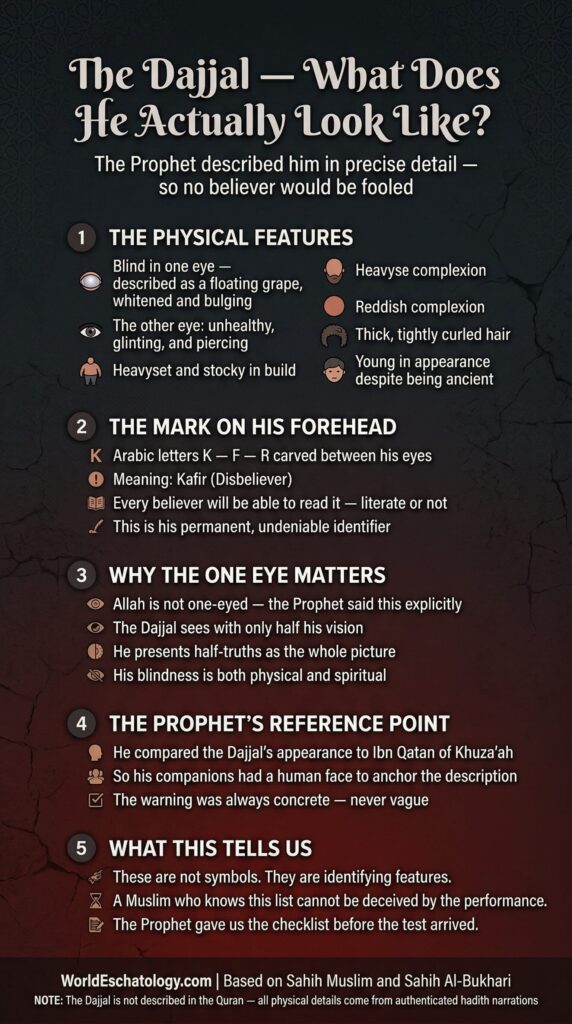
The Blind Eye
The single most repeated detail in every description of the Dajjal is that he is blind in one eye.
Some narrations specify the right eye, others the left. The Prophet described the affected eye in one hadith as resembling a floating grape, bulging and whitened, essentially non-functional.
The other eye is sometimes described as emitting a particular kind of unhealthy glint.
The symbolism here is significant and has been commented on by scholars for centuries.
A being that claims to show you the whole truth while literally seeing with only half its vision.
The one-eyed nature of the Dajjal became, in classical Islamic thought, a symbol of a perspective that is fundamentally incomplete and therefore fundamentally deceptive.
The Mark on His Forehead
Perhaps the most dramatic identifying feature is the writing between his eyes.
The Prophet (peace be upon him) said that written on his forehead will be the letters K-F-R, which stand for kafir, meaning disbeliever or infidel. In some narrations, the full word is written out explicitly.
What is particularly remarkable about this detail is the hadith that adds: every believer, whether literate or not, will be able to read it.
This is not about reading skill. It is about a kind of spiritual perception that will be granted to the faithful, allowing them to see through his claims to the truth of what he is.
General Appearance
Across the various narrations, the Dajjal is described as a young man, heavyset or stocky in build, with reddish skin.
His hair is described as thick and curly. The Prophet is reported to have compared his appearance to a specific person known to the companions, a man named Ibn Qatan from the tribe of Khuza’ah, as a point of reference for his contemporaries.
There are also narrations in which the Prophet described seeing the Dajjal in a vision, circling the Kaaba, and another where he saw him as part of a dream.
In one famous account, he described Isa ibn Maryam and the Dajjal in the same vision, giving the companions a kind of visual comparison between the true messiah and the false one.
Where Is the Dajjal Right Now?
This is the question that captures people’s imagination most powerfully. If this is a real, physical individual who will one day emerge, where is he at this moment?
The answer given in Islamic tradition is surprisingly specific.
According to a narration reported by the companion Tamim ad-Dari and recorded by Imam Muslim, the Dajjal is currently imprisoned on an island somewhere in the sea, bound in chains, waiting for the permission to be released at the appointed time.
The Story of Tamim ad-Dari
This account deserves to be told in full because it is one of the most unusual and fascinating pieces of prophetic tradition in the entire corpus of Islamic hadith.
Tamim ad-Dari was a Christian from the Levant who converted to Islam. He came to the Prophet with a story of a sea voyage during which his ship was blown off course and landed at an unknown island.
There, he and his companions encountered a strange creature, later understood to be the Jassasah, a kind of scout or spy creature mentioned in Islamic eschatology.
The Jassasah directed them to a monastery-like structure on the island. Inside, they found a man of enormous size, bound in chains at the wrists and ankles.
The man questioned them at length about various places in the world, asking about the palm groves of a certain region, whether a particular lake still had water, whether news had come of the Prophet in Mecca.
Finally, the chained figure revealed his identity. He told them he was the Masih ad-Dajjal, and that the moment was coming when he would be permitted to emerge.
The Prophet, when Tamim brought him this account, confirmed its authenticity and recounted it to his companions publicly from the pulpit.
This narration is the primary textual basis for the belief that the Dajjal exists right now, somewhere, in a state of imprisonment, waiting.
The Signs That Precede His Arrival
The emergence of the Dajjal does not happen in a vacuum. The prophetic traditions describe a specific sequence of events that will precede him, a kind of global deterioration that sets the stage for his appearance.
The Sequence Described in Hadith
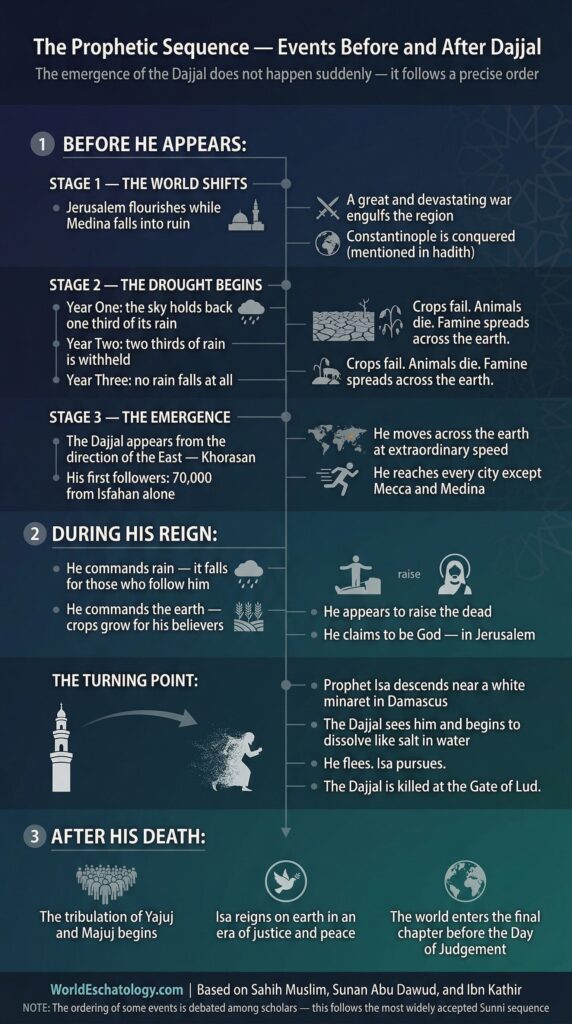
In one narration attributed to the companion Muadh ibn Jabal, the Prophet described a chain of events: a great flourishing of Jerusalem while Yathrib, the old name for Medina, falls into ruin; then a great and devastating war; then the conquest of Constantinople; and then, following those events, the emergence of the Dajjal.
Whether this sequence is meant to be strictly linear or to identify overlapping conditions is a matter of scholarly discussion.
The Three Years of Drought
One of the most striking signs mentioned in the hadith literature is a period of severe drought that will precede the Dajjal by three years.
In the first year, the sky will hold back one third of its rain. In the second year, two thirds. In the third year, no rain will fall at all. Crops will fail.
Animals will die. The world will be experiencing a famine of catastrophic proportions.
It is in this context of desperation that the Dajjal will appear, claiming to be able to command the rain and restore abundance to the earth.
The timing is not incidental. He arrives precisely when people are at their most vulnerable, most hungry for someone or something to save them.
He Cannot Enter Mecca or Medina
Despite the speed with which he will travel across the earth, the Dajjal will be prevented from entering two cities: Mecca and Medina.
The narrations describe angels standing guard at every entrance to these cities, blocking his path.
He will camp outside Medina, and the city will shake three times during his encampment, causing the hypocrites and those weak in faith to flee out to him.
This detail has been a source of comfort for Muslims across generations.
Whatever else the Dajjal destroys or corrupts, the two holiest cities in Islam remain beyond his reach.
The Powers and Deceptions He Will Wield
The Dajjal’s danger lies not in brute force but in his apparent miracles.
The prophetic traditions describe abilities that would, to an ordinary observer with no grounding in this knowledge, look exactly like divine power.
This is the core of his deception: he will do things that look like the signs of prophethood or divinity.
Commanding the Rain and the Earth
As mentioned above, the Dajjal will appear to have control over nature itself.
He will command the sky to rain over the lands of those who follow him, and crops will grow abundantly for his believers.
For those who reject him, the earth will be dry and barren. The economic and physical pressure this creates will be enormous. Starvation is a powerful argument for doubt.
His Paradise and His Hell
The Dajjal will travel with what appears to be a river of water and a river of fire.
The Prophet specifically warned his companions about this: if they were to encounter the Dajjal, they should enter what appears to be the fire, because it is actually cool, fresh water.
What appears to be the water, the river of paradise, is in reality fire. The reversal is complete. What looks like mercy is punishment and what looks like punishment is mercy.
Raising the Dead
Among the most dramatic powers attributed to the Dajjal is the ability to kill a person and then bring them back to life.
The narrations describe him killing a young believer, cutting him in two, and then calling the halves back together, with the person apparently alive again.
After this spectacle, the Dajjal will ask the young man if he now believes in him.
The young man will refuse, and according to the narration, the Dajjal will be unable to harm him again after that point.
This miracle of apparent resurrection is considered one of his most dangerous tools because it mimics one of the most profound abilities associated with divine power and with the miracles of Prophet Isa, peace be upon him.
Claiming Divinity
At some point in his campaign, the Dajjal will cross a threshold and claim to be God himself. He will make this claim in Jerusalem.
The narrations note that Allah is not one-eyed, and that the mark on the Dajjal’s forehead will be visible to every believer as a refutation of this claim, but for those who have already been drawn in by his material miracles, this final claim may not seem outrageous.
Who Will Follow the Dajjal?
The hadith literature addresses this question directly, and it is worth approaching with both honesty and care.
The narrations paint a picture of a mass movement, not a small fringe group, following the Dajjal.
The Prophet warned that the Dajjal’s initial following will include seventy thousand people from a particular city, described in some narrations as Isfahan in Persia.
Beyond that initial group, he will attract followers from across humanity. The narrations specifically mention that many of his followers will be those whose faith was superficial, those who followed Islam outwardly without real conviction, as well as those who are simply overawed by his apparent miracles.
The Prophet also warned that a person’s confidence in their own faith is not a reliable protection.
He specifically cautioned that a believer might approach the Dajjal certain that they will expose or reject him, and still end up being swayed.
The recommended response to news of the Dajjal was not heroic confrontation but careful distance.
The Believing Young Man
Against the backdrop of mass confusion, the narrations include the striking account of a young believer, sometimes interpreted as one of the Abdal, a class of hidden saints in Islamic tradition, who stands before the Dajjal publicly and declares him a liar.
This young man is killed and apparently resurrected, but maintains his rejection of the Dajjal throughout.
The account serves as a model of the kind of rooted, unshakeable faith that the tribulation demands.
How to Protect Yourself from the Dajjal
The prophetic tradition is not merely descriptive about the Dajjal. It is deeply practical.
The Prophet taught his companions specific tools and habits to prepare them, and by extension, all Muslims who would come after them, for this test.
Reciting the First and Last Ten Verses of Surah Al-Kahf
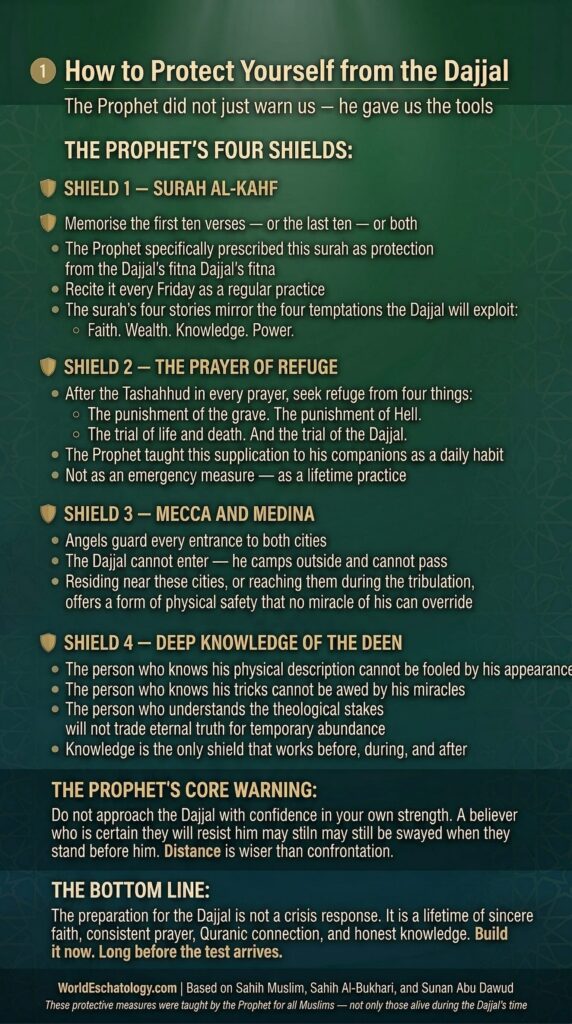
This is the most widely cited protection. The Prophet said in a narration collected by Imam Muslim that whoever memorizes the first ten verses of Surah Al-Kahf will be protected from the Dajjal.
Other narrations mention the last ten verses. Most scholars recommend memorizing both.
The recitation of the entire surah, particularly on Fridays, is a well-established practice connected to this protection.
Seeking Refuge in the Prayer
The Prophet (peace be upon him) used to seek refuge from the tribulation of the Dajjal in every prayer, specifically in the final sitting position of the Tashahhud, just before the closing salams.
He taught this supplication to his companions and encouraged it as a regular practice, not something reserved only for when the Dajjal actually appears.
The idea is that spiritual preparation begins long before the crisis arrives.
Living in or Near Mecca and Medina
Since the Dajjal cannot enter these cities, the narrations suggest that residing in them, or reaching them during his tribulation, offers a form of physical safety.
However, the scholars note that this protection is conditional on genuine faith.
The people who flee Medina during his encampment, the ones who leave to join him, are described as hypocrites. The city’s sanctuary applies to the sincere believer.
Deep Knowledge of the Deen
Perhaps the most sustainable protection is the one that cannot be circumvented by any miracle: deep, rooted knowledge of Islamic theology.
The Dajjal’s claims can be evaluated against what you already know. He is one-eyed. God is not. He has a mark on his forehead.
The mark can be read. He dies and his system collapses when Prophet Isa returns.
A person who knows these things well will have a framework for interpreting whatever they witness, rather than being left to rely on raw impressions.
The Dajjal and the Christian Antichrist: How Do They Compare?
For readers coming from a Christian background, or those interested in comparative eschatology, the parallels between the Islamic Dajjal and the Christian concept of the Antichrist are hard to miss.
They are also genuinely interesting from a scholarly perspective.
The Similarities
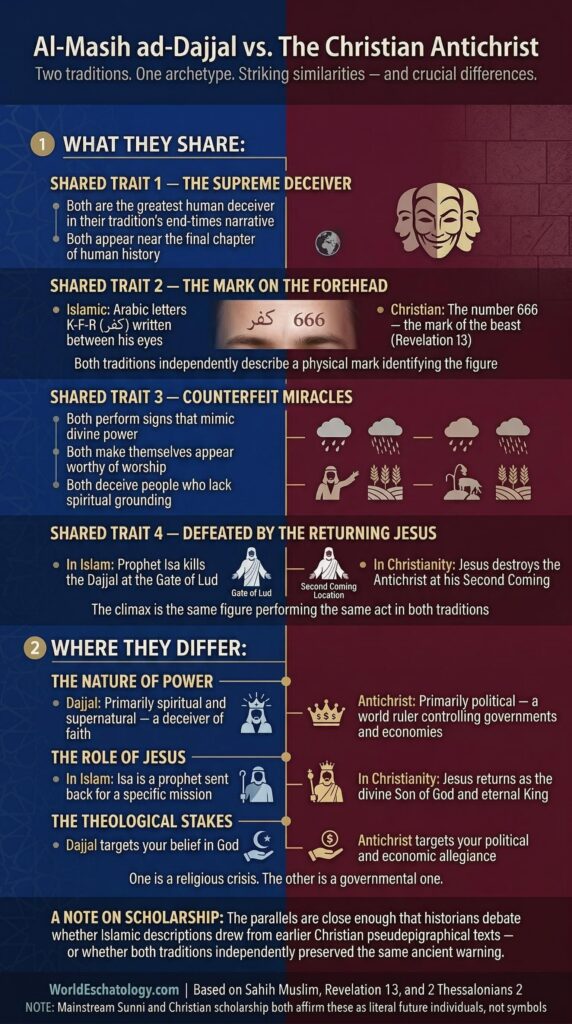
Both traditions describe a singular, extraordinarily powerful figure who appears near the end of history and deceives a large portion of humanity into following him.
Both involve apparent miracles that mimic divine power. Both traditions describe a mark or sign on the figure’s forehead.
In Revelation, this connects to the number 666 and the mark of the beast. In the Islamic narrations, it is the Arabic letters for disbeliever.
The parallel is remarkably specific for two traditions that developed largely in different cultural spheres.
Both the Dajjal and the Antichrist are ultimately destroyed at the Second Coming of Jesus. In the Islamic tradition, Prophet Isa kills the Dajjal personally.
In Christian eschatology, Jesus defeats the Antichrist and the false prophet at his return. The climactic resolution is essentially the same figure performing the same act.
The Differences
The Christian Antichrist in most traditional readings is primarily a political figure, a world ruler who controls economies, governments, and militaries.
His power is largely geopolitical. The Islamic Dajjal’s power is more supernatural and religious in character.
He is not merely a tyrant but a deceiver of faith, targeting spiritual loyalty rather than political submission.
There is also the question of theological framing. In Christian eschatology, the Antichrist is opposed by Jesus returning as the divine Son of God.
In Islamic tradition, Isa is a prophet, albeit an extraordinary one, sent back to fulfil a specific mission.
The victory of the returned Jesus over the Dajjal reads differently depending on the theological framework you bring to it.
The Joel Richardson Thesis
One angle worth mentioning for its cultural influence, even if the mainstream Islamic and Christian scholarly establishments largely reject it: the Christian author Joel Richardson argued in a widely-read book that the Islamic Mahdi, the guided leader expected to appear before the Dajjal, matches the description of the biblical Antichrist, while the Islamic Dajjal might correspond to the biblical Jesus returning.
It is a provocative thesis built on identifying typological parallels between the two traditions.
It has generated significant debate in both Christian apologetics and Islamic response literature, which makes it worth knowing about even if you find its conclusions unconvincing.
The Defeat of the Dajjal: Prophet Isa Returns
The story of the Dajjal does not end with his triumph. Islamic eschatology is very clear on this point.
The Dajjal’s time is limited, and the instrument of his destruction is the return of Prophet Isa ibn Maryam, Jesus the son of Mary, peace be upon him.
The narrations describe Isa descending from the heavens near a white minaret in the eastern part of Damascus, dressed in garments dyed with saffron, his hands resting on the wings of two angels.
At that moment, the Dajjal will be on his way to Jerusalem to continue his campaign.
When the Dajjal sees Isa, the narrations describe what happens as a kind of immediate, visceral unraveling.
The Dajjal will begin to dissolve or melt like salt dissolving in water. He will attempt to flee. Isa will pursue him.
The narrations specify that the Dajjal will be killed at the gate of Lud, a location in modern-day Israel near what is now the city of Lod.
This moment is the theological centrepiece of the entire narrative. The false messiah is killed by the true one.
The counterfeit Al-Masih is destroyed by the real Al-Masih. The titles converge in the final encounter, and the truth asserts itself over the deception completely.
What Comes After
The death of the Dajjal is not the end of the end-times narrative in Islamic tradition.
It is followed by the emergence of Yajuj and Majuj, which we know in the Western tradition as Gog and Magog, a separate and even greater tribulation.
Isa’s reign on earth follows, described as a period of extraordinary justice, peace, and spiritual flourishing. But those are stories for other articles.
Modern Interpretations of the Dajjal
It would be incomplete to discuss the Dajjal only as a classical theological subject without acknowledging how these narratives have been applied and interpreted in more recent times.
Since at least the late twentieth century, popular Islamic writing has frequently used the concept of the Dajjal as a framework for understanding contemporary geopolitics, culture, and media.
Some writers have identified the Dajjal not as a literal future individual but as an existing system: global media, corporate power, financial capitalism, or Western cultural dominance.
The imagery of the Dajjal’s river of paradise that is actually fire maps neatly, for these writers, onto a consumer culture that promises happiness and delivers spiritual emptiness.
The Ahmadiyya movement, considered outside mainstream Sunni Islam, has a formal doctrinal position that the Dajjal is not a person at all but a collective entity.
Their founder, Mirza Ghulam Ahmad, taught that the Dajjal represents Christian missionary activity and European colonialism combined, a force of spiritual deception operating across institutions rather than incarnated in one individual.
These metaphorical or systemic readings can be thought-provoking, but it is worth noting that the mainstream Sunni position, grounded in the literalness of the hadith descriptions, is that the Dajjal is a real, physical individual who will genuinely appear in the future.
The physical details, the one eye, the mark, the imprisonment on the island, the killing at the gate of Lud, do not lend themselves easily to purely symbolic reading.
Frequently Asked Questions
Is the Dajjal mentioned in the Quran?
No. The Quran does not mention the Dajjal by name. Our knowledge of him comes almost entirely from the hadith literature, particularly the collections of Sahih Bukhari and Sahih Muslim.
Where is the Dajjal right now?
According to the hadith of Tamim ad-Dari, authenticated and recounted publicly by the Prophet himself, the Dajjal is currently imprisoned on an island, bound in chains, awaiting the time when he will be released.
The precise location of the island is not identified in the narrations.
What are the signs that the Dajjal has appeared?
The most specific signs include a three-year period of severe drought and famine immediately before his emergence, the shaking of Medina which causes hypocrites to leave, his rapid movement across almost the entire earth within a short period, and reports of his apparent miracles including commanding rain and seemingly raising the dead.
Who kills the Dajjal?
Prophet Isa ibn Maryam, Jesus the son of Mary, peace be upon him, kills the Dajjal upon his return. The Dajjal is killed at the gate of Lud, according to the authentic narrations.
Will the Dajjal enter Mecca or Medina?
No. The narrations are explicit that he will be prevented from entering both cities. Angels guard the entrances. He will camp outside Medina but will not be able to enter it.
How do you protect yourself from the Dajjal?
The main protective measures taught in the hadith are memorizing the first and/or last ten verses of Surah Al-Kahf, seeking refuge from his tribulation in every prayer, remaining in or reaching Mecca or Medina, and grounding oneself deeply in Islamic knowledge and practice well before his emergence.
Is the Dajjal the same as the Christian Antichrist?
They share significant parallels: both are supreme deceivers at the end of history, both perform counterfeit miracles, both have identifying marks on the forehead, and both are destroyed by the returning Jesus.
However, they differ in key ways: the Antichrist is primarily a political tyrant while the Dajjal is a spiritual deceiver, and the theological framing of Jesus’s identity in each tradition differs substantially.
Conclusion: The Dajjal as a Mirror
If there is a single thought to carry away from this entire discussion, it might be this: the Dajjal is not merely a future threat. He is a present warning.
The Prophet’s consistent instruction was not to wait for the Dajjal and then figure out what to do.
It was to build, right now, the kind of faith, knowledge, and spiritual grounding that would make a person unmovable when the test arrives.
The person who encounters the Dajjal and is fooled is, in the prophetic framing, someone who did not prepare.
The person who sees through him is someone whose connection to truth was too deep to be severed by a spectacular performance.
In that sense, the Dajjal narratives function as something more than eschatological information.
They are a diagnosis of spiritual weakness: what happens when material abundance replaces spiritual conviction, when impressive spectacle overrides principled knowledge, when desperation makes people willing to follow anyone who promises relief.
The remedy the Prophet prescribed was not complicated. Know your religion. Pray sincerely. Read Surah Al-Kahf.
Keep the company of the sincere. Do not let the glitter of this world become so dazzling that you lose the ability to tell the difference between what is real and what only looks real.
As for what comes after the Dajjal, the story of Prophet Isa’s return, the era of justice that follows, the final signs before the Day of Judgement, those deserve their own treatment.
This is a series with a long way still to go.
Sources and Further Reading
Sahih Muslim | Sahih Al-Bukhari | Sunan Abu Dawud | Ibn Kathir, Al-Nihaya fi al-Fitan wal-Malahim
6 thoughts on “Dajjal: The Islamic Antichrist Explained”