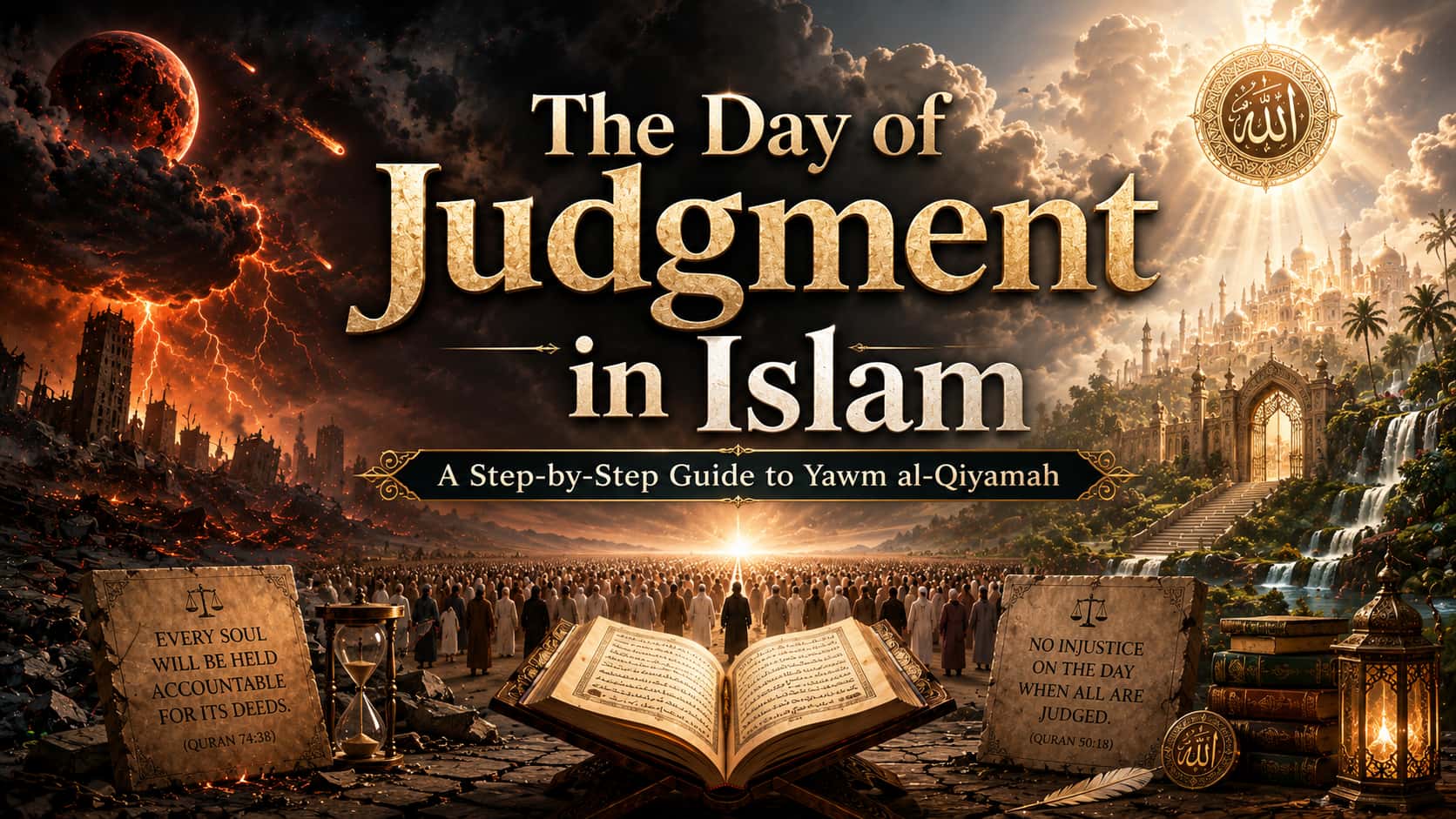
Something real is happening right now. Searches for “Day of Judgment Islam,” “Yawm al-Qiyamah,” and “signs of Qiyamah” are climbing every month.
Islamic content on YouTube covering the stages of Judgment Day is pulling in tens of millions of views.
Mosques and online Islamic circles are reporting that questions about the end times, about the Dajjal, about the Mahdi, and about what happens after death are drawing their largest audiences.
By every available signal, global interest in the Day of Judgment in Islam is surging in 2025 and 2026, and it is not slowing down.
This guide takes that interest seriously. It does not treat the topic as fear-mongering or myth.
It engages honestly and directly with what Islam actually teaches about Yawm al-Qiyamah, walking through every major stage in sequence, from the signs that come before it, to the resurrection, to the crossing of the Sirat, to the final destinations of Jannah and Jahannam.
The aim is to give every Muslim, and every curious person, a clear, complete, and honest understanding of what the Day of Judgment in Islam looks like according to the Quran and the authentic Sunnah.
What is Yawm Al Qiyamah?
The Meaning and Importance of the Day of Judgment in Islam
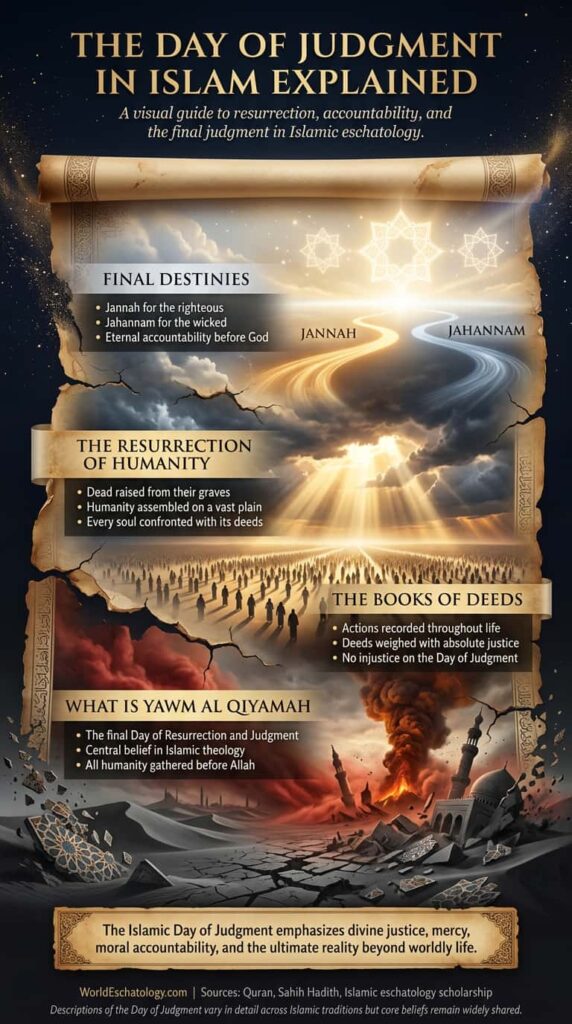
The word Qiyamah comes from the Arabic root meaning “to rise” or “to stand.” Yawm means “day.”
Together, Yawm al-Qiyamah means “The Day of Standing” or “The Day of Rising.”
It is also called Yawm ad-Din, the Day of Judgment, Yawm al-Hashr, the Day of Gathering, and Yawm al-Ba’th, the Day of Resurrection. Each of these names points to a different aspect of the same massive event.
Believing in the Day of Judgment is not optional in Islam. It is one of the Six Articles of Faith.
A person who denies it has stepped outside the boundaries of the faith entirely. The Quran mentions it hundreds of times. Allah even swears by it in Surah Al-Qiyamah:
“I swear by the Day of Resurrection.” (Surah Al-Qiyamah 75:1)
When Allah swears by something, He is drawing your attention to how absolutely real and certain it is.
The Day of Judgment in Islam is the point toward which everything in this life is moving.
Every prayer, every sin, every act of kindness, every moment of patience or cruelty, all of it is being recorded and is building toward this one final accounting.
Understanding Yawm al-Qiyamah is not just theology. It is the most practical knowledge a Muslim can have because it shapes every choice you make in this world.
According to an authentic hadith, this Day will last the equivalent of 50,000 years of worldly time.
For the sincere believer, Allah promises it will feel shorter. For others, every moment will feel like an eternity.
The signs before judgment day
Minor Signs: What Has Already Come and What Is Still Coming
Before Yawm al-Qiyamah arrives, there will be signs.
The Prophet Muhammad, peace be upon him, described these signs in detail, and Islamic scholars divide them into two categories: minor signs and major signs.
Many of the minor signs have already appeared. Others are still unfolding.
The Prophet, peace be upon him, described a time when knowledge would be lifted and ignorance would spread, when fornication would become open and normalized, when alcohol consumption would increase, when people would compete in building tall buildings, when earthquakes would multiply, when time would feel like it was passing faster, when a man would obey his wife but disobey his mother, and when music and entertainment would spread everywhere.
None of these require a long stretch of imagination to see in the world of 2025 and 2026.
The minor signs are not the end. They are the warning period, the time when the door of repentance is still wide open and when each person still has the opportunity to turn back to Allah.
The Ten Major Signs: When the End Is Genuinely Near
The 10 major signs of Judgment Day are ten specific events that the Prophet, peace be upon him, described as the final markers before the Hour.
He compared them to beads on a necklace. Once the first one comes, the rest will follow rapidly.
The first major sign is the appearance of the Mahdi, a man from the family of the Prophet, peace be upon him, who will emerge and lead the Muslim world, establishing justice after a period of widespread oppression.
The second is the emergence of the Dajjal, the Antichrist. This is described in the hadith literature as the greatest trial this world will ever face.
The Dajjal is a one-eyed man who will claim to be God. He will perform what appears to be miracles and will mislead enormous numbers of people.
The Prophet, peace be upon him, warned about him so extensively that it is said no prophet was sent except that he warned his community about the Dajjal.
The third is the return of Prophet Isa, Jesus, peace be upon him.
He will descend from the sky in Damascus, kill the Dajjal, and lead the believers in a final period of justice on earth before he eventually dies a natural death.
The fourth is the release of Gog and Magog, known in Arabic as Ya’juj and Ma’juj.
These are two nations currently held behind a barrier built by Dhul-Qarnayn, and their release near the end of time will bring tremendous destruction.
The fifth major sign is the sun rising from the west instead of the east. This is the event that permanently closes the door of repentance.
After this, a person who was not already a believer will gain no benefit from believing.
The sixth is the emergence of the Beast of the Earth, a creature that will mark people and distinguish between the believers and the disbelievers.
The remaining major signs include three massive landslides in the east, the west, and the Arabian Peninsula; a great fire emerging from Yemen that drives people toward Syria; a thick smoke that covers the earth; and finally, the destruction of the Kabah stone by stone by a man from Ethiopia called Dhul-Suwayqatayn.
When these signs have all appeared, the stage is set for the end.
The stages of judgment day in sequence
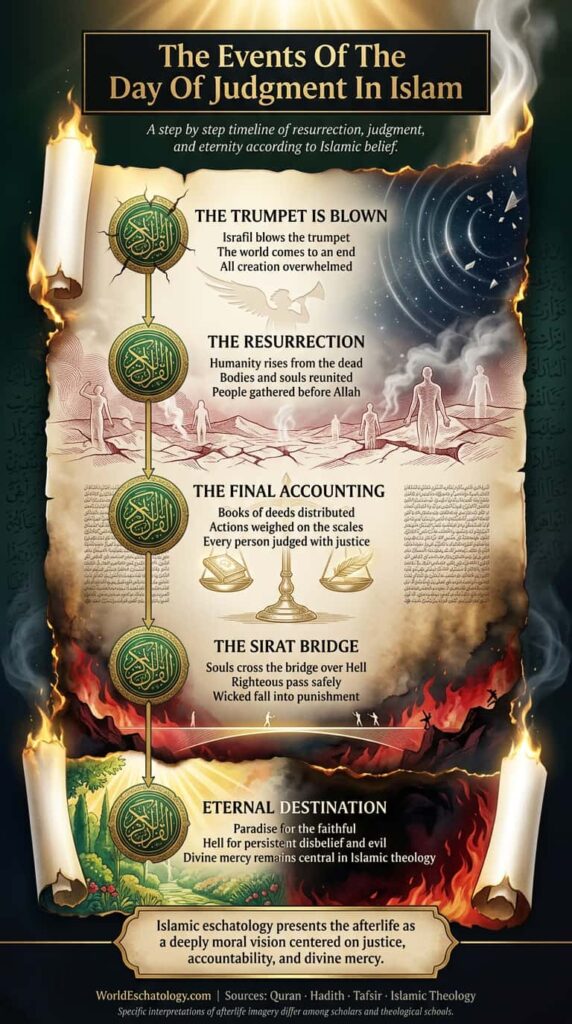
The First Blow of the Trumpet: The End of This World
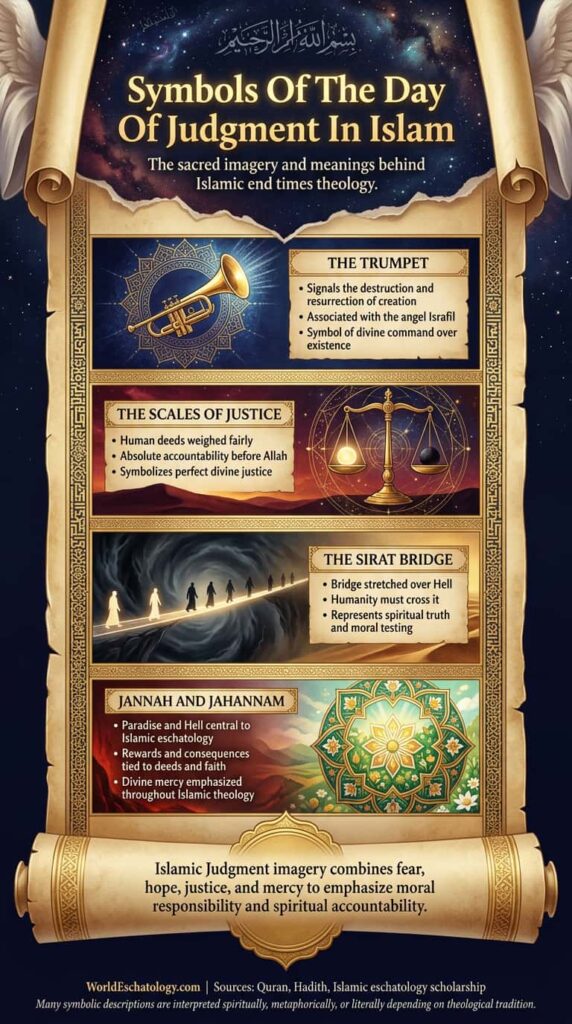
Once Allah wills it, the angel Israfil, peace be upon him, will blow the Trumpet. With this first blow, every living thing will die.
Every human being, every animal, every bird, every creature in the seas, and every angel except those Allah chooses to spare will die in an instant.
The mountains will crumble into dust. The oceans will boil and overflow. The stars will fall. The sky will be split open.
Everything you have ever known will be gone.
“And the Trumpet will be blown, and whoever is in the heavens and whoever is on the earth will fall dead, except whom Allah wills.” (Surah Az-Zumar 39:68)
There will then be a period between the two blows. During this period, rain will fall from the sky and the bodies of human beings will grow again from the earth, preparing for the resurrection.
The Second Blow: Al-Ba’th and the Resurrection
Then Israfil, peace be upon him, will blow the Trumpet a second time. With this blow, every person who has ever lived will be brought back to life.
From Adam, peace be upon him, to the last person who ever existed, every soul will be resurrected and will stand.
Those buried in graves will rise from them. Those whose remains dissolved into the ocean or burned into ash will be reconstructed. Nothing is beyond Allah’s power.
The Prophet, peace be upon him, told us that people will be resurrected barefoot, naked, and uncircumcised.
When the Mother of the Believers, Aisha, may Allah be pleased with her, expressed concern about this, the Prophet, peace be upon him, told her the situation will be so overwhelming that no one will have any attention to spare for looking at others.
People will be resurrected in different states. Some will have light shining from them.
Some will arrive in forms reflecting the nature of their deeds. This is the moment every soul has been moving toward since the day it was created.
Al-Hashr: The Great Gathering on the Plains of Mahshar
All of resurrected humanity will then be gathered on a completely new earth. It is flat, white, and featureless.
There are no mountains, no rivers, no shade, and no landmarks. This is the Mahshar, the place of gathering. Every person who has ever lived will be there, all at the same time.
The sun will be brought close. Some narrations describe it as only a mile away. The heat is indescribable.
People will sweat according to their deeds. Some will sweat up to their ankles, some to their knees, some to their necks, and some will be entirely submerged in their own sweat.
People will stand and wait for an enormously long period. In that sea of suffering, there will be seven categories of people who receive the shade of Allah’s Throne, the only shade that exists on that Day.
The Prophet, peace be upon him, listed these seven: a just leader, a young person who grew up worshipping Allah, a person whose heart is attached to the masjid, two people who loved each other purely for Allah’s sake, a man who refused temptation saying “I fear Allah,” a person who gave charity secretly, and a person who remembered Allah in private and wept.
Shafa’ah: The Intercession That Begins the Judgment
The waiting on the Mahshar will become so unbearable that humanity will go looking for someone to intercede with Allah to begin the judgment.
They will go to Prophet Adam, peace be upon him, who will direct them to Nuh, then to Ibrahim, then to Musa, then to Isa. And Isa, peace be upon him, will say: “Go to Muhammad.”
The Prophet Muhammad, peace be upon him, will say: “I am the one. I am for this.”
He will prostrate before Allah, and Allah will inspire him with words of praise that have never been given to anyone before.
Then Allah will say: “Raise your head, ask and it will be granted, intercede and your intercession will be accepted.”
This is the Grand Intercession. This is the Maqam al-Mahmud, the Praised Station, mentioned in the Quran (17:79).
It belongs to the Prophet Muhammad, peace be upon him, alone.
Al-Hisab: The Individual Reckoning
Now every soul is called, one by one, to account. Each person’s book of deeds will be presented to them.
Every deed is in it. Every word. Every intention. Every moment. Nothing has been missed, nothing has been forgotten, and nothing has been altered.
“So whoever does an atom’s weight of good will see it, and whoever does an atom’s weight of evil will see it.” (Surah Az-Zalzalah 99:7-8)
The righteous will receive their book in their right hand. The wicked will receive theirs in their left hand from behind their back.
The Prophet, peace be upon him, told us that every person will be questioned about five things: their life and how they spent it, their youth and how they used it, their wealth and how they earned and spent it, their knowledge and whether they acted on it, and their body and how they wore it out.
And there is a group who will bypass the reckoning entirely.
The Prophet, peace be upon him, spoke of 70,000 people from his ummah who will enter Jannah without any accounting.
These are described as people who never asked for ruqyah, never believed in bad omens, never branded themselves, and put their trust entirely in Allah.
Al-Mizan: The Weighing of Deeds
After the reckoning, a great Scale is established. This is the Mizan. It is a scale of absolute and perfect justice. Good deeds go on one side.
Bad deeds go on the other. Not a single deed is excluded. Not a single small kindness. Not a single whispered cruelty.
“And We place the scales of justice for the Day of Resurrection, so no soul will be treated unjustly at all.” (Surah Al-Anbiya 21:47)
What is the heaviest thing on the scale of good deeds? According to a hadith, it is good character. How you treated people. Your patience.
Your honesty. Your kindness. Your gentleness. These carry a weight that surprises many people.
Simple acts of remembrance, SubhanAllah, Alhamdulillah, Allahu Akbar, are described in hadith as light on the tongue but enormously heavy on the Mizan.
Al-Sirat: The Bridge Over Hellfire
Every single person must then cross the Sirat. It is a bridge stretched directly over the top of Jahannam.
The bridge is described in hadith as thinner than a hair and sharper than a sword. It has hooks along it that grab people. Hellfire roars beneath. No one is exempt from crossing.
How you cross depends entirely on what you brought with you from this world. Some will cross like lightning.
Some like the wind. Some like a fast horse. Some will run. Some will walk. Some will crawl.
And some will be caught by the hooks and dragged down into the Fire below. The light that guides a person on the Sirat comes from their faith and their deeds built up in this world.
Al-Hawd: The Pool of the Prophet
For those who make it across, the Prophet Muhammad, peace be upon him, has a pool waiting.
This is the Hawd, also known as Al-Kawthar. Its water is whiter than milk, sweeter than honey, and more fragrant than musk.
It is so large that traveling from one end to the other would take a month. Whoever drinks from it will never feel thirst again.
The Prophet, peace be upon him, will recognize his ummah by the mark of wudu on their faces, hands, and feet. But some will be turned away.
The Prophet, peace be upon him, said that he will reach out toward some people and angels will say to him: “You do not know what they changed after you.”
This is a serious warning that the love of the Prophet is expressed in following his way, not only in words.
The final destinations
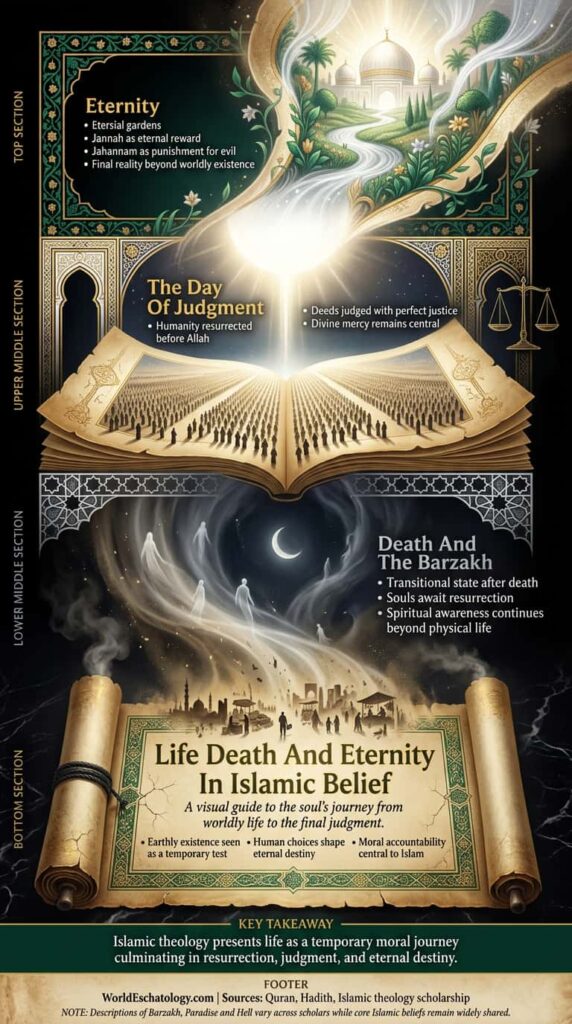
Jahannam: The Reality of Hellfire
For those whose deeds did not save them and who do not receive Allah’s mercy, the final destination is Jahannam.
Hellfire is real. It will be brought to the gathering with 70,000 ropes, each held by 70,000 angels. It will roar and groan.
Jahannam has seven levels, each worse than the one above it. Its food is the Zaqqum tree. Its drink is scalding water.
Its guardian is the angel Malik, who has never smiled since he was created.
Muslims who committed major sins without repentance may enter the Fire. But no person with even a mustard seed of genuine faith will remain in Jahannam forever.
They will eventually be removed by Allah’s mercy or through the intercession of the Prophet, peace be upon him.
For disbelievers and hypocrites, the punishment is eternal. This is written not to cause despair but so that you take this life seriously, because it is serious.
Jannah: The Final and Greatest Reward
On the other side is Jannah, and no description of it in this world can do it justice. The highest level is Al-Firdaus, directly beneath the Throne of Allah.
Its rivers flow with water, milk, honey, and a pure wine unlike anything in this world. Its palaces are built of bricks of gold and silver.
Its soil is made of musk. Everything you could want is there, and it is better than you imagined it.
But none of that is the greatest reward. The greatest reward in Jannah is seeing Allah.
“Some faces that Day will be radiant, looking at their Lord.” (Surah Al-Qiyamah 75:22-23)
The Prophet, peace be upon him, described this as seeing Allah as clearly as you see the full moon in the sky.
And when the people of Jannah see Allah, they will forget every other pleasure Jannah has ever given them.
And Jannah is forever. There is no end. No aging. No sickness. No sadness. No loss. It is a joy that increases and deepens and expands without ever stopping.
How to prepare for Yawm al Qiyamah?
Practical Steps That Actually Matter
Every major stage of the Day of Judgment has something that connects back to what you do right now, in this life.
The Mizan is being loaded today. The light for the Sirat is being charged today. The shade of the Throne on the Mahshar is earned today.
Make sincere tawbah. The door is open right now, not tomorrow. Every sin can be erased if you come to Allah with genuine regret, stop the sin, and resolve not to return to it.
Allah is Al-Ghaffar. He forgives again and again.
Protect your salah. The five daily prayers are the first thing you will be asked about on the Day of Judgment.
If your prayers are in order, the rest of your accounting will be easier. Guard them with your life.
Focus on good character. The heaviest thing on the Mizan is how you treated people. Your patience with your family.
Your honesty in your dealings. Your kindness to those who could give you nothing in return.
Give sadaqah consistently. Charity will shade you on Judgment Day. Give what you can, give regularly, and give without seeking recognition.
Fill your tongue with dhikr. SubhanAllah, Alhamdulillah, Allahu Akbar, La ilaha illallah. These cost nothing and weigh enormously on the Mizan.
Make dua for the Day of Judgment specifically. Ask Allah to make your reckoning easy.
Ask Him to give you your book in your right hand. Ask Him to make you firm on the Sirat. Ask Him for a place in Al-Firdaus.
Guard yourself from major sins. Protect yourself from fornication, from riba, from backbiting, from cutting family ties, from oppressing others.
These sins carry serious weight on the wrong side of the scale.
Remember death often. The Prophet, peace be upon him, called death the destroyer of pleasures.
Keeping death in mind keeps the Day of Judgment real in your heart rather than abstract.
Frequently asked questions about yawm al qiyamah
What is the Day of Judgment in Islam?
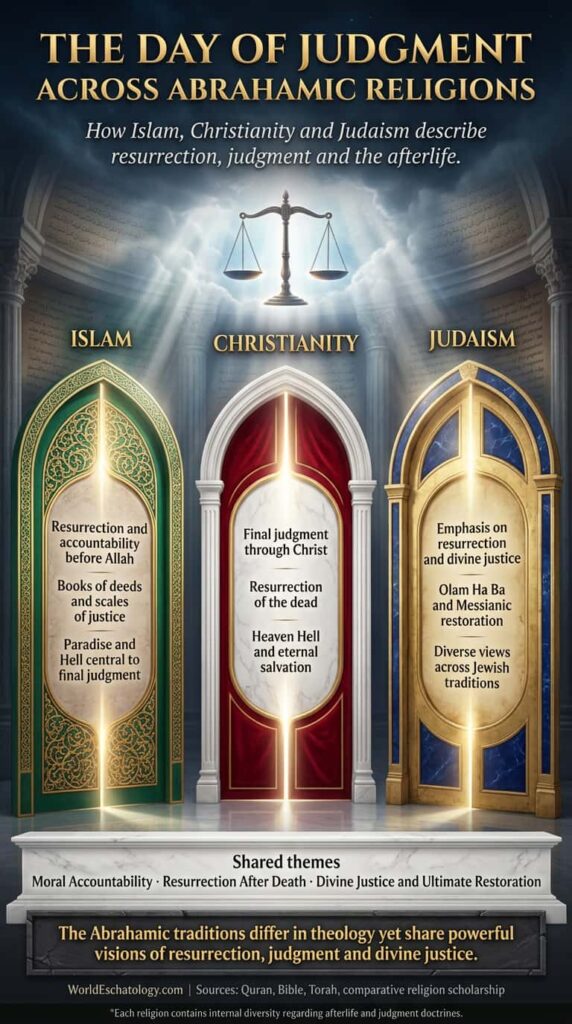
The Day of Judgment in Islam, known as Yawm al-Qiyamah, is the final Day when Allah will resurrect all of creation, gather every human being and jinn who ever lived, and hold each one accountable for everything they did in this world.
It is one of the Six Articles of Faith in Islam, meaning no Muslim can deny it and remain within the faith.
The Quran describes it hundreds of times, and the Prophet Muhammad, peace be upon him, spoke about it in tremendous detail.
It is the day when perfect justice will be established for every soul that ever existed.
What are the stages of Judgment Day in Islam?
The stages of Judgment Day in Islam follow a specific sequence described in the Quran and hadith.
First come the signs, both minor and major, that signal the approach of the end. Then the first blow of the Trumpet by Israfil destroys all of creation.
After a period, the second blow resurrects all of humanity. People are then gathered on the Plains of Mahshar.
The Grand Intercession of the Prophet, peace be upon him, initiates the formal proceedings.
Each soul then undergoes the Hisab, the individual reckoning of their deeds. The Mizan weighs every deed with perfect accuracy.
Every person then crosses the Sirat. Those who make it across may drink from the Prophet’s pool, the Hawd. The journey ends in either Jannah or Jahannam.
What are the signs of Yawm al-Qiyamah?
The signs of Yawm al-Qiyamah are divided into minor and major signs.
The minor signs include a general increase in ignorance, widespread fornication, the spread of music and entertainment, faster passage of time, and frequent earthquakes.
Many of these have already appeared. The ten major signs are the appearance of the Mahdi, the emergence of the Dajjal, the return of Prophet Isa, the release of Gog and Magog, the sun rising from the west, the Beast of the Earth, three massive landslides, a fire from Yemen, the smoke, and the destruction of the Kabah.
These major signs have not yet occurred, and their appearance will signal that the end of this world is genuinely imminent.
How long does the Day of Judgment last in Islam?
According to a hadith recorded by Muslim, the Day of Judgment will last the equivalent of 50,000 years of worldly time.
This is a length of time that is nearly impossible for the human mind to fully grasp. For the believer who had taqwa and good deeds, Allah promises the Day will feel much shorter.
For others, the waiting and the reckoning will feel like an eternity.
This is one reason the scholars describe it as the longest and most difficult day any human soul will ever experience, and also why preparing for it now, in this brief worldly life, is the most important investment a person can make.
What is the Sirat in Islam and will everyone cross it?
The Sirat is a bridge stretched directly over the top of Jahannam on the Day of Judgment. Every single person must cross it.
It is described in hadith as thinner than a hair and sharper than a sword, with hooks along it that grab people based on their sins.
The speed at which a person crosses the Sirat depends entirely on their faith and their deeds. Some will cross as fast as lightning.
Some will run, walk, or crawl. Some will be caught by the hooks and fall into the Fire below.
The light a person carries on the Sirat comes from their faith and righteous deeds accumulated in this world. It is one of the most sobering aspects of the stages of Judgment Day in Islam.
Can Muslims go to Jahannam on the Day of Judgment?
Yes, Muslims who committed major sins without sincere repentance may enter Jahannam. This is established in authentic hadith.
However, no Muslim who had even a mustard seed of genuine faith in Allah and the Last Day will remain in Hellfire forever.
They will eventually be removed from Jahannam by Allah’s mercy or through the intercession of the Prophet, peace be upon him, and will enter Jannah. For those who died in a state of disbelief or hypocrisy, the Quran is clear that the punishment is eternal.
This understanding should motivate Muslims to seek sincere repentance in this life rather than relying on this mercy as a safety net.
What is the highest level of Jannah in Islam?
The highest level of Jannah is Al-Firdaus, which is directly beneath the Throne of Allah.
In a hadith recorded by Bukhari, the Prophet, peace be upon him, instructed Muslims to ask Allah for Al-Firdaus specifically when making dua, because it is the best and highest of the levels of Jannah.
From Al-Firdaus, the rivers of paradise flow downward. The greatest reward for the people of Al-Firdaus, and for all of the people of Jannah, is seeing Allah directly, which the Quran describes in Surah Al-Qiyamah.
This vision of Allah is described as surpassing every other pleasure of Jannah and is the ultimate reward for the believers.
What is the Hisab on the Day of Judgment?
The Hisab is the individual reckoning or accounting that every person will go through on the Day of Judgment.
Each person will be presented with their complete book of deeds, containing every action, word, and intention from their entire life.
They will be questioned about five specific things: how they spent their life, how they used their youth, how they earned and spent their wealth, whether they acted on their knowledge, and how they used their body.
The Hisab is not for Allah’s benefit since He knows everything already. It is the completion of perfect justice, so that every person understands fully and clearly why their outcome is what it is.
What is Al-Mizan and what is the heaviest deed on the scale?
Al-Mizan is the great scale that will be established on the Day of Judgment to weigh every person’s deeds.
Good deeds go on one side and bad deeds go on the other, and not a single deed, however small, is left out.
The Quran in Surah Az-Zalzalah states that whoever does an atom’s weight of good will see it and whoever does an atom’s weight of evil will see it.
According to a hadith in Tirmidhi, the heaviest deed on the scale of good deeds is good character.
This is one of the most important lessons from the stages of Judgment Day in Islam: that how you treat people carries more weight on the Mizan than many people expect.
What is the Grand Intercession on the Day of Judgment?
The Grand Intercession, known as Al-Shafa’ah al-Uzma, is the intercession of the Prophet Muhammad, peace be upon him, that opens the formal proceedings of the Day of Judgment.
On the Mahshar, when the suffering of the long wait becomes unbearable, humanity will go to the prophets one by one seeking someone to intercede with Allah.
Each prophet will decline until the people come to the Prophet Muhammad, peace be upon him, who will accept.
He will prostrate before Allah and be inspired with unique words of praise. Allah will then permit him to intercede.
This is the Maqam al-Mahmud, the Praised Station, which the Quran references in Surah Al-Isra (17:79), and it belongs exclusively to the Prophet Muhammad, peace be upon him.
How should a Muslim prepare for the Day of Judgment?
The most effective preparation for Yawm al-Qiyamah combines sincere repentance, consistent practice of the five pillars, and the cultivation of good character.
Making tawbah regularly and not delaying it is essential. Protecting the five daily prayers is non-negotiable since they are the first thing accounted for.
Building good character loads the Mizan in your favor. Giving regular sadaqah provides shade on the Mahshar.
Filling time with dhikr adds weight to the right side of the scale.
Asking Allah directly in dua for ease on the Day of Judgment, for the book in your right hand, and for a place in Al-Firdaus connects your daily worship to these specific outcomes.
Avoiding major sins prevents catastrophic damage to the scale.
Conclusion:
The Day of Judgment in Islam is not a distant or abstract event. It is the most certain thing in existence.
Every soul alive right now will stand before Allah on Yawm al-Qiyamah. Every deed being done today is going into the book. The scale is waiting.
The journey of the stages of Judgment Day is long and unlike anything this world has produced.
From the blowing of the Trumpet, to the resurrection on the Mahshar, to the Grand Intercession, to the Hisab, to the Mizan, to the crossing of the Sirat, to the Hawd, and finally to either Jannah or Jahannam, every stage is real and every stage is connected to choices being made in this life right now.
Here is the truth that is easy to forget in the noise of daily life. Allah did not design this system to destroy us.
He designed it as perfect justice. He is Al-Wadud, the Most Loving. He is Arham al-Rahimeen, the Most Merciful of all who show mercy.
He is the One who said that His mercy outstrips His wrath. He made repentance easy. He made dhikr easy. He made sadaqah accessible.
He made the path to His shade on the Mahshar achievable by any Muslim who takes their faith seriously.
The book is still being written. The scale is still open.
The choices you make today, the prayer you pray tonight, the kindness you show tomorrow, the sin you walk away from this week, all of it matters infinitely more than it appears to.
May Allah make us among those who receive their book in their right hand.
May He shade us beneath His Throne on the Day when there is no shade but His.
May He make the Sirat easy for us to cross. May He allow us to drink from the pool of His beloved Prophet, peace be upon him.
And may He grant us and our families a place in Al-Firdaus, where the greatest reward of all awaits: seeing His Face.
Ameen.