
Introduction
The Book of Ezekiel almost did not survive. The Talmud tells us that some sages wanted to hide it.
Its description of the temple seemed to disagree with the Torah. According to the story, a scholar named Hananiah ben Hezekiah saved it.
He sat in an upper room with 300 jars of oil and worked until he found the answers (Shabbat 13b).
That story says a lot about the book. It is bold and strange. It speaks of wheels within wheels, a field of dry bones and a great war against a ruler named Gog.
It ends with a vision of a new temple and a river of life.
Today, Ezekiel is still in the headlines. Whenever tension rises in the Middle East, writers and preachers point to Ezekiel 38.
Some name modern nations. Others say that is a mistake. The debate is lively and often heated.
This guide explains the Ezekiel’s Prophecies about the end times in clear terms.
It covers the Book of Ezekiel end time prophecy, the meaning of the last days in the book and the famous Ezekiel 38 and 39 Gog and Magog end times passage.
It also sets out an Ezekiel end times timeline as different readers see it. Each tradition is described as its followers understand it.
What Does the Book of Ezekiel Teach About the Last Days?
Who Was Ezekiel?
Ezekiel was a priest and a prophet. He was taken to Babylon in 597 BCE, along with King Jehoiachin and thousands of others from Judah.
He received his call by the Chebar canal around 593 BCE. His last dated vision comes in 571 BCE.
His message came in two stages. Before Jerusalem fell in 586 BCE, he warned of judgment. After its fall, he spoke of hope and restoration.
This shift is key to understanding his visions of the last days.
The Shape of the Book
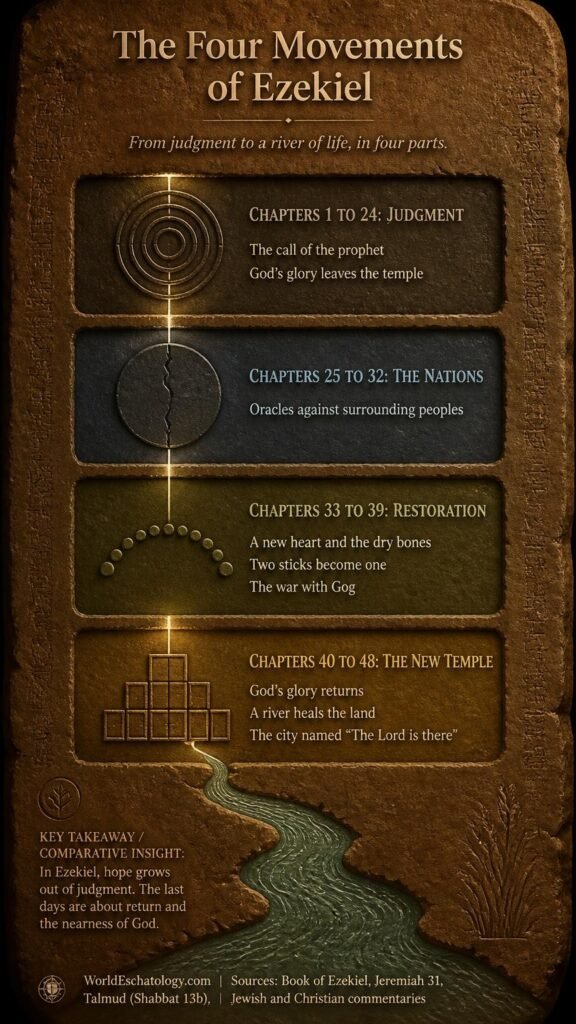
The book follows a clear plan.
- Chapters 1 to 24: The call of Ezekiel, the departure of God’s glory from the temple and warnings of judgment on Jerusalem.
- Chapters 25 to 32: Oracles against the surrounding nations.
- Chapters 33 to 39: Restoration. The new shepherd, the new heart, the dry bones, the reunited kingdom and the war with Gog.
- Chapters 40 to 48: The vision of a new temple, the return of God’s glory and the river that heals the land.
This order matters. The last days material comes after judgment. Hope grows out of a hard time.
The Core Message: Ezekiel Prophecies Last Days Meaning
To understand the Ezekiel prophecies last days meaning, start with the book’s main themes.
- God is holy. He acts so that the nations will know who he is. The phrase “then they will know that I am the Lord” appears dozens of times.
- People are responsible. Ezekiel 18 teaches that each person answers for their own actions.
- God gives a new heart. Ezekiel 36 promises a new heart and a new spirit, and God’s own Spirit within his people.
- God returns to dwell among his people. The book ends with a city named “The Lord is there” (Ezekiel 48:35).
So the last days in Ezekiel are not only about war. They are about cleansing, return and the nearness of God.
One more point is worth noting. Ezekiel uses phrases such as “latter years” and “latter days” (Ezekiel 38:8 and 38:16).
The Hebrew expression acharit hayamim can mean a future time, the end of an era or the end of days. Readers differ on which sense fits each passage.
The Return and the New Heart (Ezekiel 36 and 37)
Ezekiel 36 promises that God will gather his people from the nations and bring them home. He will cleanse them with clean water.
He will take away the heart of stone and give a heart of flesh.
Ezekiel 37 opens with the valley of dry bones. The prophet sees the bones come together, gain flesh and receive breath.
God explains that the bones are the whole house of Israel. They say their hope is lost. God promises to open their graves and bring them home.
The chapter then adds the sign of two sticks. One stick stands for Judah and the other for Ephraim.
They become one in the prophet’s hand. God promises a single kingdom under one king, a covenant of peace and a sanctuary among them forever.
Ezekiel 38 and 39: Gog and Magog End Times
These two chapters are the most discussed in the book. Here is what the text says.
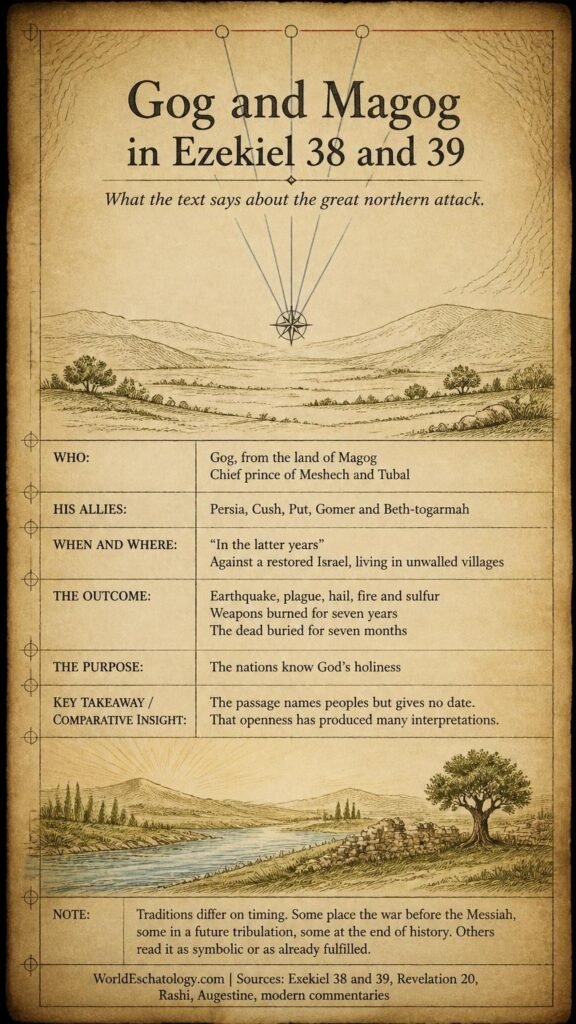
- Gog is described as being from the land of Magog. He is the chief prince of Meshech and Tubal (Ezekiel 38:2).
- He leads a coalition. It includes Persia, Cush, Put, Gomer and Beth-togarmah (38:5 and 6).
- He attacks Israel in the latter years. The land has been restored and the people are living in security, in unwalled villages (38:8 and 11).
- God brings the attack to judgment. There is an earthquake, plague, panic among the troops, hail, fire and sulfur (38:19 to 22).
- The aftermath is vast. Weapons are used as fuel for seven years. The dead are buried for seven months in the valley of Hamon Gog (39:9 to 16).
- The result is that the nations know God’s holiness. Israel knows that its exile came from its own sin, and God promises not to hide his face again (39:21 to 29).
Ezekiel does not name a date. He does not explain exactly which nations he means. That open quality has made the passage a magnet for many interpretations.
The New Temple and the River of Life (Ezekiel 40 to 48)
In the last section, Ezekiel is carried to a high mountain in the land of Israel.
A guide measures a great temple complex with a reed. Every court, gate and chamber is described in detail.
Then God’s glory returns. In chapter 10 and 11 it had left the old temple. In chapter 43 it enters the new one.
A river flows from the temple threshold. It grows deeper with each measure and heals the Dead Sea.
Trees along its banks bear fruit every month. The land is divided among the tribes, and the city is named The Lord is there.
Ezekiel End Times Timeline: How the Book Is Ordered
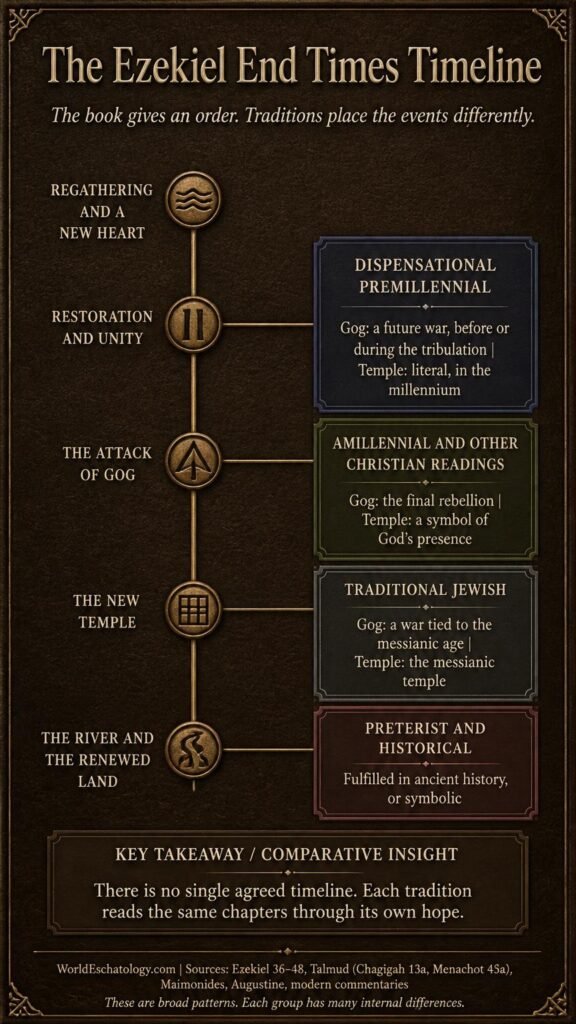
There is no single, agreed Ezekiel end times timeline. The book gives a sequence of visions.
Readers differ on whether the order is a strict chronology of events.
The order of the chapters runs like this.
- Regathering and a new heart (Ezekiel 36).
- Restoration and unity (Ezekiel 37).
- The attack of Gog (Ezekiel 38 and 39).
- The new temple and the return of the glory (Ezekiel 40 to 46).
- The river of life and the renewed land (Ezekiel 47 and 48).
Here is how some major traditions place these events.
| Reading | Gog (Ezekiel 38 and 39) | Temple (Ezekiel 40 to 48) |
| Dispensational premillennial | A future war, often placed before or during the tribulation. Debated. | A literal future temple in the millennial kingdom. |
| Other premillennial and amillennial | Often linked to the final rebellion in Revelation 20. | A symbol of God’s presence and the people of God. |
| Preterist and historical readings | Fulfilled in ancient history or a symbol of recurring evil. | An ideal vision never fully built. |
| Traditional Jewish | A war of Gog and Magog tied to the messianic age. | The messianic or Third Temple. Details left to Elijah and the Messiah. |
These are broad patterns. Each group contains many internal differences.
Key Texts and Sources
Within the Book of Ezekiel
- Ezekiel 1 to 3: The vision of the throne chariot and the call of the prophet.
- Ezekiel 18: Personal responsibility.
- Ezekiel 34: God as the true shepherd, with a promised Davidic ruler.
- Ezekiel 36 and 37: The new heart, the dry bones and the two sticks.
- Ezekiel 38 and 39: Gog of Magog.
- Ezekiel 40 to 48: The temple, the river and the city.
Related Biblical Passages
- Jeremiah 31: The promise of a new covenant, close to Ezekiel 36.
- Joel 3 and Zechariah 12 to 14: Nations gather against Jerusalem. God intervenes.
- Daniel 11 and 12: A final conflict and the hope of resurrection.
- Revelation 20 to 22: Gog and Magog appear again. A river of life and a new Jerusalem follow.
Jewish Sources
- The Talmud: It discusses Ezekiel’s temple (Menachot 45a and Chagigah 13a). It also records views on the dry bones (Sanhedrin 92b).
- Rashi, Radak and other medieval commentators: They explain the visions and link Gog and Magog with the messianic age.
- Maimonides: He notes that the order of the messianic events, including the war of Gog and Magog, is not entirely clear.
- Synagogue readings: Ezekiel 37 is read on the Sabbath during Passover. Ezekiel 38 and 39 is read on the Sabbath during Sukkot.
Christian Sources
- Augustine, City of God, book 20: He reads Gog and Magog as nations across the world that oppose the church at the end.
- Ambrose and other early writers: They linked Gog to peoples of their own day, such as the Goths.
- Scofield Reference Bible and Hal Lindsey’s The Late Great Planet Earth: They helped make the Russia reading well known in the twentieth century.
Islamic Sources
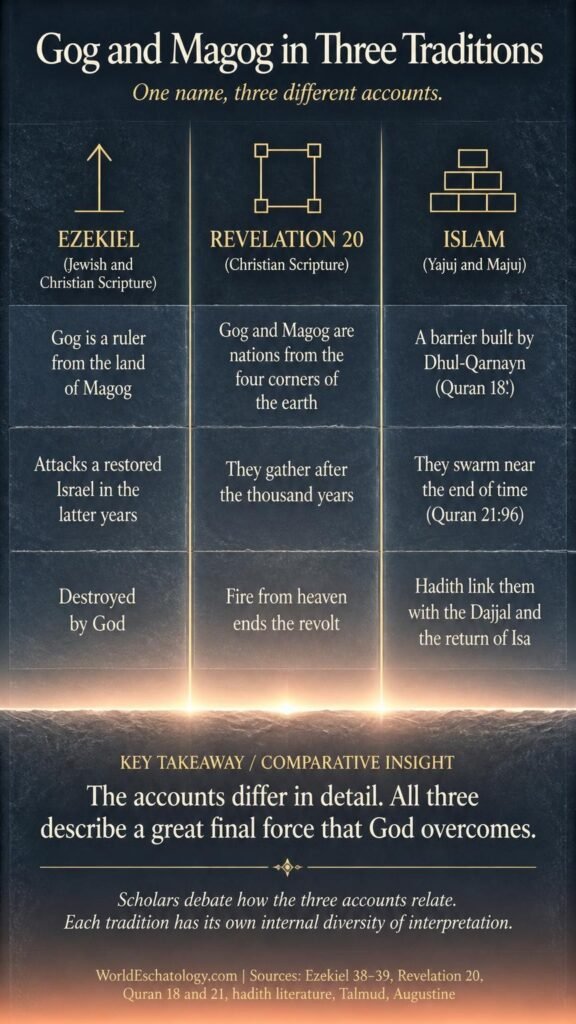
Islam knows Gog and Magog as Yajuj and Majuj. The Quran tells of Dhul-Qarnayn, who built a barrier against them (18:83 to 98).
It says they will break out and swarm near the end of time (21:96). Hadith literature describes their coming after the Dajjal and the return of Isa, and tells of their destruction by God.
This is not the same account as Ezekiel’s, but scholars often compare the two.
Different Views Within the Traditions
Who Is Gog?
The text gives names. Scholars and believers still debate what they mean.
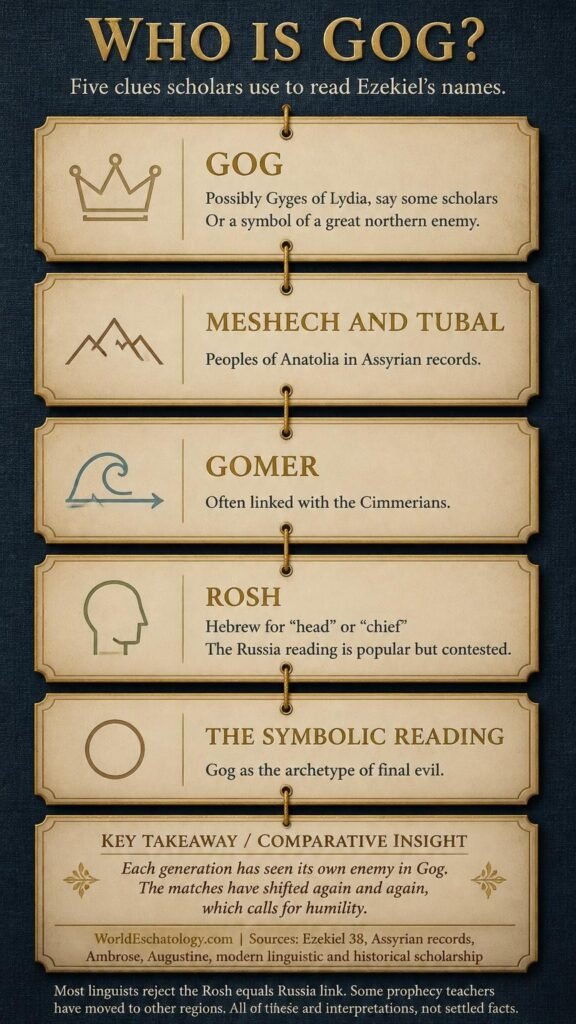
- Gog may reflect the name of Gyges, a king of Lydia in the seventh century BCE, according to some scholars.
- Meshech and Tubal are known from Assyrian records as peoples in Anatolia, in what is now Turkey.
- Gomer is often linked with the Cimmerians. Cush, Put and Persia point to Africa and the east.
- Others read Gog as a symbol, a name for any great enemy from the north.
Is Rosh Russia?
Some translations read Gog as “the chief prince of Rosh, Meshech and Tubal.” Popular prophecy teachers have linked Rosh to Russia, and Meshech to Moscow.
This became widely known in the twentieth century.
Most linguists and Bible scholars disagree. In Hebrew, rosh simply means head or chief.
Many modern translations render it that way. They note that Meshech and Tubal were in Anatolia, far from modern Moscow.
Some prophecy teachers have also moved away from the Russia view and now stress Turkey or other regions.
This shows how easily names are matched to the headlines of each era.
Jewish Views
In Jewish tradition, the war of Gog and Magog is tied to the messianic age. Some sources place it before the Messiah’s reign.
Others place it after the ingathering of the exiles. Maimonides says the order is uncertain.
Many Jewish commentators also see the war as God’s final vindication of Israel and of his name.
On the dry bones, the Talmud records a debate. One sage taught that the vision was a parable.
Another taught that the dead really rose and later died again. Many later Jewish readers see national revival. Some see the hope of resurrection, which is also taught elsewhere.
Views on today’s events vary. Religious Zionist teachers often see a step toward the ingathering of exiles.
Some haredi teachers hold that the redemption must come by God’s own act, not by human politics.
Reform and Conservative thinkers often read Ezekiel as a call to moral renewal and national hope, not as a literal timetable.
Dispensational Christian Views
Dispensational premillennial readers expect Ezekiel to be fulfilled in literal detail.
They tend to see the return of Jews to the land as the setting for Ezekiel 36 and 37.
They look for a future invasion in Ezekiel 38 and 39, and a future temple in 40 to 48.
Many of them separate this battle from the one in Revelation 20, because the details differ.
Ezekiel’s Gog is a person from Magog. In Revelation, Gog and Magog are nations.
Amillennial and Reformed Views
Amillennial readers, such as Augustine, treat the passage as a picture of the final conflict between the world and the people of God.
They do not look for a particular modern nation. They often read the temple as a symbol of God’s presence, now fulfilled in Christ and the church.
They point to Revelation 21, where the new Jerusalem has no temple.
Preterist and Historical Views
Some interpreters hold that Ezekiel’s prophecies met their main fulfillment in the ancient world.
They cite the return from Babylon, the wars of the Persian and Greek periods, or the time of the Maccabees.
They often see the temple vision as an ideal that the returning exiles never built.
Critical Scholarly Views
Many academic scholars see Ezekiel 38 and 39 as an early form of apocalyptic writing. Gog stands for a final enemy from the far north.
Some think that these chapters were shaped over time. Scholars of this kind often stress the literary and theological design more than a future timetable.
Many still treat the text as sacred scripture.
The Question of the Temple
The temple of Ezekiel has no exact match with the earlier temple of Solomon, the second temple or the temple in the Torah.
For some, this proves that it is a future building. For others, it shows that the vision is symbolic.
Jewish sages left certain puzzles to Elijah. Christian readers split between a literal millennial temple and a spiritual one.
Why Ezekiel’s Prophecies Matter Today
Ezekiel’s visions are not only for scholars. They show up in sermons, books, social media and news talk.
Conflicts involving Israel, Iran, Turkey and Russia often lead people to ask if Ezekiel 38 is near. Many popular writers have said yes, and many have said no.
A wise reader can learn from history. Over the centuries, Gog has been linked to Goths, Huns, Mongols, Turks and later to other powers.
Each generation saw its own enemy in the text. Each time the match failed to hold. This does not prove that Ezekiel has no future meaning. It does call for humility.
Ezekiel also speaks to people who feel that their hope is gone. The dry bones say, in effect, that it is not over.
The new heart says that change is possible. The river says that life can return even to the Dead Sea. These themes speak to exile, loss and renewal in any age.
For comparative readers, Ezekiel shows how one text can feed several traditions.
Jews, Christians and Muslims all speak of Gog and Magog, though in different ways.
The shared figure shows that all three traditions think about the same question. How will evil be ended, and how will God’s justice be known?
A careful reader can keep two ideas together. The book gives real hope about the future.
It also gives few simple formulas. Many teachers say that Ezekiel’s greatest lesson is the call to trust and to live in holiness. Dates and names are secondary.
Frequently Asked Questions
What are the main Ezekiel prophecies about the end times?
They are the regathering of Israel (Ezekiel 36 and 37), the war with Gog and Magog (38 and 39) and the vision of a new temple with a river of life (40 to 48).
Together they speak of judgment, restoration and God’s presence.
Who is Gog in Ezekiel 38?
Gog is a ruler from the land of Magog. He is the chief prince of Meshech and Tubal. The text does not give his full identity.
Scholars link him with Gyges of Lydia, with a symbolic northern enemy or with a future leader.
Is Magog Russia?
Some popular prophecy teachers say so, based on the word Rosh. Most linguists disagree. Rosh means head or chief in Hebrew.
Meshech and Tubal were in Anatolia. The Russia view is one interpretation, not a settled fact.
When will the battle of Gog and Magog happen?
Ezekiel says it will be in the latter years. The text gives no date. Traditions differ on the timing.
Some place it before the Messiah, some in a future tribulation and some at the end of history. Others see it as already fulfilled or as symbolic.
Is Ezekiel 38 the same as Revelation 20?
Views differ. Many readers link them because both mention Gog and Magog. Dispensational readers often separate them, because the details differ.
In Ezekiel, Gog is a person who comes from the north. In Revelation, Gog and Magog are nations from the four corners of the earth.
What does the valley of dry bones mean?
The text says that the bones are the whole house of Israel. Most readers see national restoration.
Jewish and Christian traditions have also seen the hope of resurrection. Some see spiritual renewal. These readings can be held together.
Does Ezekiel predict a third temple?
Ezekiel describes a new temple. Many Jewish readers connect it with the future messianic temple.
Some Christian readers expect a literal temple in the millennium. Others see it as a symbol of God’s presence. There is no single view.
What does acharit hayamim mean?
It is the Hebrew phrase behind latter days. It can mean a future time, the end of an age or the end of days. Readers differ on what it means in each passage.
What does Islam say about Gog and Magog?
Islam calls them Yajuj and Majuj. The Quran tells of a barrier built by Dhul-Qarnayn and says they will break out near the end of time.
Hadith literature links their coming with the Dajjal and the return of Isa. The account differs from Ezekiel’s, though both speak of a great final force that God overcomes.
Can Ezekiel be used to predict the end date?
Most major traditions say no. Jesus said that no one knows the day or the hour (Matthew 24:36).
The Talmud warns against those who calculate the end (Sanhedrin 97b). Many teachers urge faithful living instead of date setting.