
Introduction
Few books of the Bible have shaped end times belief like Daniel. It is short. It has only twelve chapters. Yet it has been studied, argued over and treasured for more than two thousand years.
Here is a striking fact. The book was written in two languages. Part of it is in Hebrew. A long middle section, from Daniel 2:4 to 7:28, is in Aramaic. Scholars still debate why.
That small detail shows how layered this book is.
Daniel end times prophecy also speaks to people living under pressure. Its stories are set in exile, under foreign kings.
Its visions describe empires rising and falling. They end with a promise that God will have the final word.
That message feels close to home whenever the world seems unstable.
This guide explains the in plain language. It covers what the book teaches, which passages matter most and how different traditions read them.
It also asks why the book still matters today. The goal is to describe each view as its followers understand it. You will not be told which one to hold.
What Does the Book of Daniel Teach About the End Times?
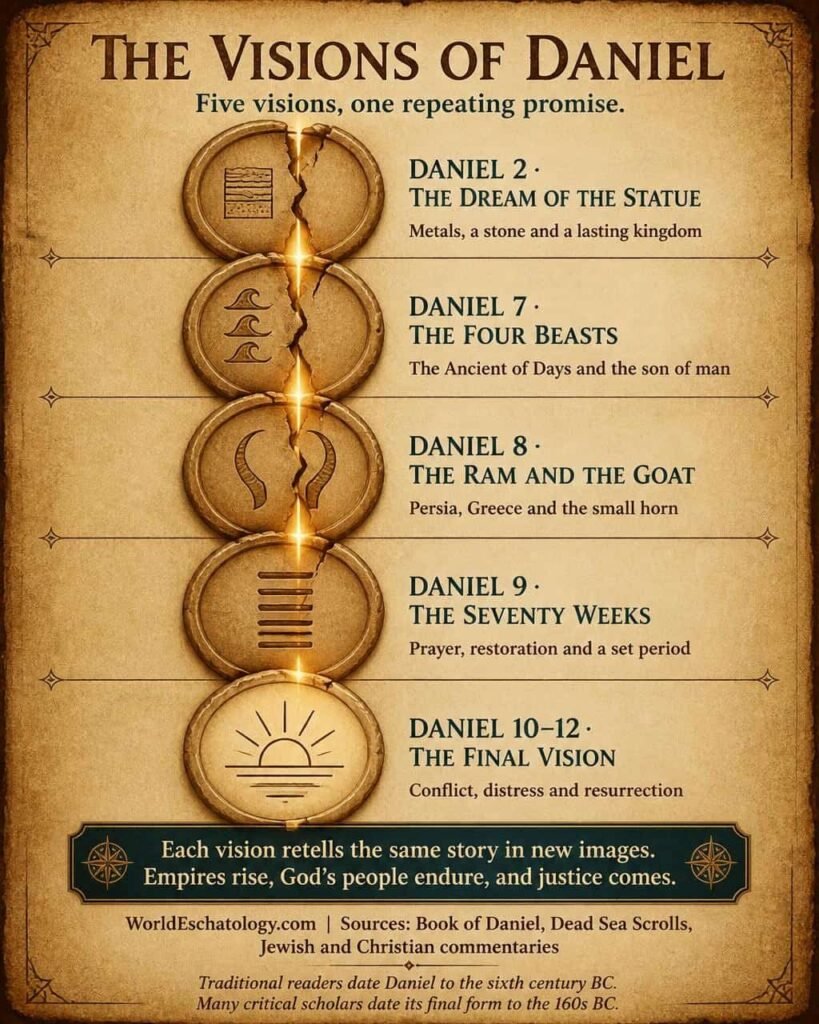
The book of Daniel prophecy follows a clear pattern. Human kingdoms come and go. They look strong, but they do not last.
In the end, God establishes a kingdom that will never be destroyed. Almost every vision repeats this idea in a new form.
The Statue Dream (Daniel 2)
King Nebuchadnezzar dreams of a great statue. Its head is gold. Its chest and arms are silver.
Its belly and thighs are bronze. Its legs are iron. Its feet are a mix of iron and clay.
A stone, cut without human hands, strikes the feet. The statue breaks apart. The stone then grows into a mountain that fills the whole earth.
Daniel explains that the metals stand for a series of kingdoms. The stone stands for a kingdom God sets up, one that will never be left to another people.
The Four Beasts (Daniel 7)
Daniel then has his own dream. Four beasts rise from a stormy sea. The first looks like a lion with eagle’s wings.
The second is like a bear. The third is like a leopard with four wings and four heads. The fourth is terrifying and has iron teeth and ten horns.
A small horn grows among the ten. It speaks arrogant words. It wages war against the holy ones.
Then the scene shifts to a heavenly court. The Ancient of Days takes his seat. Judgment is given.
One like a son of man comes with the clouds of heaven and receives an everlasting kingdom. That rule is then shared with the holy ones of the Most High.
This chapter also gives one of the book’s best known time markers. The small horn’s power lasts for a time, times and half a time.
Many readers take this to mean three and a half years.
The Ram and the Goat (Daniel 8)
In Daniel 8, a ram with two horns is attacked by a goat with a single great horn. The angel Gabriel explains that the ram stands for Media and Persia.
The goat stands for Greece. The great horn is its first king. When that horn breaks, four horns replace it.
From one of these a small horn arises. It grows toward the Beautiful Land. It stops the daily sacrifice and throws down the sanctuary.
The vision speaks of 2,300 evenings and mornings. After that, the sanctuary will be restored.
The Seventy Weeks (Daniel 9)
Daniel reads in Jeremiah that the exile will last seventy years. He prays a long prayer of confession. Gabriel then gives him a new message.
Seventy weeks have been set for his people and the holy city.
The goals of this period are large. They include ending transgression, atoning for guilt and bringing in everlasting righteousness.
The text divides the time into seven weeks, sixty two weeks and one final week. An anointed one is cut off.
A city and sanctuary are destroyed. In the last week, a covenant is made, and sacrifice is stopped. An abomination that causes desolation appears.
Most interpreters read each week as seven years. That gives a total of 490 years.
How those years are counted is one of the most debated questions in the book.
The Final Vision (Daniel 10 to 12)
The last vision is the longest. A messenger tells Daniel what will happen to his people. It begins with the kings of Persia and Greece.
It then describes a long conflict between the king of the north and the king of the south.
One ruler stands out in chapter 11. He is called a contemptible person. He turns against the holy covenant.
His forces desecrate the sanctuary and set up the abomination that causes desolation. Then the text moves to a time of distress such as the world has never seen.
At that moment, Michael, the great prince, arises. God’s people are delivered. Daniel 12:2 adds a famous promise.
Many who sleep in the dust of the earth will awake. Some will rise to everlasting life. Others will rise to shame and contempt. Those who are wise will shine like the brightness of the sky.
The book closes with two numbers. Daniel hears of 1,290 days and 1,335 days. He is told to go his way until the end.
He will rest, and he will rise to receive his portion at the end of the days.
Key Texts and Sources
To understand Daniel’s end times prophecy, it helps to know the main texts. It also helps to know the writings that explain them.
Passages Within the Book
- Daniel 2: the statue and the stone.
- Daniel 7: the four beasts, the Ancient of Days and the son of man.
- Daniel 8: the ram, the goat and the small horn.
- Daniel 9: the prayer and the seventy weeks.
- Daniel 10 to 12: the final vision, the resurrection and the closing numbers.
Connected Biblical Passages
Daniel is quoted and echoed across the Bible. In the Gospels, Jesus refers to the abomination of desolation spoken of by Daniel the prophet (Matthew 24:15, Mark 13:14).
His favorite title for himself, the Son of Man, is widely linked to Daniel 7.
The book of Revelation borrows heavily from Daniel. Its beasts, its horns and its time periods of 42 months and 1,260 days all echo Daniel’s visions.
Christians often read the two books side by side.
Jewish sources connect Daniel to other prophets as well. Ezekiel, Isaiah, Jeremiah and Zechariah all shed light on its themes of exile, restoration and judgment.
Historical and Extra Biblical Sources
- 1 Maccabees describes the desecration of the Jerusalem Temple under Antiochus IV in 167 BC. It uses language close to Daniel’s abomination of desolation (1 Maccabees 1:54).
- The Dead Sea Scrolls include several copies of Daniel. They show the book was valued and copied in the last centuries before the Common Era.
- Josephus, a first century Jewish historian, wrote about Daniel and discussed his prophecies in his Antiquities of the Jews.
- Early Christian writers such as Hippolytus and Jerome wrote commentaries on Daniel. Jerome also answered the third century critic Porphyry, who argued the book was written in the Maccabean age.
Where Daniel Sits in the Canon
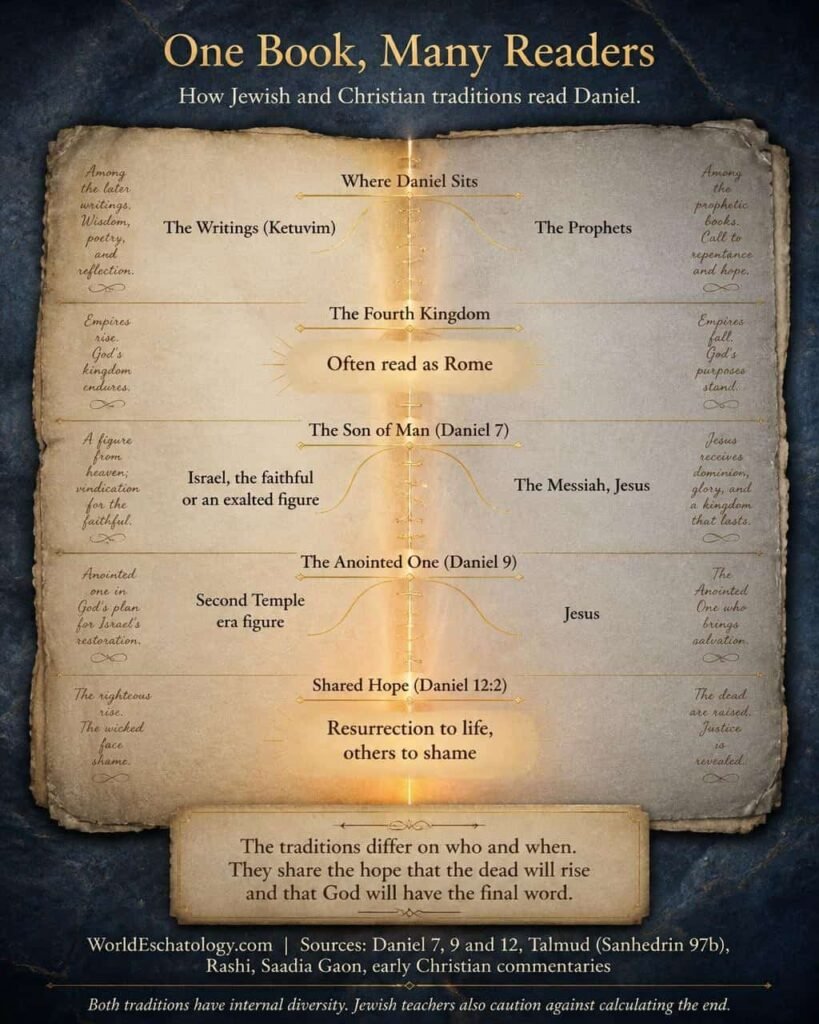
Jewish Bibles place Daniel in the Writings, not among the Prophets. Christian Bibles, following the Greek tradition, place it with the Prophets.
This difference shapes how each tradition reads the book. Many Jewish readers see Daniel as a sage and visionary. Many Christian readers see him as a prophet in the full sense.
Daniel is also respected beyond Judaism and Christianity. In Islamic tradition, Daniyal is remembered as a righteous figure in commentary and storytelling, although he is not named in the Quran.
Different Scholarly Views Within the Tradition
There is no single reading of Daniel. Believers and scholars have long disagreed on when the book was written, what its symbols mean, and whether its prophecies are fulfilled.
Each view below is held sincerely by serious readers.
When Was Daniel Written?
The traditional view holds that Daniel wrote the book in the sixth century BC, during the Babylonian exile and the early Persian era.
On this view, the book contains genuine predictions of events centuries ahead. Many conservative Jews and Christians hold this position.
Most critical scholars place the final form of the book in the 160s BC, during the Maccabean crisis.
On this view, the visions in chapters 7 to 12 respond to the persecution under Antiochus IV.
The author, they argue, wrote to strengthen faithful Jews facing death for their beliefs. Many scholars who hold this view still treat the book as inspired and deeply meaningful.
The difference matters. It changes which events the prophecies seem to describe.
Who Are the Four Kingdoms?
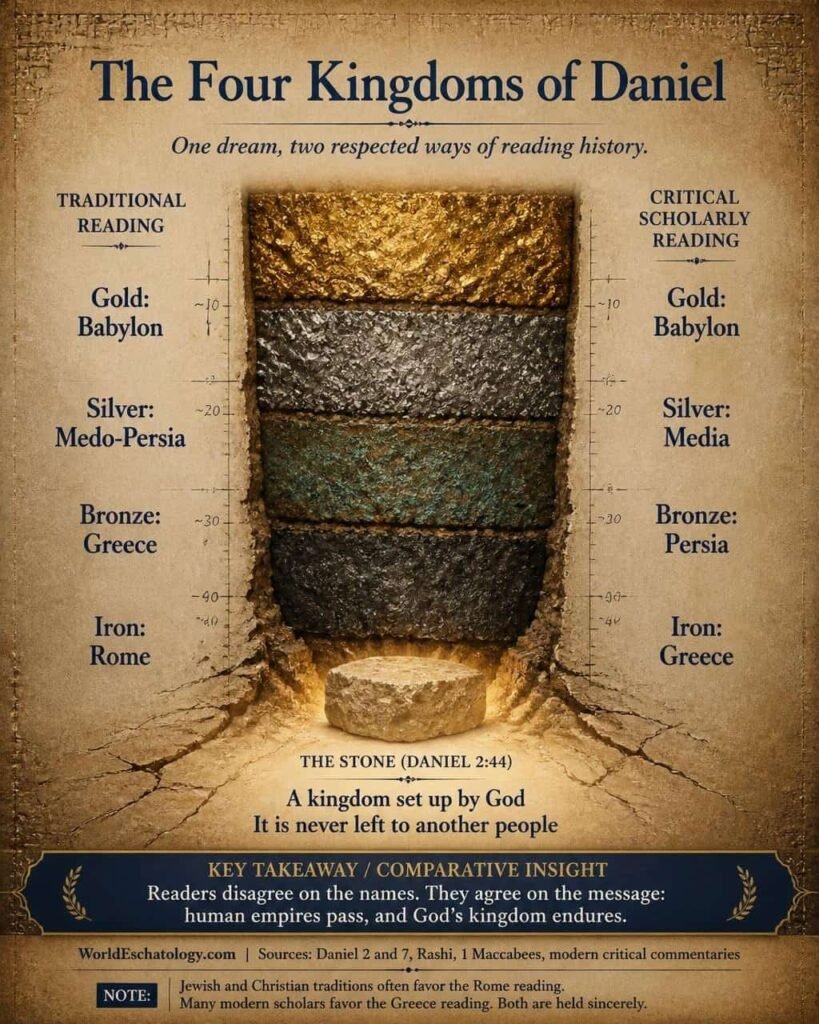
Most traditional readings name Babylon, Medo-Persia, Greece and Rome.
This view is common in Jewish commentary, in early Christian writing, and in many Protestant and Catholic traditions.
Rashi, a leading medieval Jewish commentator, read the fourth kingdom as Rome.
Critical scholars often propose another order. They name Babylon, Media, Persia, and Greece.
On this view, the fourth beast is the Greek empire, and the little horn is Antiochus IV Epiphanes.
The Four Main Christian Approaches
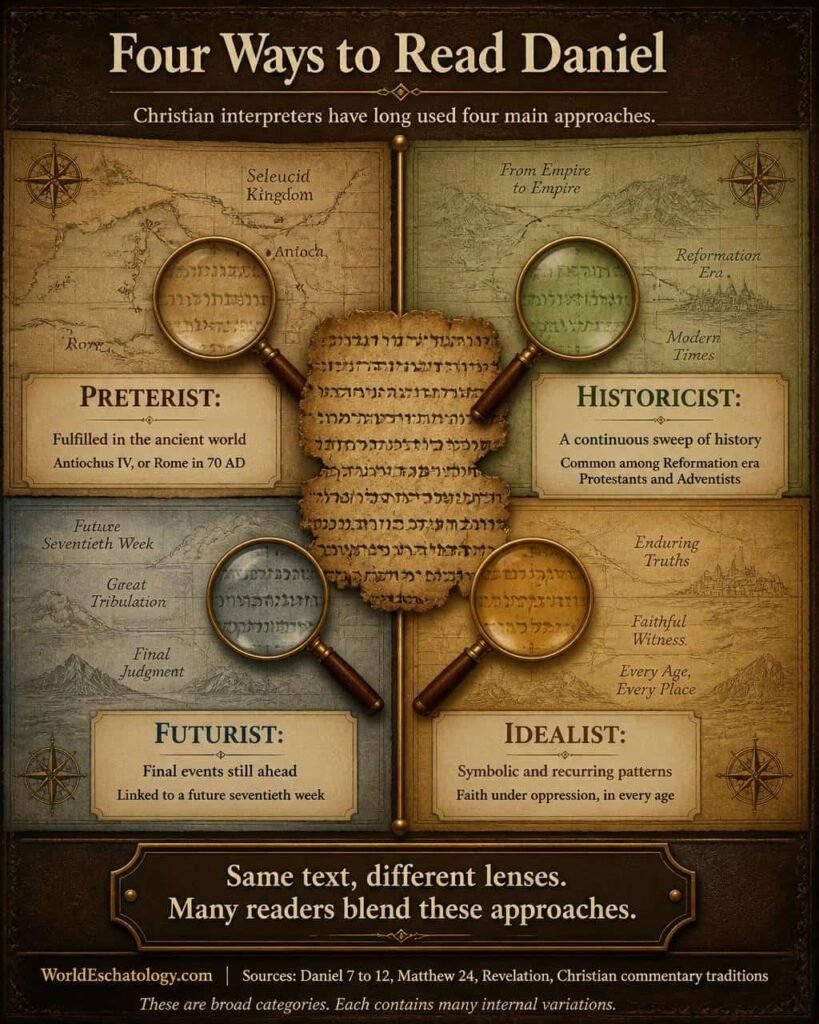
Christian interpreters have usually followed one of four broad methods.
- Preterist: Most of Daniel’s prophecies were fulfilled in the ancient world. Some preterists point to Antiochus IV. Others point to Rome and the destruction of Jerusalem in 70 AD.
- Historicist: The visions trace history from Daniel’s day to the end of the age. Many Reformation era Protestants held this view and often read the little horn as the papacy. The Seventh day Adventist tradition also uses this method.
- Futurist: Many of the final events are still ahead. Dispensational teachers, made popular through John Nelson Darby and the Scofield Reference Bible, expect a future seven year tribulation tied to Daniel’s seventieth week.
- Idealist: The visions describe a pattern that repeats across history. They show the clash between faithful people and oppressive powers. They do not point to one fixed timeline.
Some interpreters mix these methods. For example, a reader might see the little horn as Antiochus IV in the first instance and as a final figure at the end of time.
How Should the Seventy Weeks Be Counted?
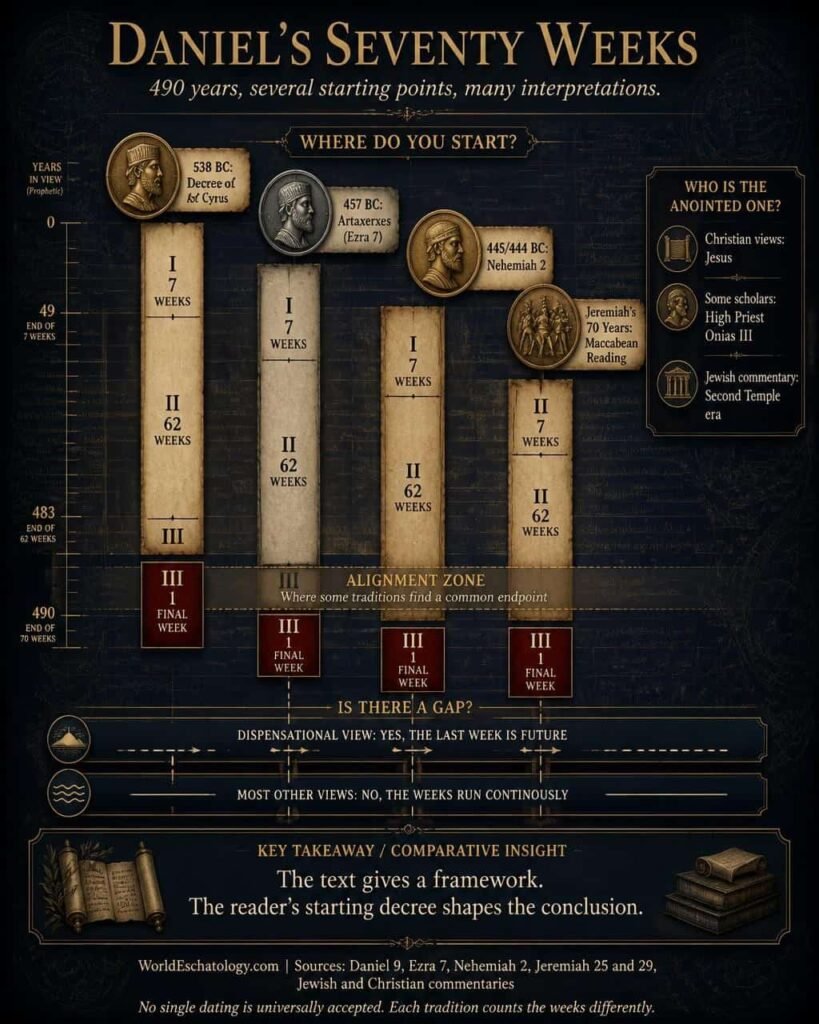
This is among the most debated questions in the book of Daniel prophecy. The starting point depends on which decree is chosen.
- Many conservative Christians choose the decree of Artaxerxes in 457 BC (Ezra 7). Counting 483 years leads to the time of Jesus’ ministry. Adventists then link the 2,300 days to the year 1844.
- Others choose the decree in 445 or 444 BC (Nehemiah 2). This approach has been widely taught in dispensational circles.
- Some begin with the decree of Cyrus in 538 BC.
- Many Jewish commentators read the seventy weeks as covering the Second Temple period. They see its end in the destruction of the Temple in 70 AD.
- Critical scholars often begin with Jeremiah’s prophecy of seventy years and end in the time of Antiochus IV. The anointed one cut off may be the high priest Onias III.
Another major question is whether there is a gap before the seventieth week. Dispensationalists say yes.
They place the final week in the future. Most other readers say no. They see the weeks as one continuous time, ending in the first century or in the Maccabean era.
Jewish Views on Daniel and the End
Jewish tradition treats Daniel with respect and with caution. The Talmud warns against those who try to calculate the end (Sanhedrin 97b).
Rabbinic teachers worried that failed predictions would crush people’s hope.
Even so, many Jewish scholars wrote about Daniel. Saadia Gaon, Rashi, Ibn Ezra and Isaac Abarbanel all addressed its visions.
They often linked the fourth kingdom to Rome and expected a messianic age in which Israel would be restored. Daniel’s vision of resurrection is also an important root of later Jewish belief in the afterlife.
The Anointed One and the Son of Man
Christians generally read the anointed one of Daniel 9 as Jesus. They read the son of man in Daniel 7 as the Messiah who will return in glory.
Jewish interpreters read these figures differently. Some see the son of man as a symbol of Israel itself, or of the faithful remnant. Others see him as an exalted messianic or angelic figure.
These differences are real. Each reflects a distinct way of reading the same text.
Why Daniel’s End Times Prophecy Matters Today
Daniel is not only a book about the future. It is a book about faithfulness under pressure. Its heroes refuse to bow to idols.
They pray when prayer is forbidden. They trust God when a fiery furnace and a lions’ den are real threats.
That message continues to speak. People living in times of war, political change or economic fear often turn to Daniel. They look for a sense that history is not out of control.
Daniel also stays in the public conversation. Current events in the Middle East, debates about Jerusalem and the Temple Mount, and shifting global powers lead many people to ask if these texts are coming true.
Believers answer in different ways. Some watch world events closely. Others warn against drawing quick links.
Many urge humility, noting that every generation has thought it saw Daniel’s visions come alive.
A balanced reader can hold two ideas at once. The book gives real hope about the end. It also gives few simple formulas.
Its chief lesson may be about character. Daniel stayed steady, prayed daily and served faithfully in a hostile empire.
For many, that is the practical heart of the Daniel end times prophecy. It points beyond fear and toward trust.
Frequently Asked Questions
What is the main message of the book of Daniel prophecy?
The main message is that God rules over all nations. Human empires rise and fall. God’s kingdom will last forever.
The book also calls God’s people to remain faithful in hard times.
What are the four kingdoms in Daniel?
Traditional readings name Babylon, Medo-Persia, Greece and Rome. Many modern scholars name Babylon, Media, Persia and Greece. Both views rely on the images in Daniel 2 and Daniel 7.
What does the seventy weeks prophecy mean?
It is a period of 490 years, based on seventy sets of seven. It deals with the future of Daniel’s people and Jerusalem.
Christians often tie it to Jesus. Many Jews connect it with the Second Temple era. Some scholars link it to Antiochus IV. The text itself does not settle the question.
What is the abomination of desolation?
It is a desecration of the Temple that leads to its desolation. Many scholars link it to the altar to Zeus that Antiochus IV set up in 167 BC.
Jesus spoke of it as a coming event in his own teaching. Some Christians expect a final fulfillment in the future.
Does Daniel predict a resurrection?
Yes. Daniel 12:2 is widely seen as one of the clearest statements of bodily resurrection in the Hebrew Bible. It speaks of some rising to everlasting life and others to shame.
Who is the little horn in Daniel?
Views differ. Many scholars say it is Antiochus IV Epiphanes. Many Christians expect a final Antichrist figure.
Historicists have sometimes named the papacy. Others see the horn as a symbol of any arrogant power that persecutes God’s people.
What do the 1,290 and 1,335 days mean?
The text does not explain them. Some readers see literal days tied to the time of Antiochus IV. Others see a future tribulation period.
Others treat the numbers as symbolic. The blessing on those who reach the 1,335 days has drawn special attention.
Was Daniel written in the sixth century BC or the second century BC?
Traditional Jewish and Christian readers hold to the sixth century BC. Most critical scholars hold to the second century BC.
Evidence from language, history and the Dead Sea Scrolls has been used in this debate, and it remains open.
Can the Daniel prophecies be used to predict the end date?
Most major traditions say no. Jesus said that no one knows the day or the hour (Matthew 24:36). Many teachers in Judaism and Christianity warn against date setting.
They urge readers to focus on faithful living.