
Introduction
In Hindu tradition, the story of the world is not told once. It is told in cycles.
In each cycle, the divine steps in when the world is in danger. Vaishnava tradition says Vishnu has done this many times.
Nine of his best known descents have already come. The tenth is still to come.
That tenth is Kalki. He is expected at the close of the present age, called Kali Yuga. Here is a striking fact.
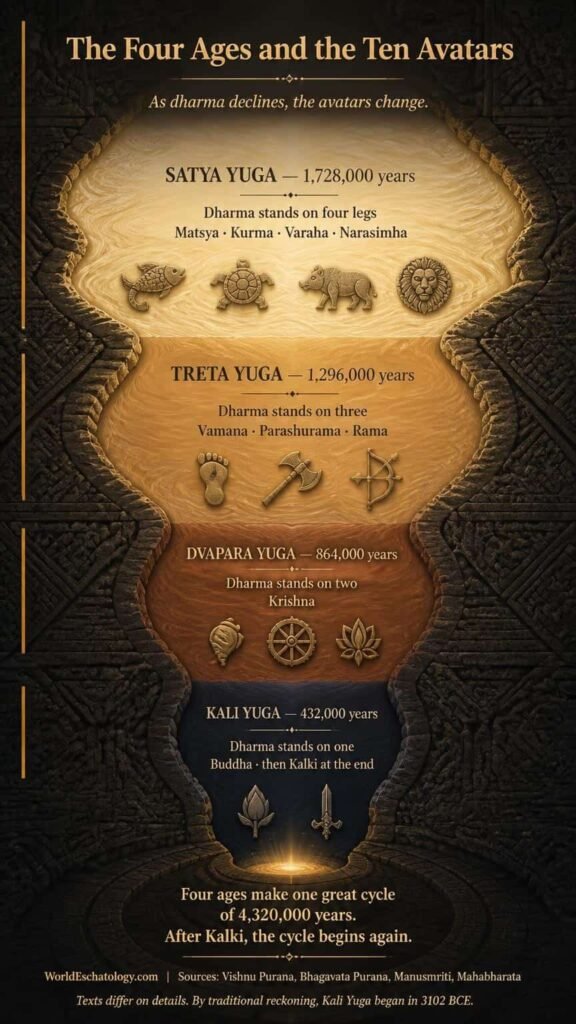
By traditional reckoning, Kali Yuga lasts 432,000 years. It began in 3102 BCE. About 5,100 years have passed. More than 426,000 years remain.
So the Hindu end times are not near in the way many people imagine.
They are also not final. When Kalki appears, the cycle does not close forever. It begins again.
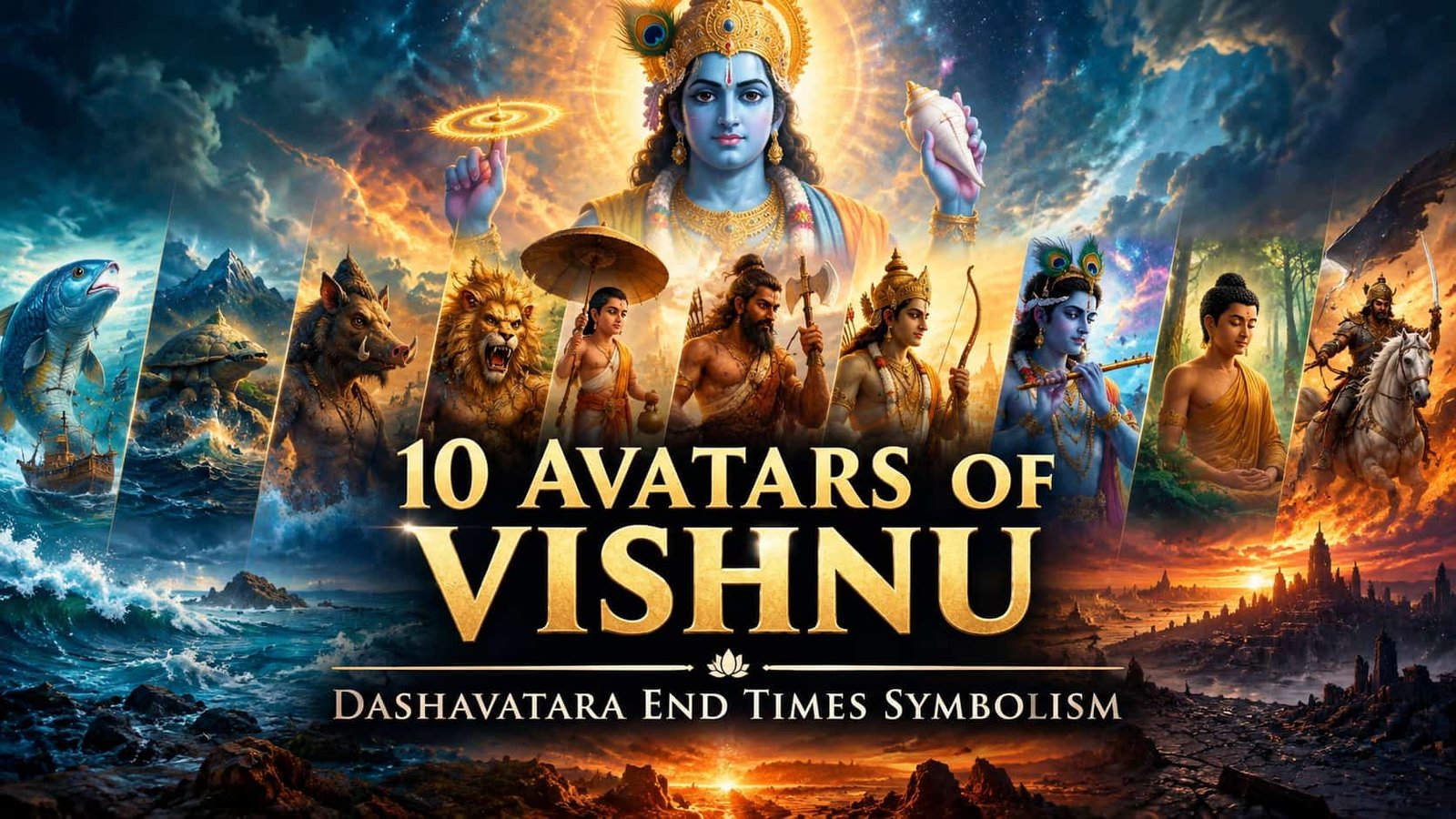
This guide explains Dashavatara, the 10 avatars of Vishnu, and what each one means.
It looks at Dashavatara end times symbolism and at the Kalki avatar in Hindu end times prophecy.
It also shows how Vishnu avatars and the end of Kali Yuga fit together in the larger Hindu view of time.
Where traditions differ, each view is described as its followers understand it.
What Does Hindu Tradition Teach About the Dashavatara?
What Is an Avatar?
The Sanskrit word avatara means descent. It describes the coming down of the divine into the world.
In Vaishnava belief, Vishnu is the preserver of the cosmos. When the world loses balance, he descends to restore it.
The classic statement is in the Bhagavad Gita (4.7 and 4.8). Krishna says that whenever dharma declines and adharma rises, he comes forth.
He comes to protect the good, to remove evil and to establish dharma. He does so age after age.
This idea is not the same as the Christian belief in a single incarnation.
In Hindu thought, there are many avatars. They appear in different ages for different needs. Each has its own mission.
Why Ten?
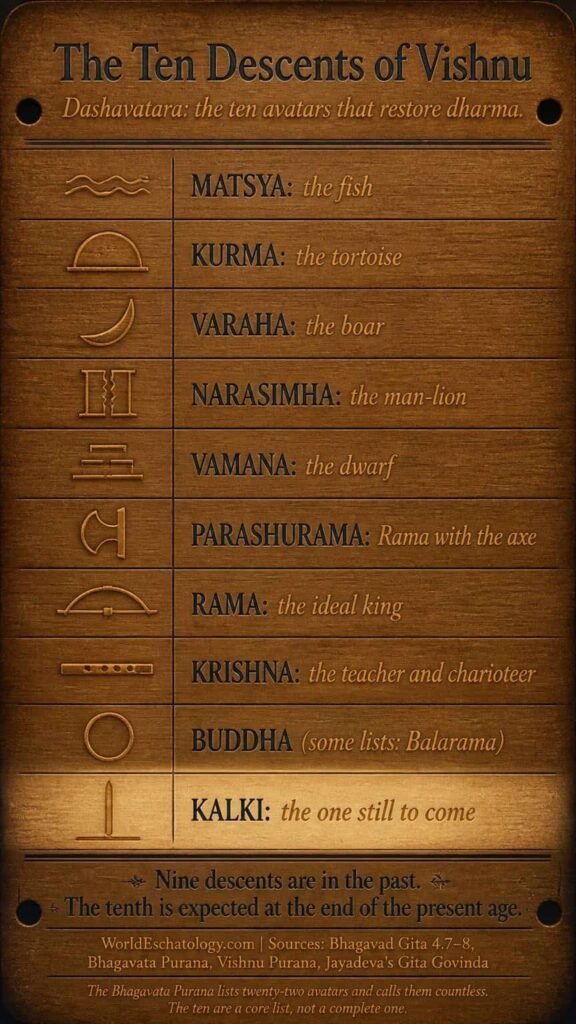
Dashavatara means ten avatars. Many Puranas and devotional works use this list.
It became the standard form in temple art, dance and poetry.
Ten is not the only count. The Bhagavata Purana (1.3) lists twenty two avatars.
It then says that the descents of Vishnu are as countless as the streams from a great lake. So the ten are best seen as a core list, not a complete one.
The Four Yugas and the Ten Avatars
Hindu time moves through four ages. Together they form a great cycle called a mahayuga.
- Satya Yuga (Krita Yuga): the age of truth. Dharma stands on four legs.
- Treta Yuga: dharma begins to weaken.
- Dvapara Yuga: dharma is only half intact.
- Kali Yuga: dharma is at its lowest. It is the present age.
The ten avatars are usually placed along this cycle. The first four belong to Satya Yuga.
The next three belong to Treta Yuga. Krishna belongs to Dvapara Yuga.
The Buddha and Kalki belong to Kali Yuga, the Buddha near its start and Kalki at its end.
Not every text agrees on every detail, but this is the common pattern.
As the ages decline, the avatars change. In the early ages, Vishnu appears in animal and hybrid forms.
Later, he appears as a human being, then as a teacher, then as a judge.
Quick Reference
| Avatar | Age | Core theme |
| 1. Matsya (fish) | Satya | Rescue from the great flood |
| 2. Kurma (tortoise) | Satya | Support for the churning of the ocean |
| 3. Varaha (boar) | Satya | Lifting the earth from the waters |
| 4. Narasimha (man-lion) | Satya | Protection of the devoted against tyranny |
| 5. Vamana (dwarf) | Treta | Humility against pride |
| 6. Parashurama (Rama with the axe) | Treta | Correction of corrupt power |
| 7. Rama | Treta | The ideal of just rule |
| 8. Krishna | Dvapara | Teaching and moral struggle |
| 9. Buddha (some lists: Balarama) | Kali | Compassion and restraint |
| 10. Kalki | End of Kali | Judgment and renewal |
Matsya, the Fish
A great flood is coming. Vishnu appears as a fish and warns Manu, the first man of this cycle.
He guides Manu’s boat to safety. Some accounts say he also saves the sacred Vedas.
Eschatological meaning: The world faces dissolution, and yet life is preserved. The seed of the next age is carried through the deluge.
Kurma, the Tortoise
The gods and demons churn the cosmic ocean to win the nectar of immortality.
The mountain they use as a churning rod begins to sink. Vishnu becomes a tortoise and holds it up on his back.
Eschatological meaning: Creation and renewal require effort. The divine is the hidden support of the whole process.
Varaha, the Boar
The demon Hiranyaksha drags the earth beneath the primal waters. Vishnu takes the form of a boar. He lifts the earth on his tusks and sets her back in place.
Eschatological meaning: When the world sinks into chaos, the divine raises it again. Earth is not abandoned.
Narasimha, the Man-Lion
The demon king Hiranyakashipu has been granted a boon that seems to make him unkillable.
He cannot die by day or night, indoors or outdoors, by man or beast.
He torments his own son Prahlada, who is devoted to Vishnu. Vishnu emerges from a pillar as a being who is neither man nor animal. He ends the tyrant at twilight, on a threshold.
Eschatological meaning: No power, however protected, is beyond the reach of divine justice. The devotee is never forgotten.
Vamana, the Dwarf
The generous king Bali has conquered the three worlds. Vishnu comes as a small brahmin boy and asks for as much land as he can cover in three steps.
Bali agrees. Vishnu grows to cosmic size. With two steps he covers the earth and the sky. For the third, Bali offers his own head.
Eschatological meaning: Pride is humbled, yet devotion is honored. Many traditions say Bali is rewarded and will rule again in a future age.
Parashurama, Rama with the Axe
Parashurama is a sage and warrior. In the Puranic accounts, he confronts rulers who have misused their power.
He is one of the immortals in Hindu belief. Texts such as the Kalki Purana say he will live to train Kalki.
Eschatological meaning: Power must serve dharma. The link between Parashurama and Kalki creates a thread across the ages.
Rama
Rama is the hero of the Ramayana. He is the ideal son, husband and king.
He defeats the demon king Ravana. His rule, called Rama Rajya, stands as a model of justice and peace.
Eschatological meaning: Even in a declining age, dharma can be lived in a human life. Rama Rajya is a picture of what restored order looks like.
Krishna
Krishna appears as a cowherd, a prince and a charioteer. In the Mahabharata, he guides Arjuna on the battlefield and speaks the Bhagavad Gita.
Tradition says his departure from the world marks the start of Kali Yuga.
Eschatological meaning: Krishna teaches how to act rightly when the world is torn by conflict.
The Gita offers guidance for the very age that follows him. Many Vaishnavas, especially in Gaudiya tradition, hold that Krishna is not only one avatar but the source of all of them.
Buddha
Many Puranas include the Buddha as the ninth avatar. Some say his role was to stop violent ritual and promote compassion.
Others say he was meant to lead the unrighteous away from false practice.
Some lists, especially in parts of South India, name Balarama, Krishna’s elder brother, in this place instead.
Eschatological meaning: Even in Kali Yuga, compassion has a place.
How this avatar is understood is one of the most debated points in Dashavatara studies, and it is discussed in the views section below.
Kalki, the Final Avatar
Kalki has not yet come. The Puranas describe him arriving at the end of Kali Yuga.
This is the heart of the Kalki avatar Hindu end times prophecy, and it is explored in the next section.
Kalki and the End of Kali Yuga
The Puranas describe Kali Yuga as an age of moral decline. The Bhagavata Purana (12.2) says that wealth alone will become the mark of status.
Rulers will behave like thieves. Truth and mercy will weaken. Lives will become shorter. People will lose trust in sacred teaching.
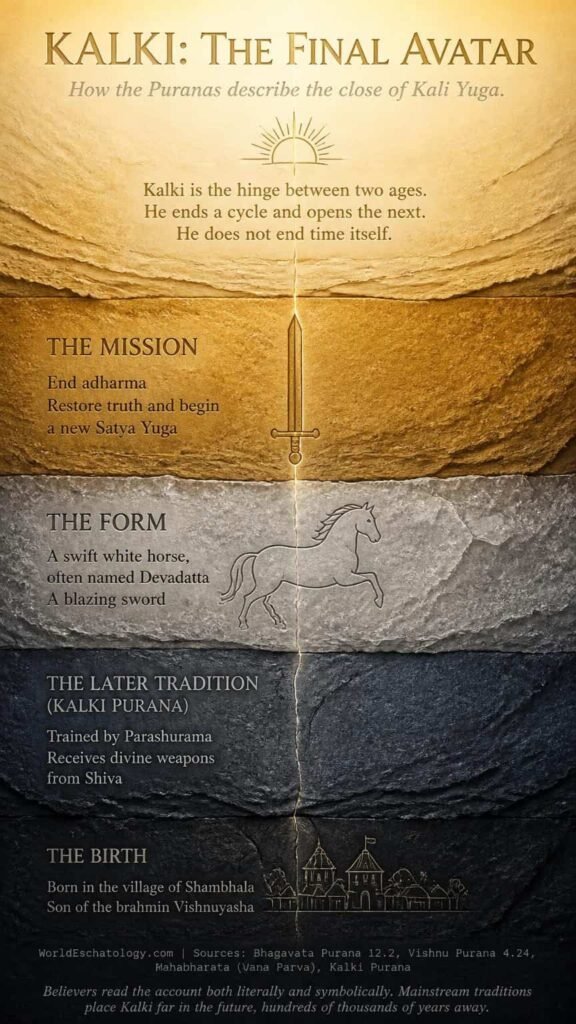
At the deepest point of this decline, Kalki appears. The Bhagavata Purana says he will be born in a village called Shambhala.
His father will be a brahmin named Vishnuyasha. He will ride a swift white horse, often named Devadatta, and carry a blazing sword.
The Vishnu Purana (4.24) and the Mahabharata (Vana Parva, the Markandeya section) tell a similar story.
The later Kalki Purana adds many details. It names his wife as Padma. It says Shiva gives him divine weapons and that Parashurama trains him.
Kalki’s mission is to end adharma and restore truth. After his work, Satya Yuga begins again.
This is why Vishnu avatars and the end of Kali Yuga are tied so tightly in Hindu thought. The tenth avatar is the hinge between one great cycle and the next.
Some passages are read as the description of an outer, historical battle.
Many teachers read them as a symbol of the victory of truth over falsehood. Both readings exist among believers.
Dashavatara End Times Symbolism
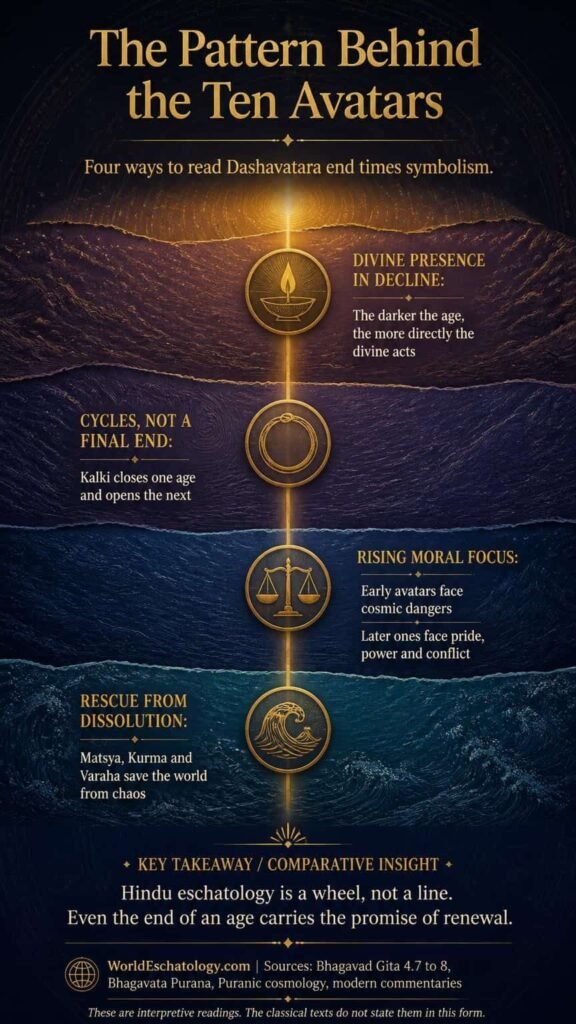
Many readers find a deeper pattern in the ten avatars. Dashavatara end times symbolism has several layers.
- Rescue from dissolution: Matsya, Kurma and Varaha each save the world from a form of ending. Water, chaos and loss are overcome.
- Rising moral focus: The early avatars face cosmic dangers. Later ones face human failings such as pride, abuse of power and violence.
- Cycles, not a final end: Kalki closes one age and opens another. The hope is for renewal, not for a single last day.
- Divine presence in decline: The darker the age, the more directly the divine acts.
This makes Hindu eschatology different from many Abrahamic views.
There is no one final judgment that ends time. Instead, time is a great wheel. Even great dissolutions, called pralaya, are followed by new creation.
The path out of the wheel is moksha, liberation. Individual souls can be freed in any age.
Key Texts and Sources
No single text contains the entire Dashavatara doctrine. It grew over many centuries. These are the main sources.
Early Sources
- The Rig Veda: It praises Vishnu and his three strides across the universe. This image later connects with Vamana.
- The Shatapatha Brahmana: It contains an early flood story with a fish and Manu. Early Vedic texts also link forms such as the tortoise and the boar to the creator Prajapati.
- The Mahabharata and the Harivamsa: They develop Krishna, Narasimha and other forms. They also describe the signs of Kali Yuga and mention Kalki.
The Bhagavad Gita
Verses 4.7 and 4.8 give the core theology of the avatar. They explain why and when the divine descends.
The Puranas
- Vishnu Purana: Gives a clear account of the yugas and of Kalki (4.24 and book 6).
- Bhagavata Purana: Lists twenty two avatars, describes Krishna’s life in depth and tells of Kalki in 12.2.
- Matsya, Agni, Garuda and Padma Puranas: Many contain the ten avatar list.
- Kalki Purana: A later text devoted to the final avatar.
Devotional and Philosophical Works
- Jayadeva’s Gita Govinda (12th century): Opens with a famous hymn to the ten avatars.
- Pancharatra Samhitas: Explain how Vishnu manifests in different modes. The avatars are one of these modes.
- Commentaries by Ramanuja, Madhva, Shankara and later teachers: Offer different views of what an avatar is.
Art and Performance
The ten avatars are shown in temple sculpture, including the Dashavatara cave at Ellora (Cave 15).
They also appear in Dashavatara theatre in Maharashtra and Goa and in painted card sets from regions such as Odisha and Karnataka.
This living culture keeps the avatars close to daily devotion.
Different Views Within the Tradition
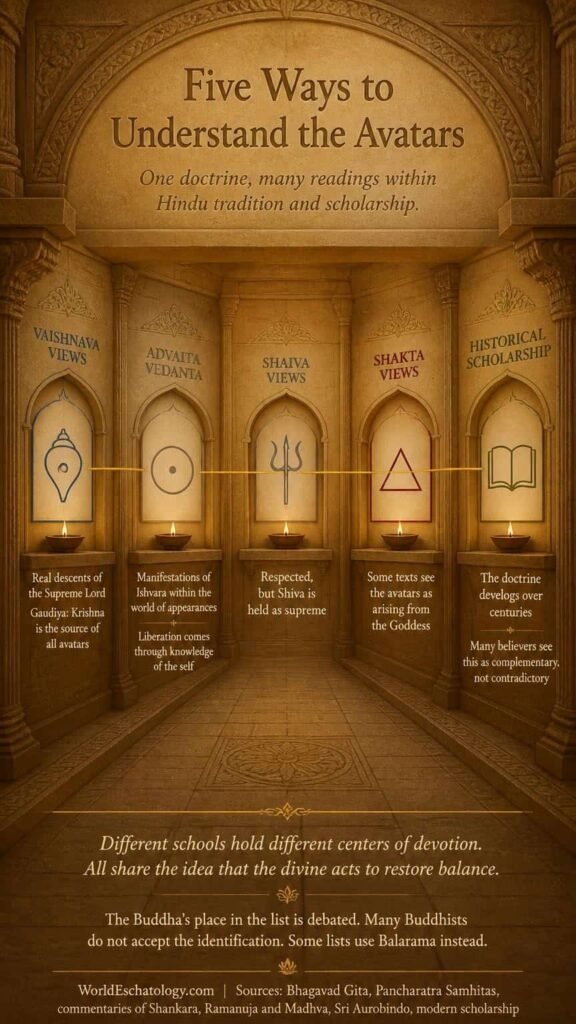
Hinduism is not one centralized system. Many schools and sects have different readings of the avatars. Here are the main ones.
Vaishnava Views
For Vaishnavas, Vishnu is the Supreme Being. The avatars are real descents.
In the Sri Vaishnava tradition of Ramanuja, they take divine forms that are not bound by ordinary matter. Madhva’s Dvaita school also treats them as real and eternal.
The Gaudiya tradition teaches that Krishna is the original form of God. For them, other avatars are expansions of Krishna.
That is why Krishna is sometimes called the source of the avatars and not simply the eighth in a list.
Advaita Vedanta
In the Advaita tradition of Shankara, Brahman is ultimately without form. An avatar is a manifestation of Ishvara, the Lord, within the world of appearances.
It is true for devotion and worship. Final liberation comes through knowledge of the self.
Shaiva and Shakta Views
Shaivas honor Shiva as the Supreme. They respect Vishnu’s avatars but do not usually place them at the top.
Shakta traditions center the Goddess. Some Shakta texts say the avatars of Vishnu arise from her power. These are different theological frames, not simple disagreements.
The Question of the Buddha
The inclusion of the Buddha is the most debated feature of the list. Puranic accounts give different reasons.
Some praise him for teaching compassion and ending animal sacrifice. Others say he came to turn the unrighteous away from the Vedic path.
Many Buddhists do not accept this identification. They regard the Buddha as an awakened teacher in his own right.
Some historians see the inclusion as an example of Hindu traditions absorbing a rival movement.
Some Hindu thinkers see it as an expression of the idea that truth appears in many forms. Respectful readers keep both perspectives in view.
Historical and Academic Views
Academic scholars study how the doctrine grew over time. Early texts speak of Prajapati taking forms such as a fish, tortoise and boar.
Later texts attach these to Vishnu. The list of ten becomes common in the Puranic period, roughly in the first millennium CE.
Some scholars suggest that Vishnu absorbed regional gods and heroes such as Krishna and Rama. Many believers see this differently.
They hold that the avatars are the same eternal Lord appearing as needed. These approaches can coexist, since one describes history and the other describes faith.
Evolutionary and Symbolic Readings
A popular modern reading sees the order of the avatars as a picture of evolution.
A fish, then a tortoise, then a land animal, then a hybrid, then a human. Some thinkers, including Sri Aurobindo, read the avatars as stages in the rise of consciousness.
Scholars caution that this reading is modern. It is not stated in the classical texts.
Many traditional teachers prefer to read the avatars as real events within sacred history. Others value both layers.
When Will Kalki Come?
The traditional view is that Kalki comes at the end of Kali Yuga, far in the future. Some modern teachers disagree.
Sri Yukteswar, in The Holy Science (1894), taught that the cycle is much shorter and that humanity is already rising out of the darkest phase.
Over the years, several modern figures have also been presented by followers as Kalki. Mainstream traditions do not accept such claims.
Why the Dashavatara and Kalki Matter Today
These ancient ideas are still part of everyday culture. The term Kali Yuga is common in conversation.
People use it to talk about greed, conflict and moral confusion. Even those who do not hold the doctrine literally often use it as a moral language.
Popular culture has also brought Kalki to new audiences. The 2024 film Kalki 2898 AD, for example, introduced the Kalki idea to millions of viewers across India and abroad.
Films and stories reshape sacred themes in their own way, and viewers often turn to the texts afterward to learn more.
The avatars also shape living devotion. The consecration of the Ram temple at Ayodhya in January 2024 drew global attention to Rama, the seventh avatar.
For many Hindus, it was a deeply sacred moment.
The Dashavatara also offers a thoughtful alternative to fear. Many apocalyptic ideas focus on a final catastrophe.
The Hindu vision of Kalki is different. It places even great decline inside a cycle of renewal. It reminds believers that each age has its own duty.
In Kali Yuga, many teachers say, devotion and remembrance of the divine name are especially powerful.
For comparative readers, there are interesting parallels and differences.
Kalki can be compared with Maitreya in Buddhist tradition, with the Saoshyant in Zoroastrianism, and with the Messiah or the Mahdi in Abrahamic traditions.
All describe a figure who restores justice at a decisive time. Yet each belongs to a distinct view of history.
Scholars debate whether any of these figures influenced one another. Careful comparison respects what makes each unique.
Frequently Asked Questions
What are the 10 avatars of Vishnu in order?
The common list is Matsya, Kurma, Varaha, Narasimha, Vamana, Parashurama, Rama, Krishna, Buddha and Kalki. Some lists place Balarama before Krishna or in place of the Buddha.
What does Dashavatara mean?
Dasha means ten and avatara means descent. Dashavatara refers to the ten main descents of Vishnu to restore dharma.
What is the meaning of Vishnu avatars?
Each avatar answers a crisis in the world. Together they show that the divine does not abandon creation. They also trace a movement from cosmic rescue to moral teaching to final renewal.
Which avatar of Vishnu is expected at the end of Kali Yuga?
Kalki. The Puranas say he will appear when Kali Yuga reaches its lowest point. He will end adharma and begin a new Satya Yuga.
When will Kalki appear?
By traditional calculation, Kali Yuga began in 3102 BCE and lasts 432,000 years. That places Kalki more than 426,000 years in the future. Some modern teachers propose much shorter cycles.
Is Buddha an avatar of Vishnu in Hinduism?
Many Puranas list the Buddha as the ninth avatar. Not all Hindus agree, and some lists use Balarama instead. Buddhists generally do not accept this view, and they honor the Buddha as an awakened teacher.
Is Krishna the eighth or ninth avatar?
In the most common list, Krishna is the eighth. In lists that include Balarama, Krishna is the ninth. Gaudiya Vaishnavas teach that Krishna is the source of all avatars.
What is Kali Yuga?
Kali Yuga is the fourth and darkest age of the four ages. Texts describe it as a time of declining virtue. Traditional chronology says it began around 3102 BCE.
Does the Dashavatara predict the end of the world?
Not in a final sense. Kalki ends the current age. Then a new cycle begins. Hindu texts also describe great dissolutions, called pralaya, but these too are followed by renewal.
Do all Hindus believe in the Dashavatara?
No. Vaishnavas hold the doctrine as central. Shaivas, Shaktas and Advaitins hold different views of the avatars.
Many Hindus honor the avatars as part of a wider tradition without making them the highest focus.