
Introduction
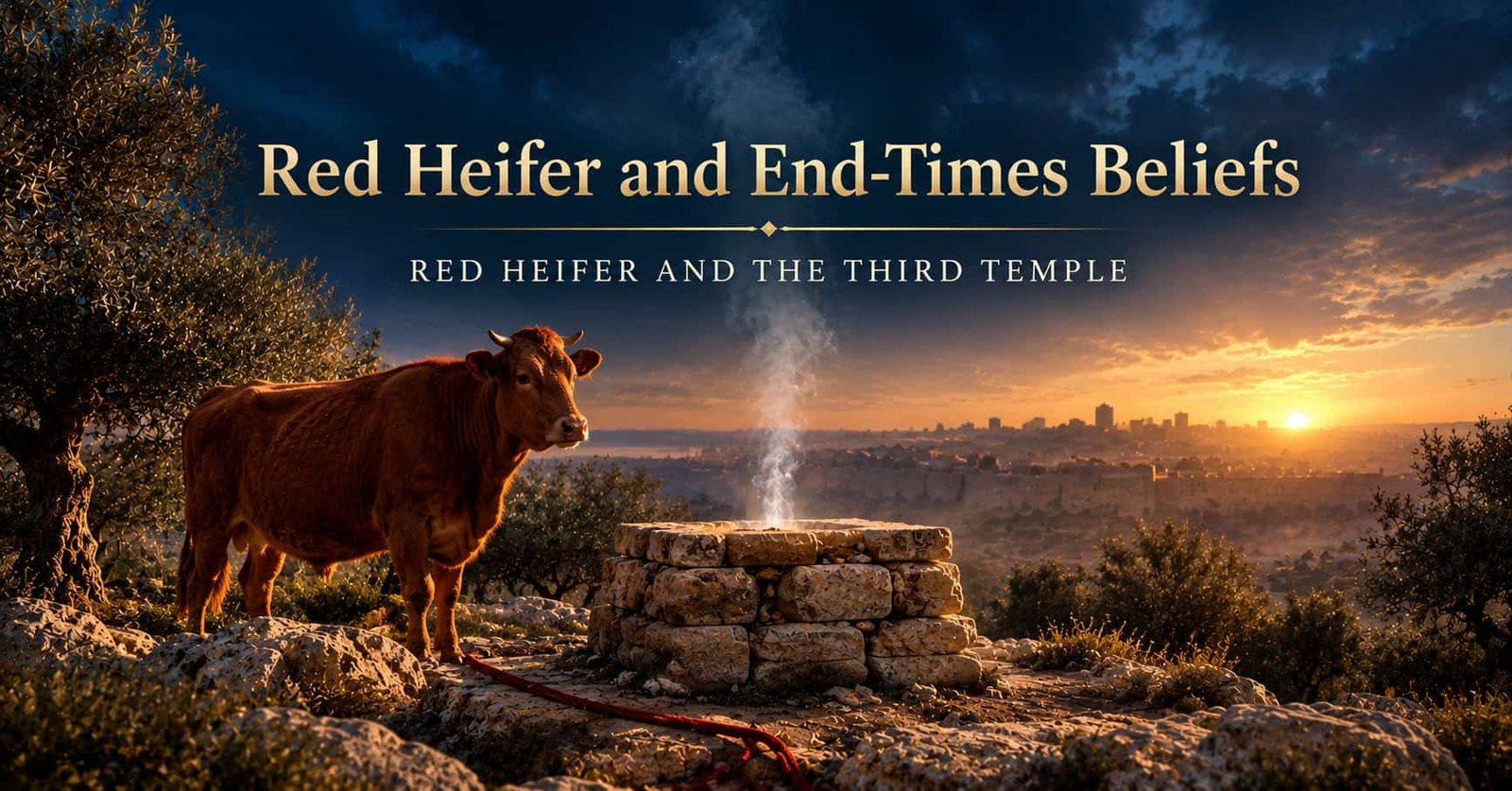
A red calf is born in Israel, and the news travels the world. Websites track its coat. Rabbis inspect it.
Millions of people ask the same question. Could this animal change the future?
That is the power of the red heifer. It is a single cow mentioned in a single chapter of the Torah.
Yet it has become one of the most watched symbols in modern religious life. Jews, Christians and Muslims all follow the story, though for different reasons.
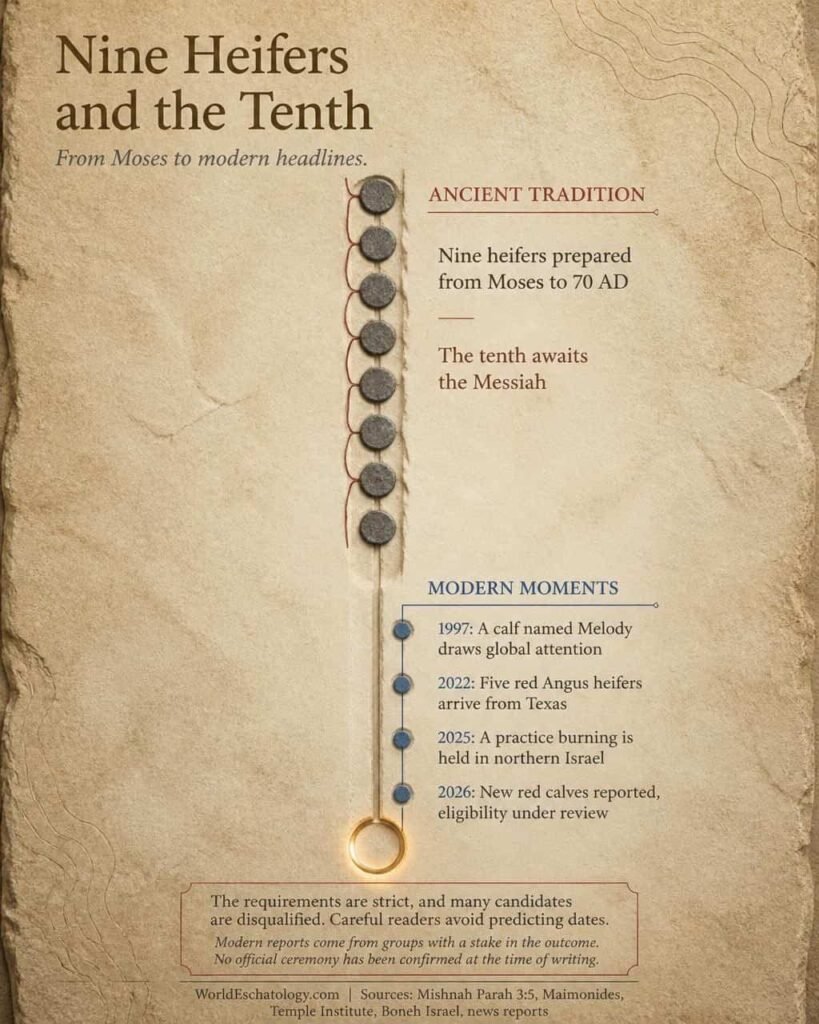
Here is a striking fact. According to Jewish tradition, only nine red heifers were prepared from the time of Moses to the destruction of the Second Temple in 70 AD.
That is nine in about 1,400 years. The tradition adds that the tenth will be prepared by the Messiah.
This guide explains the red heifer in the Bible and what Parah Adumah means. It looks at the red heifer and the Third Temple.
It also explains how the red heifer prophecy is read in different traditions.
You will see why some believers treat red heifer end times events as a sign, and why others urge caution. Each view is presented as its followers understand it.
What Does Tradition Teach About the Red Heifer (Parah Adumah)?
What Is the Red Heifer?
The red heifer is a rare sacrificial animal. The Hebrew name is Parah Adumah. Parah means cow. Adumah means red.
The Torah describes it as a red cow without blemish, one that has never worn a yoke (Numbers 19:2).
Its purpose is purification. The ashes of the heifer were mixed with water. That water cleansed people who had become ritually impure through contact with a dead body.
This is not about hygiene. In the biblical world, contact with death created a special kind of impurity.
It kept a person from entering the sanctuary. The red heifer was the remedy.
The Ritual Step by Step
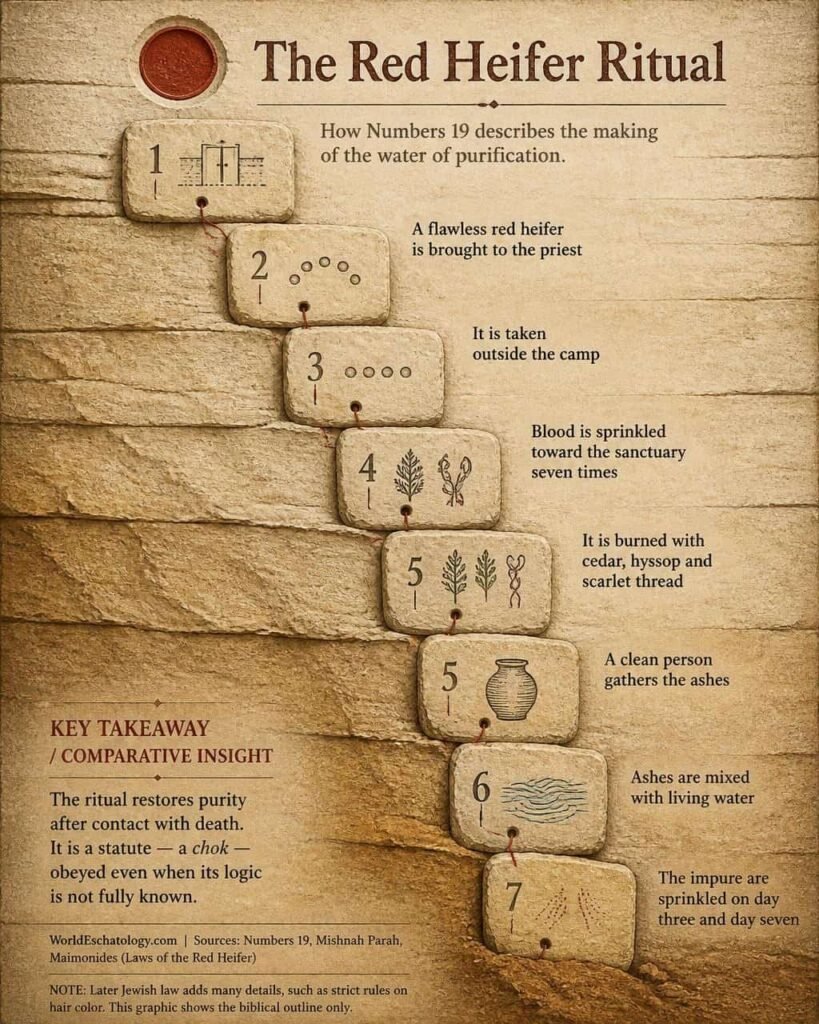
Numbers 19 lays out the ritual in detail. In simple terms, it works like this.
- The heifer is brought to Eleazar the priest.
- It is taken outside the camp and slaughtered in his presence.
- The priest sprinkles some of its blood toward the front of the tent of meeting seven times.
- The whole animal is burned. Cedar wood, hyssop and scarlet yarn are thrown into the fire.
- A person who is ritually clean gathers the ashes. They are stored in a clean place outside the camp.
- When needed, the ashes are mixed with fresh running water. This is called the water of purification.
- A clean person sprinkles it on the impure on the third day and the seventh day.
Later Jewish law, recorded in the Mishnah tractate Parah, adds many more rules. For example, even a few non-red hairs can disqualify the animal.
The Mishnah also says the heifer was burned on the Mount of Olives, facing the Temple.
A Paradox at the Heart of the Law
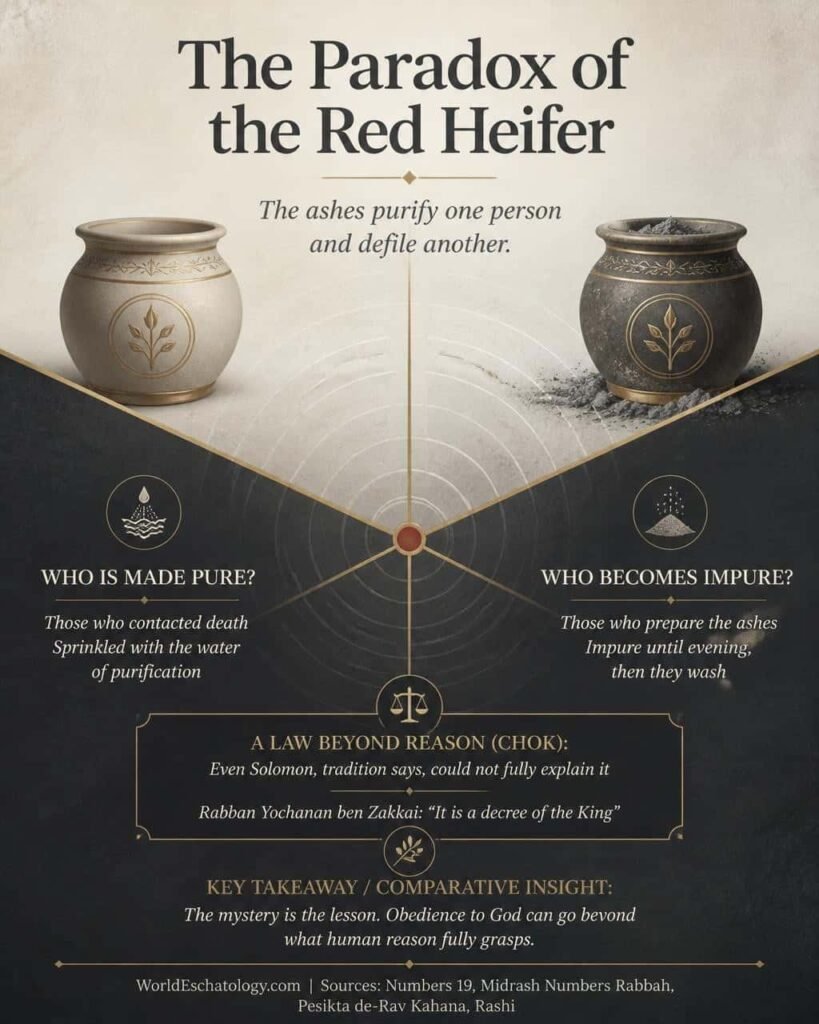
The red heifer is full of tension. The people who prepare the ashes become impure until evening. Yet the same ashes make impure people pure.
The law cleanses one person and defiles another.
Jewish tradition calls this kind of law a chok, a statute that goes beyond human reason.
A well known rabbinic story says that even King Solomon, the wisest of men, could not fully understand it.
Another tells how Rabban Yochanan ben Zakkai answered a skeptic. He said that a corpse does not truly defile, and the water does not truly cleanse. It is a decree from the King.
For many believers, this mystery is the point. It teaches obedience to God even when the reason is not fully clear.
Why the Ashes Matter: Purity and the Temple
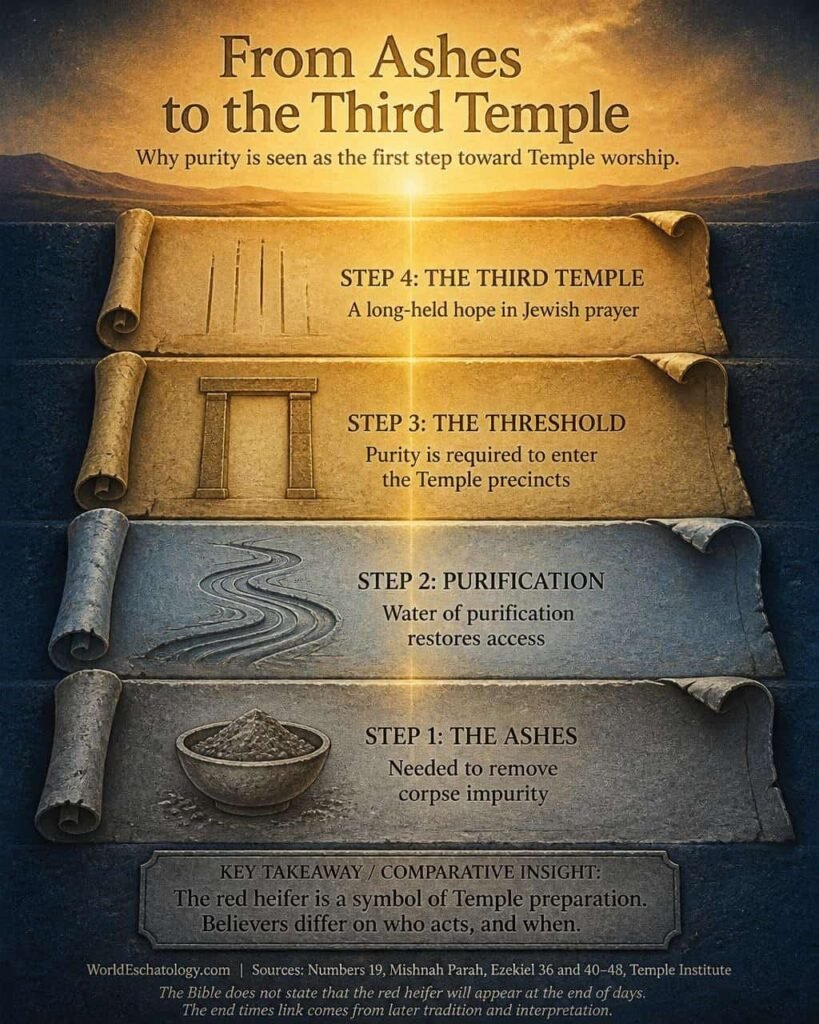
In Jewish law, ritual purity is required to enter the Temple precincts and to take part in Temple service.
Almost everyone alive today is considered to have contact with the dead in some way. Without the ashes, that impurity cannot be removed in the biblical manner.
This is why the red heifer is tied so closely to the Temple. Many authorities teach that the ashes are a key step toward full Temple worship.
Others note that the law is complex and that some aspects of Temple service may proceed under special rules.
Even so, the red heifer has become the best known symbol of Temple preparation.
Red Heifer and the Third Temple
Jewish prayer has long asked for the rebuilding of the Temple in Jerusalem. The First Temple was destroyed by Babylon in 586 BC.
The Second was destroyed by Rome in 70 AD. The hope for a Third Temple has been part of daily prayer for nearly two thousand years.
Groups such as the Temple Institute in Jerusalem, founded in the 1980s, work to prepare for that day.
They have reconstructed priestly garments and sacred vessels. They also support efforts to find a qualified red heifer.
For them, the red heifer and the Third Temple are directly connected. Purity must come first.
Many Orthodox Jews see this as faithful preparation. Others see it as a task that belongs to the messianic age.
Both groups share the hope of a restored Temple. They differ on who acts and when.
Red Heifer and End Times Beliefs
The Bible does not say that the red heifer will appear at the end of days. The link comes from later tradition and from interpretation. Three ideas stand behind it.
- The Mishnah tradition says the tenth red heifer will be prepared in the messianic age. Maimonides records this in his Mishneh Torah.
- Prophets such as Ezekiel speak of a purified people and a restored Temple. Ezekiel 36:25 says God will sprinkle clean water on His people.
- Many Christians who expect a rebuilt Temple before the return of Christ see the red heifer as a possible sign.
So red heifer end times belief is not one belief. It is a set of related views. Some see a messianic sign.
Some see a step in human preparation. Some see only a symbol. The next sections explore these differences.
Key Texts and Sources
The red heifer prophecy, as people often call it, rests on a small number of texts. It is helpful to separate what the Bible says from what later traditions add.
Primary Biblical Texts
- Numbers 19:1 to 22: The main passage on Parah Adumah in the Bible. It gives the commandment, the ritual and the purpose.
- Deuteronomy 21:1 to 9: The law of the heifer whose neck is broken. This is a different ritual. It deals with an unsolved murder. It is often confused with the red heifer.
- Ezekiel 36:25: A promise of clean water and a renewed people. Some readers link it to the water of purification.
- Ezekiel 40 to 48: A vision of a restored Temple. It is central to Third Temple hopes.
- Hebrews 9:13 and 14: The New Testament compares the ashes of a heifer with the blood of Christ.
- Hebrews 13:11 to 13: It notes that Jesus suffered outside the gate, an echo of the heifer burned outside the camp.
Jewish Sources
- The Mishnah, tractate Parah: The most detailed account of the rules and of the nine heifers.
- Maimonides, Mishneh Torah, Laws of the Red Heifer: A clear legal summary and the source for the tenth heifer tradition.
- Midrash and Rashi: They treat the heifer as a mystery and, in one famous teaching, as atonement connected to the golden calf. The image is a mother cleaning up after her child.
- Parashat Parah: A special Torah reading on the Sabbath before the month of Nisan. Numbers 19 is read aloud to recall purification before Passover.
Christian Sources
- The Epistle of Barnabas, chapter 8: An early Christian text that reads the heifer as a figure of Jesus.
- Church Fathers and later commentators: Many wrote that the heifer foreshadowed Christ’s sacrifice and the cleansing of conscience.
- Modern prophecy writers: Many evangelical authors link the heifer to Daniel 9:27, Matthew 24:15 and 2 Thessalonians 2:4, passages that mention a Temple in the last days.
Modern Sources
Today, news reports and statements from groups such as the Temple Institute, Boneh Israel and the National Red Heifer Institute shape the public story.
These groups have a clear purpose. Readers should treat their statements as the views of committed participants and compare them with independent reporting.
Different Scholarly and Religious Views
There is no single view of the red heifer. Even among those who respect it deeply, opinions vary. Here are the main positions.
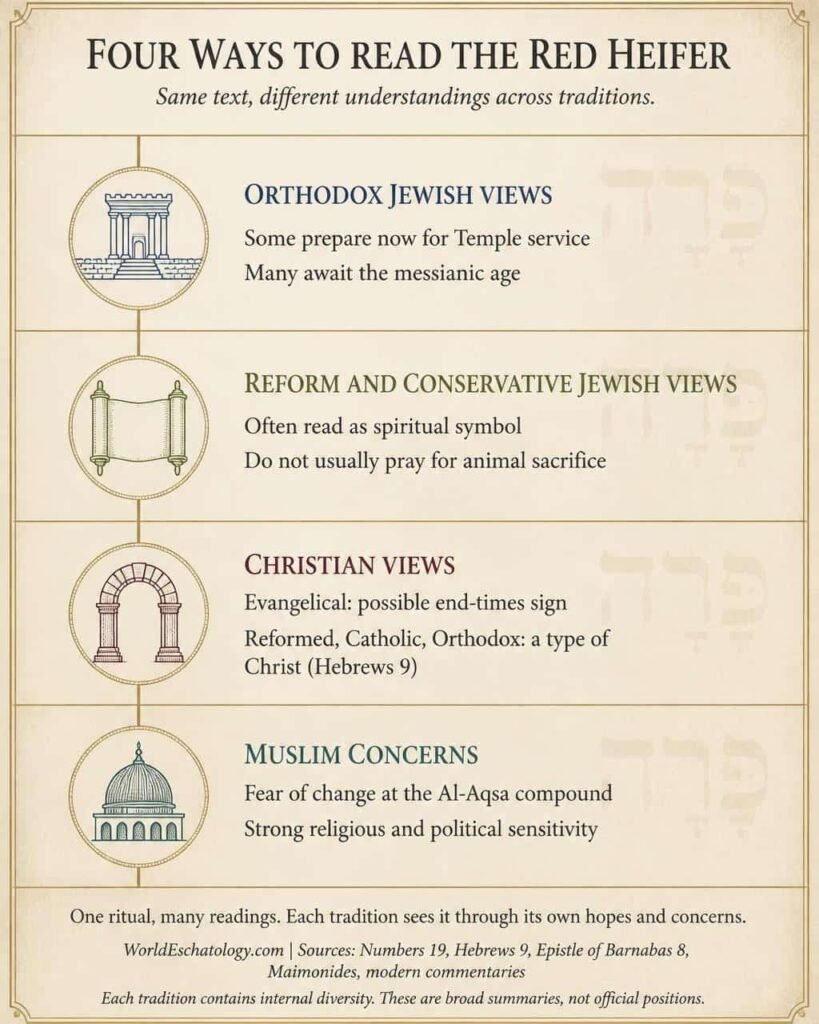
Orthodox Jewish Views
Orthodox Judaism holds the commandment as binding and eternal. Within it, however, opinion divides.
- Temple activists: Many religious Zionist groups believe the community should prepare now. They see a qualified red heifer as a step toward Temple service.
- Cautious voices: Many rabbis hold that the Temple will be rebuilt by God in the messianic age. They teach that human attempts are premature. Many also rule that Jews should not enter the Temple Mount at all, because the exact location of the holiest areas is uncertain.
- Legal skeptics: Some experts question whether a heifer can be valid if it was bred by modern methods, flown from abroad or raised in unusual conditions. These are detailed debates in Jewish law, and they are still open.
Reform, Conservative and Other Jewish Views
The Reform and Conservative movements generally do not pray for the return of animal sacrifice.
They often read the Temple tradition as a symbol of spiritual renewal. Prayer, study and acts of kindness take the place of sacrifice.
Many in these movements respect the history of the red heifer without expecting it to be literally restored.
Christian Views
Christian readers hold at least three main approaches.
- Dispensational and many evangelical readers: They expect a rebuilt Temple in the last days. They often see the red heifer as a possible sign that the time is near. Many American evangelicals have also helped the search. Examples include Clyde Lott, a Mississippi rancher in the 1990s, and Byron Stinson, a Texas rancher who helped bring heifers to Israel in 2022.
- Reformed, amillennial and many mainline readers: They believe Christ’s sacrifice fulfilled the red heifer. They cite Hebrews 9. On this view, no Temple or sacrifice needs to return. Some also worry that a focus on the heifer draws attention away from Christ.
- Catholic and Orthodox readers: They usually emphasize typology. The heifer points to Christ and to the cleansing of the soul. They do not usually treat it as a sign of a coming Temple.
Some Christians also raise ethical concerns. They urge believers not to treat other people’s sacred hopes as a prophetic puzzle. Respect for Jewish voices is a common theme in these warnings.
Muslim Perspectives
Islam does not have a red heifer ritual in the same sense. Yet Muslims have a deep interest in the story.
The Temple Mount is also the site of Al-Aqsa Mosque and the Dome of the Rock, known as Haram al-Sharif.
Many Muslims fear that any move toward a Third Temple would threaten these holy places. Their concerns are religious and political, and they are widely expressed.
Surah Al-Baqarah, the second chapter of the Quran, also tells a story about a cow that Moses asked the Israelites to sacrifice.
It is not the same ritual as the red heifer of Numbers 19. Still, scholars sometimes compare the two.
Why the Red Heifer Matters Today
The red heifer is no longer only an ancient topic. It is part of current news.
In 2022, five red Angus heifers were flown from Texas to Israel. Over the following years, rabbinic inspectors examined them.
Some were disqualified. In July 2025, a practice burning was held in northern Israel. It was a rehearsal. The animal used was not a qualified heifer.
In July 2026, groups such as the National Red Heifer Institute and Israel365 News reported the birth of new red calves.
One was reported in the Galilee. Another was reported in the Golan Heights. The same reports raised legal questions about eligibility.
A calf must keep a fully red coat until it is at least two years old. Rabbis must also confirm its breeding and health.
At the time of writing, no official ceremony has been confirmed. Readers should check current reports.
This history shows a pattern. Earlier moments of excitement also faded. In 1997, a calf named Melody drew global attention.
She was later reported to be disqualified because of a few non-red hairs. Such stories remind us how strict the requirements are.
The red heifer also touches politics. The Temple Mount is among the most sensitive sites in the world.
Under a long-standing arrangement, Jews may visit but may not pray openly on the site.
Any talk of Temple preparation can raise fear and anger. After October 7, 2023, news outlets reported that a Hamas figure included the arrival of the cows in a list of grievances.
Analysts treat such claims with caution. Still, they show how a religious symbol can carry political weight.
A balanced reader may hold several thoughts at once. The red heifer is a real part of Jewish law and hope.
It matters deeply to many Jews and Christians. It is also easy to sensationalize. Careful readers avoid predicting dates.
Many teachers in both Judaism and Christianity warn against that.
In the end, the red heifer speaks to a universal human longing. People want to be made clean.
They want to approach what is holy. The red heifer is one of the oldest ways that tradition has expressed that hope.
Frequently Asked Questions
What is the red heifer in the Bible?
It is a red cow without blemish that was burned as part of a purification ritual in Numbers 19. Its ashes were mixed with water to cleanse people who had contact with a dead body.
What does Parah Adumah mean?
Parah Adumah is Hebrew for red cow. The Torah calls it a Parah Adumah Temimah, a perfect red cow. The word heifer in English usually refers to a young cow that has not given birth.
Why is the red heifer important?
Its ashes were needed to remove corpse impurity. This kind of purity was required for Temple service. That is why the red heifer is tied to the hope of a rebuilt Temple.
How many red heifers have there been?
Jewish tradition, based on the Mishnah, says nine were prepared from Moses to the destruction of the Second Temple. The tenth is said to come in the messianic age.
Is the red heifer prophecy in the Bible?
The Bible commands the red heifer ritual. It does not say the heifer will appear in the last days.
The link to end times comes from later Jewish tradition and from Christian prophetic interpretation. Many traditions read it as a ritual and a symbol, not as a dated prophecy.
Is the red heifer linked to the Third Temple?
Yes, in many Jewish and Christian views. Purity from corpse impurity is needed for Temple worship.
So the ashes are seen as a step toward a rebuilt Temple. Not every tradition shares this view.
Do all Jews want the Third Temple built now?
No. Jewish views vary. Some groups work actively toward it. Many Orthodox teachers believe God will build it in the messianic age.
Many Reform and Conservative Jews do not expect the return of animal sacrifice.
What do Christians believe about the red heifer?
Views differ. Some evangelical Christians see it as a possible sign of the last days. Many other Christians see it as a type of Christ, based on Hebrews 9:13 and 14. They do not expect a rebuilt Temple.
Has a red heifer been sacrificed in modern times?
No ceremony has been confirmed as valid. There have been practice burnings and candidate heifers. Each case has raised strict legal questions.
Why does the red heifer make some people impure?
Those who prepare the ashes become impure until evening. Yet the ashes purify others. Jewish tradition calls this a chok, a law that goes beyond human reasoning.