
Few words in human history carry as much weight as Armageddon. The moment you say it, people know what you mean. The end. The final war.
The last chapter of civilization. It shows up in news headlines, disaster movies, political speeches, and religious sermons all around the world.
It is one of the most searched biblical topics on the internet, and that number keeps growing every year.
But here is the problem. Most people who use the word Armageddon have never actually read what the Bible says about it.
The popular version of Armageddon, the one from movies and headlines, is almost completely different from what Scripture actually describes.
The battle of Armageddon is not a meteor strike. It is not a nuclear exchange between superpowers. It is not the accidental end of the world.
According to the Bible, the battle of Armageddon is a deliberate, prophesied event that has been planned since the beginning of time.
It has specific participants, a specific location, a specific trigger, and a very specific outcome. And understanding it changes the way you see everything happening in the world right now.
This article walks through all of it. The meaning of the word itself, the biblical foundation, the events that lead up to it, who fights, who wins, what happens next, how different Christians interpret it, what Islam says about a parallel event, and what it all means for people living today.
What Does Armageddon Actually Mean?
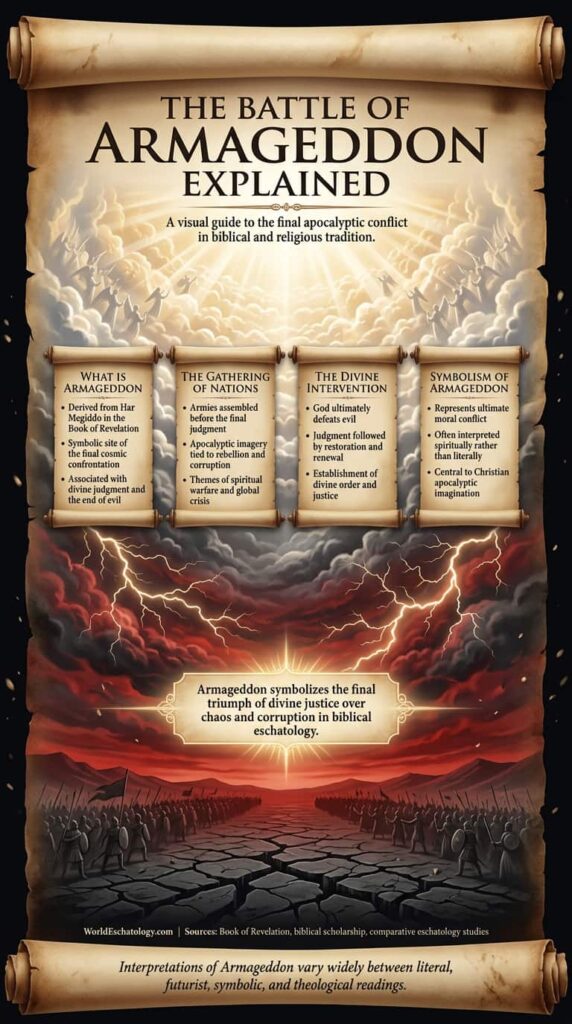
The word Armageddon comes from Hebrew. It is a combination of two Hebrew words: “Har,” which means mountain or hill, and “Megiddo,” the name of an ancient city in northern Israel.
Put them together and you get “Har Megiddo,” which means the Mountain of Megiddo or the Hill of Megiddo. Armageddon is simply the Greek transliteration of that Hebrew phrase.
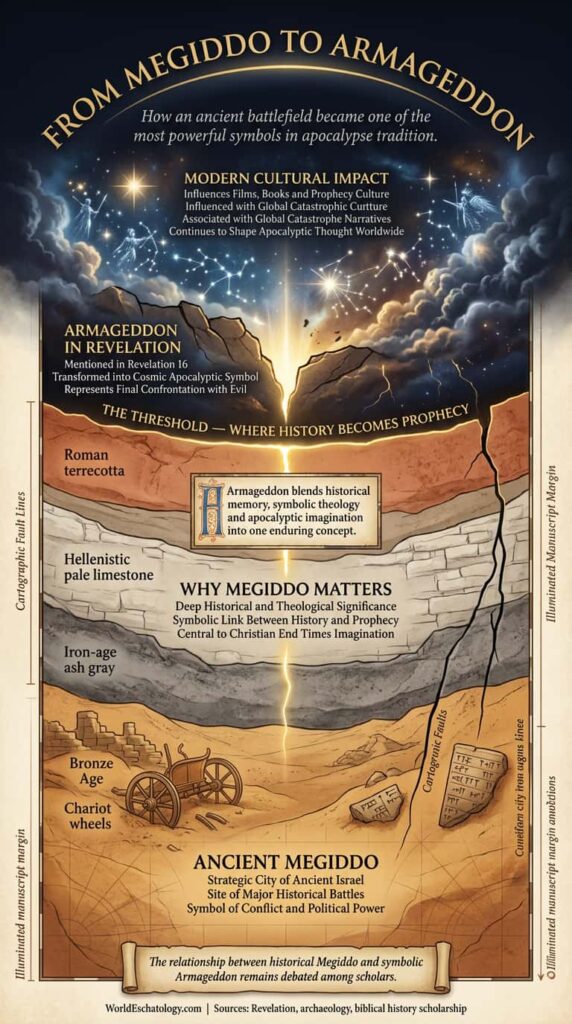
Megiddo is a real place. It sits on the edge of the Jezreel Valley in northern Israel, overlooking a wide and flat plain that stretches for miles in every direction.
This valley has been one of the most strategically important pieces of land in the ancient world for thousands of years. Armies that wanted to control the region had to control this valley.
This is not just biblical history. Over thirty major battles have been fought in and around the Megiddo area throughout recorded history.
Thutmose III fought here in 1457 BC. The Crusaders fought here. Even Napoleon Bonaparte marched his army through this valley in 1799.
After seeing the landscape, Napoleon reportedly said it was the most natural battlefield on earth. He was right. The flat, open plain of Megiddo is made for large-scale military conflict.
Given all of that history, it makes complete sense that the Bible would point to this location as the gathering place for the final war of human history.
There is only one place in the entire Bible where the word Armageddon appears directly.
That is Revelation 16:16, where it says the kings of the whole world are gathered to the place called Armageddon.
Just one verse. But that one verse is connected to dozens of other prophecies across the Old and New Testaments that fill in the full picture.
The Biblical Foundation: Where Is Armageddon in the Bible?
The primary text for the battle of Armageddon is found in Revelation 16:12 through 16.
This section describes the sixth bowl judgment, one of seven final judgments poured out on the earth during the Great Tribulation.
In these verses, the Euphrates River dries up to make a path for the kings of the east, demonic spirits go out to the kings of the whole world, and they are gathered together to the place called Armageddon.
But Revelation does not stand alone. Several Old Testament prophecies point to the same event.
Zechariah 14:1 through 4 describes a day when all nations gather against Jerusalem, the city is overtaken, and then the Lord himself stands on the Mount of Olives and the mountain splits in two.
Joel 3:1 through 2 speaks of God gathering all nations and bringing them down to the Valley of Jehoshaphat, which is near Jerusalem, to judge them for what they have done to Israel.
Isaiah 34 describes a devastating judgment on the nations in a way that many scholars connect to the same end-times events.
Taken together, these passages paint a picture of a gathering of nations against Israel and Jerusalem that culminates in direct divine intervention.
The book of Revelation is not creating something new. It is completing what the Old Testament prophets began describing centuries earlier.
It is also important to understand what kind of writing the book of Revelation is.
It is apocalyptic literature, meaning it uses vivid symbols, imagery, and numbers to communicate deep spiritual and prophetic truth.
This is why Christians disagree on whether the battle of Armageddon should be understood as a literal military battle or as a symbolic representation of the final conflict between good and evil.
Both interpretations are held by serious, faithful biblical scholars.
The Road to Armageddon: Events That Lead Up to It
The battle of Armageddon does not happen out of nowhere.
According to biblical prophecy, it is the climax of a period of time called the Great Tribulation, a seven-year period of unprecedented suffering, judgment, and chaos on the earth.
During the Tribulation, a world leader rises who is commonly referred to as the Antichrist.
This figure is described in Daniel, in 2 Thessalonians 2, and extensively in Revelation.
He rises to global power, initially presenting himself as a man of peace, and then at the midpoint of the seven-year period, he reveals his true nature.
He demands to be worshipped, he persecutes believers, and through him and his ally the False Prophet, he imposes a system of global control connected to what Revelation 13 calls the Mark of the Beast, the number 666, without which no one can buy or sell.
During this same period, God pours out a series of judgments on the earth.
There are seven seal judgments, then seven trumpet judgments, then seven bowl judgments. Each set is worse than the last.
Wars, famines, plagues, cosmic disturbances, and supernatural disasters shake the entire planet.
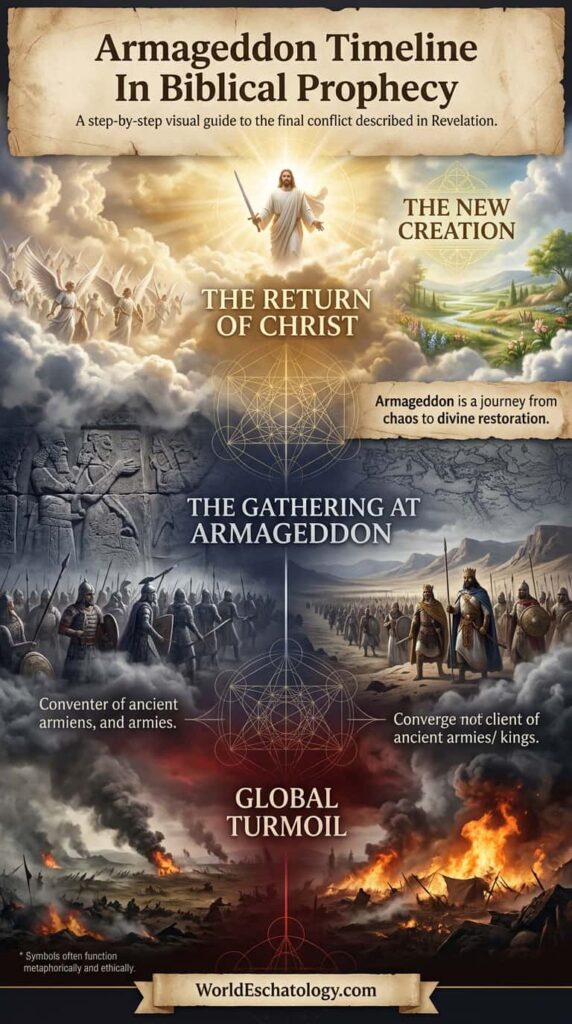
The specific trigger for the gathering at Armageddon is found in Revelation 16:12. The sixth bowl judgment causes the great Euphrates River to dry up.
The Euphrates runs through modern-day Turkey, Syria, and Iraq, and it has historically been a natural barrier between the Middle East and the far east.
When it dries up, it creates a clear path for what the Bible calls “the kings of the east” to march their armies westward toward Israel.
At the same time, demonic spirits described as looking like frogs go out to the kings of the whole world and deceive them into gathering their armies together.
The destination is the Hill of Megiddo. The valley below it is about to host the largest military gathering in the history of the world.
The Armies of Armageddon: Who Fights Whom?
This is one of the most common questions people have about the battle of Armageddon.
Who exactly is fighting? The Bible gives us pieces of the picture, though it does not give a complete military breakdown in the way a history book would.
What is clear is that the nations of the world, led by and aligned with the Antichrist, gather their forces in the region of Megiddo and then move toward Jerusalem.
The ultimate target is Israel and specifically the city of Jerusalem. Zechariah 14 describes the city being captured and the fighting reaching the streets before the divine intervention takes place.
Joel 3 adds another layer. It describes God gathering all nations to the Valley of Jehoshaphat, which is located just outside Jerusalem near the Kidron Valley, for judgment.
This suggests that the military gathering at Megiddo may transition into or overlap with a final confrontation directly at Jerusalem.
The kings of the east appear to be a separate coalition.
Some scholars identify them as Asian nations, possibly referring to China and other eastern powers, based on the scale of their army described in Revelation 9:16 as two hundred million strong.
Others see this as symbolic of an enormous force. Whether these kings are allied with the Antichrist or opposed to him is debated.
What is not debated is the scale. The Jezreel Valley is roughly 20 miles long and 14 miles wide.
It is one of the few pieces of land in the region that could physically hold millions of soldiers. Napoleon saw it.
Ancient generals saw it. The biblical prophets pointed to it centuries before any of them did.
What brings all these armies together, despite their differences, appears to be a shared opposition to God and to Israel.
They do not know they are walking into a divine trap. Revelation 16:14 says the demonic spirits that drive them are gathering them for the battle on the great day of God Almighty.
The Return of Jesus Christ: The Turning Point
Here is where the battle of Armageddon takes a turn that no military analyst could predict.
The battle does not end because one side outfights the other. It ends because Jesus Christ returns.
Revelation 19:11 through 16 is one of the most powerful passages in the entire Bible.
It describes heaven opening and a rider on a white horse coming out. His name is called Faithful and True. His eyes are like a flame of fire.
On his head are many crowns. He wears a robe dipped in blood. His name is the Word of God.
The armies of heaven follow him, also on white horses, clothed in white and clean linen. Out of his mouth comes a sharp sword with which to strike down the nations.
“And I saw heaven opened, and behold a white horse; and he that sat upon him was called Faithful and True, and in righteousness he doth judge and make war.” (Revelation 19:11)
This is the Second Coming of Jesus Christ. Not the quiet birth in a manger in Bethlehem. This is his return in power, in glory, and in judgment.
The sharp sword coming from his mouth is widely understood not as a literal physical weapon but as the Word of God, the spoken authority of Christ.
Hebrews 4:12 calls the Word of God sharper than any two-edged sword. When Christ speaks, it is done.
The forces gathered against Jerusalem are defeated not by superior military force but by the spoken word and power of the returning King.
Revelation 1:7 says that when he comes, every eye will see him. This is not a quiet or hidden return.
The whole world, every person alive at that moment, will witness it.
Zechariah 14:4 adds the detail that his feet will stand on the Mount of Olives on that day, and the mountain will split in two from east to west.
This is significant because the Mount of Olives is the same place from which Jesus ascended into heaven after his resurrection, and Acts 1:11 records the angels telling his disciples that he would return in the same way he left.
The armies gathered at Armageddon do not stand a chance. The battle of Armageddon, in terms of actual combat, is over almost before it begins.
The Outcome of the Battle: What Happens Next?
The defeat of the armies gathered at Armageddon is total.
Revelation 19:17 through 21 describes an angel standing in the sun, calling to all the birds flying in midair to gather for what it calls the great supper of God, to eat the flesh of kings, generals, and mighty men.
The imagery is graphic and deliberate. The scale of destruction is enormous.
The Antichrist and the False Prophet are captured. They are thrown alive into the lake of fire burning with sulfur.
This is the first mention of anyone being cast into the lake of fire in the book of Revelation, and it happens immediately at the conclusion of the battle of Armageddon.
Then in Revelation 20:1 through 3, an angel comes down from heaven with a great chain and seizes Satan.
He is bound and thrown into a pit, the Abyss, and sealed there for one thousand years. The age of Satan’s deception over the nations is over, at least temporarily.
This leads directly into what Revelation 20:4 through 6 describes as the Millennial Kingdom, a one-thousand-year reign of Jesus Christ on the earth.
During this period, Christ rules from Jerusalem, the earth is restored, and the people who remained faithful through the Tribulation enter into this kingdom.
It is described as a time of peace, justice, and the knowledge of God filling the earth the way water fills the sea.
The earth after Armageddon is not a wasteland. It is a renewed creation under the direct and righteous rule of its Creator. That is what the battle of Armageddon makes possible.
Armageddon in Different Christian Interpretations
Not all Christians read the battle of Armageddon the same way, and it is worth understanding the main perspectives because they significantly affect how believers approach end-times prophecy.
The most widely held view among evangelical and Protestant Christians is premillennialism.
This view holds that the battle of Armageddon is a literal, future military conflict that will take place at a real location in Israel.
It teaches that Christ returns before the Millennial Kingdom to end the battle and establish his reign.
Most of the prophecy content you find on Christian television, in best-selling books like the Left Behind series, and in evangelical churches comes from this framework.
The second major view is amillennialism, which is common among Reformed, Lutheran, and Catholic Christians.
This view does not interpret the Millennium as a literal future one-thousand-year period.
Instead, it sees the Millennium as representing the current church age, the time between Christ’s first and second coming.
In this view, Armageddon is understood symbolically as the final confrontation between good and evil at the very end of history, not a specific military engagement in northern Israel.
The third view is postmillennialism. This school of thought believes that the gospel will spread throughout the world so effectively that society will gradually be transformed before Christ returns.
In this view, the world gets better through the influence of Christianity before the Second Coming, and Armageddon represents the last resistance to Christ’s already-spreading kingdom.
A fourth view is preterism, which argues that most or all of the prophecies in Revelation were fulfilled in the first century AD, specifically in the destruction of Jerusalem by the Romans in 70 AD.
In this reading, the gathering at Armageddon referred to the Roman siege, and Revelation was written as a message to persecuted first-century Christians rather than as a prediction of events thousands of years in the future.
Each of these positions has serious biblical scholarship behind it.
The differences matter because they shape how Christians read current events, how urgent they feel about evangelism, and how they understand the role of Israel in God’s plan.
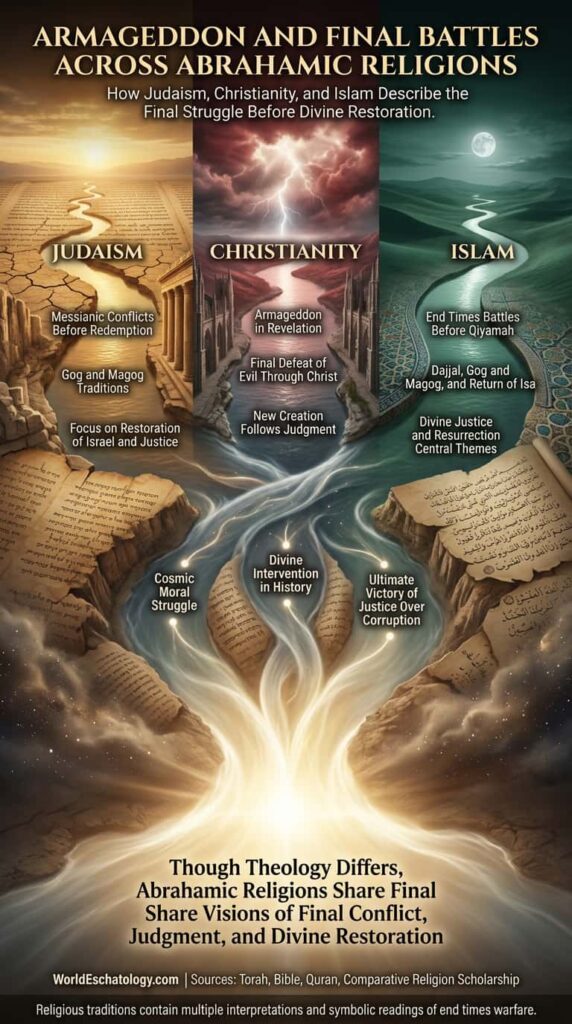
Armageddon in Islam: A Parallel Perspective
The battle of Armageddon has a parallel in Islamic eschatology that most people have never heard of, and it is striking how much overlap there is between the two traditions.
In Islamic end-times theology, there is an event called Al-Malhama al-Kubra, which translates to the Great Battle or the Grand Slaughter.
It is described in hadith literature as the greatest battle humanity will ever witness, a massive war involving the Muslim world and its enemies in the region of greater Syria, specifically in areas near a place called Dabiq and another called Al-A’maq.
Both the biblical and Islamic traditions describe a final, world-altering war in the general region of the Levant, the area covering modern-day Syria, Lebanon, Jordan, and Israel.
Both traditions describe tremendous destruction. And both traditions share something even more significant: the role of Prophet Isa, known in Christianity as Jesus Christ.
In Islam, Prophet Isa is expected to return from heaven before the end of times.
According to hadith, he will descend near a minaret in Damascus and will join the believers in the final confrontation against evil.
He will kill the Dajjal, the Islamic equivalent of the Antichrist, and bring justice to the earth.
This is almost identical in structure to the Christian account of the Second Coming. Both traditions are waiting for Jesus to return.
Both traditions believe his return will coincide with or closely follow the greatest battle in human history.
Both traditions believe his return brings an end to the rule of a great deceiver. The overlap is real and it is significant.
Is Armageddon Happening Soon? Modern Signs According to Scripture
This is the question that drives more search traffic to the topic of Armageddon than almost anything else. And it is a fair question.
When people look at the state of the world today, the conflict in the Middle East, the alignment of global powers, the instability in Israel and surrounding nations, and the spread of weapons capable of mass destruction, the question feels urgent.
Several biblical passages that scholars connect to the events leading up to Armageddon describe alignments of nations that look remarkably similar to today’s geopolitical reality.
One of the most discussed is Ezekiel 38 and 39, which prophesies a coalition of nations attacking Israel in the last days.
The nations described include Gog and Magog, widely identified by many scholars as Russia, along with Persia (Iran), Cush (parts of Africa), Put (Libya), and Gomer and Togarmah (identified by various scholars with Turkey and regions to the north).
The military alliance between Russia, Iran, and Turkey that has developed over the past decade is something scholars who study biblical prophecy find hard to ignore.
The re-establishment of the nation of Israel in 1948 is considered by many prophecy scholars to be the most significant prophetic event since the first century.
The Old Testament is full of prophecies about Israel being scattered among the nations and then regathered to their land in the last days before the Messiah comes.
The existence of the modern state of Israel is central to almost every end-times framework that takes the biblical text literally.
The normalization of Middle East tensions, the development of nuclear capabilities in multiple nations in the region, and the increasing involvement of major world powers like the United States, Russia, and China in Middle Eastern conflicts all add layers to the conversation.
But Scripture itself provides the most important balance.
Matthew 24:36 records Jesus saying that no one knows the day or the hour, not the angels in heaven, not even the Son, but only the Father.
This verse is a direct and clear instruction not to set dates, not to claim certainty, and not to let eschatology become a source of fear or speculation that replaces genuine faith and daily obedience. The right response to prophetic signs is not panic. It is readiness.
Armageddon in Culture: Movies, Books, and Misunderstandings
The 1998 blockbuster film Armageddon starring Bruce Willis has probably done more damage to the public understanding of this biblical event than anything else in modern history.
In the film, Armageddon refers to a massive asteroid heading toward earth that a team of oil drillers is sent to destroy.
It has nothing to do with the biblical battle. Nothing at all.
But the film cemented a popular idea: that Armageddon means any catastrophic, world-ending event. A nuclear war becomes Armageddon.
A pandemic becomes Armageddon. A climate crisis becomes Armageddon.
The word has been stretched so far from its original meaning that most people who use it have no idea it refers to a specific place in northern Israel described in the book of Revelation.
The cultural misuse of the word is not entirely harmless.
When the biblical meaning of Armageddon is drowned out by its pop culture version, people lose access to what is actually a deeply meaningful and carefully documented prophecy.
They dismiss it as mythology or entertainment rather than engaging with it as a serious theological and prophetic topic.
Understanding the real battle of Armageddon requires setting aside the movie version entirely and going back to the source.
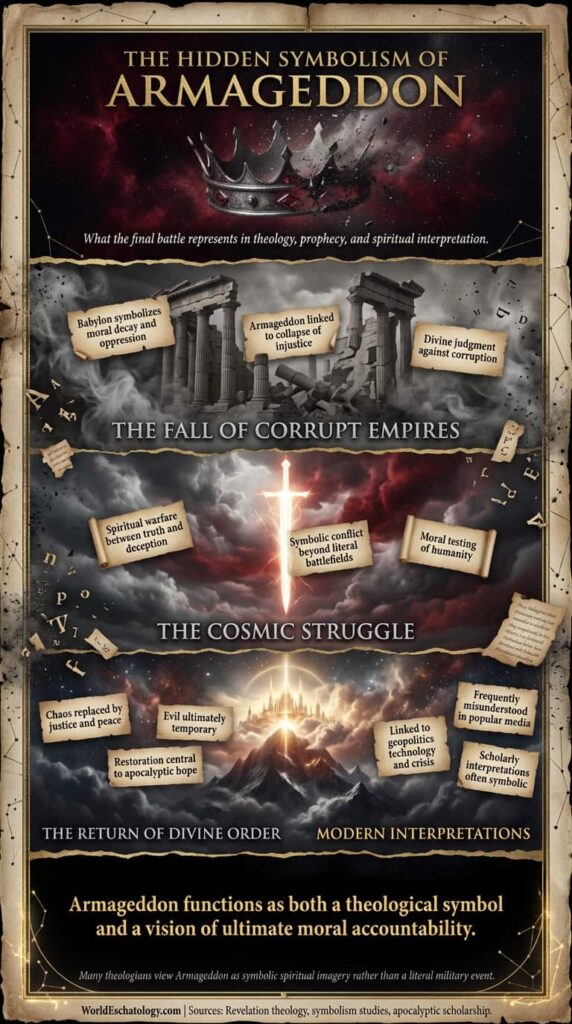
What Should a Believer Do with This Knowledge?
Every time Jesus or the biblical writers described end-times events, they followed the description with a practical call to action.
The purpose of prophecy in Scripture is never simply to inform. It is always to transform.
The Bible’s message about the battle of Armageddon is ultimately a message of hope, not fear.
It is the story of how history ends and who ends it. The final chapter does not belong to the Antichrist. It does not belong to any coalition of nations.
It does not belong to chaos. It belongs to Jesus Christ, returning on a white horse, ending evil, and beginning a reign of peace that lasts forever.
For the person who believes, that is the most comforting news imaginable. The story ends well. God wins. His people are on the winning side.
But Scripture also calls for readiness. Not the panicked, anxious kind of readiness that leads people to stockpile food and predict dates.
The readiness that Jesus consistently called for is the readiness of a life well-lived. Faith that is genuine. Repentance that is ongoing.
Love for God and for other people that shows in daily choices. A willingness to share the message of the gospel with urgency because time is real and eternity is coming.
The knowledge of Armageddon is not meant to paralyze you. It is meant to clarify your priorities.
If this world is heading toward a final reckoning, and the Bible says it is, then the things that matter are the things that last. Character. Faith. Relationship with God. The people you love.
Frequently Asked Questions About the Battle of Armageddon
Where is Armageddon in the Bible?
The word Armageddon appears only once in the Bible, in Revelation 16:16.
However, the event it refers to is connected to a much broader collection of passages across both the Old and New Testaments.
Key texts include Revelation 16:12 through 21, Revelation 19:11 through 21, Zechariah 14:1 through 5, Joel 3:1 through 2, and Ezekiel 38 through 39.
The single direct mention of Armageddon in Revelation 16:16 names it as the gathering place for the kings of the whole world, brought together by demonic spirits for the battle on the great day of God Almighty.
The fuller narrative of what happens at and after that gathering is described in the surrounding chapters of Revelation.
What happens at the Battle of Armageddon?
According to biblical prophecy, the battle of Armageddon begins with the nations of the world gathering their armies in the region of Megiddo in northern Israel during the period of the Great Tribulation.
These armies, aligned with or under the influence of the Antichrist, move toward Jerusalem.
The city faces attack. Then, at the point when all seems lost, Jesus Christ returns from heaven in what is called the Second Coming.
He is described in Revelation 19 as riding a white horse, with the armies of heaven behind him. The gathered forces are defeated by the word of his mouth.
The Antichrist and the False Prophet are thrown into the lake of fire. Satan is bound for one thousand years.
The battle ends in total divine victory and is immediately followed by the beginning of the Millennial Kingdom, the one-thousand-year reign of Christ on earth.
Is Armageddon the end of the world?
Not exactly. The battle of Armageddon is not the end of the world in the sense that everything ceases to exist.
It is more accurately described as the end of the world as we know it and the beginning of a new era.
After Armageddon, the Bible describes the Millennial Kingdom, a one-thousand-year period of Christ’s reign on a renewed earth.
After that, there is the final judgment, the Great White Throne judgment of Revelation 20, and then the creation of a new heaven and new earth described in Revelation 21.
Armageddon is a turning point, not a termination. The world does not end at Armageddon. It is transformed by what Armageddon makes possible.
Who wins the Battle of Armageddon?
Jesus Christ wins. The outcome is not in doubt and is not determined by military strength, numbers, or strategy.
According to Revelation 19, Christ defeats the gathered armies by the word of his mouth.
The Antichrist and the False Prophet are captured and thrown into the lake of fire. Satan is bound. The nations that came against Jerusalem are defeated.
This is not presented in Scripture as a close contest.
The entire point of the Armageddon narrative in Revelation is to show that no matter how powerful evil becomes, no matter how many nations align against God and his people, the return of Christ ends it completely and immediately. God wins. His people win.
What does Armageddon mean in Hebrew?
Armageddon comes from the Hebrew phrase Har Megiddo, meaning the Mountain of Megiddo or the Hill of Megiddo.
Har means mountain or hill, and Megiddo is the name of an ancient Canaanite and Israelite city located in the Jezreel Valley in northern Israel.
The site of ancient Megiddo is today an archaeological tel, a mound built up over thousands of years of continuous habitation, and it is a UNESCO World Heritage Site.
The valley surrounding it, the Jezreel Valley, is the broad flat plain that many scholars and military historians have identified as one of the most naturally suited locations in the world for large-scale ground warfare, which is why it appears in the Bible as the gathering place for the final battle.
When will Armageddon happen?
No one knows. Jesus himself said in Matthew 24:36 that no one knows the day or the hour of his return, not the angels, not even the Son, but only the Father.
Despite this clear instruction, many people throughout history have tried to predict dates for the end-times events including Armageddon, and every single one of those predictions has been wrong.
What the Bible does provide is signs to watch for, broad patterns that suggest the approach of the end rather than a specific timeline.
The re-establishment of Israel in 1948, the alignment of nations described in Ezekiel 38, the increasing global reach of technology enabling events like every eye seeing Christ’s return, these are things that many prophecy scholars point to as signs that the stage is being set.
But no date can or should be set. The appropriate response to not knowing when is to be ready always.
What is the difference between Armageddon and the Tribulation?
The Tribulation and Armageddon are related but different.
The Tribulation refers to the entire seven-year period of divine judgment and global catastrophe that the Bible describes coming before the return of Christ.
It includes a wide range of events: the rise of the Antichrist, the seal judgments, the trumpet judgments, the bowl judgments, the persecution of believers, cosmic disturbances, and more.
Armageddon specifically refers to the final military gathering that occurs near the very end of the Tribulation period.
It is the climax of the Tribulation, not the whole thing. Think of the Tribulation as the seven-year period and Armageddon as the final battle that ends it and triggers the return of Christ.
Conclusion
The battle of Armageddon is one of the most misunderstood events in all of human knowledge. People have turned it into a movie.
They have turned it into a metaphor. They have used it to describe every kind of disaster from a stock market crash to a global pandemic.
In doing all of that, they have missed the actual thing.
The actual thing is this: the Bible describes a future moment when the nations of the world, led by forces opposed to God, gather in northern Israel for what they intend to be a decisive conflict.
They believe they are going to win. They are wrong. Jesus Christ returns, the battle ends before it truly begins, evil is defeated, and a new era of peace and justice begins under his reign.
Armageddon is not the end of hope. It is the beginning of everything that hope has always been pointing toward.
The conflict ends. The deceiver is bound. The King takes his throne. The world is made right.
Whatever is happening in the headlines today, whatever tensions are rising, whatever alliances are forming, the end of the story has already been written. And for those who trust in the God of that story, it is a very good ending.