
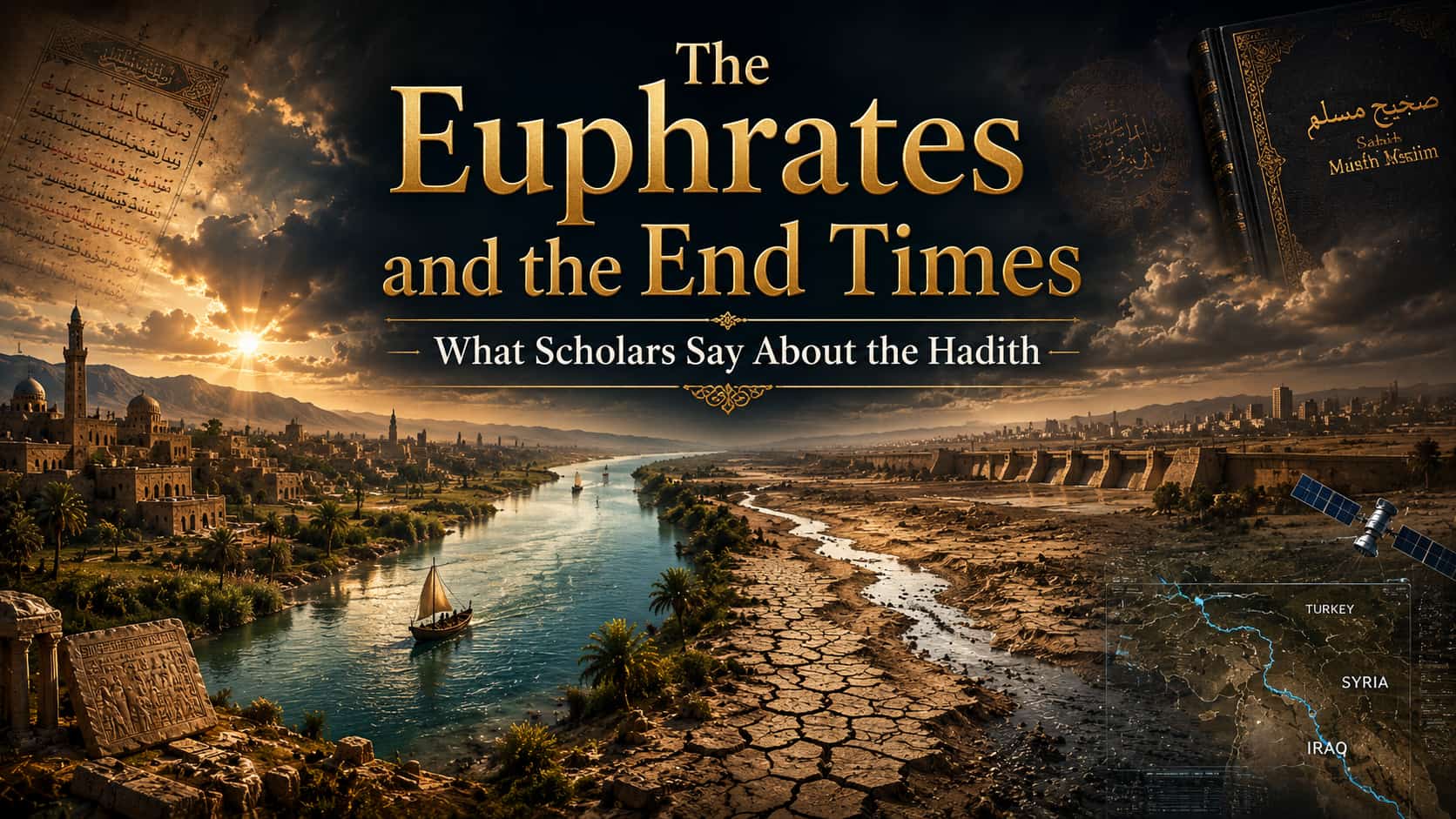
A River the Prophet Warned About 1,400 Years Ago
In 2009, the Iraqi government issued an urgent warning: the Euphrates River, one of the oldest and most historically significant waterways in the world, was drying up.
Ministers reported that water levels had dropped dramatically and that entire stretches of the river that had supported farming communities for thousands of years were running dry.
By 2021, satellite imagery confirmed what local farmers had been saying for years: large sections of the Euphrates and its sister river the Tigris had shrunk to a fraction of their former size.
A United Nations report warned that both rivers could effectively cease to exist as functional waterways by 2040 if current trends continued.
To millions of Muslims around the world, this news carried an unmistakable resonance.
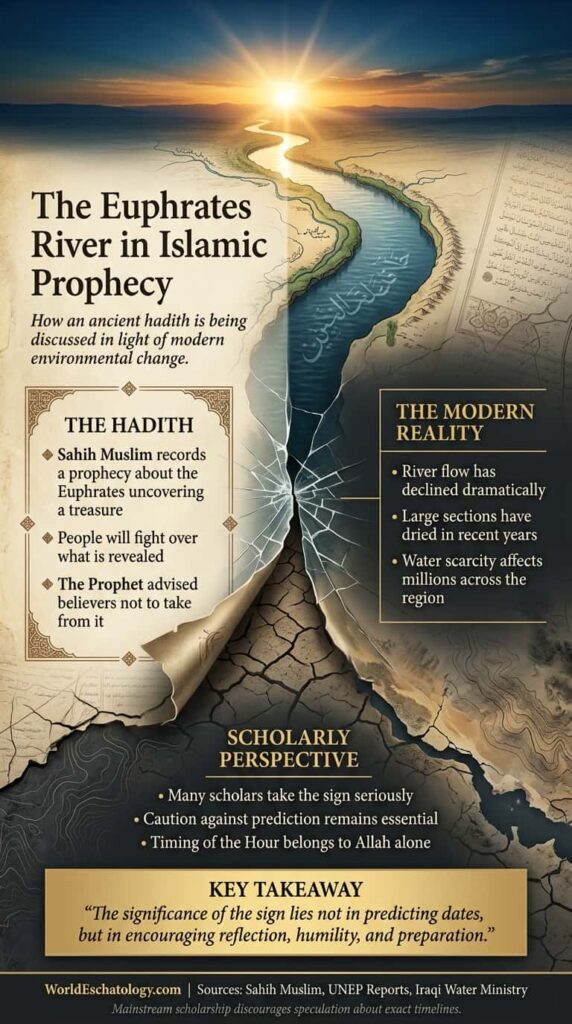
Fourteen centuries ago, the Prophet Muhammad is reported to have said that the Euphrates would dry up and reveal a treasure, and that the nations of the world would fight over it with devastating loss of life.
The hadith is found in Sahih Muslim, the second most authoritative hadith collection in Sunni Islam, and it has attracted enormous attention in recent years as the Euphrates river drying up has shifted from ancient prophecy to observable reality.
This article examines that hadith and the broader Islamic eschatological tradition surrounding the Euphrates with the care and honesty it deserves.
It draws on the primary sources, explains the hadith in its full context, presents the range of scholarly interpretation, explores what the contemporary environmental reality means for how Muslims understand this sign, and offers a framework for approaching the question with knowledge rather than sensationalism.
What Islamic Tradition Teaches About the Euphrates and the End Times
The Euphrates in Islamic Sacred Geography
Before turning to the specific eschatological hadith, it is worth understanding the significance of the Euphrates in the broader Islamic tradition.
The river runs through modern Turkey, Syria, and Iraq, passing through lands that were among the earliest and most important centers of Islamic civilization.
The great city of Basra, one of the first major cities founded after the Islamic conquests of the seventh century, sits near the confluence of the Euphrates and the Tigris.
Baghdad, the capital of the Abbasid caliphate and for centuries the intellectual capital of the Islamic world, was built on the banks of the Tigris but drew from the same river system.
The region the classical Arab geographers called the land between the two rivers, Iraq in Arabic, was understood as one of the heartlands of the faith.
The Euphrates also appears in pre-Islamic religious tradition in ways that would have been known to early Muslim scholars.
It is one of the four rivers described in the Genesis account of Eden, and it runs through the landscape of virtually every major civilization of the ancient Near East, from Babylon and Assyria to the Seleucid and Parthian empires.
When the Prophet Muhammad mentioned the Euphrates in his teachings, he was speaking about a river that carried enormous historical and sacred weight in the consciousness of the ancient world.
That weight gives the eschatological hadith about the Euphrates a resonance that a prophecy about a lesser river simply would not have.
The Primary Hadith: The Text and Its Context
The central hadith about the Euphrates and the end times is narrated by Abu Hurairah and recorded in Sahih Muslim.
The narration reads, in translation: the Hour will not come until the Euphrates uncovers a mountain of gold, and people will fight over it.
For every hundred who fight, ninety-nine will be killed, and every man among them will say perhaps I will be the one who survives.
A parallel narration, also in Sahih Muslim, is transmitted on the authority of Abu Hurairah and states: the Euphrates will soon uncover a treasure of gold.
Whoever is present at that time should not take anything from it.
A third narration attributed to Ubayy ibn Ka’b adds a further detail, describing the treasure as a mountain of gold.
The consistency across multiple transmission chains of the core elements, the Euphrates, the drying or uncovering, the treasure, and the catastrophic fighting, is part of why mainstream Sunni scholarship treats this hadith as reliably established.
It is important to be precise about what the hadith says and what it does not say.
The text says the Euphrates will uncover a mountain of gold. It does not say the river will dry up completely and permanently.
It does not specify when this will happen relative to other eschatological events, beyond the general framework that it is one of the signs of the approaching Hour.
And it does not specify the exact nature of the treasure, whether it is literally gold, something that functions like gold in terms of value, or something to be understood metaphorically.
The Euphrates Hadith in the Eschatological Sequence
Islamic eschatology places the signs of the approaching Hour in a broad sequence, distinguishing between minor signs that have been unfolding over a long period of history and ten major signs that will occur in rapid succession near the Final Hour itself.
The Euphrates hadith is classified by classical scholars as one of the minor signs, not among the ten major signs that include the emergence of the Imam Mahdi, the appearance of the Dajjal, the descent of the Prophet Isa, and the rising of the sun from the west.
This classification matters for how the hadith is interpreted. Minor signs are, by their nature, events or conditions that unfold across history and intensify over time.
Some minor signs have already been fulfilled, such as the death of the Prophet himself or the conquest of Jerusalem.
Others are described as conditions that will grow more pronounced as the Hour approaches.
The drying of the Euphrates, in the classical scholarly framework, belongs in this second category: it is a sign that is moving toward fulfillment rather than one that constitutes a sudden and unmistakable event.
The Prophet’s counsel in one of the narrations, that whoever is present at the time of the uncovering should not take anything from the treasure, has attracted significant scholarly attention.
This advice suggests that the event is a test rather than an opportunity, and that the correct response for a believer who witnesses it is restraint rather than participation in the scramble for the treasure.
The catastrophic killing described in the hadith is the consequence of ignoring this counsel and competing for worldly gain over something that the Prophet explicitly warned against.
Classical scholars understand this as a lesson about the nature of material greed and its destructive consequences at the individual and societal level.
Key Texts and Sources: The Hadith Literature on the Euphrates
Sahih Muslim and the Authentication of the Hadith
The inclusion of the Euphrates hadith in Sahih Muslim is the single most important factor in its scholarly standing.
Sahih Muslim, compiled by the ninth-century hadith scholar Muslim ibn al-Hajjaj of Nishapur, is considered in Sunni Islamic scholarship to be the second most rigorously authenticated hadith collection after Sahih Bukhari.
Muslim ibn al-Hajjaj applied extremely demanding standards of chain verification, requiring that every narrator in a chain have demonstrated personal contact with the narrator before them, not merely overlap in lifetimes.
The fact that the Euphrates hadith meets these standards in multiple transmission chains gives it a level of authentication that places it beyond reasonable scholarly doubt in the mainstream Sunni framework.
The hadith does not appear in Sahih Bukhari, the most authoritative collection in Sunni scholarship.
Scholars have noted that Bukhari’s collection was highly selective by design, and absence from it does not weaken a narration that is well-authenticated in Muslim and other collections.
The combination of appearance in Sahih Muslim with multiple supporting transmission chains gives the Euphrates hadith what classical scholars call a high degree of reliability.
Supporting Narrations in Other Collections
Beyond Sahih Muslim, variants of the Euphrates hadith appear in Sunan Abu Dawud, Jami at-Tirmidhi, and the Musnad of Imam Ahmad ibn Hanbal.
The consistency of the core narrative across these independent collections is one of the arguments classical scholars use for the doctrine of tawatur, or mass transmission, of this particular sign.
While no single additional chain reaches the standard of the Sahih Muslim narration on its own, their collective weight reinforces the central tradition.
Nu’aym ibn Hammad’s Kitab al-Fitan, an early ninth-century compilation of tribulation traditions, also contains material related to the Euphrates and the end times.
Scholars note that this collection contains traditions of widely varying reliability, and material from it requires individual scrutiny.
But some of what it preserves about the Euphrates fits within the framework established by the Sahih Muslim narration and is cited by later scholars as supporting context.
Classical Commentaries on the Euphrates Hadith
The most important classical commentary on the Euphrates hadith comes from Ibn Hajar al-Asqalani’s Fath al-Bari, his monumental commentary on Sahih Bukhari.
Although the Euphrates hadith is not in Bukhari, Ibn Hajar discusses related material and provides important context for how the treasure should be understood.
Al-Nawawi’s commentary on Sahih Muslim addresses the hadith directly and provides the standard classical analysis of its authenticity and meaning.
Both scholars affirm the hadith’s reliability and treat the mountain of gold as referring to something of immense material value that will be exposed when the river’s waters recede.
Ibn Kathir’s Al-Bidaya wa al-Nihaya devotes attention to the Euphrates among the signs of the Hour and synthesizes the available hadith material with historical context.
Al-Qurtubi’s Al-Tadhkira similarly treats the sign as established and genuine.
The near-unanimity of the major classical scholars on the authenticity of this tradition is itself a significant data point for how contemporary Muslims and scholars should approach it.
Different Scholarly Views: How Scholars Interpret the Euphrates Hadith
The Literal Treasure Interpretation
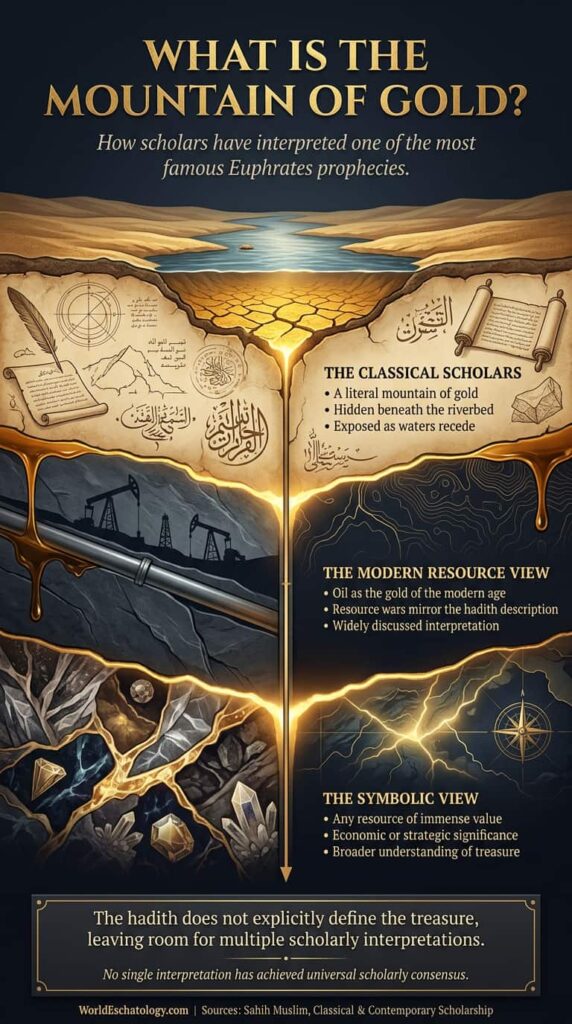
The dominant interpretation in both classical and contemporary Sunni scholarship is that the hadith describes a literal physical event: the waters of the Euphrates will recede to the point where something of enormous material value, described as a mountain of gold, is exposed.
The fighting over this treasure will be so intense that ninety-nine out of every hundred combatants will die.
Contemporary scholars who hold this interpretation are divided on what the treasure might be.
Some maintain that it is literally a deposit of gold or precious metals beneath the riverbed, pointing to the fact that the Mesopotamian region sits above some of the richest oil fields in the world and that the geology of the region is complex enough to harbor deposits of minerals not currently mapped.
Others suggest that the treasure might be the oil itself, given that oil functions in the modern world as the precise equivalent of gold in earlier eras:
it is the resource over which nations fight catastrophic wars, it determines the wealth and power of states, and it lies beneath the earth of exactly the region the hadith describes.
The oil interpretation is particularly compelling to scholars who think carefully about the function of the metaphor.
The Euphrates river drying up and revealing something of immense value beneath is an image that maps remarkably well onto what has actually happened in Iraq, where the decline of the river system has exposed more of the underlying geology, and where the oil reserves that have fueled regional and global conflict for over a century lie beneath the same land the hadith is describing.
Scholars including Sheikh Imran Hosein have argued for this interpretation at length, noting that the catastrophic wars fought over Iraq’s oil resources in the late twentieth and early twenty-first centuries fit the hadith’s description of devastating conflict over a revealed treasure.
The Cautious Literal Interpretation
A number of mainstream Sunni scholars, while accepting the hadith’s authenticity and its literal import, counsel caution about connecting it too quickly to current events.
Their position is that the Euphrates river drying up is a genuine sign of the approaching Hour, that it may well be in the process of fulfillment given current environmental conditions, but that the specific event the hadith describes, the uncovering of a mountain of gold and the catastrophic fighting that follows, has not yet occurred in the form the text describes.
These scholars emphasize that the hadith describes a specific dramatic event, not simply a gradual environmental trend.
The uncovering of a mountain of gold is an extraordinary occurrence that, when it happens, will be unmistakable.
The fighting described, in which ninety-nine out of every hundred combatants die, is on a scale that has not yet been witnessed specifically over a Euphrates treasure.
The fact that the Euphrates is currently drying up may represent the environmental conditions being prepared for this future event, but the event itself, in this reading, remains ahead of us.
This cautious position reflects a broader methodological commitment in traditional Islamic scholarship to resisting the temptation to match current events too quickly to prophetic descriptions, a temptation that has produced confident but mistaken eschatological predictions in every previous era of Muslim history.
Scholarly Discussion of What the Treasure Means
One of the most interesting areas of scholarly discussion involves the precise meaning of the Arabic word used for the treasure in the hadith.
The narrations use the term kanz, which can mean a buried treasure or hoard, and dhahab, meaning gold.
Classical scholars largely took these words at face value as describing a literal deposit of gold. Contemporary scholars have reopened the question in light of modern geography and economics.
Sheikh Yusuf al-Qaradawi and other contemporary scholars have noted that the description of a mountain of gold, or jabal min dhahab, could reasonably be understood as a metaphorical description of something of gold-like value rather than a literal mountain of the metal.
In the idiom of the ancient world, calling something gold was a way of saying it was the most precious commodity imaginable.
Whether the Prophet’s description is understood as literal gold, as oil, as mineral deposits, or as something else, the core meaning of the hadith is consistent: the Euphrates will expose a treasure of enormous value that will become the occasion for devastating human conflict.
Shia Scholarly Perspectives
Shia Islamic scholarship engages with the Euphrates hadith within a somewhat different eschatological framework.
For Twelver Shia Muslims, the central eschatological event is the return of the Twelfth Imam, the Imam Mahdi, and all other signs are understood in relation to that return.
The Euphrates sign is acknowledged in Shia eschatological literature, and some Shia scholars place it among the signs that will precede or accompany the Mahdi’s return.
The Euphrates has particular significance in Shia sacred history because of its connection to the tragedy of Karbala.
The Battle of Karbala in 680 CE, in which the Imam Husayn ibn Ali and his companions were killed while being denied access to the Euphrates water, is the central event of Shia sacred history and remains the most important point of Shia religious remembrance.
The river therefore carries an emotional and spiritual weight in the Shia tradition that is distinct from its eschatological significance.
Some Shia scholars connect the eschatological promise about the Euphrates to a broader theme of divine justice: the river that was withheld from Husayn will ultimately be the site of a divinely determined reckoning.
Why This Matters Today: The Euphrates River Drying Up and What Scholars Say
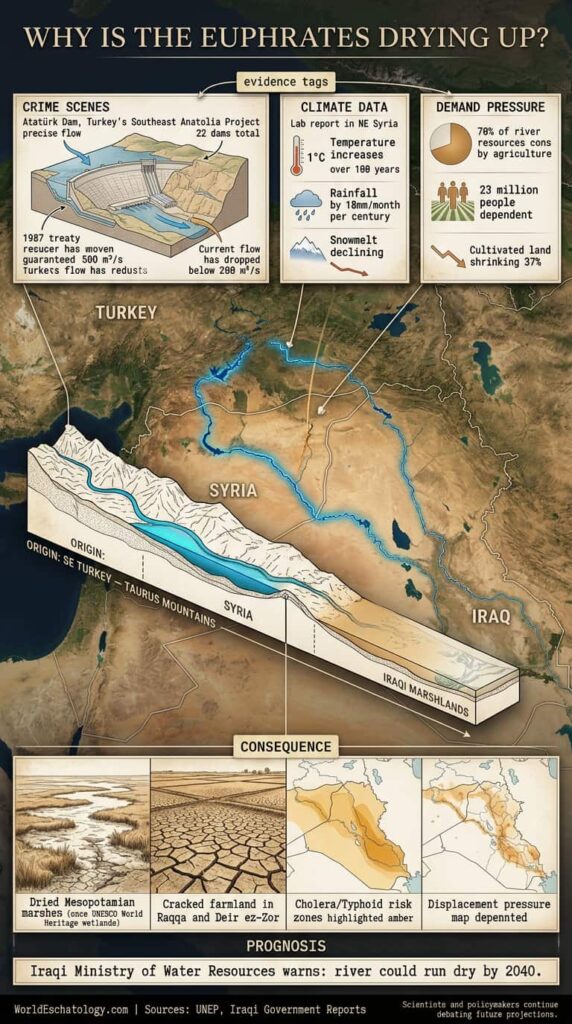
The Environmental Reality: What Is Actually Happening to the Euphrates
The environmental situation of the Euphrates is not a matter of religious interpretation but of documented scientific fact, and it is serious.
The river originates in the mountains of eastern Turkey and flows through Syria and Iraq before emptying into the Persian Gulf.
Over the past four decades, its flow has been dramatically reduced by a combination of factors.
The construction of major dams in Turkey, most significantly the Ataturk Dam completed in 1990 and the series of dams in the Southeast Anatolia Project, has reduced the amount of water reaching Syria and Iraq by a very large percentage.
Climate change has reduced rainfall and snowmelt in the river’s source regions. Increased agricultural and industrial water use throughout the basin has drawn further on diminishing supplies.
Iraqi government reports have documented the severity of the situation with increasing urgency.
The Mosul Dam, Iraq’s largest, has seen reservoir levels drop to critically low levels.
The marshlands of southern Iraq, fed by the Euphrates and the Tigris and recognized by UNESCO as a World Heritage Site, have dried up in large sections. Iraqi farmers in provinces along the river have abandoned their land in growing numbers as irrigation water has become unavailable.
The United Nations Environment Programme has issued multiple warnings about the trajectory of the Euphrates basin and the regional instability that water scarcity will increasingly generate.
For Muslim scholars engaging with this situation through an eschatological lens, the Euphrates river drying up is not a future possibility but a present observable reality.
The question is not whether the river is declining but whether its current decline represents the beginning of the fulfillment of the prophetic sign, a precondition for a future specific event, or something that needs to be understood differently from earlier scholarly expectations.
Geopolitical Conflict Over Euphrates Water
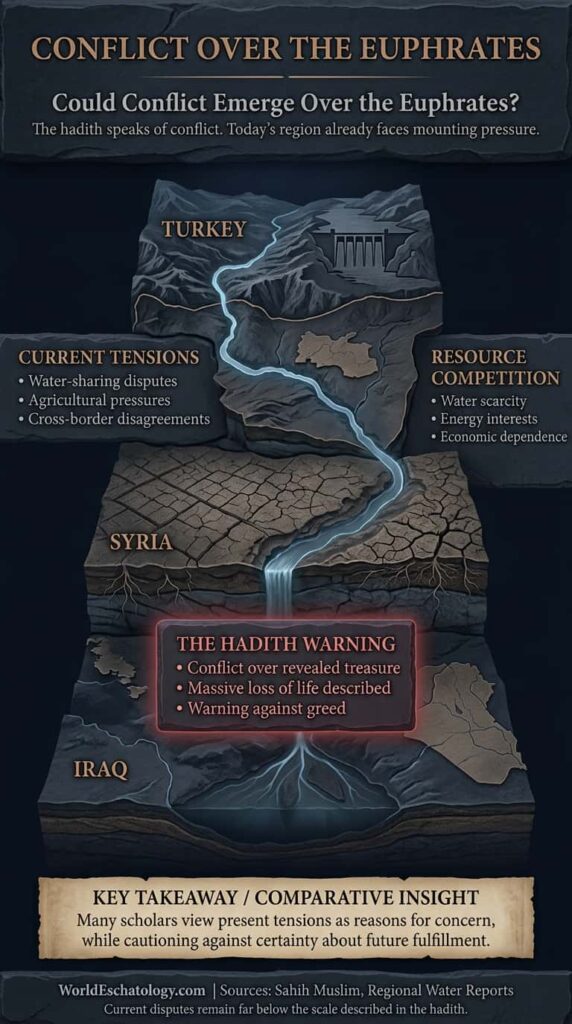
The eschatological hadith predicts devastating conflict over what the Euphrates reveals.
The current political reality around the river already shows the signs of precisely this kind of conflict, though not yet at the scale the hadith describes.
Turkey, Syria, and Iraq have been in dispute over Euphrates water rights for decades.
Turkey’s dam construction programme has been a source of acute diplomatic tension with both Syria and Iraq, who depend on the river’s flow for their agriculture and drinking water.
Iraq has accused Turkey of reducing its water flow to levels that constitute an existential threat to Iraqi agriculture and to the Iraqi population that depends on it.
The broader Middle East water crisis, of which the Euphrates situation is a central component, is widely recognized by geopolitical analysts as one of the most significant sources of potential future conflict in the region.
A 2019 report by the United States intelligence community identified water scarcity in the Middle East as a major driver of instability and potential armed conflict in the coming decades.
When Islamic scholars note that the hadith describes catastrophic fighting over a treasure revealed by the Euphrates, and then point to the escalating geopolitical tensions over the river’s water and resources, they are drawing a connection that is at minimum worth taking seriously.
How Contemporary Muslims Should Understand This Sign
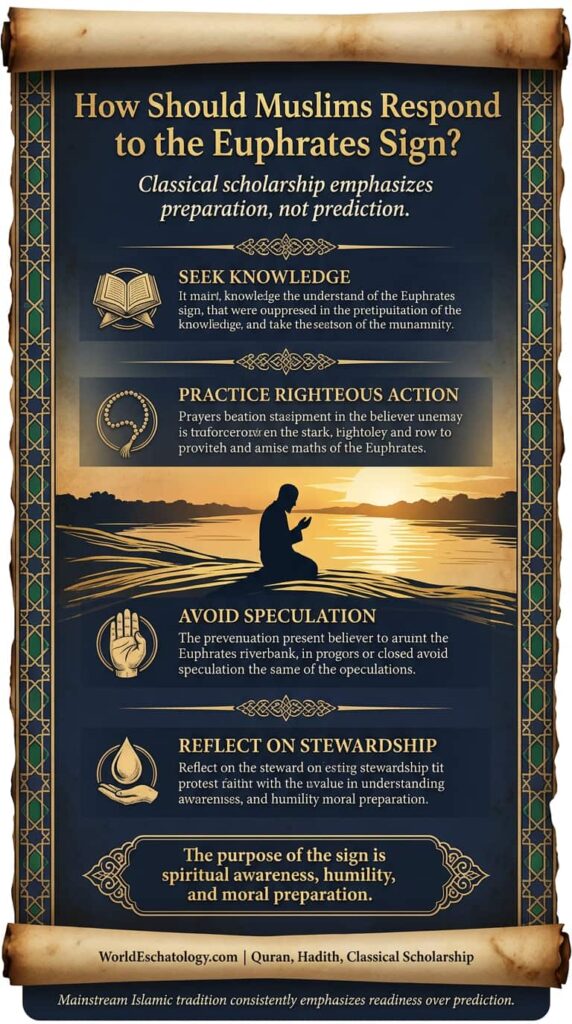
Mainstream Islamic scholarship is consistent in its guidance about how believers should relate to eschatological signs that appear to be unfolding.
The purpose of knowing the signs is not to become obsessed with calculation or prediction, and certainly not to take political or violent action based on eschatological conviction.
The Prophet’s own counsel in the hadith, that whoever is present when the treasure is uncovered should not take from it, is itself a model for the appropriate response: awareness without greed, knowledge without agitation.
The drying of the Euphrates, taken seriously as a possible fulfillment of a prophetic sign, should prompt in a Muslim believer a heightened sense of the nearness of the divine reckoning, a deepened commitment to righteous action in the time available, and a sober awareness of the consequences of human greed and injustice.
It should not prompt panic, financial or political speculation, or the kind of confident end times prediction that the tradition itself repeatedly warns against.
The environmental dimension of the Euphrates situation also raises a challenge that contemporary scholars are beginning to engage with directly.
If human action, specifically the construction of dams, industrial water use, and climate-affecting carbon emissions, is contributing to the drying of the Euphrates, then the fulfillment of the prophetic sign is happening in part through human choices.
This raises genuine questions about human responsibility within divine providence that thoughtful scholars are working through, and it connects Islamic eschatological awareness to contemporary discussions about environmental stewardship in ways that earlier generations of scholars did not need to address.
Frequently Asked Questions: The Euphrates River Drying Up and Islamic Prophecy
What does the hadith say about the Euphrates drying up?
The primary hadith about the Euphrates is narrated in Sahih Muslim on the authority of Abu Hurairah.
It states that the Hour will not come until the Euphrates uncovers a mountain of gold, and that people will fight over it with devastating loss of life, with ninety-nine out of every hundred fighters being killed.
A companion narration advises that whoever is present at the time should not take anything from the treasure.
The hadith does not specify a precise date or describe the Euphrates as drying up permanently and completely.
It describes the river uncovering something of enormous value beneath it, most naturally understood as the river’s waters receding to expose what lies beneath the riverbed.
The hadith is classified as one of the minor signs of the approaching Hour and is considered reliably authenticated by the standards of Sunni hadith scholarship.
Is the Euphrates actually drying up today?
Yes, the Euphrates river is experiencing dramatic and documented water level declines.
The river’s flow into Iraq has been reduced by more than half compared to its historical levels, primarily due to the construction of major dams in Turkey as part of the Southeast Anatolia Project, combined with the effects of climate change reducing rainfall and snowmelt in the river’s source regions, and increasing agricultural and industrial water demand throughout the basin.
Iraqi government reports, United Nations environmental assessments, and satellite imagery all confirm the severity of the decline.
Large sections of the river and its tributaries have dried up entirely in recent years. Some projections suggest the river could effectively cease to function as a major waterway by 2040 if current trends continue.
This environmental reality is the basis for the widespread contemporary Muslim discussion connecting current events to the prophetic hadith.
What is the mountain of gold the hadith describes?
Classical scholars generally interpreted the mountain of gold literally, as a physical deposit of the precious metal beneath the Euphrates riverbed.
Contemporary scholars have proposed several alternative understandings.
The most widely discussed is that the mountain of gold represents the oil reserves beneath the Mesopotamian region, given that oil functions in the modern economy precisely as gold did in earlier eras: it is the most valuable resource, it determines the power of nations, and wars are fought over it.
The catastrophic conflicts fought over Iraqi oil resources, in a region through which the Euphrates flows, fit this interpretation closely.
Other scholars suggest that actual mineral deposits, including gold, may lie beneath the river’s current bed and will be exposed as water levels continue to decline.
Still others understand the mountain of gold metaphorically as any resource of extraordinary value that the river’s recession will expose.
All of these interpretations are held by serious scholars, and the hadith does not provide sufficient detail to settle the question definitively.
What does Islamic eschatology say about conflict over the Euphrates?
The Euphrates hadith describes the most extreme version of human conflict: a situation in which ninety-nine out of every hundred combatants are killed while fighting over the treasure the river reveals.
The Prophet’s framing of this prediction is sobering: each fighter will hope that he will be among the one percent who survives, but the catastrophic death toll means that hope is almost always disappointed.
Classical scholars understand this as a description of the consequences of human greed when it overcomes the restraint that faith prescribes.
The Prophet’s counsel not to take from the treasure is understood as the religiously correct response, which the vast majority of those present will ignore to their destruction.
Contemporary scholars who connect this to current and projected conflicts over water and resource rights in the Euphrates basin note that the geopolitical trajectory of the region already shows the early stages of precisely this kind of conflict, though not yet at the scale the hadith describes.
Is the drying of the Euphrates a sign that the Day of Judgment is near?
This question requires a careful and honest answer. The Euphrates hadith is a genuine and well-authenticated sign of the approaching Hour, classified as one of the minor signs in the Islamic eschatological framework.
The current documented decline of the Euphrates is consistent with what the hadith describes and is taken seriously by many contemporary scholars as a possible beginning of its fulfillment.
However, mainstream Islamic scholarship consistently cautions against claiming that any specific current event proves the Day of Judgment is imminent.
The tradition has a long history of sincere Muslims believing, with apparently good evidence, that the end was near, and being proven wrong.
The correct scholarly position is that the Euphrates situation represents a sign worth taking seriously, that it should increase a believer’s awareness of the nearness of divine accountability, and that it should motivate heightened commitment to righteous action.
It does not, by itself or with other current events, constitute proof that the Final Hour is immediately at hand. Knowledge of the timing of the Hour belongs to Allah alone, as stated explicitly in the Quran in multiple places.
What do Sunni and Shia scholars say differently about the Euphrates hadith?
Both Sunni and Shia scholarship acknowledge the Euphrates hadith and treat it as a genuine eschatological sign.
The primary differences are in emphasis and in how the sign is located within each tradition’s broader eschatological framework.
Sunni scholarship places the Euphrates sign among the minor signs that precede the major sequence beginning with the Imam Mahdi’s emergence.
Shia scholarship places it within the framework of signs preceding the return of the Hidden Imam, the Twelfth Imam Muhammad ibn Hasan al-Askari.
Additionally, the Euphrates carries unique sacred significance in Shia tradition because of its role in the events of Karbala, where the Imam Husayn was denied access to the river’s water before his martyrdom in 680 CE.
Some Shia scholars connect the eschatological promise about the Euphrates to the broader theme of divine justice for that historic tragedy.
Both traditions agree on the core content of the hadith and on the principle that believers should prepare through righteous action rather than through speculation or calculation about timing.
Conclusion:
The Euphrates river drying up is one of the most striking points of connection between ancient Islamic prophecy and observable contemporary reality.
The hadith in Sahih Muslim describing the river uncovering a treasure of gold and the catastrophic conflict that follows is reliably authenticated, widely recognized by classical and contemporary scholars, and addresses a river whose documented decline has become one of the most serious environmental crises in the Middle East.
What the tradition itself insists on, however, is that signs are given not to enable prediction but to promote preparation.
The Prophet’s own counsel in the hadith is not to prepare for war, not to calculate timelines, and not to speculate about when the treasure will appear.
It is to refrain from taking part in the destructive scramble when it comes.
That counsel is an expression of the broader Islamic principle that eschatological awareness should produce in a believer not anxiety or aggression but a deepened commitment to what is right, a clearer sense of what truly matters, and a more honest reckoning with the fact that divine judgment is real and near.
The Euphrates carries the weight of thousands of years of human civilization, of sacred prophecy, and of present-day crisis.
For Muslims who understand the tradition well, that weight is not a cause for panic but for reflection: about the consequences of human greed, about the responsibilities of stewardship over the natural world, and about the kind of person one intends to be when signs that were foretold so long ago are unfolding in plain sight.
Related Articles on WorldEschatology.com
- Imam Mahdi: Who He Is, His Signs, and What Islam Teaches
- The Dajjal in Islam: What the Hadith Actually Say
- The Minor and Major Signs of the Day of Judgment: A Complete Guide
- Gog and Magog (Yajuj and Majuj): A Complete Islamic Overview
- Islamic vs Christian vs Jewish End Times: A Comparative Study
Sources
Sahih Muslim (Kitab al-Fitan wa Ashraat al-Saa’ah); Sunan Abu Dawud; Jami at-Tirmidhi; Musnad Ahmad ibn Hanbal; Nu’aym ibn Hammad, Kitab al-Fitan; Ibn Hajar al-Asqalani, Fath al-Bari; Al-Nawawi, Sharh Sahih Muslim; Ibn Kathir, Al-Bidaya wa al-Nihaya; Al-Qurtubi, Al-Tadhkira; United Nations Environment Programme, Euphrates-Tigris River Basin Reports (2018-2022); Iraqi Ministry of Water Resources, Annual Reports; Sheikh Imran Hosein, The Euphrates in Islamic Eschatology; US National Intelligence Council, Global Water Security Assessment (2019).