
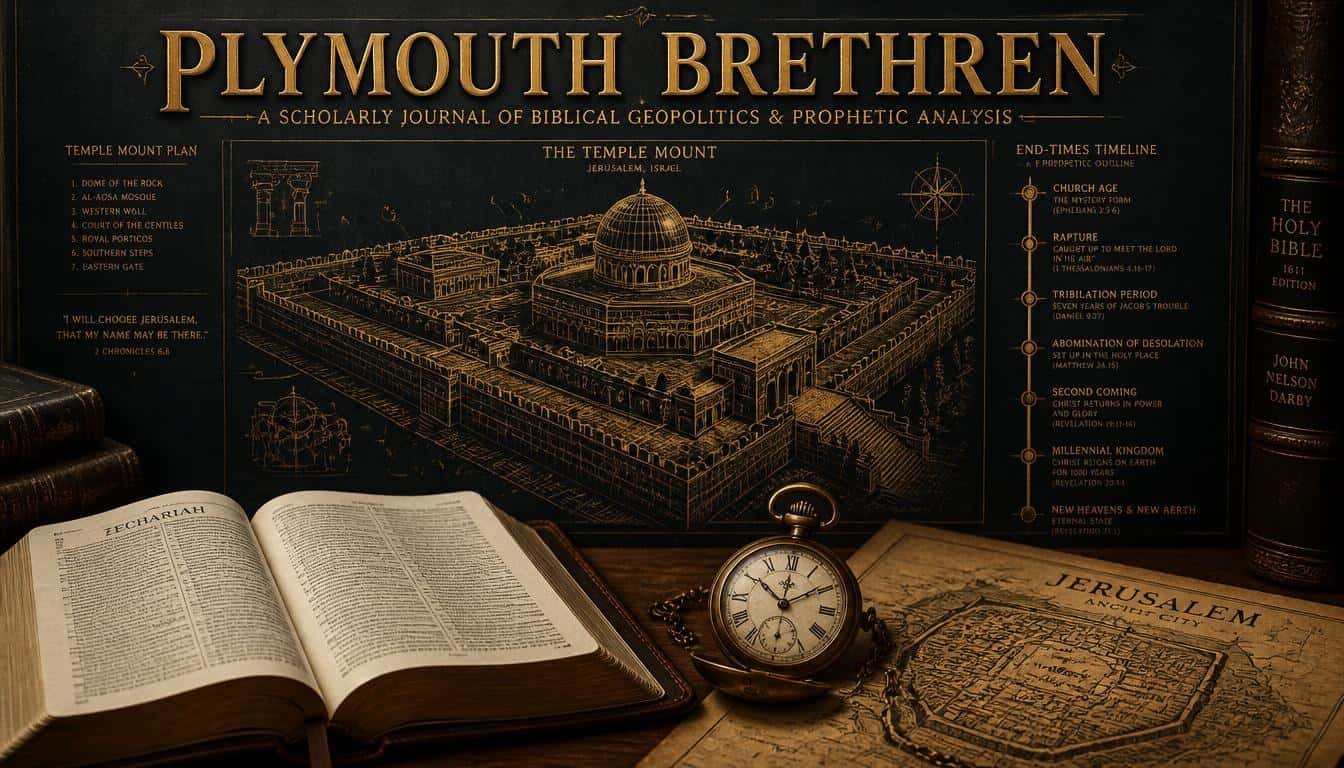
The theological system that gave the world the Rapture, the Antichrist as a singular end-times world dictator, the seven-year Tribulation, the rebuilt Third Temple in Jerusalem as an eschatological countdown trigger, and the neat sequential prophetic timetable that ties them all together was developed in the 1830s by a small, theologically radical, deeply earnest group of believers who met in rented rooms in Dublin and Plymouth.
They called themselves the Brethren. The man who gave their movement its prophetic architecture was a restless, brilliant, and utterly driven Anglo-Irish clergyman named John Nelson John Darby.
The story of how the Plymouth Brethren engineered a theological framework that now influences global geopolitics is one of the most consequential and least-understood chapters in the history of Christian thought.
It is the story of how a marginal sect’s literal reading of a handful of biblical texts became the dominant eschatological imagination of the world’s largest religion.
The Origins of Apocalypse: John Nelson Darby and the Brethren Movement
The World That Produced the Brethren
The early nineteenth century was a period of profound religious restlessness across the English-speaking Protestant world.
The Industrial Revolution was reshaping social life at a pace that felt genuinely disorienting.
The French Revolution had demonstrated, within living memory, that the established order could be overturned with terrifying speed.
The established churches of Britain and Ireland, the Church of England and the Church of Ireland, were widely perceived by serious believers as corrupt, bureaucratic, and spiritually dead.
Their clergy were often political appointments; their congregations were often indifferent; their formal liturgies felt to many earnest Christians like empty performance rather than living encounter with the divine.
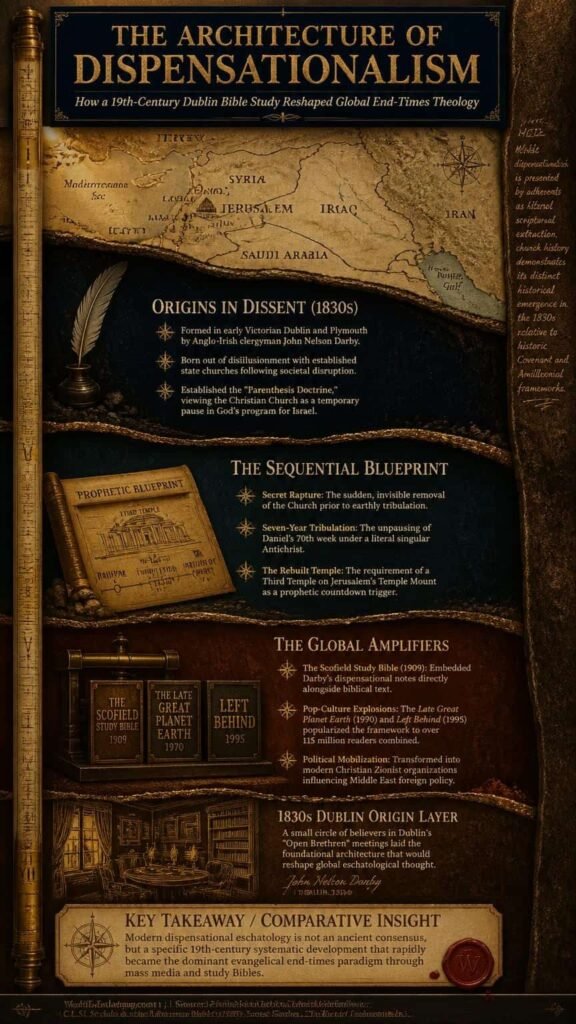
It was in this atmosphere of institutional disillusionment that small groups of believers in Dublin, Plymouth, and Bristol began gathering in homes and hired rooms for prayer, Bible study, and what they described as a simple breaking of bread, a communion service stripped of all clerical hierarchy and ecclesiastical formality.
They had no ordained ministers, no formal creeds beyond scripture itself, and no institutional structure.
They called themselves simply the Brethren, or the saints, and they understood their informal assemblies as a recovery of the primitive Christianity of the first-century church.
John Nelson Darby was born in 1800 into a prominent Anglo-Irish family with significant landholdings in Ireland.
He was trained as a lawyer before taking holy orders in the Church of Ireland, and he brought to his theological work the same methodical, argument-building instinct that characterized his legal training.
He was ordained as a curate in County Wicklow in the mid-1820s, where he worked with an intensity bordering on the ascetic, reportedly walking miles each day through rural Ireland to reach dispersed Catholic parishioners he hoped to bring into the Protestant fold.
A riding accident in 1827 confined him to bed for months and gave him the sustained time for biblical study that would prove transformative.
By the time he recovered, he had begun to develop the theological framework that would eventually reach further than any lawyer’s brief or any bishop’s pastoral letter.
The Paradigm Shift: Darby’s Dispensationalism
What John Darby developed during those months of convalescence and the years of intensive study that followed was a comprehensive system of biblical interpretation unlike anything that had existed in quite that form before.
He called his method a recognition of the different dispensations, or epochs, of God’s dealings with humanity.
History, in John Darby’s reading, was divided into distinct eras, each characterized by a specific arrangement between God and human beings, each ending in human failure and divine judgment, and each giving way to a new dispensation with new terms of engagement.
This approach was not entirely without precedent. Earlier biblical scholars had noted that God seemed to relate to humanity differently in different eras: the pre-flood world, the period of the Mosaic law, the age of the prophets, and so on.
But John Darby systematized and radicalized this observation in ways that had enormous implications.
He identified seven distinct dispensations, each with its own rules, its own promises, and its own mode of salvation.
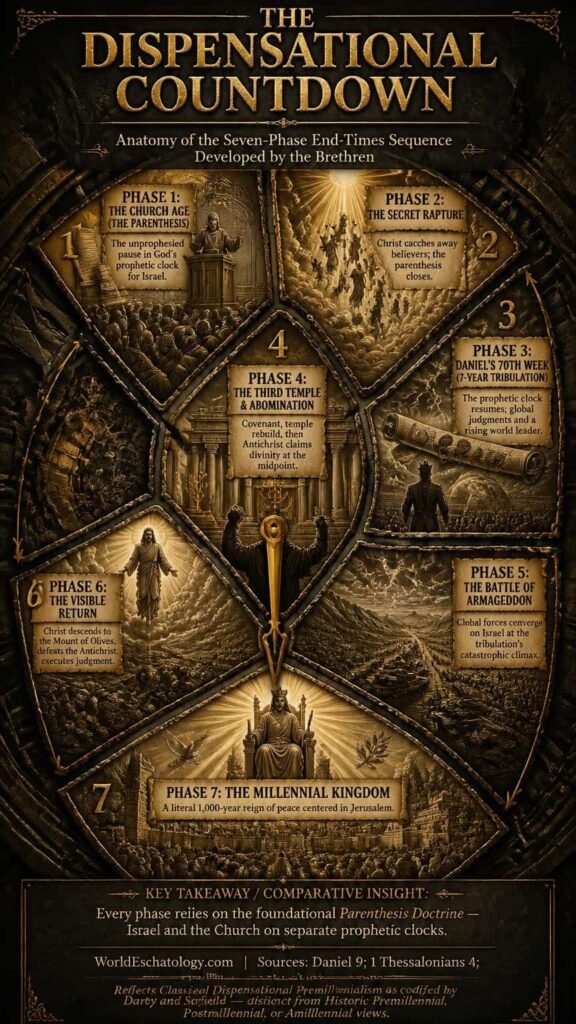
The most consequential of his arguments was that the current age, the age of the Christian church, was not the climax of biblical history at all. It was a parenthesis.
The Parenthesis Doctrine: The Church as a Temporary Interruption
This concept deserves careful attention because it is the hinge on which everything else in John Darby’s system turns.
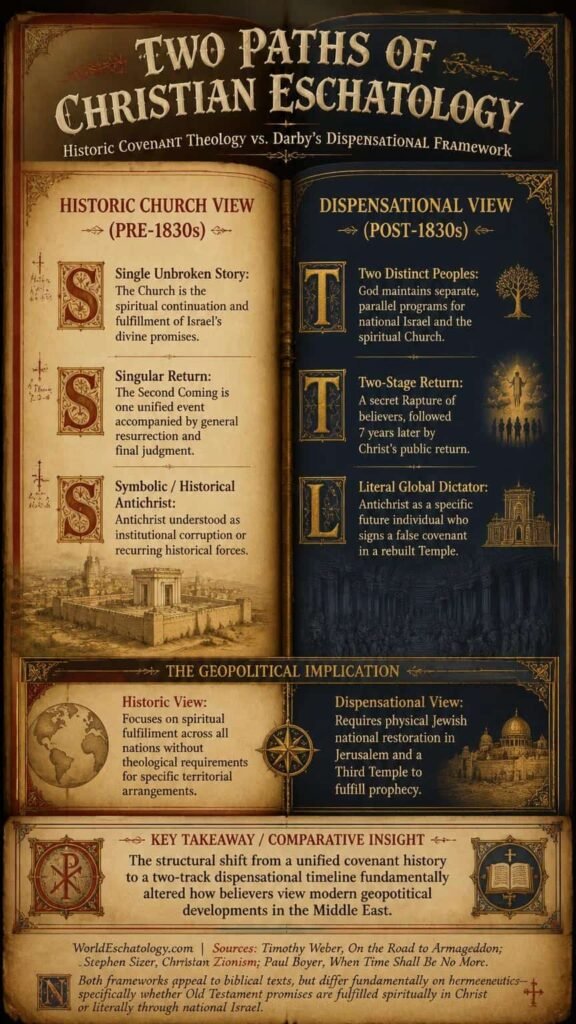
In standard Christian theology, going back to Augustine and running through the Reformers and beyond, the church is understood as the culmination or the fulfillment of the story that began with Abraham and the people of Israel.
The promises God made to Israel find their fulfillment in Christ, and the church, composed of both Jewish and Gentile believers, is the community of those who belong to Christ.
The story of Israel and the story of the church are one continuous story.
Darby rejected this entirely. In his reading, God’s primary programme has always been and always will be with the literal, ethnic, national people of Israel.
The prophets of the Old Testament made specific, concrete promises to the nation of Israel: a restored land, a rebuilt temple, a Davidic king ruling from Jerusalem, a kingdom of peace and justice centered on the Jewish people in their ancestral homeland.
These promises, John Nelson Darby argued, were never cancelled, never transferred to the church, and never spiritualized into something other than what they plainly said. They were simply postponed.
The postponement occurred when the Jewish people rejected Jesus as their Messiah.
At that moment, God’s prophetic programme with Israel was placed on hold, and a new, entirely unexpected community was created: the church. The church is real, the church matters, and individual believers in the church receive genuine spiritual blessings.
But the church is not the heir of Israel’s promises. It is an interruption in Israel’s story, a parenthesis inserted into God’s prophetic timeline while that timeline is paused.
When the parenthesis closes, God’s clock for Israel will resume exactly where it stopped, and all the unfulfilled prophecies of the Hebrew scriptures will be literally fulfilled for the literal nation of Israel in the literal land.
The implications of this single idea are enormous. If the church is a parenthesis, then none of the Old Testament prophecies about kings, temples, territories, and national restoration refer to the church. They all refer to a future, literal, national Israel.
And if a future, literal, national Israel is the goal of God’s prophetic programme, then the return of Jewish people to the land of Israel, the reestablishment of Jewish sovereignty in Jerusalem, and eventually the reconstruction of the Temple are not incidental historical events.
They are the necessary conditions for biblical prophecy to be fulfilled and for history to reach its divinely appointed conclusion.
The Prophetic Timeline: The Brethren’s End-Times Blueprint
The Secret Rapture: A Two-Stage Second Coming
Once Darby had established the parenthesis doctrine, the rest of his prophetic system followed with something close to logical inevitability.
If the church is a parenthesis in God’s programme for Israel, then at some point the parenthesis must close.
The church must be removed from the scene so that God can resume and complete his work with Israel.
John Nelson Darby found his mechanism for this removal in a combination of New Testament passages, most significantly 1 Thessalonians 4:16-17, where Paul describes the Lord descending from heaven and believers being caught up to meet him in the air.
In the historic reading of this passage, shared by virtually all Christian traditions before John Nelson Darby, it described a single event at the end of history: the return of Christ, the resurrection of the dead, and the gathering of all believers to be with him.
John Nelson Darby split this event in two. He argued that the passage described a secret, preliminary return of Christ for his church, in which believers would be instantaneously caught up to be with him in the air and removed from the earth, entirely invisible to and unnoticed by the unbelieving world.
This was the Rapture. Only after this secret event, Nelson Darby argued, would the prophetic clock for Israel resume.
The concept of a secret removal of believers from the earth, prior to and entirely separate from the public, visible return of Christ described in the Gospels and Revelation, had no real precedent in Christian theology before Nelson Darby.
It was a genuinely new idea. Some scholars have pointed to a vision reported by a young Scottish woman named Margaret MacDonald in 1830 as a possible influence on Nelson Darby’s thinking, though the connection is contested.
What is not contested is that the pre-tribulation Rapture, as a distinct and theologically elaborated doctrine, emerged from within the Brethren movement in the early 1830s and that Nelson Darby was its primary architect and most tireless advocate.
The Tribulation and the Antichrist
Once the church has been raptured, John Nelson Darby’s timeline moves into the period he identified with the seventieth week of Daniel’s prophecy in Daniel 9:24-27.
Daniel describes a sequence of seventy weeks decreed for the Jewish people and the holy city, and John Nelson Darby argued that sixty-nine of these weeks had been completed by the time of Christ’s first coming, but that the seventieth week had been indefinitely postponed along with the rest of God’s programme for Israel when the Jewish people rejected Jesus.
The parenthesis of the church age represents the gap between Daniel’s sixty-ninth and seventieth weeks.
When the church is raptured and the parenthesis closes, Daniel’s seventieth week begins.
This is a literal seven-year period of unprecedented global tribulation, drawn from Daniel and from the Book of Revelation’s descriptions of seal, trumpet, and bowl judgments.
At the center of this period stands the figure John Nelson Darby identified as the Antichrist:
not a spiritual principle or a symbol of evil institutions, as many earlier Christian interpreters had read the relevant passages, but a literal individual, a singular demonic world leader who will emerge after the Rapture, make a covenant with Israel, and then at the midpoint of the seven years break that covenant, proclaim himself God in the rebuilt Temple in Jerusalem, and unleash the most intense persecution the world has ever seen.
The Antichrist as a specific future individual, a charismatic global dictator who will seize world power, broker a false peace in the Middle East, and ultimately demand worship as God, is so embedded in contemporary evangelical imagination that it is genuinely difficult to convey how novel this conception was in its original context.
Before John Nelson Darby and the Brethren, the dominant Protestant interpretation of the Antichrist had applied the term to the papacy as an institution.
The identification of the Antichrist as a future individual world leader drawing on Daniel and Revelation was the Brethren’s contribution, and it has proven extraordinarily durable.
The Rebuilding of the Temple: The Eschatological Countdown
Among all the elements of the Brethren prophetic timeline, none has proven more geopolitically consequential than the role assigned to the Third Temple in Jerusalem.
In John Nelson Darby’s reading, the abomination of desolation described by Jesus in Matthew 24, combined with the Antichrist’s proclamation of himself as God in 2 Thessalonians 2, and Daniel’s reference to the cessation of sacrifice and offering, all required a functioning Jewish Temple in Jerusalem.
Without a rebuilt Temple, the specific events of the seven-year tribulation simply cannot unfold as the prophetic text describes.
This means that for every Christian who holds the Brethren’s prophetic framework, the reconstruction of the Jewish Temple on the Temple Mount in Jerusalem is a theological necessity, a precondition that must be met before the eschatological sequence can proceed.
The Temple Mount is currently occupied by the Dome of the Rock and the Al-Aqsa Mosque, two of the holiest sites in Islam.
The political and geopolitical implications of a theology that treats the replacement of these sites with a Jewish Temple as a divine requirement need no elaboration.
They are visible in the positions of Christian Zionist lobbying organizations, in the work of groups that donate to Temple preparation organizations in Israel, and in the broader evangelical framework that treats Israeli control of Jerusalem as a prophetic non-negotiable.
From Marginal Sect to Global Phenomenon: Exporting the End Times
The Scofield Catalyst
John Nelson Darby himself was an extraordinarily energetic propagandist for his own ideas.
He made no fewer than seven extended visits to North America between 1859 and 1874, preaching in churches, conducting Bible conferences, and winning influential converts to his dispensational system.
He published prodigiously, producing commentaries, theological essays, and biblical translations that laid out his framework in exhaustive detail.
But John Nelson Darby was not a natural popularizer, and his writing style was dense, difficult, and demanding.
The transmission of his ideas to a mass audience required a different kind of communicator and a different kind of vehicle.
Both arrived in the form of Cyrus Ingerson Scofield, a Texas lawyer with a colorful personal history who became a Congregationalist minister after a religious conversion and fell under John Nelson Darby’s influence through the Bible conference circuit.
Scofield understood that John Nelson Darby’s system needed to be embedded in the Bible itself, in the margins and notes of a study edition that ordinary Christians would read alongside the text, if it was ever going to reach beyond the lecture halls and conference rooms where it had so far circulated.
He spent years preparing what he called his Reference Bible, published in 1909 by Oxford University Press, and the result was one of the most consequential publications in the history of American Protestantism.
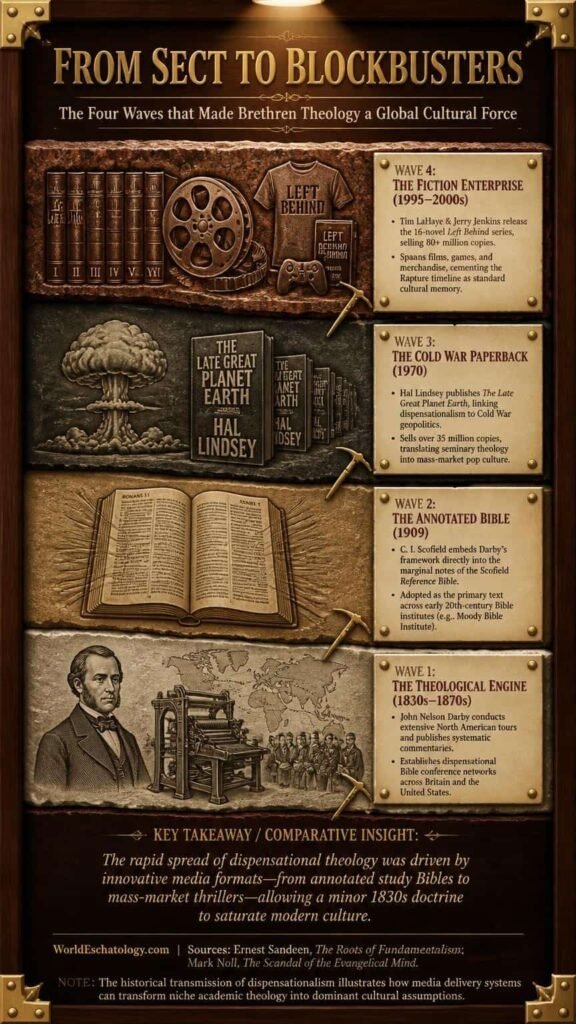
The Scofield Reference Bible placed John Nelson Derby’s dispensational framework into the notes and cross-references that surrounded the biblical text, presented in clear, confident, authoritative prose as if these were simply the plain, obvious meaning of the passages they accompanied.
A reader who had never heard of John Nelson Derby or the Plymouth Brethren would absorb the entire dispensational system simply by reading their Bible with its notes.
The Rapture, the parenthesis doctrine, the seven-year Tribulation, the literal Antichrist, the rebuilt Temple, the prophetic significance of a restored Israel: all of it was there, woven seamlessly into the fabric of the text.
For millions of American evangelical Christians who used the Scofield Bible throughout the twentieth century, these ideas were simply what the Bible taught.
The Scofield Bible was adopted by the network of Bible institutes that spread across North America in the late nineteenth and early twentieth centuries, institutions like the Moody Bible Institute in Chicago and the Philadelphia College of Bible.
These schools trained generations of pastors, evangelists, and missionaries, all of them steeped in Scofield’s dispensational notes.
Those graduates went out and planted churches, founded denominations, ran radio ministries, and eventually television networks.
The institutional infrastructure that made dispensational theology dominant in American evangelical Protestantism by the mid-twentieth century was built largely on the foundation of the Scofield Bible’s influence.
The Pop-Culture Explosion
The translation of Brethren theology from Bible college classrooms to mass popular culture happened in two dramatic surges, separated by a generation.
The first came with Hal Lindsey, a former Mississippi tugboat captain turned Campus Crusade for Christ worker who published The Late Great Planet Earth in 1970.
Lindsey took the John Nelson Derby-Scofield framework and applied it with breathless urgency to the geopolitical landscape of the Cold War era: the Soviet Union as the Gog of Ezekiel, the European Economic Community as the revived Roman Empire from which the Antichrist would emerge, the nuclear arsenal of the superpowers as the instruments of Revelation’s apocalyptic devastation.
The book became the best-selling non-fiction work of the entire decade of the 1970s, eventually selling over thirty-five million copies in fifty-four languages.
A generation of evangelical Christians encountered John Nelson Derby’s prophetic system for the first time not in a church or a seminary but in a mass-market paperback that read like a thriller.
The second surge came a quarter-century later with the Left Behind series, sixteen novels written by Tim LaHaye and Jerry Jenkins beginning in 1995.
LaHaye was a prominent Baptist pastor and political activist deeply embedded in the American religious right; Jenkins was a professional writer with a gift for pacing and narrative suspense.
Together they produced a fictional dramatization of the dispensational end-times sequence that began with the Rapture and moved through the seven-year Tribulation, the rise of the Antichrist, and the eventual return of Christ.
The series sold over eighty million copies, spawned films, children’s books, graphic novels, and a video game, and introduced John Nelson Derby’s prophetic timeline to an audience that would never have read a theological treatise.
The specific scenario that John Nelson Derby had worked out in Dublin and Plymouth in the 1830s was now a global entertainment franchise.
The Modern Geopolitical Echo: The Present-Day Reality
Christian Zionism as Political Force
The line from Nelson Derby’s Dublin Bible studies to the lobbying halls of Washington is direct, documented, and shorter than most people realize.
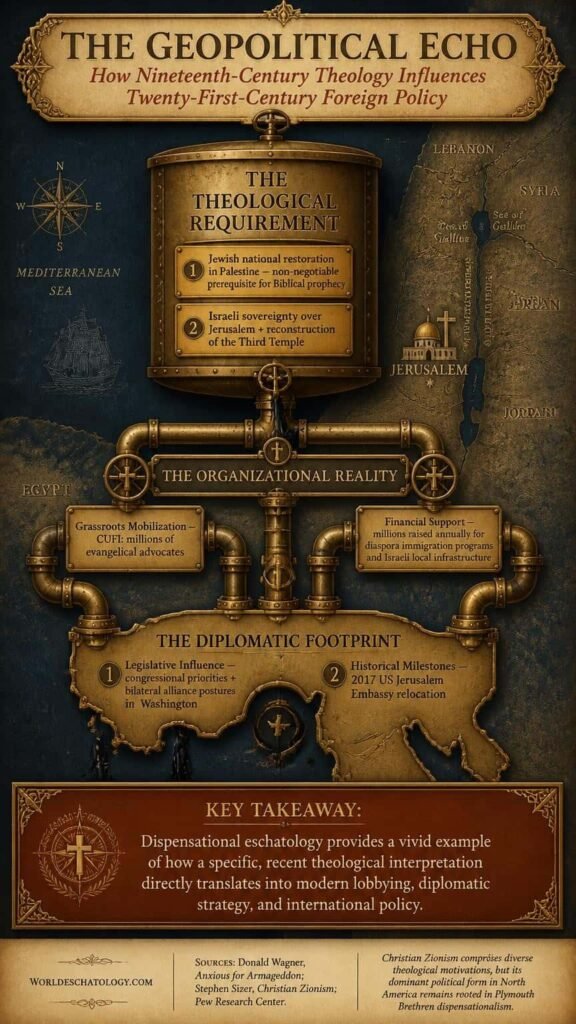
The dispensational theology of the Plymouth Brethren required a sovereign Jewish state in the land of Israel as a prophetic prerequisite.
It required Jewish possession of Jerusalem and eventually a rebuilt Temple. These are not incidental details in the system.
They are load-bearing elements without which the entire prophetic architecture collapses.
The political consequence is that millions of Christians who hold this framework have a theological investment in the specific territorial and political arrangements of the Middle East that goes far deeper than ordinary diplomatic sympathy.
Christians United for Israel, founded by Pastor John Hagee in 2006 and currently the largest pro-Israel lobbying organization in the United States, draws its membership almost entirely from evangelical and Pentecostal Christians who hold some form of the dispensational framework.
The International Christian Embassy Jerusalem, founded in 1980 by Christians from seventeen nations, explicitly frames its work in terms of fulfilling the biblical command to comfort Zion and describes the return of Jewish people to Israel as the fulfillment of Old Testament prophecy.
These organizations and dozens like them direct hundreds of millions of dollars annually toward Israel support, fund immigration programmes that bring Jewish people from the diaspora to Israel, and exercise significant influence over the positions of politicians in the United States, Brazil, the United Kingdom, and increasingly across the Global South where Pentecostal Christianity is expanding rapidly.
The political potency of this movement became visible at key moments across the late twentieth and early twenty-first centuries.
Ronald Reagan’s administration included senior figures who were openly influenced by dispensational eschatology.
The United States’ decision in 2017 to recognize Jerusalem as Israel’s capital and move its embassy there was received by Christian Zionist communities as a prophetically significant moment.
The movement’s influence on American Middle East policy, and through American policy on the broader geopolitical landscape of the region, represents one of the most concrete examples in modern history of a nineteenth-century theological idea having twenty-first-century geopolitical consequences.
The Modern Brethren: From Isolationism to Influence
What of the Plymouth Brethren themselves in the twenty-first century?
The movement that Nelson Derby founded has evolved into several distinct streams with quite different relationships to both the broader culture and to the prophetic legacy their founder left behind.
The Open Brethren, the larger and less restrictive stream of the movement, have largely maintained the core dispensational theology while engaging freely with the wider evangelical world, attending interdenominational conferences, supporting Christian Zionist organizations, and participating in the broader political and cultural life of their respective countries.
Many Open Brethren assemblies would be indistinguishable in their eschatological commitments from a Baptist or Pentecostal congregation that shares the same dispensational framework.
The Plymouth Brethren Christian Church, sometimes called the Exclusive Brethren or the Taylorites after a mid-twentieth century leader named James Taylor Sr.,
represents a very different path. Under a series of increasingly authoritarian leaders across the twentieth century, this stream of the movement became progressively more isolated from the surrounding culture, prohibiting eating with non-members, restricting members’ access to radio, television, and eventually the internet, and maintaining a strict separation from what they describe as the evil of worldly society.
The PBCC, now led by the current Elect Vessel Bruce D. Hales and operating under the corporate name Rapid Relief Team for its public-facing activities, has significant financial resources and operates internationally, but its relationship to the prophetic tradition of Nelson Derby is more devotional than political.
Its members await the Rapture and the fulfillment of the dispensational sequence, but they do not lobby governments or fund Israeli immigration programmes.
Their response to John Derby’s prophetic legacy is withdrawal rather than engagement.
Between these two poles lies the full spectrum of communities that trace some lineage to the Brethren movement or to the dispensational theology John Derby developed, from open evangelical churches fully engaged with Christian Zionist political advocacy to quiet, insular assemblies simply waiting for the trumpet to sound.
Conclusion: The Echo of 1830s Meeting Rooms
There is something genuinely remarkable about the story this article has traced.
In rented halls in Dublin and Plymouth, in the years when Queen Victoria was not yet on the throne and the American Civil War was still decades away, a small group of believers who had walked away from institutional Christianity sat together with their Bibles and worked out a reading of prophetic scripture that would, within two centuries, reshape the religious imagination of hundreds of millions of people and exercise measurable influence on the foreign policy of the world’s most powerful nation.
The end of days envisioned by millions of Christians today, the sudden disappearance of believers, the seven-year reign of a demonic world dictator, the rebuilt Temple in Jerusalem as the site of history’s climactic confrontation, the literal return of Christ to the Mount of Olives, and the millennial kingdom centered on a restored Israel, is an echo of those 1830s meeting rooms.
It is the product of John Nelson John Derby’s restless, systematic, and genuinely innovative theological mind, packaged by Cyrus Scofield for popular consumption, dramatized by Hal Lindsey and Tim LaHaye for a mass entertainment audience, and embedded by decades of institutional transmission into the default eschatological imagination of evangelical Protestantism.
None of this means the system is wrong, and this article has not argued that it is. What the historic record establishes clearly is that it is new.