
A Theology That Shapes Foreign Policy
When the United States formally recognized Jerusalem as the capital of Israel in December 2017 and moved its embassy there the following year, the decision was greeted with celebration by tens of millions of American evangelical Christians.
For many of them, the move was not primarily a matter of geopolitics.
It was a moment of prophetic fulfillment, a step in a divine plan that had been set in motion thousands of years ago in the pages of the Hebrew Bible and brought to its contemporary expression through a stream of Christian theological thought known as Christian Zionism.
The influence of Christian Zionism and biblical prophecy on modern political life is genuinely remarkable.
A 2015 Pew Research survey found that more than forty percent of American adults believed that the creation of the state of Israel in 1948 was a fulfillment of biblical prophecy.
Among white evangelical Protestants, that figure was significantly higher.
Organizations connected to Christian Zionist belief spend hundreds of millions of dollars annually on support for Israel, on political advocacy, and on helping Jewish people immigrate to Israel from around the world.
Heads of state in the United States and Israel have cultivated relationships with Christian Zionist leaders as a matter of deliberate political strategy.
Yet Christian Zionism is also one of the most contested theological movements in contemporary Christianity.
Its critics include not only non-Christian scholars and Muslim and Jewish voices but a large body of Christian theologians, Catholic and Orthodox leaders, and Palestinian Christian communities who regard the movement’s theological foundations as deeply flawed and its political consequences as harmful.
Understanding Christian Zionism requires engaging honestly with both what it believes and why serious people disagree with it, and that is exactly what this article sets out to do.
What Is Christian Zionism? Core Beliefs and Theological Foundations
A Working Definition
Christian Zionism is a strand of Christian belief that holds that the Jewish people have a divine right to the land of Israel, that the modern political restoration of Jewish people to that land is a fulfillment of biblical prophecy, and that Christians have a religious obligation to support that restoration actively.
The term Zionism in this context is borrowed from the Jewish political movement founded by Theodor Herzl in the late nineteenth century, but Christian Zionism predates Herzl by several decades and has distinct theological rather than primarily political roots.
It is important to distinguish Christian Zionism from simple sympathy for Jewish people or support for the security of the state of Israel, positions that are held across a much wider range of Christian opinion.
What makes Christian Zionism distinctive is its specifically prophetic framework:
the belief that the modern state of Israel is not merely a political entity deserving of normal diplomatic consideration but a sign of divine activity in history, a fulfillment of specific biblical promises, and a central actor in the unfolding events of the last days before the return of Jesus Christ.
The Biblical Basis for Christian Zionism
The biblical basis for Christian Zionism rests on several interconnected pillars of scriptural argument.
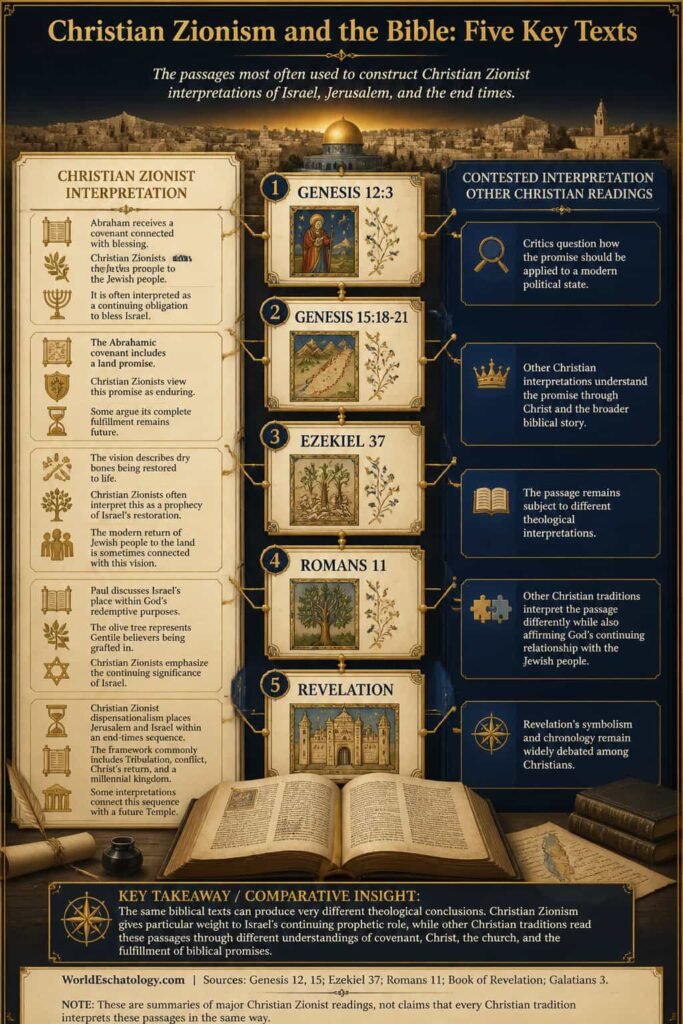
The first and most foundational is the covenant God made with Abraham in Genesis, particularly the promise in Genesis 12:3 where God says to Abraham: I will bless those who bless you, and whoever curses you I will curse, and all peoples on earth will be blessed through you.
Christian Zionists understand this promise as applying permanently to the physical descendants of Abraham through Isaac and Jacob, meaning the Jewish people, and they interpret it as a divine command for all people, and specifically for Christians, to support and bless the Jewish people and their national aspirations.
The land promise is equally central. Genesis 15:18-21 describes God’s covenant with Abraham granting his descendants the land from the river of Egypt to the great river Euphrates.
Similar land promises appear throughout Genesis and are repeated to Isaac and Jacob.
Christian Zionists argue that these promises have never been permanently fulfilled, that the periods of Jewish sovereignty in the land during the biblical period were incomplete or conditional, and that the full and permanent fulfillment of the land covenant awaits a future restoration that the modern state of Israel represents the beginning of.
Ezekiel 37 is perhaps the single most cited passage in the Christian Zionism and biblical prophecy literature.
The vision of the valley of dry bones, in which the prophet sees scattered bones come together, receive flesh, and finally receive breath and come to life as a vast army, is interpreted by Christian Zionists as a direct prophecy of the restoration of the Jewish people to their land after centuries of exile.
The text itself provides an interpretation: God tells Ezekiel that these bones are the whole house of Israel, who say their bones are dried up and their hope is gone, and that God will open their graves and bring them up from them and bring them back to the land of Israel.
Christian Zionists read the establishment of the state of Israel in 1948, and the subsequent immigration of millions of Jewish people from around the world, as the fulfillment of this vision in unmistakable terms.
Other key texts include Zechariah 12 and 14, which describe a future siege of Jerusalem and a divine deliverance that will precede the coming of the Lord.
Isaiah 11 describes a second return of the dispersed of Israel from the four corners of the earth.
Romans 11, one of the most theologically important New Testament passages for Christian Zionists, describes the future salvation of Israel as a whole and warns Gentile Christians against arrogance toward the Jewish people, using the image of Gentiles as wild branches grafted into an olive tree whose natural branches are the Jewish people.
Christian Zionists read Paul’s argument in Romans 11 as proof that God’s covenant with the Jewish people remains in force and that a future mass turning of Jewish people to faith in Jesus Christ is expected before the end.
Christian Zionism Origins and Beliefs: A Historical Journey
Restorationism: The Movement Before Zionism
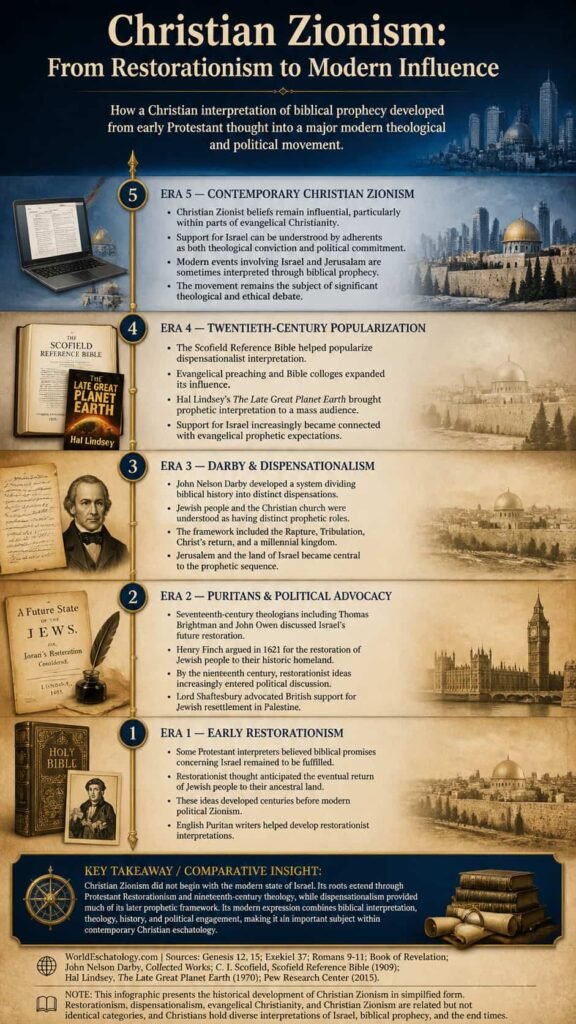
The origins of Christian Zionism lie not in the twentieth century but in the Protestant Reformation and its aftermath.
As Protestants began reading the Old Testament in their own languages and developing their own interpretations of scripture, some began arguing that the literal fulfillment of the Hebrew prophets’ promises to Israel was still outstanding.
This position, sometimes called Restorationism or Christian Restorationism, held that the Jewish people would eventually be restored to the land of their ancestors and would come to faith in Jesus Christ as their Messiah.
English Puritanism was particularly fertile ground for these ideas.
In the early seventeenth century, Puritan theologians including Thomas Brightman and John Owen wrote extensively about the future restoration of Israel as a necessary element of the prophetic scheme.
The idea that Christians had a duty to support and even facilitate this restoration began to take political form.
In 1621, British statesman Henry Finch published a work arguing that the Jewish people would be restored to their ancient homeland, a position that attracted considerable attention and some controversy.
By the mid-nineteenth century, the Restorationist current had grown strong enough to produce actual political advocacy.
Lord Shaftesbury, one of the most influential social reformers of Victorian England and a deeply committed evangelical Christian, campaigned persistently for British government support of Jewish resettlement in Palestine.
His famous phrase, a land without a people for a people without a land, later adopted and disputed in various contexts, expressed the Restorationist vision in its most condensed form.
Shaftesbury saw the restoration of Jewish people to Palestine as both a prophetic imperative and a humanitarian opportunity, and he lobbied British foreign ministers accordingly.
His advocacy represents one of the earliest examples of Christian Zionist origins and beliefs finding direct political expression.
The Balfour Declaration and Christian Influence
The line from nineteenth-century Christian Restorationism to the Balfour Declaration of 1917 is shorter than many people realize.
Arthur Balfour, the British Foreign Secretary who signed the declaration promising British support for the establishment of a Jewish homeland in Palestine, was himself shaped by a background in evangelical Protestantism that included strong currents of Restorationist thought.
While the Balfour Declaration was a product of complex political calculations including British imperial interests, the influence of the Zionist lobby, and strategic considerations related to the First World War, the personal religious convictions of those who supported it cannot be separated from its history.
David Lloyd George, the British Prime Minister at the time, later acknowledged that his education in a Welsh Nonconformist tradition had given him a familiarity with and reverence for the Hebrew scriptures that made him sympathetic to the Zionist cause in a way that went beyond pure geopolitics.
The Balfour Declaration and Christian Zionism and biblical prophecy are thus historically entangled in ways that continue to shape how the movement understands its own significance.
John Nelson Darby and Dispensationalism
The most influential theological development in the history of Christian Zionism was the emergence of dispensationalism in the nineteenth century, associated primarily with John Nelson Darby, an Irish-British evangelist who broke from the Church of Ireland and became one of the founders of the Plymouth Brethren movement.
Darby developed a comprehensive system of biblical interpretation that divided all of history into distinct periods or dispensations, in each of which God relates to humanity according to different principles.
How does dispensationalism relate to Christian Zionism? The connection is direct and structural.
In Darby’s system, the Jewish people and the church of Jesus Christ are two distinct peoples of God with distinct destinies.
The church age, which began at Pentecost, represents a parenthesis in God’s primary programme with Israel, which will resume after the church is removed from the earth in an event known as the Rapture.
After the Rapture, a seven-year period of tribulation will occur during which the Jewish people will go through intense suffering, come to faith in Jesus as their Messiah, and be delivered when Christ returns to earth at the end of the tribulation to establish his millennial kingdom in Jerusalem.
This scheme requires the Jewish people to be in their land, in possession of Jerusalem, and in a position to rebuild the Temple before the end-times sequence can unfold.
The practical implication of dispensationalism for Christian Zionism is therefore theological and urgent: supporting the Jewish return to the land of Israel and their possession of Jerusalem is not merely a political preference but a necessary element of the prophetic programme leading to the return of Christ.
Darby’s system, popularized in North America through the Scofield Reference Bible (first published in 1909), through Bible colleges and seminaries, through the preaching of Dwight L. Moody, and eventually through the enormously popular Left Behind novels of Tim LaHaye and Jerry Jenkins, became the dominant theological framework of American evangelicalism by the mid-twentieth century.
Evangelical Support for Israel in the Twentieth Century
Evangelical support for Israel as a specifically religious and prophetic commitment reached a new level of intensity after 1948,
when the state of Israel was established, and especially after 1967, when Israel’s capture of Jerusalem’s Old City in the Six Day War seemed to many evangelical Christians to be a direct fulfillment of the words of Jesus in Luke 21:24, which describes Jerusalem being trampled by the Gentiles until the times of the Gentiles are fulfilled.
Prophecy teachers across the English-speaking evangelical world pointed to these events as proof that the end times sequence was moving forward on schedule.
Hal Lindsey’s 1970 book The Late Great Planet Earth brought dispensational eschatology and Christian Zionist convictions to a massive popular audience.
Lindsey connected the restoration of Israel, the capture of Jerusalem, the geopolitics of the Cold War, and the formation of the European Economic Community to a detailed prophetic timetable drawn from the Book of Revelation, Daniel, and Ezekiel.
The book became one of the best-selling non-fiction works of the 1970s and shaped the eschatological expectations of a generation of evangelical Christians.
Organizations including Christians United for Israel, founded by Pastor John Hagee in 2006, formalized evangelical support for Israel into a large-scale political lobbying movement that continues to operate today.
Key Biblical Texts and Sources in Christian Zionism
Genesis 12:3 and the Abrahamic Covenant
The Abrahamic covenant, particularly Genesis 12:3 with its promise that God will bless those who bless Abraham and curse those who curse him, functions as perhaps the most frequently invoked text in Christian Zionist preaching and political advocacy.
Christian Zionists argue that this promise creates an ongoing obligation for nations and individuals to support the Jewish people, and that the historical fortunes of nations can be traced to their treatment of the Jewish people based on this principle.
Critics note that this interpretation requires reading the promises made to the individual Abraham as permanently transferable to all his physical descendants and as establishing an ongoing political obligation, readings that are contested within biblical scholarship.
Ezekiel 37 and the Vision of Dry Bones
Ezekiel 37 remains one of the most dramatic and debated prophetic texts in the Christian Zionism and biblical prophecy literature.
The vision of bones being restored to life is understood by Christian Zionists as a prediction of the physical restoration of the Jewish people to their land, fulfilled in the modern immigration movements known in Hebrew as aliyah that brought millions of Jewish people to Palestine and then Israel from the nineteenth century onward.
The subsequent verses of Ezekiel 37, which describe the reunification of the northern and southern kingdoms of Israel under a single Davidic king, are connected by dispensationalist interpreters to the future millennial kingdom of Christ.
The Book of Revelation and the End Times Sequence
The Book of Revelation provides the eschatological framework within which Christian Zionists locate the modern state of Israel.
The seven-year tribulation period, often identified with the seventieth week of Daniel’s prophecy in Daniel 9, is understood as a future period of unprecedented suffering centered on Israel and Jerusalem.
The Antichrist, described in Revelation and in the letters of John, will make a covenant with Israel, desecrate a rebuilt temple in Jerusalem, and persecute the Jewish people before being defeated by the returning Christ.
The Battle of Armageddon, described in Revelation 16, will be fought in the Jezreel Valley of northern Israel.
All of these elements require a sovereign Jewish state in the land of Israel as a prerequisite for the end-times drama to unfold.
Romans 11 and the Future of Israel
Romans 11 is the New Testament passage that Christian Zionist theologians regard as most clearly establishing that God’s purposes for the Jewish people as a distinct people remain in force.
Paul’s argument that the gifts and calling of God are irrevocable, combined with his prediction that all Israel will be saved as part of the conclusion of God’s redemptive plan, is read by Christian Zionists as a direct biblical refutation of any theology that transfers all the promises made to Israel to the church.
The olive tree image, in which Gentile believers are grafted into a tree whose natural branches are Jewish people, is understood as establishing the priority of Jewish people in salvation history and the obligation of Gentile Christians to support rather than replace them.
Different Scholarly Views: The Christian Theological Debate
Covenant Theology and Supersessionism
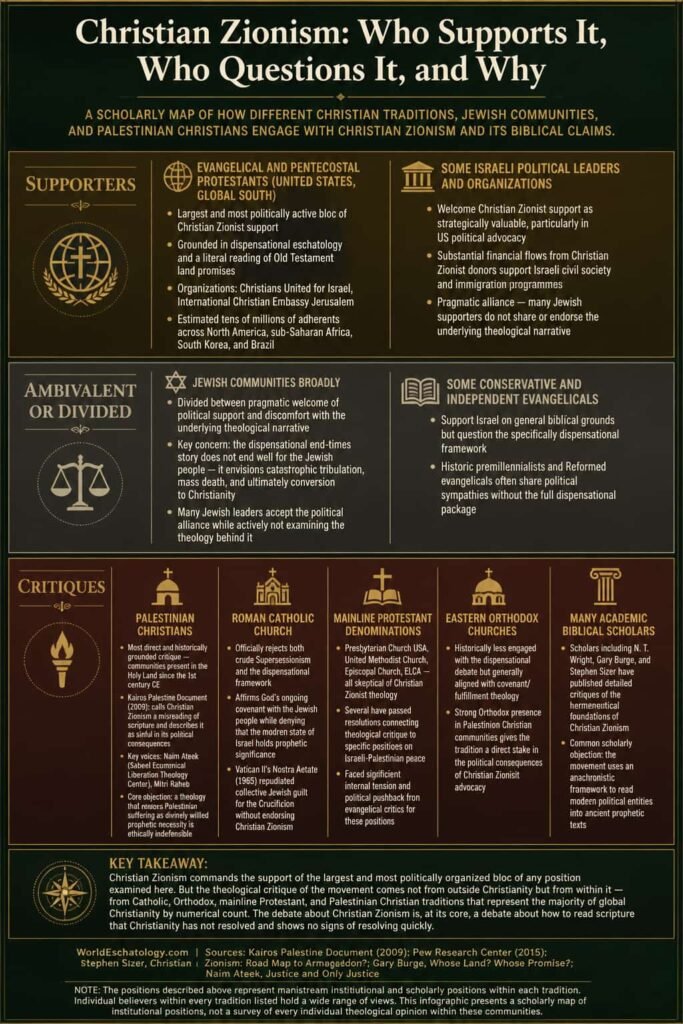
The most direct theological challenge to Christian Zionism comes from Covenant Theology, the interpretive framework associated with Reformed and Presbyterian Christianity and with much of historic Catholic and Orthodox thought.
Covenant Theology understands the biblical story as organized around a small number of divine covenants, most importantly the covenant of grace, which encompasses both the Old and New Testaments as two administrations of the same fundamental promise of salvation through Christ.
Within this framework, the promises made to Abraham and his descendants find their fulfillment in Jesus Christ, who is the true seed of Abraham according to Galatians 3:16, and in all those who are united to Christ by faith, regardless of ethnic background.
The church, composed of both Jewish and Gentile believers, is understood as the continuation and fulfillment of Israel, not as a separate entity that exists alongside a distinct programme for ethnic Israel.
This position is often called Supersessionism or Replacement Theology, terms that critics of Covenant Theology use to describe the idea that the church has replaced Israel in God’s redemptive plan.
Many Covenant theologians resist this framing, arguing that the language of replacement misrepresents their position.
They prefer to say that the promises are fulfilled in Christ and in the multi-ethnic community of the church rather than that one group has replaced another.
But regardless of the precise terminology, the practical implication is clear: if the Old Testament promises to Israel are fulfilled in Christ and the church, then the modern state of Israel, while it may deserve consideration as a state among other states, does not carry special prophetic significance.
What are the main theological arguments against Christian Zionism? From the Covenant Theology perspective, they are several.
The land promises of the Old Testament are fulfilled in the person of Christ and in the eschatological new creation, not in a geographically specific modern state.
The New Testament consistently reads the promises to Abraham as finding their ultimate fulfillment in Christ and those who belong to him.
The genealogical reading of the covenant that makes physical descent from Abraham the basis for divine favor is explicitly rejected by Paul in Galatians and Romans.
And the political implications of treating one modern state as specially favored by God create serious ethical problems, particularly for Christian communities in the regions affected.
Palestinian Christian Voices
One of the most powerful critiques of Christian Zionism and biblical prophecy interpretation comes from Palestinian Christians, a community whose existence many Western Christian Zionists are simply unaware of.
Palestinian Christians, who include Greek Orthodox, Greek Catholic, Latin Catholic, Anglican, Lutheran, and various Protestant communities, have lived in the Holy Land continuously since the earliest centuries of Christianity.
They represent a direct link to the land of Jesus and the apostles that predates the modern Zionist movement by nearly two millennia.
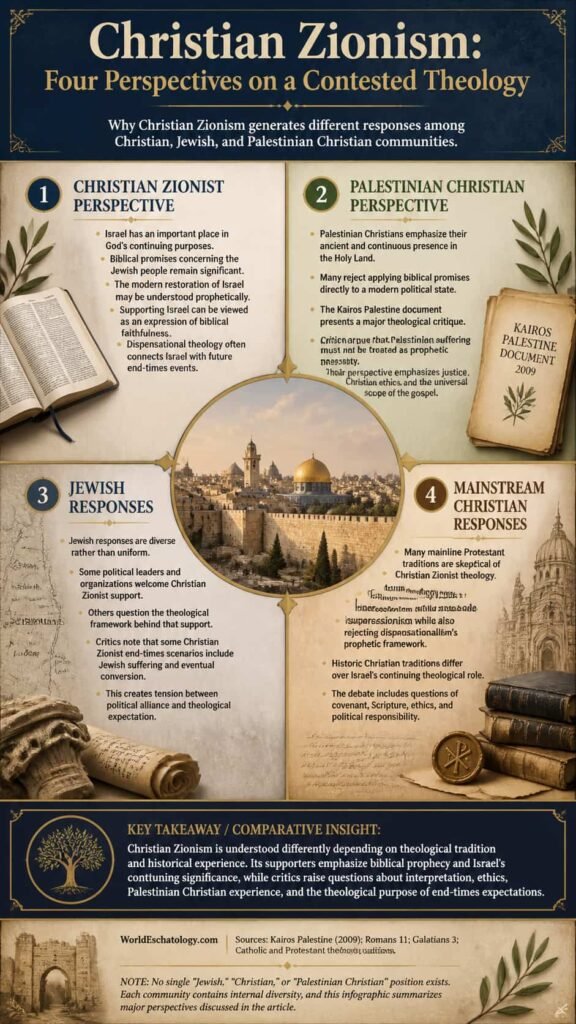
The Palestinian Christian theological critique of Christian Zionism is articulated most clearly in the Kairos Palestine document, issued in 2009 by Palestinian Christian leaders of multiple denominations.
The document argues that Christian Zionism misreads scripture by applying to the modern political state of Israel promises that belong to a different era of salvation history and that have been fulfilled in Christ.
It describes Christian Zionism as a heresy because it places ethnic and national identity at the center of God’s redemptive plan in a way that the New Testament explicitly rejects.
Palestinian Christian theologians including Naim Ateek and Mitri Raheb have written extensively on this critique, arguing that a theology which treats the dispossession and suffering of Palestinian people, including Palestinian Christians, as divinely willed prophetic necessity represents a serious theological and ethical failure.
Jewish Responses to Christian Zionism
Jewish responses to Christian Zionism are genuinely divided and often complex.
Many Israeli political leaders and Jewish organizations have welcomed Christian Zionist support as a strategically valuable alliance, particularly in the context of lobbying the United States government.
The financial and political support that Christian Zionist organizations provide to Israel and to Jewish communities is substantial, and pragmatic considerations lead many Jewish leaders to accept it without excessive scrutiny of the theological framework behind it.
At the same time, a significant body of Jewish opinion is deeply uncomfortable with Christian Zionism.
The underlying theological narrative of Christian Zionism, it is important to acknowledge, does not end with a Jewish state living in peace in the land of Israel.
It ends with a period of catastrophic tribulation centered on Israel, the death of a large proportion of the Jewish population during this tribulation in some readings, and the conversion of the surviving Jewish remnant to Christianity.
Jewish critics of Christian Zionism point out that this is not actually a narrative of Jewish flourishing but of Jewish suffering serving as a vehicle for Christian eschatological fulfillment.
The support, in this reading, is not really for the Jewish people but for a prophetic script in which the Jewish people play a necessary but ultimately tragic role before the Christian conclusion arrives.
Mainline Protestant and Catholic Positions
The mainline Protestant denominations, including the United Methodist Church, the Presbyterian Church USA, the Episcopal Church, and the Evangelical Lutheran Church in America, have generally maintained positions that are skeptical of Christian Zionist theology and critical of Israeli government policies toward Palestinians.
Several of these denominations have passed resolutions connecting their theological critique of Christian Zionism to specific political positions on Israeli-Palestinian peace and have faced intense criticism from Christian Zionist voices for doing so.
The Roman Catholic Church does not endorse Christian Zionism and has been consistent in rejecting Supersessionism in the crude form that treats the Jewish people as having been rejected by God, while simultaneously rejecting the dispensationalist reading that assigns to the modern state of Israel a specific prophetic role.
Catholic theology since the Second Vatican Council has emphasized the ongoing validity of God’s covenant with the Jewish people within a framework that is distinct from dispensationalism, reading the relationship between Israel and the church as one of deep continuity without the political-prophetic framework that Christian Zionism adds.
Why This Matters Today: Christian Zionism in the Twenty-First Century
The practical significance of Christian Zionism in the contemporary world is difficult to overstate.
Tens of millions of Christians in the United States, in sub-Saharan Africa, in South Korea, in Brazil, and in other parts of the Global South hold some version of Christian Zionist convictions, and the political and financial consequences of those convictions are substantial.
Understanding what Christian Zionism is, where its origins lie, and what serious theological critiques of it look like is therefore not merely an academic exercise.
It is a necessity for anyone trying to make sense of some of the most consequential religious-political dynamics of our time.
The events of October 2023 and the subsequent conflict in Gaza produced one of the most intense seasons of Christian Zionist political activity in recent decades.
Christian Zionist organizations and leaders in the United States advocated strongly for unconditional American support for Israeli military operations, framing the conflict explicitly in prophetic terms.
Critics, including many Christian theologians and Palestinian Christian communities, argued that this framework rendered invisible the suffering of Palestinian civilians, including Palestinian Christians, and that it represented a failure of Christian moral responsibility masquerading as prophetic faithfulness.
The debate is not going away, and it is deepening.
As the conflict in the Middle East continues and as questions about international law, human rights, and religious responsibility become more urgent, the theological foundations of Christian Zionist belief will continue to be examined from within and without the Christian tradition.
The movement’s critics argue that a theology built on specific ethnic privilege, on the prophetic necessity of another people’s suffering, and on a reading of scripture that sidelines the New Testament’s consistent emphasis on the unity of all people in Christ is not sustainable under serious scrutiny.
The movement’s defenders argue that they are simply taking seriously what the Bible plainly teaches and that faithfulness to scripture requires them to stand with Israel regardless of political pressure.
For readers of this article who are exploring these questions honestly, the most important thing to recognize is that this is a genuine theological debate among serious people, not a simple matter of good faith versus bad faith.
The questions it raises, about how to read the Old Testament in light of the New, about the relationship between the church and the Jewish people, about the role of political states in divine purposes, and about the ethical obligations that arise from prophetic conviction, are among the deepest and most difficult questions in Christian theology.
They deserve to be engaged with the same rigorous and respectful attention that this website brings to all sacred traditions and their beliefs about the ultimate things.
Frequently Asked Questions About Christian Zionism and Biblical Prophecy
What is Christian Zionism?
Christian Zionism is a theological movement within Christianity that holds that the Jewish people have a God-given right to the land of Israel, that the modern restoration of Jewish people to that land is a fulfillment of biblical prophecy, and that Christians have a religious duty to support this restoration.
It is distinguished from general sympathy for Jewish people or normal diplomatic support for Israel by its specifically prophetic framework, which reads current events in the Middle East as the fulfillment of divine promises made in the Hebrew Bible and as part of the sequence of events leading to the return of Jesus Christ.
The movement has its deepest roots in Protestant evangelical Christianity and is particularly influential in the United States, where it shapes the political positions of tens of millions of Christians.
What is the biblical basis for Christian Zionism?
Christian Zionism and biblical prophecy are connected through several key scriptural passages.
The foundational texts include the Abrahamic covenant in Genesis, particularly Genesis 12:3 with its promise to bless those who bless Abraham and his descendants.
The land promises in Genesis 15 and throughout the Pentateuch, which describe God granting the land of Canaan to Abraham’s descendants as an eternal possession, are central to the argument for Jewish restoration.
Ezekiel 37’s vision of dry bones coming to life is interpreted as a prophecy of the physical restoration of the Jewish people to their homeland.
Romans 11’s teaching that the gifts and calling of God are irrevocable is read as proof that God’s covenant with the Jewish people as a distinct people remains in force.
And the Book of Revelation’s end-times narrative, which places a rebuilt temple in Jerusalem at its center, is understood as requiring a sovereign Jewish state in the land of Israel as a prophetic prerequisite.
How does dispensationalism relate to Christian Zionism?
Dispensationalism is the theological system that provides Christian Zionism with most of its detailed prophetic framework.
Developed by John Nelson Darby in the nineteenth century and widely popularized through the Scofield Reference Bible and later through the Left Behind series, dispensationalism divides history into distinct periods and holds that the Jewish people and the church are two separate peoples of God with distinct destinies.
In the dispensational scheme, the church will be removed from the earth in the Rapture, after which a seven-year tribulation period will unfold centered on Israel and Jerusalem, concluding with the return of Christ to establish a millennial kingdom.
Because this scheme requires the Jewish people to be in their land and in possession of Jerusalem before these events can unfold, dispensationalism generates a strong theological motivation for evangelical support for Israel.
Most Christian Zionists are dispensationalists, though not all dispensationalists take equally strong political positions on the Israeli-Palestinian conflict.
What is Replacement Theology and why do Christian Zionists reject it?
Replacement Theology, also called Supersessionism, is the theological position that the church of Jesus Christ has inherited or fulfilled the role and promises of Old Testament Israel, so that the ethnic Jewish people no longer hold a distinctive place in God’s redemptive plan as a people.
Covenant Theology, associated with Reformed and Presbyterian traditions and with much of Catholic and Orthodox thought, holds some form of this position, though many theologians in this tradition resist the term replacement in favor of fulfillment.
Christian Zionists reject Supersessionism strongly, arguing that it empties the Old Testament promises of their meaning, contradicts Paul’s teaching in Romans 11 about the ongoing significance of Israel, and has historically contributed to anti-Jewish theology and persecution.
They argue that God’s covenant with the Jewish people is unconditional and eternal, and that the church’s inclusion in that covenant through Christ supplements rather than replaces the original promise.
What are the main theological arguments against Christian Zionism?
Serious theological critiques of Christian Zionism are made from within Christianity, not only from outside it.
The main arguments include the following. First, the New Testament consistently reads the Old Testament promises to Israel as fulfilled in Jesus Christ and in the multi-ethnic community of believers united to him, not in a specific modern political state.
Galatians 3 identifies Christ as the true seed of Abraham and argues that all who are in Christ are Abraham’s descendants and heirs of the promise.
Second, the land promises of the Old Testament are understood by many theologians as types and shadows of the ultimate inheritance of the whole earth and the new creation, not as permanent guarantees of a specific geographical territory for a specific ethnic group.
Third, the political implications of treating one modern state as specially chosen by God create serious ethical problems, particularly when the interests of other people living in the same land are rendered theologically invisible.
Fourth, the underlying narrative of dispensational Christian Zionism, which envisions catastrophic suffering for the Jewish people during the tribulation before a Christian eschatological resolution, is not genuinely pro-Jewish in the way it presents itself.
Palestinian Christian theologians and many Jewish critics have made this last point with particular force.
What do Palestinian Christians say about Christian Zionism?
Palestinian Christians, who belong to communities that have lived in the Holy Land continuously since the first centuries of Christianity, are among the most direct and theologically serious critics of Christian Zionism.
The Kairos Palestine document of 2009, signed by leaders of multiple Palestinian Christian denominations, describes Christian Zionism as a misreading of scripture that treats promises belonging to a particular moment in salvation history as permanently applicable to a modern political state.
Palestinian Christian theologians argue that a theology which frames the displacement and suffering of Palestinian people, including Palestinian Christians who are themselves descendants of the earliest Christian communities, as divinely ordained prophetic necessity is ethically untenable and theologically indefensible.
They also point out the profound irony of a theology that claims to support the land of Jesus while rendering invisible the suffering of communities that have inhabited that land and practiced Christianity there for two thousand years.
Is Christian Zionism growing or declining?
Christian Zionism is growing in the Global South even as it faces increasing scrutiny in the United States and Europe.
The movement has expanded significantly in sub-Saharan Africa, South Korea, Brazil, and other parts of the world where Pentecostal and evangelical Christianity has grown rapidly, often bringing dispensational eschatology and Christian Zionist convictions with it.
In the United States, younger evangelical Christians show somewhat less enthusiasm for Christian Zionist political positions than their parents’ and grandparents’ generations, though commitment to Israel as a matter of biblical obedience remains strong in many evangelical communities.
The conflicts in Gaza and the wider Middle East beginning in 2023 have both intensified existing Christian Zionist commitments among those who hold them and generated a significant counter-reaction among younger Christians who find the movement’s political implications incompatible with their understanding of the gospel.
Whether this represents a long-term theological shift or a temporary generational tension remains to be seen.