
Here is a striking detail. In the Book of Revelation, a rider on a white horse comes to judge the world and make war in righteousness.
In the Hindu Puranas, Kalki rides a white horse with a blazing sword to end an age of darkness.
The pictures look alike. So people ask a natural question. Is Jesus the same as Kalki?
It is one of the most searched questions in interfaith discussion. It comes up in classrooms, family conversations and online debates.
It also comes up wherever Christians and Hindus live and work side by side.
The honest answer is that most Christians and most Hindus say no. They give different reasons.
Their views of God, time and salvation are not the same. Yet the comparison is not foolish.
It shows how two great traditions imagine the end of evil and the renewal of the world.
This guide offers a careful Kalki and Jesus comparison. It explains what each tradition teaches, where the pictures meet and where they part.
It also covers the views of scholars and of those who see a deeper unity. Each belief is described as its followers understand it.
What Do Christian and Hindu Traditions Teach About End Times Saviors?
The Christian Teaching: The Second Coming of Jesus
Christians believe that Jesus of Nazareth came once in history. He was born, taught, died on the cross and rose again.
They also believe he will come again. This is called the Second Coming, or the Parousia.
The Nicene Creed states it in simple words. Jesus will come again in glory to judge the living and the dead. The New Testament adds several details.
- Jesus promises to return (John 14:3, Matthew 24:30).
- Two angels tell the disciples that he will come back in the same way he left (Acts 1:11).
- The dead in Christ will rise, and the living will join them (1 Thessalonians 4:16 and 17).
- No one knows the day or the hour (Matthew 24:36).
- He will judge the nations and make all things new (Matthew 25, Revelation 21).
For Christians, this is the final act of history. After it comes the new heaven and the new earth. There is no repeating cycle.
The Hindu Teaching: Kalki, the Tenth Avatar
In Hindu thought, Vishnu descends to the world many times. These descents are called avatars.
Ten are most often listed. Nine are said to have appeared already. The tenth is Kalki.
The Puranas place Kalki at the end of Kali Yuga, the present age of moral decline.
The Bhagavata Purana says he will be born in the village of Shambhala. His father will be a brahmin named Vishnuyasha.
He will ride a swift white horse and carry a blazing sword. He will end adharma and restore dharma. A new Satya Yuga will begin.
Traditional chronology says Kali Yuga lasts 432,000 years and began in 3102 BCE. So Kalki is not expected for a very long time.
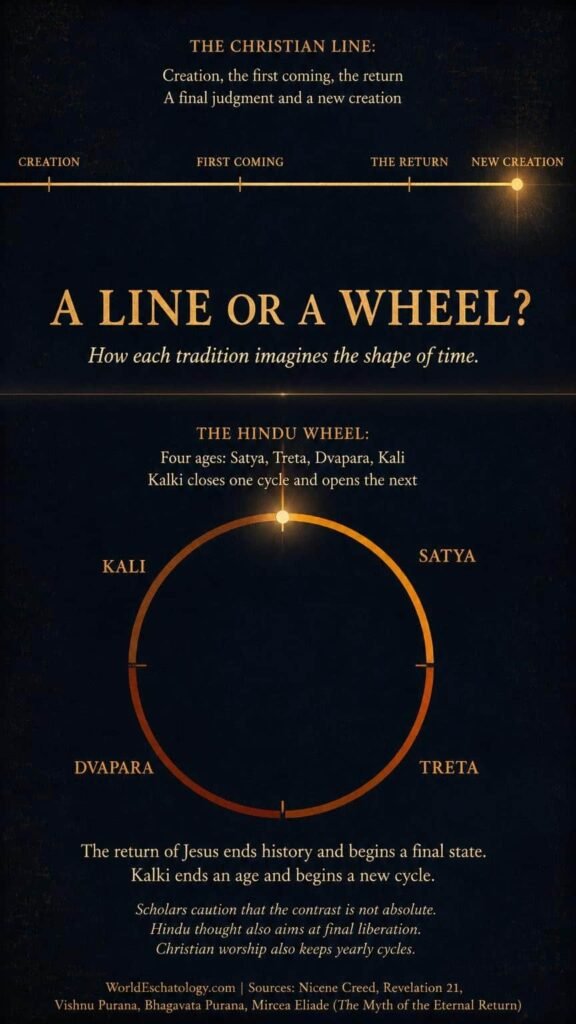
Even then, his coming does not end all time. It closes one great cycle and opens another.
Where the Two Pictures Look Alike
There are real parallels. Many readers notice them first.
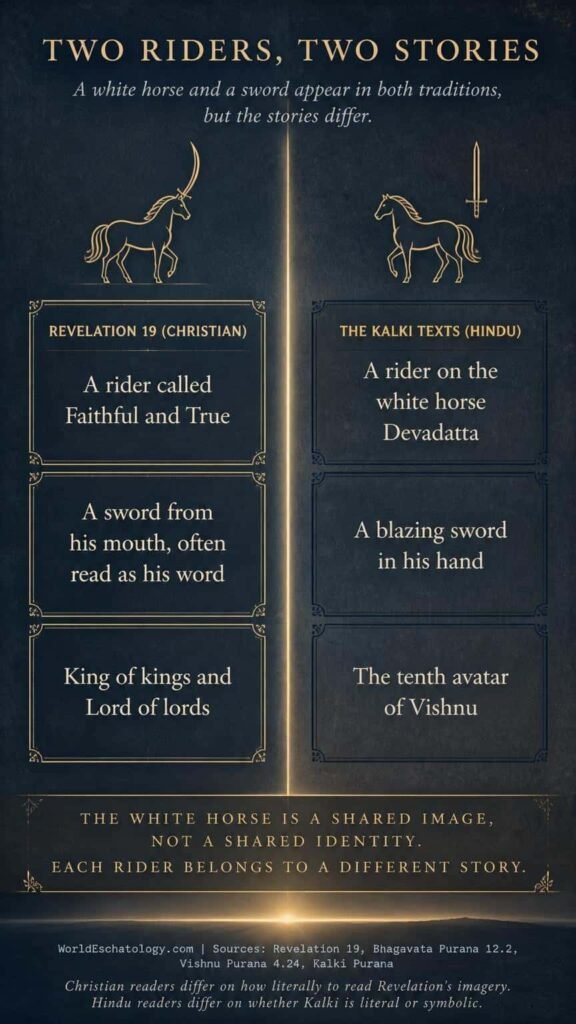
- A rider on a white horse. Revelation 19 and the Kalki texts both use this image.
- A sword. In Revelation it comes from the rider’s mouth. In the Puranas it is a blazing blade.
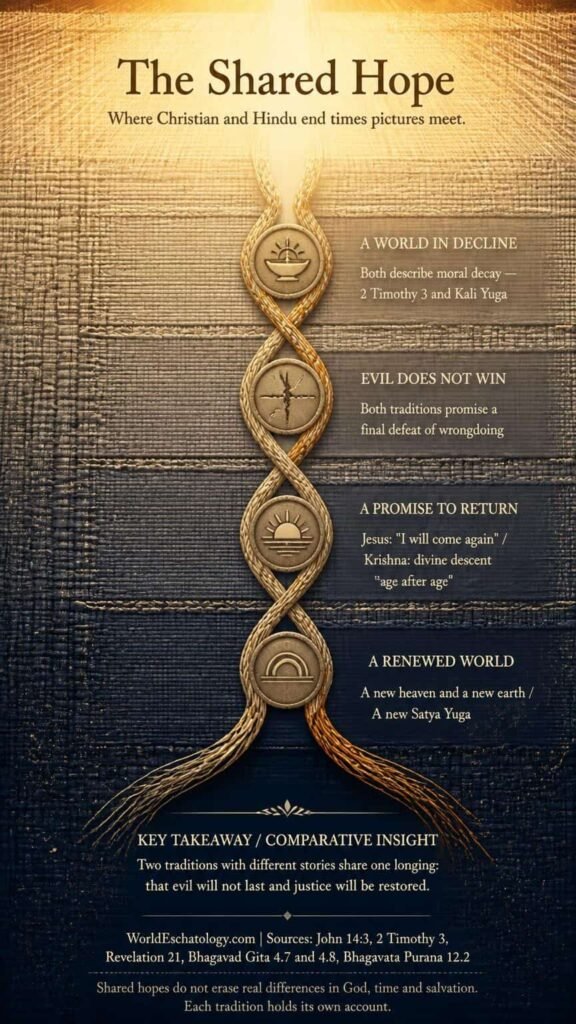
- A world in moral decline. Second Timothy 3 speaks of difficult last days, with people who love money and themselves. The Puranas describe Kali Yuga in similar terms.
- A final defeat of evil. Both traditions say that wrongdoing will not have the last word.
- A renewed world. Christians look to a new heaven and a new earth. Hindus look to a new Satya Yuga.
- A promise to return. In the Gita (4.7 and 4.8), Krishna says he comes again in every age when dharma declines. Jesus also says he will come again.
Where They Differ
The differences are deep. They are not only about details. They come from different views of God and history.
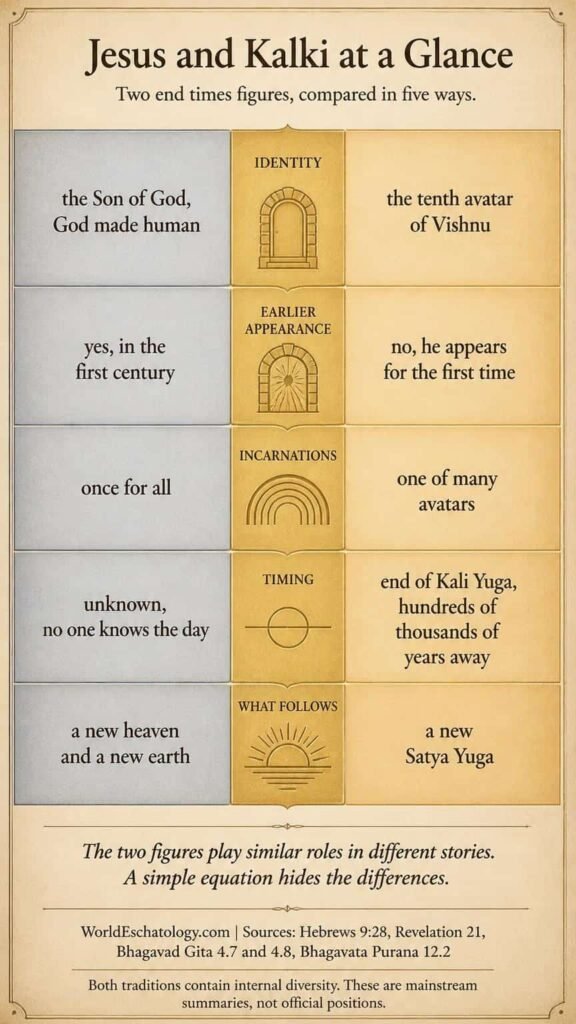
| Theme | Jesus (Christian tradition) | Kalki (Hindu tradition) |
| Identity | The Son of God, God made human | The tenth avatar of Vishnu |
| Earlier appearance | Yes. His first coming was in the first century. | No. He appears for the first time as Kalki. |
| Number of incarnations | One, once for all (Hebrews 9:28) | One of many avatars across the ages |
| View of time | Linear. History has a beginning and a final end. | Cyclical. Ages follow one another. |
| Timing | Unknown. No one knows the day. | Traditionally at the end of Kali Yuga, hundreds of thousands of years away. |
| Main role | Judge the living and the dead, and complete salvation | End adharma and restore dharma |
| Suffering before glory | Yes. The cross comes before the return. | No earlier suffering is attached to Kalki. |
| Key image | A rider called Faithful and True, with a sword from his mouth | A rider on Devadatta, with a blazing sword |
| What follows | The new heaven and new earth, a final state | A new Satya Yuga, a new cycle |
A Closer Look at the White Horse and the Sword
The shared imagery deserves a second look. In Revelation 19, the rider is called Faithful and True.
His eyes are like fire. He wears many crowns. His robe is marked with blood, and his name is the Word of God.
A sharp sword comes from his mouth. Most Christian readers take the sword as a symbol of his word and his authority.
In the Puranas, Kalki’s sword is a weapon in his hand. His horse has a name, Devadatta.
His birthplace, his family and his helpers are described. The Christian rider is presented as a figure of the Word and of judgment.
The Hindu rider is presented as a divine warrior who restores the order of dharma. Shared symbols can serve different stories.
Salvation and Judgment: Two Different Questions
The two traditions also ask different questions about the end. Christian belief centers on salvation and judgment.
People are raised, judged and given a lasting destiny. Forgiveness through Christ lies at the heart of the hope.
Hindu belief centers on dharma and liberation. The cycle of rebirth continues.
Each soul seeks moksha, release from the cycle, through knowledge, devotion or action. Kalki renews the world.
He does not take the place of each person’s path to liberation. This is one more reason why the two figures cannot simply be swapped.
These differences show why a simple equation is hard to defend. The question is not only who rides the horse. It is also what story the rider belongs to.
Is Jesus the Same as Kalki?
What Mainstream Christianity Says
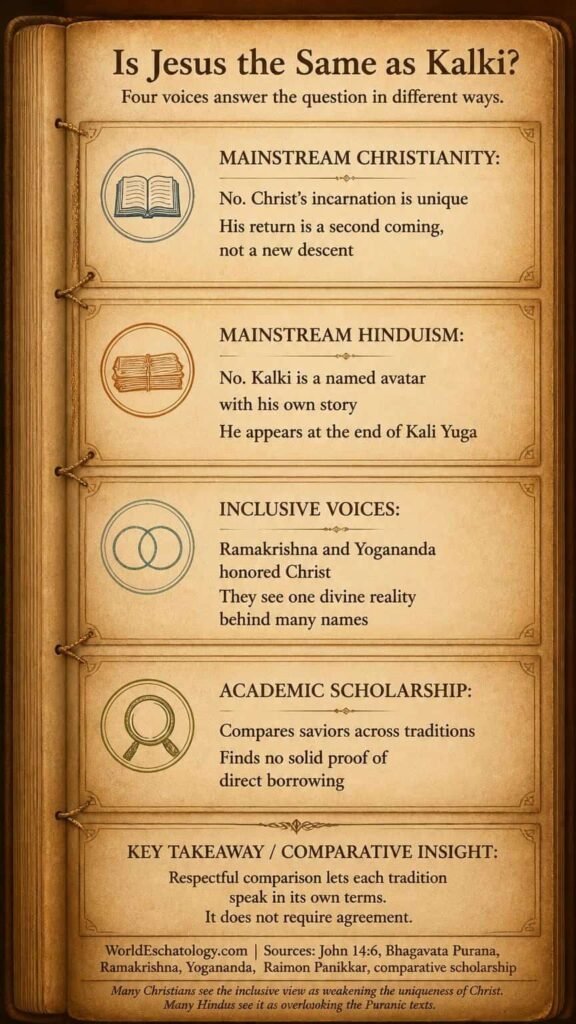
Mainstream Christianity says no. The reasons are theological.
- Jesus is not an avatar in the Hindu sense. Christians hold that God became human once, in Jesus, and that this event is unique.
- Christian teaching says Jesus is the only way to the Father (John 14:6, Acts 4:12). Placing him among many saviors would change that claim.
- Jesus has already come. His return is a second coming of the same person, not a first appearance under a new name.
- His return ends history. It does not begin a new cycle.
Christian theologians also point to the cross. The Messiah first suffered and rose. Kalki’s story has no such earlier chapter.
What Mainstream Hinduism Says
Mainstream Hinduism also says no. Its reasons are drawn from the Puranic texts.
- Kalki is a specific avatar, with a named birthplace, father and mission.
- He appears at the end of Kali Yuga, not in the first century.
- He is a new descent of Vishnu, not a return of an earlier avatar.
- The Puranas do not mention Jesus.
At the same time, Hindu thought is often open to many forms of the divine.
A Hindu may honor Jesus as a holy person or as a divine teacher without calling him Kalki. That is a different claim from saying the two are the same.
What Inclusive and Universalist Voices Say
Some voices go further. They see Jesus and Kalki as two names for one divine reality at work in the world.
- The Hindu saint Ramakrishna honored Jesus. His followers say he had a vision of Christ in 1874. He taught that all sincere paths lead to God.
- Paramahansa Yogananda taught that Christ and Krishna point to the same spirit. His book The Second Coming of Christ reads the Second Coming as an inner awakening.
- Raimon Panikkar, a Catholic priest and scholar with Hindu roots, wrote The Unknown Christ of Hinduism. He explored how Christ may be present in Hindu life without being named.
These views are respected by many. They are not accepted by all. Many Christians say that they weaken the unique claim of Christ.
Many Hindus say they ignore the specific teaching of the Puranas.
Some popular writers also claim that the Kalki texts secretly predict Jesus. Scholars of Sanskrit texts do not find support for that claim.
Key Texts and Sources
Christian Sources
- Matthew 24 and 25, Mark 13 and Luke 21: Jesus teaches about the end and the judgment.
- Acts 1:11: The angels promise his return.
- 1 and 2 Thessalonians: The rising of the dead and the final opposition.
- 2 Peter 3: The day of the Lord and new heavens and a new earth.
- Hebrews 9:28: Christ appears a second time.
- Revelation 19 to 22: The rider on the white horse, the final judgment and the new creation.
- The Nicene Creed: The classic summary of belief in his return.
Hindu Sources
- Bhagavad Gita 4.7 and 4.8: The doctrine of divine descent.
- Bhagavata Purana 1.3 and 12.2: Kalki is listed and described, together with the signs of Kali Yuga.
- Vishnu Purana 4.24 and book 6: The decline of the age and the coming of Kalki.
- Mahabharata, Vana Parva: A prophecy of Kalki Vishnuyasha, in the Markandeya section.
- Kalki Purana: A later text that adds many details, such as his wife Padma, his training under Parashurama and weapons from Shiva.
Modern Sources
Comparative studies include Mircea Eliade’s The Myth of the Eternal Return, which contrasts cyclical and linear time.
Raimon Panikkar’s work and Yogananda’s writings show how some thinkers bring the traditions together.
Different Views Within Each Tradition
Within Christianity
Christians agree that Jesus will return. They differ on how and when.
- Premillennial readers expect Christ to return before a thousand year reign. Some are pretribulation, some posttribulation.
- Amillennial readers see the thousand years as symbolic. They expect one return, one judgment and the new creation.
- Postmillennial readers expect gospel progress first and then the return.
- Preterist readers hold that many of the end time passages were fulfilled in the first century. Many still hold to a final return.
- Catholic and Orthodox churches affirm the Parousia in the creed. They place less stress on detailed timelines.
Christians also differ on how to view other religions. Exclusivists hold that salvation comes through faith in Christ alone.
Inclusivists hope that God’s grace can reach people outside the church. Pluralists see many paths. These views shape how a Christian reads the Kalki question.
Within Hinduism
Hindu tradition has no single church or creed. Views on Kalki vary.
- Vaishnavas treat Kalki as the final descent of Vishnu. For Gaudiya Vaishnavas, he is an expansion of Krishna, the source of all avatars.
- Advaita Vedanta sees avatars as manifestations of the one formless Brahman within the world. The deeper goal is liberation through knowledge.
- Shaiva and Shakta traditions respect Vishnu’s avatars but center Shiva or the Goddess.
- The Arya Samaj and some other reform movements reject the idea of avatars altogether.
- Some modern teachers read Kalki as a symbol of an inner awakening, and not only as a future person.
Many Hindus read the Kalki texts literally. Others read them as a moral story about the victory of truth. Both views are found.
Scholarly Perspectives
Academic scholars study how such figures developed. They compare Kalki with the Messiah, the Mahdi, the Buddhist Maitreya and the Zoroastrian Saoshyant.
All are saviors who appear at a decisive time.
Some scholars ask whether these ideas influenced one another. The evidence is debated. Kalki appears in texts from the early centuries CE onward.
Many scholars link the idea to times of social upheaval. Most do not find solid proof of direct borrowing between Christianity and Hinduism.
They treat the likenesses as parallel answers to a shared human question. How will evil end?
Scholars also caution against a neat contrast between linear Christian time and cyclical Hindu time.
Hindu thought also holds the goal of final liberation from the cycle. Christian worship has its yearly cycles. The contrast is useful, but it is not absolute.
Why This Comparison Matters Today
The question is not only academic. Christians and Hindus live together in India and in diaspora communities across the world.
Conversations about faith happen at weddings, workplaces and online.
Popular culture has fueled interest. The 2024 film Kalki 2898 AD brought the Kalki idea to a wide audience.
Many viewers were curious how its themes relate to other end times traditions, including Christian belief.
This comparison offers a chance to practice respect. A Christian can learn how Hindus understand divine descent.
A Hindu can learn why Christians hold the uniqueness of Christ so dearly. Neither needs to give up their faith to listen well.
It also guards against sloppy claims. Online posts sometimes say that one tradition secretly confirms the other.
Careful readers check the texts. They notice that Kalki is described in Hindu sources in great detail and that these details differ from the New Testament portrait of Jesus.
Finally, both traditions share a hope. They say that evil will not last, and that justice and peace will win.
Many people find comfort in this. It speaks to anyone who has looked at the world and longed for it to be set right.
Frequently Asked Questions
Is Jesus the same as Kalki?
Most Christians and most Hindus say no. Christians hold that Jesus is the unique Son of God who has already come once.
Hindus hold that Kalki is a future avatar of Vishnu. Some universalist teachers see both as expressions of one divine reality, but this is not the mainstream view.
Is Kalki the second coming of Jesus?
No, not in mainstream teaching. The Second Coming is the return of Jesus, who has already appeared.
Kalki is a new, tenth descent of Vishnu. He is not a return of an earlier avatar.
What is the Kalki avatar second coming idea?
Some people use this phrase to compare Kalki with the Second Coming. Both are expected at the end of an age.
Both restore justice. Yet Kalki is not a second coming in the Hindu texts. He is the final avatar in a cycle that continues afterward.
Is the rider on the white horse in Revelation Kalki?
Christians read the rider in Revelation 19 as Christ. He is called Faithful and True and King of kings.
His sword comes from his mouth, which many readers see as the power of his word. Kalki is a different figure in a different tradition. The white horse is a shared image, not a shared identity.
Do Hindus believe Jesus is an avatar?
Some do. Teachers such as Ramakrishna honored Jesus as a divine figure. Others see him as a great teacher or saint.
Many Hindus do not place him in the list of ten avatars. Hindu views are varied.
What is the difference between a Messiah and an avatar?
In Christian belief, Christ is the anointed one and God made human, once for all.
An avatar is a descent of Vishnu, one of many across the ages. The first is a single decisive event. The second is a repeated pattern.
When will Kalki appear?
By traditional calculation, Kali Yuga began in 3102 BCE and lasts 432,000 years.
That places Kalki more than 426,000 years in the future. Some modern teachers propose shorter cycles. Christians say that no one knows when Jesus will return.
Do Christians believe in Kalki?
No. Christian doctrine does not include Kalki. Christians generally respect Hindu belief as a different tradition, though they do not accept its account of avatars.
Do both traditions expect a new world after the end?
Yes. Christians expect a new heaven and a new earth. Hindus expect a new Satya Yuga. The first is a final state. The second is the start of a new cycle.
Can the two traditions be compared respectfully?
Yes. Comparison works best when each tradition is allowed to speak in its own terms. It does not require agreement. It only requires care and fairness.