
Fourteen centuries ago, a man sat with his companions and described the end of the world. He spoke of rivers drying up.
He spoke of buildings racing toward the sky. He spoke of widespread killing, collapsing trust, and a singular figure of deception who would mislead nearly all of humanity.
He described the descent of a prophet, the emergence of a just ruler, and a final sequence of cosmic events that would close the chapter of human history.
That man was the Prophet Muhammad, peace be upon him. His words were recorded, verified, and transmitted with a care that is unparalleled in the pre-modern world.
Those words, the hadith, form the single most detailed body of Islamic eschatology in hadith literature available to us.
They are the foundation of everything Muslims believe about the signs of the Hour in Islam.
Today, millions of Muslims around the world read these narrations with fresh urgency.
Wars, environmental catastrophe, the erosion of moral norms, and political upheaval all appear to echo descriptions the Prophet gave long ago.
The question is no longer whether these narrations are worth studying.
The question is how to study them well, with the right sources, the right scholarly framework, and the right spirit of reflection rather than panic.
This article is a guide to the most important hadith on the signs of the Hour.
It presents the narrations directly, explains their context and scholarly standing, and offers the balanced, respectful academic perspective that the tradition deserves.
What Islamic Eschatology Teaches About the Signs of the Hour
The Meaning of Ashraat al-Saa’ah
In Arabic, the signs of the approaching Hour are called Ashraat al-Saa’ah. The word saa’ah means the Hour, referring to the Day of Judgment.
The word ashraat means signs or indicators. Together the phrase describes the events and conditions that will mark the approach of that final moment.
Islamic scholarship divides the signs into two categories. The first is the minor signs. These are many in number.
Some have already occurred. Others are ongoing. Still others will intensify as the Hour draws near.
The second is the major signs. These are ten specific events that will unfold in rapid succession very close to the Hour itself.
No major sign has appeared yet, according to mainstream scholarly consensus.
The Prophet himself described this framework clearly. One hadith in Sahih Muslim records him saying:
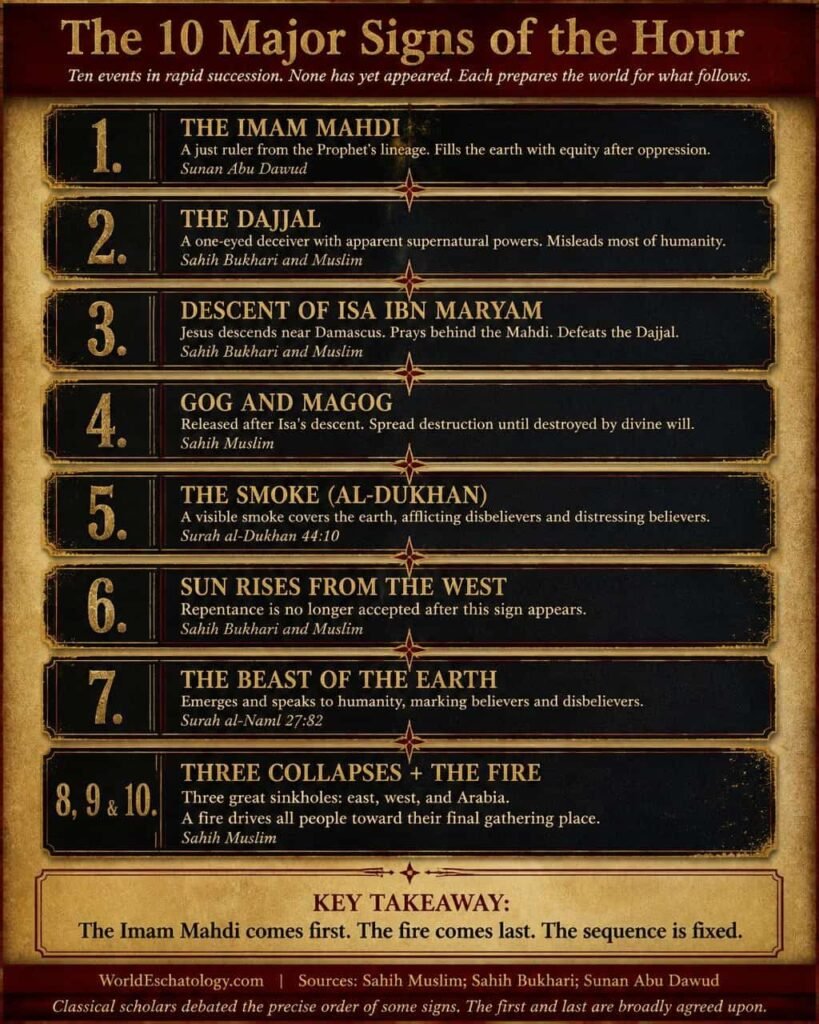
The Hour will not come until you see ten signs: the smoke, the Dajjal, the Beast, the rising of the sun from the west, the descent of Isa ibn Maryam, Gog and Magog, three landslides, one in the east, one in the west, one in the Arabian Peninsula, and a fire that will drive people to their gathering place.
Sahih Muslim, Book of Tribulations, narrated by Hudhayfah ibn Asid
This single narration lays out the entire sequence of major signs. Each one has its own body of supporting hadith. Together they form the backbone of Islamic eschatology in hadith literature.
The Hadith of Jibril: The Foundation
No discussion of hadith on the signs of the Hour can begin without the famous Hadith of Jibril.
It is one of the most important narrations in all of Islam. It defines faith, practice, and eschatological awareness in a single exchange.
The Angel Jibril appeared to the Prophet in the form of a man and asked him a series of questions.
At the end, he asked about the Hour. The Prophet replied:
The one being asked knows no more about it than the questioner. But I will tell you of its signs: when the slave woman gives birth to her mistress, and when you see the barefoot, naked, destitute herders of sheep competing in the construction of tall buildings.
Sahih Bukhari and Sahih Muslim, narrated by Umar ibn al-Khattab
This is one of the most studied narrations in all of Islamic scholarship. Scholars have debated what it means for a slave woman to give birth to her mistress.
Some understand it as a description of children who grow up to treat their mothers disrespectfully, reversing the natural order of authority.
Others read it as a description of widespread social inversion.
The second sign is clearer and more frequently cited today. Nomadic desert-dwellers who historically had no permanent homes are now competing to build the tallest skyscrapers.
Scholars across the spectrum point to the Gulf states, particularly the UAE and Qatar, as a striking contemporary fulfillment of this description.
Key Hadith on the Minor Signs of the Hour
The Spread of Ignorance and the Removal of Knowledge
One of the earliest minor signs the Prophet described was the gradual disappearance of authentic religious knowledge.
This is not simply a lack of education. It is the loss of scholars who carry the tradition correctly.
Among the signs of the Hour is that knowledge will be removed, ignorance will become widespread, wine-drinking will be common, and fornication will spread openly.
Sahih Bukhari, narrated by Anas ibn Malik
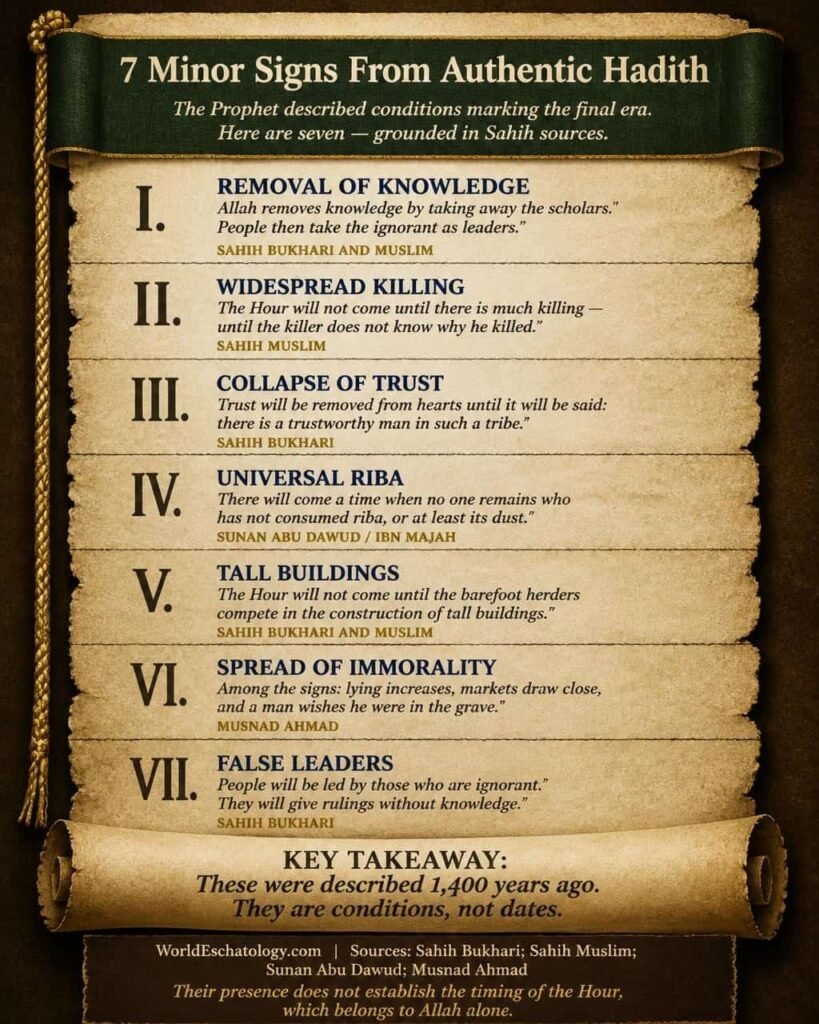
Allah does not remove knowledge by snatching it away from people. Rather, He removes knowledge by taking away the scholars. When no scholars remain, people will take the ignorant as their leaders. They will be asked questions and give rulings without knowledge. They will go astray and lead others astray.
Sahih Bukhari and Sahih Muslim, narrated by Abdullah ibn Amr
This hadith is cited frequently by contemporary scholars who observe the rise of online religious personalities with no traditional training.
It warns that the crisis of the end times is not only moral. It is epistemological. It is a crisis of who we trust to tell us the truth about our faith.
Widespread Killing and Social Breakdown
The Prophet described a time when killing would become so common that neither killer nor victim could explain why it was happening.
This is one of the most haunting of the hadith on the signs of the Hour.
The Hour will not come until there is much killing (harj). The companions asked: What is harj? He said: Killing, killing. By the One in Whose Hand my soul is, until a man does not know why he is being killed and why he killed.
Sahih Muslim, narrated by Abu Hurairah
There will come a time of harj in which the heart of the believer will melt, just as salt melts in water, because of what he sees of bloodshed and the violation of sanctities.
Musnad Ahmad, narrated by Abu Hurairah, graded as authentic by scholars
The Prophet also warned that in this period, a man’s killer and his victim would both enter the Fire. The companions asked how the victim could enter the Fire. He replied:
He was keen to kill his companion.
Sahih Bukhari and Sahih Muslim, narrated by Abu Hurairah
This reflects the moral state of a society in which violence becomes normalized, and in which even victims are consumed by the same destructive spirit as their killers.
The Collapse of Trust
The Prophet described the erosion of trustworthiness as one of the most significant minor signs.
He did not merely say that dishonesty would increase. He described the systematic removal of trust from the human heart.
The Hour will not come until trust is removed. Then people will ask: Where are the trustworthy people? And it will be said: In such-and-such tribe, there is a trustworthy man. Until it is said of a man: How resolute he is, how intelligent he is, how wise he is, but he does not have even a mustard seed of faith in his heart.
Sahih Bukhari, narrated by Hudhayfah ibn al-Yaman
Hudhayfah ibn al-Yaman later described how trust was first removed from ordinary people, then from scholars and leaders.
He described a time when people would make contracts and deals but nobody would be certain the other party was truly trustworthy.
This narration is frequently invoked by contemporary scholars discussing the collapse of institutional credibility across governments, media, and religious leadership in the modern world.
The Prevalence of Riba
The Prophet warned that interest-based financial transactions would become so widespread that even those trying to avoid them would be affected.
There will certainly come a time when no one will remain who has not consumed riba. And whoever does not consume it directly will be affected by its dust.
Sunan Abu Dawud and Sunan Ibn Majah, narrated by Abu Hurairah, authenticated by Al-Albani
This narration is considered by many contemporary scholars to be one of the most clearly fulfilled minor signs.
The global financial system is built entirely on interest-based lending.
Every nation that participates in that system, including Muslim-majority nations, is immersed in exactly the condition this hadith describes.
The Appearance of Tall Buildings
The Prophet described the competition in constructing tall structures as both a sign and a rebuke of misplaced priorities.
He returned to this theme in several narrations.
The Hour will not come until people compete with each other in the height of their buildings.
Sunan Ibn Majah, narrated by Abu Hurairah
Among the signs of the Hour is that buildings will become very tall.
Sahih Bukhari, from the Hadith of Jibril, reported by Abu Hurairah
These narrations are read together as a description of a civilization that has inverted its values.
People who were historically poor, nomadic, and without permanent shelter are spending enormous resources reaching for height rather than depth, for external spectacle rather than spiritual substance.
The Spread of Immorality
The Prophet was specific about the moral conditions that would characterize the time before the Hour.
I swear by the One Who sent me with the truth, this world will not end until there is widespread tribulation (fitna), until lying increases, until markets draw close together, until the moon appears larger, until the number of police (shurat) increases, until rain falls but plants do not grow, until a man passes by another man’s grave and says: I wish I were in his place.
Musnad Ahmad, narrated by Ibn Masud, authenticated by scholars
The Hour will not come until immorality appears openly, until a man greets only the person he knows, until trade is so widespread that a wife helps her husband in business, until family ties are cut, until the giving of false witness becomes common while honest witness is concealed.
Musnad Ahmad and other collections, narrated by Abdullah ibn Masud
Key Hadith on the Major Signs of the Hour
The Imam Mahdi
The Imam Mahdi is the first of the major signs in the sequence described by most scholars.
He is a divinely guided leader from the household of the Prophet. He will emerge at a time of maximum crisis and injustice.
The Mahdi will be from my family, from the descendants of Fatimah. He will have a broad forehead and a slightly hooked nose. He will fill the earth with justice and equity as it had been filled with oppression and tyranny, and he will rule for seven years.
Sunan Abu Dawud, narrated by Umm Salamah
Even if only one day remains of this world, Allah will extend that day until a man from my family appears. His name will be the same as my name. He will fill the earth with justice just as it had been filled with tyranny.
Sunan Abu Dawud and Jami at-Tirmidhi, narrated by Abdullah ibn Masud
The Prophet also described how the Mahdi will come to power. He will be pressed into his role reluctantly.
He will not seek leadership. A group of believers will pledge allegiance to him at the Kaaba in Mecca.
A man will come forth between the corner of the Kaaba and the Maqam Ibrahim, and people will be compelled to give him the pledge of allegiance even though he does not want it.
Musnad Ahmad, narrated by Ali ibn Abi Talib
The Dajjal
The Dajjal, or the Antichrist, is one of the most extensively described figures in the entire hadith literature on Islamic eschatology in hadith.
The Prophet spoke about him so frequently that his companions were almost afraid to discuss it.
There is no prophet who has not warned his nation about the one-eyed liar. Verily, he is one-eyed and your Lord is not one-eyed. Written between his eyes is the word Kafir, which every believer, literate or illiterate, will be able to read.
Sahih Bukhari and Sahih Muslim, narrated by Anas ibn Malik
The Dajjal will emerge in a time of weakness of religion and lack of knowledge. He will have with him a form of paradise and a form of fire. His fire will be a paradise and his paradise will be a fire. He will stay on earth for forty days. One day will be like a year, one day like a month, one day like a week, and the rest of the days like your days.
Sahih Muslim, narrated by an-Nawwas ibn Sam’an
The Prophet’s advice on how to protect oneself from the Dajjal was specific and practical.
Whoever among you sees the Dajjal, let him recite the opening verses of Surah al-Kahf over him. Whoever is at the edge of the earth when the Dajjal emerges will be safe from his trial. He will not be able to reach Mecca or Medina.
Sahih Muslim, narrated by an-Nawwas ibn Sam’an
The Descent of Prophet Isa (Jesus)
The descent of Isa ibn Maryam is one of the most significant events in the Islamic eschatological sequence.
He will descend near Damascus. He will join the Muslim community. He will pray behind the Imam Mahdi.
By the One in Whose Hand my soul is, the son of Mary will certainly descend among you as a just ruler. He will break the cross, kill the pig, and abolish the jizyah. Wealth will be so abundant that nobody will accept it. A single prostration will be better to a person than the whole world and everything in it.
Sahih Bukhari and Sahih Muslim, narrated by Abu Hurairah
Isa ibn Maryam will descend at the white minaret in the eastern part of Damascus, wearing two garments lightly dyed with saffron, placing his hands on the wings of two angels. When he lowers his head, beads of perspiration will fall from it, and when he raises his head, beads like pearls will scatter from it.
Sahih Muslim, narrated by an-Nawwas ibn Sam’an
Gog and Magog
Gog and Magog are described as a vast and destructive people who will be released near the end of times to spread chaos across the earth.
Allah will inspire Isa to say: I have brought forth servants of Mine whom no one can overpower. Take my servants safely to the mountain of Tur. Then Allah will send Gog and Magog. They will rush down from every slope. The first of them will pass the Sea of Tiberias and drink it dry. The last of them will pass and say: There was once water here.
Sahih Muslim, narrated by an-Nawwas ibn Sam’an
Gog and Magog are digging every day until they can almost see the light of the sun, and then their leader says: Return tomorrow and we will finish it. But Allah restores it to what it was. This will continue until their time comes and Allah wills that they be released.
Jami at-Tirmidhi and Sunan Ibn Majah, narrated by Abu Hurairah, graded as authentic
The Euphrates Revealing a Treasure
The Prophet gave a specific and well-authenticated sign related to the Euphrates River.
The narration is recorded in Sahih Muslim and has attracted enormous attention in recent years as the river’s water levels have declined sharply.
The Hour will not come until the Euphrates uncovers a mountain of gold, and people will fight over it. For every hundred who fight, ninety-nine will be killed. And every man among them will say: Perhaps I will be the one who survives.
Sahih Muslim, narrated by Abu Hurairah
The Prophet then advised clearly what a believer should do if they witness this event.
The Euphrates will soon uncover a treasure of gold. Whoever is present at that time should not take anything from it.
Sahih Muslim, narrated by Abu Hurairah
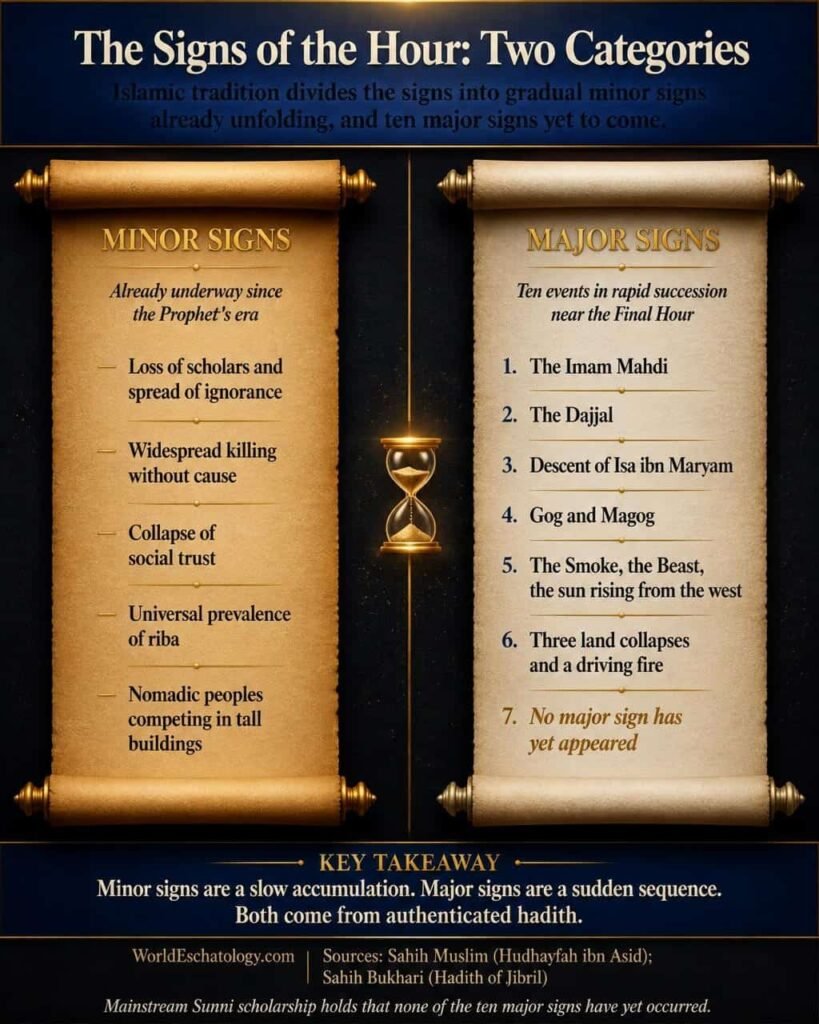
Different Scholarly Views on the Hadith on the Signs of the Hour
The Question of Hadith Grading
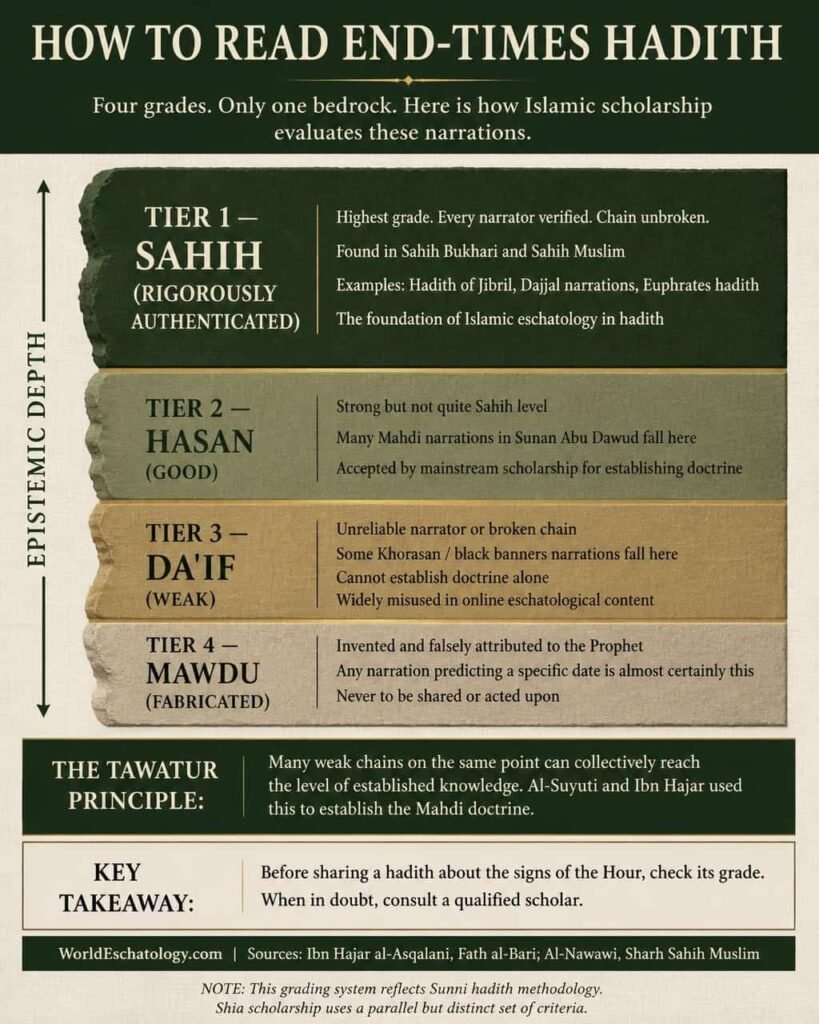
Not all hadith on signs of the Hour in Islam carry the same weight. Islamic hadith scholarship uses a precise grading system.
Sahih means rigorously authenticated. Hasan means good. Daif means weak. Mawdu means fabricated.
The most important hadith on eschatological signs are found in Sahih Bukhari and Sahih Muslim.
These carry the highest level of authentication in Sunni scholarship. The compilers of these collections applied extremely demanding standards to every chain of transmission they included.
Other signs appear in Sunan Abu Dawud, Jami at-Tirmidhi, Sunan Ibn Majah, and Musnad Ahmad.
These collections contain hadith of varying grades. A hadith that appears in one of these with a single strong chain may still be accepted as reliable.
One that appears only in weaker sources requires more caution.
The concept of tawatur, or mass transmission through many independent chains, is particularly important in hadith on eschatological signs.
Classical scholars including Ibn Hajar al-Asqalani and Al-Suyuti argued that even where individual chains of specific signs show weakness, the collective weight of multiple independent narrations on the same core point gives the doctrine a cumulative strength that is very difficult to dismiss.
The Cautious Approach: Traditional Sunni Scholarship
Mainstream traditional Sunni scholarship, represented by institutions like Al-Azhar and by classical commentators like Al-Nawawi and Ibn Kathir, takes a cautious and measured approach to the signs of the Hour in Islam.
These scholars affirm the signs as real and the narrations as authentic.
They insist, however, that connecting specific current events to specific prophetic descriptions requires extreme care.
Their argument is partly historical. Every major period of crisis in Muslim history produced confident predictions of imminent end times that proved wrong.
The Mongol invasions, the fall of the Abbasid caliphate, the Crusades, the fall of the Ottoman Empire: all generated eschatological speculation that was eventually superseded by the continuation of history. This track record counsels humility.
Their argument is also textual. The Prophet himself repeatedly declined to specify timing when asked about the Hour.
The Quran states clearly in Surah al-A’raf that knowledge of the Hour belongs to Allah alone.
The Engaged Contemporary Approach
A different strand of contemporary scholarship takes a more direct approach to connecting Islamic eschatology in hadith with observable current events.
Scholars in this tradition, most prominently Sheikh Imran Hosein, argue that the hadith provide a uniquely accurate framework for understanding the modern geopolitical world.
They point to the drying of the Euphrates as a documented environmental reality.
They note that nomadic Gulf populations now build the world’s tallest buildings.
They observe that the global financial system has universalized riba in exactly the way the Prophet described.
They identify the collapse of social trust across institutions as a fulfillment of the hadith of Hudhayfah.
These are not fringe observations. They are serious scholarly arguments that deserve honest engagement.
Shia Perspectives on the Signs of the Hour
Shia Islamic eschatology engages with the signs of the Hour through a framework centered on the return of the Twelfth Imam.
The Imam Mahdi, in Twelver Shia doctrine, is not a future figure yet to be born. He is Muhammad ibn Hasan al-Askari, born in 868 CE, currently alive in a state of occultation.
Shia scholarship acknowledges many of the same minor signs described in the hadith literature, including the spread of immorality, the prevalence of injustice, and the erosion of religious knowledge.
The difference is in how these signs are organized. In the Shia framework, they are signs of the approaching return of the Hidden Imam, the event around which all other eschatological developments revolve.
Both traditions share a common ethical conclusion. Whether one is Sunni or Shia, the correct response to observing the signs is deeper personal piety, not speculation or agitation.
Why This Matters Today: Islamic Eschatology in Hadith and the Modern World
The interest in hadith on signs of the Hour in Islam has never been higher.
Social media has made Islamic eschatological content accessible to hundreds of millions of Muslims who would never have sat in a madrasa or read a classical commentary.
This is both an opportunity and a risk.
The opportunity is real. Muslims who engage seriously with the authentic hadith on this subject find a coherent, sobering, and spiritually clarifying picture of where history is going.
The tradition does not leave believers without a map. It gives them a detailed description of the conditions they should expect, the pitfalls they should avoid, and the qualities they need to cultivate.
The risk is equally real. Weak or fabricated hadith circulate widely online, sometimes presented with the same confidence as the rigorously authenticated narrations in Sahih Bukhari or Sahih Muslim.
Predictions are made and dates are assigned. Political movements invoke end-times expectations to justify actions that the tradition itself would condemn.
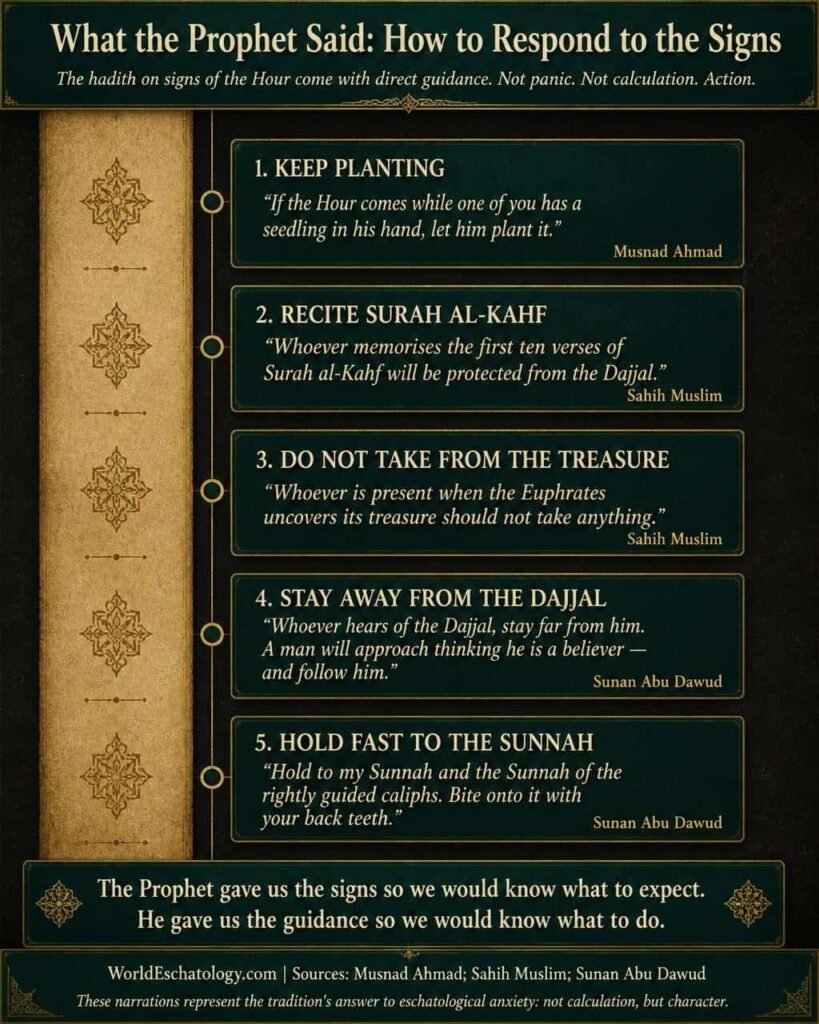
The Prophet addressed this directly. His advice was not to predict or to calculate. His advice was to act.
If the Hour comes while one of you has a seedling in his hand, and he is able to plant it before the Hour comes, let him plant it.
Musnad Ahmad and Al-Adab al-Mufrad by Bukhari, narrated by Anas ibn Malik, authenticated by Al-Albani
This narration is the tradition’s clearest statement on the correct relationship to eschatological knowledge. It does not matter when the Hour comes.
What matters is that you are doing something useful and righteous when it arrives.
Frequently Asked Questions: Islamic Eschatology in Hadith
What is Islamic eschatology in hadith?
Islamic eschatology in hadith refers to the body of narrations from the Prophet Muhammad that describe the events of the end times, the signs preceding the Day of Judgment, and the nature of the afterlife.
While the Quran establishes the certainty of the Hour and mentions some signs, the detailed descriptions come almost entirely from the hadith literature.
Collections like Sahih Bukhari, Sahih Muslim, Sunan Abu Dawud, and others contain dedicated chapters on the signs of the Hour (Ashraat al-Saa’ah) that together form a comprehensive eschatological map.
These narrations cover everything from minor social and moral signs that unfold gradually over time to the ten major signs that will occur in rapid succession near the Final Hour itself.
What are the most authentic hadith on the signs of the Hour in Islam?
The most rigorously authenticated hadith on signs of the Hour in Islam are found in Sahih Bukhari and Sahih Muslim.
Among the most important are the Hadith of Jibril, which describes the slave woman giving birth to her mistress and barefoot herders competing in tall buildings; the narration of Hudhayfah ibn Asid listing the ten major signs; the Sahih Muslim narrations about the Dajjal and the descent of Isa ibn Maryam; and the narration about the Euphrates uncovering a mountain of gold also found in Sahih Muslim.
Additional well-authenticated narrations come from Sunan Abu Dawud and Musnad Ahmad, including those on the Imam Mahdi and the spread of killing without cause.
Hadith scholars including Ibn Hajar al-Asqalani, Al-Nawawi, and Al-Suyuti assessed these narrations and their conclusions form the foundation of what mainstream Sunni scholarship considers reliably established on this topic.
What are the minor signs of the Hour in Islam?
The minor signs of the Hour in Islam are conditions and events that the Prophet described as preceding the Final Hour by a long period of time.
Many have already occurred. Others are ongoing.
The Prophet mentioned the spread of religious ignorance, the removal of trustworthy scholars, the prevalence of riba in financial dealings, the normalization of immorality, widespread killing in which people do not know why they are killing or being killed, the collapse of social trust, the competition in building tall structures among people who were historically poor and nomadic, the erosion of family ties, the spread of false witnesses while honest witness is concealed, and many others.
These signs are not meant to trigger calculation or panic. Classical scholars understood them as a call to heightened personal piety and a reminder that the world is not the final destination.
What does the hadith say about the Dajjal?
The hadith literature on the Dajjal is extensive. The Prophet described him as one-eyed, while Allah is not one-eyed.
He will have the word Kafir written between his eyes, readable by every believer.
He will possess extraordinary apparent powers: he will seem to bring the dead back to life, to produce food and water, and to travel the earth at great speed.
He will emerge in the east, between Iraq and Syria according to some narrations, and will travel every land except Mecca and Medina.
He will stay on earth for forty days, the first of which will seem as long as a year, the second as long as a month, the third as long as a week, and the rest like normal days.
The Prophet’s advice was to recite the opening verses of Surah al-Kahf for protection and to stay far from the Dajjal if one encounters him, because his trials will be so powerful that even sincere believers who approach thinking they can resist will be in danger.
What should a Muslim do when they see the signs of the Hour?
The tradition is remarkably clear on this question. The correct response to observing the signs of the Hour is not alarm, not political action justified by eschatological conviction, and not the confident prediction of timing.
The Prophet’s own advice, embedded in the narrations themselves, is to increase in righteous action and personal preparation.
He counseled recitation of Surah al-Kahf as protection against the Dajjal. He advised that whoever witnesses the uncovering of the Euphrates treasure should not take from it.
His famous narration about planting a seedling even if the Hour is imminent is the tradition’s clearest statement: keep doing what is right regardless of how close the end may be.
Classical scholars including Al-Nawawi and Ibn Hajar al-Asqalani consistently interpreted knowledge of the signs as a motivation for personal piety and spiritual vigilance, not as a basis for calculating timelines or taking drastic action.
Which hadith about the end times are considered weak or fabricated?
Not all hadith on the signs of the Hour are equally reliable, and honest scholarship requires acknowledging this directly.
Among the most widely circulated but problematic traditions is the narration about black banners from Khorasan being a sign of the Mahdi’s arrival.
While versions of this narration exist in respectable collections, many specific details that circulate online are found in weaker chains or in Nu’aym ibn Hammad’s Kitab al-Fitan, which classical scholars acknowledged contains traditions of very uneven quality.
Similarly, some narrations about specific dates or specific political figures being the Antichrist are either weak in chain or have been misattributed entirely.
The scholarly rule is that where a narration exists only in weak sources, or contradicts what is clearly established in Sahih Bukhari and Sahih Muslim, or produces a specific date or name-based prediction, it should be treated with significant caution and not circulated as established prophetic knowledge.
1 thought on “Islamic Eschatology in Hadith: A Guide to the Most Important Narrations”